A Guide to Your Antique Floor Safe
Discover how to identify, value, move, and restore your antique floor safe. Our guide helps you unlock the history and worth of these unique treasures.
Finding an antique floor safe is like stumbling upon a real-life treasure chest. These aren't just heavy metal boxes; they're time capsules built of iron and steel, each one a relic from a time when security meant sheer, immovable weight.
An antique floor safe was designed to be the ultimate fortress, physically embedded into the floor of a home or business for maximum protection.
The Story Locked Inside Your Antique Floor Safe
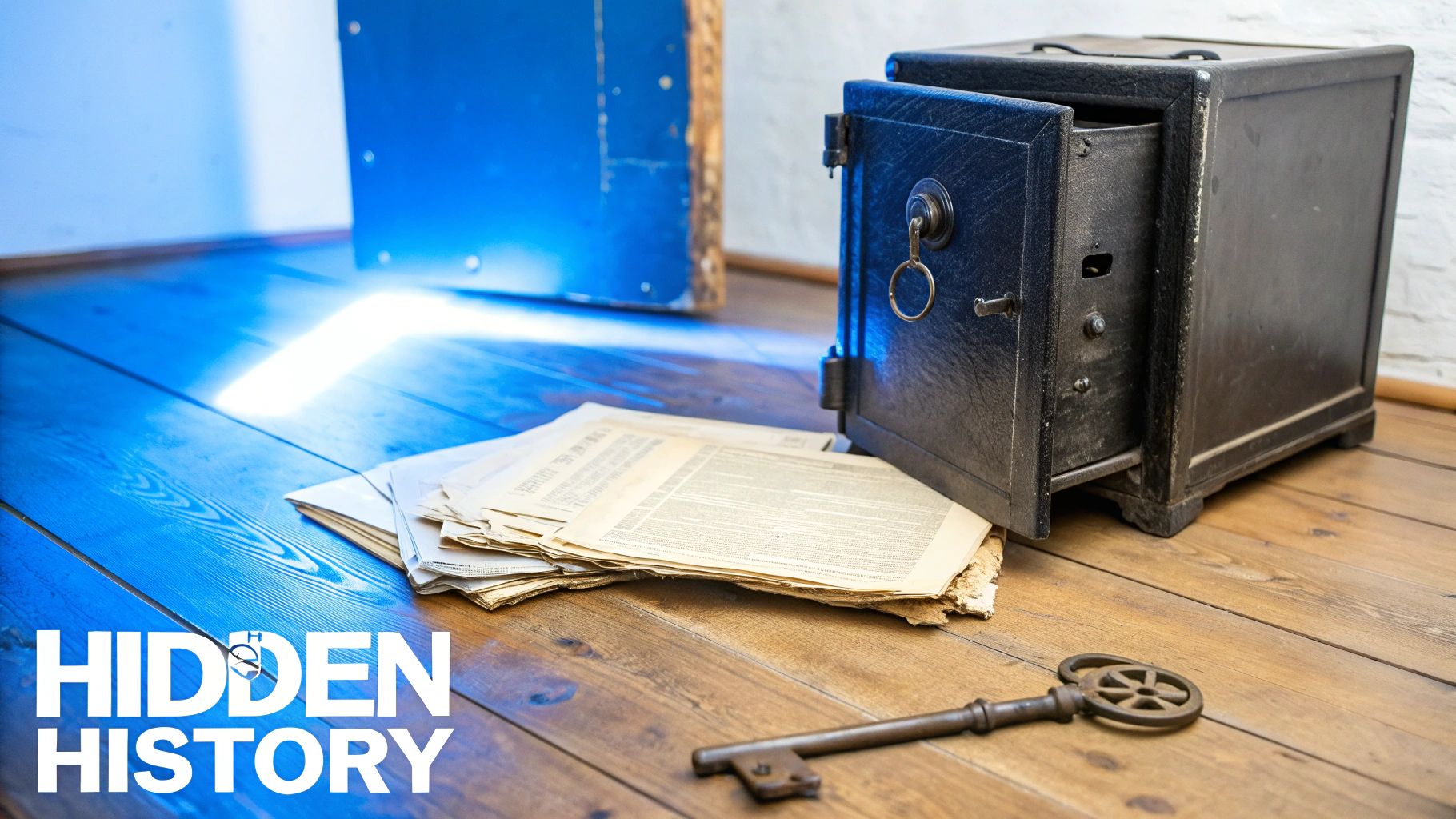
When you uncover one of these in a basement or an old office building, the first question is always the same: what's inside? But just as important are the questions about the safe itself. Who made it? How old is it? What was it meant to protect?
These safes are testaments to a bygone era of craftsmanship, long before digital codes and alarm systems. Their history goes back centuries, with early versions popping up in the 17th century and becoming fixtures in the 18th and 19th centuries, especially across Europe. If you're curious, you can learn more about the fascinating history of antique safes and their place in history.
A Roadmap for Your Discovery
Think of this guide as your roadmap. Whether you're a homeowner who just found a mysterious safe, a serious collector, or an estate seller figuring out what to do with a massive asset, we'll walk you through it. Our goal is to turn that initial curiosity into practical knowledge so you can make smart decisions.
This journey is about more than just the object itself; it's about uncovering the story embedded in the steel, understanding its place in history, and preserving its legacy for the future.
What You Will Learn in This Guide
Dealing with an antique safe can feel like a huge task, but we've broken it down into simple, manageable steps. We’ll cover everything from the moment of discovery to the final sale.
Here’s a quick look at what we’ll cover:
- Identification and Provenance: We'll teach you how to read the clues—maker's marks, patent dates, and unique construction styles—to figure out where your safe came from and how old it is.
- Valuation and Condition: You'll learn how to assess what your safe is actually worth by looking at its condition, originality, and whether the locking mechanism still works.
- Safe Removal and Logistics: These things were built to not be moved. We’ll cover the critical safety steps and why you almost always need a professional.
- Restoration vs. Preservation: Should you make it look brand new or keep its historic character? We'll help you decide what’s right for your safe.
- Selling and Preparation: Get practical strategies for marketing and selling your safe to the right buyer, whether you're using a platform like DIYAuctions or another route.
By the time you're done with this guide, that mysterious metal box will be a valuable piece of history you understand completely.
How to Identify Your Safe Like an Expert
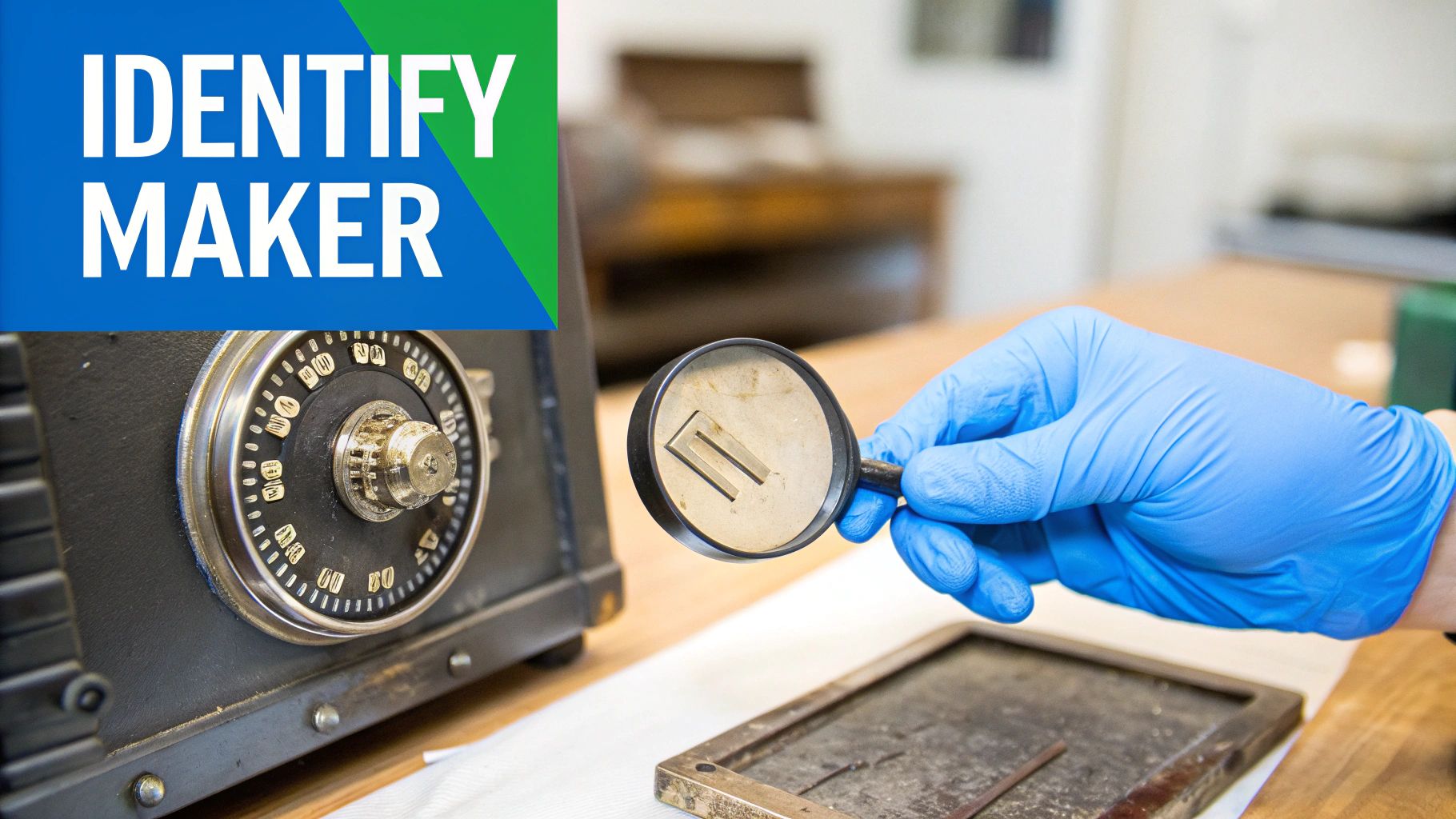
Every old floor safe has a story, and it’s written right there in the steel, the artwork, and the clunky mechanical parts. To really understand what you have, you need to play detective for a day. It’s a process that turns a heavy metal box into a genuine piece of history.
Your first move is always a careful visual inspection. You're looking for any little clue that can point you in the right direction. They’re often hiding in plain sight.
Start with the Obvious Clues
The easiest place to start is the exterior, where the manufacturer would have proudly displayed their work. They wanted everyone to know who made it.
Begin your hunt in these key spots:
- The Dial and Handle: Prime real estate for a maker's name, city of origin, or a distinct logo. Check for any engravings on the dial ring or the handle itself.
- The Door Face: Many makers painted their name directly on the front, often framed by beautiful pinstriping or even a scenic mural.
- The Metal Plate: Look for a small brass or steel plate, usually on the door or frame. This is often a goldmine, listing the maker, serial number, and sometimes patent dates.
Finding a name like "Herring-Hall-Marvin" or "Diebold" is your first big break. It gives you a clear path for research and makes everything that follows much simpler.
Decode the Design Language
Beyond a name, the safe’s overall look tells you a lot about its era. Just like cars or furniture, safes had their own distinct style trends that evolved over the decades.
Victorian-era safes (from roughly 1837-1901) are typically the showstoppers. They’re often covered in elaborate, hand-painted artwork, detailed pinstriping, and gold-leaf accents. The hardware is just as fancy, with ornate cast-iron handles and dials featuring floral or geometric patterns.
As the calendar flipped to the 20th century, designs got more serious and industrial. The artistic flair was replaced by a more utilitarian, function-over-form look. If your safe is plain and all business, it’s likely from a later period than one that looks like a piece of art.
The shift from ornate, almost furniture-like safes to stark, industrial boxes says a lot about changing times. It was a move away from showcasing artistry to emphasizing pure, functional security above all else.
Examine the Construction Details
How your safe was put together is another huge clue. Early manufacturing was a world away from modern methods, and the differences are usually easy to spot if you know what you’re looking for.
Take a close look at the seams:
- Riveted Construction: If you see rows of rounded metal studs holding the steel plates together, you’re almost certainly looking at a 19th-century safe. Welding wasn't a common practice for this kind of work until the early 20th century.
- Welded Seams: Smooth, continuous lines where the metal plates meet point to a more modern build, probably from the 1920s or later.
- Hinge Design: Even the door hinges can be a giveaway. Big, external strap hinges are a classic feature of older safes, while newer models tend to have more hidden or streamlined mechanisms.
By combining these clues—the maker's mark, the artistic style, and the construction methods—you can build a surprisingly detailed biography for your safe. This isn't just fascinating trivia; it’s the foundation for figuring out what it's really worth. And if you're looking to hone these skills, our guide on how to identify valuable antiques has more great tips that work for all kinds of historic items.
What Is Your Antique Safe Actually Worth?
So, you’ve dug into the history of your antique floor safe. The big question now is, what’s it actually worth? Figuring out the value isn't as simple as looking up a price online. It’s a careful balancing act between the safe's history, who made it, its condition, and—most importantly—whether it still works.
Think of it less like a fixed price tag and more like an appraisal for a piece of functional art. Several key ingredients come into play. A safe from a big name like Diebold or Herring-Hall-Marvin will always catch a collector's eye more than one from an obscure maker. And if you have provenance—that is, a documented history connecting the safe to a famous person or historical event—its value can jump significantly.
Assessing the Physical Condition
Your first real step is a top-to-bottom physical inspection. You need to look at the safe not just as a single object, but as a collection of parts, each with a story to tell about its life and value.
Start with the overall structure. Are there big dents, deep gouges, or pry marks from a break-in attempt? A little wear and tear adds character, but serious damage is a definite minus. Next, check for rust. A bit of surface patina is often a good thing, but deep, flaking rust that’s eating away at the steel is a major red flag.
Pay close attention to the original artwork. For many Victorian-era safes, the hand-painted pinstripes, gold-leaf lettering, and detailed murals are where the real value lies.
- Intact Artwork: Is the painting still vibrant and mostly there? Some fading is expected, but if large chunks are flaking off, the value drops.
- Originality: Can you tell if it’s been repainted? A sloppy, modern "touch-up" can completely strip away its historical and financial worth.
An unrestored safe in good original condition is almost always more valuable to a serious collector than one that has been poorly refinished. The wear, fading, and minor imperfections are part of its authentic history—once you paint over that, it's gone forever.
The Million-Dollar Question: Does It Work?
Beyond its good looks, the functionality of the lock is probably the single most important factor. A gorgeous safe that won’t open or can’t be locked is, at the end of the day, just a really, really heavy sculpture.
Gently test the mechanism. Does the dial spin smoothly, or does it catch and grind? When you dial in the combination, do you hear that satisfying click of the tumblers falling into place? The door should swing freely and lock up tight when you close it. A fully working, original lock is the gold standard.
If you don't have the combination, don't panic. You'll just need to factor in the cost of hiring a professional safecracker to manipulate it open. Whatever you do, never try to force it open yourself. Drilling or prying the door will cause permanent damage and tank its value.
For a broader perspective on valuation, you can get more detailed information by checking out an online antique price guide.
Understanding the Market Value
Before putting a price tag on your safe, it's essential to understand how these factors come together in the real world. This table breaks down what collectors and buyers look for.
Antique Safe Valuation Factors at a Glance
| Valuation Factor | High Value Indicators | Low Value Indicators |
|---|---|---|
| Manufacturer | Renowned maker (Diebold, Herring-Hall-Marvin) | Obscure or unknown maker |
| Condition | Original finish, intact artwork, minor wear | Significant rust, major dents, forced entry damage |
| Functionality | Smooth, fully operational original lock with combo | Non-functional lock, missing combo, drilled or pried |
| Artwork | Vibrant, original hand-painted scenes/lettering | Faded, flaking paint; modern repaint |
| Provenance | Documented history with a famous owner or event | No known history or background |
| Rarity | Unusual size, unique features, limited production | Common, mass-produced model |
This gives you a solid framework for a realistic valuation.
While the market for antique safes can shift, the core principles hold true: rarity, brand recognition, and incredible condition are what drive the highest prices. Auction records show that while a standard safe might go for under $1,000, rare iron floor safes can soar past $50,000. The truly exceptional, museum-quality pieces have even fetched upwards of $124,500.
You can get a feel for the market by exploring 19th-century safe valuations to see what similar items are listed for. By weighing all these factors, you can build an accurate picture of what your piece of history is truly worth.
The Right Way to Move a Floor Safe
An antique floor safe was designed with a single, stubborn purpose: to be completely immovable. We're talking about objects that can weigh hundreds or even thousands of pounds, sometimes even encased in concrete. Trying to move one isn't a weekend DIY project—it's a serious logistical and safety challenge.
The sheer weight and awkward size create massive risks. Attempting this yourself can lead to severe personal injuries, from crushed limbs to debilitating back problems. It can also cause catastrophic damage to your home, like cracked foundations, splintered floor joists, or busted-up doorways. This isn't like moving a heavy couch; it's more like trying to wrestle a small boulder out of your living room.
Why You Must Hire Professional Safe Movers
The single most important decision you can make is to hire a team that specializes in moving safes. This is a niche skill, and your average moving company is rarely equipped to handle it properly. A professional safe mover brings the right experience, specialized equipment, and crucial insurance to get the job done safely.
Their expertise goes way beyond just brute force. They know how to assess the structural integrity of your floors, navigate tight corners without smashing walls, and properly balance an object with a dangerously high center of gravity.
A DIY safe removal is a gamble where the risks are just not worth the potential savings. The cost of hiring a pro is tiny compared to a hospital bill or thousands of dollars in home repairs.
The process of moving a safe actually starts with a good assessment, long before anyone tries to lift it.

This quick visual shows how understanding the safe’s history, condition, and lock mechanism all feed into planning the safest, most effective removal strategy. The valuation and the move itself are intertwined.
Finding and Vetting the Right Professionals
Not all movers are created equal. When you're searching for a company, you need to dig a little deeper and ask the right questions to make sure they can handle your antique with the care it deserves.
Here are the key things you should ask any potential mover:
- Do you specialize in moving antique safes? Modern safes are different. You need someone who understands the unique construction and weight distribution of older models.
- What kind of equipment will you use? You want to hear them mention things like heavy-duty dollies (especially stair-climbing ones), pallet jacks, specialized straps, and maybe even a crane or forklift for the really big jobs.
- Can you provide proof of insurance? This is a big one. They absolutely must have liability insurance that specifically covers damage to both the safe and your property. Don't be afraid to ask for their certificate of insurance.
- What's your process for checking out the job site? A reputable mover will always want to know the safe's dimensions, its estimated weight, and the exact path it needs to take out of your house—including stairs, doorways, and floor types.
- Can you give me references from similar jobs? Talking to a couple of their past clients will give you real peace of mind about their skills and professionalism.
The removal process itself is slow and methodical. The team will first secure the safe, then carefully maneuver it onto a heavy-duty dolly. They'll protect your floors, walls, and door frames along the entire exit path. If the safe is embedded in concrete, the job gets even more intense, requiring jackhammers and other tools to carefully excavate it without damaging your home's structure.
By investing in the right team, you’re ensuring both your valuable antique—and your property—stay protected.
To Restore or Preserve? That Is the Question
You've got the safe identified and moved, and now you’re standing in front of it, wondering what to do next. This is a critical fork in the road. Do you preserve it as-is, or do you restore it to its former glory? They might sound like the same thing, but the path you choose will dramatically impact its story, character, and ultimately, its value.
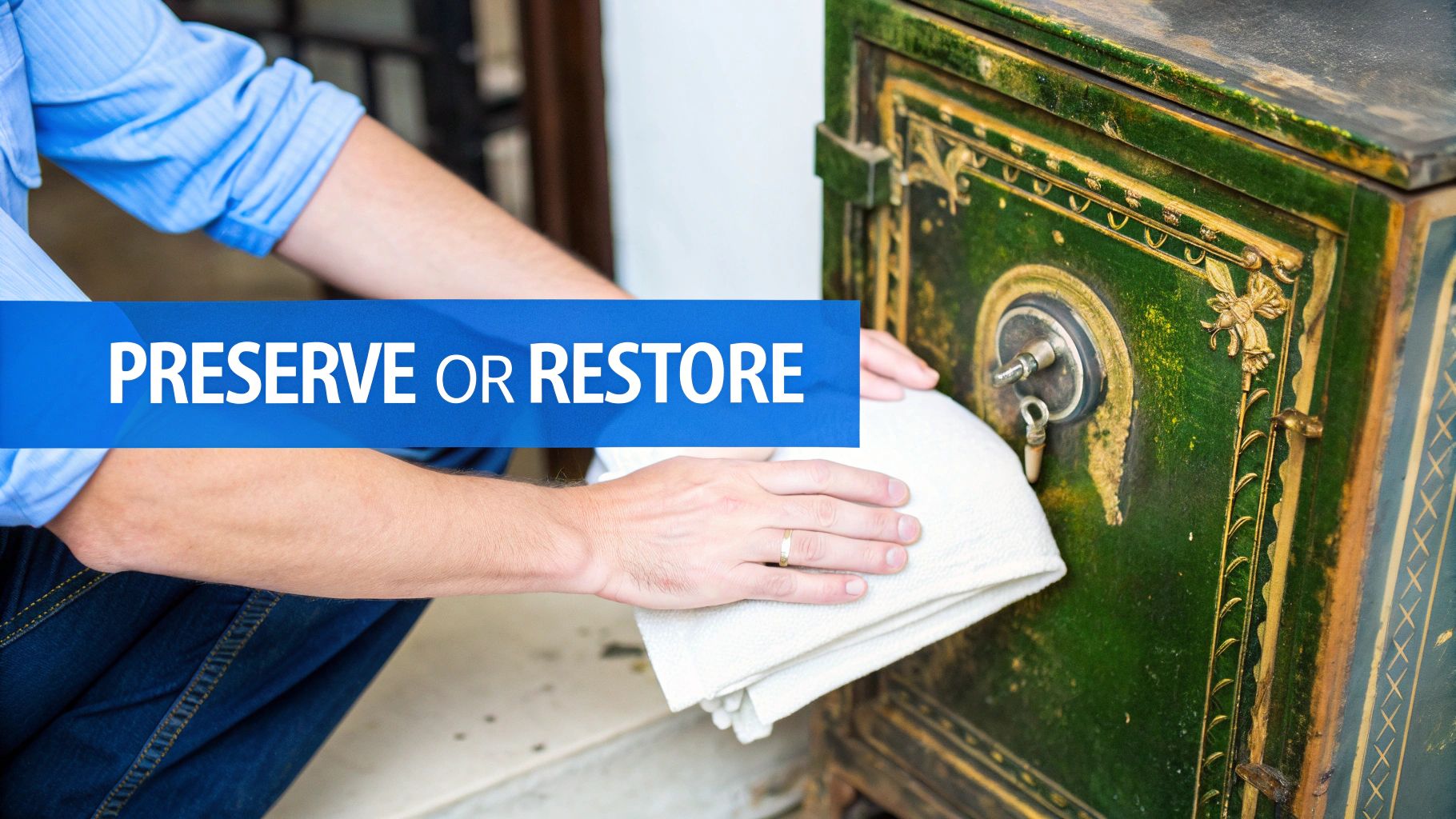
Let's break it down. Preservation is about stopping the clock. You're working to halt any further decay while keeping the safe in its current, authentic condition. It’s about embracing the history—the dings, the faded artwork, the unique patina—as essential parts of its journey. Think of yourself as the custodian of a historical artifact, protecting its story from being erased.
Restoration, on the other hand, is about turning back time. This is a much more aggressive process that often involves stripping old paint, banging out dents, and applying a brand-new finish. While it might sound appealing to make it look shiny and new, this approach can wipe away the very history that makes an antique safe so special, effectively turning a piece of history into a modern decoration.
Why Preservation Almost Always Wins
For serious collectors, the original finish is everything. Every scratch, every worn spot on the dial, every faded pinstripe tells a tale. When you take a sandblaster to it or slather on a new coat of paint, you're not just removing rust; you're erasing its soul. That decision can absolutely tank its market value.
The most valuable antiques are the ones that wear their history with pride. A preservation-first approach ensures the safe’s unique story—told through its original finish and imperfections—remains intact for future generations to appreciate.
This isn't just about sentiment. The global market for safes and vaults was valued at a whopping USD 8.43 billion in 2023 and is expected to more than double by 2032. That's a lot of interest in secure storage, and authentic antique models are a prized niche in that market. You can read more about these market projections to see just how much value is placed on authenticity and history.
When a Little Bit of Repair Makes Sense
Preservation doesn't mean you have to live with a safe that doesn't work. If the lock is jammed or the hinges are seized up, of course you should get it fixed. The trick is finding the right person for the job.
This isn't a task for your average locksmith. You need a specialist, someone who has proven experience with antique safe mechanisms. Ask for references and look at their portfolio. A true expert will know how to get the lock spinning again using non-destructive methods that respect the safe's historical integrity.
Your Quick Guide to Safe Preservation
Caring for an antique safe is a delicate balance. You want to protect it without accidentally causing more harm.
The "Do" List:
- Gentle Cleaning Only: Dust with a soft, dry cloth. If you have stubborn grime, use a slightly damp cloth with a pH-neutral cleaner, but always test it on a hidden spot first.
- Give it a Protective Coat: A very thin layer of museum-quality microcrystalline wax (like Renaissance Wax) on the metal can work wonders. It creates a barrier against moisture and rust without changing the look.
- Stabilize Flaking Paint: If the original artwork is flaking off, don't "touch it up." Call a professional art conservator who knows how to work with painted metal. They can stabilize what's there so you don't lose any more of it.
The "Don't You Dare" List:
- No Harsh Chemicals: Stay far away from abrasive cleaners, rust removers, and solvents. They will strip the patina and original paint in a heartbeat.
- Put Down the Power Tools: Sandblasting or using a wire brush is the fastest way to destroy the finish, any delicate artwork, and all of its value.
- Step Away from the Paint Can: The urge to "touch up" a few spots is a costly mistake. A modern paint job is a huge red flag for collectors and will slash the safe's value.
By choosing preservation, you’re not just maintaining an old box. You’re honoring its journey and ensuring it remains a valuable and authentic piece of the past.
How to Sell Your Antique Floor Safe
Selling an antique floor safe isn’t like listing an old chair on Facebook Marketplace. It’s a specialized process that demands the right strategy to catch the eye of serious buyers and, just as importantly, ensure the deal goes smoothly.
Success boils down to presenting the safe accurately, finding the right audience, and being totally upfront about the logistical challenges. With the right preparation, you'll connect with collectors who truly appreciate its history and are ready for the unique adventure of owning one.
Choosing Your Sales Channel
Where you list your safe makes a huge difference in who sees it and what price you'll get. Each option has its own pros and cons.
- Local Antique Dealers: This is usually the fastest way to get cash. A local dealer might offer a lower price since they need to cover their own costs and make a profit, but it saves you the headache of marketing and moving it.
- Auction Houses: A good auction house can connect you with a dedicated pool of serious collectors who are often willing to pay a premium for a rare piece. The catch? They charge a hefty commission, and the whole process can take months.
- Online Platforms: Websites built for antiques or DIY estate sales give you the widest reach. Platforms like ours put you in the driver's seat, letting you control the price and listing while connecting you directly with buyers. For more ideas, check out our guide on where to sell antiques online.
Even though a safe isn't furniture, many of the same selling principles apply. You can find some helpful tips in guides about where to sell antique furniture.
Preparing the Perfect Listing
Your online listing is your single most important sales tool. Think of it as a blend of storytelling and straight facts that captures a buyer’s imagination while giving them all the information they need to make a confident bid.
Start with its provenance—the safe's ownership history. Did it come from a historic bank, a prominent local family, or an old general store? A good story adds incredible character and value.
From there, it's all about creating a presentation that stands out.
Your listing's main job is to build trust. High-quality photos, a detailed description, and complete honesty about its condition and moving requirements are non-negotiable. This is how you attract serious, qualified buyers.
Here’s how to create a listing that works:
- Take High-Quality Photographs: Use good, natural light and capture the safe from every angle. Get close-ups of the maker's mark, the dial and handle, the hinges, any original artwork or pinstriping, and be sure to show any dings, scratches, or wear.
- Write a Compelling Description: Go beyond the basics. Include the maker, estimated age, dimensions, and weight. Don't forget to highlight what makes it special, like intricate details, a working combination, or its beautiful original patina.
- Be Transparent About Logistics: This is the most important part. State clearly that the buyer is responsible for arranging and paying for professional removal. Give them the safe’s weight and dimensions so they can get accurate quotes from specialized movers. This honesty prevents headaches and makes for a much smoother sale.
Common Questions About Antique Floor Safes
When you come across an old floor safe, a handful of questions almost always pop up. Getting the right answers is key to making smart decisions, whether you're keeping it, restoring it, or selling it. Let's tackle some of the most frequent things people wonder about.
I Found a Safe Without the Combination. Is It Worthless?
Absolutely not! This is one of the most common scenarios. Finding a beautiful old safe that’s been locked for decades with no known combination is a classic situation, not a dead end.
While having the combo is great, a locked safe is far from junk. A qualified safe technician can often open it without any damage through a delicate process called manipulation. They literally feel and listen to the lock's inner workings to figure out the code. It’s more art than science.
Choosing professional manipulation over brute force is the single best way to preserve the safe’s integrity and market value. A professionally opened antique is always worth more than one that has been damaged by a drill or crowbar.
Should I Repaint My Rusty Antique Safe?
As tempting as it might be to slap a fresh coat of paint on a rusty or faded safe, the overwhelming advice from collectors and experts is a firm no. Doing so can crush its value.
The original finish—patina, scuffs, and all—tells the story of the safe. It’s a physical record of its history. Aggressive "restoration" like sandblasting or repainting completely erases that history. The best approach is always preservation, not refinishing.
- Gentle Cleaning: Just use a soft cloth to wipe away loose dust and dirt.
- Rust Prevention: After cleaning, you can apply a microcrystalline wax. This protects the metal from moisture and stops any further oxidation in its tracks.
- Embrace Character: Think of the wear and tear as proof of its long life, not as a flaw.
How Can I Tell If Anything Is Inside a Locked Safe?
This is the million-dollar question, isn't it? Unfortunately, there's just no way to know for sure without opening it. These safes were built with thick steel and iron, which means tools like X-rays or metal detectors are basically useless.
The only way to find out is to have a professional open it. While we all dream of finding stacks of cash or lost jewels, the reality is that most abandoned safes are empty. It’s always best to base your decision on the value of the antique floor safe itself. Think of anything you might find inside as a bonus, not the main prize.
If you decide the safe itself is the treasure, finding reliable channels to sell your antique items is the next logical step to ensure you get what it's truly worth.
More guides in Selling Antiques & Collectibles
July 31, 2026
Ceramic Christmas Tree Atlantic Mold Seller's Guide
Identify, value, and sell a Ceramic Christmas Tree Atlantic Mold piece with confidence. Covers markings, rarity, condition, pricing, and listing tips.
Read guideJuly 30, 2026
Nurre Mirror Value: How to Identify and Sell for Profit
Learn to assess nurre mirror value with our step-by-step guide. Identify authentic pieces, estimate price, and sell profitably on DIYAuctions.
Read guideJuly 29, 2026
Distinction Deluxe Stainless Steel by Oneida HH: A Complete
Learn to identify, assess, and price your distinction deluxe stainless steel by oneida hh set for maximum profit.
Read guideGet the estate sale pricing guide
Enter your email for pricing ranges, planning notes, and a clearer path to launch.