Auction Jonesboro AR: Types, Listings and How to Bid
Plan your auction Jonesboro AR visit: estate, government, storage and online sales, where to find listings, and the buyer and seller steps that matter.
You've found a dresser you like, a truck that looks affordable, or a house advertised for auction in Jonesboro. The listings all invite you to bid, but they don't necessarily tell you the same thing about payment, collection, or what happens after you win. If you're clearing a family home instead, those differences matter just as much when choosing how to sell.
A search for auction Jonesboro AR brings together household sales, vehicle auctions, storage units, and real estate. Start by identifying the sale category, not by comparing opening bids. The right question isn't just what something might sell for, but what you'll be responsible for afterward.
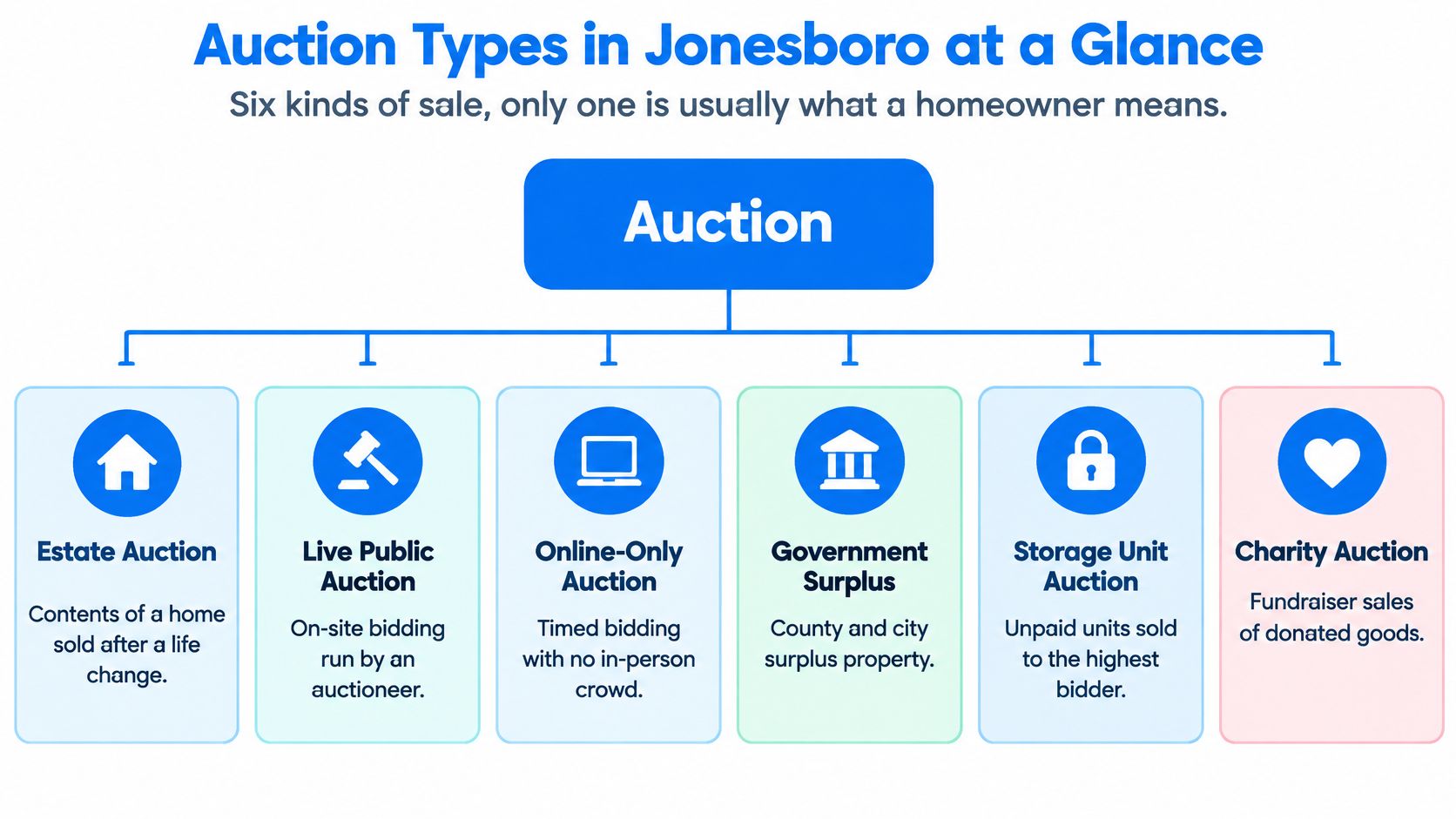
Auction Types in Jonesboro at a Glance
If you're selling the contents of a home, an estate auction is usually the category you mean. Jonesboro auction listings also cover government surplus, vehicles, storage contents, tax-delinquent property, and foreclosures. These aren't interchangeable ways to shop.
There's another distinction to make: live and online describe bidding formats, not the property being sold. An estate auction can be online-only, while a surplus sale can accept both on-site and remote bids.
Jonesboro auction types compared
| Auction type | Usually run by | Typical items | Bidding format |
|---|---|---|---|
| Estate auction | Estate company or executor | Household contents, furniture, collectibles | Live bidding or timed online bidding |
| Government surplus | City or county | Surplus equipment, vehicles and property | On-site and online bidding when offered |
| Vehicle auction | Dedicated auction operator | Cars and trucks | Register under the operator's rules before bidding |
| Storage unit auction | Storage facility | Contents of abandoned units | Remote bidding possible; photos may be the only preview |
| Tax-sale auction | Tax-sale authority identified in the official notice | Properties with unpaid taxes | Follow the notice's identification and registration requirements |
| Foreclosure auction | Lender or trustee | Foreclosed property | Bid through the process specified in the trustee's notice |
Estate auctions focus on possessions rather than ownership of the house. A family might sell furniture, workshop tools, kitchenware, and collectibles after a death, relocation, or downsizing. Check whether the listing sells an individual item or a grouped lot.
Government surplus means a public body is disposing of property it no longer needs. A surplus vehicle isn't automatically covered by the same inspection, payment, or removal arrangements as a vehicle sold through a dedicated operator.
Storage auctions require a different mindset. You may be purchasing the visible and unseen contents together, rather than selecting individual objects. Include unwanted contents and disposal work in your decision.
Tax sales and foreclosures involve real property and require more investigation than a household purchase. Don't assume the advertised bid represents the full cost of acquiring usable, transferable property.
Charity auctions are another category you may encounter, with donated goods sold to support a fundraiser. Their event rules still need reading.
Before registering: Identify who is selling, exactly what you're buying, and how bids become binding. Those answers tell you which terms to investigate.
Buyer Obligations by Auction Type
The expensive mistake is treating a storage, tax, or vehicle auction like an ordinary household sale. Winning a dining table creates a collection problem; winning property with unresolved title questions can create a much larger commitment.
Dedicated operators serve distinct markets. For example, Jonesboro Auto Auction describes a vehicle-auction operation, not a general household estate-sale service. Confirm eligibility directly rather than assuming every auction advertised publicly accepts every buyer.
Buyer obligations by auction type
Use these as questions to resolve, not universal terms that override an individual sale notice.
| Auction type | Preview | Payment and deadlines | Title or deed | Sale terms |
|---|---|---|---|---|
| Estate auction | Attend advertised preview hours, if offered | Confirm accepted methods and invoice deadline | Household goods generally need no deed; check titled assets separately | Read condition, refund and removal provisions |
| Storage unit auction | Often photos only; no guaranteed physical preview | Pay and clear the unit by the facility's deadline | No real-estate deed transfers with the contents | Remote bidding may be allowed; follow cleanup terms |
| Tax-sale auction | Review the official notice and property records | Confirm photo ID, registration and post-sale payment requirements | Confirm the responsible authority and deed process | Treat final-sale provisions and possible surviving liens or fees seriously |
| Government surplus | Follow inspection instructions in the official listing | Use the listed payment method and removal deadline | Equipment may need no title; vehicles and real property require separate documentation | Follow the specific surplus-sale conditions |
| Vehicle auction | Ask about inspection and testing access | Confirm deposits, payment methods and settlement deadline | Follow the operator's title-transfer rules | Confirm bidder eligibility and any condition guarantees |
What to get in writing
Before bidding, save the terms and resolve these points:
- Eligibility and inspection: Who may register, and what can you examine or test?
- Total charges: Is there a buyer's premium, applicable tax, processing charge, or deposit?
- Payment: When must cleared funds arrive, and which methods are accepted?
- Removal: Who provides labor, loading equipment, transport, and cleanup?
- Ownership and condition: When do documents transfer, and what does an as-is clause exclude?
For household purchases, our guide to online estate auctions provides useful context for understanding timed bidding.
Foreclosure buyers should separately investigate the trustee's notice, ownership records, occupancy, and any surviving obligations. Tax-sale buyers shouldn't assume a successful bid immediately produces clear title or possession. For either category, have an Arkansas real-estate attorney review unresolved issues before committing funds.
A missing answer isn't permission to assume favorable terms. If the organizer can't clarify a material obligation in writing, don't bid on the expectation that you can sort it out afterward.
Where to Find Upcoming Auctions and Auction Houses
Start with whoever controls the sale. A shared social post may help you discover an auction, but the organizer's current listing should supply the operative dates, descriptions, and terms. An old announcement isn't evidence that registration is still open.
Search in this order
-
The City of Jonesboro's public-auction information. Use the city's own website to locate surplus announcements. Open the individual sale notice rather than relying on a search-result summary, and check whether bidding takes place on-site, online, or through another platform.
-
Dedicated auction operators' websites. Search the operator's name, then find its registration instructions and current catalog. Distinguish a business's general description from the conditions attached to the auction you want to enter.
-
Storage facilities and their designated listing platforms. Confirm that the facility recognizes the listing. Study the photographs, access instructions, and removal conditions before arranging a truck.
-
Official tax-sale and foreclosure notices. Start with the authority or trustee named in the notice and cross-check property identifiers against official records. Don't substitute a street address or promotional description for the legal property description.
-
Estate-sale companies' websites and social accounts. Look for the actual catalog, not just attractive preview pictures. Confirm whether the event is an auction, a fixed-price estate sale, or an advertisement for a future sale.
-
Local news and community pages. These can reveal fundraisers and smaller household sales. Follow the announcement back to the organizer before sending payment or providing registration information.
Verify before committing
Record the organizer's name and physical address, inspection arrangements, closing time, registration instructions, and accepted payment methods. If key details are absent, call using contact information you've independently checked.
Watch for conflicting versions of the same listing. Ask which notice is current, especially if someone has changed the venue, pickup address, or payment instructions.
Save the preview, bidding close, payment deadline, and collection appointment as separate calendar entries. Winning the auction doesn't extend any of those deadlines.
Keep a copy of the catalog description and terms alongside your calendar entry. That gives you a practical reference when arranging transport or checking an invoice.
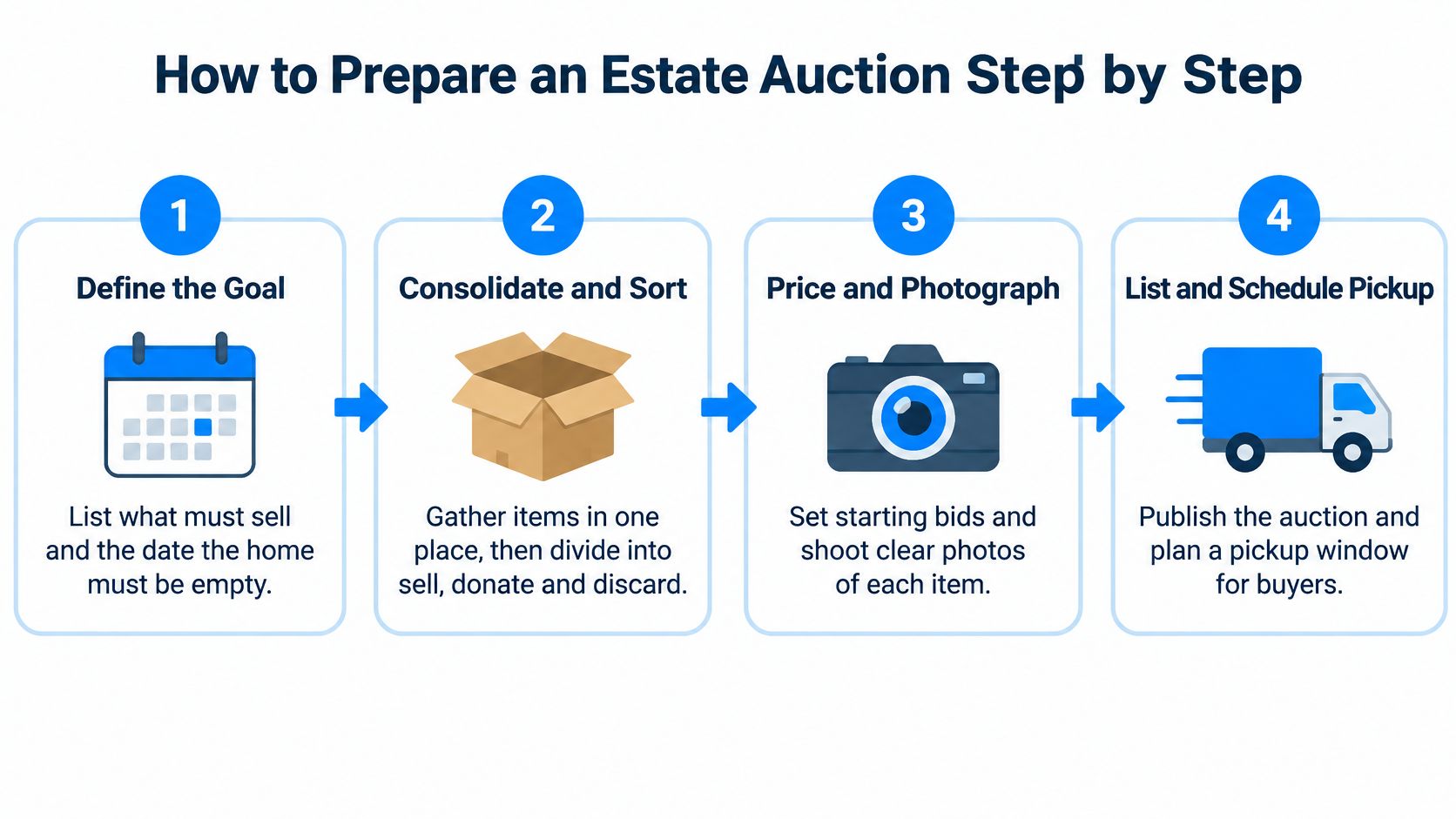
How to Prepare an Estate Auction Step by Step
A well-prepared estate auction begins with decisions about ownership and logistics, not photographs. Before listing anything, confirm that you have authority to sell it and separate belongings that family members, beneficiaries, or other owners haven't released.
Build the catalog and collection plan
-
Define the outcome. Write down what must leave and when the property must be empty. Allow room in the schedule for unsold goods and anything that needs separate handling.
-
Sort before moving everything. Create clearly marked sell, keep, donate, and discard areas, and secure documents, medication, photographs, and personal records. For relocation-focused sorting, TLC Moving & Storage's guidance on decluttering before a local move is a useful companion.
-
Choose the sale schedule. Set the opening, closing, preview arrangements, and collection window before publishing. Check that the people responsible for answering questions and supervising collection are available.
-
Give each lot an identifier. Photograph items in good light against an uncluttered background, including maker's marks, accessories, and damage. Keep the identifier visible in your working records so similar chairs or boxes don't get confused.
-
Describe what buyers need to know. Record dimensions, materials, brand, model, condition, and what's included. Say whether an appliance was tested, and don't describe an untested item as working.
-
Research and set opening bids. Separate ordinary household goods from pieces that need specialist identification. Decide which objects belong together before assigning prices.
-
Publish and promote locally. Share the actual catalog through relevant community groups, email, and personal contacts where posting is permitted. Tell prospective buyers what kinds of goods are available rather than using a vague announcement.
-
Respond and update. Check messages regularly and add useful clarifications to the public description. If someone asks whether a cabinet comes apart, other bidders may need that answer too.
-
Organize collection. Label sold lots and map a safe route through the property. Tell buyers about stairs, narrow doorways, and whether they must bring lifting help.
-
Reconcile and close the file. Match payments, collected lots, and remaining items against your records. Keep the settlement information and decide how to handle anything left behind.
Prevent avoidable disputes
For wider planning considerations, use our Arkansas estate-sale guide alongside your property-specific checklist.
Don't let a missing measurement or unanswered condition question undermine careful preparation. Accurate descriptions help buyers decide confidently and give the person supervising collection a clear record of what was sold.
Pricing Items, Starting Bids and Seller Mistakes
Price by item category, condition, and evidence, not by attachment. A serviceable dining set, a collectible vase, and a specialist workshop tool need different research. The amount a family originally paid doesn't establish what another household will offer today.
Jonesboro's median household income was $55,424 in the Census Bureau's reporting, according to U.S. Census Bureau QuickFacts. That provides local economic context, not a formula for pricing a sofa or a ceiling on what a collector might spend.
Match the method to the goods
For everyday furniture, tools, and appliances, compare practical substitutes. Look at recent completed sales where available, assess condition, and account for collection effort. A buyer who must hire transport may offer less for a large cabinet than for a smaller piece they can carry.
For collectibles and specialty goods, identify the maker, model, age where documented, and distinguishing marks. Search sold results rather than treating an optimistic asking price as proof of value. Compare like with like, including missing parts, repairs, provenance, and whether shipping was included.
For higher-value pieces, decide the minimum acceptable outcome before publishing. Use a reserve where the sale permits one, or an opening bid you're willing to accept. Broader regional promotion makes sense when the likely buyer needs specialist knowledge or a particular collecting interest.
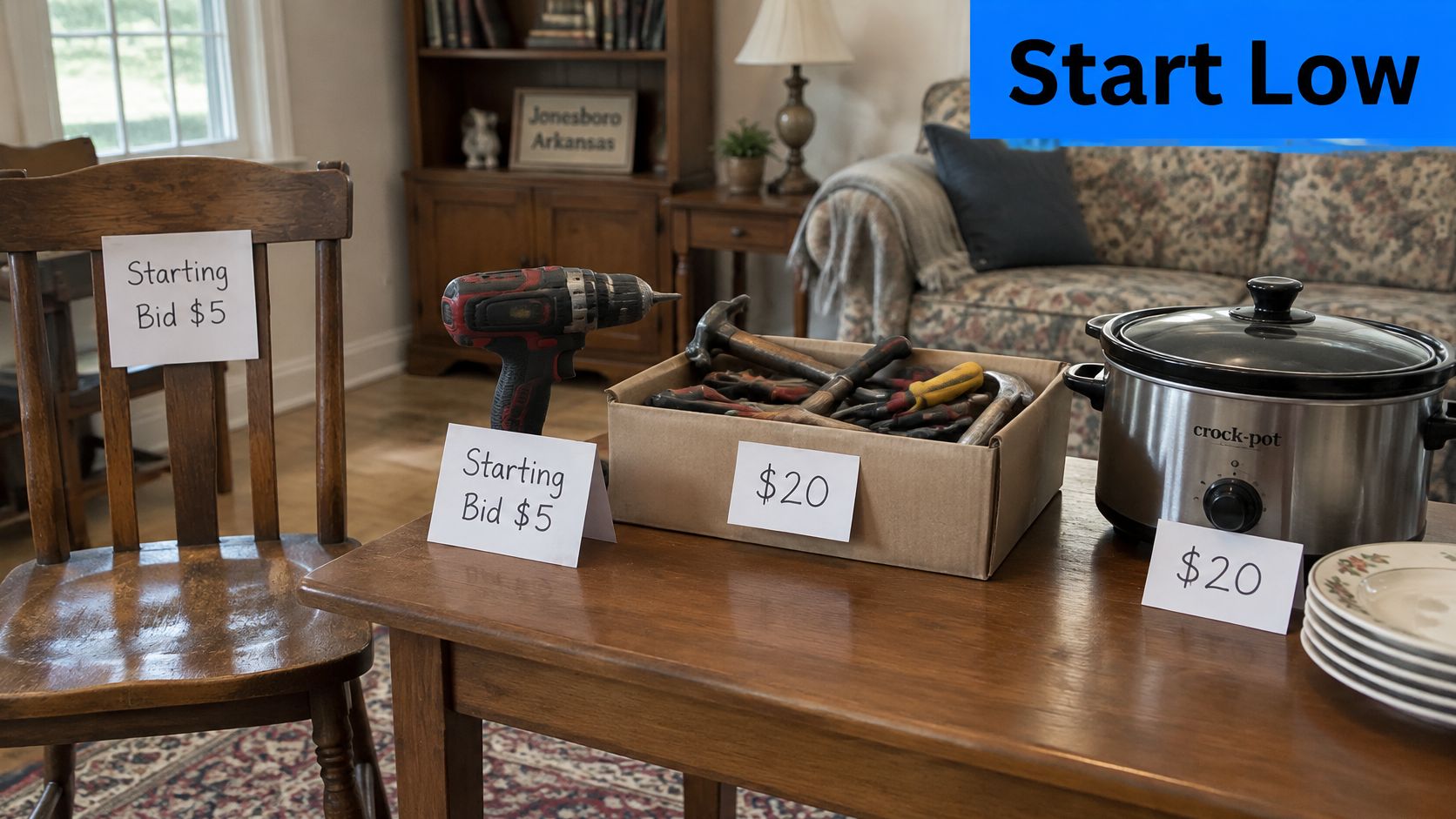
An opening bid and a reserve do different jobs. The opening bid invites participation; the reserve protects the seller's minimum where supported. A low opening doesn't guarantee competitive bidding, so don't expose an important asset below your acceptable amount merely to make the catalog look active.
Bundle small, related items when they make a useful purchase together. A coherent baking-equipment lot is easier to assess than a box combining kitchen utensils, electrical cords, and unrelated ornaments.
Errors that reduce the seller's options
- Using purchase price as resale evidence: Depreciation, wear, style, and transport all affect the buyer's alternatives.
- Leaving out measurements: Buyers can't confidently bid on a desk if they don't know whether it fits their room or vehicle.
- Skipping authentication: An uncertain maker's mark shouldn't become a confident attribution in the listing.
- Leaving valuable goods unprotected: If you wouldn't accept the opening amount, establish an appropriate safeguard before bidding begins.
- Making oversized bundles: Don't force a specialist buyer to remove unrelated goods merely to obtain the piece they want.
A useful comparable is an item that actually sold in similar condition through a reasonably similar selling channel.
Buyers should set a written all-in ceiling that includes applicable charges, transport, and repairs. Work backward from that ceiling to your maximum bid, and resist increasing it because another bidder remains active.
Choose Between an Auction House and a DIY Online Sale
Choose the route based on who can do the work, not just who advertises the lowest fee. Cataloging, identifying valuable objects, communicating with bidders, and supervising removal all take attention. Paying for help can make sense when you can't provide that attention yourself.
A local auction house may handle more of those tasks, but the written agreement must say which ones. A seller-led online sale leaves you closer to the inventory and schedule, with responsibility for preparing accurate listings and managing the property.
Estate auction route compared
| Criterion | DIYAuctions | Local auction house |
|---|---|---|
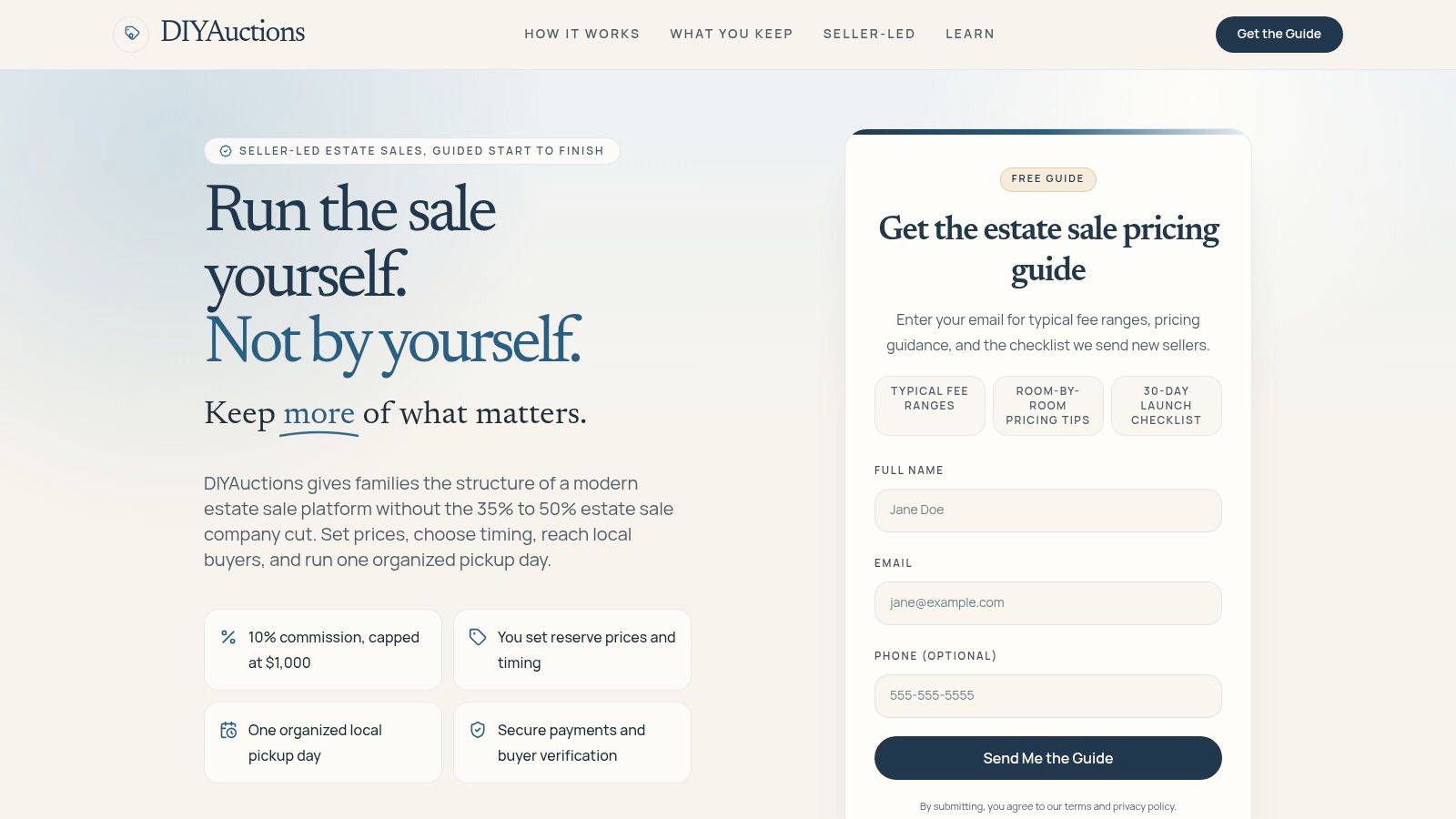
| Cost | 10% commission on the sale price, capped at $1,000 per transaction | Obtain written seller commission, marketing, removal and other charges |
| Price and schedule control | Seller sets reserves, closing windows and pickup day | Establish reserve rights and scheduling authority in the contract |
| Time required | Seller manages listings and buyer questions | Confirm responsibility for sorting, cataloging and inquiries |
| Buyer reach | Online buyers plus local promotion | Ask how the operator will reach buyers for your inventory |
| Pickup management | One coordinated local pickup day | Confirm location, staffing, loading responsibilities and removal arrangements |
Our secure pre-payment system means buyers have already paid before collecting their items. The coordinated collection day replaces multiple days of buyers walking through the home, but you still need safe access and clearly identified lots.
Choose the help your inventory needs
An auction house is worth considering when you have limited time, can't manage listings, or need physical assistance with the contents. For a small consignment, first establish whether the operator accepts that category and whether transport or minimum charges make the arrangement worthwhile.
A seller-led online sale suits a full household when you can prepare the catalog and want direct control over the timetable. It's less suitable if nobody can answer condition questions or supervise access to the property.
Specialist objects deserve a separate decision. Before adding a luxury watch to a mixed household catalog, consult the ECI Jewelers watch selling guide to consider specialist selling channels and the information a watch buyer may request.
If you're interviewing professionals, our guide to estate-sale agents can help you frame the scope of assistance you need. Ask each candidate to explain what happens to unsold property and which expenses remain payable if the sale disappoints.
Compare the expected net proceeds and the work you retain. A commission alone doesn't reveal whether catalog preparation, transport, cleanup, or specialist evaluation is included. Keep those responsibilities in the same comparison sheet as the fees.
Start with a room-by-room inventory, flag anything that needs specialist review, and choose a realistic collection date. Then check the fee terms in writing and, if a seller-led estate auction fits your situation, start your auction with DIYAuctions.
Get the estate sale pricing guide
Enter your email for pricing ranges, planning notes, and a clearer path to launch.