Best way to sell furniture online: Quick Guide to Higher Returns
Discover the best way to sell furniture online with proven pricing, staging, and pickup tips to boost speed and profit.

Let's be honest—the best way to sell furniture online is through a platform that connects you to a huge local market without all the usual headaches. The days of paying high fees at consignment shops or placing a tiny ad in the paper are long gone. Digital marketplaces give you way more reach, total control over your pricing, and much simpler logistics.
Why Selling Online Is the Smartest Move

The thought of selling furniture online might feel a little daunting at first, but the payoff is so much bigger than with old-school methods. When you move past printed ads or local shops, you're suddenly showing your items to a massive pool of people who are actively looking to buy. Instead of just hoping for foot traffic, your listings are working for you 24/7.
This guide is designed to walk you through the entire process, whether you're selling a single vintage armchair or liquidating a whole house full of furniture. We’ll break down how different selling models work so you can pick the one that fits your situation perfectly.
The Power of the Digital Marketplace
The move to online furniture sales isn’t just a passing trend; it’s a massive economic shift. In 2024, the United States became the global leader in furniture e-commerce, with revenues hitting nearly $125 billion—easily blowing past China's $45 billion. This explosive growth is exactly why platforms like DIYAuctions are changing the game for everyday sellers.
Think about it: a staggering 31% of U.S. shoppers now buy household furniture online every single month. That’s the highest rate in the world.
For someone just looking to sell a few pieces, this digital shift brings some clear wins:
- Massive Reach: Your listings are seen by thousands of local buyers, not just the few people who might wander into a store.
- Total Pricing Control: You decide what your stuff is worth. Whether you set a fixed price or let bidders compete in an auction, you're in the driver's seat.
- Real Convenience: You can manage the entire sale from your couch, from snapping photos to coordinating a single pickup day.
It's More Than Just a Sale
Beyond the cash, selling your furniture online is one of the most effective ways to declutter your home. If you feel stuck and don't know where to start, these actionable decluttering tips for beginners can help you get moving. Every single item you sell is one less thing taking up precious space.
When you choose the right online method, you're not just offloading an old couch. You're taking back control of your assets, your space, and your time. It’s about making a smart choice that lines up with how people actually shop today.
Whether your goal is to make the most money possible, sell everything quickly and securely, or just find a good new home for your beloved pieces, an online strategy is your best bet. The rest of this guide will show you exactly how to do it right.
How to Prep Your Furniture for a Profitable Sale
The difference between a piece of furniture that sells in a day for top dollar and one that gets scrolled past a hundred times? It almost always boils down to prep work. And I'm not talking about a quick wipe with a paper towel. I'm talking about showing a buyer its true potential so they can immediately picture it in their own home.
Think of it this way: you’re not just selling a used dresser; you’re selling a beautiful, functional piece that's going to solve someone's storage problem. Putting in a little effort upfront can make a huge difference in your final sale price and bring in serious buyers who are ready to commit.
Start with a Good Cleaning and Simple Fixes
First impressions are everything online. Your photos are all a buyer has to go on. That’s why you need to start with a deep, thorough cleaning that’s appropriate for the material. For wood, this means getting past the surface dust. I always recommend a quality wood cleaner, or even a simple mix of mild soap and water, followed by a good polish or oil. Something like Howard Feed-N-Wax can work wonders on a thirsty piece of wood, restoring its luster and hiding minor scratches almost instantly.
Next, you have to tackle the little annoyances that buyers always check for. Got a drawer that sticks? Rub a little bar soap or wax on the runners. Is a knob loose? Grab a screwdriver and tighten it up. These tiny fixes take minutes but tell a buyer that the piece was well cared for, and that builds a ton of trust.
- Upholstery: Grab your vacuum and use the upholstery attachment to get into every crevice. If you find a stain, use a fabric-specific cleaner, but always—always—test it on a hidden spot first.
- Hardware: Is the hardware looking a little tired and tarnished? A dab of brass polish can make it shine like new. This adds a pop of quality that really stands out in photos.
- Stability: Flip the piece over and give the legs a good shake. A wobbly table or chair is a major red flag for buyers, but it's often just a loose bolt that needs a quick tightening.
A buyer makes a snap judgment in seconds. A sticky drawer or a wobbly leg is often enough to make them assume the whole piece is junk. That 20 minutes you spend on minor repairs? It might be the most profitable time you spend on the entire sale.
Staging and Photography: Your Most Powerful Selling Tools
You don't need a fancy DSLR camera to take photos that sell furniture. Your smartphone is more than powerful enough if you nail two things: lighting and background. Honestly, these two factors are the secret sauce to making your furniture look incredible.
Find the spot in your house with the best natural light—usually right next to a big window. Bright, indirect sunlight is your best friend. It gets rid of ugly shadows and shows the true color and texture of the wood or fabric. Whatever you do, avoid using your phone's flash. It creates a harsh, flat look that kills any appeal.
Your background needs to be simple and completely free of clutter. A plain, neutral-colored wall is your best bet. You want the furniture to be the star of the show, not your kid's toys or the TV in the background. If you don’t have a clear space, just hang up a plain bedsheet or grab a big piece of poster board from the dollar store.
Getting All the Essential Shots
To give a buyer the confidence to hit "bid" or "buy," you have to show them everything. A great set of photos answers their questions before they even think to ask, which means fewer messages for you and a faster sale.
Here’s the shot list I always follow:
- The "Hero" Shot: This is a straight-on, front-facing photo showing the entire piece. Make this your main listing image.
- Angled Shots: Snap photos from the left and right sides, at about a 45-degree angle. This gives a much better sense of depth and dimension.
- Detail Close-Ups: Get in close on any unique features. Think intricate wood carvings, cool original hardware, or the texture of the fabric.
- The "Honesty" Shot: Be upfront about imperfections. Take clear, well-lit photos of any major scratches, dings, or scuffs. This builds massive credibility and prevents headaches later.
- Context & Scale: Take at least one photo that helps people understand the item's size in a real room. Placing a familiar object, like a book or a small lamp on a nightstand, works perfectly.
Don't forget to also show the inside of drawers, the back of the piece, and any manufacturer's labels you find. The more visual proof you provide, the quicker a serious buyer will feel ready to pull the trigger.
Choosing the Right Platform and Pricing for Maximum Return
So, you’ve cleaned, polished, and prepped your furniture. Now comes the big question: where should you actually sell it? This decision is huge. It will directly impact how much money you make, how fast the piece sells, and frankly, how much of a headache the whole process becomes.
There isn't one single "best" way to sell furniture online. The right answer depends entirely on what you're selling and what you're trying to achieve. You’ve got a few different types of venues to consider, and each one attracts a different kind of buyer and comes with its own quirks.
Breaking Down Your Selling Options
Let's get real about the pros and cons of the most popular platforms. Choosing the right one is less about finding the most buyers and more about finding the right buyers for your specific items.
-
Local Marketplaces (Facebook Marketplace, Craigslist): These are the default for a reason. They're free, fast, and connect you with people in your area, which is essential for big, bulky items. If you have a standard IKEA sofa or a basic dining set, this is often the path of least resistance. The catch? You have to be ready for an onslaught of lowball offers, endless "Is this still available?" messages, and frustrating no-shows.
-
Niche & Consignment Sites (Chairish, 1stDibs): If you're selling a genuine mid-century modern credenza or a high-end designer piece, don't waste your time on local marketplaces. These curated sites attract serious collectors and designers who are willing to pay a premium for quality. Just be prepared for the trade-off: their commission fees can be steep, often ranging from 20% to 40%, and the listing process is usually much more involved.
-
Online Auction Platforms (eBay, DIYAuctions): Auctions bring a secret weapon to the table: competition. The thrill of bidding can drive the final price well beyond what you might have asked for. While eBay has a massive audience, its fee structure can be confusing, and figuring out shipping for a wardrobe is a logistical nightmare most people want to avoid.
For a really detailed breakdown of the numbers, check out this comparison of DIYAuctions vs. eBay vs. Facebook Marketplace. It’s eye-opening to see how the fees and features stack up side-by-side.
A platform like DIYAuctions is tailor-made for situations like an estate sale or a major downsizing project. Its low commission cap and single-day pickup event solve the two biggest pains of selling furniture online: coordinating a dozen different pickups and losing a huge chunk of your profit to fees.
This flowchart can help you visualize the process and figure out which path makes the most sense for you based on your timeline and priorities.
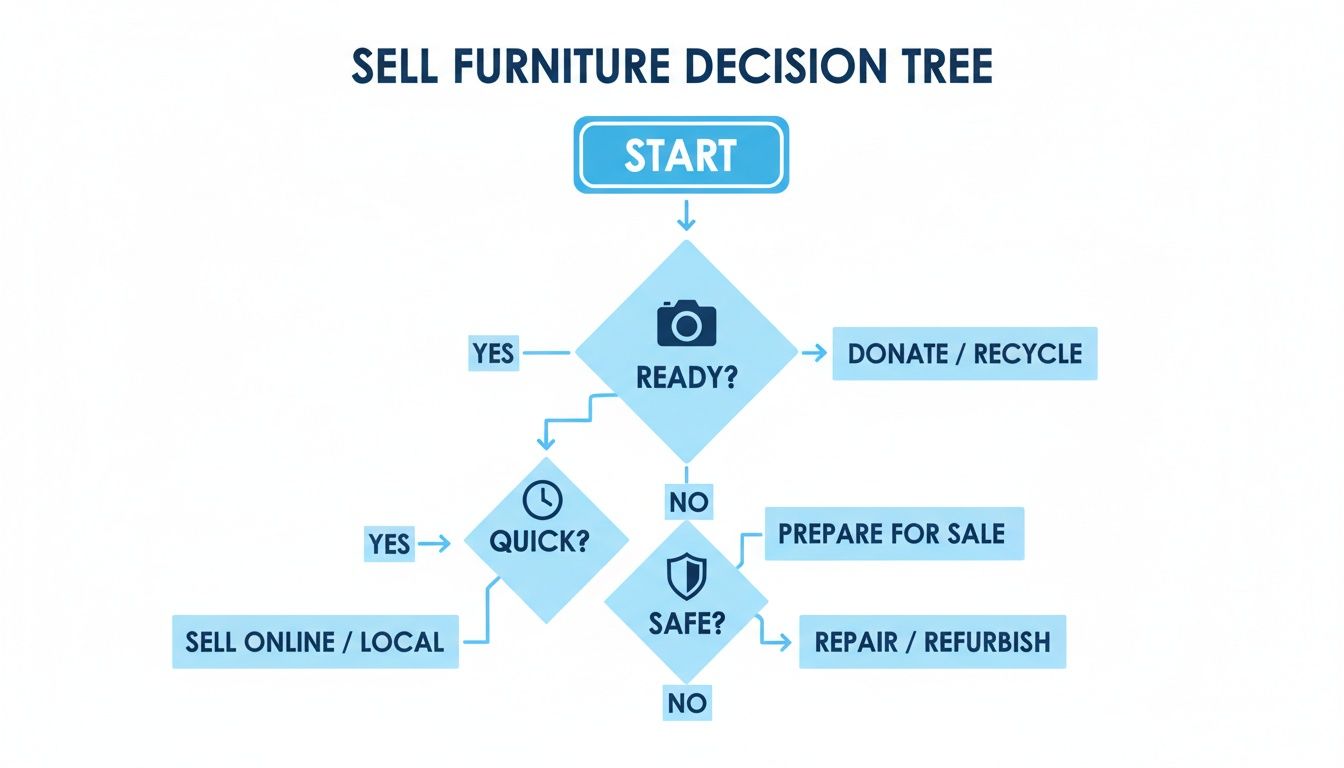
The market itself is shifting to favor smarter, more localized selling. E-commerce now accounts for over 10% of global furniture sales, and while overall production has leveled off at around $470 billion, the real action is in these direct-to-community online sales.
I've put together a quick-glance table to help you compare your main options.
Comparison of Online Furniture Selling Platforms
| Platform Type | Examples | Typical Fees | Best For | Logistics Model |
|---|---|---|---|---|
| Local Marketplace | Facebook Marketplace, Craigslist | Generally Free | Common, everyday items; quick local sales | DIY (Seller coordinates with individual buyers) |
| Niche Consignment | Chairish, 1stDibs | 20% - 40% Commission | High-end designer, vintage, antique pieces | Platform often assists with shipping coordination |
| Broad Auction | eBay | ~13% + various listing fees | Collectibles, shippable items | Mostly DIY (Seller responsible for packing/shipping) |
| Local Auction | DIYAuctions | 10% (capped) | Estate sales, downsizing, multiple items | Coordinated single-day local pickup event |
This table shows there’s a clear trade-off between reach, fees, and convenience. The best choice depends entirely on your specific inventory and goals.
Master Your Pricing Strategy
Pricing feels like a guessing game, but it doesn't have to be. With a little research, you can land on that perfect number that gets you a great price without letting your item sit for months.
First, you need to find your "comps"—what have similar items actually sold for recently? Spend some time searching on the platform you plan to use. Look for the same style, brand, and condition. Ignore the pie-in-the-sky asking prices and focus on the listings that are marked as sold. This gives you a realistic starting point.
From there, you have a couple of solid approaches:
-
The Fixed-Price Model: This is as straightforward as it gets. You name your price, and that's it. This works well when you know exactly what your piece is worth and you aren't in a major rush. Pro tip: always price it 10-15% higher than your bottom line to give yourself some wiggle room for negotiation. People love feeling like they got a deal.
-
The Auction-Style Model: This is where the magic can happen. Auctions create a sense of urgency and competition that often pushes the final price higher than you'd expect. By starting the bidding really low (even $1), you attract a ton of eyeballs and get people emotionally invested. As they compete against each other, the price climbs to its true market value.
This auction approach is a lifesaver for an estate sale or a big downsizing move. It’s the most efficient way to sell a large volume of items quickly. The competitive environment from a timed event encourages people to act decisively, maximizing your total profit without the soul-crushing task of researching and pricing every last lamp and end table.
Creating Listings That Attract Eager Buyers

You’ve prepped your piece and have some fantastic photos ready to go. You're halfway there. Now it’s time to craft a listing that does more than just state facts—it needs to sell the story of your furniture. A great listing anticipates a buyer's questions, builds trust, and helps them immediately see that piece fitting perfectly into their home.
Think of your title as your first impression. It has one job: to stop the scroll and pull someone in. A lazy title like "Brown Couch" is a guaranteed way to get lost in the sea of listings. You have to be descriptive and use the exact keywords a serious buyer is typing into their search bar.
Writing Titles That Convert
A really effective title is a mix of specifics and appeal. The trick is to pack in as much useful info as you can without making it feel like a jumbled mess. A good starting point is to include the details buyers care about most.
I've found this simple formula works wonders: [Style/Era] + [Brand/Material] + [Item Type] + [Key Feature]
Let's look at a real-world example:
- Weak Title: "Vintage Dresser"
- Strong Title: "Mid-Century Modern Walnut 6-Drawer Dresser by Broyhill"
The second title is a game-changer. It instantly connects with buyers looking for specific styles, well-known brands, or certain materials. It answers questions before they're even asked and frames the piece as a quality find, not just another used dresser.
Think of it this way: a detailed title is your first filter. It weeds out the casual browsers and attracts motivated buyers who know exactly what they're looking for. That means fewer time-wasting questions for you.
Weaving a Story in Your Description
Once your photos and title have hooked a buyer, the description is where you seal the deal. This is your moment to move beyond basic facts and dimensions. It's where you tell the story.
First, get the essentials out of the way:
- Dimensions: Always give precise measurements (Height x Width x Depth).
- Materials: Be specific. Is it solid oak, walnut veneer, or linen upholstery?
- Condition: Brutal honesty is your best friend here. Point out every scratch, scuff, and wobble. This builds incredible trust with buyers.
- Brand/Era: If you know the maker or the general age, say so. It adds value.
With the basics covered, it's time to bring the piece to life. Instead of saying "a sturdy armchair," try something more evocative, like, "This is the perfect armchair for a cozy reading nook, with supportive cushions and wide arms just right for resting a cup of tea." You're helping the buyer visualize it in their own life.
For more hands-on tips to get those perfect, story-telling shots, check out our guide on how to take professional product photos.
The online furniture market is absolutely massive, and making your listing pop is more important than ever. Projections show the market is set to grow by an eye-watering $282.1 billion between 2025 and 2029. With 62.3% of furniture searches in 2024 being "buy-ready," a compelling listing on a low-commission platform like DIYAuctions is your direct line to these motivated shoppers.
Getting More Eyes on Your Listing
Don't just post your listing and hope for the best. A little promotion can make a huge difference and speed up your sale. Most local marketplaces make it easy to share your listing in relevant online communities.
Look for local buy/sell/trade groups, neighborhood pages, or even hobbyist groups dedicated to specific styles, like "Mid-Century Modern Enthusiasts." Sharing your listing there puts it right in front of an engaged, local audience that's already looking for what you have. It's a simple step that can massively increase your views and lead to a much faster sale.
Navigating Payments and Pickups Safely
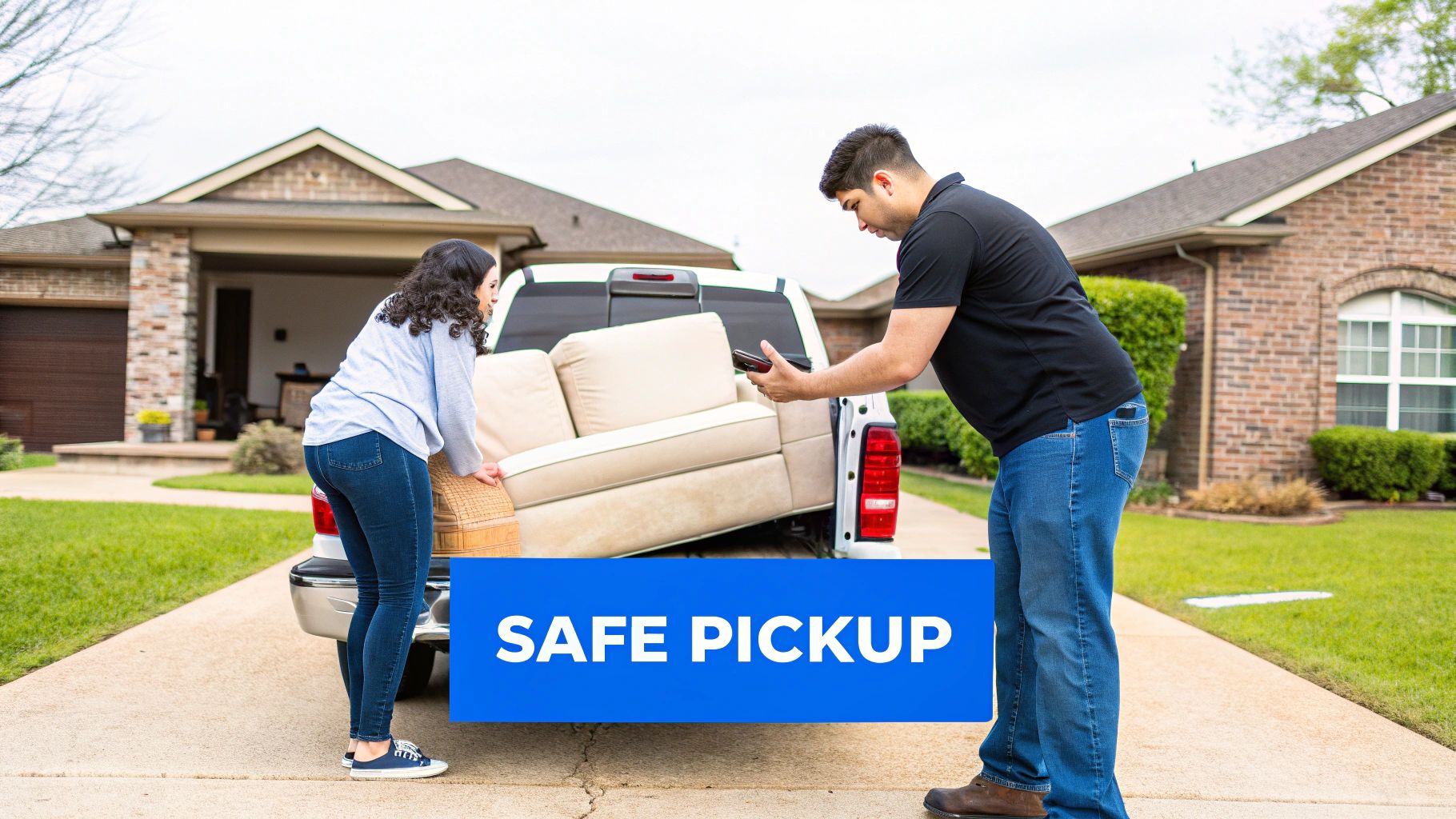
You’ve done the hard work of prepping, photographing, and listing your furniture. Now comes the part that can feel the most stressful: actually getting paid and handing the item over. But with a solid plan, this final step can be smooth, safe, and simple for everyone involved.
Let's break down how to handle the money and the physical handoff with confidence.
Mastering Pickup Logistics
For most of us selling furniture from our own homes, local pickup only is the way to go. Shipping furniture is a logistical nightmare—it’s expensive, complicated, and can easily eat up all your profits. Sticking to local buyers just makes sense.
But even local pickups need a smart approach to avoid the endless back-and-forth messaging, no-shows, and awkward scheduling.
I’ve learned from experience that the biggest challenge isn't moving the furniture; it's managing the people. Trying to coordinate individual pickups for multiple items is a recipe for chaos.
A much better system, especially if you're clearing out several pieces for a downsizing or estate sale, is to set up a single-day pickup event. It's incredibly efficient. You just pick one day and a time window (say, Saturday from 9 AM to 1 PM), and all your buyers come during that period. This strategy practically eliminates the coordination headaches.
For very large or valuable pieces, you might also point buyers toward a professional furniture pickup and delivery service if they can't manage it themselves.
A Safety Checklist for Local Pickups
Whether you’re handing off one armchair or twenty items, your safety is non-negotiable. Here's a simple checklist to protect yourself and your property.
-
Confirm Everything in Advance: A day before the pickup, send a quick message confirming the address, the time slot, and any specific instructions. Something like, "Just confirming for tomorrow between 9-1! Please park on the street and come to the side gate."
-
Pick a Safe Spot: If it's a small item, meeting at a public place like a police station parking lot is a great option. For big furniture that has to be picked up from your home, do yourself a favor and move it into the garage or onto the driveway beforehand. This keeps strangers from needing to walk through your house.
-
Use the Buddy System: Never, ever handle a pickup alone. Having a friend or family member there is a simple but powerful safety measure.
-
Create a Digital Handshake: After the buyer has looked the item over, ask them to send a quick confirmation through the platform's messages. A simple "Item received, thanks!" from them creates a digital paper trail that the transaction is complete.
Securing Your Payment and Avoiding Scams
How you get paid is just as important as how much you get paid. The number one rule is to never accept weird payment methods. Stick to the secure, built-in payment system on the platform you're using.
Platforms like DIYAuctions are designed for safety. They process all payments online before the pickup event. This is the gold standard. It means the money is verified and in your account before your item ever leaves the driveway, which completely eliminates the risk of dealing with fake cash or bounced checks.
Scammers count on sellers who are willing to bend the rules. Keep an eye out for these classic red flags:
- The Overpayment Trick: A buyer "accidentally" sends you a check for way more than the asking price and asks you to wire the difference to their "shipper." The check is always fake, and you'll be out both the money and your furniture.
- Asking for Personal Info: A legitimate buyer never needs your bank account number or other sensitive details. All payments should happen through the platform.
- Complex Pickup Stories: Be wary of convoluted tales involving a cousin's friend or a third-party agent picking up the item. You should only be dealing directly with the person whose name is on the winning bid.
It's helpful to learn more about how modern fraud protection works to see how these systems keep you safe. At the end of the day, trust your gut. If something feels off or a deal seems too good to be true, it is. It's always better to decline the sale and wait for a real buyer. Your peace of mind is worth it.
Got Questions? We’ve Got Answers.
Even with a solid plan, a few nagging questions always seem to pop up when you're selling furniture. It can feel like a huge undertaking, but sorting out these common sticking points is the key to making the whole process smoother and more profitable. Let's dig into the questions we hear from sellers most often.
What Kind of Furniture Actually Sells Best?
You're not wrong to wonder this. Certain pieces definitely have a head start in the online marketplace. Anything with strong brand recognition—think West Elm, Restoration Hardware, or well-known vintage designers—tends to get snapped up quickly. Unique antiques and solid wood pieces are also perennial favorites.
On the style front, mid-century modern and Scandinavian designs are still incredibly hot. But don't write off the basics. Even a simple IKEA piece can sell fast if it’s in good shape and priced right. The real secret isn't the item itself, but how you present it. With great photos and an honest description, you can find a buyer for almost anything.
If you're selling a whole house full of furniture, like in an estate cleanout, an auction platform is your best friend. It draws in a wide range of buyers looking for all sorts of different things at once, which dramatically increases your odds of clearing everything out.
How in the World Do I Ship a Couch?
This is the big one, isn't it? The answer is simpler than you think: for most of us selling our own stuff, local pickup only is the only way to go. Shipping large, heavy furniture is a logistical and financial nightmare. The costs can easily swallow your entire profit, and the hassle is immense.
Stick with local pickup. It's the safest, easiest route. If you absolutely have to ship something, you’ll need to look into freight services like uShip that specialize in big items. Just be ready for some serious sticker shock, a cost you'll definitely need to pass on to your buyer.
An even better way to dodge this bullet is to use a platform designed around a single-day pickup event. This model is a game-changer. You just pick a date and a time window, and all your buyers come to you. It completely removes the shipping headache from your plate.
Should I Sell My Dining Set Together or Split It Up?
Ah, the classic "sell as a set or part it out" dilemma. Honestly, it depends, but there's a smart way to figure it out. Most of the time, matching dining room or bedroom sets will fetch a higher total price when sold together. Buyers absolutely love the convenience of getting a complete, coordinated look in one go.
But there’s a big exception. If the individual pieces are special on their own—say, from a high-demand designer—you might make a lot more by selling them separately. A vintage Paul McCobb dresser, for example, is likely worth more by itself than as part of a less-desirable bedroom set.
Here’s a strategy to get the best of both worlds:
- List it as a set first. Give it an attractive package price.
- Add a note in the description. Mention you're willing to sell pieces individually if the full set doesn't find a home within a week or so.
This tactic lets you test the waters for a quick, bundled sale while keeping your options open.
What’s the #1 Biggest Mistake People Make?
I can answer this one without a moment's hesitation: bad photography. It is, without a doubt, the single biggest and most costly mistake you can make. Dark, blurry, or cluttered photos will make a beautiful piece of furniture look like junk. It will absolutely torpedo your selling price or, worse, scare away buyers completely.
Your photos are all a buyer has to go on. A few extra minutes spent here will pay off more than anything else you do.
Make these your non-negotiable rules for every photo you take:
- Go Toward the Light: Natural light is your best friend. Set up near a window with bright, indirect sun. And please, turn off the harsh flash.
- Clear the Clutter: The focus has to be on the furniture. Move the laundry basket and the dog toys. A plain wall is perfect.
- Get All the Angles: Shoot it from the front, back, sides, and from a 45-degree angle. Let them see everything.
- Show, Don't Just Tell: Get close-ups of the details—the wood grain, fabric texture, unique hardware, and especially any dings or scratches. Being upfront about flaws builds trust and heads off any problems down the road.
More guides in Selling Antiques & Collectibles
July 31, 2026
Ceramic Christmas Tree Atlantic Mold Seller's Guide
Identify, value, and sell a Ceramic Christmas Tree Atlantic Mold piece with confidence. Covers markings, rarity, condition, pricing, and listing tips.
Read guideJuly 30, 2026
Nurre Mirror Value: How to Identify and Sell for Profit
Learn to assess nurre mirror value with our step-by-step guide. Identify authentic pieces, estimate price, and sell profitably on DIYAuctions.
Read guideJuly 29, 2026
Distinction Deluxe Stainless Steel by Oneida HH: A Complete
Learn to identify, assess, and price your distinction deluxe stainless steel by oneida hh set for maximum profit.
Read guideGet the estate sale pricing guide
Enter your email for pricing ranges, planning notes, and a clearer path to launch.