Customer Service Training for Estate Sale Hosts
Customer service training for estate-sale hosts: a four-stage plan with scripts, KPIs, role-plays, and a 30-day onboarding schedule.

Pickup morning is already loud. Two winning bidders are in the driveway before the window opens. One points at a scratch that is visible in the catalog photos and wants money back. The seller, still holding a box of family papers, asks why the fee is nothing like the 30 to 50 percent a traditional company quoted last month. You have one pickup day, a short line forming, and no time to invent a policy on the porch.
Customer service training for an estate sale host is the rehearsal for that hour. It is not a certificate after a video. It is whether a host can turn catalog rules, fees, payment, fraud checks, and a single pickup window into words a stressed person can repeat back.
The Estate Sale Training Map
A one-page map should sit where the work happens: by the phone, the listing notes, and the pickup clipboard. It works like a floor plan for the sale. The host sees five modules, the moment each one covers, and the pass signal a manager can hear on a call. If the buyer or seller cannot repeat the next step, the lesson has not transferred.
| Module | What hosts practice | Pass signal |
|---|---|---|
| Clear communication | Catalog questions, seller commission, and reserve outcomes | Buyer or seller can restate the next step |
| Problem resolution | Condition disputes, missed pickup windows, and bid questions | Issue logged with owner, next step, and deadline |
| Payment and pickup | Invoices, reserve outcomes, and the single pickup day | Winner knows payment method, window, and what to bring |
| Fraud awareness | Identity checks and off-platform payment requests | Escalation note written before any exception |
| Inclusive service | Executors, older sellers, and low digital confidence | Instructions offered in a second format without embarrassment |
How a host uses each row on a live call
Clear communication begins in the catalog conversation. A buyer asks whether the dining table "as is" includes the chip on the leg. The host opens the listing, names the visible condition note, and stops there. The pass is the buyer saying, "So I pick it up within the stated window, chip and all, and I pay on the invoice." A seller who hears that a reserve did not meet should be able to say what happens to that lot next, not just that they are disappointed.
A fee answer uses the same discipline. DIYAuctions handles payment protection, invoices, and transaction flow for sales, while the fee comparison example covers seller commission only. A host who blends those together creates a new question where there was only one. The seller needs the commission explanation in plain words. The buyer needs the invoice and pickup sequence in plain words. Keep the two conversations separate.
Problem resolution starts when someone is already upset. The scratch dispute on the driveway gets an owner, a next step, and a deadline. "I'll note the photo number and call you by 3 p.m. with a yes or a no" beats a promise to "look into it." Missed windows and bid questions use the same three fields. Sympathy without a log creates a second call.
Payment and pickup is the practical row. DIYAuctions handles payment protection, invoices, and transaction flow, so the host does not invent an off-platform workaround on the sidewalk. The winner leaves knowing the payment method, the pickup window, and what to bring. A reserve, the minimum a seller will accept on a higher-value item, is explained before bidding closes, not after a low bid feels personal.
General support handles questions about accounts, auctions, or platform features. Technical issues go through the separate Report Issue option. That split matters on pickup day. A buyer who cannot find an invoice needs one path. A buyer who cannot load the platform needs another. The host should name the right path instead of promising to fix everything from the driveway.
Fraud awareness is a refusal with a paper trail. An off-platform payment request or a skipped identity check gets an escalation note before anyone makes an exception. The pass signal is the note, not a clever comeback. This keeps the host from turning a suspicious request into a private favor.
Inclusive service is the executor who cannot follow a fast phone script, the older seller who wants the steps written down, and the heir who is unsure of the app. The pass is a second format, text or a short written recap, offered without embarrassment. Written steps work like a receipt for the conversation: everyone can check the same next move after the call ends.
Questions about terms can go to support@diyauctions.com. Support is open Monday to Friday from 9:00 AM to 6:00 PM EST and Saturday from 10:00 AM to 4:00 PM EST. It is closed on Sunday. Partnership, media, and business development inquiries go to business@diyauctions.com. Some service features also require an account, so hosts should check access before promising that a seller or buyer can use a feature during the sale.
Practical rule: If you cannot hear the pass signal on a recorded call, the module is not done, no matter how many people watched the lesson.
Why the hour on the wall is worth it
Service quality changes what people do next, which is why the map is a business tool and not an HR packet. A 2022 review reported that 73% of consumers would go out of their way to do business with a company providing better customer service, while 52% said they would pay more when they expected superior service, according to CMSWire's summary of customer service training returns. The same review found that 70% of customers were likely to tell friends and family after a good experience, and 79% trusted a brand more when it delivered excellent customer service.
Customer-experience leaders have also been associated with stronger long-term market returns than laggards over a multiyear period. That gap is context, not proof that a short course alone moves revenue. It does show why trust-sensitive moments, pricing, payment, scheduling, fraud, and issue resolution deserve a posted standard before the first bidder arrives early.
Run Training in Four Transfer Stages
A finished module that nobody uses on a grieving seller's call is a filing exercise. Training pays off when a host can turn policy into behavior during a fee question, a payment worry, a fraud concern, or a single pickup window. Run the work as four transfer stages, with one estate-sale job attached to each stage. Managers stay in the room. A slide a host watches alone does not count.
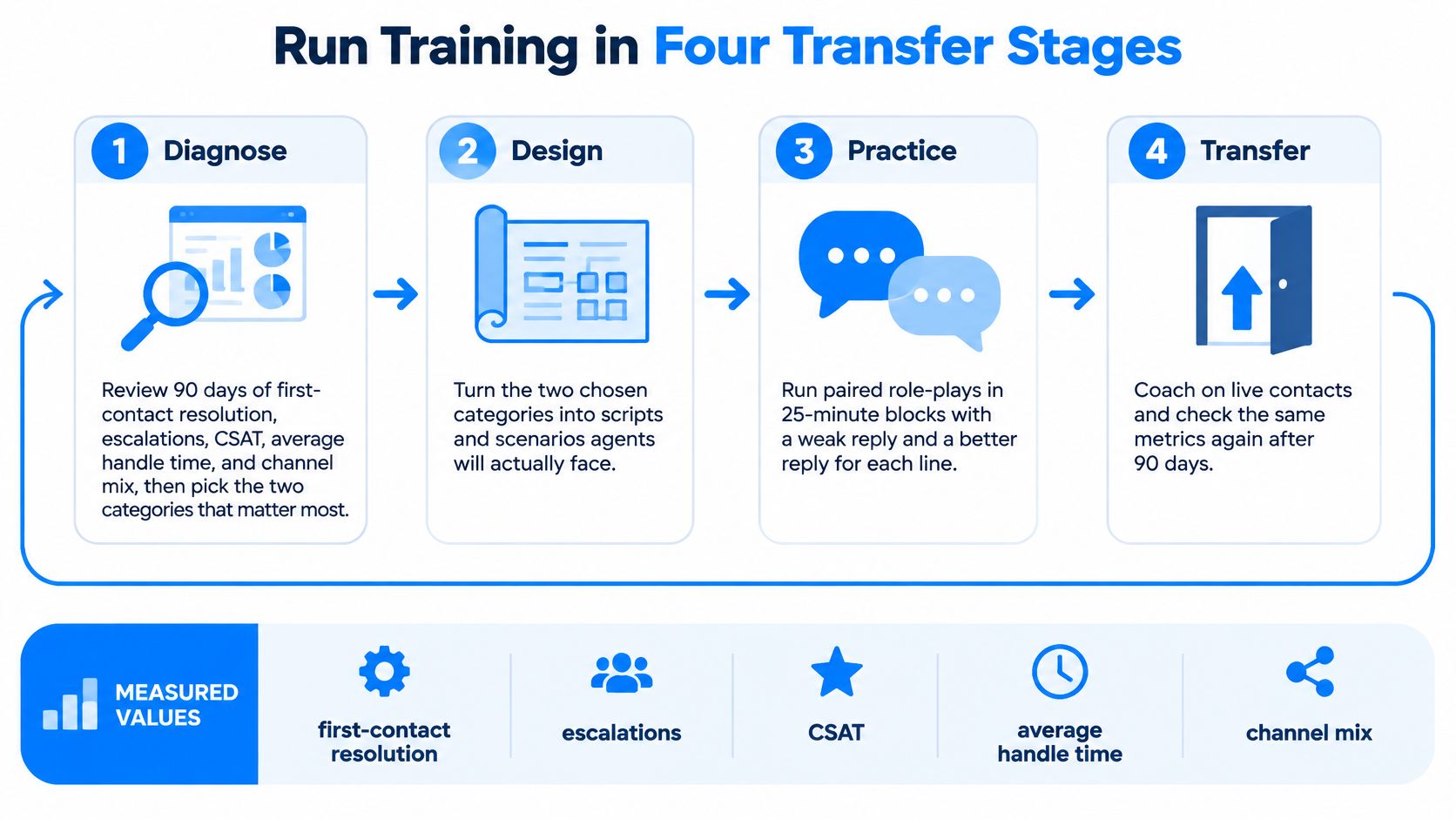
Stage 1. Diagnose the contacts that come back
Pull a useful recent window of first-contact resolution, escalations, customer satisfaction, average handling time, and channel mix. Qiscus's write-up of customer service training programs frames that window as the way to find the categories that drive second contacts. For a small host team, the repeat piles are usually fee questions and pickup disputes. Do not train “empathy” as a theme. Train the two piles that already fill the inbox.
Say the last quarter shows 40 fee threads and 28 pickup threads that each needed a second message. Those two win the month. Catalog photo arguments can wait unless they are the ones coming back.
This stage works like sorting donation boxes before a sale. You do not open every box at once. You open the ones that keep producing loose ends, because those are the ones a trained host can close on the first pass.
Stage 2. Teach only those scenarios
Build a short module a host can finish between listings. Cover the 10 percent commission cap, catalog creation, a payment worry, and a pickup conflict. Leave the rest of the policy manual on the shelf. A seller comparing DIYAuctions with a traditional company needs the cap and what stays on the platform, not a history of online auctions.
Keep the fee lesson concrete. DIYAuctions uses a simple, transparent 10 percent commission model capped at $1,000. Sellers set their own prices, schedule the sale, and catalog items. DIYAuctions handles payment processing, invoices, fraud protection, and transaction flow. General support covers accounts, auctions, platform features, and questions about the terms at support@diyauctions.com, while technical issues go through the separate Report Issue option. Partnership, media, and business development inquiries go to business@diyauctions.com.
Catalog photos belong in the module because condition fights often start in the pictures. Hosts who photograph mahogany under mixed indoor light can use colour grading course modules to see why a scratch looks mild on a phone and obvious on the porch. The point is a listing a buyer can trust when they arrive. A clear photo, a reserve on a higher-value item, and a plain explanation of payment flow prevent three different arguments later.
Stage 3. Practice the same week, with a manager present
Require role-play, a screen walkthrough of a live or sample auction, and manager feedback before anyone is left alone on those issues. A two-person team can pair a 20-minute product module with one live case each week. Policy recited from memory fails when the seller is sorting a parent's house and hears a fee for the first time.
In-person coaching and role-play transfer better than video-only modules. The coach in the room catches the vague answer before it reaches a seller, a bidder, or the pickup table. That is the difference a longer video cannot create.
Use one case per practice round. The seller asks why the commission differs from a traditional company. The host answers with the 10 percent commission and $1,000 cap, the reserve rule for a higher-value lot, and the fact that invoices and payments stay on the platform. Then the manager asks the same question in a rougher tone, because that version rarely arrives calmly.
Support hours matter here too. Hosts should know that DIYAuctions support is open Monday to Friday from 9:00 AM to 6:00 PM EST, Saturday from 10:00 AM to 4:00 PM EST, and closed on Sunday. A host who can name the right support path on a weekday afternoon can give a clean answer when a seller asks where to send a terms question.
Stage 4. Measure the trained categories for two to four weeks
Compare first-contact resolution, escalation, satisfaction, and repeat contacts on the trained issues with the baseline. Ignore attendance. A useful onboarding bar, and this is an operational target rather than an industry law, is whether a new helper reaches at least 80% of the team's first-contact resolution average by day 30.
Post-sale support guidance belongs in that review, because the behavior you are scoring shows up after the hammer falls, not in the quiz. Check what happens once the sale moves into payment, invoices, fraud concerns, and pickup day. If a fee thread turns into two more messages, the host needs a clearer script. If a pickup thread keeps bouncing, the pickup window needs to be said earlier and repeated in the same words.
Measure the trained categories one at a time. Fee questions, payment worries, fraud concerns, and pickup conflicts should each have a clear first-pass answer. When one category improves and the others stay flat, the module worked for that job. When all four stay flat, shorten the lesson and practice the exact phrases hosts will use on the next call.
Scripts for Fees Pickup and Fraud
"Seller down the street takes half. Why are you cheaper? Are we getting the same service?"
That is the kind of question a host hears with one hand on a box tape gun and the other on a phone. The answer has to survive that moment. A pair of hosts can run three role-plays in about 25 minutes. Read them aloud. Score them. The weak line is what people say when they are tired. The better line is what you want on pickup day.

Fee script
Seller: "The company down the street takes 30 to 50 percent. Why isn't your cut the same?"
Weak reply: "We're just cheaper. You'll love it. Don't worry about the invoice."
Better reply: "Our commission is 10 percent, and it stops at $1,000. You set a reserve on a higher-value lot, and that reserve is the minimum you'll accept. Invoices and payment stay on the platform, so you aren't chasing a buyer by text. If this table doesn't meet the reserve, it doesn't sell. Want me to walk the next listing with you?"
The better reply names the cap, the reserve, and where money moves. It also keeps the seller in the decision. Fee confusion often comes from mixing two questions: what DIYAuctions charges and how much the seller keeps. Answer them separately. The commission answers the first. The reserve, catalog, and sale flow answer the second. Do not promise a cash discount or invent a side arrangement. The invoice is part of the platform process.
Pickup script
Winner: "I can't make Saturday. Can I come Sunday, or can my brother grab it whenever?"
Weak reply: "Maybe. Text me and we'll figure it out. I don't want the item sitting here either."
Better reply: "This sale has one pickup window, Saturday 10 to 2. The table is tagged and in the garage. If it isn't collected in that window, it stays with the seller and the sale terms for uncollected lots apply. I can text you the address, the window, and what to bring. I can't open a second day."
One window is the product. A second day feels kind and then wrecks the next estate on the calendar. The host's job at pickup is to protect that boundary while making the buyer's next move obvious. Give three things every time: the exact window, where the lot is, and who to contact if the plan changes. Keep the wording steady so the buyer does not hear a loophole in a sympathetic tone.
Fraud script
Caller: "I'll pay the seller directly and you can skip the ID thing. Faster for everyone."
Weak reply: "If the seller is okay with it, I guess we can make an exception this once."
Better reply: "I can't take payment off the platform, and I can't skip the identity check. I'm writing an escalation note now, and a lead will confirm before anything moves. If this is a real invoice, you'll pay it in the sale flow."
Then stop talking. The note exists before any exception. Our fraud prevention checklist is the list the host follows, not a speech they improvise. Payment protection, invoices, and transaction flow stay inside the platform. A buyer who wants speed may be solving a real transportation problem, but speed does not change the payment path. The correct next step is the escalation note and the lead's confirmation.
Technical issues need a different route from general questions. Accounts, auctions, and platform features go through general support. Technical issues with the platform go through the separate Report Issue option. Questions about terms can be sent to support@diyauctions.com. Support is open Monday to Friday 9:00 AM to 6:00 PM EST, Saturday 10:00 AM to 4:00 PM EST, and closed on Sunday. A host who separates those paths avoids telling a buyer to email about something that needs a technical report.
When the executor is overwhelmed
Executor: "I don't know the password, I don't know which lots are hers, and I can't stay on the phone."
Do not deliver a faster version of the same script. Offer three plain steps, a written recap, and a second channel such as email. "I'll send three lines: which lots are live, when pickup is, and who to call if a buyer disputes a photo. You can answer when you can."
That is an access choice, not a softer tone. Some people need time, writing, or another channel because the phone is the wrong tool in that moment. Ontario's 2025 accessible customer service recommendations call for training of employees, volunteers, and contractors, with review at least every two to three years or sooner when laws and best practices change. Disabled respondents commonly ask for better staff understanding of disability and for inclusive support channels beyond the phone. One empathy script does not cover an executor, an older seller, and a buyer who cannot use the app. Practice the decision, not a memorized apology.
A short briefing on how frontline teams practice hard conversations is worth ten minutes before you score:
Score each role-play on three checks only.
- Next step named: The person knows what happens today, not "soon."
- Policy accurate: Cap, reserve, single window, and on-platform payment match what you do.
- Person not rushed: A second format is offered when the first one fails, without a sigh.
Two out of three is a rewrite, not a pass. A perfect tone with the wrong fee is a fail. The point of the drill is pickup-day behavior: the host explains the fee once, protects the reserve, holds the single pickup window, keeps payment on the platform, and gives the overwhelmed person a usable next step.
Measure Transfer Not Course Completion
A perfect quiz after a video does not tell you what happens at pickup. A host can define a reserve on Thursday and still tell a seller on Saturday that “we'll see how the bids feel.” That is the transfer gap: the seller heard the lesson, but the host did not carry it into the conversation.
Transfer is the point of service training. The question is whether a host can use the policy when a seller asks about fees, a buyer questions payment, or the pickup window starts slipping. A quiet coaching slot and a calm space make that transfer easier. A cancelled practice session and a noisy table leave hosts guessing when the first real question arrives.
Research summarized in research on customer service training effectiveness connects training transfer and job satisfaction to customer-service quality. For a small estate-sale team, the practical version is simple: give people time to practice the decision, then score the behavior where it appears.
A spreadsheet a two-person team can keep
You do not need a data team. You need a baseline, a short knowledge check, an observed score on a real or simulated case, and outcome numbers for 30 to 60 days. If two helpers train in different weeks, that staggered start stops you from calling a quiet estate month a training win.
Segment by issue. A satisfaction jump that came from fewer fraud cases that week is not a fee-script victory. Keep the same category beside itself, like comparing one pickup window across several sales instead of mixing every sale into one average.
| Metric | What to capture | When to judge |
|---|---|---|
| First-contact resolution | Share of issues closed without a second contact, by category | 2-4 weeks; new helpers at 80% of team FCR by day 30 |
| Escalation rate | Cases sent to a lead or the Report Issue path | Compare with the 90-day baseline on the same category |
| CSAT | Score after payment, pickup, or catalog contacts | 30-60 days, with a note if the case mix changed |
| Repeat contact | Same person, same issue, within 7 days | Drop only counts on categories that were role-played |
| Average handle time | Minutes per contact | Flag confusion, never treat a shorter call as the goal |
Use a table like this as a training mirror. It shows whether the lesson reached the catalog note, the fee answer, the payment explanation, and the pickup-day handoff. The point is not to collect more numbers. The point is to see which behavior changed.
What not to celebrate
Average handle time is the metric that fools small teams. A four-minute call that leaves the seller unable to restate the fee is a fail. A nine-minute call that ends with “I pay on the invoice Saturday, and I bring the truck” is a pass.
Treat speed as a flag. If a call gets shorter while repeat contacts rise, the host probably skipped the decision the seller needed. If a call gets longer and the seller leaves with a clear next step, that extra minute did useful work.
Pickup day makes transfer visible. The host either has the reserve, fee cap, reserve meaning, payment flow, and single pickup window ready, or the team hears a new version of the policy. Score what the seller can repeat back, not how confident the host sounded.
Schedule and facilities belong in the measurement too. Protected coaching time gives hosts a place to practice before live sellers arrive. A quiet space lets them work through the awkward parts, such as explaining that technical problems with the platform go through the separate Report Issue option while general support handles accounts, auctions, and platform features. When that practice time disappears, the numbers often show more hesitation, more repeat questions, and more escalations.
A lesson stays only if the targeted category improves and someone can point to a call where the new behavior showed up.
Use our sales performance metrics page to keep the columns consistent from one estate to the next. Add a note when the case mix changes, when a policy changes, or when a holiday week floods you with pickup questions. Confidence is higher when the same category is compared with itself, not when all contacts are blended into one happy average.
A 30 Day Schedule for Small Teams
No training department is required. Start Monday with four short blocks. The person who answers live questions has to be in the room. A backup who only "reads the notes later" will invent a second policy on the first hard call.
| Week | Focus | Time and who |
|---|---|---|
| Week 1 | Review 90 days of contacts and choose two categories | 90 minutes, host and one backup |
| Week 2 | Teach fees, catalog creation, and the pickup window | 60 minutes plus one live case |
| Week 3 | Role-play payment, fraud, and a missed pickup | Scored script with the lead present |
| Week 4 | Compare FCR and CSAT on those categories only | Keep, rewrite, or drop one lesson |
What a new helper must clear before a live question
Week 1 is diagnosis, not orientation theater. Still, a new helper should not touch a seller's question until a few checks are true.
- Account first: They create an account before they click into a live sale. Certain features are not available without one.
- Fee from memory: They can explain the commission cap without notes, including what a reserve does on a higher-value lot.
- Right door for the question: General support covers accounts, auctions, and platform features. Technical problems with the platform go through Report Issue, not a long guess in the host chat.
- Hours they can promise: Support is open Monday to Friday 9:00 AM to 6:00 PM EST, Saturday 10:00 AM to 4:00 PM EST, and closed Sunday. Do not tell a Saturday-evening bidder that someone will "jump on it tonight."
Why the coaching slot is not optional
Turnover is how a good script dies. Training Industry's summary of continuous training statistics reports Gallup figures that highly engaged workplaces achieved 17% higher productivity, 20% higher sales, and 21% higher profitability than disengaged workplaces. The same source cites the Work Institute's 2020 Retention Report, which attributed 37% of employee resignations to insufficient career-development opportunities, while 94% of employees said they would stay longer when an employer invested in their career development.
On a two-person estate team, one resignation means the remaining host relearns fees, pickup rules, and fraud notes while a driveway fills up. The 60-minute week-2 block and the scored week-3 script are the development those numbers are pointing at. Cancel the review and the script fades within two sales.
What to skip in month one
Do not build a long slide deck. Do not add a tool tutorial that is not tied to a live case. A walkthrough of every button in the catalog builder, with no seller on the line, will not change Saturday. If a feature does not show up in the two categories you chose in week 1, it waits until month two.
Protect the coaching slot the way you protect pickup day. Put it on the same calendar, with a name next to it. If the lead cannot attend week 3, move the role-play. Do not let the backup "try it live and debrief later."
Start the First Module This Week
You do not need the whole map finished before you change one conversation. Seller-led sales on our platform already run from the first lot to pickup day, so this week should reinforce that path instead of inventing a second process beside it.
Day 1. Pull the last 90 days of questions. Circle the two that come back most often. If you are unsure, pick fees and pickup. Write the two category names at the top of a blank page.
Day 2. Draft the fee script and the pickup script from the module map. Use the set cap and the single pickup day. Read both aloud once. Cut any sentence the seller would not be able to repeat.
Day 3. Run one role-play with your backup. Score the three checks: next step named, policy accurate, person not rushed. Keep the weak line in the notes so you can hear the difference next time.
Day 4. Sit with one live seller question and use the script. After the call, write whether the person could restate the next step. That sentence is your observed score.
Day 5. Log that contact against the baseline so week 4 has a number to compare. One call is not a trend. It is the first row, and without it the later review is a feeling.
Questions about the terms go to support@diyauctions.com during the hours already on your map. Partnership, media, and business development notes go to business@diyauctions.com so they do not sit in the same queue as a bidder who cannot find the invoice.
Train the two contacts that already hurt, coach them live, and keep the lesson only if the next real conversation gets cleaner.
Open last quarter's messages today and circle the two topics that forced a second reply. Put a 25-minute role-play on the calendar with your backup before the next pickup window, and send any terms question you cannot answer from the script to support@diyauctions.com rather than guessing on the porch.
Get the estate sale pricing guide
Enter your email for pricing ranges, planning notes, and a clearer path to launch.