Maximize Your Estate and Tag Sales Profit with This Guide
Discover how to master estate and tag sales. Get proven strategies for pricing, planning, and promotion to ensure you earn the most from your items.
People often throw around the terms “estate sale” and “tag sale” interchangeably, and for the most part, they’re right. Both are ways to sell just about everything in a home, usually triggered by a major life event like a move, downsizing, or handling a loved one's inheritance.
This isn’t your typical Saturday morning garage sale where you’re just trying to offload some old clothes and a wobbly bookshelf. An estate or tag sale is a full-scale liquidation of a home’s contents—we’re talking everything from the antique dining table and fine china down to the half-used bottle of Windex under the sink.
Understanding Estate and Tag Sales in Today's Market
Jumping into the world of estate sales can feel like a lot to take on, but it's really just a powerful way to convert a household of items into cash. The name you hear—"estate sale" or "tag sale"—often just comes down to what people call it in your neck of the woods. What’s a tag sale in parts of the Northeast is simply an estate sale almost everywhere else. Don't get hung up on the name; they both mean the same thing: an organized event to clear out a house.
Because this is a much bigger undertaking than a weekend garage sale, the potential payoff is significantly higher. As more people downsize or relocate, especially with the recent shifts in the U.S. housing market, these sales have become incredibly popular. A well-managed estate sale can bring in 60-80% of an item's fair market value. That’s a huge leap from the 20-30% you might get from a typical garage sale.
Estate Sale vs. Tag Sale vs. Garage Sale: A Quick Comparison
To really see the difference, it helps to lay it all out. The table below breaks down the scope and purpose of each sale type, making it clear why an estate sale is in a league of its own.
| Feature | Estate Sale | Tag Sale | Garage Sale |
|---|---|---|---|
| Scope | Entire home contents | Often used interchangeably with "estate sale" | Select unwanted items |
| Reason | Major life event (death, move, downsizing) | Same as estate sale | General decluttering |
| Pricing | Based on research and fair market value | Based on research and fair market value | Typically low, designed for quick sale |
| Duration | Usually 2-3 days | Usually 2-3 days | Often 1-2 days |
Ultimately, a garage sale is for casual decluttering, while an estate or tag sale is a planned, comprehensive liquidation event driven by necessity.
Why Choose an Estate Sale
When you’re staring down the challenge of clearing out an entire home, an estate sale is often the smartest choice for maximizing both your profit and your time.
- It’s a complete solution. You get a structured process for selling everything at once, from the valuable heirlooms to the everyday kitchen gadgets.
- You’ll make more money. With proper research, pricing, and marketing, you attract serious buyers who are ready to pay fair prices, not just bargain hunters.
- It’s incredibly efficient. The entire selling process is consolidated into a single, organized event, usually over just one weekend.
The goal of an estate sale is to clear out a home respectfully and profitably. Modern tools like DIYAuctions have completely changed the game, letting you run the sale yourself and keep up to 90% of the profits—a world away from the 30-50% commission that traditional estate sale companies charge.
Once you understand what an estate sale really involves, you can make a smart decision that fits your goals. For a much deeper look, check out our full guide on what an estate sale is and how it works.
Building Your Strategic Sale Plan
A profitable, smooth-running estate sale doesn’t just happen. It's the result of smart planning long before the first buyer ever shows up. The real difference between a chaotic free-for-all and a successful event comes down to having a clear, actionable plan. Moving from a house full of memories to an organized sale can feel overwhelming, but breaking it down into a few key stages makes it entirely manageable.
The first step is always the toughest: sorting through a lifetime of belongings. This is where a simple system saves your sanity. Don't try to tackle the whole house at once; just focus on one room at a time. Create four distinct piles or categories for every single item you handle.
- Sell: These are the items with market value that you'll be listing in your sale.
- Keep: This is for personal mementos and anything you're taking with you. Try to be disciplined here—the goal is to downsize, not just move clutter from one place to another.
- Donate: Items in good shape but unlikely to sell well, like everyday clothing or older kitchen gadgets, can find a new home through local charities.
- Discard: It's okay to let go of anything broken, stained, or simply unusable.
This one process instantly transforms a mountain of "stuff" into organized, actionable groups.
Creating Your Sale Timeline
Once you start sorting, it's time to build a realistic timeline by working backward from your ideal sale date. Give yourself at least four to six weeks from the moment you start sorting to the day buyers arrive for pickup. A rushed process is where you lose money, misprice items, and create unnecessary stress.
Imagine you're managing a parent's estate. The emotional load is heavy enough without adding time pressure. A six-week window gives you the breathing room to sort through possessions without feeling frantic, properly research valuable items, and schedule donation pickups. It’s about building in enough time to handle both the practical and personal sides of the job.
Key Takeaway: A well-paced timeline is your best defense against stress. Rushing the sorting and planning stages is the number one cause of lost profits and frustration in both estate and tag sales.
This infographic breaks down the core stages, from that initial sorting phase right through to collecting your earnings.
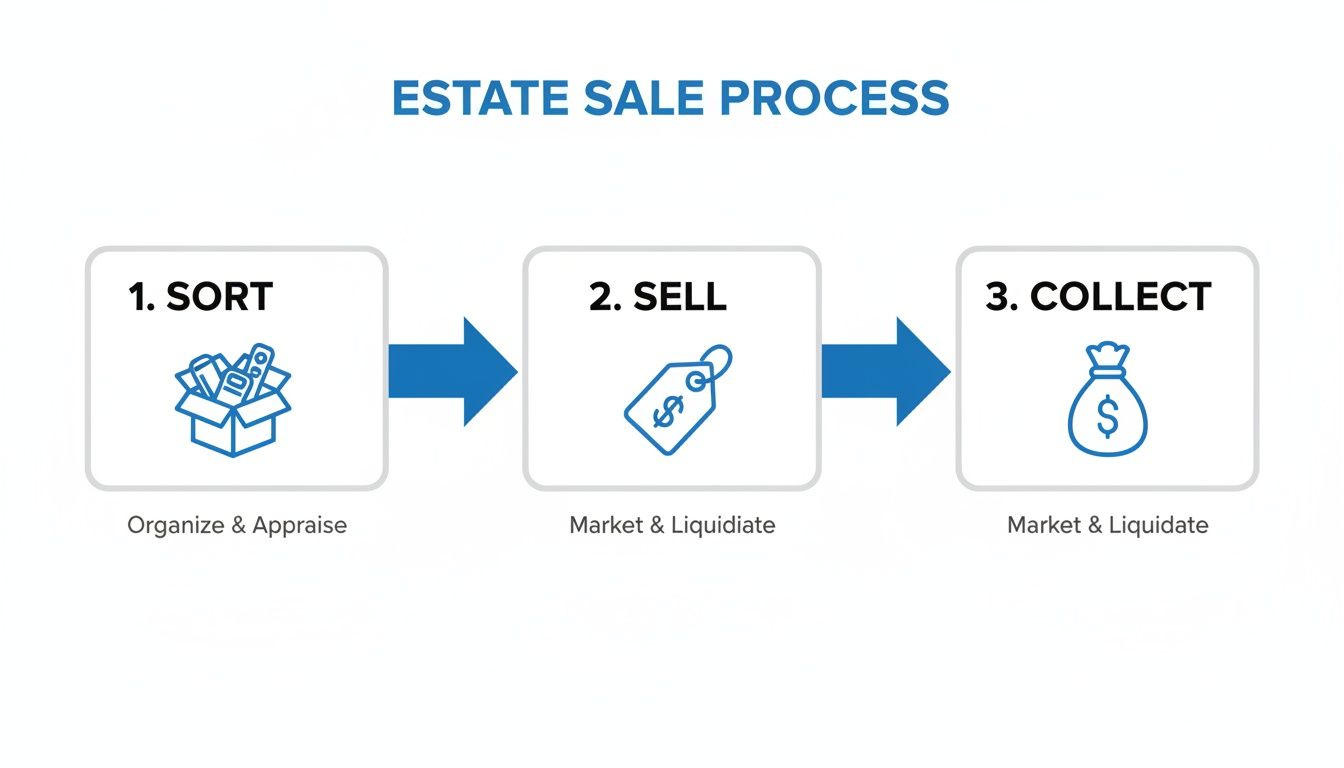
You can see how each step logically builds on the last. A successful sale truly depends on that strong organizational foundation you build at the beginning.
Managing Logistics and Local Rules
With a timeline sketched out, you can shift your focus to the nitty-gritty logistics. Every town, and sometimes even a homeowners' association, has its own rules. You can't just assume it's okay to put up signs and open your doors.
Start by checking your local city or county website, or just give the clerk’s office a call. You need to get clear answers on a few things:
- Permit Requirements: Does your town require a permit for an estate or tag sale? Getting hit with a fine for not having one is a surefire way to eat into your profits.
- Signage Regulations: Find out where you're actually allowed to place signs. Many communities have strict rules about posting on utility poles or in public medians.
- Parking Rules: Think about your neighbors. Will a rush of cars block driveways or create a traffic mess? It's smart to have a simple parking plan ready to share with your buyers.
Thinking through the sale space itself is just as important. Start thinking like a retailer. Create clear pathways for people to walk through rooms and group similar items together—all the kitchenware in the kitchen, all the tools in the garage. A well-organized space feels professional and encourages buyers to stick around and browse longer.
Sometimes, especially when time is short or you have a lot left over, you might want to look into services that offer cash paid for house clearance. This can be a really efficient way to handle the final stage of clearing a property. By getting ahead of these details, you’re setting the stage for a sale that’s smooth, professional, and profitable.
Pricing and Cataloging Items for Maximum Return

The image above nails the modern approach to estate sales. A great photo and the right price? That's everything.
Once you’ve sorted through your items, you hit the most critical phase: turning those piles into a profitable catalog that gets serious buyers clicking. This is where the art of pricing meets the science of presentation. Getting it right is the single most important factor in how much money you’ll make.
Researching Fair Market Value
For most everyday household goods—think kitchen appliances, standard furniture, and tools—a quick online search is your best friend. Don't just look at asking prices on sites like eBay or Facebook Marketplace. You need to find the sold listings. That’s what tells you what people are actually willing to pay for similar items.
But some things need a more expert eye. Don’t guess when it comes to potentially valuable pieces.
- Antiques and Fine Art: If you think an item might be special, it’s worth investing in a professional appraisal. They can spot maker's marks, verify authenticity, and give you a price range that keeps a priceless heirloom from selling for pocket change.
- Jewelry and Collectibles: Niche items like coins, stamps, or fine jewelry have their own dedicated markets. A quick chat with a local dealer can give you invaluable insight into their real worth.
The goal isn't to squeeze every last dollar out of every item. It's about setting a fair market value that encourages quick sales and builds trust with your buyers. Overpricing is the fastest way to end up with a house full of stuff after the sale is over.
As you go, think about how you'll track each sale. Using simple tools like generic point-of-sale receipt templates can make accounting much easier and gives buyers proof of purchase.
Creating a Compelling Online Catalog
In a modern estate sale, your online catalog is your storefront. This is where a platform like DIYAuctions really helps, guiding you to create listings that actually sell.
Seasoned collectors and sellers using an online platform can move 2,500-5,000 items in a single sale. By creating a professional-style catalog and marketing to local buyers, they typically recover around 65% of an item's value. Best of all, they keep up to 90% of the profits, a huge step up from the 40-60% fees charged by traditional estate sale companies.
Your catalog really comes down to two things: great photos and solid descriptions.
Photography That Sells You don’t need a fancy camera—your smartphone is perfect for the job. It’s all about how you use it.
- Find Natural Light: Take photos near a window. It avoids harsh shadows and shows an item's true colors.
- Show All The Angles: Snap the front, back, and any important details or flaws. Being transparent builds trust.
- Use a Simple Background: A plain wall or a sheet of white poster board makes your item the star of the show.
Descriptions That Tell a Story A good description is more than just a label. Include dimensions, condition, and any interesting history you know. Don’t just write "old chair." Instead, try something like: "Mid-century modern armchair with original tweed upholstery. Shows some minor wear consistent with age, but is sturdy and incredibly comfortable. Perfect statement piece for a living room or reading nook."
This paints a picture and helps buyers imagine the item in their own home. For more tips, check out our guide on inventory management best practices.
Implementing Smart Pricing Strategies
With your items researched and photographed, you can use a few key strategies to generate buzz. Platforms like DIYAuctions give you the flexibility to price things in a way that makes the most sense for each item.
- Setting a Reserve Price: Got a high-value item? Set a secret minimum price. Bidding can start low to get people interested, but the item won’t sell unless the reserve is met. This protects you from letting a valuable piece go for way too little.
- Using a 'Buy It Now' Option: If you know exactly what something is worth, a "Buy It Now" price lets a buyer purchase it instantly. This is great for common goods where a bidding war is unlikely.
- Starting with a Low Opening Bid: For most items, starting the auction at just $1 is a powerful move. It gets rid of any hesitation and encourages that crucial first bid. This creates momentum that often drives the final price right up to—or even past—its fair market value.
Marketing Your Sale to Attract Eager Buyers
You’ve sorted, priced, and meticulously cataloged every last item. But all that hard work doesn't mean much if nobody shows up. Effective marketing is what turns a house full of carefully curated goods into a truly profitable event.
Think of it as building a bridge between your items and the people who are actively looking to buy them.
The great news is, you don't have to build that bridge from scratch. Modern platforms like DIYAuctions give you a massive head start by automatically promoting your sale to an established network of local buyers. These are folks who have already raised their hands, asking to be notified about estate and tag sales right in their area. Your sale lands directly in front of a pre-qualified audience from day one.
This built-in marketing machine does a ton of heavy lifting, but you can always amplify its reach with a few smart, targeted moves of your own.
Expanding Your Reach with Social Media
Platforms like Facebook Marketplace and local community groups are your digital bullhorns. They are powerful, free tools for getting the word out to thousands of people in your immediate vicinity.
Creating a post that grabs attention is all about showing buyers what they want to see.
- Lead with Your Best Photos: Your first photo should be a showstopper. Whether it's a mid-century modern credenza, a pristine collection of vintage tools, or a unique piece of art, that first image is your hook.
- Write Compelling Descriptions: Don't just list what you have. Spotlight the stars of the show. Mention brand names, unique features, and the overall vibe of the sale. Something like, "Massive estate sale this week featuring Stickley furniture, Waterford crystal, and a garage packed with Ryobi tools!" works wonders.
- Provide Clear Logistics: Your post must include the sale dates, pickup times, and a direct link to your online catalog. Clarity prevents headaches and makes your sale look professional and buttoned-up.
Pro Tip: Post in several relevant local groups, but tweak the text or the main photo for each one. This keeps your posts from looking like spam and helps you connect with different segments of the local buying audience.
The Power of Local Buyer Pools
If you're managing an asset liquidation or acting as a trustee, attracting the right kind of buyers is what makes or breaks your results. Time and again, well-marketed local estate sales outperform anonymous, ship-it-anywhere online listings. We see recovery rates that are often 25-35% higher.
It makes sense when you think about it. Local buyers can see items in person (if you offer a preview), they skip the outrageous shipping costs, and there’s a greater sense of urgency.
Platforms like DIYAuctions are built specifically to capitalize on this local advantage. They give you simple tools for everything—from photo uploads and bid management to scheduling—all while capping commissions at a flat $1,000. This model ensures you get the highest possible return by connecting you directly with the most interested buyers right in your community.
For a deeper dive into getting the word out, check out our guide on effective estate sale marketing strategies.
Managing a Secure and Seamless Pickup Day
This is it. The moment all your planning and hard work pays off. Pickup day is the final, crucial step that transforms your online sales into a cleared-out home and cash in your account. With a solid plan, you can make sure the day runs smoothly, safely, and efficiently for everyone.
The real key to a stress-free experience is all in the prep work. Your goal is to create an organized system so buyers can grab their items and go without causing a bottleneck at the door. This means thinking through the entire flow, from how you’ll stage the sold items to how you’ll manage the people coming and going.

Setting the Stage for Success
Before the first car pulls up, your space needs to be ready. This isn’t just about being tidy; it’s about creating a logical and secure environment.
Start by grouping sold items by buyer or by item number. If you sold a big dining set to one person and a box of small kitchen gadgets to another, keep their purchases together. It makes life so much easier.
Next, clearly label every item or group of items with the buyer’s name and invoice number. I can’t stress this enough. This simple step prevents so much confusion and dramatically speeds things up. You don't want to be scrambling to find a specific lamp while a line of people starts forming outside.
Then, establish a clear path. If you can, designate a single entrance and exit to control the flow of traffic. I always recommend setting up a small check-in station near the entrance. It’s the perfect spot to greet buyers and confirm their purchases before they even step inside.
Verifying Purchases and Managing People
That check-in process is your first line of defense against mix-ups and theft. When a buyer arrives, simply ask for their name and have them pull up their paid invoice on their phone. Using a platform like DIYAuctions makes this a breeze, since every single payment is handled online ahead of time.
This pre-payment system is an absolute game-changer for a few reasons:
- No Cash Handling: You don’t have to worry about making change, dealing with bounced checks, or the security risk of holding a pile of cash.
- Wipes Out No-Shows: Because buyers have already paid, they are 100% committed to picking up their stuff. This all but eliminates the frustration of dealing with people who win an item but never materialize.
- Effortless Verification: The digital receipt is their proof of purchase. You just match the invoice to the labeled items, and you’re done.
My Pro Tip: Always have a friend or family member help you on pickup day. One person can manage the check-in at the door while the other helps buyers locate and carry out their items. This teamwork makes the entire process faster, safer, and so much less stressful.
Ensuring Safety and Security
Security is non-negotiable during a pickup. You're inviting strangers into a private home, so taking a few sensible precautions is essential to protect both the property and any items that aren't for sale.
First thing’s first: lock all doors to rooms that are not part of the sale. If there are areas with personal belongings or items you’re keeping, make them completely off-limits. You can even use simple signs like "Private - Do Not Enter" to reinforce those boundaries.
It’s also smart to have a plan for large or heavy items. Make sure you state clearly in your sale description that buyers are responsible for bringing their own muscle and moving equipment (like dollies or moving blankets). You are not obligated to provide moving help, and trying to do so can easily lead to injury or property damage.
Finally, do one last walkthrough after the final pickup. Check for any scuffs on the walls, misplaced items, or anything left behind by buyers. It's always easier to address issues right away than to discover them days later.
A well-run pickup day is the perfect finale to a successful sale, leaving you with a clear space and your profits secured.
To help you stay on track, I’ve put together a quick checklist covering the essentials for a flawless pickup event.
Pickup Day Success Checklist
This table is your go-to guide for making sure you’ve covered all your bases before the big day arrives.
| Task Category | Action Item | Pro Tip |
|---|---|---|
| Preparation | Group sold items by buyer and clearly label them with name and invoice number. | Use large, easy-to-read labels. You can even color-code them for different pickup time slots to stay super organized. |
| Logistics | Define a single entry and exit point. Clear a path for easy movement. | Post simple, clear signs directing buyers on where to go and where to park. It prevents a lot of confusion and questions. |
| Verification | Set up a check-in station to greet buyers and verify their paid invoices. | Have a tablet or laptop handy with a digital list of all sales. This allows you to quickly cross-reference names and items. |
| Supplies | Have boxes, packing paper, and bags available for smaller, fragile items. | Buyers should bring their own, but having a few extra supplies on hand is a fantastic customer service touch people appreciate. |
| Security | Lock doors to private areas and rooms not involved in the pickup. | Ask a friend to be your "floater"—someone who can walk through the space to make sure people stick to designated areas. |
| Final Steps | Perform a final walkthrough of the property after the last buyer leaves. | Take photos of the cleared-out space for your records. This is especially important if you are managing an estate for someone else. |
With these steps in mind, you're not just hoping for a good pickup day—you're planning for one.
Your Estate and Tag Sale Questions Answered
Even with the best plan, you're going to have questions. It's only natural. Let's tackle some of the most common ones we hear, clearing up any confusion so you can move forward with total confidence.
Getting these details right is the difference between a smooth sale and a stressful one.
What Are the Tax Implications of an Estate Sale?
For most people running their own sale, the news here is pretty good. You generally only owe taxes on the profit you make from selling personal items. That means you have to sell something for more than what you originally paid for it.
The reality is, most of what you'll sell—furniture, everyday dishes, home decor—sells for far less than its original purchase price. Since there's no profit, there's nothing to tax. The big exceptions are things that can appreciate in value, like rare art, fine antiques, or sought-after collectibles. If you’re settling an inherited estate, the rules can get a bit more complex depending on your location and the estate's value.
Crucial Takeaway: Tax laws can get tricky and vary by state. This is a solid rule of thumb, but it is always smart to check in with a tax professional to understand exactly how it applies to your situation.
How Should I Handle Items That Don’t Sell?
It’s a guarantee: you'll have items left over. Don't sweat it. Having a post-sale game plan is key to tying up loose ends and getting the property completely cleared out.
You’ve got a few great options for what's left:
- Donation: Many local charities would be thrilled to take your unsold goods. They often pick up larger items like furniture for free, which saves you a massive headache. Make sure you get a receipt—you might be able to claim a tax deduction.
- Consignment: Got a few high-value pieces left, like designer furniture or a specific collectible? A local consignment shop might be the perfect fit. They'll sell it for you and take a cut of the final price.
- Final Clear-Out: For everything else, sometimes you just need it gone. A junk removal service is the fastest way to handle the final cleanup, leaving the house empty and ready for whatever comes next.
Should I Hire a Company or Do It Myself?
This is probably the biggest decision you'll face. Going with a traditional estate sale company is hands-off, but it comes at a steep price. They often charge commissions of 30-50% of your total sales. That’s a huge chunk of your proceeds.
The modern alternative is to use a platform like DIYAuctions. It gives you all the professional-grade tools to run the sale yourself, from creating an online catalog and marketing to handling secure payments. With our commission at just 10% (capped at $1,000), you keep way more of the money you earn. It’s the perfect approach for anyone who wants to stay in control and maximize their financial return.
What Are the Biggest Mistakes to Avoid?
Learning from others' mistakes is the fastest way to get it right. Here are a few common tripwires to watch out for:
- Poor Pricing Research: If you price things too high, you'll scare buyers away. Too low, and you're just giving money away. The fix: Check "sold" listings on sites like eBay for real-world market values, and get an expert opinion on anything you think might be valuable.
- Weak Marketing Efforts: You could have the best stuff in the world, but it won't sell if nobody knows about it. The fix: Use a platform that already has a built-in network of local buyers, and then amplify your reach by sharing the sale link in local Facebook groups and community forums.
- A Chaotic Pickup Day: A disorganized pickup is a recipe for stress and potential security issues. The fix: Plan it like a military operation. Group all of a buyer's items together, label everything clearly, and create a single check-in point to manage the flow of people.
More guides in Estate Sale Basics
July 28, 2026
Revenue Reporting for Estate Sales and Auctions
Learn revenue reporting essentials for estate sales and auctions. Discover key metrics, templates, and best practices to simplify tracking and compliance.
Read guideJuly 26, 2026
Stamp Collection Valuation: A Practical Step-by-Step Guide
Stamp collection valuation made simple. Learn how to identify, grade, price, and sell your stamps with confidence for estate sales or consignment.
Read guideJuly 23, 2026
Estate Sales Brick NJ: Your 2026 Guide to Success
Planning your estate sales brick nj? Our guide covers permits, pricing, marketing, & running a safe sale with DIYAuctions.
Read guideGet the estate sale pricing guide
Enter your email for pricing ranges, planning notes, and a clearer path to launch.