Estate Sales Fort Worth: A Practical Guide to Profits and Planning
estate sales fort worth: Learn how to run successful events with pricing, rules, and marketing tips to maximize profits.

Whether you’re wrapping up a loved one's affairs or downsizing your own home, the thought of running an estate sale in Fort Worth can feel completely overwhelming. This guide is here to cut through the noise and give you a clear, practical path forward—one that actually works right here in Tarrant County.
Your Practical Guide to Estate Sales in Fort Worth
Let's be honest, an estate sale is so much more than just sticking price tags on old furniture. It's an emotional marathon and a logistical puzzle. You're sorting through decades of memories while trying to make smart financial decisions under pressure. Most people don't even know where to begin.
This guide isn't about generic advice. It's built to give you the confidence to manage the entire process effectively, from start to finish, with a sharp focus on what makes the Fort Worth market tick.
We'll walk through the essentials:
- Building a Realistic Timeline: A simple schedule to keep you from feeling rushed and stressed.
- Navigating Fort Worth Rules: How to handle local regulations and permits without getting hit with surprise fines.
- Pricing for Profit: Smart strategies for valuing items that local buyers are actually looking for.
- Modern Marketing that Works: Where and how to advertise to attract the right crowd.
The Fort Worth Market Context
First things first, you need to understand the local landscape. The health of the estate sales Fort Worth market is almost always tied to what’s happening with local real estate. And right now, the news is good.
The broader housing market here has shown impressive stability, which makes for a predictable and active environment for estate sales. As of October 2025, the median home price in Tarrant County hovered around $345,000. Even with more houses on the market, demand has held steady. This tells us that buyers are active and confident, creating a fantastic climate for selling household contents. You can explore more about Fort Worth’s real estate market to get a better feel for these trends.
Think of this guide as your toolkit. From comparing the costs of traditional estate sale companies to using modern online platforms for a bigger payout, you'll get the practical knowledge you need to run your sale with confidence and come out ahead.
Planning Your Sale and Navigating Local Rules
A great estate sale doesn't just happen—it’s built on a smart, solid plan. Think of this as your pre-sale blueprint, covering the essential organizing and legal steps you need to take right here in Fort Worth. Getting this part right from the beginning saves you from major headaches later on.
First things first, give yourself a realistic timeline. I've seen too many people try to rush this process. Ideally, you want four to six weeks to prepare. This gives you enough breathing room to sort through everything—separating sentimental keepsakes from items you're ready to sell—without feeling overwhelmed.
Sorting, Legalities, and Fort Worth Rules
Before you even think about putting a price tag on anything, you have to know what you can legally sell. This is especially critical if you're managing an inherited estate. You'll need to get familiar with the difference between probate and nonprobate assets in Texas. Understanding what's officially part of the estate is non-negotiable and will keep you out of serious legal trouble down the line.
While you're sorting, it’s the perfect time to tackle a few other crucial tasks:
- Secure the property. The moment you take charge, change the locks. It’s a simple step that provides immediate peace of mind.
- Protect personal information. Go through every drawer and file cabinet. Pull out all financial records, photos, legal papers, and anything with personal data.
- Create a "not for sale" zone. Pick a room or a closet for items the family is keeping. Mark it off clearly so there's absolutely no confusion once the sale begins.
Don't Get Fined: Know the Local Regulations
Fort Worth is pretty reasonable when it comes to residential sales, but that doesn't mean it's a free-for-all. The city has specific rules, especially about signage, and ignoring them can lead to fines. For instance, you absolutely cannot post signs on utility poles or in public medians. It’s a common mistake that code compliance is always on the lookout for.
Key Takeaway: The good news is that most Fort Worth estate sales don't need a special city permit since they're treated like garage sales. However, you must check with the local Homeowners' Association (HOA). They almost always have their own set of rules covering how often you can have a sale, how long it can run, and where you can place signs.
Getting these details sorted out from day one is essential. It keeps your sale running smoothly and prevents any unwelcome interruptions.
This simple diagram breaks down the core phases of a profitable sale.
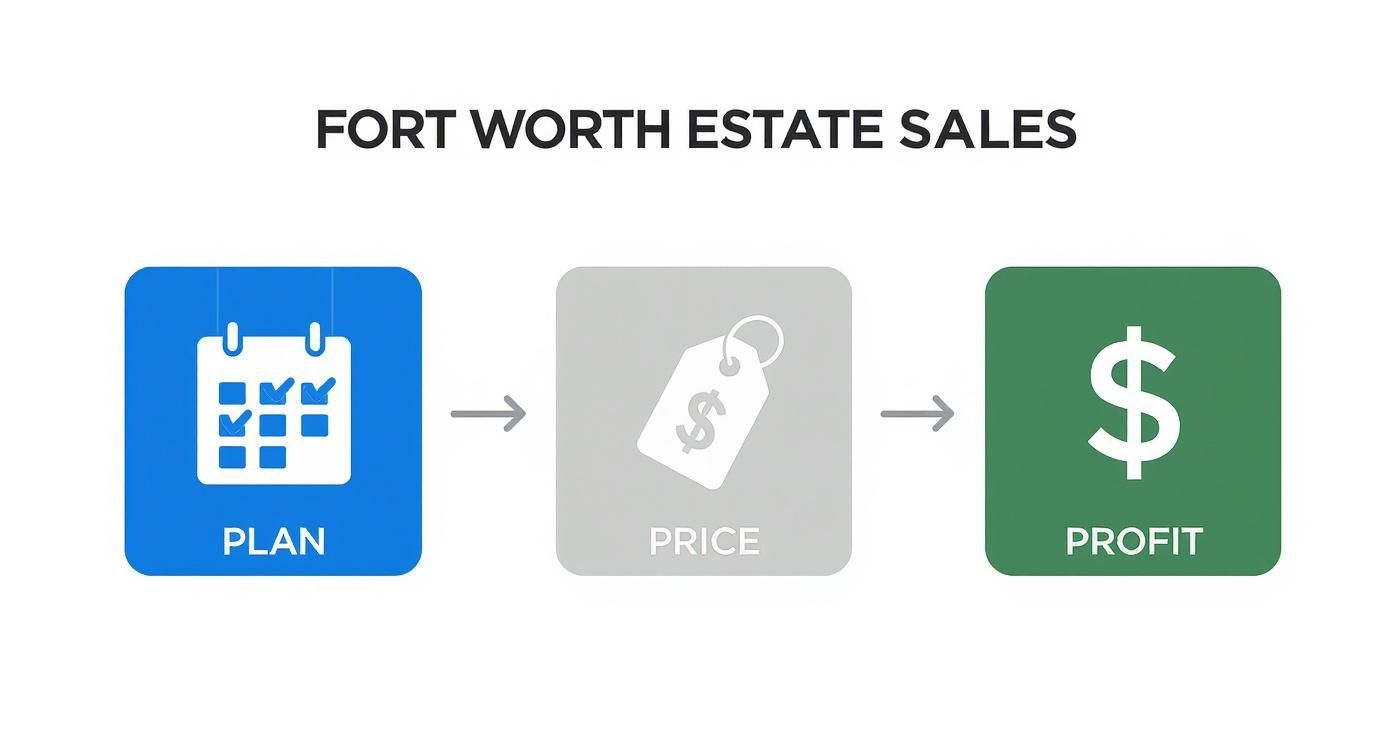
As you can see, a solid plan leads to smart pricing, which is what ultimately drives your final profit.
How to Price Items for the Fort Worth Market

This is where the rubber meets the road. Getting your pricing right is the single most important factor in a successful sale. It's a delicate dance between what an item is truly worth and what local Fort Worth buyers are actually willing to spend.
Go too high, and you'll be staring at a house full of stuff after the sale is over. Go too low, and you're just giving away money. The sweet spot is what we call fair market value—not the original price tag or what it means to you, but what someone would realistically pay for it today. It takes a little detective work, but it's simpler than you might think.
Researching Prices Like a Pro
Forget about guessing. The best pricing tools are the very places your future buyers are already browsing. To get a real pulse on the Fort Worth market, you'll want to spend some time on these sites:
- Facebook Marketplace (Fort Worth Area): See what similar furniture, décor, and tools are actually selling for. Pay attention to listings that disappear quickly—that’s your clue to a good price point.
- eBay (Sold Listings): This is an absolute goldmine for collectibles, vintage clothing, and specialty items. The key is to filter by "Sold Items" to see what people have actually paid, not just the asking price.
- Replacements, Ltd.: If you're dealing with china, crystal, or silverware, this site is an indispensable resource for identifying patterns and their market value.
The local real estate scene also gives you critical context. Right now, Fort Worth's median listing home price is hovering around $350,000. But that's just an average. Prices in neighborhoods like Woodhaven are closer to $229,500, while in historic Fairmount, they can top $522,500. This economic diversity means the value of your items can feel different depending on where in the city your sale is located. You can get a better feel for Fort Worth's dynamic real estate landscape on realtor.com.
The table below offers a practical starting point for pricing common household goods.
Pricing Strategy by Item Category
| Item Category | Condition | Research Method | Suggested Price Range (% of New) |
|---|---|---|---|
| Furniture (Wood) | Good - Excellent | Facebook Marketplace, Local Consignment | 30-50% |
| Furniture (Upholstered) | Like New, No Stains | Facebook Marketplace | 20-40% |
| Major Appliances (5+ yrs) | Working | eBay (Sold), Local Appliance Resellers | 15-25% |
| Kitchenware/Glassware | Good | Replacements, Ltd., eBay (Sold) | 25-50% (Varies by brand) |
| Collectibles/Vintage | Varies | eBay (Sold), WorthPoint | Varies (Research is key) |
| Clothing (Designer) | Excellent | Poshmark, The RealReal | 20-40% |
| Tools (Power/Hand) | Good | Facebook Marketplace | 40-60% |
Remember, these are just guidelines. Unique or highly sought-after items can always command a higher price, especially in an auction format.
When to Price Yourself vs. When to Call an Appraiser
For the vast majority of what's in a home—kitchen gadgets, everyday furniture, tools, books—you can absolutely set the price yourself using online research. You’ll develop a feel for it pretty quickly.
However, some items demand an expert eye.
Expert Tip: Don't just write something off as "old junk." If you find things like original artwork, antique jewelry, military medals, or rare coins, it pays to bring in a professional. A certified appraiser can spot a hidden gem that might otherwise sell for a few bucks.
For these higher-value finds, an online auction is your best friend. It opens up the bidding to a much wider pool of serious collectors and lets the market determine the true value. You’ll almost always get a better return than you would by just slapping on a price tag.
For a deeper dive, check out our guide on essential strategies for pricing estate sale items here: https://www.diyauctions.com/learn/pricing-for-estate-sales.
Once your research is done, creating a simple inventory with clear photos and honest descriptions is your final move. This not only keeps you organized but also becomes the powerful marketing material that will draw in the best buyers before your pickup day even arrives.
Marketing Your Sale to Attract Motivated Buyers

Even the most amazing collection of treasures won't sell itself. If you want a successful sale, you have to get the word out, and in a competitive market like Dallas-Fort Worth, a simple sign on the corner just doesn’t cut it anymore. Your mission is to create a buzz that draws in motivated, serious buyers who are ready to bid.
Think of your marketing as telling the story of the sale. Great photos are your most powerful tool—they do the selling before anyone reads a single word. Focus on capturing clear, well-lit pictures of your most desirable items. That antique furniture, the valuable collectibles, or the high-end tools are your "hero" items. They're what will hook potential buyers and get them curious about everything else you have.
Choosing Your Digital Storefront
Your online presence is where the real action begins. To reach the right audience for estate sales in Fort Worth, you need to be smart about where you post. Forget casting a wide, generic net and instead focus your energy where local buyers are already looking.
- Local Facebook Groups: This is your ground game. Join Fort Worth and Tarrant County buy/sell groups and neighborhood pages. These are goldmines for reaching an engaged local audience.
- EstateSales.net: A non-negotiable for any serious sale. This is the go-to site for dedicated estate sale shoppers, from hobbyists to professional resellers. A listing here puts you directly in front of your target market.
- Facebook Marketplace: While it's a broader platform, its algorithm is surprisingly powerful. It connects your items with users who have searched for similar things, dramatically expanding your reach.
It also helps to understand the local DFW housing market. Through 2025, home sale prices have remained strong, with properties selling for around 98.2% of their listing price. This tells us there are plenty of savvy buyers out there looking for value—making strategic marketing for your estate sale even more critical to stand out.
Crafting an Ad That Gets Clicks
Your online listing is your sales pitch. It needs to be clear, compelling, and easy to scan. A great ad doesn't just list what you have; it sells the opportunity.
Pro Tip: Post your online listings on a Tuesday or Wednesday evening. This gives people several days to see your ad, get excited, and plan their weekend around your sale or auction pickup, which drives up visibility right before the peak shopping days.
Don't forget the physical world! Well-placed, professional-looking signs are still incredibly important for day-of traffic. Check out some creative signage ideas to attract local buyers to get inspiration.
Ultimately, an online auction platform acts as your central marketing hub. It gives you a single, professional link to share across all channels, funneling every interested buyer to one organized place. This makes it easy for them to browse, bid, and get excited, which helps build that critical bidding momentum before pickup day even arrives.
For more deep-dive strategies, explore our complete guide to estate sale marketing: https://www.diyauctions.com/learn/estate-sale-marketing.
Managing a Smooth Sale and Pickup Day
All your careful planning and marketing have led to this moment—the main event. Now it's all about execution.
For a traditional, in-person sale, success means managing crowds and transactions smoothly. With a modern online auction, it means orchestrating a seamless pickup day. The goal is the same: an organized, secure, and stress-free process for everyone involved.
If you go the old-school route, you’ll need a clear strategy for customer flow. Designate one door for entry and another for exit to prevent bottlenecks and reduce the risk of theft. Having a friend greet people at the door and another person managing a central checkout station can make a world of difference.
Also, be ready for different payment types. Cash is king, but you'll absolutely make more sales by accepting digital payments through apps like Venmo or a card reader like Square. It's also smart to keep a counterfeit detection pen handy for larger bills—a tiny investment that can prevent a big headache.
The Modern Approach: A Scheduled Pickup Day
When you run an online auction, your "sale day" becomes a single, streamlined pickup event. This completely eliminates the chaos of a multi-day open house, putting you in total control.
The secret sauce here? Scheduled time slots.
After your online auction ends, our system automatically prompts winning bidders to choose a pickup appointment from a list of times you've made available. This one simple step prevents the dreaded "everyone shows up at once" rush.
- Staggered Arrivals: By scheduling pickups in 15 or 30-minute intervals, you keep the flow of people manageable and have time to help each buyer.
- Easy Item Verification: Have a printed or digital list of each winner's items. As they arrive, you can quickly check off their purchases, making sure everyone leaves with exactly what they won.
- Clear Communication: We send a confirmation email with the pickup address, their scheduled time, and a friendly reminder to bring help for loading heavy furniture.
This structured approach transforms what could be a frantic day into a surprisingly calm and orderly process. It’s one of the biggest reasons so many people are choosing this method for estate sales in Fort Worth.
A single-day, scheduled pickup is far more efficient and secure than a traditional multi-day sale. It minimizes disruption to the property and reduces the window for potential issues, giving you greater peace of mind.
Handling Post-Sale Cleanup and Unsold Items
No matter how well you market your sale, you'll almost always have some things left over. The goal is to clear the house completely, not to end up with a new collection of unwanted items.
Fortunately, you’ve got several great options right here in Fort Worth.
Don't let the final cleanout overwhelm you. Just follow a simple plan:
- Donate Usable Goods: Many local charities will schedule a pickup for furniture, clothing, and household goods that are still in good shape. The Salvation Army and Goodwill are always reliable choices.
- Consider a Buyout Service: If you just want it all gone fast, some companies will offer you a flat fee to take everything that's left. You'll make less than selling things individually, but the speed and convenience can be a lifesaver.
- Responsible Disposal: For anything that's broken or truly unusable, schedule a bulk trash pickup with the City of Fort Worth or rent a small dumpster for one final, clean sweep.
Comparing Your Options: Traditional vs. DIY Estate Sales
Deciding how you're going to run your estate sale is easily one of the most critical financial choices you'll make. The route you take has a massive impact on your bottom line, so let's break down the real numbers.
When you hire a traditional estate sale company in Fort Worth, you're paying for a full-service, hands-off experience. They come in, price everything, stage the home, market the event, and run the sale days. For that convenience, you'll pay a hefty commission—typically somewhere between 30% and 50% of the total gross sales.
The True Cost of Convenience
That percentage is the big number, but it's not always the only one. It's common for companies to pass along extra charges for advertising, bringing in professional appraisers for high-value items, or hiring extra security for a particularly large sale. Always ask for a detailed breakdown of every potential fee so you aren't blindsided when the final check arrives.
If you want to dive deeper into all the potential expenses, we cover them in our complete guide to the cost of an estate sale.
Think about it: on a pretty standard sale bringing in $18,000, a 40% commission means $7,200 goes straight to the estate sale company. And that's before any of those other "hidden" fees get tacked on.
The DIY Approach: A Smarter Path to Profit
A DIY online auction flips that entire model on its head. Instead of giving up a huge chunk of your earnings, you keep the vast majority. On a platform like DIYAuctions, for example, sellers keep up to 90% of the final sale price.
This puts you in the driver's seat. You handle the on-site work of sorting and managing the pickup day, but you get to offload the hard parts—marketing to thousands of local buyers, processing all the payments, and communicating with winners. For anyone willing to put in a bit of their own time, the financial reward is substantial. You’re not just selling items; you’re maximizing their value.
Cost Comparison Traditional Company vs. DIYAuctions
To make it crystal clear, here’s a look at how the numbers could shake out for a typical Fort Worth estate sale generating $18,000 in gross revenue.
| Expense/Revenue Item | Traditional Estate Sale Company | DIYAuctions Platform |
|---|---|---|
| Gross Sales Revenue | $18,000 | $18,000 |
| Commission/Platform Fee | -$7,200 (40% average) | -$1,800 (10% platform fee) |
| Additional Fees | -$500 (Est. for advertising, etc.) | $0 |
| Net Payout to Seller | $10,300 | $16,200 |
As you can see, the difference isn't small—it's thousands of dollars. While traditional companies offer a hands-off service, that convenience comes at a significant cost that directly reduces the funds going back to the estate or the homeowner. The DIY online auction model puts that money right back where it belongs: in your pocket.
Common Questions About Fort Worth Estate Sales
When you're planning an estate sale, a million questions can pop up. Getting clear, straightforward answers is key to moving forward with confidence and sidestepping the common hurdles that can trip people up.
Let's tackle some of the most frequent questions we hear from folks in Fort Worth.
Do I Need a Permit for an Estate Sale in Fort Worth?
Good news: for the most part, the answer is no. The City of Fort Worth generally treats a residential estate sale just like a typical garage sale, which means you don’t need to go down to a city office and file for a special permit for a one-off event.
But—and this is a big one—you absolutely need to do a little local homework. If you live in a neighborhood with a Homeowners' Association (HOA), they almost always have their own rulebook. These rules can dictate everything from how many days your sale can run, the exact hours you can operate, and especially where you can (and can't) place signs.
Before you do anything else, it's always a smart move to double-check the official City of Fort Worth website and your specific HOA guidelines to make sure you're in the clear.
What Is the Best Time of Year for a Sale?
Timing your sale can make a real difference in turnout. Here in Fort Worth, the sweet spots are easily Spring (March-May) and Fall (September-November). The weather is just right—not too hot, not too cold—which encourages more people to get out and about.
We always advise people to steer clear of major holiday weekends and the blistering heat of a Texas July or August. While an online auction can run anytime, scheduling your pickup day when the weather is pleasant makes life a whole lot easier for you and your buyers.
How Should I Handle Valuables Like Jewelry or Firearms?
This is where you need to be extra careful. For high-value items—think fine art, serious collectibles, or nice jewelry—getting a professional appraisal is a must. It’s the only way to know their true market worth so you don't accidentally give something away for a fraction of its value.
When it comes to firearms, there's zero room for error. You must follow all federal and Texas laws to the letter. In almost every case, this means you’ll need to work with a licensed firearms dealer (an FFL) to handle the legal transfer to the new owner. Don't try to handle this part yourself.
More guides in Estate Sale Basics
July 28, 2026
Revenue Reporting for Estate Sales and Auctions
Learn revenue reporting essentials for estate sales and auctions. Discover key metrics, templates, and best practices to simplify tracking and compliance.
Read guideJuly 26, 2026
Stamp Collection Valuation: A Practical Step-by-Step Guide
Stamp collection valuation made simple. Learn how to identify, grade, price, and sell your stamps with confidence for estate sales or consignment.
Read guideJuly 23, 2026
Estate Sales Brick NJ: Your 2026 Guide to Success
Planning your estate sales brick nj? Our guide covers permits, pricing, marketing, & running a safe sale with DIYAuctions.
Read guideGet the estate sale pricing guide
Enter your email for pricing ranges, planning notes, and a clearer path to launch.