A Savvy Guide to Estate Sales Santa Barbara
Unlock the secrets to successful estate sales Santa Barbara. Our guide covers local laws, smart pricing, and marketing to maximize your returns.
When you’re facing an estate sale in Santa Barbara, it can feel like you're standing at a crossroads. Whether you're clearing a loved one's home or downsizing your own, you have two main options: hire a traditional estate sale company and give up a huge chunk of the profits, or take control yourself with a modern online platform and keep what you earn.
This guide will walk you through exactly how to plan and run a successful, profitable sale in Santa Barbara’s unique market, from start to finish.
Your Starting Point for Santa Barbara Estate Sales

Jumping into an estate sale without a solid game plan is a recipe for stress. The first few decisions you make will set the tone for the entire process, directly impacting your bottom line and your peace of mind. And let's be clear—Santa Barbara isn't just any market. Its mix of affluent residents, discerning collectors, and high-value items creates both unique opportunities and specific challenges.
Your first move isn’t sorting through china patterns; it's deciding on your strategy. Are you going to hand the keys to a full-service company, or are you ready to be more hands-on to keep more of the money?
The Two Core Approaches to Consider
It really boils down to a classic trade-off: convenience versus control.
A traditional estate sale company handles almost everything for you—pricing, staging, staffing the sale, the works. It sounds great, but that convenience comes with a hefty price tag. Commissions in the Santa Barbara area often run between 35% and 50% of your total sales. That’s a massive slice of your proceeds.
The alternative is a Do-It-Yourself (DIY) online auction. This approach puts you in the driver's seat, giving you full control over the process while slashing fees. You photograph and list the items, set the sale dates, and manage a single-day pickup. The platform itself handles the heavy lifting of marketing, payment processing, and communicating with buyers.
Here’s the bottom line for anyone planning an estate sale in Santa Barbara: a traditional company might gross $20,000 from your items, but you could walk away with as little as $10,000 after their cut. With a DIY auction, you could pocket a much larger portion of that $20,000.
Why Your Strategy Matters in This Market
The buyers in Santa Barbara are savvy. You’ve got a mix of locals, interior designers, antique collectors, and even folks driving up from L.A. looking for that perfect piece. This means that a "one size fits all" approach just won’t cut it. To get top dollar, you need smart pricing and targeted marketing.
An effective strategy hinges on a few key questions:
- What are you selling? Do you have high-end art, mid-century furniture, or valuable antiques that need a wider, online audience to find the right buyer?
- What's your timeline? Are you in a rush to clear out a property for a real estate closing, or can you be more flexible over a few weeks?
- How involved can you be? Realistically, how much time and energy can you dedicate to the project?
Getting organized from day one is critical. To make sure nothing falls through the cracks, a good checklist is your best friend. Our complete estate sale checklist breaks down every single task, from the initial inventory to the final clean-out. It’s an invaluable tool for staying on track.
To help you see the differences more clearly, let's compare the two paths side-by-side. This should make it easier to decide which approach aligns with your goals for your Santa Barbara estate sale.
Estate Sale Approaches Compared Traditional vs DIY Online Auction
This table breaks down the key differences between hiring a traditional company and running your own online auction. Pay close attention to how the fees and control can impact your final outcome.
| Factor | Traditional Estate Sale Company | DIY Online Auction (e.g., DIYAuctions) |
|---|---|---|
| Fees & Commission | 35% - 50% of gross sales | Typically a low, flat fee or small commission (e.g., 10% capped) |
| Control Over Pricing | Limited; company sets final prices | Full control; you set starting bids and reserve prices |
| Timeline | Set by the company's schedule and availability | Flexible; you choose the auction start and end dates |
| Buyer Reach | Primarily local foot traffic during the event | Broader reach to local and national buyers online |
| Personal Effort | Low; the company handles most of the work | Higher; you are responsible for cataloging and managing pickup |
| Net Profit Potential | Lower due to high commission fees | Significantly higher due to minimal fees |
Ultimately, the choice is yours. A traditional company offers a hands-off experience at a significant cost, while a DIY online auction demands more of your time but rewards you with dramatically higher profits and complete control over the process.
Navigating Santa Barbara's Legal Landscape
Before you even think about cataloging items or taking a single photo, you absolutely have to get a handle on the local rules. Santa Barbara, like a lot of cities in California, has specific regulations for estate sales. Ignoring them is the fastest way to get a shutdown notice slapped on your door—a mistake that's both stressful and expensive.
These rules aren't just polite suggestions. They're local ordinances designed to keep residential neighborhoods from turning into chaotic marketplaces, managing everything from traffic flow to noise. Getting this part right is a non-negotiable first step for any successful estate sale in Santa Barbara.
Permits and Zoning: What You Need to Know
The first thing everyone asks is, "Do I need a permit?" The answer isn't always a simple yes or no; it really depends on your exact address in Santa Barbara County. The City of Santa Barbara has its own rulebook, which can be different from what you'll find in Montecito, Goleta, or out in the Santa Ynez Valley.
For the most part, a one-time estate sale run by a homeowner at their own house might not require a special permit, as it's often treated like a garage sale. But don't get too comfortable—there are some serious limitations you need to know about.
- Frequency: Most cities cap how many sales you can have at one property each year. Go over that limit, and you could be classified as a business, which opens up a whole new world of requirements.
- Duration: Sales are almost always limited to just a few consecutive days, typically a single weekend.
- Signage: This is a big one. There are strict rules on the size, type, and placement of your signs. You can’t just staple signs to every telephone pole in a five-mile radius; that's a quick way to get fined.
Zoning is another huge piece of the puzzle. If the home is in a community with a Homeowners Association (HOA), their rules come first. Some HOAs ban estate sales entirely, while others have their own strict guidelines on parking and hours that are even tougher than the city's. A quick call to the City of Santa Barbara Planning Division or your HOA board is time well spent.
The Sales Tax Obligation
This is the detail that trips up so many sellers. In California, you are generally required to collect sales tax on everything you sell. It doesn't matter if you're an individual or a professional company; the California Department of Tax and Fee Administration (CDTFA) considers the sale of "tangible personal property" a taxable event.
If you fail to collect and remit that sales tax, you could be on the hook for penalties and back taxes down the road. You’ll most likely need to get a temporary seller's permit from the CDTFA for the period of your sale. This is what legally allows you to collect the local district sales tax and gives you the forms needed to send it in.
Important Takeaway: Don't just assume your sale is exempt. The seller is responsible for the sales tax, period. The only way to be sure you're compliant is to proactively contact the CDTFA and clarify your obligations.
Special Considerations for Probate and Trusts
If the estate sale is happening as part of a probate process, the legal side gets a lot more complicated. The estate's executor or administrator has a fiduciary duty—a legal obligation—to the court and the heirs to get the most value out of the estate. Every single action, especially selling off personal property, has to be transparent and by the book.
Before anything is sold, the executor must have the official green light from the probate court. In many situations, you'll need a specific court order to even hold the sale. It's critical to work side-by-side with an estate attorney to make sure every step you take is in line with the court's directives and the California probate code. While laws differ by jurisdiction, having a basic grasp of general wills and estate law principles can give you valuable context.
For a deeper look into the specific regulations that apply, our guide covering estate sale laws provides more detailed information. This will help ensure you're ready for every legal hurdle your Santa Barbara estate sale might present.
Pricing Your Items for the Santa Barbara Market
In a sophisticated market like Santa Barbara, pricing isn't just a task—it's the absolute core of your strategy. Get it right, and you maximize your proceeds. But get it wrong, and you'll either leave a ton of money on the table or end up with a house full of unsold goods.
This isn't about slapping a sticker on a lamp and hoping someone bites. It’s about knowing what local buyers actually want and what they’re willing to pay for it today. Your goal is to find that perfect sweet spot where fair value meets motivated buyer.
Understanding Santa Barbara’s Unique Tastes
Folks here have a distinct eye for style. Certain aesthetics are always in demand, attracting everyone from interior designers to homeowners looking to furnish their multi-million dollar properties.
When you’re sorting through the estate, keep an eye out for these styles that consistently sell well at estate sales in Santa Barbara:
- Spanish Colonial Revival: This is the quintessential Santa Barbara look. Think dark, carved woods, wrought iron accents, and decorative tiles. It's woven into the city's DNA and always finds a buyer.
- Coastal & Nautical: It just makes sense. Light woods, wicker, rattan, and anything with a breezy, oceanfront vibe resonates with the local lifestyle.
- Mid-Century Modern: The clean lines of designers like Eames or Noguchi are just as popular here as anywhere else, especially with buyers who appreciate timeless design.
If you can spot these themes, you can feature them in your marketing and, more importantly, price them to capture their full market value.
When to Call in a Professional Appraiser
You can price most everyday household goods yourself, but some things really do need an expert’s eye. Don't guess. For high-value items, a certified appraiser is a crucial investment that could save you from making a multi-thousand-dollar mistake.
Seriously consider hiring an appraiser for collections like:
- Fine art and signed prints
- Antique jewelry or high-end watches
- Rare books and first editions
- Authenticated memorabilia
That plein air painting of the Santa Barbara coastline? It could be a decorative piece worth a few hundred dollars, or it could be a significant work by a known California Impressionist worth tens of thousands. A qualified appraiser from a group like the American Society of Appraisers (ASA) will give you a formal valuation, which builds confidence for both you and your buyers.
DIY Valuation for Everything Else
For the vast majority of the estate—furniture, kitchenware, decor, tools—you can figure out the pricing with a bit of online legwork. The trick is to look at what things have actually sold for, not what people are asking.
Here are a few trusted methods I always recommend:
- Check eBay's "Sold Items": Search for items just like yours on eBay, then use the filter to see only "Sold Items." This gives you real-world data on what people have recently paid.
- Use Replacements, Ltd.: This site is your best friend for identifying and valuing china, silver, and crystal. A good rule of thumb for an estate sale is to price pieces at 25-50% of their listed replacement cost.
- Browse Local Auction Results: Platforms like LiveAuctioneers let you search the archives of past auctions. Focus on Southern California auction houses to get a sense of regional pricing.
Your goal isn't to get full retail value. It's to price items attractively enough to sell quickly while still reflecting their fair market worth in a second-hand context. Speed and volume are key to clearing an entire house.
The local economy absolutely plays a role here. Santa Barbara's real estate market has seen a staggering 220 percent increase in home values since its 2012 low. With the median single-family home price hitting $2.5 million as of mid-2025, you're dealing with a community that has significant purchasing power. You can read more on these trends in the 2025 mid-year real estate update from the Santa Barbara Independent.
The Art of Strategic Pricing
Finally, think about buyer psychology. Bundling everyday items, like a box of kitchen gadgets or a set of gardening tools for a single price, is a great way to move lower-value goods efficiently.
For an online auction, the bidding process naturally finds the true market price for you. My advice? Set a low starting bid on your most desirable items. This generates excitement and encourages competition, often pushing the final sale price much higher than a fixed price ever could. It’s a dynamic approach that lets the market tell you what your items are truly worth.
Marketing Your Sale to Eager Local Buyers
Great pricing is only half the battle. If you want a profitable sale, you’ve got to attract the right audience, and simply sticking a sign on the curb for your estate sale in Santa Barbara isn't going to cut it. Not in this market.
You need a modern game plan to grab the attention of motivated local buyers—from Montecito designers on the hunt for unique pieces to collectors over in Goleta. The goal isn’t just about getting bodies through the door; it's about building genuine excitement before the sale even starts. You want a pool of bidders ready to compete for your best items, and the best way to do that is online.
Crafting a Compelling Online Listing
Think of your online listing as your digital storefront. It's the first—and maybe only—impression a buyer will get. This means high-quality, well-lit photos are absolutely non-negotiable. Shoot items from a few different angles and make sure to capture any unique details, signatures, or maker's marks.
Beyond great photos, your descriptions need to tell a story. Don't just write "brown chair." Instead, try something like, "Vintage Mid-Century Modern Armchair with Original Upholstery." Weave in keywords that Santa Barbara buyers are actually searching for, like "Spanish Colonial," "Coastal Decor," or "Fine Art."
And don’t forget the critical details. Make them impossible to miss:
- Sale Dates and Times: If it’s an online auction, be precise about the start and end times.
- Pickup Information: Clearly state the date, time window, and general location for your single-day pickup.
- Payment Methods: List exactly what you’ll accept.
A well-crafted listing does more than just display items; it creates a sense of discovery. By showcasing the best pieces with compelling descriptions, you signal that this is a high-quality sale worth a buyer's time and attention.
Tapping Into Local Social Media Channels
Social media is a fantastic tool for reaching a targeted local audience for free. Santa Barbara has tons of active community groups on Facebook where you can post a link to your online sale.
Look for groups focused on buying and selling, neighborhood news, or specific communities like "Montecito Swap" or "Goleta Buys." When you post, don't just drop a link and run. Share a few of your best photos and write a quick, engaging post that highlights what makes your sale special.
Instagram is another powerhouse, especially for anything visually appealing. Use relevant local hashtags like #SantaBarbaraEstateSale, #805Vintage, and #SantaBarbaraAntiques to help people find you. A quick video walkthrough of the key items can generate a surprising amount of interest and shares.
Expanding Your Reach Beyond Santa Barbara
While local buyers are your bread and butter, running an online auction gives you a massive advantage: national reach. For niche collectibles, rare antiques, or important art, the perfect buyer might be in New York or Chicago, not just down the street. This is where a platform like DIYAuctions really shines, automatically marketing your sale to a much wider audience.
This expanded reach is vital in a market as dynamic as Santa Barbara's. The local economy is robust, with significant cash transactions driving sales. Year-to-date figures confirm this upward trend, with total sales volume reaching $3.257 billion, an increase of 19.1 percent. Cash transactions continue to play a big part, making up around 37 to 38 percent of all sales. To learn more about these market dynamics, you can explore the full Santa Barbara market update. This economic strength means there are serious buyers out there, both locally and nationally.
A comprehensive approach is key. For more great ideas on building out your strategy, check out our in-depth guide on estate sale marketing. It covers everything from photography tips to writing effective ad copy. By combining targeted local outreach with the broad exposure of an online platform, you ensure every item has the best possible chance of finding its ideal buyer and hitting its peak value.
Executing a Flawless and Secure Sale
You’ve done the hard work of planning, pricing, and marketing. Now comes the pickup day—the moment your efforts pay off. A successful event all comes down to logistics and security. When you get this part right, buyers have a great experience, and you can rest easy knowing everything is protected.
Think of it like running a pop-up retail shop for a day. Your home needs to be welcoming and easy for people to navigate, making the pickup process efficient and secure. This is especially true for estate sales in Santa Barbara, where buyers appreciate a professional, well-run event.
Staging for a Smooth Pickup Day
Even though the bidding is over, how you present your home on pickup day still matters. A clean, organized space makes it simple for buyers to find what they won and get it out the door safely.
Before your pickup window opens, run through this quick staging checklist:
- Clear the Pathways: Make sure there are wide, unobstructed paths from the items to the main exit. Move any tripping hazards like area rugs, loose cords, or small decorative pieces out of the way.
- Group Winning Items: If you can, try to group items won by the same buyer together. This is a huge time-saver and cuts down on confusion when people arrive.
- Set Up a "Checkout" Point: Pick one spot, usually near the entrance, to be your command center. This is where you’ll greet buyers, check their paid invoices, and manage the flow of traffic.
An organized approach like this prevents chaos and feels much more professional. Buyers who can get in and out quickly are far more likely to come back for your next sale.
Remember, the goal of pickup day is efficiency and security. Every step you take to organize the space beforehand directly contributes to a faster, safer, and more profitable event.
Protecting your items from getting lost in the shuffle is a top priority. It's smart to review proven strategies to prevent retail theft and apply them to your home setup. A few simple precautions can make all the difference.
Managing a One-Day Pickup Schedule
One of the best parts of running an online auction is that you can funnel the entire pickup process into a single block of time. No more dealing with a stream of strangers showing up over several days.
Create a schedule that lets buyers book their pickup time. Most online platforms, including DIYAuctions, can help you automate this. By staggering appointments every 15-20 minutes, you prevent a crowd at the door and can give each buyer your full attention.
The day before, send every buyer a confirmation email with all the details:
- The exact address and any notes on where to park.
- A reminder of their specific time slot.
- A polite note to bring their own muscle for moving heavy furniture.
- A copy of their paid invoice for easy reference.
This one email sets clear expectations and drastically reduces the number of questions and potential delays on the big day.
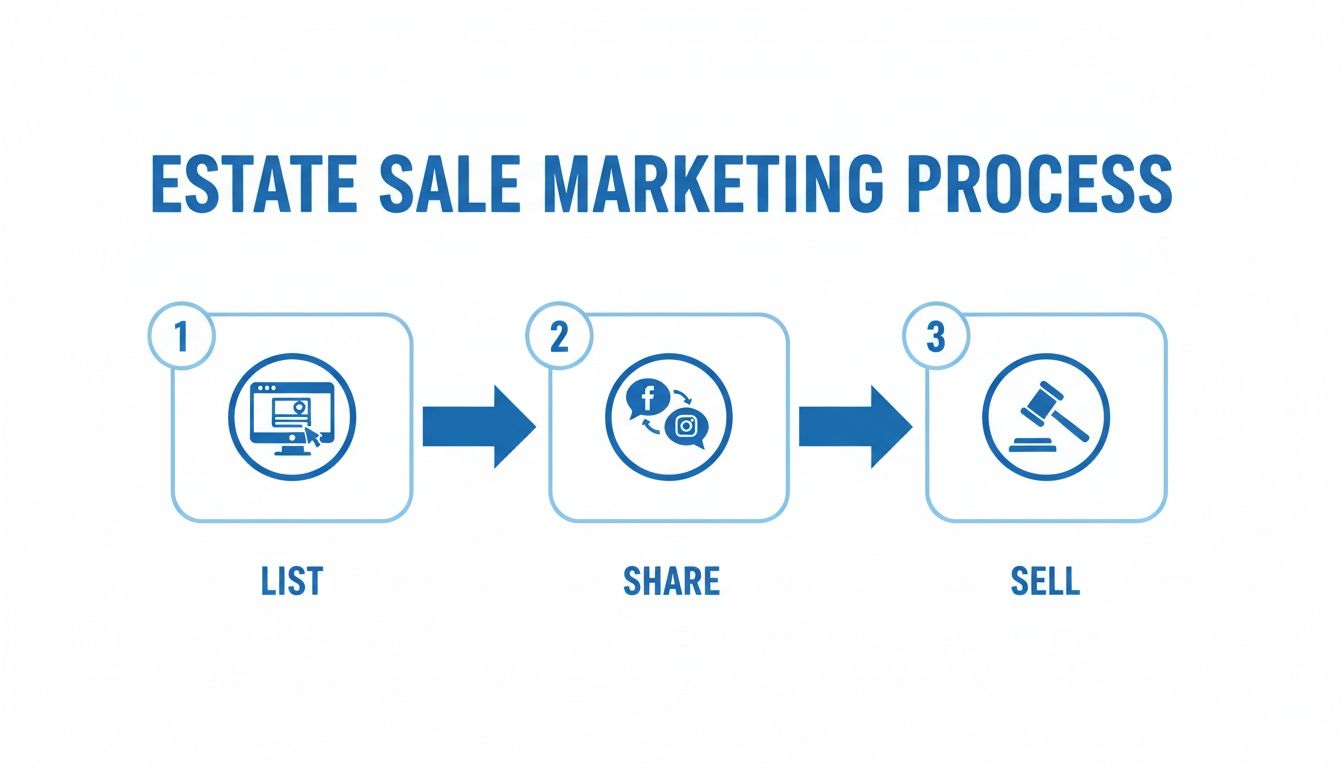
This process—listing your items, sharing the sale online, and letting the auction run—is designed to attract serious buyers who are ready for an organized pickup day.
Critical Security Measures
You can't be too careful when it comes to security. An event with lots of people coming and going can create confusion, which unfortunately can open the door to theft.
First, take any small, high-value items that have been sold—like jewelry, coins, or silverware—and keep them in a secure spot until that specific buyer arrives. Never leave them sitting out unattended.
Next, get a friend or family member to help you out. It’s a game-changer. One of you can greet buyers at the door to check their invoice, while the other supervises inside the home. This "two-person rule" is one of the best ways to prevent items from walking out the door unpaid, whether by accident or on purpose.
Finally, because you're using an online platform, all payments should be collected and cleared before pickup day ever starts. This completely removes the risk of handling cash, dealing with bad checks, or fighting credit card chargebacks. It is, without a doubt, the single best way to prevent fraud and ensure you’re paid for every single item that leaves your home.
Your Santa Barbara Estate Sale Questions Answered
When you're staring down the barrel of an estate sale, a million questions can start to swirl. It’s a big undertaking, and it’s smart to get a handle on the details, especially with the unique ins and outs of the Santa Barbara market.
We’ve pulled together the most common questions we hear from folks in your exact position. Let's get you some straight, practical answers so you can move forward with confidence.
How Long Does an Estate Sale Take From Start to Finish?
This is usually question number one, and for good reason. Deadlines to clear a property are often what set the whole process in motion. The honest answer? It really depends on the size of the estate and the path you take.
A traditional, full-service estate sale company in Santa Barbara typically needs a decent amount of lead time. After you sign a contract, they’ll spend a week or two on-site sorting, pricing, and staging everything before their two or three-day public sale. All in, from that first phone call to a completely empty house, you're likely looking at a four to six-week timeline.
Running a DIY online auction puts you in the driver's seat and tightens up that timeline considerably. You photograph and catalog items on your own schedule—a process that might take a few days or a week. Once you launch, the auction itself usually runs for seven to ten days. That’s followed by a single, pre-scheduled pickup day. The whole thing can often be wrapped up in just two to three weeks.
What Happens to Items That Don't Sell?
It’s the reality of any sale: not every single item will find a new home. Having a game plan for the leftovers is a crucial, and often overlooked, part of the process.
Here’s the typical breakdown for dealing with what’s left:
- Donation: Local Santa Barbara charities like the Unity Shoppe are wonderful options for unsold household goods. Many will even schedule a pickup for larger loads, which is a lifesaver when you're tired and just want the stuff gone.
- Consignment: Got a few high-value pieces that didn't hit their mark? Local consignment shops can be a great next step. They’ll do the selling for you in exchange for a cut of the final price.
- Buyout Services: Some companies will make a flat offer to buy out all the remaining contents. This is the fastest way to an empty house, but be prepared—you’ll only get a fraction of the items' potential resale value. It's a trade-off between speed and money.
- Junk Removal: For the truly unsellable, broken, or non-donatable items, a junk hauler is your final step to getting the property 100% cleared.
Pro Tip: Don't wait until the sale is over to figure this out. The smartest move you can make is to schedule a donation pickup for the day after your sale ends. It saves you from that last-minute panic.
Can I Set a Minimum Price on Certain Items?
Yes! And for your most valuable pieces, you absolutely should. This is where a reserve price becomes your best friend, particularly in an online auction. A reserve is simply a secret minimum bid. If the bidding doesn’t reach your set amount, the item doesn’t sell.
Think of it as a safety net. It prevents that heirloom painting or valuable antique from being sold for a song. This is a level of control that traditional estate sale companies, who often slash prices on the final day to clear the house, can be hesitant to offer.
For an estate sale in Santa Barbara, where you might have desirable California art or high-end furnishings, setting a reserve on a platform like DIYAuctions gives you critical peace of mind. You can let the market run wild on most items while still protecting your most important assets.
Is an Estate Sale the Same as a Garage Sale?
They might both involve selling stuff from a house, but that's where the similarities end. They operate on completely different levels. A garage sale is a casual affair, usually just a homeowner clearing out a handful of unwanted items from the driveway over a weekend.
An estate sale is a total liquidation. It’s the process of selling nearly all the contents of a home, typically triggered by a major life event like a death, a cross-country move, or a significant downsizing. The inventory is vast, covering everything from the fine china in the cabinet to the tools in the garage.
It’s a far more organized and strategic event, with methodical pricing and targeted marketing designed to get the best possible return for the entire contents of the property.
More guides in Estate Sale Basics
July 28, 2026
Revenue Reporting for Estate Sales and Auctions
Learn revenue reporting essentials for estate sales and auctions. Discover key metrics, templates, and best practices to simplify tracking and compliance.
Read guideJuly 26, 2026
Stamp Collection Valuation: A Practical Step-by-Step Guide
Stamp collection valuation made simple. Learn how to identify, grade, price, and sell your stamps with confidence for estate sales or consignment.
Read guideJuly 23, 2026
Estate Sales Brick NJ: Your 2026 Guide to Success
Planning your estate sales brick nj? Our guide covers permits, pricing, marketing, & running a safe sale with DIYAuctions.
Read guideGet the estate sale pricing guide
Enter your email for pricing ranges, planning notes, and a clearer path to launch.