Family Moving Away: A Step-by-Step Plan for Homeowners
Planning a family moving away? Get a timeline, downsizing checklist, selling options, family communication templates and legal checks for a smooth move.

The spare room is full of boxes, your mother's dining table is still in the dining room, and your brother, who lives three states away, has opinions about both. Nobody has said who gets the final word on the china cabinet, the mover wants an inventory list you haven't written, and the closing date isn't moving. A family moving away isn't one decision. It's three separate questions that most advice blends together: who decides, who signs, and who is physically in the house.
Those questions have different answers, and the trouble starts when a family assumes one person holds all three. Distance makes it sharper, not softer. In 2025, 29% of Americans tracked in United Van Lines' National Movers Study said they moved interstate to be closer to family, according to Furniture Today's coverage of the study, so plenty of households are reorganizing around relatives who don't live down the road. Here's the sequence I'd work through, in order.
Week-by-Week Timeline for a Family Move
Print this and put it on the fridge. The owner column matters more than the dates, because a task with two owners is a task nobody does.
| Timeframe | Main task | Who owns it |
|---|---|---|
| 8+ weeks before | Agree on move date and who makes final decisions | Whole family |
| 6 weeks before | Sort room by room and list items worth checking for value | Person moving |
| 4 weeks before | Choose sell, donate, ship or keep for each item and book pickup or auction end date | Person moving with executor |
| 2 weeks before | Notify utilities, banks, insurers and set up mail forwarding | Person moving |
| 1 week before | Pack essentials, confirm pickup or handoff day and label boxes | Both |
| Moving day | Walk through empty rooms, photograph condition and collect all keys | Person moving |
| After the move | Settle final payments, update inventory and thank helpers | Executor or family contact |
Eight to six weeks out, settle authority before boxes
The first conversation isn't about furniture. It's about who breaks a tie when two relatives want the same thing, and it needs to happen while everyone is still calm. Write the name down.
Most moves stay close to home, which is exactly why the contents of the house become the main project. The U.S. Census Bureau's 2022 geographic mobility analysis found that 26.5% of people who moved cited a family-related reason, the second most common broad reason, and that 53.5% of movers relocated within the same county. Short moves still involve a full household, local buyers and a tight window.
Six weeks out, start sorting in the garage or spare room and keep a running list of anything that might be worth real money. If the destination is another state, our checklist for relocating to another state walks through the steps and timing in more detail.
Four to two weeks out, fix the sale date first
Every item gets one of four outcomes: sell, donate, ship or keep. Book the pickup day or the auction end date now, because the mover's date should bend around the sale, not the reverse.
Practical rule: the sale window closes before the truck arrives. If those two dates overlap, you'll pay for a second trip or dump good furniture at the curb.
Two weeks out is admin week. Utilities, banks, insurers, pension providers and mail forwarding all take longer than people expect, and a lapsed homeowner's policy on an empty house is a real risk. If vehicles are travelling separately from the household goods, National Car Transport's guide to planning a long-distance household move is worth reading before you commit to driving two cars across the country yourself.
The last week and the walk-through
Pack one essentials box per person, confirm the handoff in writing, and label boxes by room rather than by contents. On moving day, walk the empty rooms, photograph each one including inside cabinets and the garage, and collect every key, fob and garage remote. Afterwards, whoever holds the money settles final payments and closes out the shared inventory so nobody is chasing receipts in three months.
Easing the Emotional Side of Moving Away
Say a grandmother refuses to let go of the piano until the final week. The family has three options: argue, sell it behind her back, or let her keep it and set a standing Sunday call where she can talk about it in her own time. The third one works. She decides, the family stops negotiating, and the piano gets dealt with on her schedule instead of during the worst week of the move.
Two feelings run underneath almost every family move. The person leaving feels guilty about breaking a routine that other people depend on. The person staying feels abandoned, even when they support the move. Naming both out loud, early, takes a surprising amount of pressure off the logistics.
A systematic review of 22 studies published in the Journal of Epidemiology and Community Health linked residential mobility with behavioural and emotional problems, adolescent depression and reduced continuity of healthcare, while noting that associations vary by circumstance. Poverty and household strain can drive both the moving and the poor outcomes, so a move isn't automatically the cause of anything. What the review supports is a planned transition rather than an improvised one.
Concrete practices that hold up:
- A standing call day: pick Sunday at six and keep it, so contact has a shape instead of depending on who remembers.
- One shared ritual: a weekly photo, a recipe swap, a shared playlist. Small and repeatable beats grand and occasional.
- A visit inside the first three months: book it before the truck leaves, so the old house isn't the only place the family meets.
- Protected routines for children: keep bedtimes and meals steady through packing, have school and healthcare records transferred before departure, and don't ask kids to decide what to sell during the highest-stress week.
Watch sleep, mood and school attendance across the first six months and say something to the family when a pattern shifts. The common slip is treating the move as finished on moving day. The hard stretch usually shows up weeks later, when the boxes are gone and the new routine hasn't formed yet.
Legal and Financial Checks Before Departure
Settle authority before anything else, because every other decision rests on it. Who can legally sell or give away the items in this house: a named executor, someone holding power of attorney, or a joint owner? If the answer is unclear, a sale can be challenged later, and state probate rules may require a court step before an item leaves the property. I'd get that confirmed in writing before the first listing goes live.
The person moving often isn't the person everyone assumes. Among moves that brought older parents and adult children closer together, historical research summarized in CareTrigger's long-distance caregiving statistics found the adult child moved alone in 67% of cases. The same summary reports that the share of adults age 65 and older moving for other family reasons rose from 14.7% in 2019 to 18.6% in 2023. Relocation is frequently reactive and health-triggered, which means decisions get made by relatives who live somewhere else entirely.
Claims, value and receipts
Set a documented claim deadline. Give every relative the same date, the same list and the same instructions, and record each claim in writing with the name attached. Verbal claims made at a holiday dinner are the single most reliable source of family conflict I know of.
Pull valuable pieces aside and get an objective price check before listing. Completed auction results, a dealer's written opinion or a comparable sold listing all work. The point isn't precision, it's evidence, so nobody can say later that the silver went for a song.
Keep every receipt: sales, donations, mover payments, storage, cleaning. They support tax filings and reimbursements, and an executor who can't produce them will spend months reconstructing them.
The house itself
Confirm the property's status and who pays for it in the gap. Sold, rented or empty, someone is responsible for property tax, insurance and utilities, and an empty house often needs a specific policy. The person signing paperwork may not be the name on the deed, so record who holds each role separately.
Gather these before the first sale:
- Deed or lease, plus any probate filing
- Homeowner's insurance policy and the vacancy terms
- Will or power of attorney naming who can act
- Mover contract with dates and inventory attached
- The shared inventory list with claims and decisions logged
Coordinating Decisions and Messages From a Distance
When relatives live far away, their role doesn't disappear. It changes from hands-on labour to coordination, approvals and financial oversight, and that shift needs a structure or it turns into a group chat with 200 unread messages. The scale is ordinary, not exceptional: the Federal Reserve's 2025 report on the economic well-being of U.S. households found that 17% of adults regularly provide unpaid care to an adult relative or friend because of aging, disability or illness, and that more than 10% of caregivers live at least an hour from the person they support.
Three roles, one threshold
- On-site contact: holds keys, meets the mover, supervises pickup, photographs condition. This person doesn't need decision authority, just access and a phone.
- Decision-maker: breaks ties on disputed items. One name, agreed in advance, ideally the executor or the person moving.
- Inventory keeper: updates the shared sheet after every claim, sale and removal. Nothing exists until it's in the sheet.
Set a threshold that routes decisions automatically. For example, any item priced above an agreed amount, or any item with a claim from a second relative, goes to a group vote with a fixed reply deadline. Everything below the threshold, the on-site contact handles alone. If you're unsure how to raise ownership questions without starting a fight, our guide to questions to ask relatives gives you wording that keeps the conversation about the item rather than the history.
Build one shared spreadsheet with a photo, a short description, a claim column and a final-decision column. Google Sheets works fine. Photos matter more than descriptions, because a sibling who hasn't visited in years won't recognize "the brown dresser."
Three messages you can copy
Announcing the move: "Mom's move is set for the 14th. I'll be cataloguing the house room by room over the next three weeks and posting photos in the shared sheet. Pickup day for anything sold is the 12th. Questions to me, please, not to Mom."
Requesting claims: "Photos of the dining set, the wall clock and Dad's tools are in the sheet. If you want any of them, add your name in the claim column by Sunday the 26th at 8pm. After that they go into the sale. No reply counts as a pass."
Confirming a decision: "Confirmed: the wall clock goes to Anna, the dining set goes into the sale, tools split between Mark and Joe. Logged in the sheet with today's date. Speak up in the next 48 hours if I've got this wrong."
Approvals happen asynchronously. Nobody needs to fly back for a single clock, and the family that pretends otherwise usually ends up storing furniture for two years because a decision never got made.
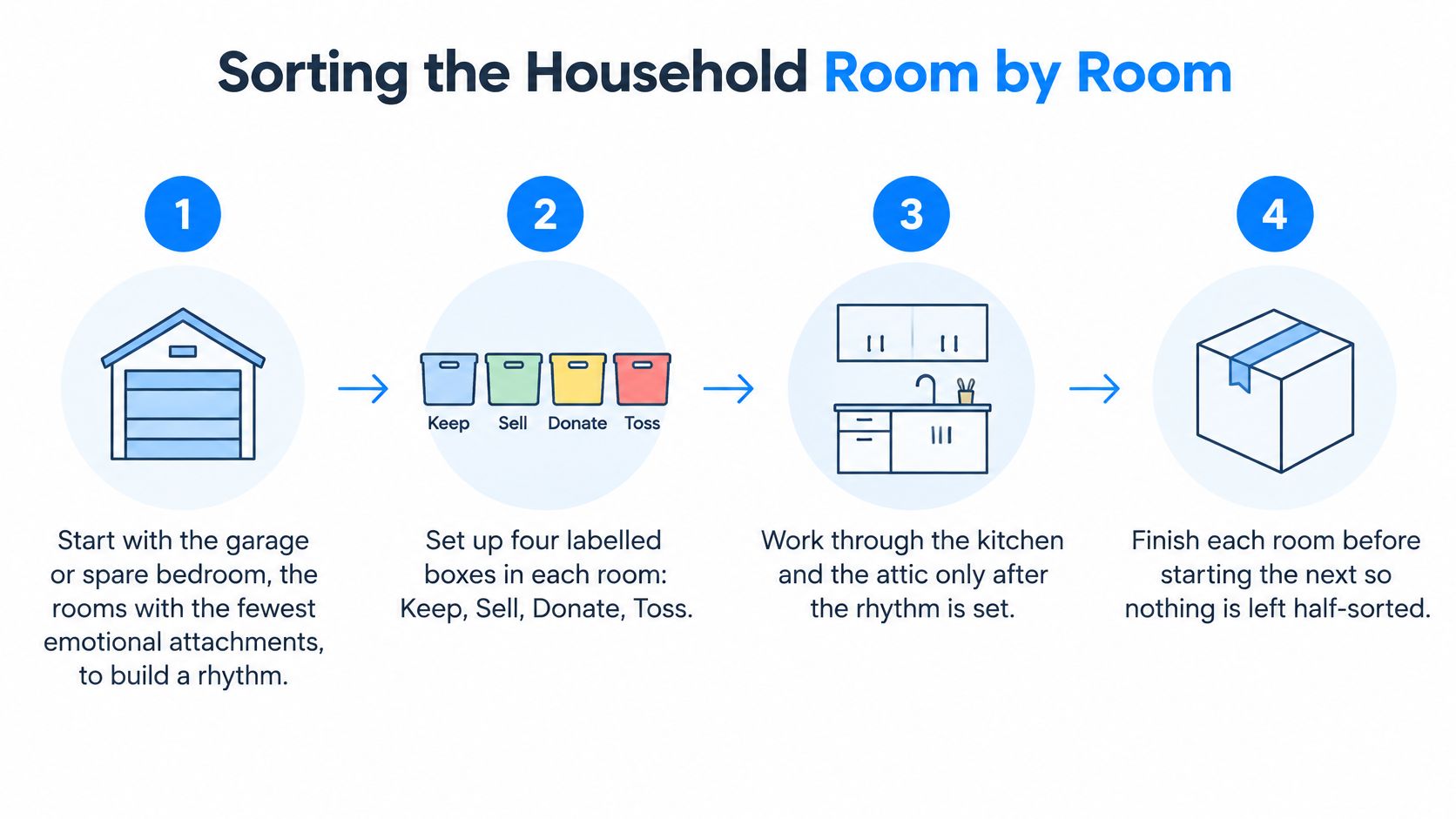
Sorting the Household Room by Room
Sorting is where the plan either holds or collapses. The method below works because it separates the emotional decisions from the volume decisions, and it gives you a visible finish line for each room.
Build the rhythm before you hit the hard rooms
-
Start where nobody's heart is. The garage, the spare bedroom, the utility closet. You'll make twenty fast decisions and learn how your own household sorts before you reach the kitchen or the attic. The common slip is opening the photo albums on day one and losing a whole afternoon.
-
Set up four labelled zones in the room. Keep, sell, donate, and ship or store. Use painter's tape on the floor or four open boxes with a marker label. Without physical zones, everything becomes a maybe pile, and maybe piles follow you to the new house.
-
Empty every drawer and cupboard before deciding. You can't judge quantity from a closed cabinet. Finding eleven mismatched serving spoons changes the decision in a way that looking at one spoon never will.
Decide fast, then catalogue properly
-
Make a first pass at five seconds per item. Gut decision, into a zone, move on. Anything you stall on goes into a single undecided box that you revisit once, at the end, with a timer running. Two passes beat one agonizing pass.
-
Write the catalogue as you go. Brand, model, dimensions, material, condition and every flaw. Photograph the flaw, not just the good side. Buyers ask for measurements and scratch photos, and answering those messages one at a time later is the rework people never budget for. A tape measure, a phone and a notes app are the whole toolkit.
-
Protect the sensitive items first, not last. Documents, photographs, jewellery, letters, anything with a legal title, anything another relative has claimed. These go into a locked box or a labelled tub in a separate room before any selling starts. Mixing a grandmother's ring into the costume jewellery lot is how family disputes begin, and no sale price is worth it.
A room is finished when every item sits in a labelled zone, the undecided box is empty and the floor is clear. Anything less and you'll reopen it during packing week.
Work one room to completion before starting the next. Half-sorted rooms are the reason people end up hauling boxes of unexamined clutter across the country and paying to store them.
Choosing How to Sell or Clear Belongings
Route each item based on its value, not habit. The table below covers practical options for a household on a deadline.
| Option | Best for | Timeline | Effort | Cost |
|---|---|---|---|---|
| Online estate auction | Full household and valuable or collectible items | 1-2 weeks of listing plus one pickup day | Medium, mostly photos and descriptions | Flat commission on sales |
| Garage or yard sale | Small, low-value items | One to two days | High, on-site work | Low, mainly advertising |
| Local listings such as Facebook Marketplace | Single furniture pieces | Days to weeks | Medium, many buyer messages | Free, with some no-shows |
| Consignment shop | Furniture, art and designer goods | Several weeks | Low to medium | Store keeps a large share of the price |
| Donation | Clothing and usable household goods | One drop-off | Low | Free, receipt may support a tax deduction |
| Estate sale company | Whole home, fast clearance | Several weeks | Low | Commission, often a significant share |

The value-split rule
Pull the high-value pieces out first: collectibles, art, silver, designer goods, quality tools. These need a route that reaches serious buyers, which usually means an online estate auction or a consignment shop, and the choice between them is mostly about how many weeks you have.
Bulky, low-value furniture and working appliances go the other way. One local listing for the lot, or a scheduled clearance pickup, beats six separate negotiations, because a single buyer taking everything saves days of messaging and no-shows. Our guide on how to sell furniture when moving covers pricing and pickup arrangements for that middle pile in more depth.
Clothing and usable household goods go to donation with a receipt kept for a possible deduction. Combine the remaining small items into one grouped lot rather than listing them individually.
The mistake I'd steer you away from is running a whole household through a garage sale. It costs a weekend of hard labour, reaches whoever drives past, and the serious buyers for your good pieces aren't among them. Check the commission structure before you commit anywhere: a flat fee and a percentage split produce very different results on a house full of mid-value furniture.
Packing and Moving Logistics Step by Step
Book the moving side early, and treat shipping and local pickup as two separate decisions with two separate budgets.
-
Get at least three mover quotes against a written inventory. Not a room count, not a guess. Send every company the same list and the same dates, then compare like for like. A quote built on "about a three-bedroom house" will change on loading day, and it won't change in your favour.
-
Confirm the pickup or handoff day in writing. Buyer, auction platform or clearance company, get the date and the window in an email or a message you can screenshot. The mover arrives after the sale window closes, not during it.
-
Ship only what a local buyer won't take and you can't replace. Sentimental pieces, documents, small valuables. Check the carrier's insurance limits and packing standards before you hand anything over, because default coverage on many services is limited and claims on poorly packed items get denied. Cross-border moves add customs paperwork and firm departure dates, and the pressure to decide what stays behind is global rather than local: the United Nations International Migrant Stock dataset tracks migrant populations across 233 countries and areas from 1990 through 2024.
-
Order packing materials a week out. Medium boxes for books, small boxes for heavy items, wardrobe boxes for hanging clothes, and a roll of stretch wrap for drawers. Pack one labelled essentials box per person: medication, chargers, kettle, sheets, towels, a change of clothes.
-
Label by room and by zone. "Kitchen, keep" or "Study, store" on two sides of every box. Movers place boxes correctly without asking, and family members can find the medication at midnight.
Eco Clean Solutions' week-by-week plan for moving home is a useful companion for the cleaning and handover tasks that sit alongside packing.
On payment, be blunt with yourself: no advance money to a buyer, no unusual payment methods, no wire requests from someone claiming to be a mover. Confirm every payment through the platform or the documented contract, and never release goods before funds clear.
Start Your Online Estate Sale Before Moving Day
Run the sale before moving day, with the listing window closing before the mover arrives. That single sequencing choice is what turns a chaotic week into a manageable one.

Families use DIYAuctions for settling a parent's home, downsizing after decades in one house, and clearing a property before listing it. You create the lots and organize the house room by room, which keeps the context only your family has: who made the quilt, which drawer sticks, what the cabinet was used for. The sale ends with one coordinated local pickup day instead of multiple days of buyers walking through the house.
If you're selling one home and buying another on the same day, the Cyber Homes guide to back-to-back closings explains how those timelines interact, and it's worth reading before you promise anyone a handover date.
Here's the walkthrough of how a sale comes together:
Don't open a listing until the catalogue exists, the family roles are assigned and the decision threshold is agreed. Listing first and negotiating ownership afterwards is how a sale gets cancelled mid-window.
Three things to do this week:
- Finish one room and label every item with its zone.
- Write down the decision threshold and the claim deadline, then send both to the family.
- Draft listings for your three most valuable items with photos, measurements and a price check.
Start with the garage this weekend, then open a seller account on DIYAuctions and build your first three lots while the rest of the house is still being sorted. Our commission is 10%, capped at $1,000, so you keep up to 90% of what your household sells, and we handle marketing to local buyers, secure payment and fraud protection while you focus on one organized pickup day. Set that pickup date before you book the mover, and the rest of the calendar falls into place.
Get the estate sale pricing guide
Enter your email for pricing ranges, planning notes, and a clearer path to launch.