Fontanini Nativity Set 1983: Identify, Value and Sell
Identify Fontanini Nativity Set 1983 pieces, check markings, spot condition issues, see realistic price ranges and list them for sale online.
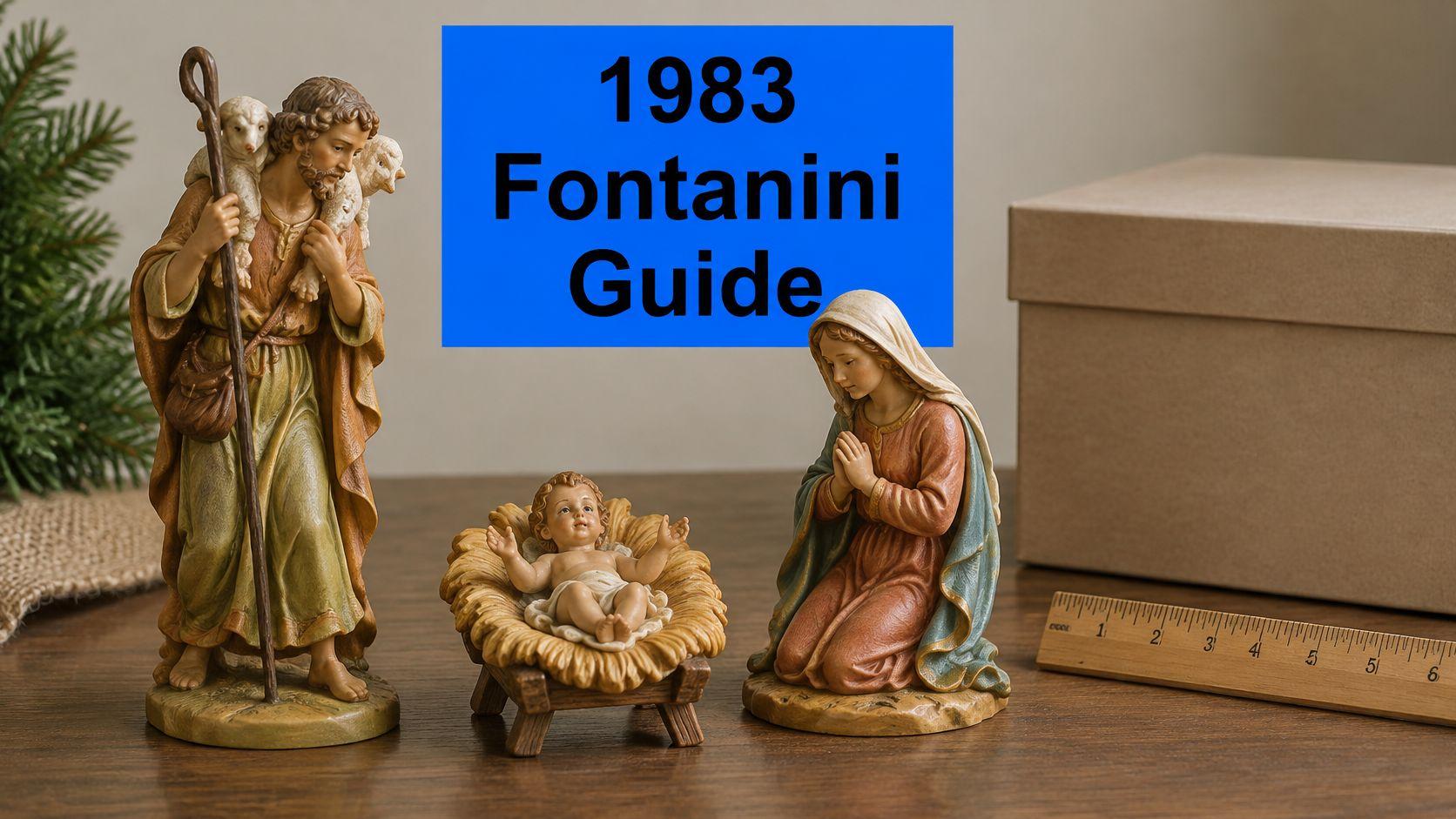
The most misleading advice about a Fontanini nativity set marked 1983 is to price it by the date alone. A dated figure still needs an identity, a scale, a condition assessment and a defensible comparison. Calling an inherited collection rare or complete before checking those details can leave you with an overpriced listing or a poorly described bundle.
Start with the objects, not the asking prices. Separate the figures, examine their bases and match the paperwork to the pieces it describes. Completeness, provenance and presentation deserve more attention than the year stamp.
Which 1983 Fontanini Pieces and Configurations Exist
A Fontanini nativity set marked 1983 is a family of pieces, not one fixed box. The same date stamp turns up on compact religious groupings, individually purchased figures and expanded scenes assembled over years of buying and gifting. Never assume that everything stored in one carton left the factory as a single retail package.
Resale lots come in a wide spread of counts. Groupings of 4, 6, 11, 13, 14, 17, 18 and 41 pieces all surface on the secondary market, and the figures themselves appear in roughly 5-inch, 6-inch, 6.5-inch, 7.5-inch and 12-inch formats. One documented group paired 17 figures with a 12-inch scale. Treat these as examples of what sellers have bundled, not a manufacturer's checklist of what your collection should contain.
Documented lots are examples, not package specifications
The table separates what each record states from what it leaves open. "Not stated" means the record doesn't establish that detail, not that the figure lacks a measurable size.
| Configuration or lot | Reported scale or size | Recorded value or note | Source type |
|---|---|---|---|
| 18-piece Depose 1983 nativity set | 5-inch figures | Documented resale example, not a package specification | Resale listing |
| 17-piece 1983 group | 12-inch scale | Offered as a single lot on the secondary market | Resale lot |
| 10-piece set marked 1983 | Not stated | Sold for $269.00 on eBay on July 6, 2023, according to Fontanini Collection Hero's sale record | Historical sale record |
| 41-piece vintage lot | Not stated | Completed-sale example, not an original-package specification | Market sale record |
| 4-, 6-, 11-, 13- and 14-piece lots | Roughly 5-inch through 12-inch formats across listings | Each listing needs its own scale check | Resale lots |
A seller's lot count describes that seller's bundle. Matching the number proves nothing about completeness, desirability or consistent scaling in your own group.
Recurring subjects include the Holy Family, Three Kings, shepherds, angels and animals. Separate Mary, Joseph and the infant Jesus from supporting figures, then sort the camels, donkeys and sheep into their own cluster. Keep loose accessories beside their likely owners without attaching anything until you've checked the fit.
Measure the figure and identify its scale separately
Actual height and scale aren't interchangeable. A kneeling figure can belong to the same scale family as a taller standing shepherd, while an animal may sit lower still. Measure the object as it stands, including its base, then record any scale designation supported by its packaging or a matching catalog description.
A useful first inventory includes:
- Subject: Identify the character or animal, using a specific name only when the evidence supports it.
- Actual height: Measure from the supporting surface to the highest intact point.
- Markings: Transcribe the base rather than summarizing it as authentic.
- Condition: Note missing accessories, damaged projections and visible finish wear.
- Packaging: Match each box and story card to its figure before counting either as included.
Give loose pieces temporary inventory labels on separate paper, not adhesive labels on painted surfaces. That keeps identities and packaging from getting confused while you sort.
The distinction that matters at sale time is between a collection of compatible figures and a documented original grouping. Both can sell. Only the second supports an original-set claim, and I price the first as a well-matched lot rather than stretch a description the paperwork can't carry.
Markings That Prove a 1983 Fontanini Piece
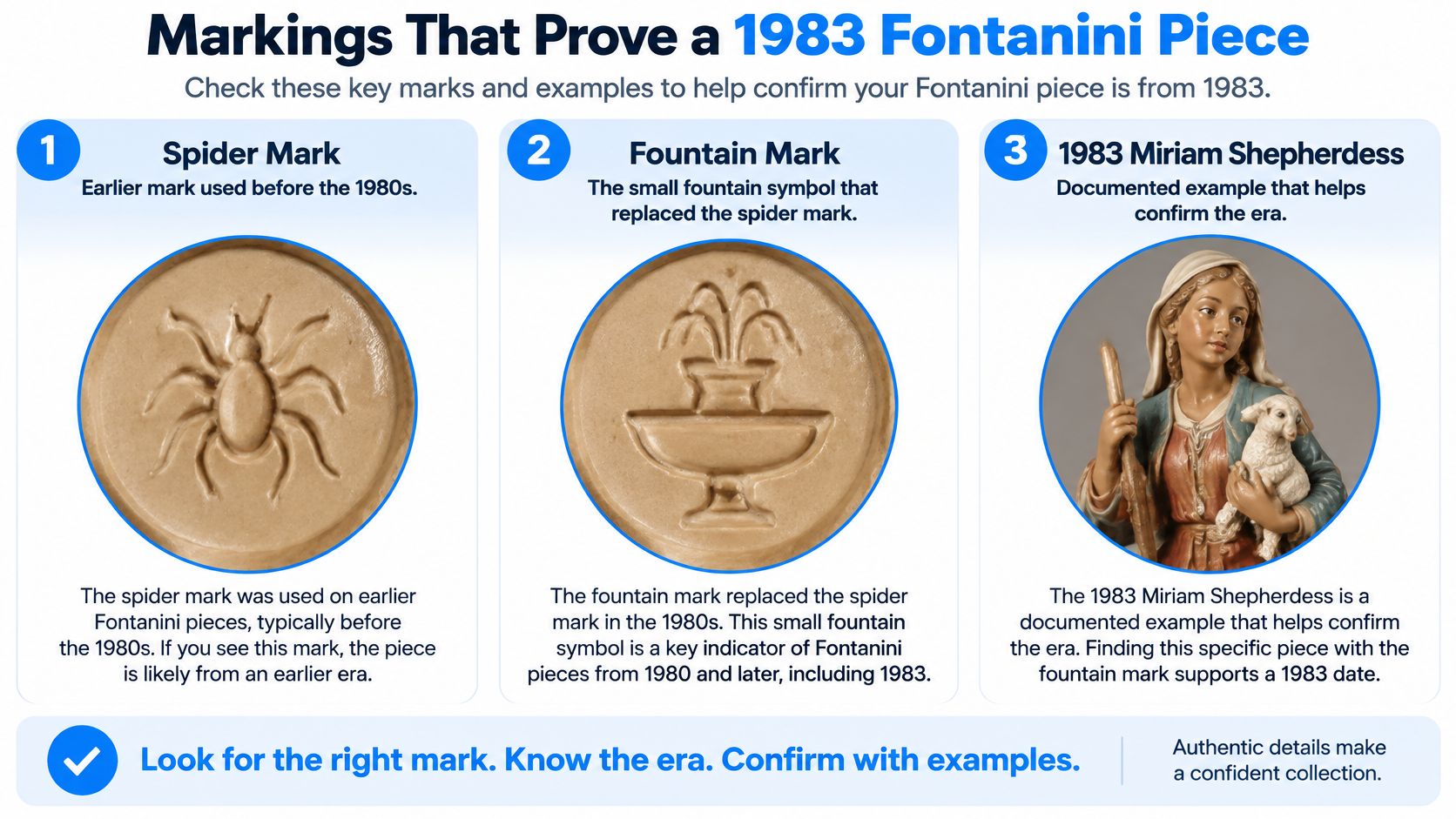
The small fountain mark is an important identification clue, but it isn't a stand-alone certificate. Read it alongside the date, origin, sculptor information and the figure itself.
A Poshmark listing for the Miriam shepherdess describes the replacement of the earlier spider mark with a fountain symbol during the 1980s, explains the name as “small fountain,” and identifies a 1983 hand-painted example signed by Elio Simonetti, with a Fontanini seal, serial number 197 and Italian/Depose identification. That's a useful documented comparison, not proof that every authentic figure must carry an identical combination of marks.
Use the visual guide to locate the relevant symbols, then inspect the actual underside.
Rank the evidence rather than counting marks
The weight below is a practical seller's assessment. Stronger evidence means several details agree, not that a single feature guarantees authenticity.
| Marking or feature | What to look for | Weight as evidence |
|---|---|---|
| Fountain mark | Small fountain symbol associated with the change from the earlier spider mark | Strong when present with other consistent markings |
| Depose, Italy origin | Transcribe the origin and Depose wording exactly as shown | Strong when combined with a maker mark |
| Sculptor signature | Compare the signature with a documented matching figure | Strong when the subject and sculpt agree |
| Serial number | Record the complete number without assuming it means limited edition | Supporting, check against matching records |
| Production-year stamp | Read the date directly from the figure or base | Supporting only |
| Original box and story card | Check that the subject and identifying details match | Supporting, especially for provenance and packaging completeness |
A number molded into a base doesn't automatically establish a production quantity or an edition number. Describe it as the mark you can see unless reliable documentation explains its meaning.
Likewise, a date doesn't establish that adjacent figures share the same origin. One confidently identified shepherd can't authenticate an entire carton.
Record uncertainty without upgrading it into a claim
Use a magnifying glass and a movable lamp before deciding a mark is absent. Light from the side can make shallow lettering easier to read. Photograph the base with the light in different positions, but don't rub chalk, pencil or pigment into the recesses.
If a mark remains ambiguous, write partially legible base mark and transcribe only the characters you can distinguish. If the underside is unmarked, say so. Don't borrow a date from another figure or from an unmatched box.
Authentication rule: Describe the evidence you possess, not the conclusion you hope a buyer will accept.
A mismatch warrants investigation, not an immediate counterfeit accusation. It might be a different production period, an incorrectly identified subject, or an assembled collection. Flag the difference and let the photographs show it.
Completeness and Provenance Check
Completeness has to be defined before it can support a price. A scene can look finished on a mantel while lacking an accessory, a matching figure or the packaging that originally accompanied it. Conversely, an intentionally assembled collection isn't defective merely because it wasn't sold together.
Start by asking what you're claiming to sell: an original boxed grouping, a compatible display collection or a partial lot. Choose the description that the objects and paperwork support.
Check the claim against the contents
Lay the figures out by subject, keeping questionable matches slightly apart. Compare the contents with any surviving box insert, purchase description or illustrated paperwork rather than with the count in an unrelated online listing.
- Core grouping: Confirm that the principal figures named in your description are present.
- Accessories: Look for detached staffs, crowns, removable components and anything tucked into packing material.
- Scale agreement: Compare body proportions, base treatment and supported scale designations.
- Finish agreement: Flag conspicuous differences in painting or antiquing for closer inspection.
- Packaging match: Check names, illustrations and identifiers before assigning a box to a figure.
Don't call an unspecified figure missing merely because another seller included it. A shepherd absent from your collection is only a missing component if you have a defensible reference showing that it belongs in the grouping you're offering.
Preserve provenance without inventing a history
Keep receipts, estate inventory notes, handwritten purchase lists and original packaging together. Photograph relevant identifying information, but cover personal addresses and payment details before publishing anything.
Separate documented provenance from family recollection. A receipt that identifies the figure supports a purchase history. A relative's memory that the display was always in the dining room is useful background, but it doesn't establish an original retail configuration.
| What you have | Safe listing treatment |
|---|---|
| Matching packaging and identifiable contents | Describe the packaging and show the match |
| Family history without paperwork | Attribute the information to the family |
| Mixed figures stored together | Describe an assembled collection |
| A clearly incomplete documented grouping | Name the absent components |
| Uncertain association | Identify the questionable piece separately |
Don't discard a worn box just because it won't photograph attractively. Preserve it, show its condition and avoid promising that it protects the figure adequately for transport.
Sell a partial set as a partial set. Name known omissions instead of hiding them behind a generous piece count.
The seller's job isn't to reconstruct an idealized collection. It's to establish exactly what will change hands.
Condition Checks and Safe Care for 1983 Fontanini Figures
Don't automatically describe these figures as ceramic. Material identification affects both care and disclosure: a molded figure with a painted surface needs a different approach from glazed earthenware.
Mondo Presepi's Fontanini statue catalog includes PVC plastic among the materials used for Fontanini figures. Other surviving descriptions identify molded resin or plastic with hand-painted finishes intended to resemble carved wood, so use the most specific material description your particular piece supports.
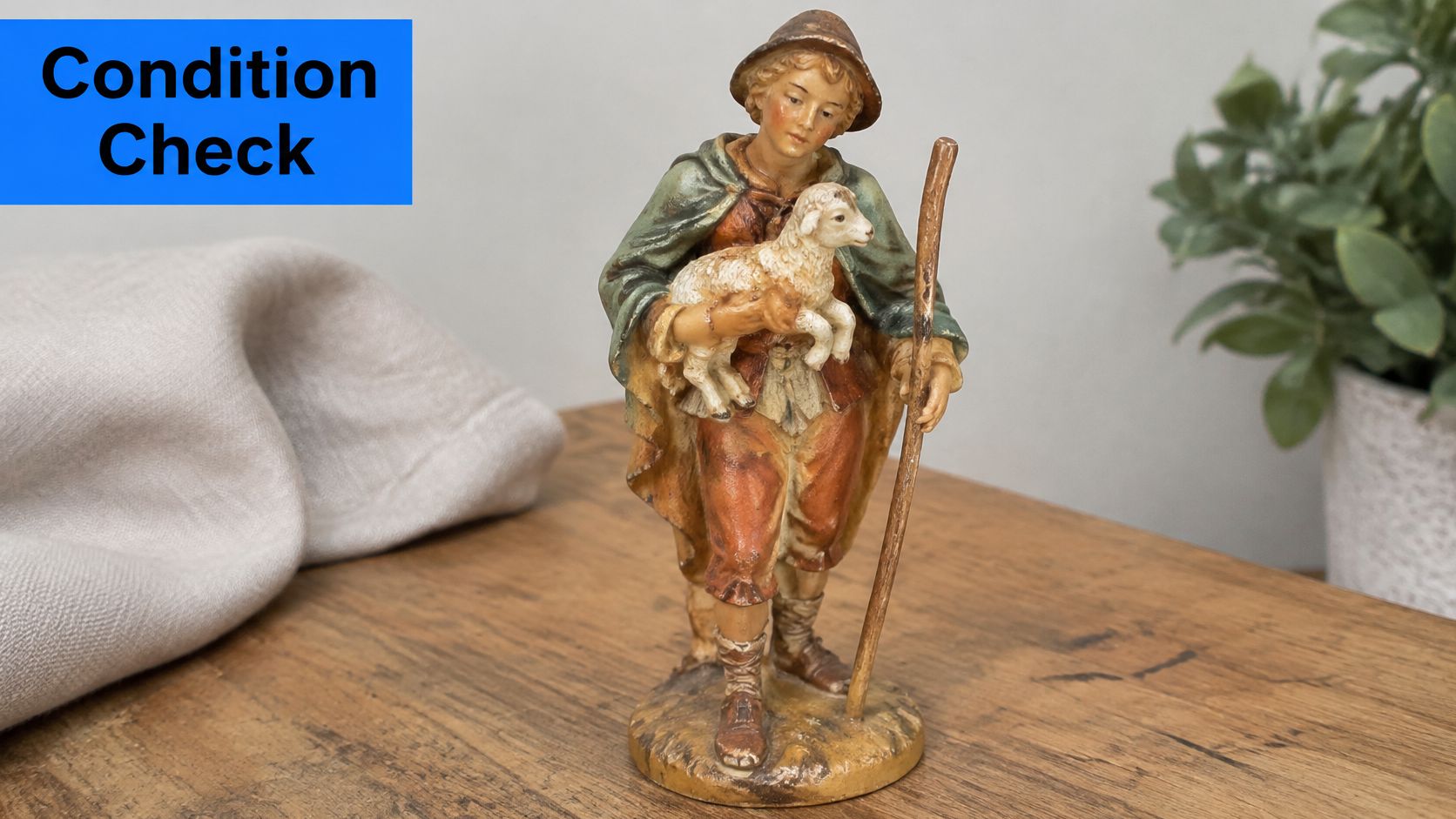
Inspect projecting details before handling the figure for cleaning or photography.
Separate structural damage from finish wear
Support the body and base rather than lifting a shepherd by its staff or an animal by its legs. Check fingers, horns, crowns and other slender projections for bending, missing tips and glue residue. Don't straighten a flexible-looking part just to see whether it moves.
Use raking light, a lamp held low across the surface, to inspect changes in sheen and texture. A glossy patch, paint ridge or uneven color can warrant closer examination, but none proves repainting by itself. Compare the suspect area with nearby surfaces and photograph it clearly.
Set the figure on a flat, stable surface. Check whether the base rocks without pressing it flat, then inspect seams and edges for distortion.
Distinguish paint rubbed from a hand from a repaired hand in your notes. Buyers may accept either, but they aren't interchangeable conditions.
Clean conservatively and stop early
- Test discreetly. If damp cleaning is necessary, try a concealed area first. Stop if color transfers, the surface becomes tacky or the sheen changes.
- Remove loose dust dry. Use a soft artist's brush, working downward so you don't repeatedly brush debris over cleaned surfaces.
- Use minimal moisture. Touch persistent grime with a barely damp, soft cloth. Don't soak the figure or let water collect around seams.
- Skip solvents and aggressive cleaners. Avoid alcohol, acetone, abrasive pads and polishing products that could disturb the finish.
- Leave original paint alone. Don't improve rubbed areas with hobby paint before sale. A cosmetic intervention creates another condition issue to disclose.
- Isolate loose components. Bag and label a detached part separately. If repair is justified, ask a qualified restorer about a material-compatible, reversible method rather than choosing household glue.
- Store with support. Keep figures upright where practical, dry and away from direct sunlight. Separate delicate projections from neighboring pieces and retain matching paperwork.
If you're sorting other holiday decorations at the same time, the Atlantic Mold ceramic Christmas tree identification guide provides a separate reference for those objects. Don't transfer ceramic-care assumptions to painted molded figures.
For an optional, clearly labeled creative introduction to a sale, Nim's talking object workflow offers a presentation idea. Keep any generated animation separate from condition evidence, which should remain unaltered photographs of the actual object.
Conservation isn't automatic value improvement. I would get a restoration quote before authorizing work on a boxed figure with a broken staff, then weigh the cost against realistic sale proceeds. Honest damage disclosure is preferable to a rushed repair.
Realistic Prices for 1983 Fontanini Sets
Only a recorded transaction proves what a buyer paid. Before comparing listings, establish whether you're looking at an active offer, a recorded completed transaction or an item that disappeared from sale.
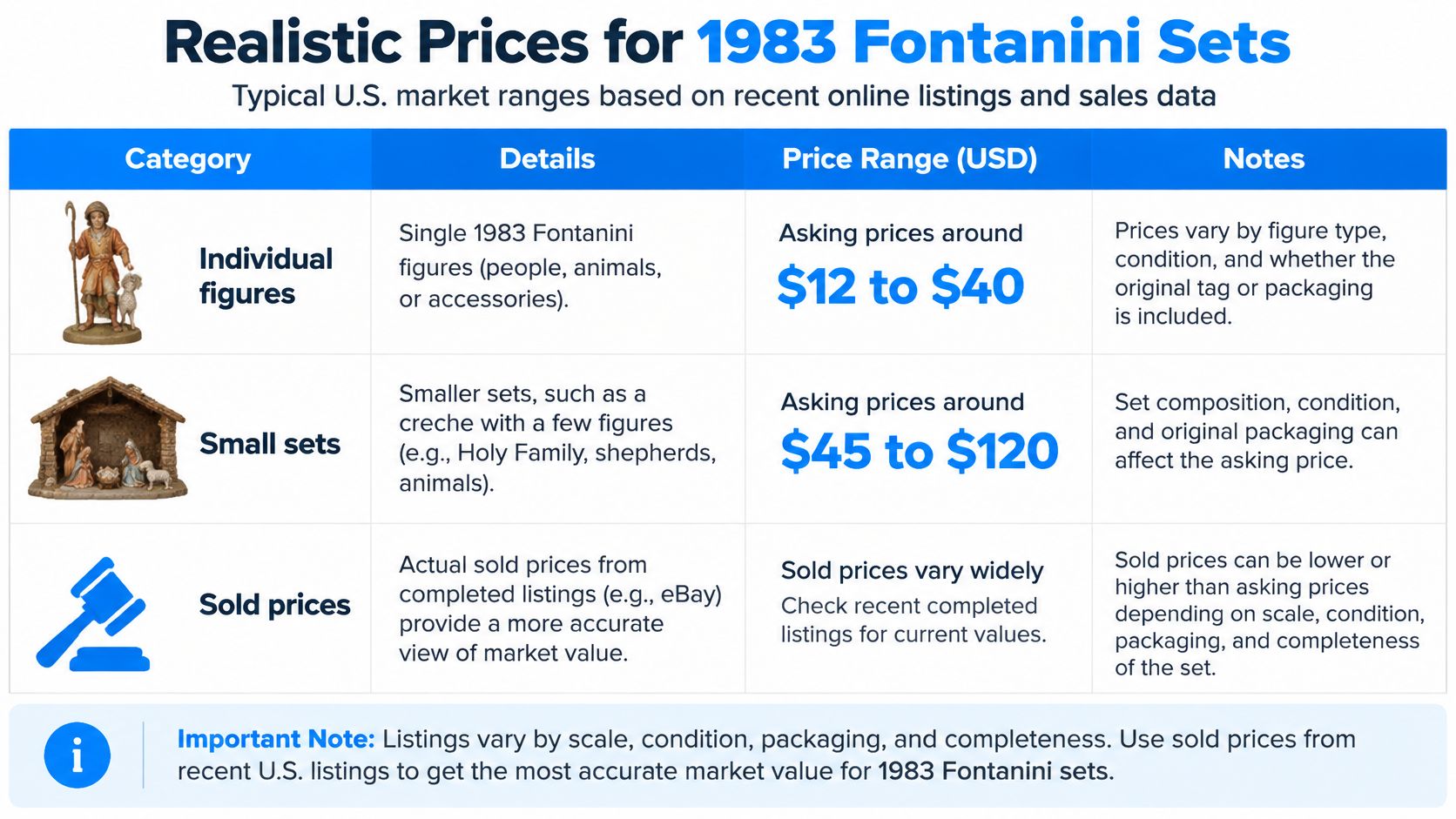
Etsy's Fontanini marketplace shows asking-price examples around $12–$40 for individual figures, $56–$99 for small groups and $130–$300 for larger or more complete sets, including a 13-piece set around $206.85. These heterogeneous offers mix scales, condition, packaging and shipping arrangements.
Treat the graphic as a broad orientation. Match your actual figures against the range before relying on it.
Asking and sold evidence answer different questions
| Price evidence | Amount | What it tells you |
|---|---|---|
| Individual figure, asking price | About $12–$40 | An advertised price awaiting a buyer |
| Small group, asking price | About $56–$99 | Offers include mixed scales and conditions |
| Larger or complete set, asking price | About $130–$300 | Check contents and packaging before comparing |
| 13-piece set, asking price | About $206.85 | A specific advertised example inside the larger-set range |
| eBay completed sale: 10-piece set marked 1983, July 6, 2023 | $269.00 | What a buyer paid for that lot; check comparability before applying it |
The documented transaction comes from the Fontanini Collection Hero sale record: a 10-piece set marked 1983 brought $269.00 on eBay on July 6, 2023. That figure records what one buyer paid for that particular lot on that date. A differently sized or differently conditioned collection will land elsewhere, and a higher piece count alone doesn't raise the total.
The evidence here doesn't justify calling every dated piece rare. Use that word only when you can explain the specific scarcity claim with credible documentation.
Build a defensible comparison
Completeness, provenance and presentation move the price more than the 1983 date. Choose comparable transactions by subject and scale first, then weigh finish condition, missing components, repairs and packaging. A sale that included a stable or accessories your set lacks isn't an equivalent total.
Keep a small comparison worksheet: listing title, sale status, included contents, disclosed defects and shipping treatment. Reject attractive-looking prices when the underlying object isn't comparable.
The collectible pricing guide can help organize those comparisons. For an auction, distinguish your minimum acceptable outcome from your estimate of what bidding might reach.
Treat video as supplementary context. A completed-sale record and a direct inspection of your own figures carry the most weight.
For inherited collections, watch for two opposing mistakes: hiding a well-identified specialty figure inside an indiscriminate bundle, and pricing an incomplete scene as though its missing components were included. Neither gets solved by adding "vintage" to the title.
Pricing judgment: A closely matched completed transaction is more useful than an ambitious asking price attached to a vaguely similar display.
If strong comparisons aren't available, acknowledge the uncertainty. A clear description and a considered selling format defend your price better than a precise appraisal built from mismatched listings.
Photographing, Describing and Listing on DIYAuctions
A buyer should be able to connect every important statement in your description to a photograph. If you describe a fountain mark, show it. If you disclose a repaired crown, don't make the buyer search a distant group photograph to find it.
Prepare the photo area before moving fragile pieces repeatedly. Use a plain background, diffuse light and a stable surface, and keep packing materials outside the frame. The guide to photographing items for online sales offers practical preparation advice for a consistent catalog.
Photograph identity and condition separately
Begin with a group photograph showing everything included in the lot. Then photograph each figure sufficiently closely that buyers can distinguish its face, costume and base.
- Front view: Show the entire figure without cropping off a staff, crown or base.
- Reverse view: Reveal the back, trailing robes and less visible surfaces.
- Underside: Make lettering readable and keep the base in focus.
- Defect details: Photograph each disclosed break, repair, paint loss or bent projection.
- Measurement reference: Place a ruler beside the figure on the same supporting surface.
- Included packaging: Show the box label, story card and any damaged areas of the packaging.
Turn the figure rather than reaching awkwardly around it. When photographing the underside, support the body on a clean, padded surface and keep pressure off projecting details.
Avoid filters, background effects that erase edges and editing that changes the color or apparent condition. A brightened photograph is only useful if it still represents what the buyer will collect.
Write a description that survives inspection
Use a factual title that identifies the maker, subject or grouping, supported date and meaningful size information. Leave unsupported rarity claims and value estimates out of it.
Your description fields should include:
- Subject or name: Use a documented character name where available; otherwise describe the figure plainly.
- Measured height: State the actual measurement rather than relying exclusively on scale.
- Scale family: Include it when supported, keeping it distinct from measured height.
- Material: Use resin, plastic or PVC only as confidently identified; otherwise describe the uncertainty.
- Marks: Transcribe readable maker, origin, sculptor and number information.
- Date evidence: Say whether the date appears on the figure, packaging or associated paperwork.
- Condition: Locate each defect on the object instead of using good vintage condition as a substitute.
- Repairs and contents: Identify repairs explicitly and list included accessories, box and story card.
A useful hypothetical description would read:
Fontanini shepherd figure, molded material, fountain-style base mark. Paint wear on the left hand; no visible adhesive repairs under ordinary inspection. Matching box included. See the underside and ruler photographs for markings and measured height.
Replace every statement with what you've verified. Don't copy a named subject, material, or scale from a similar-looking listing without checking your piece.
Choose the lot structure before publishing
The strongest presentation isn't always individual listings. A coherent display can appeal to a buyer who wants a usable scene, while an identifiable loose figure may suit someone filling a gap. Splitting a documented grouping can also leave you with less desirable remnants.
Use this sequence to make the selling decision deliberately:
- Finish the inventory first. Assign each figure and its packaging to a proposed lot before uploading photographs.
- Separate confirmed groupings from loose pieces. Preserve documented sets where that offers a clearer proposition; evaluate unrelated figures individually.
- Choose a defensible opening bid. Consider comparable completed transactions, condition and your minimum acceptable outcome. Don't copy an active asking price automatically.
- Create a complete catalog entry. Upload the overview, individual views, marks and defects together. Ensure the title and description refer to the same contents.
- Fit the schedule to the estate. Allow time for questions, then select a pickup arrangement that the executor or household can manage.
- Answer questions publicly where practical. Clarify uncertainty with another photograph rather than an unsupported assurance.
- Prepare for collection. Keep sold lots separated, label their outer containers and confirm which accessories and paperwork accompany each purchase.
Leave wrapping materials available, but don't bury the figures in packing before buyers can verify their purchases. Keep detached components in labeled protective containers so they don't disappear into discarded paper.
Your final decision is whether to sell a figure separately or preserve the grouping for a set buyer. Make that choice from the evidence and the estate timeline, not from the hope that assembling a larger lot will automatically produce a better result.
Ready to list? Finish your figure inventory, photograph the marks and defects, and decide which pieces belong together. Then use DIYAuctions to build your catalog, choose your auction schedule and organize pickup with a description buyers can trust.
Get the estate sale pricing guide
Enter your email for pricing ranges, planning notes, and a clearer path to launch.