Linden Westminster Clock: How to Sell It
Identify, test, price, and list a Linden Westminster clock for an estate sale, from movement type to pickup day.
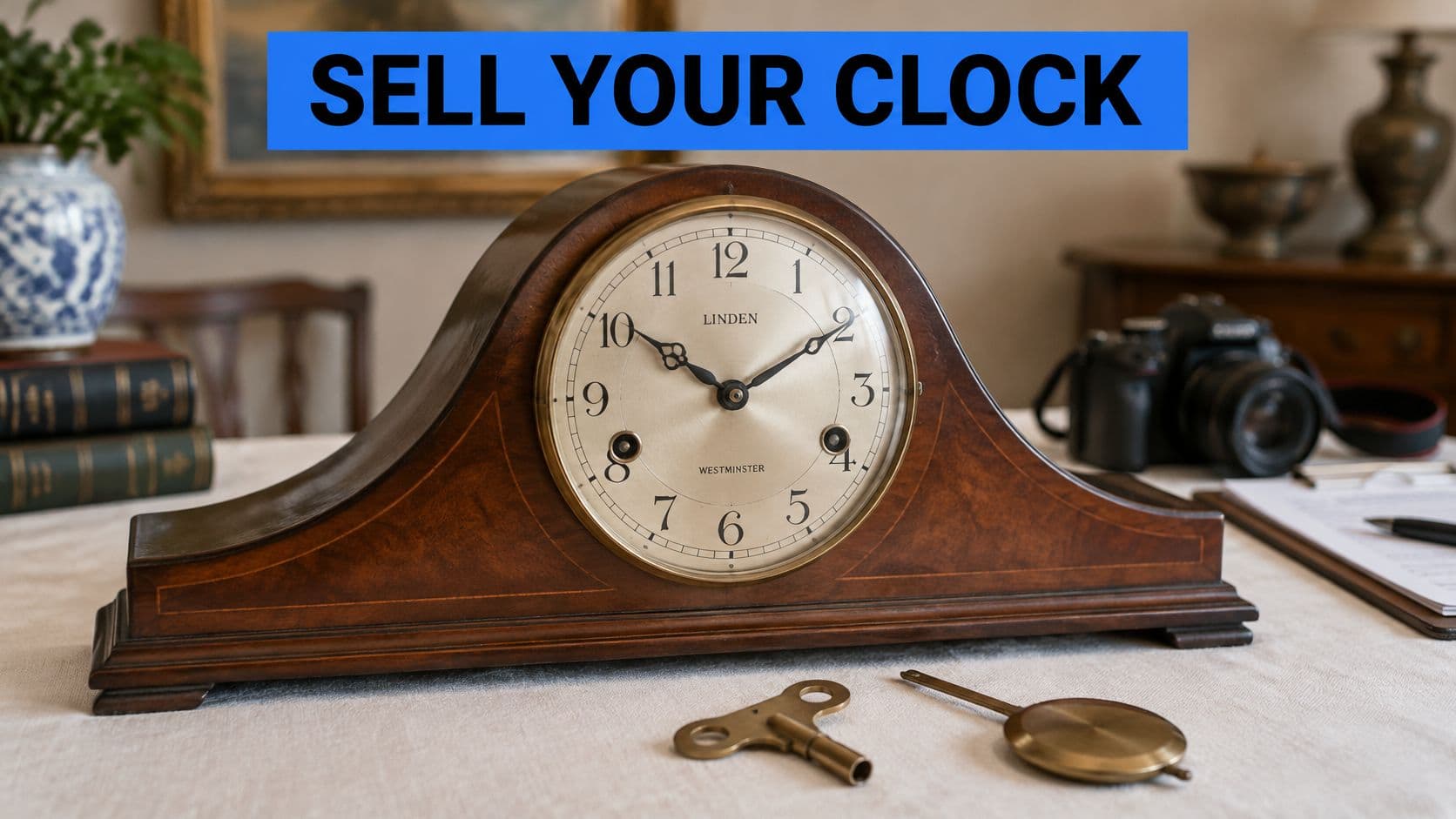
The usual advice is to look up “Linden Westminster clock” and copy a price from a similar wooden case. That's a poor way to sell one. Two clocks can look alike and play the same melody while giving buyers very different reasons to bid.
Start with the movement, completeness, and actual sale evidence. For an estate sale with a scheduled pickup day, your job isn't to prove that every household clock is a collectible. It's to identify what you have, show what works, and give local buyers enough information to make a confident offer.
What a Linden Westminster Clock Usually Brings
Linden clock types and price evidence
Match your clock by appearance first, then confirm the mechanism before choosing an opening bid. The monetary examples below come from the Used.forsale Linden clock listing index, which includes broad asking prices of $8 to $293.38, averaging $53.63, mechanical asking examples around $179.99 to $329.99, a $30 oak mantel result, and a wall-clock example estimated at $180 to $380 that sold for $90.
| Clock type | How to recognize it | Asking evidence | Sale evidence |
|---|---|---|---|
| Broad Linden listings | Linden label, movement often undescribed | Broad indexed spread, not a model-specific comparison | Market spread only, not a target |
| Vintage mechanical | Key-wound movement, possibly marked with its winding duration; pendulum or weights where fitted | Higher mechanical asking examples | Require a comparable sold clock with matching condition |
| Oak Westminster mantel | Solid-oak case, Westminster marking, shelf-sized case | Find a matching movement, not just matching wood | An oak mantel sale result is included above |
| Linden wall clock | Hanging case, possibly a long pendulum or weights | An auction estimate example is included above | The corresponding realized result was below its estimate |
| Quartz or battery decoration | Battery hatch and battery-powered movement | Use battery-clock comparisons, not mechanical asking examples | Price primarily as decor unless the case warrants more |
| Incomplete or parts | Missing operating components or a nonworking movement | Low opening bid | Case or parts value, not a running-clock price |
Listen to the clock if it's safe to run. An electronic speaker and a mechanical hammer striking rods can both produce a Westminster melody, but they aren't equivalent mechanisms.
Westminster describes the chime, not a grade of rarity. A Linden household clock isn't the Great Clock at London's Elizabeth Tower, and the familiar tune doesn't establish a connection beyond the musical pattern.
Pricing caution: An asking price shows what a seller hopes to receive. A completed sale shows what a buyer actually paid. Don't treat them as interchangeable.
Choose comparable clocks rather than attractive prices
Search sold or completed listings using the model number, case format, and movement type. Exclude results that say only “Linden” if the photographs don't establish what mechanism is inside.
Check whether the comparable includes its key and pendulum, whether the seller heard the chimes, and whether shipping was available. A shipped clock offered to a wider audience isn't a clean comparison for an untested local-pickup lot.
Treat the matched category as an opening-bid starting point, not a promised selling price. A complete, documented clock deserves stronger consideration than an identical-looking case with missing operating parts, but it doesn't automatically become a premium collectible.
For a taller clock in the same estate, the Emperor grandfather clock value guide provides a separate comparison framework. Don't carry floor-clock expectations over to a Linden mantel clock.
If you're administering an estate, separate sales pricing from formal valuation requirements. The Law Office of Bryan Fagan, PLLC's resource on probate appraisal of inherited artwork provides useful context for inherited collectibles, though it isn't a clock appraisal or a substitute for advice about your estate's requirements.
How to Identify Movement Case and Era
Identify the clock from labels, movement, and case, in that order. A traditional wooden exterior isn't enough to establish age, and a country marking on the mechanism doesn't necessarily identify where the entire clock was assembled.
Keep a tape measure, flashlight, phone camera, and notepad beside the clock. Open only doors or access panels intended for routine use; don't remove the dial or movement to find a stamp.
Record what you can actually verify
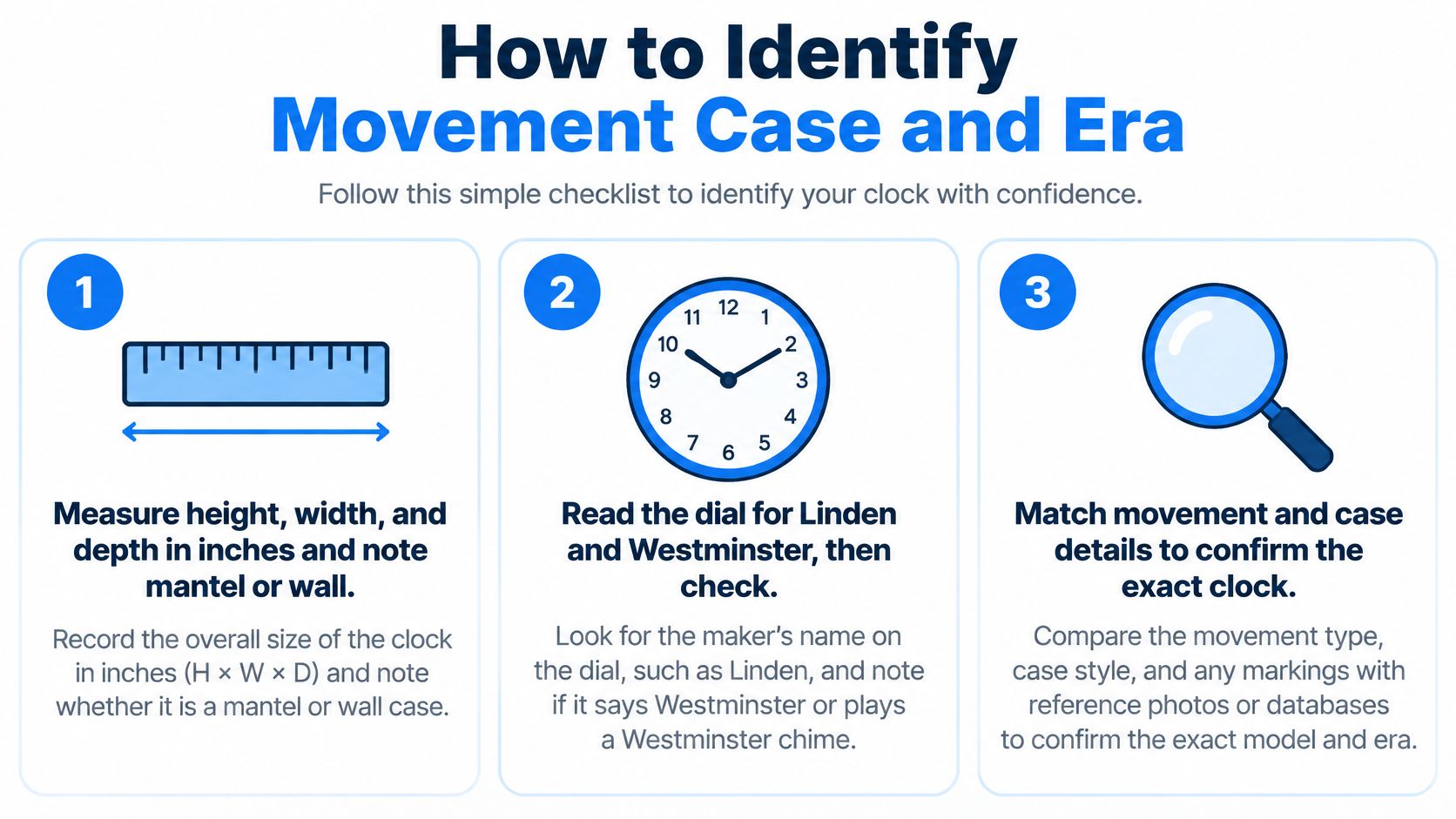
- Measure the case. Record height, width, and depth in inches, including projecting trim. Identify it as a mantel or wall clock and note any hanging hardware.
- Read the markings. Photograph Linden and Westminster on the dial, then inspect the accessible back or bottom for a model number, movement stamp, and Germany or Japan marking.
- Identify the power source. Winding arbors indicate a mechanical mechanism. A battery compartment identifies battery power, although a decorative pendulum can make a quartz clock look mechanical.
- Check the winding description. Copy any marked winding duration exactly. Note whether springs or hanging weights supply power, without guessing from the case shape.
- Inventory removable parts. Record the key, pendulum bob, weights, chains, glass, and doors as present, missing, or uncertain. Don't assume a loose key fits.
- Preserve provenance. Photograph paper labels, retailer stickers, and handwritten service notes. A service date documents attention at that time, not necessarily the clock's manufacture.
Use this visual checklist while you record the identifying details.
Why similar cases can conceal different clocks
The Linden company history document describes the brand's expansion from imported Black Forest cuckoo clocks into household formats, movements sourced from West Germany and Japan during the 1960s through the 1980s, and surviving 8-day, 31-day, and quartz mechanisms.
That history explains why the mechanism matters more than an old-fashioned silhouette. A replacement movement is another reason to describe the clock in front of you rather than assign an era from a similar online photograph.
If the case wood isn't identifiable, write “wood case” or “wood-effect case,” whichever your inspection supports. Don't turn a veneer pattern into a claim of solid oak.
The broader guide to identifying valuable antiques is useful when an estate contains other unlabeled objects. For your clock title, use the verified mechanical winding designation or battery quartz, followed by the case material only when you can substantiate it.
How to Inspect and Test the Chimes
Inspect for an honest listing, not an improvised repair. Don't bend hammer wires, remove hands, adjust internal levers, or add oil just to make the clock sound better before sale.
A clock can keep time while its chime mechanism remains silent. Record those functions separately so the buyer knows exactly what you tested.
Run a controlled listening test
- Position and power it safely. Put a mantel clock on a stable, level surface. Hang a wall clock only from secure hardware. Fit the correct fresh battery to quartz models; wind a mechanical clock only with a properly fitting key and a known winding direction, stopping at firm resistance.
- Check the silence control. Photograph its original position, then use the marked chime setting. If setting instructions are available, follow them; otherwise, let the clock reach the next chime naturally rather than experimenting with unfamiliar controls.
- Listen through a complete hourly cycle. Note the quarter sequences and whether the hour count matches the displayed hour. If instructions permit advancing the minute hand, move forward gently and let each sequence finish before continuing.
- Observe timekeeping. Let it run through a day if the sale schedule permits. Compare it with your phone at the beginning and end, recording fast, slow, or stopped rather than claiming it has been regulated.
- Inspect the exterior. Check door closure, glass edges, lifted veneer, finish wear, and visible hand interference. Photograph defects instead of trying to disguise them.
- Stop at distress. Grinding, binding, or a hammer remaining against a rod is a reason to stop testing. Don't reach into a powered movement to free it.
Condition notes that change a Linden listing
| What you find | Listing language | Price effect |
|---|---|---|
| Runs and plays quarters plus the hour | Ran through the observation period; Westminster quarters and matching hour count heard | Supports a complete mechanical comparison |
| Chime silent or only some quarters play | Chime silent or partial; complete strike operation not claimed | Pull toward decor or repair bidding |
| Hour count wrong | Strikes, but hour count is incorrect | Expect buyers to allow for correction or service |
| No key, pendulum, or weights | Name each missing component prominently | Case or parts bidding |
| Quartz, battery only | Battery-powered Westminster chime; movement isn't mechanical | Compare with battery-powered decor |
| Dead quartz movement | Fresh correct battery fitted; movement didn't operate | Nonworking decor or replacement-movement project |
| Cracked glass or lifted veneer | Cosmetic damage shown in close-up photographs | Allow for visible damage |
| Grinding or a stuck hammer | Testing stopped; sold as-is | Don't promise that it can be made to run |
| Incomplete weights or chains | Weight or chain components missing; operation not verified | Incomplete mechanical lot |
A successful short test supports a stronger description, not a service guarantee. Don't say recently serviced unless you have dated documentation, and distinguish a repair invoice from an unexplained handwritten note.
Sell the observation, not the diagnosis. “Chime silent during testing” is defensible. “Only needs oil” isn't.
An adaptable condition line is: “Ran during the observation period; quarter chimes and matching hour strike heard; service history unknown; case wear and included components shown.”
How to Clean Without Hurting Resale
Cleaning should make the clock easier to photograph, not make it look restored. Before touching it, take photographs of dust, stains, loose veneer, and existing damage so you have a record of its starting condition.
This is the level of handling you want: gentle attention to the outside of the case.
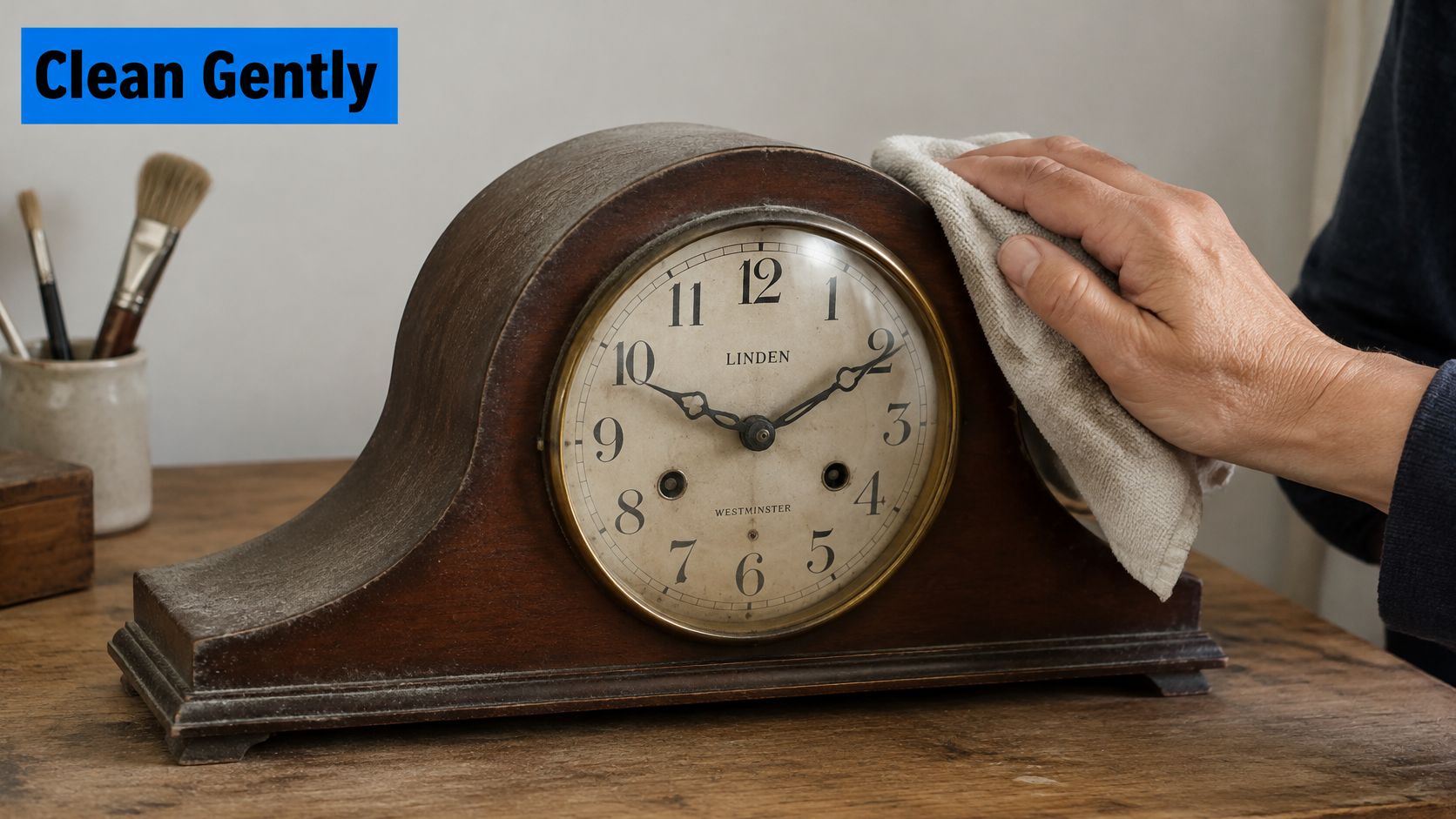
Dust the case and leave the mechanism alone
- Remove loose contents carefully. Take out old batteries and unattached scraps, but retain instructions, labels, and service paperwork with the lot. Don't scrape battery corrosion into the movement.
- Start dry. Use a soft microfiber cloth on the case. On a sound modern finish, a barely damp cloth can lift surface dirt; dry immediately and avoid veneer seams.
- Clean glass indirectly. Apply household glass cleaner to a cloth away from the clock. Never spray toward the dial, case openings, or movement.
- Leave sensitive surfaces untouched. Don't polish brass, wet a paper dial, or put oil, water, or compressed air into the gears.
- Preserve evidence and damage. Keep labels attached. Skip sanding, finish touch-ups, and hurried glue repairs to lifted veneer.
Say a mantel clock has been sitting in a spare bedroom. Remove the dust mat from its top and the cobwebs around the feet, but leave a yellowed dial as found. Polished metal beside an aged case can look conspicuous, and a wet paper dial can develop damage you can't wipe away.
If it smells of smoke, air the case in a dry, sheltered place and disclose the odor. Perfume and scented polish don't resolve the problem for a buyer who's sensitive to it.
For a visual supplement, use this video without treating it as movement-specific service instructions.
Finish with a photo-ready check
The case should be dry and the glass free of cleaner residue. Store the key with the lot, remove the battery after testing if the clock will sit unused, and secure removable pendulum components before moving it.
Keep the original dusty photographs in your records. Publish clear cleaned photographs that still show every material flaw.
Photos Keywords and Listing Copy
Photograph the clock so a buyer can identify it without sending a string of messages. Use side daylight, a neutral background, and a clean phone lens; switch off flash when it reflects in the glass.
Move yourself slightly to control reflections rather than opening the door for every picture. Keep an unobstructed front view as the lead image.
Build a useful photo set
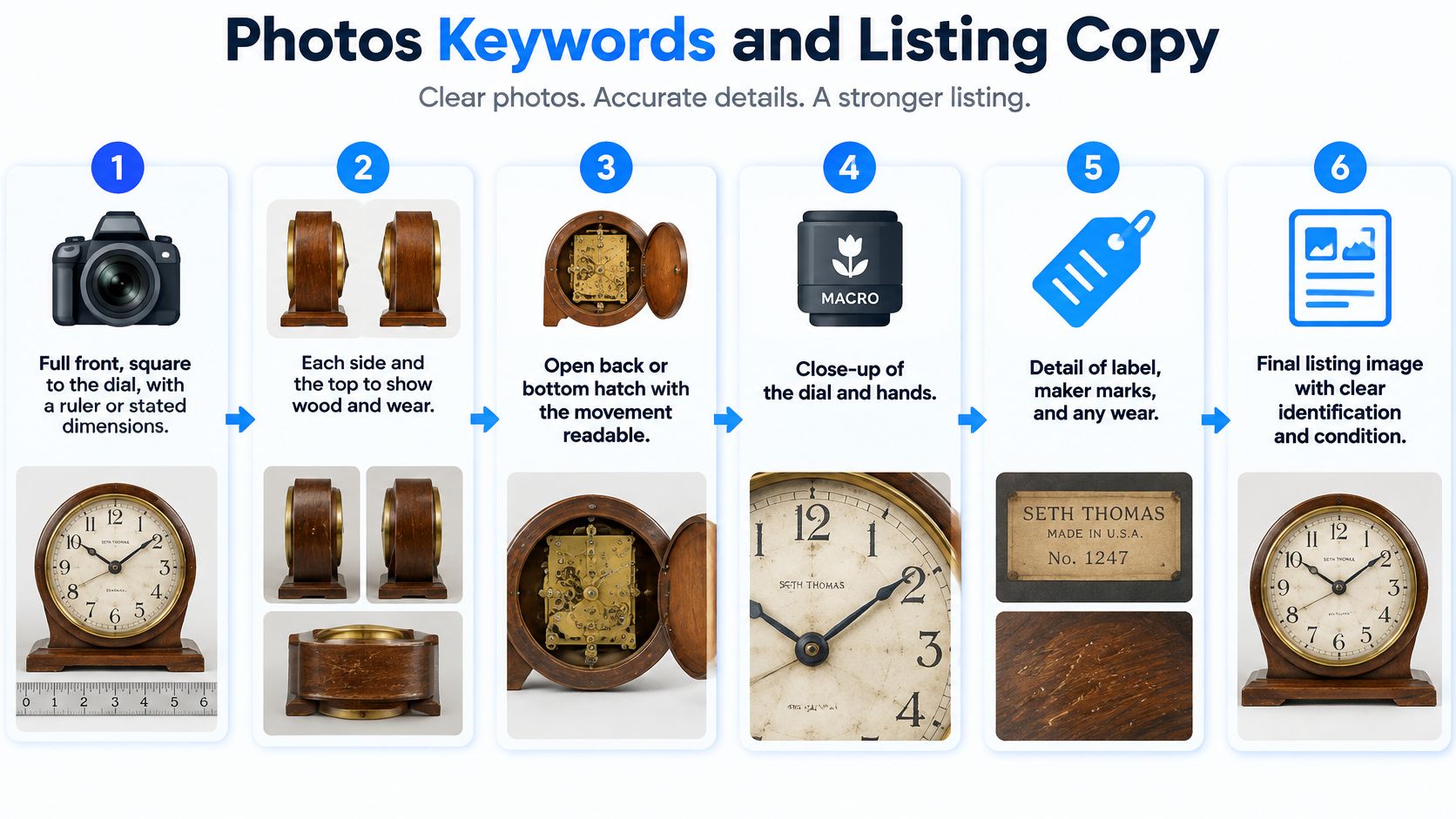
- Full front. Stand square to the dial and include the whole case. Show a ruler where practical or provide clearly measured dimensions in the description.
- Sides and top. Photograph the surfaces buyers won't see in the lead image, especially finish wear, water rings, and lifting veneer.
- Accessible movement. Open the back door or battery hatch and focus on the mechanism. Don't remove structural panels just for a photograph.
- Identification details. Capture the Linden name, Westminster marking, country stamp, and any winding-duration designation. Keep the lettering readable.
- Included components. Lay the key, detached pendulum, weights, and paperwork beside the case. If components are absent, state that in writing.
- Worst flaw. Give damage its own close-up with enough surrounding case visible to establish location.
Use this visual guide to organize the listing images.
The guide to photographing items to sell online offers broader setup advice. For small reflective details such as a key or brass trim, Carat 24 - Trusted Gold Experts' suggestions to style jewelry photos to attract buyers provide a useful lighting reference, but keep clock accessories grouped for identification rather than decoration.
Write titles that filter buyers accurately
Use verified details in descending order of importance. These are adaptable patterns, not descriptions to copy without checking:
- Mechanical title: Linden Westminster mantel clock, oak case, key-wound, marked winding duration, key and pendulum present.
- Quartz title: Linden Westminster wall clock, battery quartz, chime not tested.
- Incomplete title: Linden Westminster mantel clock, mechanical movement, pendulum missing, untested.
In the body, give type, dimensions, marked movement country, test observations, included parts, and local pickup, in that order. A buyer should find the essentials before reading background.
Work keywords into factual sentences. “West German movement” belongs only where the stamp supports it; “estate sale” describes the selling context, not the clock's age. Don't add “antique,” “rare,” “oak,” or a winding duration merely to attract searches.
If you recorded a chime video, label it with the lot identifier and retain it with your catalog records. Don't claim that photographs demonstrate working condition.
Sample running-clock description, adapt only after testing:
Linden Westminster mantel clock in an oak case with a key-wound mechanical movement. Ran during observation, with quarter chimes and the matching hour strike heard. Key and pendulum are included. Case has light wear, shown in the detail photographs. Service history is unknown. Measured dimensions appear in the lot details. Local pickup only; bring suitable padding and carry it upright.
Silent quartz alternate: “Linden Westminster wall clock with battery quartz movement; hands operate, chime silent during testing; case wear photographed; local pickup.”
Set the Bid and Plan Pickup Day
Choose an opening bid from the closest verified clock category, then make a deliberate adjustment for your lot's condition and your sale deadline. Don't keep raising it because an unrelated seller has an ambitious listing.
For a complete mechanical clock with documented operation, a mechanical comparison is reasonable. For a battery clock, choose decor comparisons. For an incomplete mechanism, invite repair or parts bidders rather than pricing it as though the missing pieces were already supplied.
Balance the bid against the pickup constraint
A firm collection day narrows the pool to buyers who can attend. Your starting bid needs to make sense for that local audience, especially if the clock is bulky, untested, or awkward to transport.
I'd favor a defensible opening over a hopeful reserve on an ordinary household clock that must leave with the estate contents. If it appears unusually significant, pause for specialist assessment rather than using a low opening to discover its identity.
- Complete and tested: Set a confident opening supported by similar sold examples.
- Attractive but untested: Leave room for the buyer's service risk.
- Incomplete or distressed: Make the missing parts unmistakable and choose an opening that suits project buyers.
Pickup rule: Pack removable operating parts as carefully as the case. A beautiful cabinet isn't a successful handoff if the pendulum gets bent on the way to the car.
Prepare the clock before the buyer arrives
Photograph how the pendulum and any weights are fitted before removal. If you're unfamiliar with the suspension or weight system, get competent help rather than pulling on it.
Put the key in a labeled bag and cushion the detached pendulum separately. Keep both with the clock, but don't tape accessories to fragile veneer, labels, or the movement. Heavy weights belong in a separate padded container, not loose inside the cabinet.
Restrain chains without tangling or pulling them through the movement. Never tape or clamp the delicate suspension spring as an improvised transport lock.
For exterior cushioning, Storage & Removal Boxes Ltd's Padded Removal Blankets Protection provides a useful reference for the type of blanket to have ready. Padding protects the cabinet from contact; it doesn't make an unsecured mechanism safe to transport.
Prefer local pickup for an unfamiliar mechanical clock. If shipping is unavoidable, obtain movement-specific packing advice, pack weights separately, protect the glass without pressure, and confirm insurance terms rather than assuming ordinary parcel packing is sufficient.
Place the clock near the exit on a stable surface with its lot tag attached securely. Have the buyer lift from the case sides and base, not the crown, handle, or decorative trim, and hand over the accessory package before they leave.
Create your clock lot on DIYAuctions with the identification photographs, measured dimensions, and your actual test notes. Set the starting bid from the closest supported comparison, choose the sale dates and a single pickup day, and keep the labeled accessories ready for the buyer's handoff.
Get the estate sale pricing guide
Enter your email for pricing ranges, planning notes, and a clearer path to launch.