Online Auction Security for Estate Sales in 2026
Online auction security explained for estate sales: threats, platform controls, seller and buyer checklists, disputes, and what to do after account takeover.
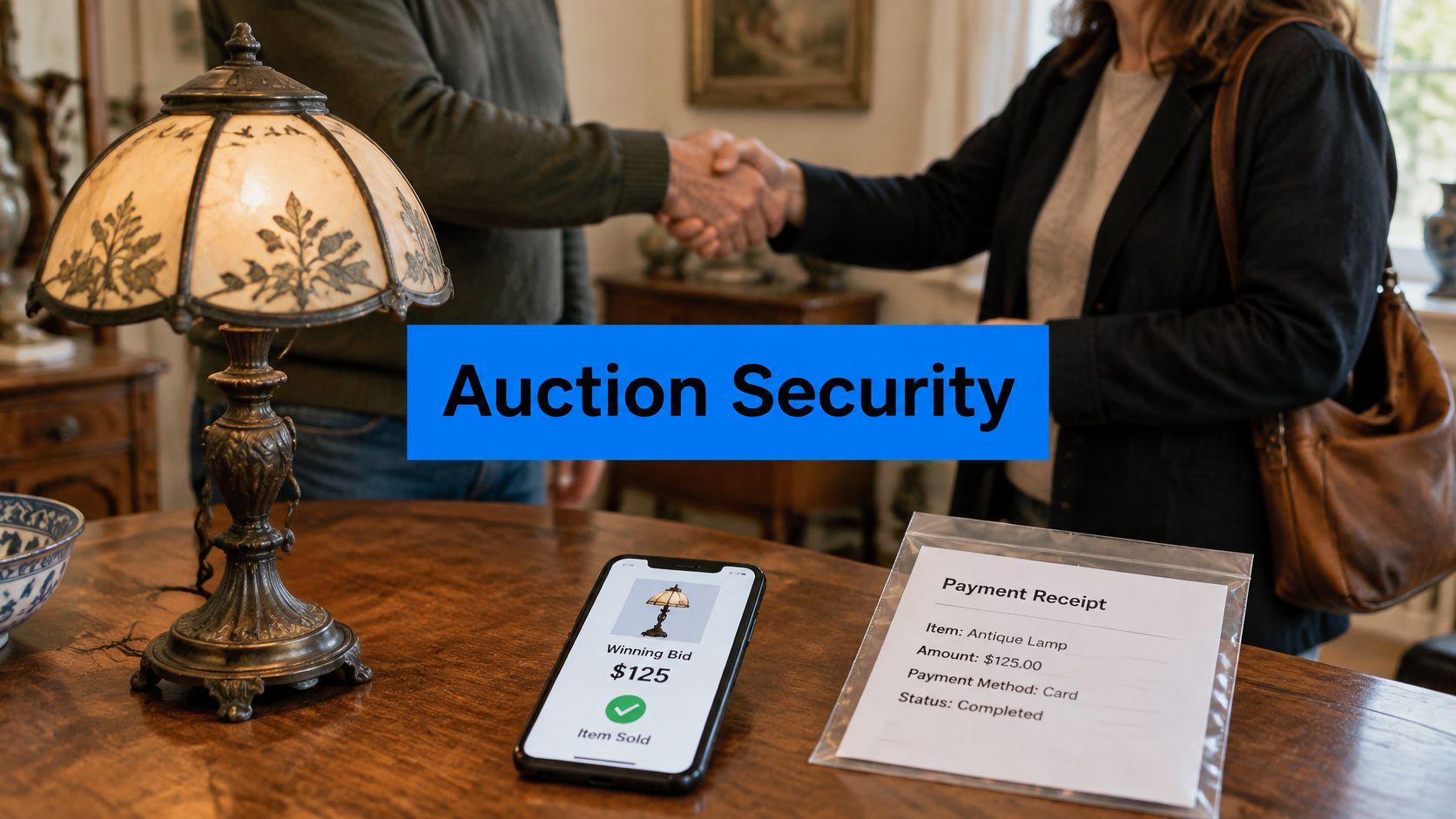
Nearly 45% of consumer complaints recorded in the FBI's 2006 Internet Crime Report involved online auction fraud, making it the largest reported category that year, according to the FBI's account of IC3 complaints. That's a historical benchmark, not today's fraud rate, but it exposes a lasting mistake: protecting an auction means more than protecting a password. For an estate sale, the description, winning bid, furniture handoff, and destination of the proceeds all need attention.
What Online Auction Security Covers
Say you're clearing a parent's home. Your sister photographs a dining table, you manage the auction, and a neighbor helps buyers load their purchases. Everyone needs clear responsibilities, but they don't all need access to bank settings.
Online auction security protects the whole sale, from establishing who's participating to resolving a problem after collection. The wider shopping environment makes that important: authorized fraud or scam activity reached a 1.62% rate in ecommerce in 2024, according to Veriff's 2025 Fraud Report. That industry measure isn't an estate-auction loss rate, but it reinforces why payment authorization alone isn't enough.
Protect the Sale Beyond the Front Door
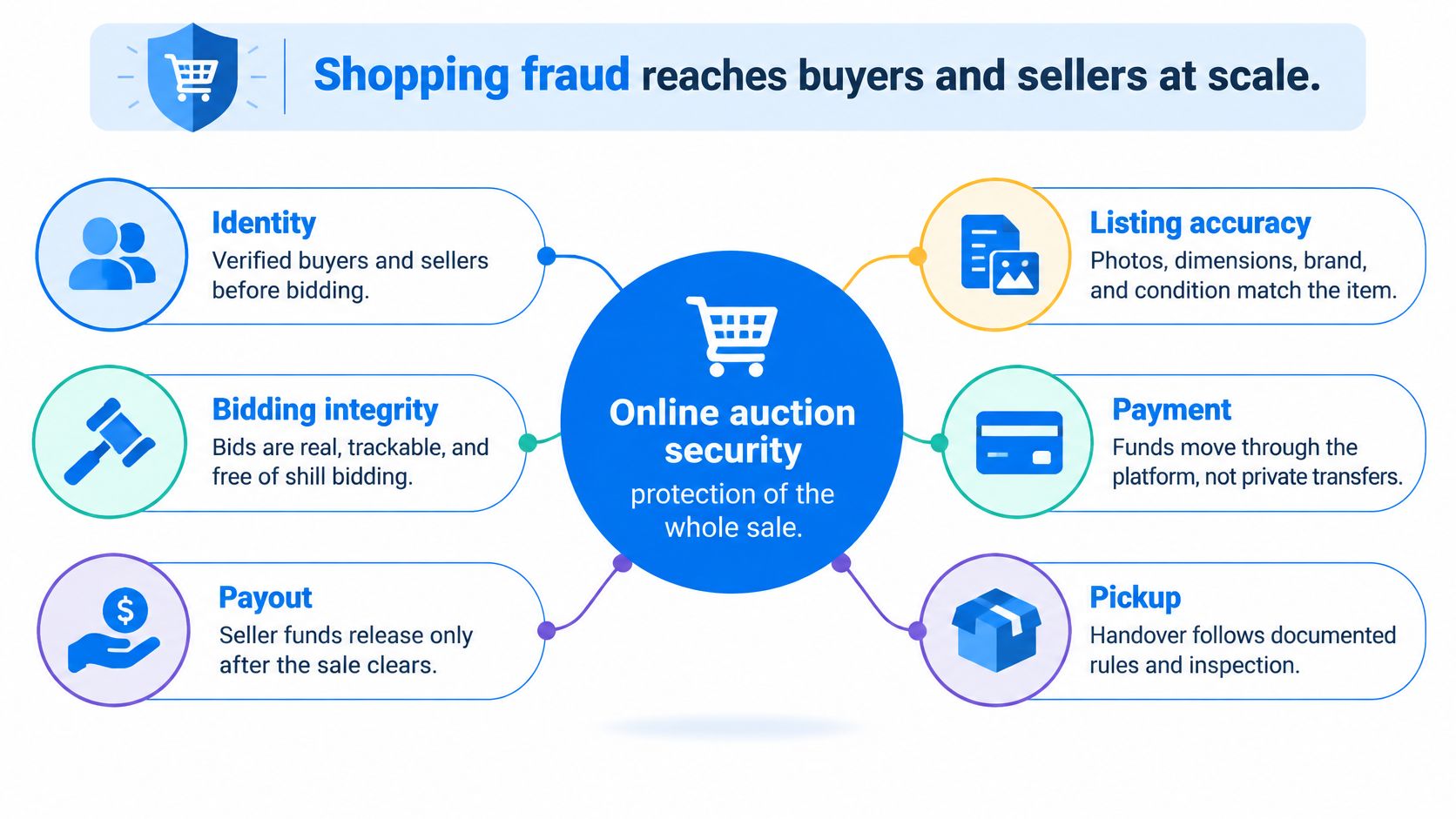
Locking a house's front door doesn't help if someone hands the furniture to the wrong person or sends the proceeds to an unfamiliar bank account. A secure auction needs connected protections:
- Verified people: Establish who controls the seller account and who's entitled to collect each purchase.
- Honest descriptions: Show the actual item, including damage, missing parts, and uncertainty about its history.
- Trustworthy bidding: Keep bids trackable and review attempts to inflate prices through coordinated accounts.
- Protected payments: Keep payment instructions and transaction records inside the marketplace.
- A documented handoff: Match the paid purchase to the person collecting it.
- A recovery route: Provide a way to report unauthorized activity, preserve evidence, and resolve disagreements.
Why Estate Sales Need Different Judgment
An inherited sideboard may have no receipt. An older homeowner may need help using the account, while relatives share the home's internet connection. With collection concentrated into a single pickup day, a small misunderstanding can affect several buyers waiting at the door.
Those circumstances call for clear permissions and good records, not blanket suspicion. A helper can photograph lots without controlling payouts; an executor can disclose uncertain provenance without inventing a manufacturer or date.
Practical rule: Give each person the access their task requires, and make someone explicitly responsible for approving money-related changes.
Security should make the sale easier to verify, not force honest families to pretend they have retail inventory records.
Threats and the Control That Stops Each One
| Threat | What people see | Primary control |
|---|---|---|
| Misdescribed goods | Item differs from photos or condition notes | Multiple photos, flaws disclosed, buyer acknowledgment |
| Non-delivery or non-payment | Winner never collects or seller never gets funds | Prepayment before pickup and a written handoff |
| Chargeback abuse | Cardholder disputes a completed local sale | Identity match, pickup receipt, delayed payout on risky sales |
| Account takeover | Listings or payout bank details change without the seller | Phishing-resistant login and a hold on payout edits |
| Counterfeit or fake provenance | Brand or signature does not match the lot | Honest limits on provenance and no invented certificates |
| Unsafe pickup | Buyer pushes cash, a new address, or a private meeting | Scheduled pickup, ID matched to the winning bidder |
| Shill or ring bidding | The same cluster inflates prices | Risk review of linked accounts, devices, and bids |
| Phishing | Fake support page asks for a code or bank login | Domain-bound credentials and no payout changes by email |
Treat this as a lookup table, not a guarantee that any control eliminates a threat. Start with what someone observes, then identify which record or safeguard could verify the situation.
A buyer holding up a payment screenshot hasn't established that your account received funds. A message displaying the seller's name hasn't established that the seller approved a different pickup address. Verify the event inside the platform, rather than trusting a convincing-looking message about it.
Card Theft Isn't the Whole Problem
In the 2008 IC3 complaint mix, non-delivery of merchandise or payment accounted for 32.9%, internet auction fraud for 25.5%, and credit and debit card fraud for 9.0%, according to the IC3's annual internet-crime report. These are historical complaint categories, not current probabilities for an individual sale.
The distinction matters operationally. A legitimate card payment won't correct a listing that wrongly describes a reproduction as an original. Nor will it prove that a buyer collected a complete lot.
For an estate auction, connect each control to a specific question:
- Before bidding: Does the description distinguish observed facts from family recollection?
- Before collection: Does the platform show the invoice as paid, and is the collector authorized?
- Before releasing proceeds: Has anyone changed the destination or requested an unusual exception?
Review Suspicion Without Inventing Guilt
A family member bidding from the same Wi-Fi network isn't automatically participating in shill bidding. Shared infrastructure is a reason to examine relationships and bidding behavior, not proof that anyone inflated the price.
Likewise, a worn antique with clearly photographed scratches isn't counterfeit merely because it looks old or imperfect. Counterfeit concerns involve identity or authenticity claims; condition concerns involve the item's physical state. Mixing them up makes disputes harder to resolve.
A warning sign should trigger a question that someone can answer with evidence, not an accusation they can't reasonably disprove.
Avoid improvising exceptions under pressure. If a winner wants to collect at a different location, arrange for the proposed change to be verified and documented before anyone moves the item.
Use our fraud-prevention checklist to turn these threat categories into a pre-sale review. Sellers and buyers should each know which actions belong to them and which require platform support.
Platform Controls Behind a Live Auction
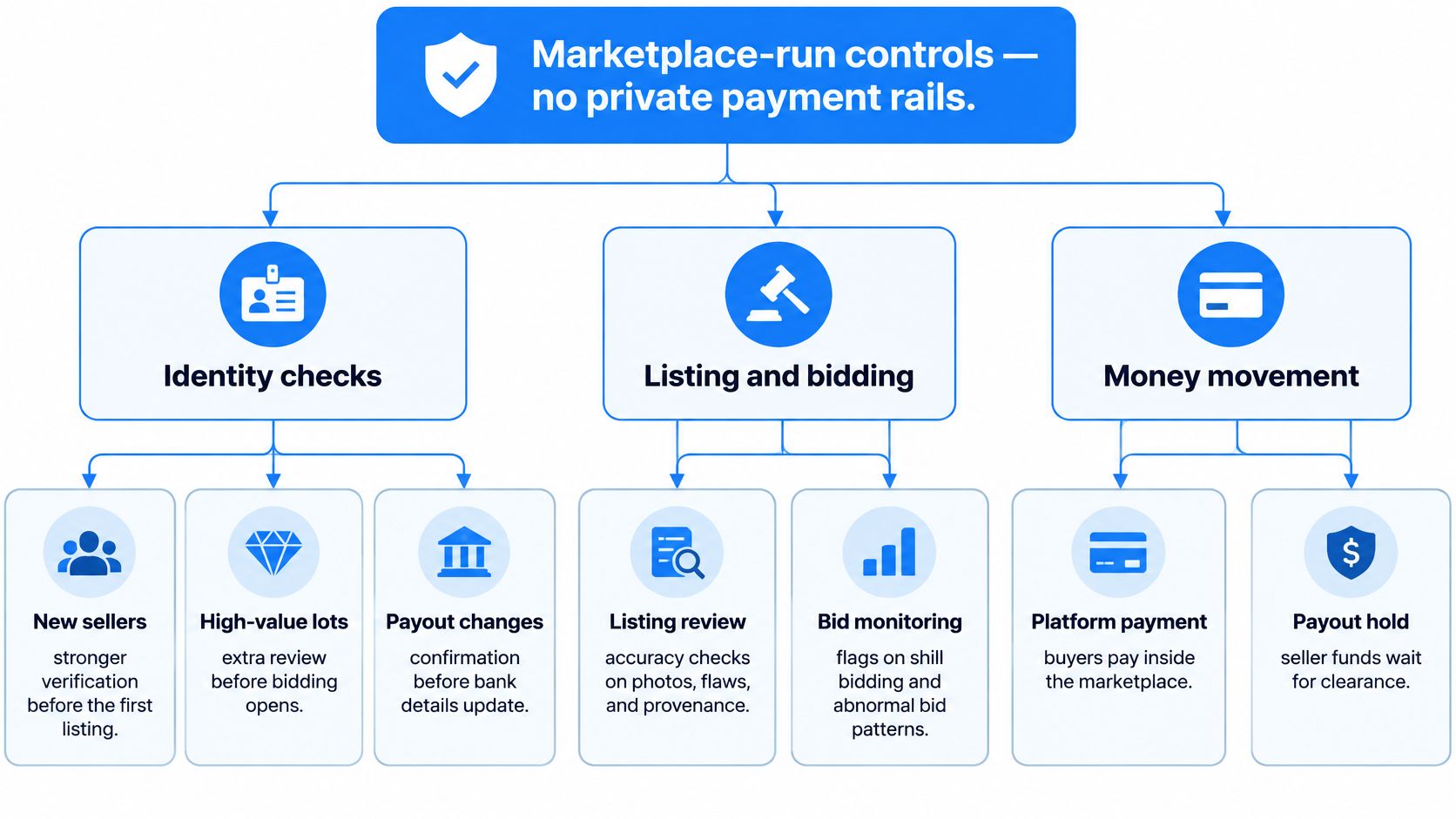
A marketplace should protect the activity that individual sellers can't reliably inspect themselves. That includes staff access, payment status, account recovery, and relationships among bidding accounts.
Verification should match the consequence of the action. Browsing a catalog shouldn't require the same scrutiny as opening a seller account, approving a refund, or replacing the bank account that receives estate proceeds.
Protect Access That Can Move Money
Phishing-resistant authentication uses credentials bound to the legitimate website rather than secrets someone can relay to an impostor, as explained in NIST's guidance on phishing resistance. FIDO2 and WebAuthn are implementations of this approach, commonly presented to users through passkeys or security keys.
A platform should apply these protections to administrators, support agents, payout changes, refund approvals, and sensitive seller actions. Recovery procedures shouldn't bypass that protection by treating access to an email inbox as sufficient proof of ownership.
Useful operational safeguards include:
- Fresh authentication: Request another sign-in when a sensitive action follows an unfamiliar device, location, or account change.
- Activity records: Log credential enrollment, failed sign-ins, recovery changes, and bank-detail edits.
- Linked-event alerts: Escalate a new authentication method followed by replacement of the payout account.
- Restricted authority: Separate routine support work from approval of financial changes.
Connect Bidding and Payment Review
The platform's invoice and payment record should determine whether collection can proceed. A seller shouldn't have to judge a bank-transfer screenshot, follow a buyer's payment link, or build a separate payment arrangement during pickup.
Bid monitoring also needs context. The NetProbe auction-fraud paper describes graph-based analysis of relationships among bidders, sellers, and transactions. The practical lesson is to examine connections between accounts, not just isolated bids.
A marketplace can review shared devices, payment instruments, pickup addresses, and repeated bidding relationships. Suspicious combinations can justify additional verification, temporary bidding restrictions, or manual investigation.
Automatic rejection isn't always the right response. A spouse using the household tablet or an estate helper working from the property may resemble a linked account without acting with bad intent. A reviewer needs enough context to distinguish shared circumstances from coordinated manipulation.
Price settings serve a separate purpose. A reserve protects an acceptable minimum sale price; it doesn't establish that bidders are genuine or that a payment is authorized.
Before opening a sale, establish who can edit the payout destination, what confirmation is required, and whether a hold follows an edit. Those answers matter more than a general assurance that the marketplace is secure.
Seller and Buyer Security Checklists
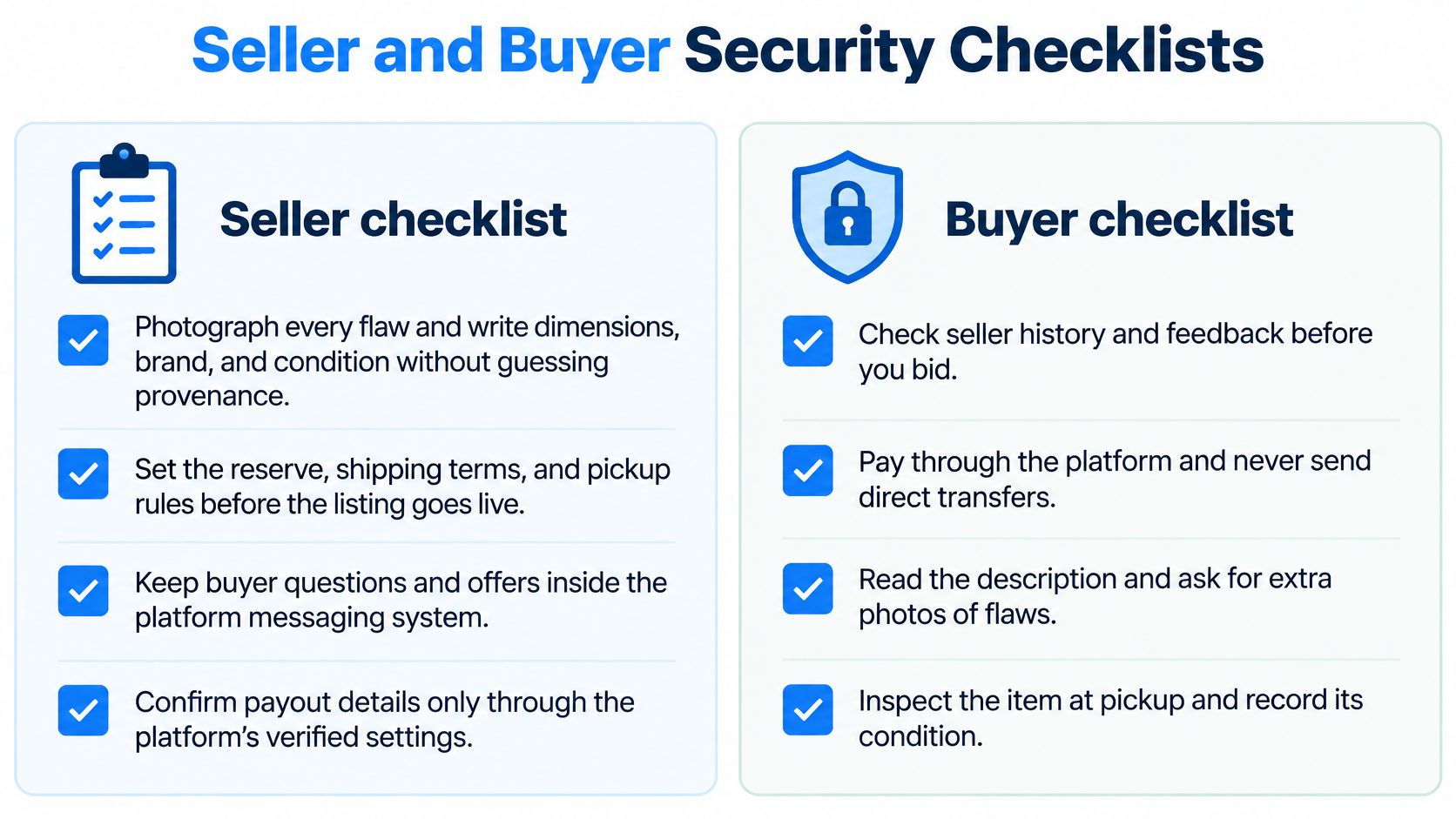
A useful routine gives each participant something concrete to do. Sellers control the catalog and physical handoff; buyers control what they review, how they pay, and whether they follow unexpected instructions.
Seller Checklist
-
Document the actual condition. Photograph flaws, measurements, brand markings, and included parts. For a cabinet, show the damaged hinge and the inside shelves, not just the attractive front.
-
Publish the sale arrangements. Establish the auction window, collection day, and pickup requirements before bidding starts. Keep answers to buyer questions in platform messages so everyone can refer to the same record.
-
Assign helper permissions. Identify who handles photography, messages, and collection, using authorized access arrangements rather than casually sharing credentials. Make sure helpers know who can approve account changes.
-
Choose any minimum deliberately. We offer reserve prices for higher-value items, meaning the minimum a seller is willing to accept. Use that setting when a minimum is justified, rather than trying to renegotiate after bidding ends.
-
Record the handoff. Match the collector to the paid invoice, confirm the lot being released, and note anything left behind. If a buyer authorizes someone else to collect, get that arrangement documented before releasing the item.
Buyer Checklist
-
Resolve questions before bidding. Read dimensions, condition notes, collection requirements, and what the lot includes. In our auctions, competitive bidding sets the final price, so buyers don't haggle at collection.
-
Use the platform's payment flow. Ignore requests to wire funds, use a personal payment app, or pay an unfamiliar invoice outside your account. A seller's urgency doesn't establish that an alternative is legitimate.
-
Keep your winning confirmation. Preserve the lot description and invoice so you can identify exactly what you purchased. For grouped lots, check whether the photograph includes objects that the description excludes.
-
Follow verified pickup instructions. Collect at the published arrangement, and verify unexpected changes through your account or support. Don't travel to a replacement address solely because a message tells you to.
-
Resolve missed collection promptly. Contact the seller through the platform if you can't attend. Our sellers can re-list uncollected items, donate them, or offer them to the next-highest bidder, so don't assume storage continues indefinitely.
Keep Evidence Without Exposing the Household
Retain the photos, messages, and receipts needed to resolve a disagreement. Don't put bank information, identity documents, or a home alarm code into a public listing, and check photo backgrounds for personal paperwork.
Our guide to ways to ensure data security can help you review what you share. If you already see unauthorized bids or unfamiliar account changes, treat that as an incident requiring account containment, not ordinary sale preparation.
Fraud, Non-Delivery, and Honest Disputes
A buyer says a dresser wasn't as described. The seller says the scratches appeared in the photographs. Neither statement, by itself, establishes fraud.
U.S. online-shopping-fraud reports exceeded 387,000 in 2024, according to Pew Research Center's discussion of FTC reporting; the category includes internet auctions. The scale warrants careful records, but it doesn't justify treating every unhappy buyer as dishonest.
Identify What Actually Went Wrong
Different problems require different evidence. Start by describing the disputed event without labeling the other person a scammer.
| Possible outcome | Question to resolve | Most useful records |
|---|---|---|
| Stolen-card fraud | Did the cardholder authorize the purchase? | Payment review, payer details, account activity |
| Non-delivery | Did the paid lot change hands? | Collection messages, handoff record, remaining inventory |
| Condition dispute | Did the item match the description? | Original photos, condition notes, included-parts list |
| Chargeback abuse | Was a received purchase later falsely denied? | Receipt, buyer acknowledgment, collection authorization |
A new account, payer mismatch, and pressure for immediate collection can justify payment review. They don't establish stolen-card use on their own. An authorized family collector can also have a different name from the buyer.
For the dresser, compare the listing's wording with the actual damage. A wide photograph showing the front may not adequately disclose a broken drawer runner, while a close-up and explicit condition note provide much clearer evidence.
Build a Neutral Evidence Packet
Gather the original listing, dated condition photographs, payment record, pickup acknowledgment, and relevant platform messages. For a partial lot, specify what was handed over and what remained rather than describing the entire purchase as delivered.
A newly changed payout destination combined with unfamiliar account access deserves escalation. An heir selling a single inherited object without its original receipt calls for honest limits on provenance, not automatic rejection.
Evidence standard: Record what you can demonstrate, distinguish it from what you suspect, and let the platform review both sides.
Holding a riskier payout can preserve an opportunity to investigate, but it also delays money an honest executor may need. A reasonable workflow explains the reason for review, what documents are missing, and how the seller can respond.
Send the evidence packet through the platform instead of arguing only through private texts. Our chargeback-management guide helps frame payment disputes; if the encounter also involved a Craigslist listing, the Gini Help guide to Craigslist scams is a separate reporting resource.
Don't publish the other person's identification, payment details, or private messages to pressure them into agreement.
After an Account Takeover
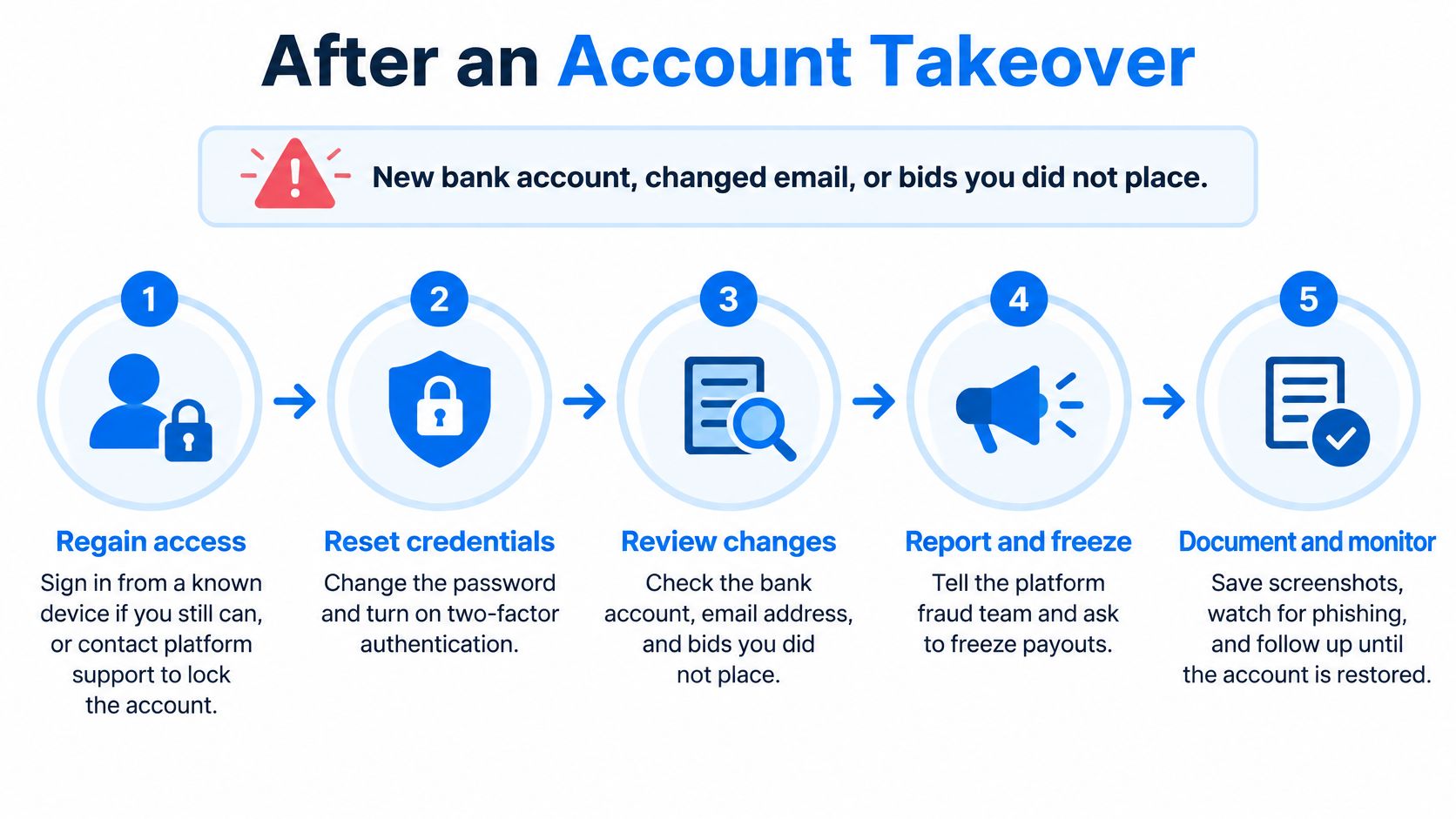
An unfamiliar bank account, changed email address, or bid you didn't place calls for immediate containment. Don't wait for the auction to finish before reporting it.
Freeze Activity and Preserve the Record
-
Use a trusted route to regain access. Open the platform directly from a known device rather than following the suspicious message. If you're locked out, contact general support; use our separate Report Issue option for technical platform problems.
-
Request a freeze. Ask support to stop affected bidding, payouts, and refunds while ownership and recent activity are checked. Identify live auctions and any collection appointments that could be affected.
-
Flag financial changes. Request a hold or reversal of unauthorized payout-detail edits. Don't accept an email-only exchange as sufficient recovery when the email account itself may be compromised.
-
List unauthorized actions. Identify bids, listing edits, messages, and transactions you didn't authorize. Arrange for affected buyers to receive verified instructions through the platform, including whether collection should pause.
-
Preserve evidence. Save screenshots, event times, payment references, and support correspondence. Contact the bank or payment provider about exposed accounts, and retain documentation for an insurer or law enforcement when money has moved.
-
Secure the account before resuming. Replace compromised credentials, remove unknown sessions or devices, and review recovery methods. Resume the auction only after authorized access and transaction instructions are confirmed.
Understand Recovery Limits
Account-takeover losses were projected to reach $17 billion globally in 2025, according to Sift's account-takeover report. That projection isn't a measure of estate-auction losses, but it illustrates why recovery deserves a written procedure.
For an executor, extra identity checks may inconvenience an authorized helper. Weak recovery can create the opposite problem: someone who controls a compromised inbox may gain authority over the sale proceeds. Explain helper relationships to support, but don't request that staff bypass ownership checks.
We may suspend or terminate accounts at our discretion, with or without notice, for terms violations or other reasons. Users retain ownership of uploaded content, while granting us a license to use it in connection with the service.
Our liability for indirect, incidental, special, or consequential damages is limited to the maximum extent permitted by law. A report doesn't guarantee reimbursement or immediate recovery of transferred funds.
Our support hours are Monday to Friday, 9:00 AM to 6:00 PM EST, and Saturday, 10:00 AM to 4:00 PM EST; we're closed Sunday. We typically respond to emails within 24 hours during business days, so include the account, affected sale, and requested freeze clearly in your first message.
Choose a Safer Way to Run the Sale
For a family home, an organized local auction is a practical alternative to scattered person-to-person listings. Keeping bidding, payment records, and collection instructions together gives sellers and buyers fewer disconnected arrangements to verify.
At DIYAuctions, we provide secure payments and buyer verification. Our secure pre-payment system means buyers have already paid before collecting their items, and we handle payment protection, invoices, and transaction flow. We also publish the sale, route local buyers, and keep bidding organized.
Decide Whether You're Ready
- Go: Your condition photos are complete, local collection instructions are ready, and the person controlling the account can manage pickup day.
- Wait: Bank details have unexpectedly changed, an authorized helper can't sign in, or important damage isn't visible in the catalog.
Our commission is 10% of the sale price, capped at $1,000 per transaction. We may change fees with 30 days' notice. For questions about the terms, contact support@diyauctions.com before committing to the sale.
Security doesn't require making every participant's task difficult. It requires putting verification at the moments when someone can change ownership, release an item, or redirect money.
Take three actions today: confirm who controls the payout account, write the pickup rule into your sale plan, and contact our support team before publishing if any login or payment detail looks unfamiliar.
Get the estate sale pricing guide
Enter your email for pricing ranges, planning notes, and a clearer path to launch.