Organizing an Estate Sale: A Practical Guide to Planning, Pricing, and Promotion
Discover organizing an estate sale: a practical guide to planning, pricing, and promotion for maximum returns with less stress.
Organizing an estate sale can feel like a mountain of a task. It's a mix of logistics and emotion, where you have to weigh sentimental attachments against market realities. The most important thing is to have a solid plan from the start—one that helps you earn the most money with the least amount of stress.
Your Framework for a High-Profit Estate Sale
Whether you're downsizing, moving, or managing a loved one’s property, the sheer volume of "stuff" can be overwhelming. But here's the secret: don't think of it as a massive, chaotic cleanout. Instead, approach it as a structured project with clear, manageable phases.
The very first decision you need to make will have the biggest impact on your bottom line. You can either hire a traditional, full-service estate sale company or take a modern, hands-on approach with a DIY platform like DIYAuctions. This choice sets the stage for your profit, timeline, and how involved you'll be.
This simple flowchart breaks the initial planning into three core steps: Assess, Choose, and Organize.
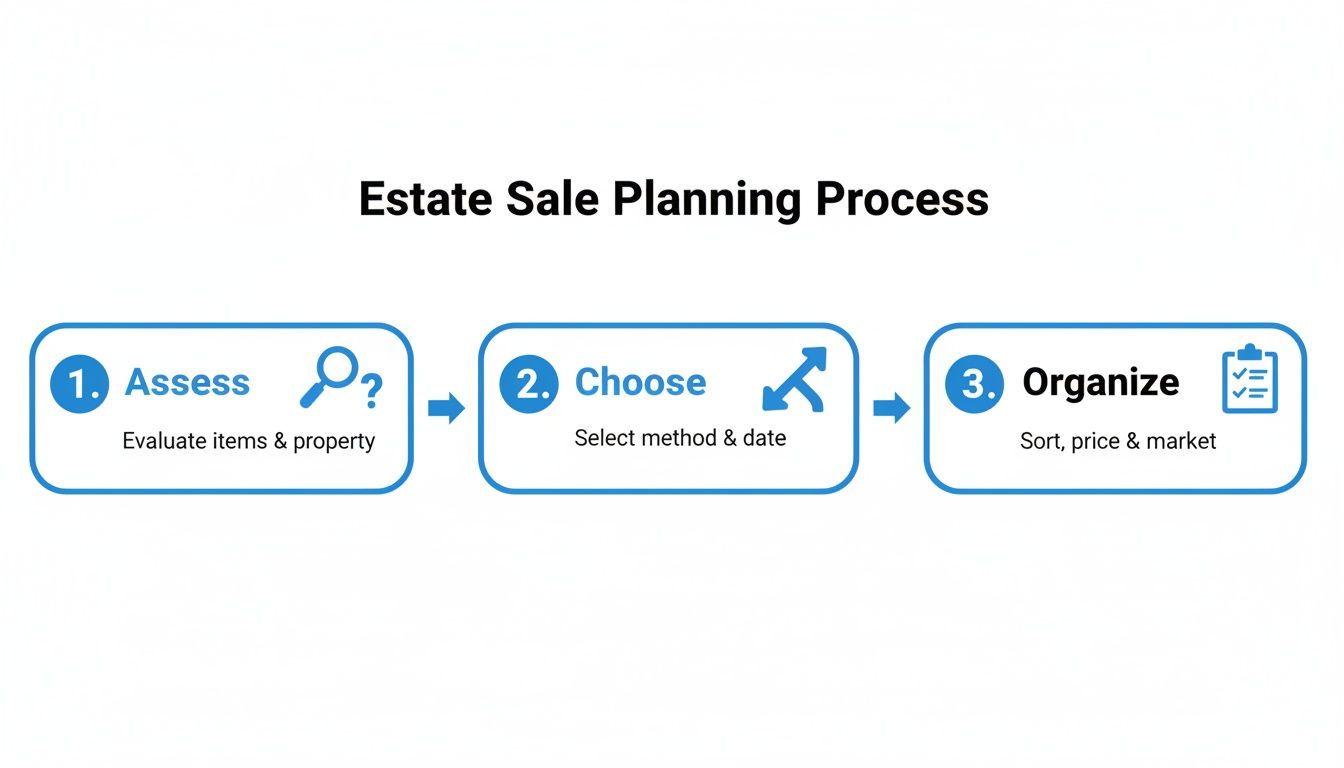
As you can see, a successful sale begins long before you put a price tag on anything. It all starts with a thoughtful assessment and a strategic decision about how you're going to sell.
Weighing Your Options
The financial gap between traditional and DIY methods is huge. A full-service company typically charges a commission between 25% and 50% of the total sales, and that's before they tack on extra fees for labor and advertising. On a $20,000 sale, you might only walk away with $11,000 to $14,000.
Compare that to a DIY auction platform, where commissions are in the single digits. You can boost your take-home amount by 10–30 percentage points—a massive difference that goes straight into your pocket.
Here’s a side-by-side look at the financial and logistical realities of hiring a traditional company versus using a DIY platform.
Traditional Estate Sale vs DIY Online Auction
| Feature | Traditional Estate Sale Company | DIYAuctions Platform |
|---|---|---|
| Commission Rate | 25% - 50% of gross sales | 10% commission (capped at $1,000) |
| Hidden Fees | Often includes charges for labor, advertising, setup, and credit card processing. | No hidden fees. Our platform fee is all-inclusive. |
| Control | Company controls pricing, marketing, and the sale timeline. | You control every aspect—pricing, schedule, and item descriptions. |
| Effort Required | Low. The company handles almost everything. | Medium. You are responsible for cataloging and managing pickup. |
| Net Profit | Significantly lower due to high commissions and fees. | Significantly higher, as you keep the vast majority of the sales. |
| Reach | Limited to local foot traffic over a weekend. | Reaches a wider, targeted audience of local online bidders. |
The table makes it clear: if you're willing to put in some work, the financial upside of a DIY auction is hard to ignore.
The most important decision you'll make is choosing the right sales method for your specific situation. Consider your available time, comfort with technology, and ultimate financial goals before committing to a path.
Handling Specialized Items
As you start sorting, you’ll probably find specialized items—things like rare coins, stamp collections, or valuable art. These aren't your typical household goods and often require a bit of research to sell for what they're truly worth.
If you find yourself with valuable collections, it’s a good idea to consult a complete success guide for selling collections to make sure you get top dollar. A little homework up front helps you separate the everyday items from the high-value assets that need special attention, setting you up for a much more profitable and organized event.
The Hands-On Work: Sorting and Cataloging Your Items
This is where the rubber meets the road. You’re about to turn a house full of possessions into a well-organized, sellable inventory. It can feel like a massive undertaking, but the key is to move methodically, room by room, to keep from feeling overwhelmed.
Trust me, this part can be emotional. But having a solid system in place makes all the difference.
As you begin, create four simple categories for every single thing you touch: Sell, Keep, Donate, and Discard. The trick is to be decisive. I've found it helps to tackle one tiny area at a time—a single bookshelf, one kitchen cabinet, a corner of the garage. Forget trying to conquer a whole room at once. These small, manageable wins build momentum and make the whole process feel less daunting.
For those handling a formal estate, it can also be helpful to get a handle on the legal side of things by understanding the probate inventory process. Knowing your responsibilities upfront can save a lot of headaches later.
Creating Your Master Inventory List
Once your piles are sorted, it’s time to build your master inventory list. This document is the absolute backbone of your sale. It’s not just for you; it's a critical tool for pricing items, marketing the auction, and tracking every single thing that sells.
You don’t need any fancy software. A simple spreadsheet does the job perfectly. To make it even easier, you can grab a pre-made guide and download our free home inventory list template to get started right away.
Your list should have a few key columns for each item:
- Lot Number: This is just a unique ID for an item or a small group of similar items.
- Item Description: Be brief but clear. Think "Vintage Pyrex Cinderella Bowl Set, 4 pcs" instead of just "bowls."
- Condition: Make a note of any chips, scratches, or visible wear. Honesty is everything and builds crucial trust with your buyers.
- Location: Simply note the room where the item lives (e.g., Kitchen, Garage, Master Bedroom).
- Starting Price: Your initial asking price or the starting bid for the auction.
Getting this list organized now will be a lifesaver when you start uploading everything to the DIYAuctions platform. You’ll have all the info right at your fingertips.
Separating High-Value Items for Special Attention
As you catalog, you’ll quickly realize that not all items are created equal. Some things will need a bit more research and a different marketing strategy. It's so important to identify and pull these high-value assets aside from the general household goods.
Think about it this way: everyday stuff like kitchenware and clothes might make up 70–90% of your total items, but it's often the remaining 10–30%—the good jewelry, fine art, or rare collectibles—that bring in 50% or more of the total revenue. Giving these special pieces the attention they deserve is how you really maximize your profits.
Pro Tip: Create a "research" box or pile for anything you think might be valuable but aren't sure about. This is for things like signed artwork, sterling silver flatware, first-edition books, or old electronics. Set them aside to investigate later so you don't break your sorting rhythm.
Crafting Descriptions and Photos That Sell
With your inventory list complete, the last step in this phase is creating the photos and descriptions that will actually get people to bid. High-quality visuals and compelling descriptions are your most powerful sales tools, period.
When it comes to photos, just follow these simple rules:
- Use Natural Light: Find a spot near a window. Good lighting makes everything look better and shows true colors. Please, no harsh flash!
- Show Multiple Angles: Capture the front, back, and sides. For a dresser, open a drawer. For a vase, show the bottom to display any maker's marks.
- Highlight the Flaws: This is a big one. Take a close-up photo of any chip, scratch, or stain you noted in your inventory. This transparency prevents any issues later and shows buyers you're trustworthy.
Your item descriptions should be short but packed with good info. Start with the basics—what it is, the brand, the dimensions. Then, add a little flavor. Instead of writing "Old Chair," try something like, "Mid-Century Modern Armchair with Original Tweed Upholstery, perfect for a reading nook." You're helping buyers imagine the item in their own home, and that connection is what drives bids.
Pricing Strategies That Maximize Your Earnings
Getting the pricing right is arguably the most important part of organizing your estate sale—and it’s where so many people stumble. If you price too high, you’ll turn off potential buyers before they even consider making an offer. But if you price too low, you’re just giving money away.
The key is finding that sweet spot where things sell quickly for what they're truly worth. This isn’t about guesswork. It’s about a simple research process that keeps your prices grounded in reality, not emotion.
Research Your Way to the Right Price
Your best friends in this phase are online marketplaces. For most of the stuff you’ll be selling—think kitchenware, everyday furniture, books, or clothing—a quick search will tell you almost everything you need to know.
But here’s the trick: don’t just look at what sellers are asking. You need to look at what things have actually sold for. The real gold is in the sold listings. On a site like eBay, you can filter your search to see what items like yours have sold for over the last 90 days. That’s hard, real-world data showing you exactly what buyers are paying right now.
- Facebook Marketplace: A great resource for gauging local demand and prices for bigger items like furniture.
- eBay (Sold Listings): This is the gold standard for collectibles, antiques, and brand-name goods.
- Etsy: Perfect for researching handmade items, unique vintage décor, and craft supplies.
You might look at an old CorningWare dish and think it’s worth $10. A quick search of sold listings could show you that a specific pattern regularly sells for over $50. That’s an extra $40 in your pocket just for a few minutes of research.
Differentiating Sentimental and Market Value
This is often the hardest part for anyone selling personal items. The truth is, an item’s personal history and the memories tied to it have zero impact on its market value. That dining table that hosted 30 years of family gatherings? To a buyer, it's just a used table.
You have to learn to see your items through a buyer’s eyes. Be objective about the condition, the style, and what’s currently in demand. It’s a tough mental shift, but it’s absolutely essential for a successful sale.
Your goal is to price items based on what someone is willing to pay for them today, not what was paid for them decades ago or what they mean to your family. Market value is determined by supply, demand, and condition—nothing more.
When you’re emotionally invested, getting an outside perspective is a game-changer. This is where an online auction format really proves its worth. It lets the market itself set the final price, effectively removing your personal bias from the equation.
The Power of Auction Style vs. Fixed Pricing
You have to decide between sticking a fixed price on something or letting it run as an auction. A fixed price is simple, but it’s also limiting. There’s no room for competition.
An auction-style listing, on the other hand, creates a competitive environment, especially for unique or desirable items. Bidders can quickly drive the price far beyond what you might have asked for initially. Platforms like DIYAuctions give you the flexibility to use this to your advantage.
You can set a low starting bid to get people interested and, for your more valuable items, a reserve price. A reserve is your safety net—a confidential minimum price that has to be met for the item to sell. If the bidding doesn’t reach your reserve, the item doesn’t sell, protecting you from letting a valuable piece go for a steal.
This strategy ensures you never lose out while still opening the door to a potential bidding war. For a deeper dive, check out our complete guide on pricing for estate sales. It's this kind of control that makes running the sale yourself so powerful.
Turning Your Inventory Into Cash: Marketing Your Sale to Eager Buyers
You can have the most beautifully cataloged and priced items, but without a steady stream of interested buyers, it’s just a well-organized collection. Smart marketing is what gets eyeballs on your auction and turns those clicks into cash. This isn't just about putting a sign on the street corner; it’s about creating a digital buzz that finds the right people where they're already looking—online.

The great thing is, a platform like DIYAuctions already does a lot of the heavy lifting by tapping into its built-in network of local bidders. But you can pour fuel on that fire. A multi-channel approach from your end is how you create a can't-miss event, connecting with everyone from serious collectors to neighborhood families hunting for a new dining table.
Your Listings Need to Create Buzz
Think of your online listing as the front door to your sale. Its only job is to grab attention and get people excited from the very first glance. You need to think like a movie trailer director—showcase the highlights and create some intrigue.
It starts with a compelling headline. Don't just say "Estate Sale." Try something like, "Mid-Century Modern Furniture & Vintage Vinyl Collector's Auction." This immediately flags down buyers searching for those exact keywords.
From there, your description should tell a quick, interesting story. "A lifetime collection from a passionate woodworker and artist" has so much more personality and appeal than a dry list of what’s for sale.
Most importantly, your photos have to do the heavy lifting. Bright, clear pictures of your best items are non-negotiable. Dark or blurry shots are a huge turn-off. Try grouping items into little vignettes—it helps people imagine how those pieces might look in their own homes.
A Simple Multi-Channel Marketing Plan
To really maximize your audience, you need to promote your sale across a few key online channels. The idea is to create multiple touchpoints where potential buyers can stumble upon your event. This casts a wide net and ensures you’re capturing different kinds of shoppers.
Here are the essential places to focus your efforts:
- Local Facebook Groups: This is a goldmine. Search for and join community, yard sale, and buy/sell groups for your town and the surrounding areas. A single, well-crafted post with your best photos can reach thousands of locals instantly.
- Facebook Marketplace: Listing your sale here is a must-do. Its huge user base and location-based algorithm make it a powerhouse for attracting nearby buyers who are actively looking for secondhand goods.
- Nextdoor: This platform is perfect for reaching your immediate neighbors. These are often highly motivated buyers who love the convenience of a sale happening just down the street.
Whenever you post, always include a direct link to your DIYAuctions sale page. This funnels everyone to one central hub where they can see the full catalog and start bidding. For a deeper dive, check out our complete guide on estate sale marketing.
Pro Tip: Set up a simple marketing schedule. Start promoting your sale online about 7-10 days before the auction closes. Post updates every couple of days, maybe highlighting a different category each time. This keeps your sale top-of-mind and builds momentum for those final, crucial bidding hours.
Finding Buyers for Niche and High-Value Items
While most of your bidders will be local, don't forget about reaching a wider audience, especially if you have high-value or collectible items. Specialized online forums or collector-focused social media groups can be game-changers. If you're selling a collection of rare coins or vintage cameras, a single targeted post in the right forum can attract serious national buyers willing to pay top dollar.
This is where the online auction format truly shines. It completely breaks down geographical barriers. A collector from another state can compete directly with a local buyer, which naturally drives up the final price on your most valuable pieces.
Running a Smooth Pickup Day and Wrapping Up
After all the sorting, pricing, and marketing, pickup day is where your hard work finally pays off. This is the last crucial phase, and a little planning goes a long way toward making it a stress-free conclusion. The goal here is a simple, efficient process that feels seamless for both you and your buyers.

The modern, online auction format simplifies this day immensely. With platforms like DIYAuctions, all payments are processed securely beforehand. You won’t be fumbling with cash or worrying about no-shows. Your only job is to manage the flow of people and make sure everyone gets their items safely.
Setting the Stage for an Easy Pickup
Preparation is everything. Before the first buyer arrives, walk through the home and stage the sold items for easy retrieval. Your mission is to minimize chaos and make each handoff as quick as possible.
- Group by Buyer: If you have the space, group all items won by a single person together. Just slap a label on the pile with their name or invoice number.
- Create a Staging Area: For larger sales, moving everything to a central spot like the garage or living room is a game-changer. It prevents people from wandering all over the house.
- Clear the Pathways: Make sure all walkways from your staging area to the front door are wide and clear. This is non-negotiable for large furniture and is a huge safety consideration.
A little prep work like this makes the entire day run smoother, turning what could be a chaotic event into an orderly process.
Managing Buyer Flow and Scheduling
The biggest advantage of a DIY online auction is the ability to schedule pickups. Instead of a free-for-all, you can use the platform’s tools to have buyers select specific time slots. This staggers arrivals and keeps a crowd from forming at your door.
As buyers arrive, have a simple check-in process ready. Ask for their name or invoice number, double-check their purchases on your list, and then point them to their items. For heavy furniture, be firm that buyers are responsible for bringing their own help and any dollies or blankets they need. This small detail prevents delays and protects you from liability.
Having a friend or family member help you on pickup day can be a game-changer. One person can check buyers in at the door while the other helps locate items, making the entire process twice as efficient and much less stressful.
The Post-Sale Plan for Leftover Items
It’s almost a guarantee you'll have some items left over. Having a plan for what to do with them is the final step. Don't let the leftovers linger—tackle them right away while you still have momentum.
First, quickly sort what’s left into three piles: Resell, Donate, and Discard.
- Resell: For any valuable items that didn’t sell, consider listing them on a different online marketplace or taking them to a local consignment shop.
- Donate: This is your best bet for most unsold goods. Many charities, like Habitat for Humanity or the Salvation Army, offer free pickup for large donations, which is a huge time-saver. Don't forget to get an itemized receipt for tax purposes.
- Discard: For anything broken or unsellable, it’s time for a clean-out. Hiring a professional junk removal service can clear the property in an hour or two. The cost is often well worth the time and energy it saves.
The time commitment for organizing an estate sale yourself is significant. Industry estimates show that liquidating an average household requires 40 to 120 person-hours for everything from cataloging to managing the pickup day. DIY platforms shift this labor to you, but in return, you keep a much larger slice of the proceeds. For those focused on maximizing their financial return, it’s an effort that can really pay off. To see how these factors impact financial outlooks, you can learn more about real estate market trends.
Common Questions About Organizing an Estate Sale
It's completely normal to have a ton of questions when you're staring down the barrel of your first estate sale. From navigating the legal side of things to figuring out the day-to-day logistics, feeling a bit overwhelmed is part of the process.
Let's cut through the noise. Here are some straightforward answers to the questions we hear most often, designed to give you the confidence you need to run a successful sale.
What Are My Legal and Tax Responsibilities?
When you’re tasked with managing an estate, you often step into the role of a fiduciary. It sounds like a complex legal term, but it really just means you have a duty to act in the best interest of the estate and its heirs by properly accounting for every asset sold. It's a big responsibility, but a manageable one.
Most of the time, selling personal property doesn’t create a tax headache. You'd typically only owe capital gains tax if an item has shot up in value since it was originally acquired. But tax laws are tricky and change from state to state. This is one area where you don't want to guess.
Our advice? Always chat with an estate attorney or a good tax professional. They can give you advice for your specific situation and make sure you're ticking all the right boxes. This is also where a platform like DIYAuctions becomes your best friend. It automatically generates a full digital record of every sale, giving you the clean, transparent documentation you need for any legal or tax reporting.
How Should I Handle High-Value Items Like Art or Jewelry?
If you come across something you think might be valuable—fine art, a piece of antique furniture, real jewelry, or a rare collectible—stop and get a professional appraisal. This is non-negotiable. An appraiser doesn't just put a price tag on an item; they verify its authenticity, which gives serious buyers the confidence to bid high.
Think of that official appraisal report as your most powerful sales tool. It allows you to set a solid reserve price online, which acts as your safety net to make sure a valuable piece doesn’t slip away for less than it's worth.
An appraisal isn't an expense; it's an investment in maximizing your return. For a unique piece, the cost of an appraisal can be a tiny fraction of the additional profit it helps you secure from educated buyers.
To really attract the right bidders for these premium items, your photos have to be top-notch. Use high-resolution images that show every detail. Make sure to photograph and describe any maker's marks, certifications, or known history—this is exactly the kind of proof that gets discerning collectors excited to bid.
When Is the Best Time of Year for an Estate Sale?
Traditionally, the sweet spots for in-person sales have always been spring and early fall. The nice weather just gets more people out and about. It’s also a good rule of thumb to avoid major holiday weekends, since your potential buyers are likely busy or out of town.
But the beauty of an online auction is that it changes the game. Your bidding can run for a week or more, so buyers can browse and bid from their couch, rain or shine. The weather on the pickup day is still a factor, but it's much less of a deal-breaker.
The single most important element isn't the season—it's giving yourself enough time. Rushing is the costliest mistake you can make. You should plan for a bare minimum of 4-6 weeks from the day you start sorting to your final pickup day. That buffer is what allows you to research, catalog, and market your items properly so you don't leave money on the table.
What Should I Do with Everything That Doesn't Sell?
You will have items left over. It’s a fact of every single sale. The key is to have a plan in place before your auction even ends, so you’re not left scrambling.
Here’s a simple, three-step approach:
- Line Up a Charity Pickup: Many non-profits will happily take your unsold goods. Organizations like Habitat for Humanity ReStore or the Salvation Army are great options and will often schedule a free pickup for furniture and other large items. Don’t forget to get an itemized receipt for a potential tax deduction.
- Book a Clean-Out Service: For the things that can't be donated, a junk removal or clean-out service is worth its weight in gold. They can clear out an entire property in a matter of hours, saving you an incredible amount of time and physical labor.
- Offer a Final "Buyout" Lot: Another great strategy is to bundle all the remaining items into one big lot. You can offer it up to a single buyer for a low, flat price with one condition: they have to take everything. It’s the fastest way to get to a completely empty house.
More guides in Estate Sale Basics
July 28, 2026
Revenue Reporting for Estate Sales and Auctions
Learn revenue reporting essentials for estate sales and auctions. Discover key metrics, templates, and best practices to simplify tracking and compliance.
Read guideJuly 26, 2026
Stamp Collection Valuation: A Practical Step-by-Step Guide
Stamp collection valuation made simple. Learn how to identify, grade, price, and sell your stamps with confidence for estate sales or consignment.
Read guideJuly 23, 2026
Estate Sales Brick NJ: Your 2026 Guide to Success
Planning your estate sales brick nj? Our guide covers permits, pricing, marketing, & running a safe sale with DIYAuctions.
Read guideGet the estate sale pricing guide
Enter your email for pricing ranges, planning notes, and a clearer path to launch.