Arizona Estate Sales: Your Guide to arizona estate sales Success in 2026
Discover effective arizona estate sales strategies: pricing, laws, and deciding between a company or DIY option in 2026.
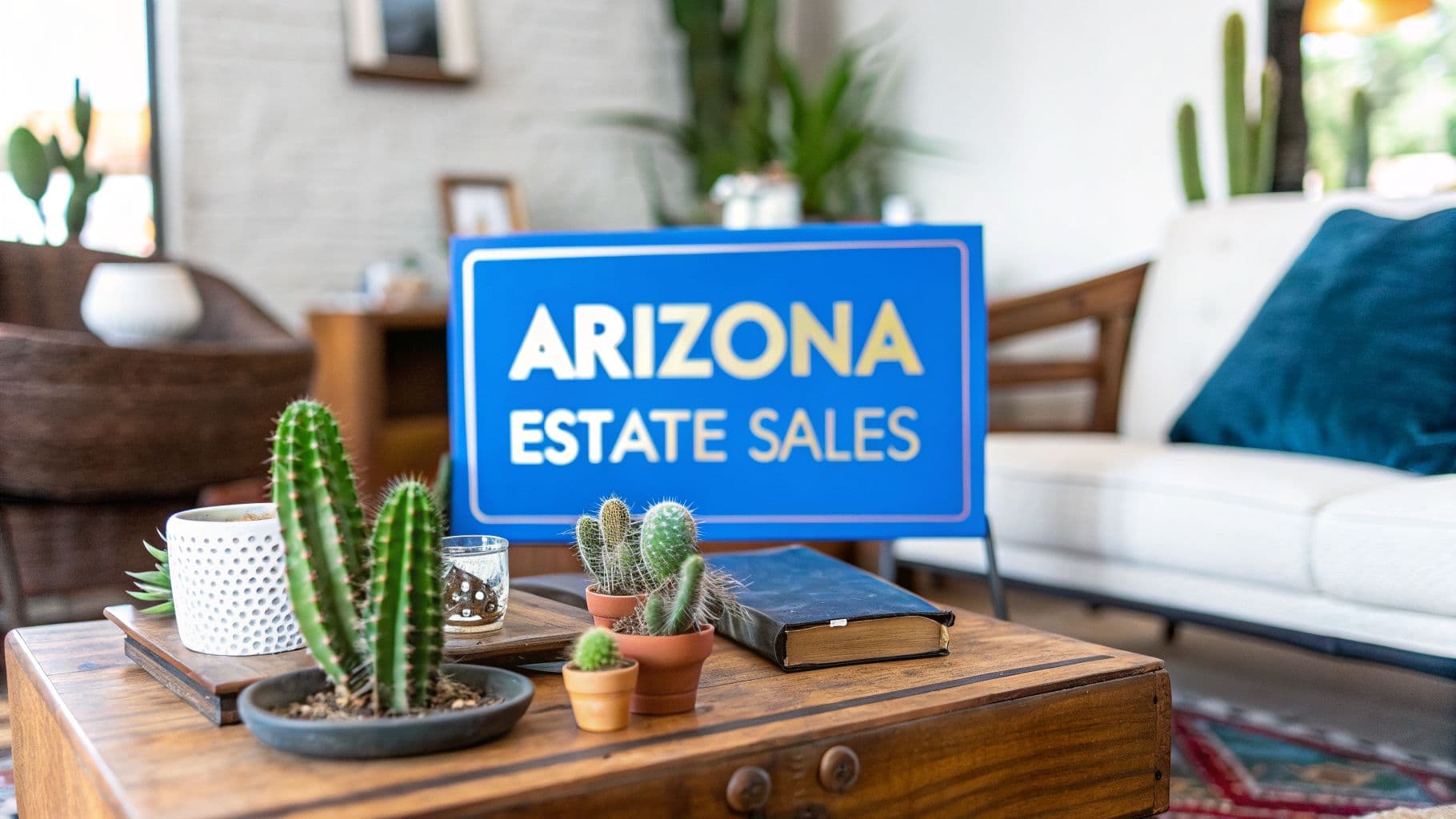
So you’re thinking about an Arizona estate sale. Whether you're downsizing, moving out of state, or handling the affairs of a loved one, liquidating a home's contents can feel like a monumental task. But it doesn't have to be.
Think of an estate sale as a well-organized, professional-grade garage sale—but for an entire household. It’s a way to turn a lifetime of accumulated items into cash, all in one go, without the endless hassle of selling things one by one.
Your Guide to Navigating Arizona Estate Sales

This isn't just about clearing out a house; it's a smart financial decision. For anyone navigating a major life transition, an estate sale provides a clear, structured path to efficiently sell a large volume of goods.
And right now, this is especially true in Arizona's shifting real estate market. The Phoenix metro area, for example, is seeing a huge spike in housing inventory. As of May 2025, active listings hit 18,701—that’s a 37% jump from last year and the most homes we’ve seen on the market since 2017.
With more houses available and properties taking longer to sell, the ability to clear out a residence quickly and profitably is more critical than ever. You can dive deeper into these numbers in the latest Arizona real estate market report.
The Two Paths for Your Sale
When you're ready to move forward with an Arizona estate sale, you really have two main options. Each has its own set of pros and cons, and the right choice depends on your timeline, budget, and how hands-on you want to be.
-
Hiring a Full-Service Company: This is the traditional, turn-key approach. You hand over the keys, and an estate sale company handles everything—sorting, pricing, staging, marketing, and running the sale. It’s the best choice if convenience is your top priority, but be prepared for them to take a hefty commission.
-
Managing a DIY Online Sale: This is the modern, self-managed route. Using an online auction platform, you stay in the driver's seat. You’ll catalog your items, set the pricing, and manage the auction online, which all leads up to a single, organized pickup day for all the buyers. This path saves a lot of money and gives you complete control.
Here’s a simple way to think about it: hiring a company is like paying for a full-service moving crew to pack up your house for you. A DIY online auction is like renting the U-Haul and doing it yourself. One is easier but costs more; the other requires your time but saves you a ton of cash.
This guide will walk you through both of these options in detail. We’ll give you the real-world insights you need to decide which approach makes the most sense for your family and your financial goals. Our aim is to turn what feels like an overwhelming project into a manageable—and profitable—experience.
Understanding Arizona's Estate Sale Rules

Before you put a price tag on a single thing, let’s talk about the legal side of holding an Arizona estate sale. Getting a handle on the rules isn't just about checking off boxes—it's about protecting yourself from fines and making sure your sale runs smoothly. The good news? Arizona’s regulations are relatively simple once you know what to look for.
First, let's get the big one out of the way. Arizona is one of the handful of states that does not have a state-level estate or inheritance tax. This is a huge relief, as it means your heirs won't be taxed by the state on what they receive from the estate itself.
However, that’s different from the sales tax you’ll need to collect on the items you sell. This is where Arizona’s Transaction Privilege Tax (TPT) comes into play. Think of the TPT as the state’s version of sales tax. The statewide rate is 5.6%, but cities and counties tack on their own rates, bringing the combined average to around 8.52%.
Do You Need a TPT License for Your Sale?
This is probably the most common question we hear from people running their own Arizona estate sales. The short answer is: it depends, but it's better to be safe than sorry.
The Arizona Department of Revenue does have a "casual sale" exemption, but it’s a pretty narrow one.
A "casual sale" usually means an infrequent sale by someone who isn't in the business of selling—like a normal weekend garage sale. An estate sale, with its larger volume of items and potential revenue, can easily be seen as a business activity that requires a TPT license.
If you hire a professional estate sale company to run your event, they are considered the retailer. They take on the full responsibility of getting the TPT license, collecting the tax, and paying the state. It's completely off your plate.
But if you run a DIY sale, you are the retailer. For any sale of significant size, getting a temporary TPT license is the smartest and safest move. It keeps you compliant and helps you sleep at night, knowing you won't face penalties down the road. For a deeper dive into the legal nuances, our guide to estate sale laws provides a great overview.
Navigating Local City Ordinances
Beyond state taxes, you absolutely have to pay attention to local city rules. These can change dramatically from one town to the next and often deal with the practical side of running the sale itself.
-
Phoenix: The city is very particular about where you can place signs. You can’t just stick them on any street corner. They must be on private property (with permission!) and are not allowed in public rights-of-way.
-
Scottsdale: Known for being a bit stricter, Scottsdale really clamps down on signage. This means you’ll need to lean more heavily on digital marketing and good old-fashioned word-of-mouth to draw a crowd.
-
Tucson: Here, the focus is on keeping traffic and parking manageable. If you’re expecting a big turnout, you need a solid plan to make sure you’re not blocking driveways or causing a neighborhood jam.
Last but not least, don't forget about your Homeowners' Association (HOA). So many communities in Arizona have their own covenants that can dictate the days, hours, and even how many sales you can have per year. Always check with your HOA before you even think about setting a date for your Arizona estate sale. A quick call to the board can save you from a world of headaches and a potentially hefty fine.
Hiring a Company Versus a DIY Online Estate Sale
When you're planning an Arizona estate sale, your biggest decision is how you'll actually run it. This choice really boils down to two paths: hiring a traditional, full-service company or managing the sale yourself with a DIY online platform.
Think of it like this: a full-service company is like going to a restaurant where the staff handles everything from cooking the meal to washing the dishes. A DIY online sale is more like a gourmet meal kit—you get the best ingredients and a proven recipe, but you get the satisfaction of doing it yourself and saving a ton of money.
The Full-Service Company Approach
Hiring a traditional estate sale company in Arizona is definitely the hands-off option. They act as a full-service concierge, coming into the home to sort, appraise, and stage everything for a multi-day event. They handle all the marketing and manage the crowds that come through the house.
Of course, that convenience comes with a hefty price tag. The industry standard commission for these companies runs anywhere from 35% to 50% of the total sales. If your sale brings in $20,000, that’s between $7,000 and $10,000 right off the top.
Part of what you're paying for is their expertise in presentation. Many companies apply professional staging strategies to make items look more appealing to shoppers, which can help boost final prices.
The DIY Online Platform Approach
The modern alternative is to use a DIY online auction platform. This approach puts you in the driver's seat, giving you control over the process and, more importantly, the profits. Your job is to catalog the items by taking photos and writing descriptions, then organizing them for pickup day.
The platform handles the rest—hosting the online auction, marketing your sale to a network of local buyers, processing every payment securely, and providing support. This is a far more cost-effective model. A platform like DIYAuctions, for example, charges a straightforward 10% commission that’s capped at $1,000.
On a $20,000 sale, the difference is staggering. A traditional company might take $8,000 (at 40%), leaving you with $12,000. A DIY platform with a capped fee would take only $1,000, leaving you with $19,000. That's an extra $7,000 in your pocket for your own time and effort.
This method also makes the event itself much smoother. Instead of having strangers wandering through the home for several days, an online auction finishes with a single, scheduled pickup day. It’s a huge improvement for your privacy and security. You can dig deeper into the pros and cons by exploring our guide on choosing the right estate sale help.
Traditional Estate Sale Company vs. DIY Online Platform
Seeing the two options side-by-side can make the decision much clearer. Here’s a quick breakdown of what to expect from each path for your Arizona estate sale.
| Feature | Traditional Estate Sale Company | DIY Online Platform (e.g., DIYAuctions) |
|---|---|---|
| Average Cost | 35-50% commission on gross sales | 10% commission (often with a cap) |
| Your Workload | Low. The company handles nearly all tasks. | Medium. You catalog items and manage pickup. |
| Control | Low. The company sets prices and runs the sale. | High. You control pricing, timeline, and process. |
| Timeline | Longer, with a multi-day public sale in the home. | Faster, with an online auction and a single pickup day. |
| Net Profit | Lower due to high commission fees. | Significantly higher due to low, capped fees. |
| Privacy & Security | Lower. The public walks through the home for days. | Higher. Only winning bidders arrive on a set day. |
Ultimately, the right choice depends on what you value most. If you truly need a hands-off solution and are willing to give up a large chunk of the proceeds for it, a traditional company could work.
But if you want to maximize your financial return and keep control, a DIY online platform offers a powerful and far more profitable alternative.
The Step-By-Step Online Estate Sale Checklist
Tackling an entire online Arizona estate sale yourself might sound overwhelming. But when you have a clear plan, it’s not just manageable—it’s profitable. We’ve broken the whole process down into five simple phases to guide you from a house full of items to a successful, stress-free sale.
Think of this checklist as your roadmap. Following it step-by-step turns a big job into a series of small, achievable wins, putting you in complete control.
Phase 1: Sort and Declutter
Your first job is to figure out exactly what you have. Before you can think about selling, you need to go room by room and sort every single item into one of four buckets.
- Keep: These are the non-negotiables—personal mementos, heirlooms, and anything you or your family wants to hold onto.
- Sell: This is everything with resale potential. Don't be shy here. You’ll be amazed at what buyers are looking for, from major furniture down to everyday kitchen gadgets.
- Donate: Set aside items that are in decent shape but might not be worth the time to sell. A local Arizona charity will be happy to take them.
- Discard: Anything broken, expired, or too worn out for a second life goes in this pile.
This is the most hands-on part of the process, but getting the sorting right from the start makes everything that follows a whole lot easier.
Phase 2: Catalog and Price
Now that you know what you're selling, it's time to build your online catalog. This is how you’ll present your items to the world, and a great catalog is your best sales tool.
Start with high-quality photos. Natural light is your best friend. Take pictures from multiple angles and be upfront about any dings or unique details. For an online auction, good photos are everything.
Next, write honest descriptions. Include the basics like dimensions, brand, and condition. If an item has a story—maybe that armchair was a favorite reading spot—add it in! A little personality can make a big difference.
Finally, you need to price your items to sell. The goal of Arizona estate sales is liquidation, not retail. Check what similar items have actually sold for on platforms like DIYAuctions, not just what people are asking on classifieds. For a deeper dive, check out our complete estate sale checklist.
Phase 3: Schedule and Market
With your catalog ready to go, it’s time to set your auction dates. A 7-10 day run is usually perfect, giving buyers enough time to browse and place their bids. The most important date to set is your pickup day—plan for a single, convenient weekend day right after the auction ends.
Your online platform handles most of the marketing by promoting the sale to its network of local buyers. You can give it an extra push by sharing the auction link on your Facebook page or in neighborhood groups. The more people who see your sale, the more bids you'll get.
Pro Tip: Arizona's economic climate creates a great opportunity for liquidating assets. Decades of rising home values mean many estates are filled with quality items. The All-Transactions House Price Index for Arizona (AZSTHPI) hit a high of 731.53 in late 2025. And with properties now taking a median of 78 days to sell, you have a solid window to catalog and sell everything properly.
The simple infographic below shows just how straightforward the process is.

It really just boils down to those three key stages: sorting, listing, and selling.
Phase 4: Host a Smooth Pickup Day
This is the big day. Unlike a traditional sale with shoppers wandering through the house for days, your online auction wraps up with one organized pickup event. Best of all, payments are already handled online, so there’s no haggling and no fumbling with cash.
Your job is simple: have all the sold items organized and ready for their new owners. Grouping items by the buyer’s invoice number makes for a fast, smooth handoff. The platform provides a master list of all winning bidders and their items, so managing the flow is easy.
Phase 5: Post-Sale Wrap-Up
Once the last car has driven away, you’re in the home stretch. The auction platform will transfer your net earnings directly to your bank account, minus their commission.
You’ll probably have a few things left over. Here’s what you can do with them:
- Donate the remaining items to a local charity.
- Call a junk removal service for anything that can't be donated.
- See if a "buyout" service will give you a flat fee for the entire remaining lot.
By following this five-phase plan, you can run your own online Arizona estate sale with confidence, getting the most money back with the least amount of stress.
Pricing Items to Maximize Your Sale Profit
When it comes to a successful estate liquidation, pricing is everything. But the strategy for an Arizona estate sale isn't like pricing for a retail shop. Your goal is to sell everything in a very short amount of time.
If you price things too high, you’ll be left with a house full of unsold goods. Price too low, and you're just leaving money on the table.
Finding that sweet spot requires a change in mindset. Instead of trying to get top dollar for every single item, you need to focus on fair, attractive prices that encourage lots of bidding. A house cleared of its contents is the real win here.
Researching Real-World Prices
The only way to price smart is to know what your items are actually worth on the secondary market right now. A classic mistake many sellers make is looking at asking prices on sites like Craigslist or Facebook Marketplace and taking them as fact. That's a huge error.
You want to know what a buyer has actually paid for an item, not just what a seller was hoping to get. This is where researching completed sales is crucial. Online auction platforms, including DIYAuctions, are perfect for this because you can see the final selling prices from past auctions.
To set prices that are both competitive and profitable, it's essential to understand the concept of fair market value. This is simply the price a willing buyer would pay a willing seller when neither is under pressure to make a deal.
Pricing Strategies for Different Items
Not everything in a home is created equal, and your pricing should reflect that. Your approach will change depending on what you're selling.
- High-Value Items: For things like fine art, quality jewelry, or rare antiques, consider starting the bidding low. It sounds counterintuitive, but a low starting bid attracts far more attention and can kick off a bidding war that drives the price well beyond what you would have set as a high starting price.
- Everyday Household Goods: Don't waste time listing every single fork and spoon. Group similar items into lots. A "box of kitchen utensils" or a "set of three decorative pillows" is much more appealing to bidders and way easier for you to manage.
- Furniture and Large Items: Research is absolutely key here. For example, mid-century modern furniture is incredibly popular in the Arizona market. Look up completed sales for similar pieces to set a realistic starting bid that gets people interested.
The goal is to create momentum. When buyers see items selling and bids flying, it creates a sense of urgency and excitement. Attractive pricing is the fuel for that fire.
The Financial Impact of Commission Fees
Knowing how to price is only half the battle. You also have to know how much of that money you actually get to keep. The commission structure of the service you choose has a massive impact on your final profit, and this is where a DIY online auction really shines.
Let's break it down with a real-world example. Imagine your Arizona estate sale brings in a total of $15,000.
-
With a Traditional Company (40% Commission):
- Total Sales: $15,000
- Commission Fee: $6,000
- Your Net Profit: $9,000
-
With a DIY Platform (10% Capped Fee):
- Total Sales: $15,000
- Commission Fee: $1,000 (capped)
- Your Net Profit: $14,000
By choosing a low-commission platform, you put an extra $5,000 directly into your pocket from the exact same sale. This simple math makes it clear: your pricing strategy and your choice of sales platform are deeply connected, and getting both right is the key to maximizing what you earn.
Common Questions About Arizona Estate Sales
As you get ready to manage your own liquidation, a few questions always seem to come up. We hear them all the time from Arizona homeowners and executors.
Here are some clear, straightforward answers to help you finalize your plan and move forward with confidence.
How Long Does an Arizona Estate Sale Take to Plan?
This really comes down to which path you take: hiring a traditional company or running a DIY online auction. The time commitment is wildly different.
A full-service estate sale company needs a long runway. From your first call to the final clean-out, you’re usually looking at four to six weeks. They have to sort and appraise every single item, stage the house, market the sale, run it over several days, and then handle whatever is left.
On the other hand, a DIY online auction puts you in the driver's seat, so things move much faster. Most people can sort, catalog, and launch their online sale in just one to two weeks. The auction itself usually runs for about 7-10 days, leading up to a single, scheduled day for pickup. It's a much quicker, more efficient process from start to finish.
The bottom line is control. With a traditional company, you're on their schedule. With a DIY online auction, you set the pace, which can make all the difference when you're on a deadline.
What Items Sell Best at Arizona Estate Sales?
While you can find a buyer for almost anything, some things are just hotter than others in the Arizona market. Knowing what people are looking for helps you focus on the items that will drive the most interest and get you the best prices.
Here are some of the categories that consistently do well at Arizona estate sales:
- Southwest and Native American Art: This is always a huge draw. We see incredible demand for authentic pottery, Navajo rugs, turquoise jewelry, and regional paintings from collectors both here and out-of-state.
- Mid-Century Modern Furniture: The clean, timeless look of 1950s and 60s furniture is incredibly popular, especially around Phoenix and Scottsdale. Pieces from brands like Herman Miller or Knoll—and even quality unbranded items—can fetch fantastic prices.
- Tools and Outdoor Equipment: Arizona is a place where people do things. Woodworking tools, garage equipment, patio furniture, and good-quality grills always attract a crowd of bidders.
- Firearms and Collectibles: When handled correctly and sold legally, firearms are a high-value category. Other collectibles like old coins, stamps, and classic vinyl records also do very well in an online auction format.
What Should I Do with Unsold Items?
Even the best sale will have a few things left over. The goal is an empty house, so you need a plan for the stragglers to avoid any last-minute stress. Luckily, you have some great options right here in Arizona.
First, you can call a buyout service. These companies offer a lump-sum payment for everything that's left. You won't get the highest price for each item, but it is the absolute fastest way to clear a house. It’s a simple trade: less profit for total convenience.
Another popular choice is donation. Many Arizona charities, like St. Vincent de Paul or Goodwill of Central and Northern Arizona, offer free pickup for furniture and other large household goods. It’s an easy way to clear things out, help the community, and get a tax receipt.
Finally, for anything that’s truly junk, a local removal service is your last step. Just search for "junk removal" in your city, and you'll find plenty of companies that can sweep the property clean, often within a day.
Do I Need to Be Present for the Entire Sale?
Your involvement really depends on the kind of sale you run. This is one of the biggest differences between the old-school model and a modern online auction.
If you hire a traditional estate sale company, you are typically asked not to be present during the public sale. Most companies find that having family around can make shoppers uncomfortable and get in the way of negotiations. Your job is basically to hand over the keys and let them work.
With a DIY online auction, it’s a completely different story. There’s no multi-day event with strangers walking through your home. Your only major on-site time commitment is the single-day pickup event. All the bidding and payments happen online beforehand. On pickup day, you're just there to greet the winning bidders as they arrive at their scheduled time to get their items. It's a model that offers far more privacy, security, and a much smaller time commitment.
More guides in Estate Sale Basics
July 28, 2026
Revenue Reporting for Estate Sales and Auctions
Learn revenue reporting essentials for estate sales and auctions. Discover key metrics, templates, and best practices to simplify tracking and compliance.
Read guideJuly 26, 2026
Stamp Collection Valuation: A Practical Step-by-Step Guide
Stamp collection valuation made simple. Learn how to identify, grade, price, and sell your stamps with confidence for estate sales or consignment.
Read guideJuly 23, 2026
Estate Sales Brick NJ: Your 2026 Guide to Success
Planning your estate sales brick nj? Our guide covers permits, pricing, marketing, & running a safe sale with DIYAuctions.
Read guideGet the estate sale pricing guide
Enter your email for pricing ranges, planning notes, and a clearer path to launch.