A Pro Guide to Bay Area Estate Sales
Hosting Bay Area estate sales? This guide covers local laws, pricing, and marketing to help you liquidate an estate with confidence and success.
The first big question you’ll face with any Bay Area estate sale is whether to hire a professional company or run it yourself. Your answer will depend on your timeline, budget, and just how much stuff you’re dealing with. Getting this right from the start really sets the tone for everything else.
Your Starting Point for a Bay Area Estate Sale
Kicking off an estate sale can feel like a massive undertaking, especially in a market as unique as the Bay Area. Before you even think about putting a price tag on a single item, you need a solid game plan. This initial phase is your foundation for a smooth, profitable sale.
The biggest fork in the road is deciding between hiring an estate sale company or going the DIY route. Professionals handle almost everything, but it comes at a cost—their commissions typically run from 35% to 50%. Taking charge yourself, especially with a platform to back you up, gives you way more control and lets you keep more of the proceeds. If you're new to this, it's worth taking a moment to learn more about what an estate sale is and how the process works.
The Four Essential Categories
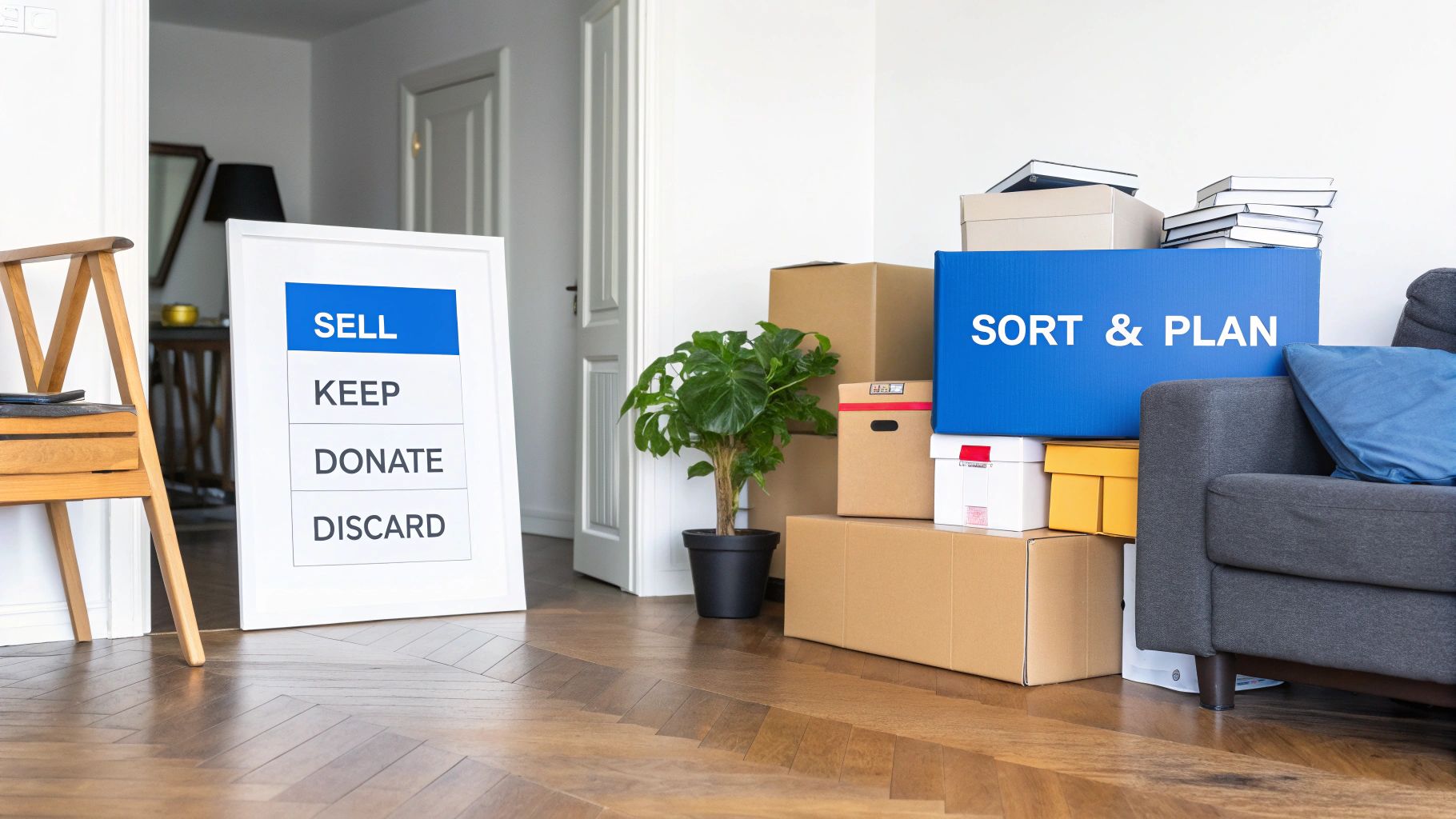
Before you can sell anything, you have to sort everything. This isn't just a quick tidy-up; it's about making strategic decisions. Get four tarps, boxes, or designated areas and label them clearly:
- Sell: Items you're confident have value and are ready to part with.
- Keep: Personal belongings, family heirlooms, or anything you just can't let go of.
- Donate: Good, usable items that might not fetch a high price but could find a new home with a local charity.
- Discard: Anything that's broken, too worn, or simply has no value.
This system keeps you from getting overwhelmed and starts building a mental inventory of what you have. It's also the best way to spot those high-value treasures that deserve a closer look later on.
A huge mistake people make is tossing out everyday things. That old set of Pyrex or a box of rusty-looking tools might seem like junk, but they could be exactly what a Bay Area collector or DIYer is searching for. Don't assume something has no value just because it isn't a flashy antique.
Building Your Timeline
A realistic timeline is your best friend in this process. It keeps you on track and cuts down on the last-minute panic. For most Bay Area estate sales, you’ll want to give yourself a good four to eight weeks from start to finish.
This gives you a bird's-eye view of the main stages you'll be working through.
Below is a simple week-by-week breakdown to help you visualize the process and stay organized.
Bay Area Estate Sale Planning Timeline
| Phase | Timeline | Key Actions and Considerations |
|---|---|---|
| Phase 1: Decision & Sorting | Weeks 1-2 | Decide between hiring a company or a DIY approach. Begin the sorting process using the "Sell, Keep, Donate, Discard" method. Don't price anything yet—just focus on organizing. |
| Phase 2: Research & Cataloging | Weeks 3-4 | Research the value of your "Sell" items. Take clear photos and write descriptions. This is the most time-intensive part, so give yourself plenty of runway. |
| Phase 3: Pricing & Staging | Weeks 5-6 | Set your starting bids or prices. If holding an in-person sale, stage the items attractively. For online sales, this is when you'll build your auction catalog. |
| Phase 4: Marketing & Sale | Week 7 | Launch your marketing efforts! Share on social media and local groups. Your sale goes live. Be ready to answer questions from potential buyers. |
| Phase 5: Pickup & Payout | Week 8 | Host your scheduled pickup event. Manage the collection of items and ensure a smooth process for buyers. Finalize payments and arrange for the cleanout of any remaining items. |
Having a clear, step-by-step plan like this turns a daunting project into a series of manageable tasks.
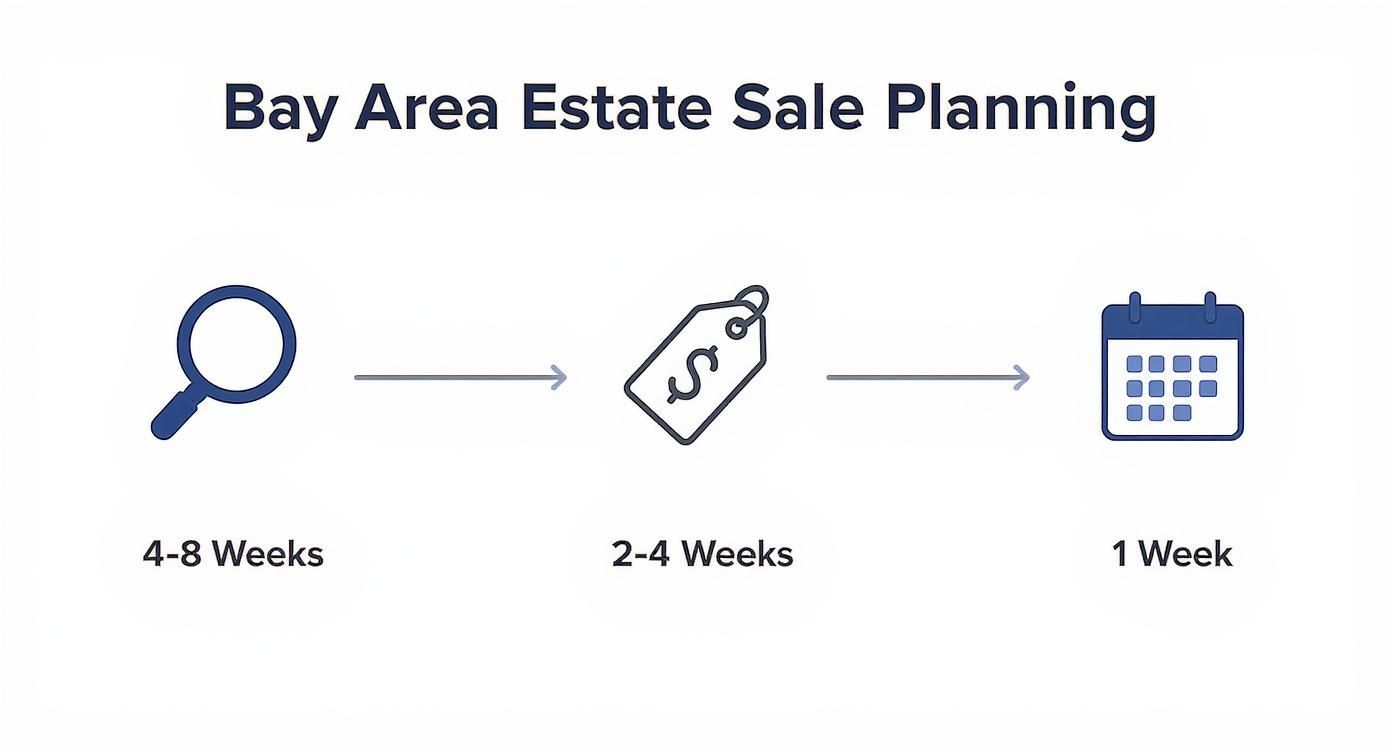
As you can see, putting in the work upfront during the research and organization phases makes the final steps of pricing and scheduling so much easier.
Navigating Local Laws and Permit Requirements
One of the biggest mistakes you can make is assuming the rules for an estate sale in Oakland are the same as in Palo Alto. The Bay Area is a patchwork of different cities, each with its own set of regulations. Getting this wrong can lead to fines and a lot of unnecessary stress.
Before you do anything else—before you even think about marketing—you need to become a mini-expert on your city's local ordinances. The best place to start is your city’s official website. A quick search for terms like "garage sale permit" or "temporary sales ordinance" will usually get you where you need to go. Some towns treat estate sales and garage sales the same, while others have entirely different rules.
Common Rules Across Bay Area Cities
While the details change from town to town, you'll find a few common threads. Most cities require a temporary sales permit. It’s usually a small fee, and you can often get it online or with a quick trip to city hall. Don't be tempted to skip this—code enforcement officers do make their rounds.
Signage is another big one. Cities are incredibly strict about where you can and can't put up signs for your Bay Area estate sale.
- Public Property: Forget about telephone poles, streetlights, or public medians. This is almost always a no-go and a fast way to get your signs removed and a fine sent your way.
- Private Property: You’re safe to place signs on the property of the sale itself. If you want to put one on a neighbor's lawn, you absolutely need their permission first.
- Time Limits: Signs are temporary. Most rules say they can only be up during the sale and must come down within 24 hours after you're done.
Here's a pro tip that many people forget: parking. If the sale is in a neighborhood with tight street parking or permit-only zones, you need a game plan. Make sure to include clear parking instructions in your online listings. It helps prevent blocked driveways, keeps neighbors happy, and stops complaints before they start.
Legal Authority and Documentation
Beyond city permits, you have to prove you have the right to sell everything in the first place. If you're the executor of the estate, keep a copy of the Letters Testamentary or other official court documents with you during the sale. This is your proof that you have the authority to liquidate the assets.
You probably won't need to show it to every customer, but having it on hand can shut down any potential legal challenges or family disputes on the spot. It’s a crucial piece of the puzzle. For a deeper look, our guide on estate sale laws and compliance covers the essentials you'll need to know. Taking a few minutes to understand the rules will ensure your sale is professional and legally sound from day one.
Pricing Your Items for the Bay Area Market
Figuring out what to charge for estate sale items in the Bay Area is a delicate dance. If you price things too high, you’ll be staring at a house full of stuff after the sale. But price too low, and you're just leaving cash on the table.
The secret is to really understand local tastes, because what sells in Marin can be completely different from what’s hot in San Jose.
You’ll see this play out all the time. That sleek, mid-century modern furniture? It can fetch a serious premium in design-savvy spots like Palo Alto or Berkeley. Take those same pieces over to Oakland's artsy neighborhoods, and you might find that rustic or industrial-style items are getting all the attention. It's all about knowing your audience.
Do Your Homework: Research Local Comps
Your best friend in this process is good old-fashioned research. Before you slap a price tag on anything, you need to look for "comps"—what comparable items have actually sold for recently. Don't just guess what that vintage armchair is worth; find out.
Here’s where to look for solid, real-world data:
- Online Marketplaces: Spend some time on eBay, Etsy, and even Facebook Marketplace, but with a twist. Don't look at asking prices; filter your searches to see the completed listings that actually sold. That's the real number.
- Local Auction Results: Many auction houses in the Bay Area publish their past results online. This is an absolute goldmine for valuing fine art, antiques, and other high-end collectibles.
- Niche Collector Forums: Have something really specific, like vintage audio equipment or rare books? Find the online forums where collectors hang out. You’ll get pricing insights you won’t find anywhere else.
As you get into the weeds of pricing, it helps to understand the general strategies behind how to sell unwanted items for cash, since many of the same principles apply here.
Knowing When to Call in a Pro
For most of the everyday household goods, your own research will get you where you need to be. But when you stumble upon something that might be truly valuable, bringing in a professional appraiser is a smart move.
You should seriously consider hiring a certified appraiser if you're dealing with:
- Fine art or original sculptures
- Signed jewelry or high-end watches
- Collections of rare coins or stamps
- Authenticated antique furniture
An appraiser doesn't just give you a price. They provide a formal valuation that works as critical documentation for insurance or legal reasons. It takes the guesswork out of the equation and makes sure you don't accidentally sell a hidden treasure for pennies on the dollar.
The Bay Area's unique economy directly impacts what buyers are willing to spend. Wild swings in the local real estate market, often driven by the tech sector, have created distinct pockets of wealth and buyer behavior. Understanding this context can give you an edge.
Create a Detailed Inventory—Your Sale's Bible
While you're researching and setting prices, start building a detailed inventory. A simple spreadsheet is perfect for this. Just create columns for the item name, a quick description, its condition, and your final price.
This list is more than just an organizational tool; it's the backbone of your entire sale.
If you're using an online platform like DIYAuctions, this inventory makes uploading your items and managing the whole process a breeze. For more in-depth advice, our guide on pricing strategies for estate sales can help you nail down the finer points.
Ultimately, a clean, organized catalog doesn’t just keep you sane—it projects professionalism, builds trust with buyers, and gets more items sold.
Marketing Your Sale to Attract Eager Buyers
Getting the right people to your sale is what separates a mediocre outcome from a truly profitable one. In today’s market, especially in a place as digitally savvy as the Bay Area, you have to do more than just stick a sign on the lawn. You need to create some real buzz.
I always advise clients to start their marketing push about a week before the sale goes live. This timeframe is the sweet spot—it builds anticipation without letting the initial excitement fizzle out. The key is to hit several different platforms at once to cast the widest net possible for your Bay Area estate sale.
Your Digital Marketing Toolkit
To get in front of real buyers, you need to go where they are. In my experience, a mix of specialized estate sale websites and local social media groups delivers the absolute best results.
Here are the channels you can’t afford to skip:
- EstateSales.net: This is the industry gold standard. Seriously, every dedicated estate sale shopper, reseller, and collector I know starts their weekend search right here. It's a non-negotiable.
- Facebook Marketplace: Perfect for showcasing your standout items. Think furniture, unique art, or sought-after electronics. It puts your best pieces in front of a huge local audience.
- Nextdoor and Local Groups: Platforms like Nextdoor are fantastic for reaching your immediate neighbors. Don’t forget to search for neighborhood-specific Facebook groups for communities like Berkeley, Palo Alto, or San Mateo, where people love to buy and sell locally.
If there's one mistake I see people make over and over, it's posting bad photos. Your items are competing for eyeballs online. Take clear, well-lit pictures from a few different angles, preferably against a plain background. A great photo can make a simple $50 item look like an absolute must-have find.
Crafting Listings That Actually Sell
Your pictures are the hook, but your descriptions close the deal.
Be detailed and be honest. Instead of just "Old Desk," try something like, "Vintage Mid-Century Modern Teak Secretary Desk, by [Brand Name if you know it]." That level of detail helps collectors find you and makes your listings show up in more specific searches.
Don’t be afraid to add a little story or context. The Bay Area has seen some dramatic real estate cycles, and a lot of locals have a deep appreciation for quality and history. From 1996 to 2006, the region saw an incredible boom, and items from that era or even earlier can really resonate with people who remember that time. You can actually discover more about the last 30 years of San Francisco real estate cycles on lindaleblanc.com to get a feel for the local history.
Mentioning the style or origin of an item connects with buyers on a much deeper level. And always be transparent about the item's condition—point out any scratches or dings. Honesty builds trust and saves you from headaches during pickup. It's this combination of great visuals, compelling details, and trustworthiness that drives interest and makes for a successful, profitable event.
Running the Show: Sale Day Logistics and Security
After all the planning and pricing, the success of your Bay Area estate sale really boils down to how the day itself goes. A solid plan for logistics and security is the difference between a smooth, profitable event and total chaos. It’s what protects the property, keeps buyers happy, and makes sure you don't lose your mind.
The first thing to tackle is traffic flow. You have to think like a shop owner and create a clear, one-way path for shoppers to follow. This prevents those frustrating bottlenecks in tight hallways or packed rooms. Don't be afraid to use ropes or even rearrange furniture to guide people and block off any areas that are off-limits.
This is especially critical when you're dealing with high-value Bay Area properties. As of October 2025, the median home price in San Francisco was still a staggering $1.5 million. Even with a slight dip, homes sell fast, often sparking bidding wars. That just goes to show how much value is tied up in the properties you're working in.
Handling Payments and Staffing
Let's be clear: a cash-only sale in the Bay Area is a huge mistake. Shoppers here expect to pay with cards or their phones, and setting this up is easier than you think.
- Mobile Card Readers: Grab a device from Square or PayPal. You can take credit cards right on your smartphone, and the small transaction fee is a tiny price to pay for the huge boost in sales.
- Digital Wallets: Get ready for Venmo and Zelle. They’re fast, free for most transactions, and incredibly popular with local buyers.
You also can’t do this alone. A good rule of thumb is to have at least one person for every 500-750 square feet of your sale area. This gives you enough coverage to watch different rooms, manage the checkout line, and help buyers with questions or carrying larger items.
Keeping Things Safe and Secure
Security isn't just about stopping theft; it’s about making sure everyone has a safe experience. Your biggest vulnerabilities are always the small, high-value items—jewelry, watches, coins, and other collectibles.
These should never be left on an open table. The best practice is to keep them in a locked display case or right behind the checkout counter where someone is always stationed. Shoppers can ask to look at items one by one, under your direct supervision.
Your responsibility extends to the safety of every single person who steps onto the property. Make sure to clear pathways of tripping hazards like loose rugs or extension cords. If there are stairs, ensure they’re well-lit and maybe even put up a small sign.
It's also a good idea to brush up on the basics of California premises liability law to understand your duties as the host. This is a critical part of running a professional and safe event.
Finally, don't be afraid to control the door. If a huge crowd arrives at once, it's perfectly fine to let people in a few at a time while others wait outside. This prevents overcrowding, cuts down on the risk of accidents, and actually creates a much better shopping environment for everyone.
Your Bay Area Estate Sale Questions Answered
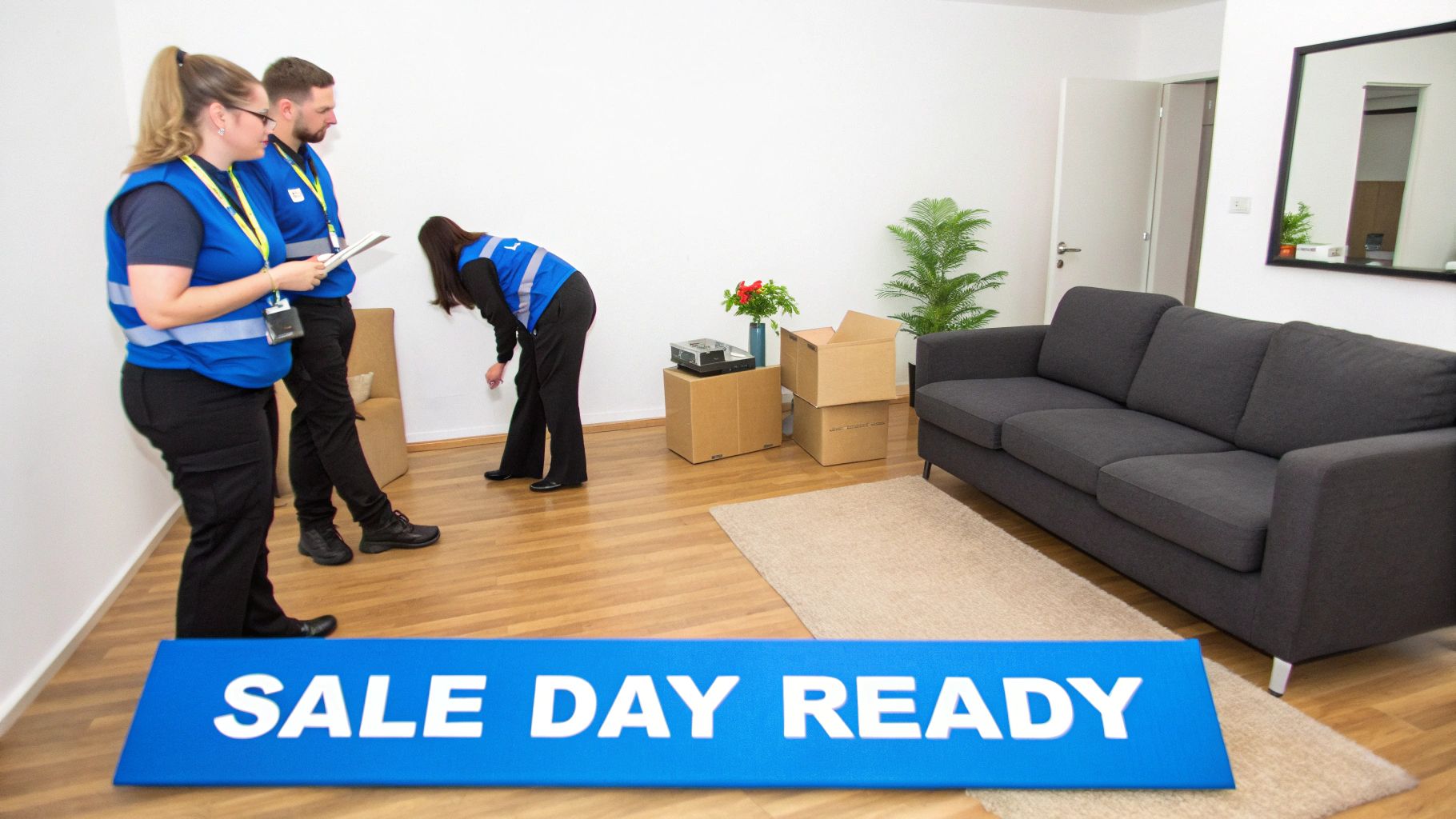
Running an estate sale in the Bay Area always brings up a few key questions. It's totally normal. From what buyers are actually looking for to how to handle that one really valuable painting, getting clear answers is the key to a stress-free, profitable sale.
Let's dig into the most common things people ask when they're getting started.
What Sells Best in the Bay Area?
While every home is different, certain things just fly off the shelves around here. If you know what local buyers are looking for, you can feature those items in your marketing and get the right kind of attention from day one.
Here's what consistently gets snapped up:
- Mid-Century Modern Furniture: This style is gold from Marin down to San Jose. Eames, Knoll, Danish modern... it all does incredibly well.
- Quality Electronics: It’s no surprise that in the heart of Silicon Valley, Apple products, high-end audio gear, and newer tech sell in a flash.
- Unique Collectibles & Art: The Bay Area has a dedicated scene for things like vintage vinyl, local pottery, and art from regional artists.
- Outdoor & Active Gear: Reflecting the local lifestyle, good-quality bicycles, kayaks, and high-end camping or hiking equipment are always in demand.
Handling Fine Art and Jewelry
So, you've stumbled upon what looks like fine art, signed jewelry, or a legitimate antique. What now? These aren't your typical estate sale items; they need a special game plan to get what they're truly worth.
Your very first move should be to get a professional appraisal from a certified expert. There are plenty of great ones in the Bay Area. This gives you a real valuation and, just as importantly, confirms authenticity.
For selling, you might think about consigning these pieces to a specialized auction house in San Francisco or Oakland. They have the right clientele of serious collectors and can market high-value items much better than a general estate sale.
Online auctions can be a fantastic alternative, giving you access to a huge, specialized audience without the hefty commissions of a traditional auction house. Platforms like DIYAuctions can connect you with buyers across the country, which often pushes final prices higher for those one-of-a-kind treasures.
Online Auction vs. In-Person Sale
This is one of the biggest decisions you'll make. In the Bay Area, though, the case for an online auction is incredibly strong.
Think about it: an online sale casts a much wider net, pulling in collectors from all over who are searching for exactly what you have. More competition almost always means higher bids.
Logistically, it's a game-changer. You don't have to worry about crowd control, on-site security, or dozens of strangers walking through the house. The entire sale, from cataloging to payment, happens online. Buyers simply show up at a scheduled time for one streamlined pickup event—a much more neighbor-friendly option, especially in communities with strict rules about public sales.
What to Do with Unsold Items
It's a fact of life: you're going to have stuff left over. Don't sweat it. The key is having a plan in place before the sale ends so you can clear the property efficiently.
You've got a couple of solid local options:
- Donation: Bay Area charities like Goodwill, Salvation Army, and Out of the Closet are fantastic resources. Many will even come to you for free furniture pickups, which is a massive help.
- Cleanout Services: If you just want it all gone, professional junk removal or estate cleanout companies will clear out everything that's left for a fee. This is the fastest, most hands-off way to get a property completely empty and ready for its next step.
More guides in Estate Sale Basics
July 28, 2026
Revenue Reporting for Estate Sales and Auctions
Learn revenue reporting essentials for estate sales and auctions. Discover key metrics, templates, and best practices to simplify tracking and compliance.
Read guideJuly 26, 2026
Stamp Collection Valuation: A Practical Step-by-Step Guide
Stamp collection valuation made simple. Learn how to identify, grade, price, and sell your stamps with confidence for estate sales or consignment.
Read guideJuly 23, 2026
Estate Sales Brick NJ: Your 2026 Guide to Success
Planning your estate sales brick nj? Our guide covers permits, pricing, marketing, & running a safe sale with DIYAuctions.
Read guideGet the estate sale pricing guide
Enter your email for pricing ranges, planning notes, and a clearer path to launch.