Bulk Item Sales: How to Plan and Run a Profitable Sale
Bulk item sales made simple: sort lots, price with evidence, photograph fast, market locally, and run one smooth pickup day while keeping up to 90%.
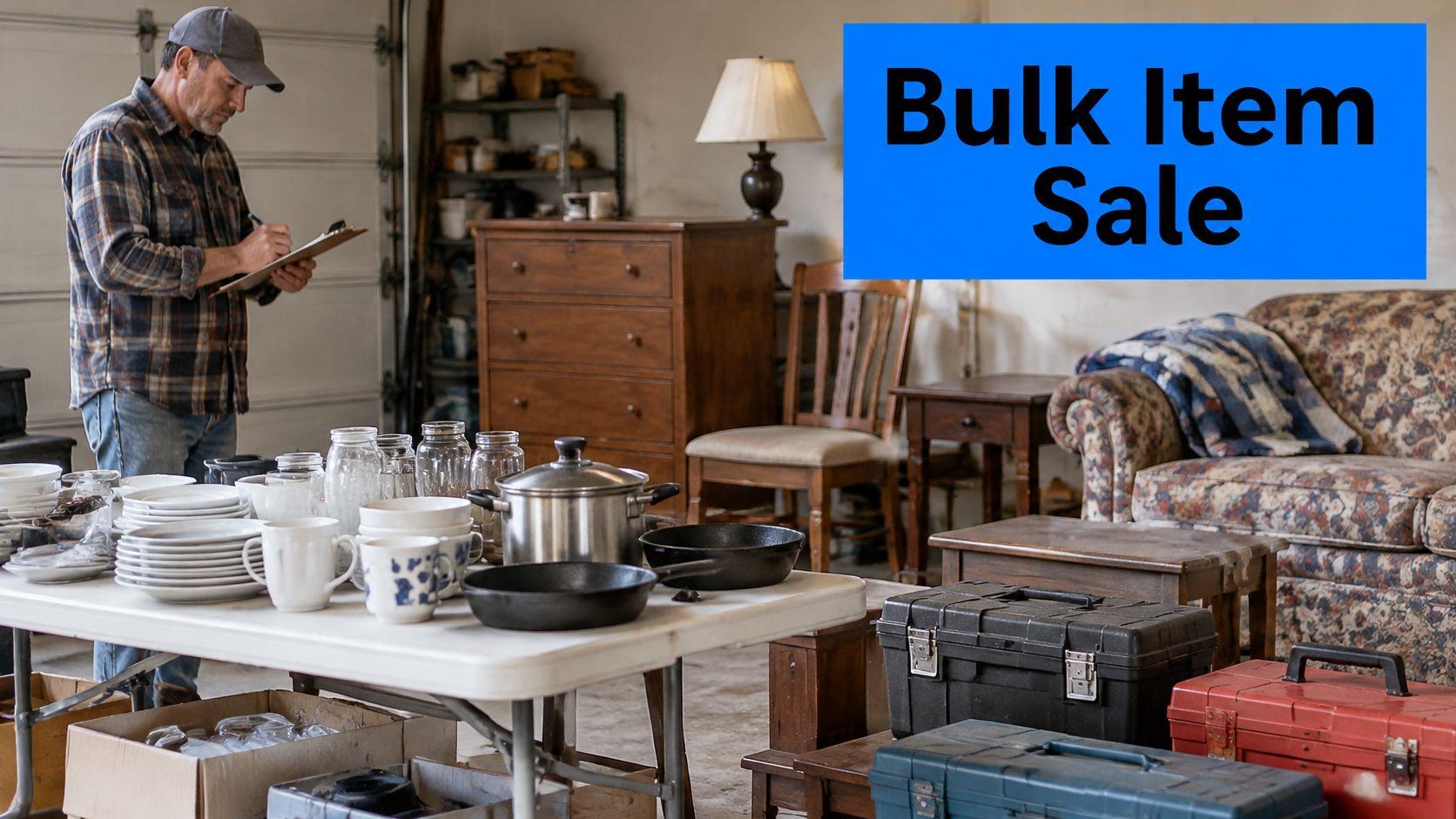
Three bedrooms, one garage, and forty years of accumulation inside them. The closing date on the house is six weeks out, the moving truck is booked, and every drawer you open adds another decision: keep, store, hand to a cousin, or sell.
That's the moment a bulk item sale starts to make sense. Not a card table in the driveway, and not forty separate online listings that each need their own photos, messages and pickup appointment. One organized, timed online auction puts hundreds of lots in front of local buyers during a fixed bidding window, then hands the winners to you on a single pickup day.
What separates a $4,000 outcome from a $14,000 one is rarely the price you ask. It's how you valued the goods, how fast you cataloged them, and whether pickup day ran like a schedule or a circus. Treat the sale as an operations problem and the money follows.
Your Bulk Item Sale Roadmap
Bulk purchasing isn't fringe behavior you have to explain to buyers. Industry estimates put warehouse club membership at 56% of American consumers, with the segment generating more than $768.3 billion in annual sales and taking roughly 7% of total U.S. retail sales (Dollars & Sense). Your buyers already know how to compare unit economics and evaluate grouped merchandise. And 34% of consumers globally reported buying certain products in bulk to save money in 2023, according to PwC's Global Consumer Insights Pulse Survey of 9,180 consumers across 25 territories.
The project breaks into four stages that carry seven phases:
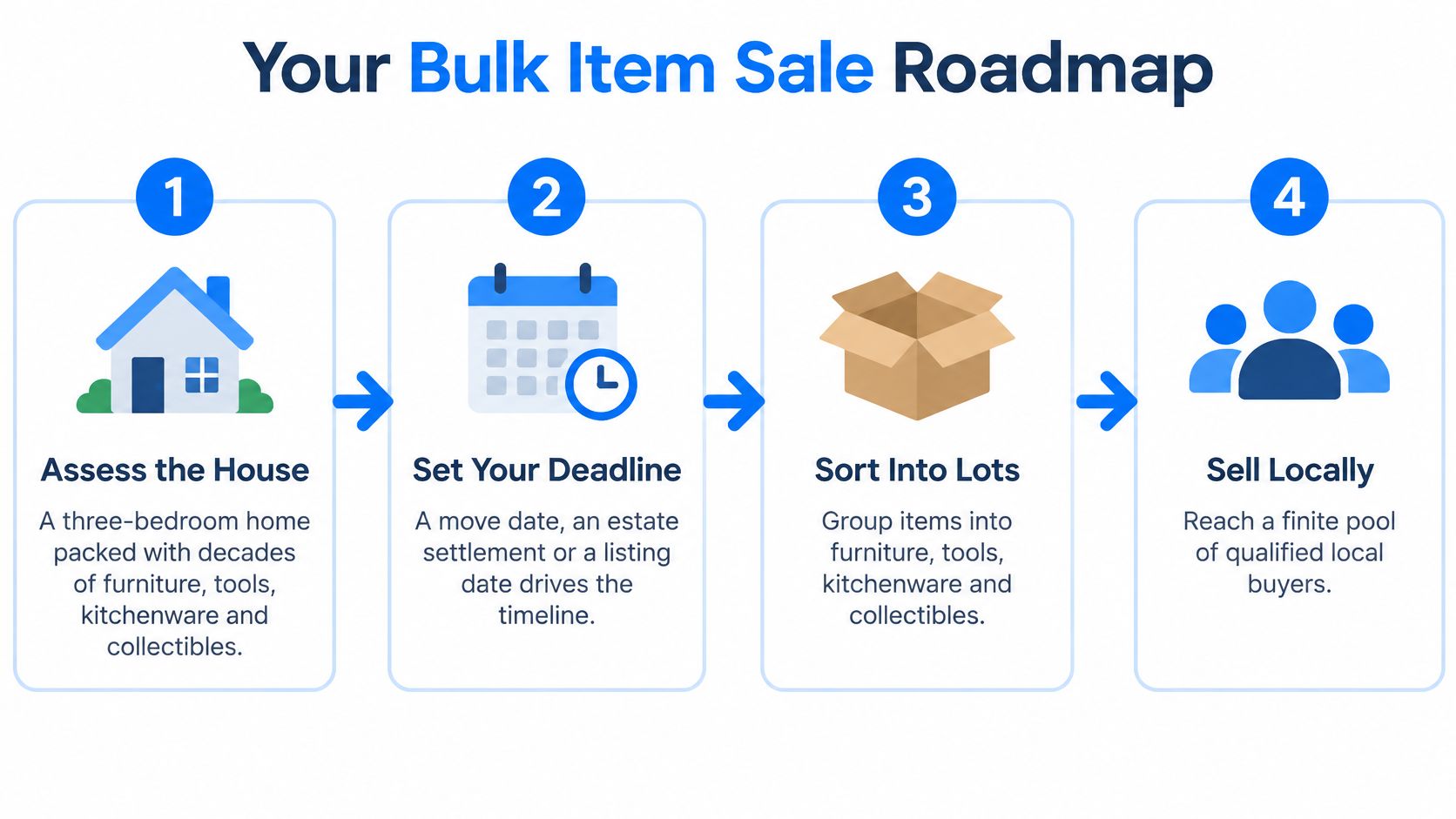
- Sort into lots. Group goods into sellable units before anything else happens.
- Price with comparables and reserves. Build a value range first, then decide where bidding opens.
- Photograph and catalog in batches. One station, one spreadsheet, hundreds of lots.
- Market to qualified local buyers. A finite pool reached at the right moments.
- Answer bidder questions. During the open window, in writing, for everyone to see.
- Run one coordinated pickup day. Narrow slots, staged lots, verified payments.
- Confirm payments and re-home leftovers. Re-list, donate, or move to the next-highest bidder.
You keep the decisions that matter: what stays, what each item is worth, and when pickup happens. The platform publishes the sale, routes buyers, handles the payment flow and keeps bidding organized while you work the inventory. If the house must be empty and clean before closing, book the cleaning before the sale date rather than after it, and use a Dallas move-out cleaning guide to get the order of operations right.
The phases below come with pace targets, a sorting table, a pricing table and a pickup-day troubleshooting table. Work them in sequence.
Decide What to Sell in Bulk and What to List Alone
Every item faces the same test: can it realistically clear about $50 on its own, or does it appeal to a named collector market? If yes, it gets its own listing with full photos and a documented description. If no, it goes in a lot with compatible goods. That single rule moves a houseful of inventory faster than any other decision you'll make.
The trap is perceived value. A 2025 survey cited by Swift Values found that 80% of respondents overestimated household-item values for probate, particularly jewelry, antiques and furniture. Executors and downsizers inherit that optimism along with the furniture, and it produces two failures: pricing everything individually until the deadline passes, or dumping a whole room as one lot and destroying recoverable value.
The four values people confuse
- Appraisal or insurance value. What it would cost to replace. Useful for coverage, useless for pricing.
- Probate value. A declared figure for legal and tax purposes. It has no relationship to what a bidder will pay on a Tuesday.
- Resale value. What a dealer or reseller would pay, which already includes their margin.
- Likely transaction value. What your local buyer pool will bid in an open auction with a pickup deadline attached.
Price for the fourth one only. "Rare" and "sentimental" are not liquid assets. Local demand, condition, completeness, provenance and pickup friction move the final number more than replacement cost ever will.
What bundles well and what doesn't
A solid-wood dining set with six chairs sells as one lot, because splitting it kills the demand that makes it worth anything. Everyday kitchen tools, hand tools and decor go out as $10 to $25 box lots, which costs you five minutes instead of five listings. A coin collection or a signed piece of art gets its own listing, its own provenance note, and its own reserve.
The three situations that dominate a household sale differ in mix. Downsizing after decades in one house leans on furniture, china and garage tools. Settling a parent's estate brings jewelry, paperwork and the high-value items nobody documented. Clearing a house before listing produces the widest mix, because staging furniture goes in the same sale as the lawn equipment. Families run all three kinds of sale through us, and the sorting logic doesn't change: tag every item Keep, Sell or Donate before a single price is discussed.
| Item category | Best format | Why | Pricing approach |
|---|---|---|---|
| Solid-wood or designer furniture | Individual lot | Strong standalone demand and easy to photograph and load one piece | Low opening bid, reserve only if a comparable exists |
| Matching dining or bedroom sets | One bundled lot | Buyers want complete sets; splitting kills demand | Bundle price set below the sum of separate pieces |
| Kitchenware, tools, decor | Grouped box lots | Listing singly costs more time than the items return | Flat low opening bid per box |
| Jewelry, watches, coins | Individual lot | High value density deserves full photos and provenance notes | Documented reserve from comparables |
| Antiques and collectibles | Individual lot | Value depends on rarity, condition and completeness | Comparable-backed reserve; appraise anything uncertain |
| Appliances and electronics | Individual lot | Heavy but in steady local demand | Low opening bid with tested, honest condition notes |
| Clothing and linens | Bulk bags or boxes | Low unit value makes single listings pointless | Flat price per bag or box |
| Books, media, games | Boxed lots | Slow to list and sell one at a time | Per-box opening bid, themed by genre when possible |
Lot size is the biggest lever on total proceeds, and lot size optimization is worth reading before you start grouping. A box lot with twelve related items pulls more bidders than twelve lonely listings with no traffic.
Set Opening Bids and Reserves That Draw Bidders
Pricing runs in two stages, and skipping the first one is how sellers end up defending their original purchase price instead of the market's.
Stage one: build an evidence range. Pull completed transactions, not asking prices. Sold listings from the past 90 days, printed results from local auctions, and estate-sale price sheets for comparable goods. Three to five data points per category give you a low, a middle and a high. If you can't find comparables, that's information: the item belongs in a bundle.
Stage two: choose your mechanism. Either a no-reserve opening bid that invites competition, or a documented reserve set at your minimum acceptable net recovery. Reserve prices carry a measurable cost in participation. In one controlled experiment summarized in the Princeton analysis of reserve prices, introducing a nonzero minimum bid cut participating bidders from 19 to 7 and individual bids from 565 to 71. A second experiment dropped bidders from 62 to 42 and bids from 1,583 to 238.
The reserve test: if you can't name the comparable sale that justifies the number, the reserve is a guess, and you're paying for it in bidders who never show up.
Auction format replaces haggling entirely: competitive bidding sets the final price, so buyers don't negotiate and you don't answer "will you take less" forty times. That makes your opening bid and your reserve the only price levers you have. Use them with intent.
Segment by liquidity, not by sentiment
Open common household goods at $1 to $10 to start the bidding war early. Restrict reserves to scarce or high-value lots where condition, provenance or documented comparables support them. Bundle compatible low-value goods whenever the listing effort costs more than the extra recovery. Never set a reserve from the owner's original purchase price.
Practical rule: a $1 opening bid on a $40 item rarely ends at $1. A $60 reserve on the same item often ends at zero bids.
Track four numbers per category
- Views-to-bid conversion. Low views means a marketing problem. Plenty of views and no bids means a pricing problem.
- Unique bidders. One bidder per lot is a warning sign, not a sale.
- Bids per lot. Thin bidding tells you the opening bid was too high.
- Sell-through rate. Unsold inventory carries storage, hauling and pickup costs.
| Lot type | Opening bid | Reserve? | Metric to watch |
|---|---|---|---|
| Common household goods | $1-$10 to invite bidding | No | Views-to-bid conversion |
| Mid-value furniture | About 25-30% of realistic resale | Only if interest stalls | Bids per lot |
| High-value jewelry or antiques | Modest opening to draw a crowd | Yes, from documented comparables | Unique bidders |
| Bulky low-value bundles | Priced by loading time, not item count | No | Sell-through rate |
| Mixed box lots | Flat low opening per box | No | Sell-through rate |
Revise after every sale cycle. The first sale teaches you what your local market pays; the second one should profit from it.
Photograph and Catalog Dozens of Items Fast
A full house is 300 to 600 lots. At two minutes per lot you're looking at a fortnight you don't have, so the work has to batch.
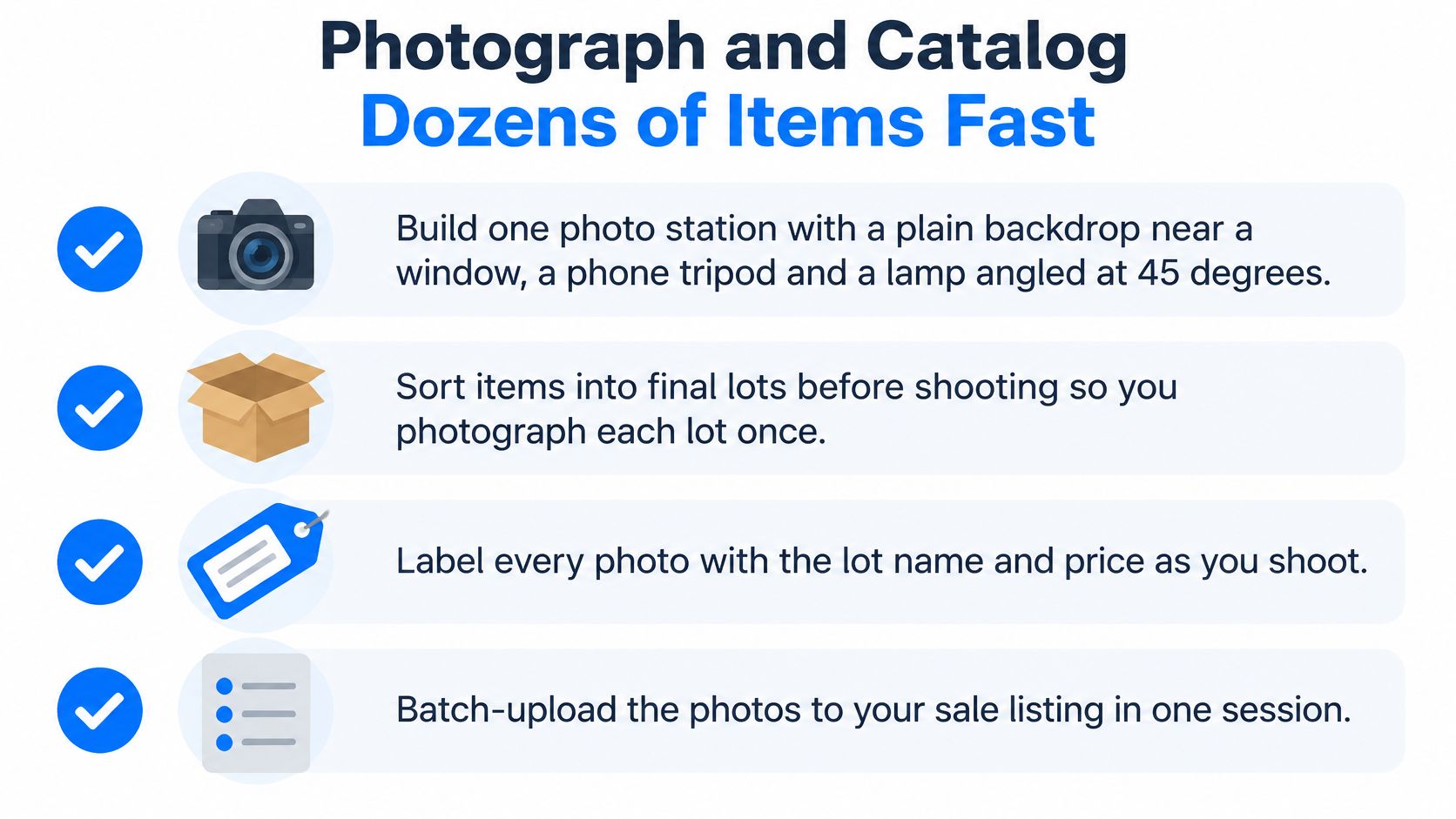
- Build one station. A plain backdrop near a window, a phone tripod and a lamp angled at 45 degrees. Set it once and never move it.
- Sort into final lots before shooting. Photograph groups, not singles. Fifteen to twenty lots per hour is a realistic pace once the station is running.
- Take three shots minimum. Full front, key detail, and an honest flaw photo. The flaw photo prevents disputes at pickup.
- Catalog while you shoot. One spreadsheet row per lot: number, title, category, dimensions, brand, material, condition. Writing the row as you press the shutter is what turns photography into cataloging.
- Title it brand first. "Henredon cherry dresser, 60 in, 9 drawers" beats "nice wooden dresser" every time, in search and in bidder confidence.
- Upload in one or two sessions. Dribbling listings out over a week splits your audience and flattens the closing rush.
- Sticker and stage in sale order. Every lot gets its number, and completed lots go to a spare room or garage bay in the order buyers will collect them.
A weekend target of 100 to 150 lots for a full house is achievable with a helper handling stickers and staging while you shoot. Our platform walks sellers through photo upload and lot descriptions step by step, so the listing mechanics don't eat the cataloging hours.
Consistency matters more than artistry. Standardizing catalog shot requirements across every lot, which Sprello's photography style guide breaks down well, gives buyers a predictable way to scan fifty lots in ten minutes. If you're new to shooting merchandise at home, these tips for photographing items to sell online cover lighting and angles without requiring gear.
Market the Sale to Qualified Local Buyers
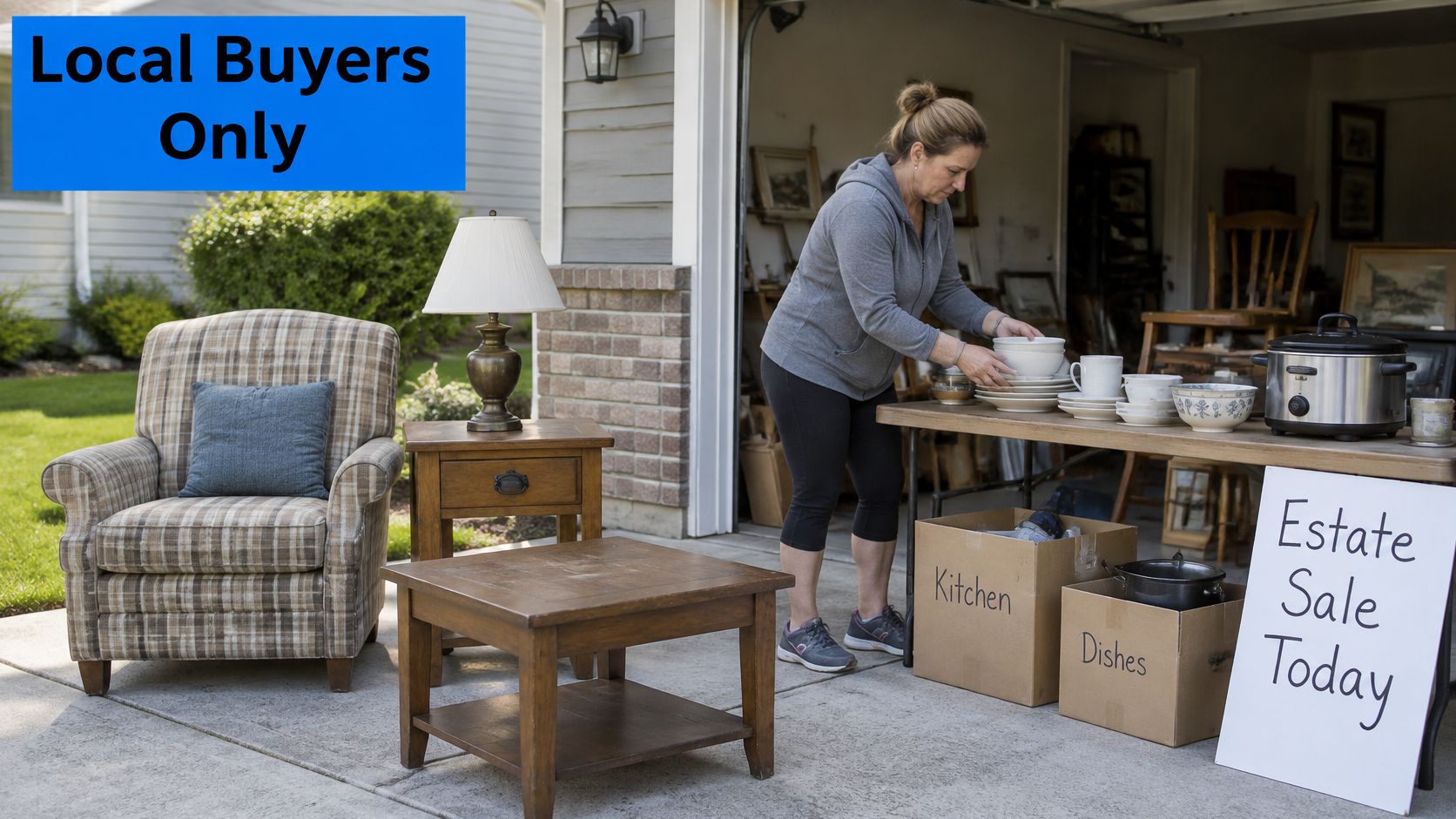
A bulk sale earns more when the right local buyers can find the lots and collect them. Plan the promotion around the items, the bidding window and pickup logistics, not raw reach.
Publish two to three weeks before closing. Then promote on launch day, midway through the window with photos of six standout lots, and during the final 48 hours. Buyers may watch before bidding, so use each reminder to give them a concrete reason to inspect or bid.
The platform connects your sale with local buyers, so list there first. Extend reach through neighborhood Facebook groups for estate sales, moving and buy-sell-trade, Nextdoor, Craigslist community posts, an email list if you have one, and collector or trade groups for specialty lots such as coins, mid-century furniture or machinist tools. Choose channels where buyers can assess the items and arrange local collection.
Tailor the message to the audience. In 2023, 39% of U.S. consumers aged 18 to 34 said they were likely to purchase products in bulk sizes instead of smaller packages, compared with 27% of consumers aged 55 and older, according to YouGov's nationally representative survey of 1,187 adults. Emphasize one-day, everything-must-go value for younger buyers, and identify specific named pieces for older buyers.
Post template that works: area and dates, three standout lots by name with photos, the bidding link, and one line stating there is a single pickup day.
Specific details help buyers decide whether a lot is worth a bid and whether they can collect it. “Lots of stuff, come see” gives them little to plan around. Name the Hallowell cabinet and state that it is 60 inches wide, for example, so a bidder can judge whether to borrow a truck. For scheduling and cross-posting ideas, see PostSyncer's ecommerce marketing guide.
During the bidding window, answer bidder questions promptly. Post condition or measurement answers as lot-page updates where every bidder can see them, and never change a lot's terms mid-auction without notifying all bidders. Track recurring questions. If several buyers ask for the same detail, add it to the listing before the next sale. These auction marketing strategies can help structure promotion across the bidding window.
Run a Single-Day Pickup and Get Paid Securely
A winning bidder pulls up at 2:15 in a sedan, no helper, and the dresser is still on the second floor. The bid looked fine on paper. Fifteen minutes of wrestling that piece down the stairs can erase the margin on a cheap lot. Reporting on the resale market shows 75% of resale activity in non-fashion categories, with secondhand sales projected to approach 8% of retail sales and reach $306.5 billion by 2030 (Trellis). Buyers are already shopping for furniture and mixed household goods. What you keep depends on whether they can load and leave on one organized day.
The sale ends with one coordinated local pickup day instead of multiple days of buyers walking through the house. You set that day to fit your timeline. Payment, access, and loading should be settled before the first car arrives, which protects both your hours and the property.
- Set pickup three to seven days after closing. Buyers need time to borrow a vehicle or take an afternoon off.
- Book narrow windows. Use fifteen to twenty minute slots grouped by buyer location for large sales, or two to three hour blocks for small ones.
- Email every winner a confirmation. Include the address, parking, gate or door codes, stairs and elevator notes, and exactly what help you will and will not provide.
- Stage lots in sale order with numbers facing out and a printed manifest of buyer, lots, and amount.
- Verify pre-payment before anything leaves the house. DIYAuctions uses a secure pre-payment system, so buyers have already paid before they collect.
- Keep dollies, straps, and blankets at the door, and stage heavy pieces on the ground floor so nobody carries a wardrobe upstairs just to turn it around.
Pickup rule: price a bundle by loading time, not item count. A $40 lot that takes fifteen minutes to wrestle into a hatchback is worth less than a $25 lot that walks out in one trip.
| Problem | Likely cause | Fix |
|---|---|---|
| Buyer no-show | Forgot the window or overbid elsewhere | Wait out the window, then offer the lot to the next-highest bidder or re-list it |
| Payment not confirmed at the door | Invoice not completed before pickup | Hold the lot until the platform shows the pre-payment cleared |
| Buyer cannot move the item | No vehicle or help planned | State vehicle and labor needs in the listing; keep a dolly and straps at the door |
| Damage during loading | Rushed handling or poor staging | Stage heavy pieces on the ground floor, pad corners, use blankets |
| Blocked driveway or elevator | Access not planned | Photograph access constraints before the sale and reserve elevators or parking |
| Lots left unsold | Overpriced or thin demand | Re-list, donate, or offer to the next-highest bidder |
Uncollected items can be re-listed, donated, or offered to the next-highest bidder. Decide which option you will use before pickup day, so you are not making that call at 6 p.m. with a van idling in the driveway.
Maximize Your Return and Launch the Sale
Run the fee math before you commit to the effort. On $20,000 in gross proceeds, a 10% commission capped at $1,000 means you keep $19,000, or 95% of the sale. Compare that with a full-service arrangement taking a quarter to half of gross: the same $20,000 would leave $15,000 or $10,000. That gap is the budget for your own weekend of sorting, and it's the test for whether a low-value lot deserves its own pickup slot.
Payment protection, invoices and the transaction flow are handled for you, so your hours go into lots and logistics. Here's the sequence:
- Block one weekend to sort and photograph, and don't schedule anything else.
- Pick a sale date three to four weeks out, which is enough runway to publish and promote.
- Build your first ten lots and launch. Momentum beats a perfect catalog.
- Log the four pricing metrics by category after closing, plus which pickup problems occurred.
- Set reserves and lot sizes for sale two from those numbers, not from memory.
Start with the room you dread most. Sort it into three piles, build ten lots, and get them photographed this weekend; the rest of the house gets faster once the station and the spreadsheet exist. Our free estate sale pricing guide covers typical fee ranges, pricing guidance and a 30-day launch checklist for new sellers, which is the fastest way to see what your sale could realistically return before you commit a single Saturday to it.
Get the estate sale pricing guide
Enter your email for pricing ranges, planning notes, and a clearer path to launch.