Lot Size Optimization: The DIYAuctions Host's Playbook
Unlock higher profits with lot size optimization on DIYAuctions. Our guide shows estate sale hosts how to bundle items, set prices, and test lots for max bids.
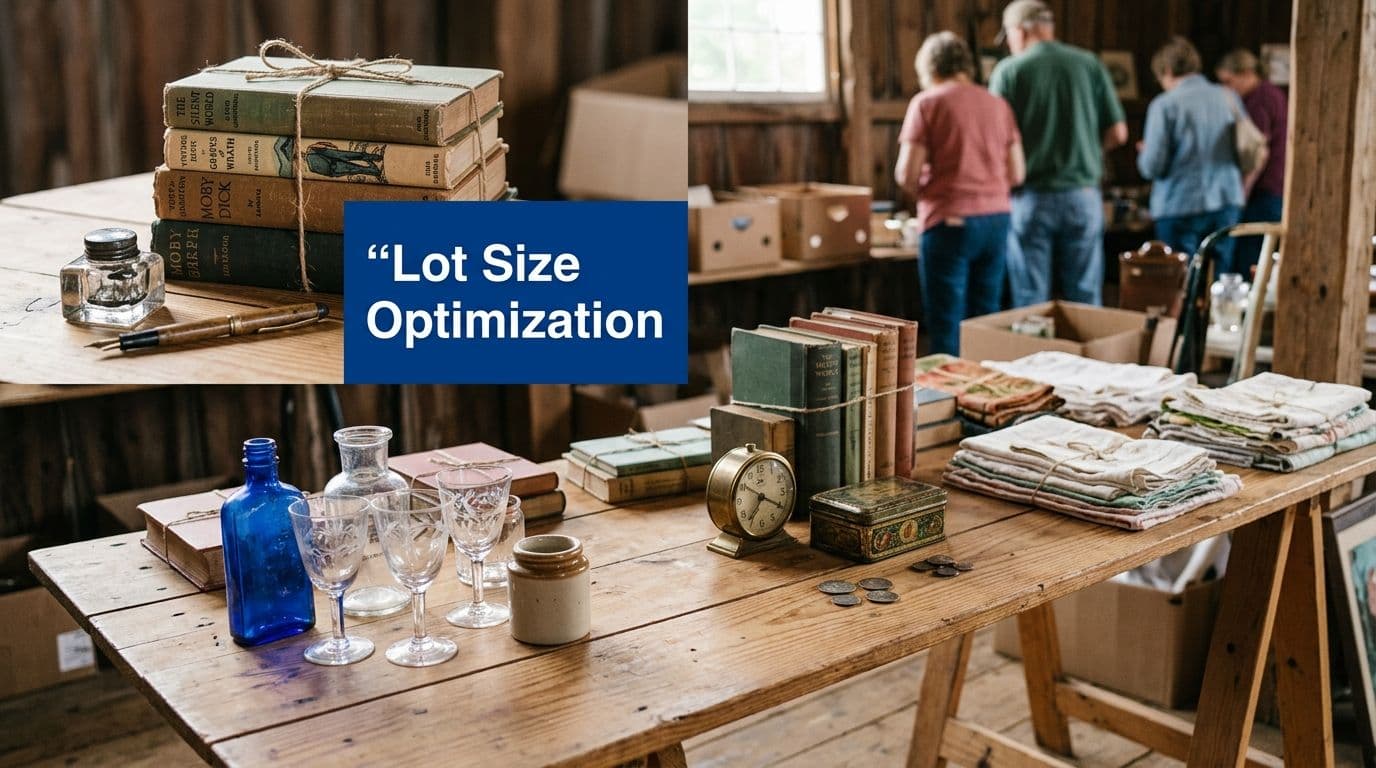
You're probably looking at a house full of things that need to move, and one question keeps coming up: should this be sold alone, or grouped with something else?
That decision has a huge effect on your final results. Most estate sellers focus on pricing first. Experienced sellers know the grouping often matters just as much. A well-built lot can pull in more bidders, clear more inventory, and save hours of listing time. A sloppy lot can bury value and leave good items sitting with no bids.
In supply-chain terms, this is called lot size optimization. In estate sale terms, it's smart bundling. Same idea, simpler language. You're finding the bundle size that creates the best balance between your effort and buyer interest.
Industrial studies have found that lot optimization principles can improve total returns by 5% to 15% when applied well across inventory decisions, which is why the concept has lasted for generations in operations management (industry analysis of lot optimization principles). For estate sellers, that translates into fewer weak listings, fewer leftovers, and more confidence about how to package what you have.
The Goal of Smart Bundling on DIYAuctions
Smart bundling means grouping items in a way that makes buyers want the lot and makes the seller's workload manageable. It isn't random. It isn't “put all the leftovers together and hope for the best.” It's a deliberate choice about where value comes from.
When sellers break out every low-value household item into its own listing, they usually create too much work for too little return. On the other hand, when they toss unrelated objects into one messy box, bidders can't tell what they're buying, so they scroll past. The middle ground is where the money is.

What smart bundling actually does
A strong lot does three jobs at once:
- Raises buyer confidence by making the group feel useful, collectible, or complete
- Cuts listing labor because you photograph and catalog one lot instead of many marginal items
- Improves sell-through because buyers can justify a bid when the package feels coherent
That's why I tell sellers to stop asking, “What's each item worth by itself?” and start asking, “What would make someone want this group enough to bid today?”
A box of ten random kitchen gadgets has no story. A “baking drawer reset” with measuring cups, cookie cutters, rolling pins, and mixing tools does. Buyers don't just bid on objects. They bid on convenience, identity, nostalgia, and resale opportunity.
Practical rule: Bundle for the buyer's purpose, not for your own cleanup convenience.
Thoughtful lots beat random piles
A good lot usually has one of three kinds of appeal: utility, theme, or quantity. A bad lot usually has none of them. That's the difference between a listing that attracts watchers and one that stalls.
Here's a simple comparison:
| Lot type | What buyers think | Likely result |
|---|---|---|
| Related and useful | “I can use this as-is” | More engagement |
| Themed and curated | “This feels intentional” | Higher perceived value |
| Purely random | “I have to sort this mess myself” | Lower interest |
One reason this matters so much is that your time has value too. If you spend hours creating separate listings for low-interest items, you may protect theoretical value while losing practical profit. That's why a solid bundle pricing strategy for estate lots matters before you even think about starting bids.
The sellers who do best usually treat lotting like merchandising. They present groups that feel easy to understand. They avoid cognitive overload. They make it obvious why the lot belongs together.
That's the primary purpose of smart bundling. Not just to move more items, but to create lots where the whole package is more appealing than the pieces would be on their own.
Three Proven Lot Templates for Higher Bids
Most estate sellers don't need a complex theory. They need a few lot templates they can use over and over without second-guessing every table, shelf, and drawer.
These three are the ones I come back to most often because they match how buyers browse.

The anchor lot
This is the easiest template to understand. Take one item that has clear appeal, then pair it with related companions that add usefulness without distracting from the main piece.
A classic estate example is a vintage Pyrex bowl paired with a few matching or adjacent kitchen items. Another is a decent cordless drill bundled with drill bits, a charger, and a small case. The anchor gets attention. The supporting items help the bidder justify a stronger bid.
This format works best when the main item is good, but not so important that it deserves to stand entirely alone.
If the supporting pieces make the star item harder to see, the lot is doing the opposite of what you need.
The bulk lot
Bulk lots are for groups of similar lower-value items where the volume itself creates appeal. Think hand tools, costume jewelry pieces, paperback mysteries, vinyl records in the same genre, holiday linens, or garage hardware.
The buyer psychology here is simple. Buyers like getting a useful quantity in one shot. Resellers also like bulk because it gives them margin and sorting opportunities.
Use bulk lots when:
- The items are similar and don't need much explanation
- The individual values are modest and listing one by one would waste time
- The condition is consistent enough that one buyer can reasonably assess the whole group
A good bulk lot has boundaries. “Twenty-two sewing notions and thread spools” is understandable. “Craft room contents” is too broad.
The themed lot
This is the most powerful template when an estate has personality. A themed lot combines related items that serve the same lifestyle, room, hobby, or aesthetic.
Examples are everywhere once you start looking for them. Mid-century barware. Gardening starter set. Christmas village shelf lot. Desk setup with pens, trays, and office tools. Framed coastal decor grouping from one room.
Themed lots perform well because they reduce friction. The buyer doesn't need to imagine how separate pieces work together. You've already done that work.
Here's a quick selection guide:
| Template | Best for | Watch out for |
|---|---|---|
| Anchor lot | One standout item plus logical extras | Don't bury the star |
| Bulk lot | Similar low-value items | Don't make it too mixed |
| Themed lot | Lifestyle or decor groupings | Don't force a fake theme |
A useful idea from lotting practice is the minimum viable lot. The group has to be appealing enough to earn a bid on its own terms. When sellers miss that threshold, value gets stranded in unsold inventory. One cited discussion of estate-style lotting frames this as avoiding capital stagnation that can tie up 18% or more of potential value when grouping misses bidder interest (minimum viable lot thinking for auction sellers).
If you're unsure which template to use, ask one question: would a buyer understand this lot in three seconds from the first photo and title? If the answer is no, rebuild it.
A Practical Framework for Pricing Your Lots
Pricing lots isn't about naming the final value. It's about setting the auction up so bidding can start.
Many sellers price bundles as if they were selling retail. That usually slows the first bid, and without that first bid, a lot can remain unbid even when the contents are good. Starting price is part valuation, part psychology.

Start with the lot type, not a generic rule
I price different lot types differently because they attract different bidders.
For an anchor lot, the lead item carries the risk. If that main item has obvious standalone value, your starting bid should reflect that enough to protect it, while still leaving room for competition. The related extras are there to widen interest, not to justify an inflated opening number.
For a bulk lot, I lean lower. Buyers need to feel they're discovering value in the quantity. If the opening bid feels like full retail for a mixed tray of tools or a stack of dishware, they won't do the work of sorting it in their head.
For a themed lot, I price based on clarity and desirability. The better the theme, the more comfortable buyers are entering early.
A simple decision filter
Use this checklist before setting the start:
- Ask what drives the bid. Is it one object, the quantity, or the complete set feeling?
- Check buyer effort. The more sorting, testing, or hauling the buyer must do, the lower the opening usually needs to be.
- Protect only what needs protecting. Don't over-defend mediocre lots with ambitious starts.
A good estate sale pricing guide for auction hosts can help with valuation, but lot pricing still needs judgment. Bundles aren't just sums on paper. They're invitations to participate.
Use momentum, then adjust with evidence
One reason low openings often work is that they create movement. Watchers see activity. Bidders stop feeling like they'll be the only one interested. That social proof matters in live auctions.
For sellers who want a deeper look at how auction openings affect activity, this walkthrough is useful:
A strong starting bid doesn't prove you know the value. It proves you know how to invite competition.
If you're hesitating between two opening prices, choose the one that gives the lot room to attract participation. You can't get a bidding contest without bidders.
Measuring and Improving Your Lot Performance
Every auction teaches you something if you know where to look. The sale itself is feedback. Buyers tell you, very clearly, which bundles make sense to them and which ones don't.
That's why lot size optimization shouldn't stop once the catalog goes live. Good sellers watch the response and treat early activity as a signal, not as random noise.

What to watch during the auction
You don't need a spreadsheet full of advanced formulas. Start with the visible signs of interest:
- Watcher count tells you whether the lot caught attention
- Bid frequency shows whether the pricing and bundle feel active enough to sustain competition
- Unique bidder count helps separate one-person interest from broad market appeal
A lot with many watchers and few bids often has one of two problems: the opening price is too defensive, or the bundle is interesting but not quite compelling enough. A lot with early bids from several people usually has the right combination of clarity, accessibility, and appeal.
Compare lot types, not just individual winners
Learning occurs when you compare patterns. Did your themed kitchen lots draw more unique bidders than your bulk housewares? Did small tool groupings outperform giant garage cleanout boxes? Did collectors respond better when items were separated by era or maker?
Flexible strategy is important. One estate may reward room-based lots. Another may reward category-based lots. In variable-demand situations, adapting to live response can reduce waste, including unsold items, by up to 25% when bundling strategies are adjusted using real-time feedback (analysis of flexible bundling in variable-demand environments).
Here's a practical review table:
| Signal | What it often means | What to do next |
|---|---|---|
| High watchers, no bids | Interest without commitment | Recheck pricing or lot clarity |
| One bidder only | Narrow appeal | Improve title, photos, or grouping next time |
| Several bidders early | Strong market fit | Use similar lot logic elsewhere |
Run small tests and keep notes
A/B testing sounds fancy, but for estate selling it can be simple. Try two different approaches in the same category. For example, list one lot of barware as a styled themed set and another as a plain bulk grouping. Then compare attention and bidding depth.
A simple sales performance metrics guide for auction hosts can help you interpret those signals. What matters is consistency. If you track what happened, your next sale gets smarter.
Buyers reveal their preferences faster than most sellers expect. The hosts who pay attention improve quickly.
Common Lotting Mistakes That Kill Profits
The most expensive lotting mistakes usually don't look dramatic. They look reasonable when you're tired, rushing, and trying to clear a room. Then the auction opens and those “reasonable” bundles sit untouched.
The junk drawer lot
Almost every seller creates one of these by accident. It's the bundle made from leftovers: a flashlight, two souvenir mugs, a tape measure, random cords, a trivet, and three pens. Nothing is broken. Nothing is offensive. It's just meaningless.
Buyers don't want to pay for your unsorted residue. They want either a useful group, a collectible group, or a recognizable theme. If a lot gets zero bids, that has a cost. In optimization language, ignoring the cost of no demand is a serious mistake. In auction practice, it means unattractive lots can leave significant money behind because the item receives no bid at all, a pitfall directly compared to “stockout costs” in operational planning (EOQ pitfalls applied to auction-style unsold inventory risk).
The oversized lot
A seller once grouped a whole linen closet into one giant listing: towels, sheets, blankets, pillowcases, and a few unopened toiletries. The logic was understandable. One lot, one pickup, done.
The problem was the buyer pool shrank immediately. Buyers didn't need all of it. Some wanted the vintage blankets. Others wanted just the better sheet sets. The lot became too large, too mixed, and too annoying to transport. A couple of tighter lots would have been easier to understand and easier to bid on.
The hidden gem problem
This one hurts because the value is there, but the presentation kills it. A sterling item gets buried in a tray of ordinary costume jewelry. A signed print gets bundled with generic wall decor. A quality hand tool disappears inside a rough garage assortment.
Use this quick safeguard before publishing:
- Pull out anything that would headline the first photo
- Separate objects that attract a different buyer category
- Ask whether the best item is carrying junk or being enhanced by companions
A valuable piece should lead the lot or leave the lot.
The fake theme
Not every bundle needs a cute story. Sellers sometimes force a theme because themed lots sound smart. Then they end up pairing objects that live in the same room but don't belong together in a buyer's mind.
A bedside lamp, a paperback novel, and a ceramic figurine are not automatically a “cozy reading lot.” If the connection feels manufactured, the buyer feels manipulated. Honest bundling works better than clever naming.
The fix for all of these mistakes is the same. Build lots that a stranger can understand instantly, carry easily, and want for a clear reason.
Advanced Lotting Questions Answered
Should a very high-value item ever be bundled?
Usually, no. Fine jewelry, strong artwork, rare collectibles, and standout antiques should typically stand alone unless the companion items clearly strengthen the story and buyer appeal.
If you do bundle one, keep the support pieces tight and relevant. The lead item must stay visually dominant in the photos and title. If the lot would still make sense after removing the smaller items, that's a good sign. If the lot falls apart without them, you may be using filler.
What's the best approach for huge collections of low-value items?
Start by sorting the collection into slices a buyer can understand. For postcards, that might mean topic, era, location, or style. For sewing supplies, it might mean thread, notions, patterns, and tools. For garage hardware, separate fasteners from hand tools and electrical parts.
Very large collections become more attractive when the buyer can see a clean reason for the grouping. Bulk works, but only when the lot still feels navigable.
What should I do if a good lot gets little traction mid-auction?
First, don't panic and assume the items are bad. Demand shifts fast in auctions, and static pricing becomes less effective when buyers are responding to a changing field. In manufacturing-based lot sizing research, demand fluctuation has been shown to reduce the effectiveness of static approaches by 25% to 35% when conditions aren't modeled dynamically (evidence on fluctuating demand and static lot strategies).
In estate sale terms, that means you should respond to weak activity with diagnosis:
- Check the title. Is it specific enough to attract the right searcher?
- Review the lead photo. Does it show the lot's best reason to bid?
- Look at the opening price and current competition. A cautious opening can suppress action.
- Use what the rest of the sale is telling you. If similar categories are active, the issue may be presentation rather than demand.
How small is too small for a lot?
If the bundle doesn't feel worth a pickup trip, it's probably too small. Buyers need enough utility, enough margin, or enough enjoyment to justify the stop. The answer isn't a fixed number of items. It's whether the lot feels complete enough to earn real interest.
Smart lot size optimization isn't about turning an estate sale into a math exercise. It's about making cleaner decisions. Group with purpose, price for participation, and learn from the bidding as it happens.
If you want a platform built for sellers who want control over cataloging, bidding, and pickup without handing over most of the proceeds, DIYAuctions is designed for exactly that.
More guides in Estate Sale Basics
July 28, 2026
Revenue Reporting for Estate Sales and Auctions
Learn revenue reporting essentials for estate sales and auctions. Discover key metrics, templates, and best practices to simplify tracking and compliance.
Read guideJuly 26, 2026
Stamp Collection Valuation: A Practical Step-by-Step Guide
Stamp collection valuation made simple. Learn how to identify, grade, price, and sell your stamps with confidence for estate sales or consignment.
Read guideJuly 23, 2026
Estate Sales Brick NJ: Your 2026 Guide to Success
Planning your estate sales brick nj? Our guide covers permits, pricing, marketing, & running a safe sale with DIYAuctions.
Read guideGet the estate sale pricing guide
Enter your email for pricing ranges, planning notes, and a clearer path to launch.