A Practical Guide to Selling Estate Sale Antiques
Discover how to find, value, and sell estate sale antiques. This guide offers practical advice for turning heirlooms into assets with confidence.
Selling antiques from an estate doesn’t have to be a dusty, overwhelming chore. It's actually a massive opportunity to connect unique pieces with a new generation of buyers who are hungry for sustainability and history—and they're willing to pay for it. This guide is your roadmap for turning those heirlooms into real assets.
Why Estate Sale Antiques Are a Modern Goldmine
The thought of liquidating an entire home's worth of possessions can be daunting, whether you’re downsizing your own home or handling a loved one's estate. But if you shift your perspective, you'll see it's less of a task and more of a treasure hunt. The market for estate sale antiques is buzzing right now, largely thanks to younger collectors who value authenticity over mass-produced furniture.
This boom has created a real seller's market where unique, storied items are snapped up quickly. If you're new to this world, it helps to understand what an estate sale is at its core. It's not just a garage sale; it's the thoughtful sale of a lifetime's collection.
Seizing the Market Opportunity
The global antiques and collectibles market is proof of this lasting appeal. Valued at a staggering $40 billion in 2025, it’s the engine that connects family heirlooms with eager new owners. That number is even projected to hit $50 billion by 2033, which tells you all you need to know about the sustained demand for these items.
Platforms like DIYAuctions are completely changing the game. Instead of losing a massive 40-60% cut to a traditional estate sale company, sellers can now keep up to 90% of the profits. You’re no longer just handing over the keys and hoping for the best.
This flowchart breaks down the entire process into three simple phases: identify, sell, and profit.
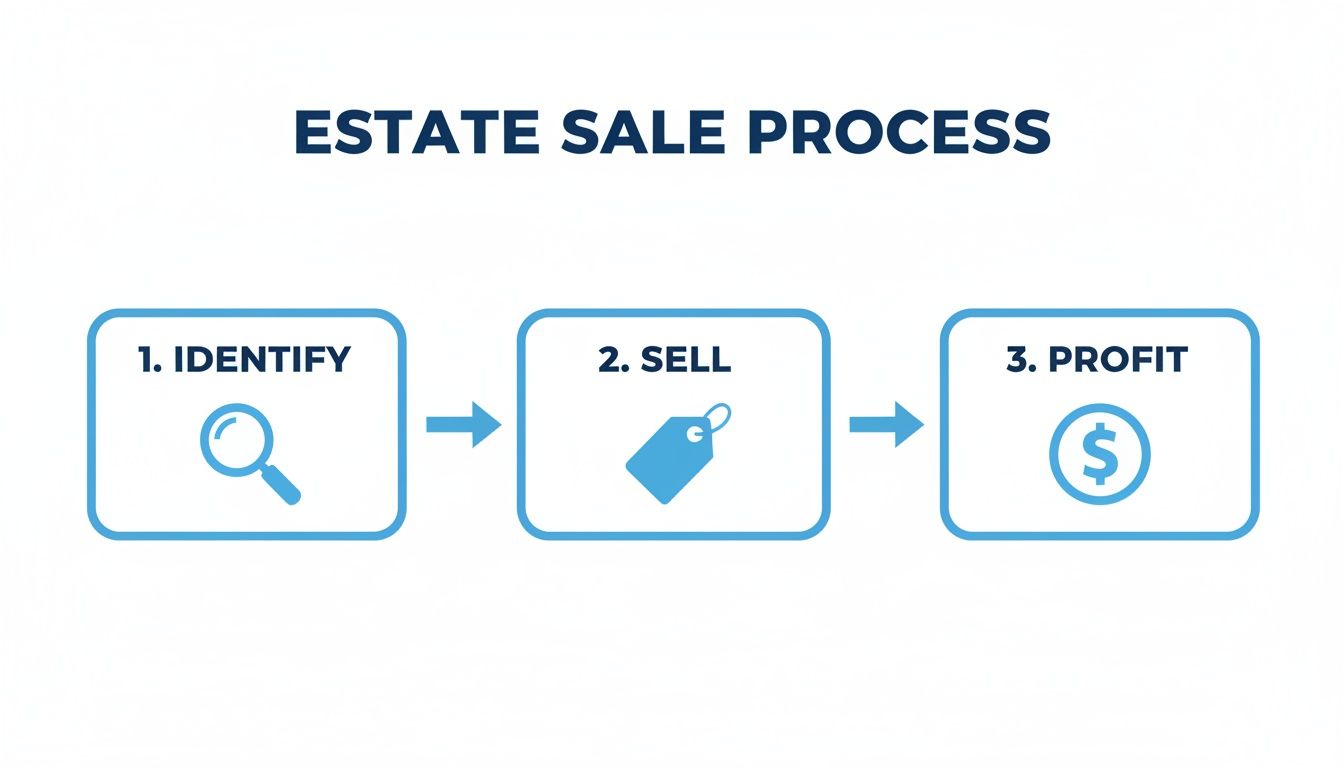
As you can see, with the right tools and approach, anyone can manage a successful sale and see fantastic results.
Taking Control of Your Sale
When you run your own sale, you call the shots. You're in complete control of the process, and more importantly, the profits. The days of being a passive spectator while a high-commission company liquidates a family's possessions are over. Now, you get to be the director.
The real power lies in taking control. When you manage your own sale, you set the prices, you tell the stories behind the items, and you ultimately decide what your family’s legacy is worth.
Deciding between a traditional service and a platform like DIYAuctions comes down to a few key differences. Here’s a quick comparison:
Traditional Estate Sale Company vs DIYAuctions Platform
| Feature | Traditional Estate Sale Company | DIYAuctions |
|---|---|---|
| Commission | 40-60% of total sales | 10% (capped at $1,000) |
| Control | Limited; company handles all pricing & marketing | Full control over pricing, descriptions, and timeline |
| Transparency | Often a "black box"; final payout can be a surprise | 100% transparent; you see all bids and sales in real-time |
| Timeline | Works on the company's schedule, may be weeks out | Flexible; launch your sale when you're ready |
| Net Profit | Significantly lower due to high commission rates | Significantly higher; you keep the vast majority of the profit |
Choosing the DIY route empowers you to maximize your returns while honoring the story behind each item. This modern approach gives you several key advantages:
- Maximum Profitability: With a low, capped commission, the money goes where it belongs: in your pocket.
- Full Transparency: You see every bid and every final sale price. There are no hidden fees or mysteries about where the money went.
- Personal Connection: You can share the history of an item, which often boosts its value and attracts buyers who will truly cherish it.
By embracing this modern method, you gain the confidence to handle everything from identifying treasures to running a smooth, highly profitable event. This guide will walk you through every practical step you need to succeed.
Identifying Antiques Hidden in Plain Sight
This is where the real treasure hunt begins. When you're sifting through a lifetime of belongings, it's easy to get overwhelmed. But tucked away among the everyday items, you'll often find valuable estate sale antiques just waiting to be discovered. The secret is knowing what to look for and understanding that age alone doesn't automatically mean value.
The real money is in an item's history, craftsmanship, and rarity. You aren't just looking for "old things"—you're looking for pieces with a story. That's what gets buyers excited and drives up bids.

Uncovering Clues in Construction and Materials
It's time to become a detective in your own home. You have to look past the surface and examine how something was actually made. These little details are the fingerprints that point to its era and origin.
Take a piece of furniture, for example. Check out the joints. Do you see dovetails—those interlocking trapezoidal pins? If they look slightly irregular, they were likely hand-cut, a hallmark of pre-1880 craftsmanship. After that, machines took over and made them perfectly uniform. Also, look for straight saw marks on the back of a piece or under a drawer; that’s a dead giveaway it was cut before circular saws became common.
For a deeper dive into the specifics, check out our complete guide on how to identify valuable antiques.
The Importance of Maker's Marks
Maker's marks, signatures, and hallmarks are your direct line to an item's creator and its history. They’re often hidden in plain sight on the bottom of a vase, inside a drawer, or along the edge of a silver spoon. These marks can turn a generic old chair into a verifiable piece from a sought-after designer.
-
Ceramics and Porcelain: Flip over every plate, vase, and figurine. Look for stamps, symbols, or painted marks. A quick online search for a description of the mark (e.g., "blue crossed swords mark on porcelain") can instantly reveal the manufacturer, country, and production date.
-
Silverware: Check the back of forks and spoons for tiny stamped symbols called hallmarks. These can tell you the silver content (like "925" for sterling), the city where it was tested, and even the year it was made.
-
Furniture: Keep an eye out for labels or stamps from manufacturers like Stickley, Herman Miller, or Drexel Heritage. These are often tucked inside drawers or on the back of the piece and can dramatically increase its value.
Many estates are also treasure troves for old jewelry, which is so often overlooked. When identifying antique jewelry, look for tiny hallmarks on the inside of ring bands or on necklace clasps. These can reveal the metal content (like 14K or 18K gold) and sometimes even the jeweler's signature.
The smallest stamp or signature can be the difference between a ten-dollar trinket and a thousand-dollar treasure. Never assume an unmarked item is worthless, but always research any mark you find.
Leveraging Modern Tools for Research
Here's the good news: you don't need to be an antiques expert to get started. The smartphone in your pocket is an incredibly powerful tool for that first round of identification.
Snap a photo of an item with an app like Google Lens. Its visual search can often identify the piece or, at the very least, pull up visually similar items for sale online. This gives you a fantastic jumping-off point for figuring out what you actually have.
Once you have a potential ID, turn to online auction databases. The key is to look at websites that show sold results, not just what people are asking. Seeing what similar pieces have actually sold for gives you a realistic baseline for value, which is crucial when you get to the pricing stage for your own estate sale antiques. This research doesn't just give you a price—it helps you build a compelling story for each item, establishing its history and justifying its worth to potential buyers.
How to Price Your Antiques for Maximum Profit
Figuring out the right price for your estate sale antiques is probably the single most important thing you'll do to turn those heirlooms into cash. If you price things too high, you’ll just scare off the knowledgeable buyers who actually know the market. But if you price too low, you’re literally giving money away.
The goal is to hit that sweet spot—a price that gets bidders excited while still honoring what your items are truly worth. This isn’t a guessing game. It’s all about doing some smart, focused research. The real secret is to look at what similar items have actually sold for, not what someone is asking. An asking price is just a wish; a sold price is a hard fact.
Get Your Hands on Real-World Data
The first move is what’s called a comparative market analysis, which sounds way more intimidating than it is. Just think of it as good old-fashioned detective work. You're hunting for recent sales of items that are nearly identical to yours in age, condition, maker, and style.
Online auction sites are your best friend for this. The trick is to find platforms that let you filter your search to see only “sold” or “completed” listings. That’s where you’ll unearth the real-world value of your pieces.
- Get Specific: Searching for "old chair" is a waste of time. But a search for "mid-century Adrian Pearsall walnut lounge chair" will give you data you can actually use.
- Condition is Everything: Pay close attention to the condition of the items that sold. A piece in mint condition will always fetch a higher price than one showing its age. Be honest about your own item's flaws.
- Borrow from the Best: Read the descriptions of the most successful sales. What keywords did they use? Which details did they make sure to highlight? That information is pure gold when it's time to write your own listings.
This research will help you nail down a realistic price range. For a broader overview, you can always consult an online antique price guide to get a general sense of the current market.
Fair Market Value vs. Insurance Value
It’s absolutely critical to know the difference between these two terms. Mixing them up is a classic rookie mistake that can sink your sale before it even starts.
Fair Market Value (FMV) is what a willing buyer would pay a willing seller on the open market today, with neither side being under pressure. This is the number you're shooting for in an estate sale. It’s what the item is worth right now.
Insurance Value is the cost to go out and replace an item with a similar new one from a retail store. This number is almost always much higher than FMV because it has to cover retail markup and the cost of immediate replacement. You should never use an insurance appraisal to set your estate sale prices.
Trying to price your antiques based on an insurance appraisal from ten years ago is one of the fastest ways to make sure nothing sells. Markets shift, and fair market value is all about today's demand, not yesterday's replacement cost.
When to Call in a Professional
Look, you can price most things yourself with a little bit of digging. But every now and then, you might stumble upon something that makes you pause. If you suspect an item is exceptionally rare or valuable—think fine art, signed designer jewelry, or a historical artifact with documentation—calling a professional appraiser is a very smart move.
A certified appraiser can give you a formal document that authenticates the piece and gives you a solid FMV. This not only gives you peace of mind but also gives serious buyers the proof they need to feel confident bidding high.
Use a Little Pricing Psychology
Pricing isn't just a numbers game; it's about people. A few simple psychological tactics can spark more interest and push those final sale prices higher.
- Start the Bidding Low: For an online auction, a low starting bid feels accessible and gets more people to place that first bid. Once a few people are in, their natural competitive spirit often takes over. A $1 starting bid can sometimes create a bidding frenzy that a $50 start never would.
- Bundle the Small Stuff: Got a beautiful set of china but it’s missing a few plates? Or a box of old tools that aren’t worth much on their own? Group them into a single "lot." Buyers often love the value of a bundle, and it helps you move a lot of lower-value inventory all at once.
- Embrace "Or Best Offer" (OBO): If you're selling items at a fixed price, adding "OBO" to your listing signals that you're open to negotiation. It’s a great way to invite a conversation and close a sale quickly.
Creating Online Listings That Attract Buyers
Your online listing is, for all intents and purposes, the digital storefront for your antiques. It's the very first impression a potential buyer gets, and I’ve seen firsthand how a great listing can be the deciding factor between an item getting ignored and one that kicks off a bidding war.
The good news? You don’t need a fancy studio to get fantastic results. Your smartphone is more than powerful enough to capture photos that sell.
The trick is to put yourself in the buyer's shoes. What would you want to know? What details would you look for? A winning listing anticipates every question and provides clear, compelling answers through both its pictures and its words. It’s how you showcase your items beautifully and build the trust needed to attract serious bidders.
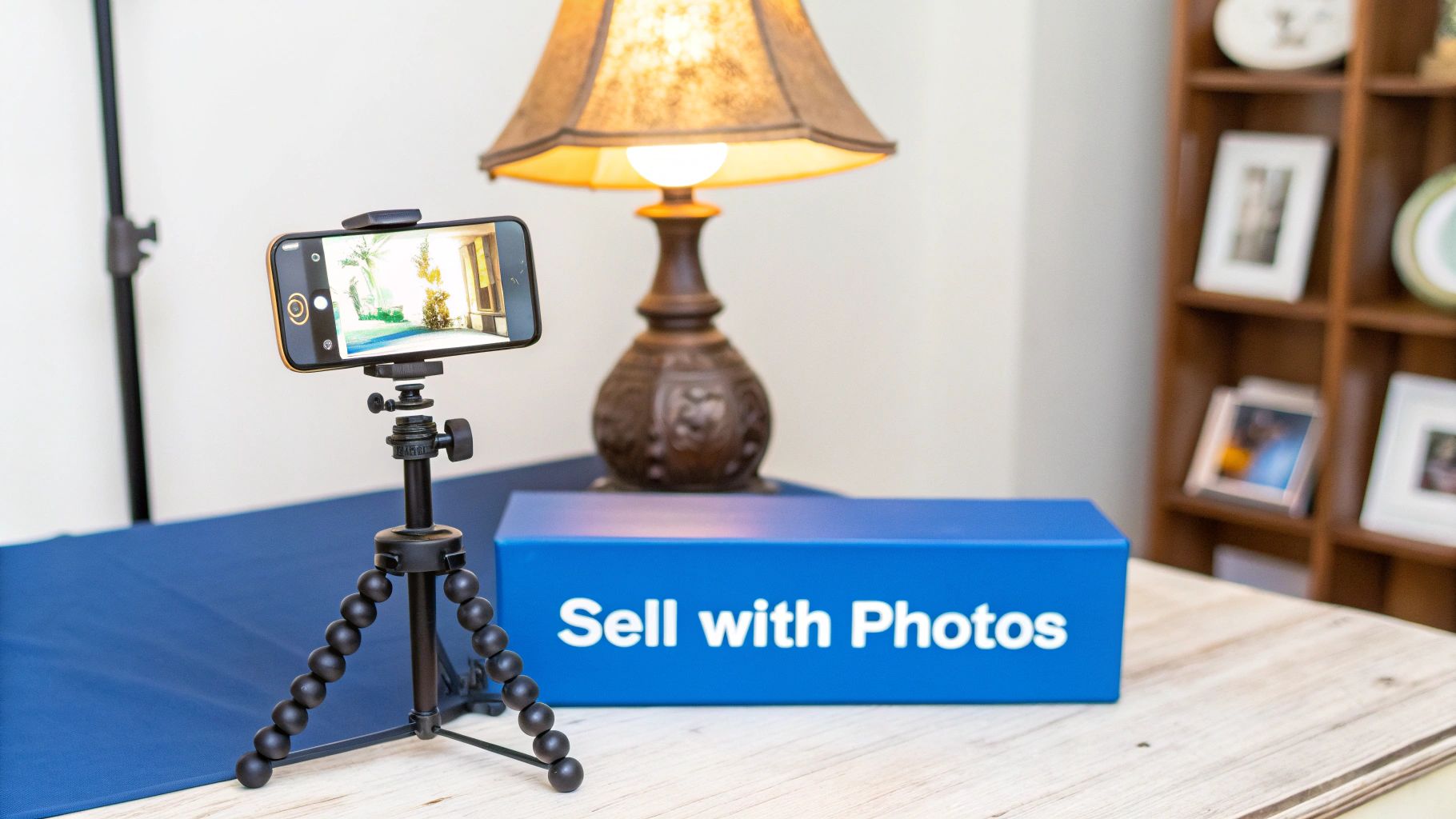
Mastering Smartphone Photography
Let's be clear: great photos are non-negotiable. They are your single most powerful selling tool. Since bidders can't hold the item themselves, they rely entirely on your images to judge an antique's condition, quality, and authenticity.
Natural light is your secret weapon here. Find a spot near a large window, ideally on an overcast day, to get soft, even lighting that reveals true colors without creating harsh shadows. Whatever you do, avoid your phone's built-in flash—it creates a nasty glare and washes out the very details you need to highlight.
Stage your items against a clean, neutral background. A plain wall or even a solid-colored sheet works wonders, as it keeps the focus exactly where it belongs: on the antique. For a full walkthrough, check out our guide on how to take professional product photos with just your phone.
When you start shooting, think about telling a complete visual story. One photo just won't cut it.
- Capture Every Angle: You need to show the front, back, sides, top, and bottom. Buyers expect a full 360-degree view.
- Highlight Key Details: Get close-ups of any maker's marks, signatures, delicate carvings, or interesting construction like dovetail joints.
- Be Honest About Flaws: Always photograph any scratches, chips, or signs of wear. Transparency is crucial for building trust and preventing any issues down the line.
- Show Scale: For smaller items, place a familiar object like a coin or a ruler next to them so buyers can instantly understand their size.
Writing Descriptions That Sell
With stunning photos in hand, it’s time to write a description that closes the deal. This is where you bring your research to life with clear, persuasive language. A truly effective description does more than just list facts; it tells the item’s story and answers a buyer's questions before they even think to ask them.
Start with a powerful, keyword-rich title. Instead of "Old Wooden Chair," try something like "Vintage Mid-Century Modern Walnut Armchair by Drexel." That level of specificity is what helps serious collectors find exactly what you're selling.
Your item description should be a conversation with the buyer. Anticipate their questions—'How big is it?' 'What's the condition?' 'Who made it?'—and answer them clearly and concisely.
From there, the body of your description needs to deliver all the essential information. Always make sure to include:
- Dimensions: Provide precise measurements—height, width, and depth.
- Condition Report: Point out any flaws you photographed. Use clear terms like "minor scuffing on left leg" or "small chip on rim."
- Provenance (if known): Briefly share the item's history if you have it. "This piece was purchased in the 1960s and has been in one family ever since."
- Materials: Be specific. Is it "solid cherry wood," "sterling silver," or "hand-painted porcelain"?
This attention to detail is more important than ever. The antiques trade is experiencing a massive comeback, with annual growth hitting 15%, largely fueled by younger buyers. It’s a trend that platforms like DIYAuctions are built for, giving you an easy way to upload photos, manage bids, and keep up to 90% of the profits. This modern approach to estate sales connects your well-documented treasures with a whole new generation of eager collectors.
Running a Smooth and Stress-Free Pickup Day
The auction is over, the final bids are in, and you’re on the home stretch. That feeling of accomplishment is huge, but don’t pack it in just yet. The final, and arguably most important, step is pulling off a smooth pickup day for your winning bidders.
This is where your preparation and a bit of thoughtful planning can make all the difference, turning what could be a frantic free-for-all into a calm, professional, and even enjoyable experience.
Setting the Stage for Success
The hours before the first buyer shows up are your golden opportunity to get organized. I've found the best way to do this is to move all the sold items into one central spot, like the garage or a cleared-out living room. This keeps buyers from wandering through the house and makes everything much more secure and efficient.
Once you have everything in one place, label each item clearly with the buyer's name and lot number. You'll thank yourself later when you aren't squinting at a tiny tag trying to figure out who bought which ceramic vase. If you sold several large estate sale antiques, do yourself a favor and move them closest to the exit.
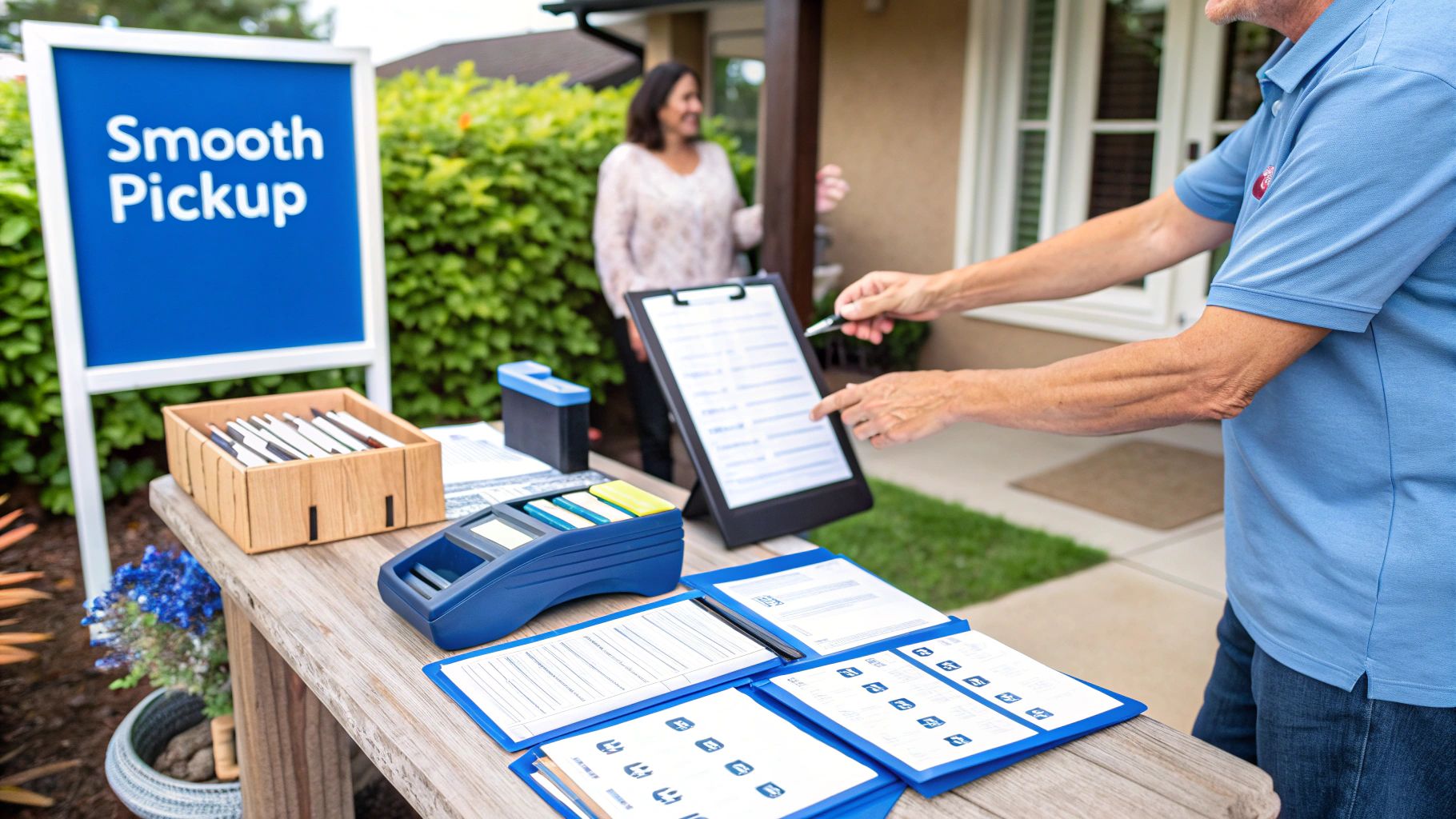
Organization is your best defense against chaos. A few hours spent prepping before pickup day can save you from a full day of stress and confusion. It transforms the experience from reactive to proactive.
Managing the Flow of People and Items
As buyers begin to arrive, your main job shifts to managing the flow. Having a single entrance and exit is a simple trick that works wonders for preventing traffic jams. I always recommend setting up a small welcome station right at the entrance to greet people and get the process started on the right foot.
Here’s what you need at your welcome station:
- A Printed List of Winners: This is your master sheet. Have a complete, printed list of every winning bidder and the items they won.
- Payment Verification: On platforms like DIYAuctions, this is incredibly simple. Payments are already handled online, so all you have to do is quickly check your dashboard to confirm it's been received before they head out with their items.
- Signage: Don't underestimate the power of a few good signs. Simple directions for parking, entering, and where to go for pickup eliminate a ton of questions and confusion.
Seriously consider asking a friend or family member for help. Having a second person makes a world of difference. One of you can greet buyers and check payments while the other retrieves the items. It keeps everything moving and lets you provide great service without feeling frazzled.
Handling On-Site Logistics and Questions
Even with the best prep, little things will come up. A buyer might need a hand with a heavy table, or someone might have a last-minute question about an item's history. Just roll with it and be friendly and helpful.
For bigger, heavier items, it’s a good practice to state in your auction terms that buyers need to bring their own help. That said, having a dolly or hand truck available is a fantastic touch that people really appreciate.
I also like to keep some extra packing supplies nearby. While buyers should come prepared, having a few spare boxes, some bubble wrap, or newspaper can be a real lifesaver for someone who forgot. It’s these small gestures that leave a lasting positive impression, ensuring the estate sale antiques you so carefully managed get to their new homes safe and sound.
Got Questions About Selling Antiques Online?
Diving into the world of estate sale antiques can feel like a whole new adventure, and it’s perfectly normal to have questions. This is the part where we tackle the most common concerns we hear from sellers just like you.
Think of this as your personal FAQ, built from years of experience. We'll give you the straight answers to help you sidestep the usual hurdles and move forward with confidence.
What's the Biggest Mistake People Make?
Hands down, the single biggest misstep is skimping on research. This mistake is a double-edged sword: you either undervalue a hidden gem and leave money on the table, or you overprice a common piece that just sits there, unsold.
Taking a few extra minutes to properly investigate what you have is non-negotiable. Look for maker's marks, understand an item's history, and most importantly, check what similar pieces have actually sold for. This bit of homework is what separates a profitable, satisfying sale from a frustrating one.
How Do I Handle Shipping and Delivery?
This is a huge source of stress for sellers, especially when you're looking at a heavy china cabinet or a box of delicate porcelain. But here’s the good news: modern platforms like DIYAuctions are designed around a local pickup model. This completely sidesteps the nightmare of shipping.
Your job is simply to be crystal clear about it in your listings.
- State that all items are for local pickup only.
- Specify the exact date, time window, and address for pickup.
- Remind buyers to bring their own help, boxes, and packing materials.
This simple approach puts the responsibility on the buyer to safely transport their new treasures. It makes your life infinitely easier and eliminates the risk of something breaking in transit.
One of the best developments in the estate sale world has been the shift to streamlined, local transactions. When you get rid of shipping, you open your sale up to a whole new group of buyers who just want a simple, direct pickup.
Do I Really Need a Professional Appraiser?
For most items in a standard estate, the answer is a firm no. It just doesn't make financial sense to pay for an appraisal on every piece of furniture or dishware. A little online research into sold listings will give you everything you need for the vast majority of your inventory.
However, you should absolutely call in a pro if you stumble upon something you suspect is truly special. We're talking about things like:
- Fine art by a known artist
- Jewelry with large gemstones or a famous designer’s mark
- Furniture from a highly coveted maker like Stickley or Knoll
- Authenticated historical documents or rare artifacts
In these rare cases, an expert’s stamp of approval can dramatically increase the final price, making the appraisal fee a very smart investment.
What if Something Doesn't Sell?
It happens! Having an item or two go unsold isn’t a failure; it’s just part of the process. The trick is to have a simple backup plan ready before your sale starts so you aren’t left scrambling.
If an item doesn't find a new home, you've got a few great options. You can relist it in a future sale with a lower starting bid, bundle it with other unsold items into an attractive "lot," or donate it to a qualified charity for a nice tax deduction. Don't forget about local antique dealers, either—they're often interested in buying leftover inventory.
Right now, some categories are hotter than others. For example, estate sales are a huge source for the antique jewelry market, which has grown into a $5.5 billion global industry in 2024. Platforms like DIYAuctions are built to help you tap into that demand, making it easy to catalog and market these pieces to local buyers while ensuring you keep up to 90% of the proceeds. You can read more about the growth in the antique jewelry market to see just how big the opportunity is.
More guides in Selling Antiques & Collectibles
July 31, 2026
Ceramic Christmas Tree Atlantic Mold Seller's Guide
Identify, value, and sell a Ceramic Christmas Tree Atlantic Mold piece with confidence. Covers markings, rarity, condition, pricing, and listing tips.
Read guideJuly 30, 2026
Nurre Mirror Value: How to Identify and Sell for Profit
Learn to assess nurre mirror value with our step-by-step guide. Identify authentic pieces, estimate price, and sell profitably on DIYAuctions.
Read guideJuly 29, 2026
Distinction Deluxe Stainless Steel by Oneida HH: A Complete
Learn to identify, assess, and price your distinction deluxe stainless steel by oneida hh set for maximum profit.
Read guideGet the estate sale pricing guide
Enter your email for pricing ranges, planning notes, and a clearer path to launch.