A Practical Guide to Estate Sales in New Jersey
Our complete guide to estate sales in New Jersey covers local laws, pricing, and marketing. Learn how to manage a successful sale from start to finish.
Running an estate sale in New Jersey means selling off the contents of a home, a task that usually comes on the heels of a major life event. Whether you're downsizing, moving, or settling a loved one's estate, the process requires real planning—from sorting through a lifetime of memories to getting a handle on state and local rules.
Your Starting Point for New Jersey Estate Sales

Tackling an estate sale in the Garden State can feel overwhelming at first, but breaking it down into manageable pieces makes all the difference. The end goal is always the same, whether you're an executor or just clearing out your own home: sell everything efficiently and get the best possible return.
The reasons people hold these sales are often personal and emotional. Most fall into a few key categories:
- Estate Settlement: This is the most common trigger. It involves liquidating a person's assets so the money can be distributed to heirs according to their will.
- Downsizing: Plenty of New Jersey retirees and empty-nesters find themselves selling belongings that simply won't fit into a smaller condo, apartment, or assisted living space.
- Relocation: A big move, especially across state lines, makes taking everything with you impractical. A sale is often the most sensible solution.
- Debt or Divorce: Sometimes, selling assets is a necessary step to settle financial obligations or divide property fairly.
The First Big Decision: DIY vs. Hiring a Pro
Right out of the gate, you have to decide: will you run this sale yourself or bring in a professional estate sale company? There's no single right answer. It really boils down to how much time and energy you have, not to mention the size and complexity of the estate.
A DIY approach, especially with a platform like DIYAuctions, puts you in the driver's seat. You keep total control and a much bigger slice of the profits. If you're okay with the hands-on work of organizing, pricing, and managing the sale, this is a fantastic option.
On the other hand, hiring a full-service company takes the entire burden off your shoulders. They do everything from staging and pricing to the final cleanup. But that convenience comes at a steep price—commissions in New Jersey typically run anywhere from 35% to 50% of the total sales.
Comparing DIY vs Professional Estate Sale Management in NJ
Here's a quick look at the key differences between running your own estate sale and hiring a full-service company in New Jersey.
| Consideration | DIY Approach | Professional Company |
|---|---|---|
| Profit Share | You keep 90% or more of the proceeds. | You keep 50% to 65% after commissions. |
| Control | Full control over pricing, timeline, and what gets sold. | Company makes most decisions on pricing and staging. |
| Time & Effort | Requires your time for sorting, cataloging, and pickup. | Minimal time commitment; they handle everything. |
| Upfront Cost | Low to none. Platform fees are taken from proceeds. | Usually no upfront cost, but high commission fees. |
| Expertise | You rely on platform tools and your own research. | They bring industry knowledge and a following of buyers. |
| Best For | Hands-on individuals wanting to maximize profit. | Those with limited time or who feel overwhelmed by the task. |
Ultimately, the choice depends on whether you'd rather trade a portion of your profits for the convenience of having someone else do all the work.
Understanding the Ground Rules
Before you start sorting through closets, you need a basic grasp of New Jersey's requirements. A foundational step for any sale is figuring out how to declutter your home—it’s the only way to get properly organized and see what you actually have to sell. This process sets the stage for everything else.
A well-organized estate sale isn't just about selling things; it's about honoring a legacy and making a difficult transition smoother. The key is to start with a clear plan and tackle one step at a time.
Getting a handle on local permits, sales tax rules, and potential inheritance tax laws is non-negotiable. Every town, from Montclair to Cape May, can have slightly different regulations. Doing this research early will save you from major headaches later. This guide will walk you through all these critical steps, giving you a clear roadmap for a sale that's both successful and fully compliant.
Navigating NJ Estate Sale Laws, Permits, and Taxes
Before you start tagging antiques or sorting through jewelry, you need to get a firm grip on the legal side of running an estate sale in New Jersey. I know, it’s not the exciting part. But trust me, overlooking these rules can lead to fines and legal headaches you absolutely want to avoid.
The most important thing to understand right off the bat is that New Jersey doesn't have a one-size-fits-all, statewide permit for estate sales. Instead, everything is handled at the local level. That means the rules in Cherry Hill can be wildly different from what you'll find in Jersey City.
First Stop: Your Local Town Hall
Your first move should always be to connect with your local municipal clerk's office. They are the ultimate authority on your town’s specific requirements. Some towns won't require a permit at all, while others have a formal application process and fees.
I've seen it all. A leafy suburb in Morris County might have strict limits on how many days your sale can run and exactly where you can put your signs. Head over to a more rural town in Hunterdon County, and you might find they're much more laid-back.
When you reach out to them, have a few key questions ready:
- Do I need a permit for a residential estate sale?
- If so, what’s the fee?
- How many days can the sale legally run? (Many towns cap it at three.)
- What are the local rules for posting signs?
Getting these answers in an email is a smart move. It gives you a written record to fall back on and helps avoid any "he said, she said" confusion down the line.
Don't Forget About New Jersey Sales Tax
This is where a lot of people get tripped up. In New Jersey, the money you make from an estate sale is generally subject to the state sales tax, which is currently 6.625%. The responsibility for collecting and paying that tax falls on whoever is running the sale.
If you’re running the sale yourself, that means you are the vendor in the eyes of the state. You’ll have to register with the New Jersey Division of Taxation for a Certificate of Authority, which is what legally allows you to collect the tax. From there, you're on the hook for adding the tax to every sale, keeping good records, and sending the money to the state.
Key Takeaway: Whatever you do, don't treat sales tax as optional. The state is very serious about compliance, and failing to collect it can lead to some painful penalties and back-tax bills.
If you hire a full-service estate sale company, this task usually falls to them. Any reputable company will already be registered with the state and will manage all the tax details as part of their fee. Just make sure this is spelled out clearly in your contract before you sign anything.
Inheritance Tax vs. Estate Tax
Here's another point of clarification. New Jersey did away with its Estate Tax back in 2018, but the Inheritance Tax is still very much in effect. This tax isn't paid by the estate itself, but by the people who inherit the property.
The rate depends entirely on the beneficiary's relationship to the person who passed away.
For example, direct relatives like children, parents, and grandchildren are "Class A" beneficiaries and are completely exempt. Siblings ("Class C") and more distant relatives like nieces or nephews ("Class D") are subject to the tax after certain exemption amounts are met. It can get complicated, but you can learn more about the bigger picture in our guide to general estate sale laws.
So, how does this affect your sale? The money raised from selling the home's contents becomes cash in the estate's bank account. When that money is distributed to the heirs, the inheritance tax rules kick in. It’s absolutely critical for the executor to keep meticulous records of every single dollar earned. This ensures the estate's final value is calculated correctly for any tax filings and keeps things transparent for everyone involved.
How to Price Valuables for the New Jersey Market

This is where a successful New Jersey estate sale is won or lost. Pricing is a delicate balance—ask too much, and you're left with a house full of stuff. Ask too little, and you're leaving cash on the table. The real key is knowing the local New Jersey market.
What sells for top dollar in a historic Morristown colonial might not get a second look in a modern Jersey City high-rise. This local dynamic is everything. Your goal is to price items based not just on their general value, but on what a local buyer is willing to pay for them right now.
Researching Fair Market Value
First things first, you need a baseline. This isn't about what was paid for an item or its sentimental worth; it’s about its current fair market value. In other words, what will someone actually hand over cash for today?
Start your digging online. Sites like eBay (make sure you use the "Sold Items" filter), LiveAuctioneers, and WorthPoint are your best friends here. They show you what similar items actually sold for, which is a world away from what people are just asking.
For example, if you have a set of mid-century modern dining chairs, you can search for the brand and model to see real-world prices. This data-driven approach takes the emotion and guesswork out of the equation.
Don't get distracted by high asking prices on active listings. Focus only on what buyers have already paid. An item listed for $500 that never sells is irrelevant. An identical one that sold for $250 is your true benchmark.
Understanding Local New Jersey Demand
While online research gives you a national average, local demand can change the game entirely. New Jersey's market is incredibly diverse, and knowing the regional sweet spots is how you maximize your profit.
- Antique & Colonial Furniture: Historic towns like Princeton, Morristown, or anywhere in Hunterdon County have a built-in audience for traditional antiques.
- Mid-Century Modern & Art Deco: These styles fly off the shelves in trendier areas like Montclair, Asbury Park, and Jersey City, where buyers are often furnishing modern condos.
- Jersey Shore Collectibles: Got vintage boardwalk signs or nautical decor? There’s a dedicated market for that in shore towns from Sandy Hook down to Cape May.
- Designer Brands & Luxury Goods: High-end clothing, handbags, and accessories will always find eager buyers in affluent communities across Bergen, Morris, and Monmouth counties.
This is also tied to the local economy. New Jersey's real estate market has been hot, with some urban areas like Jersey City seeing a median home price of $725,000. All those new homeowners need to furnish their places, creating a perfect opportunity for your sale. You can get a feel for local buyer activity by reading up on New Jersey housing market trends.
When to Bring in a Professional Appraiser
For most things, your own research is enough. But for some high-value or unique pieces, calling in a professional appraiser is a smart investment. You don't need one for every table and chair, but it’s a good idea for:
- Fine art (paintings, sculptures)
- High-end or antique jewelry
- Rare coin or stamp collections
- Certified antique furniture
- Unique historical documents
An appraiser gives you a certified valuation, which helps you set a confident price and gives serious buyers peace of mind. The cost of the appraisal is almost always covered by the higher sale price you’ll get.
The Psychology of Estate Sale Pricing
Good pricing is also about human behavior. You want to create an atmosphere where shoppers feel like they're getting a good deal, which encourages them to buy more.
Shoppers at estate sales in New Jersey expect to haggle a bit—it’s part of the fun. A good rule of thumb is to price items with a 10-15% buffer to leave room for negotiation. This lets buyers feel like they got a win while you still hit your target price.
Bundling is another great tactic. Grouping related items, like a set of kitchen gadgets or a stack of books by the same author, for a single price can move lower-value inventory much faster. For a deeper dive into these strategies, our guide on how to price items for an estate sale will help you tag everything with confidence.
Marketing Your Sale to Attract NJ Buyers
Once everything is priced and staged, it's time to get the word out. This is where the magic happens, and a well-marketed sale is the difference between a few curious neighbors stopping by and a line of serious buyers forming down the block before you even open. For an estate sale in New Jersey, you need a smart mix of digital savvy and old-school tactics to reach the right people.
Your Digital Game Plan
Let's be honest, your top priority has to be digital. Today's buyers, from seasoned antique dealers to young couples furnishing their first home, start their search online. Your first stop, without question, should be listing your sale on a dedicated platform like EstateSales.net. This is the watering hole for the entire estate sale community, and not listing here is like trying to sell without opening the front door.
But don't just stop there. Hyper-local platforms are where you'll find your bread-and-butter buyers. Get familiar with the digital hubs in your specific community.
- Local Facebook Groups: Search for "Buy and Sell" or community-specific groups for your county, whether it's Monmouth, Bergen, or Mercer. These groups are packed with engaged locals actively hunting for deals.
- Facebook Marketplace: This is a must. Its algorithm is surprisingly good at targeting users in nearby towns who have searched for items just like yours.
- Nextdoor: Perfect for getting the attention of your immediate neighbors and the surrounding blocks. These are often the first people to show up, cash in hand.
Creating a Listing That People Can't Ignore
Think of your online listing as your digital storefront—first impressions are everything. A quick, text-only post just won't cut it anymore. You need to build some excitement and create a little FOMO (fear of missing out).
The absolute key? Great photos. You don't need a fancy camera, but you do need to take clear, well-lit pictures. Stage your best items—that mid-century modern credenza, the collection of vintage Pyrex, or the designer handbag. Snap a few shots from different angles. These are your "hero" images that will stop people from scrolling past.
When you write the description, be both detailed and enticing.
Pro Tip: Don't just say "lots of furniture." Instead, try something like, "Featuring a solid oak dining set from the 1960s, a pristine Lane cedar chest, and a variety of antique side tables." Specifics sell.
List the main categories you're offering and be sure to call out any high-demand or unique brands. And of course, put the sale address, dates, and hours clearly at the top and bottom of your post. For a deeper dive, check out our guide on effective estate sale advertising to make sure your listing truly shines.
Don't Forget Tried-and-True Marketing
While a strong online presence is essential, don't completely abandon the physical world. Good old-fashioned signs are still one of the best ways to pull in drive-by traffic on the days of the sale. Get some large, easy-to-read signs and place them at major intersections nearby, using big, bold arrows to point the way.
A little networking can also go a long way. If you have specialty items, like a stamp collection or a garage full of antique tools, reach out directly to local dealers or collector clubs. A quick email or a phone call can bring in an expert buyer who knows the value of what you have and is willing to pay for it.
Tapping into that local eagerness is just as important for personal property as it is for real estate. This strategic approach helps you connect with buyers who see the true value in your items. To quickly attract high-quality leads, a good PPC for lead generation playbook can offer proven strategies you can adapt for your local sale.
Managing Sale Days and Post-Sale Logistics
All your prep work has led to this. Your marketing is out there, buyers are getting excited, and now it's time to execute. The sale days are where your planning pays off, and running a smooth, secure event is what turns browsers into happy buyers and maximizes your profit.
Think of your home as a pop-up retail shop for a few days. You need to manage customer flow, have a rock-solid checkout system, and know your policies before a single person walks through the door.
Setting Up for a Successful Sale Day
Your number one job on sale day is creating an environment that’s both safe and easy to shop. Before you open, do a final walkthrough of the entire space. Are the pathways clear? Are fragile items sitting securely on shelves? Are the most valuable pieces in a spot where you can easily see them?
Think about how people will naturally move from room to room. You can guide them with a bit of strategic furniture placement or even a few simple signs. I always recommend having a designated entrance and exit—it keeps the flow orderly and helps you manage how many people are inside at once.
This is all about getting those eager buyers to your front door.
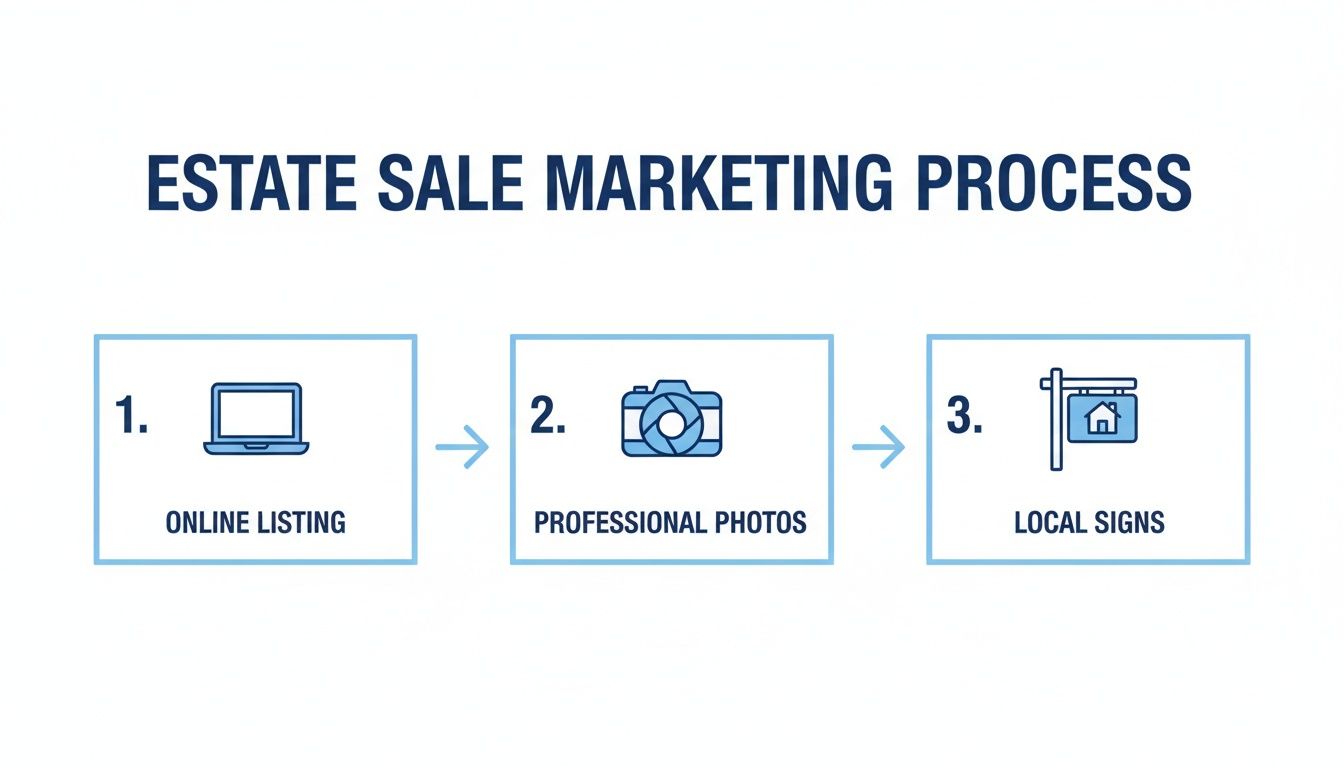
The combination of great online listings, quality photos, and old-school physical signs is a proven formula for attracting local New Jersey shoppers.
Handling Transactions and Pickups
A clunky checkout process is a sale-killer. Set up a dedicated table near the exit and have your tools ready: a cash box with plenty of small bills and change, a calculator, and a card reader. You absolutely must accept multiple forms of payment.
- Cash: It’s still a favorite at estate sales, so be ready for it.
- Credit/Debit Cards: Using a service like Square or PayPal is a no-brainer. The small fee is a tiny price to pay for the convenience it offers buyers, which means more sales for you.
- Digital Wallets: Apps like Venmo and Zelle are becoming common, especially for bigger-ticket items.
You need a clear plan for large item pickups. No one is strapping a dining room set to the roof of their sedan. Give buyers a receipt clearly marked "Paid in Full" and schedule specific pickup windows—usually at the end of the day or on the day after the sale. This keeps the aisles clear and the sale running smoothly.
Crucial Tip: Never, ever let a large item leave the property until it is paid for in full. Once it's gone, your leverage is gone, too. Secure the payment before they arrange for muscle and a truck.
After the Sale: What to Do With Unsold Items
Here’s a simple truth: not everything will sell. If you plan for this reality from the start, the final clear-out is so much easier. You’ve got a few great options for what’s left.
First, donations are a fantastic route. Many New Jersey charities, like the Vietnam Veterans of America or Goodwill Industries of Greater NY and Northern NJ, will schedule a pickup for furniture, clothing, and housewares. You clear out the house, help a good cause, and get a tax-deductible receipt.
For the higher-value pieces that didn't find a buyer, think about consignment. Local antique or consignment shops in towns like Lambertville or Red Bank are always looking for quality inventory. They’ll take a cut, of course, but it’s a hands-off way to get a return on those items.
Finally, for the quickest and most complete clear-out, you can hire a junk removal or cleanout service. For a flat fee, they will empty the entire property and leave it broom-clean, ready for its next chapter. In a market where New Jersey housing inventory rose to 28,362 homes in late 2025, having a perfectly clean property is a huge advantage. Even though 44.4% of homes still sold over the asking price, a market-ready home stands out. You can learn more about the current state of New Jersey's housing market on defalcorealty.com.
Common Questions About New Jersey Estate Sales
Even with the best-laid plans, a few questions always seem to pop up when you're in the thick of preparing an estate sale. Getting straight answers is key to moving forward with confidence and making sure you’re making the right calls.
Here are a few of the most common questions we hear from folks running estate sales in New Jersey.
What’s the Average Commission for an Estate Sale Company in New Jersey?
This is usually the first thing people ask, and for good reason—it directly impacts the bottom line. In New Jersey, you can expect professional estate sale companies to charge a commission somewhere between 35% and 50% of the total gross sales.
The exact percentage often comes down to the overall value of the items being sold. If it's a smaller estate filled with typical household goods, you’ll likely see a rate on the higher end of that scale. On the other hand, if the estate includes high-value art, a significant antique collection, or fine jewelry, you'll have more leverage to negotiate a lower commission rate.
Always get it in writing. Before you sign on the dotted line, make sure the contract clearly spells out the commission structure. It should also detail exactly what services are included (like setup, advertising, and cleanup) and explicitly state that there are no hidden fees.
Do I Need to Be There During the Sale?
The short answer is no. In fact, most professionals will strongly advise against it.
It can be an incredibly tough emotional experience to watch strangers sifting through personal belongings and family heirlooms. Beyond the emotional toll, your presence can actually hinder the sale. Buyers often feel awkward trying to negotiate prices with a family member looking over their shoulder, which can lead to fewer sales and lower offers.
Letting the professionals handle it allows them to maintain a business-like atmosphere. They can manage the event impartially, negotiate effectively, and focus completely on getting the best prices without having to navigate family emotions at the same time.
How Long Does a Typical New Jersey Estate Sale Last?
Most estate sales in New Jersey will run for two or three days, usually over a weekend (think Friday through Sunday). The total time really depends on the sheer volume of items you're dealing with.
To make sure the house is cleared out by the end, most companies use a standard discount strategy that encourages shoppers to come back.
- Day 1: Everything is sold at full price.
- Day 2: Remaining items are often marked down by 25%.
- Day 3: The discount gets steeper, usually 50% or more, to sell off whatever is left.
For a particularly large estate with thousands of individual items, the sale might even be extended into a second weekend to give everything a fair shot at being sold.
What Happens to the Stuff That Doesn’t Sell?
It’s just a fact of life: there will always be items left over. What happens to them should be something you and the company agree on from the very beginning.
You’ve got a few common options for dealing with the remaining contents, and you can decide which path makes the most sense for your situation.
| Option | Description | Best For |
|---|---|---|
| Buy-Out | A third-party liquidator comes in and buys everything that's left for a single lump sum. | A fast and complete clear-out when you just need the property empty right away. |
| Donation | Unsold items are donated to a local New Jersey charity, and you get a tax-deductible receipt. | Giving back to the community while also getting a tax benefit for the estate. |
| Consignment | Specific high-value items that didn't sell are taken to a local consignment shop. | Getting a better return on valuable pieces that just need more time to find the right buyer. |
| Clean-Out | You hire a service to haul everything away for a fee, leaving the property broom-clean. | When the main goal is simply to get the house completely empty for a real estate closing. |
Make sure you talk through these options with your chosen company beforehand. Having a clear plan for the leftovers makes for a smooth, stress-free wrap-up once the sale is over.
More guides in Estate Sale Basics
July 28, 2026
Revenue Reporting for Estate Sales and Auctions
Learn revenue reporting essentials for estate sales and auctions. Discover key metrics, templates, and best practices to simplify tracking and compliance.
Read guideJuly 26, 2026
Stamp Collection Valuation: A Practical Step-by-Step Guide
Stamp collection valuation made simple. Learn how to identify, grade, price, and sell your stamps with confidence for estate sales or consignment.
Read guideJuly 23, 2026
Estate Sales Brick NJ: Your 2026 Guide to Success
Planning your estate sales brick nj? Our guide covers permits, pricing, marketing, & running a safe sale with DIYAuctions.
Read guideGet the estate sale pricing guide
Enter your email for pricing ranges, planning notes, and a clearer path to launch.