Garage and Estate Sales: Maximize Revenue with Proven Techniques
Discover practical steps to run garage and estate sales successfully. Plan, price, and promote to maximize earnings and clear clutter fast.

So, you're looking to clear out some clutter and make a bit of cash. Great! But before you start slapping price tags on everything, we need to talk about the most crucial first step: figuring out what kind of sale you’re actually having.
Garage sales and estate sales are both fantastic ways to sell your stuff, but they are worlds apart. A garage sale is your classic weekend decluttering project. An estate sale is a whole different beast—it's about liquidating nearly everything in a home, usually because of a major life event. Getting this right from the start will save you a world of headaches down the road.
Choosing Your Sale Type: Garage vs. Estate
Seriously, don't price a single thing until you've made this call. Are you just doing some spring cleaning, or are you navigating a significant life transition, like a move or managing a loved one’s home? The answer sets the stage for everything that follows—your workload, your marketing, and how much money you can realistically expect to make.
A garage sale is perfect for that regular clear-out. Think of it as your go-to for offloading toys the kids have outgrown, that bread maker you used once, or clothes that have been sitting in the closet for years. The stakes are pretty low. The main goal is usually just to free up space and pocket some extra spending money. You'll also hear them called yard sales or moving sales, which are similar but have slightly different vibes. If you're curious about the specifics, our guide breaks down a https://www.diyauctions.com/learn/moving-sale-vs-garage-sale.
An estate sale, on the other hand, is a much bigger operation. This is when you’re selling the entire contents of a house. It’s typically triggered by a major life event—downsizing for retirement, a cross-country move, or handling an inheritance. We're talking everything from the antique dining table and fine china down to the cleaning supplies under the sink.
Scope and Purpose Define the Sale
This distinction is becoming more important than ever. With major demographic shifts on the horizon—by 2030, it's projected that a full quarter of the U.S. population will be over 65—more families are finding themselves needing to manage an entire household of belongings. Given the sheer volume of items and the often-sensitive circumstances, many people turn to professional companies for estate sales, though doing it yourself is becoming a much more popular and viable option.
The real question comes down to scale and circumstance. A garage sale is about clearing out some things. An estate sale is about clearing out everything. Your reason for selling is what shapes the entire approach and what buyers will expect when they show up.
To get a clearer picture, start by deciding what to keep and what to sell. This single task will quickly reveal whether you’re looking at a garage sale pile or have enough inventory to justify a full-blown estate sale.
This simple decision tree can help you visualize the difference.
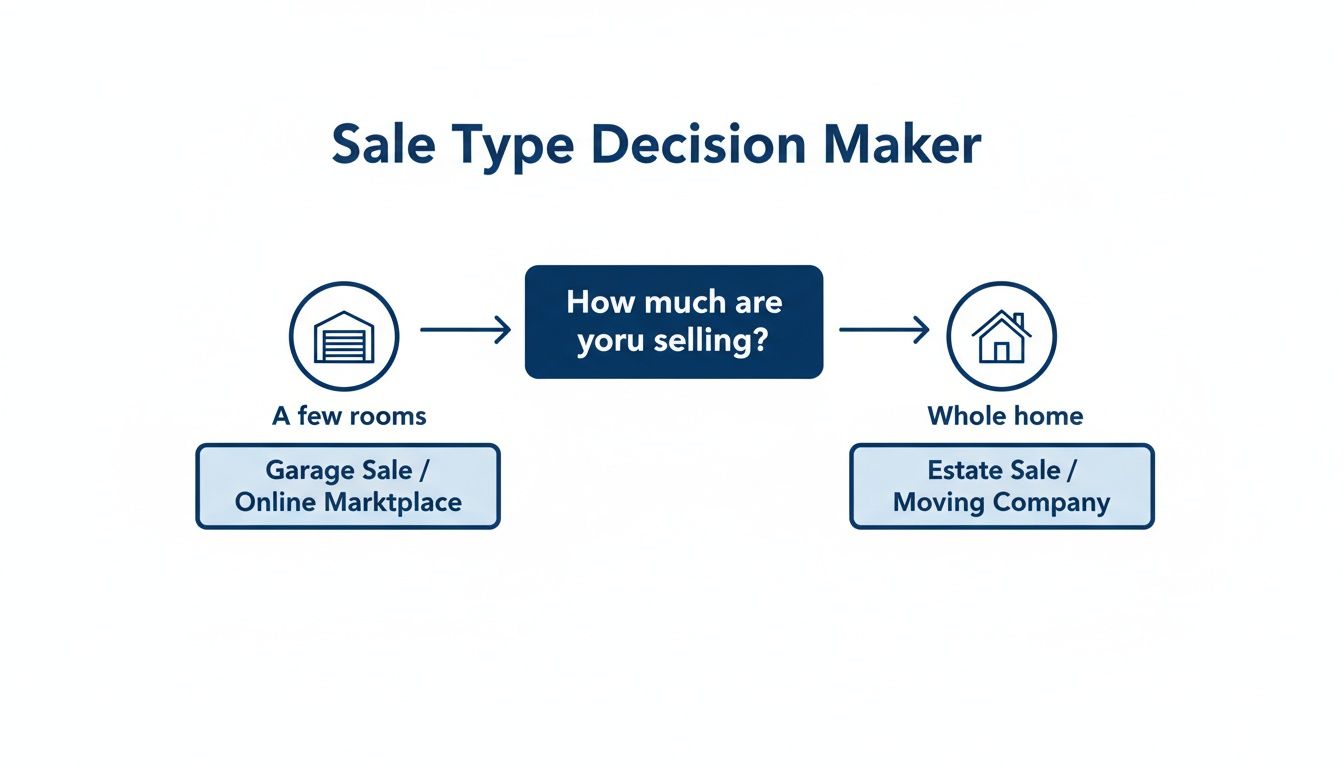
As you can see, it boils down to volume. If you're selling off items from just a couple of rooms, a garage sale is your best bet. If you’re liquidating an entire home, you’re in estate sale territory.
Garage Sale vs. Estate Sale At a Glance
Still on the fence? This table breaks down the key differences to help you make the right call for your situation.
| Feature | Garage Sale | Estate Sale |
|---|---|---|
| Inventory | Items from a few rooms; lower value goods. | Contents of an entire house, including high-value items. |
| Purpose | Decluttering, making some extra cash. | Liquidation due to a major life event (death, move, downsizing). |
| Pricing | Low prices, designed to sell fast; lots of haggling. | Items are individually priced based on fair market value. |
| Effort | Typically a DIY weekend project. | High-effort; often managed by a professional company. |
| Location | Driveway, yard, or garage. | Inside the home, with rooms open to the public. |
Ultimately, understanding these distinctions ensures you're set up for success from day one, using the right strategies for the right type of sale.
Strategic Prep Work for a Flawless Sale
Let’s be honest: a profitable sale is born from smart preparation, not luck. This is where the real work happens, long before the first customer shows up. Think of this as your pre-sale blueprint, the essential groundwork that turns a potentially chaotic weekend into a smooth, money-making event. It’s about way more than just dragging stuff onto your lawn.
The first, and frankly most important, step is getting organized. You need to dive into your storage spaces—the attic, basement, closets, and of course, the garage. Start by making three distinct zones or piles for your items: Keep, Sell, and Discard. You have to be ruthless here. If you haven't touched an item in over a year, it’s a prime candidate for the "Sell" pile. This sorting phase is also the perfect excuse to finally tackle that overwhelming mess. If you need a hand, you can find excellent guidance on how to declutter a garage effectively, which is often the biggest beast to tame.
Sorting and Cleaning for Maximum Appeal
Once you’ve sorted everything, your focus shifts to the "Sell" pile. A little elbow grease at this stage goes a surprisingly long way and can directly boost your final profits. Nobody wants to buy a dusty appliance or a grimy chair.
- Clean Everything Thoroughly: Wipe down surfaces, wash clothes and linens, and make glassware sparkle. For electronics, make sure they are clean and their cords are wrapped neatly.
- Test and Repair: Plug in that lamp. Pop some batteries in that old toy. If something needs a quick, minor fix—like a dab of glue—just do it. Working items always sell for more than "as-is" fixer-uppers.
- Group Similar Items: As you clean, start categorizing. Put all the kitchen gadgets together, group tools with other hardware, and set up a section for kids' stuff. This simple step makes staging your sale so much easier later on.
A clean, well-presented item can often fetch double the price of its dirty counterpart. Buyers see clean things as well-cared-for, which instantly increases their value in a competitive sale environment.
This prep work also helps you create a basic inventory. You don’t need a fancy spreadsheet; a simple notebook or a note on your phone is perfect. Just jot down the significant items like furniture, collectibles, or brand-name electronics. This list will be invaluable when you get to pricing and writing your sale ads.
Timing Your Sale and Checking the Rules
With your items sorted and shining, it's time to pick the perfect date. The timing of garage and estate sales can absolutely make or break their success. You want to schedule it for a weekend when the most people are out and about, ready to spend.
Most great sales happen on Fridays, Saturdays, and Sundays. The early morning hours, typically from 8 AM to noon, are pure gold—that’s when the serious buyers show up. Take a good look at the calendar and steer clear of major holiday weekends like the Fourth of July. Too many potential customers will be out of town or at other events.
Weather is another huge variable. Always check the forecast a week out. A rainy Saturday can cut your attendance in half, so having a rain date in mind or the ability to pull everything into the garage is a smart backup plan.
Finally, before you circle a date on the calendar, do a quick check of your local regulations. This is a non-negotiable step that so many people forget.
- Permit Requirements: Many towns require a permit for a garage sale, usually for a small fee of $5 to $20.
- Signage Rules: There are almost always strict rules about where you can place signs. Some HOAs or cities will fine you for putting them on utility poles.
- Sale Frequency: Some communities limit how many sales you can have per year, usually just two or three.
A quick search on your city’s website or a call to the clerk's office will get you the answers you need. Ignoring the rules can lead to fines, which is a frustrating way to watch your profits disappear. Getting these prep steps right really does set the stage for a flawless, profitable, and low-stress sale day.
Pricing Your Items to Sell and Maximize Profit
Let's talk about the part of the process that gives most sellers a headache: pricing. Setting the right price feels like walking a tightrope. Go too high, and you're packing it all back up at the end of the day. Go too low, and you’re basically giving your stuff away.
The good news? You don’t need to be a professional appraiser to nail this. With a bit of smart research, you can tag your items with confidence, ensuring they sell quickly and for a fair price.
Remember, shoppers at both garage and estate sales are hunting for deals. They aren't walking in expecting to pay retail, so your entire pricing strategy needs to start from that mindset.
The Foundation of Fair Market Value
Before you even touch a price tag, pull out your phone or hop on your computer. Your best tool for a reality check is eBay. But here's the trick: completely ignore the active listings. You want to use the "Sold Items" filter. This shows you what real people have actually paid for an item just like yours, giving you a solid, fact-based starting point.
For everyday household items—think kitchen gadgets, tools, or gently used clothes—the 25-30% rule is a fantastic guideline. Just price the item at about a quarter of what it cost new. That $80 coffee maker? If it's clean and works perfectly, tag it for around $20. It's a simple formula that sets a fair expectation for everyone.
Pricing isn't just about what you think an item is worth; it's about what the market will bear. Use real data from completed sales online to ground your prices in reality, not emotion.
This data-driven approach is your best defense against "sentimental pricing"—like thinking that old armchair is worth a fortune just because it's been in the family for ages.
Pricing Common Sale Categories
While every item is different, shoppers have a general idea of what they're willing to pay for common things. Sticking to a consistent framework makes the tagging process go way faster. If you want to dig deeper into the strategy, especially for larger sales, you can learn more about pricing for estate sales to make sure you're not undervaluing whole categories.
Here’s a quick-and-dirty guide for the stuff you'll definitely have:
- Adult Clothing: Most everyday pieces should be in the $3-$8 range. You can push it to $10-$15 for desirable brands or items that still have the tags on them.
- Kids' Clothing: People expect to pay very little here. Stick to $1-$3 a piece unless it's a fancy outfit or a high-end brand.
- Books: Paperbacks are an easy $1, and hardcovers can go for $2-$3. A "5 for $4" type of bundle deal always works well to clear them out.
- Electronics: This is all over the map. That old DVD player might only get $5, but a recent-model smart TV could still command $100 or more. If you can, have an extension cord handy to prove things work.
- Furniture: Condition is king. A bookshelf that's seen better days but is still solid might be a $25 item. A modern, clean dresser with no major dings could easily be priced at $150.
Handling Antiques and High-Value Items
Okay, what about the tricky stuff? That antique lamp from Grandma's house, the box of old coins, or the fine china. The normal pricing rules get tossed out the window for these.
Your first move should be more targeted research. Look for maker's marks or signatures and search for them on collector forums or specialty websites. When dealing with things like jewelry collections, it's a whole different ballgame. Taking time to understand the nuances of valuing and selling estate jewelry can mean the difference between getting a few bucks and a few thousand.
If you genuinely believe an item is worth a few hundred dollars or more, paying for a professional appraisal can be a smart investment. It gives you documentation to justify the price to serious buyers. For anything you're unsure about, it’s always better to price it a little higher and be willing to negotiate than to accidentally sell a treasure for pocket change.
Attracting Buyers with Smart Staging and Promotion
Once you’ve priced everything, your job shifts from organizer to marketer. Getting people to actually show up is half the battle, and these days, that means more than just a sign on the corner. That classic approach still works, but to get a truly great turnout for your garage and estate sales, you need to pair it with a smart digital push.
Think about it: an incredible 78% of shoppers are now using online resources like Facebook Marketplace and local sale groups to plan their weekend routes. That’s a huge number you can’t afford to ignore. This means your marketing work has to start online, well before the first table is set up. A few great photos posted online a couple of days in advance can be the difference between a slow trickle and a line of people waiting at your door.
This is your chance to create a little buzz. By showcasing a few of your best items—that antique dresser, the collection of vinyl records, or the set of power tools—you give serious buyers a reason to put your sale at the top of their list.
Creating Irresistible Online Listings
Your online listing is your single most important advertisement. A lazy ad with dark, blurry photos will get scrolled right past, but a good one can pull in buyers from all over town.
You don't need to be a professional photographer. Just use your phone to take clear, bright photos of your most desirable items. Make sure the background is tidy so the focus stays on what you're selling.
Next, write a headline that grabs attention and uses words people actually search for. Instead of a generic "Garage Sale," try something like, “Huge Weekend Sale: Vintage Furniture, Tools & Designer Kids' Clothes."
In the description, break things down into categories and call out specific items that will draw people in.
- Showcase the Stars: Mention any brand names, unique pieces, or in-demand items. A line like, “Featuring a mid-century modern coffee table, lots of vintage Pyrex, and a Craftsman tool chest” tells shoppers you have quality goods.
- Give All the Details: Don't make people guess. Clearly state the dates and times ("Sat & Sun, 8 AM - 2 PM") and the full address. Always double-check that the map pin in the app is pointing to the right place.
- Clarify Payment: Let everyone know what to expect. State whether you’re taking cash only or are open to digital payments like Venmo or Zelle.
A well-crafted listing tells buyers your sale is organized and worth their time, setting you apart from all the other sales happening that same weekend.
Staging Your Sale for Maximum Impact
Okay, you got them to your house. Now what? The physical presentation of your sale takes over. Your goal is to make your driveway or home feel less like a pile of stuff and more like a pop-up shop. Nobody enjoys digging through messy piles on a tarp.
Get things off the ground. Use tables to display items at a comfortable height, making it easy for people to browse. Group like items together to create mini-departments—all the kitchenware in one spot, tools in another, and so on. This keeps shoppers from feeling overwhelmed and encourages them to stick around and see everything.
The psychology here is simple: a clean, organized sale feels like a treasure hunt. A messy one just feels like work. People will stay longer—and spend more—when they can easily see what you have.
Make sure your layout has wide, clear paths for people to walk. If you’re selling clothes, hang them on a rack instead of stuffing them in a box. It makes a world of difference. Have an extension cord handy so you can plug in lamps or electronics to show they work. These small, thoughtful details make the whole experience better and can directly lead to a more profitable day.
Managing Sale Day Operations Like a Seasoned Pro
You’ve done the hard work of sorting and pricing. The signs are out. Now it's game day. The real success of your sale comes down to how you handle the flow of people, money, and items from the second that first car pulls up.
A smooth sale isn’t luck—it’s about having a game plan. Think of yourself as the manager of a pop-up shop for the day. Being organized from the crack-of-dawn setup to the final box-up will slash your stress and boost your profits.
The Morning Rush and Handling Early Birds
No matter what time you list on your sign, you will get early birds. These are often the pros—resellers and serious collectors—who show up an hour or more before your official start, hoping to snag the best stuff before the crowds. How you deal with them sets the tone for the entire day.
You’ve got a couple of options here. You can politely tell them you’re not open yet and ask them to come back, or you can let them browse while you finish setting up. A friendly but firm, "We're not quite ready, but feel free to look around! We'll start selling at 8 AM sharp," usually does the trick.
Having a plan for early birds is non-negotiable. Decide your policy beforehand and stick to it. If you let one person buy early, you risk frustrating others who respected your start time. Consistency is key.
Use that last hour before you officially open to get the final details right:
- Final Staging: Is your best stuff visible from the street? Make sure those eye-catching "star" items are front and center to pull people in.
- Cash Box Prep: Have your cash box ready with a float of at least $50-$100 in small bills and change. You’ll need it. Keep it somewhere secure but accessible.
- Payment Systems: If you’re taking digital payments like Venmo or Zelle, have your QR code printed out and clearly displayed right at your checkout spot.
Managing Transactions and Negotiations
Once the sale is officially on, you're now the cashier and chief negotiator. A designated checkout table is a must-have for both garage and estate sales. It creates a clear focal point and keeps things from getting chaotic. Keep a calculator, bags, and maybe some newspaper for wrapping fragile items right there.
Haggling is part of the fun for most shoppers, so don't take low offers personally. It’s all part of the game. A smart move is to price your items just a little bit higher than your rock-bottom price to give yourself some negotiating room.
When a customer makes an offer, come back with a friendly and confident counter. Something as simple as, "I can't go that low, but I could do it for $15," keeps the conversation positive and moving forward. For smaller items under $20, it’s usually best to hold firm on your prices during the busy morning hours when demand is at its peak.
As the day winds down, you can start getting more flexible. Offering bundle deals is a great tactic for the final hours. Announcing a "fill a bag for $5" for clothes or a "50% off everything" promotion can clear out a ton of your leftover inventory and help you end the day on a high note.
Throughout the day, take a minute here and there to tidy up. As items sell, consolidate what's left and rearrange displays to fill in the empty spaces. A sale that looks full and organized is much more appealing and encourages people to stick around and browse, which can lead to a surprising number of extra sales in the afternoon.
What to Do With Leftovers & Why Online Sales Are Gaining Ground
The last customer has driven away and you've counted the cash. That feeling of relief is well-earned, but the job isn’t quite over. Now you’re staring at the inevitable pile of leftovers, and what you do next is just as important as the sale itself.
Before you do anything else, take a few minutes to sort what’s left into a few simple categories. This one small step will make the final cleanup feel a lot less overwhelming.
The Final Cleanup: Dealing With Unsold Items
Your goal now is to clear everything out efficiently. You’ve already done the hard part; this final phase should be as painless as possible.
- Donation: This is the go-to for a reason—it’s fast and easy. Places like Goodwill or The Salvation Army will gladly take most household goods, and many even offer to schedule pickups for large furniture pieces.
- Consignment: Did that designer handbag or high-quality armchair not sell? A local consignment shop is your best bet. They’ll sell it on your behalf and split the profit with you.
- Bulk Trash Pickup: Don't forget to check with your local waste management service. Most towns have a scheduled bulk pickup day for those items that just can't be sold or donated.
The secret to a smooth post-sale cleanup is having a plan before the sale even ends. Know exactly where everything is going so you aren't left staring at a mountain of stuff with no idea what to do.
This last push gets your space back quickly and brings the whole project to a clean, satisfying close.
A Modern Twist on Estate Liquidation
Let’s be honest: traditional garage and estate sales work, but they are a massive hands-on effort. You spend days staging, pricing, and then an entire weekend managing crowds of people. If you're looking for a more efficient route with a much wider reach, online auction platforms are a game-changer.
Services like DIYAuctions flip the entire model on its head. Instead of having hundreds of people traipse through your home, you simply catalog your items online and let a huge audience of local buyers bid from their couch. The platform itself handles the marketing and payment processing.
Your only major task? Managing a single, scheduled pickup day for all the winning bidders to collect their treasures. This approach almost always leads to higher profits by creating a competitive bidding war and reaching serious buyers well beyond your own neighborhood—all with a fraction of the physical work.
Garage and Estate Sale FAQs
Even the most seasoned sellers have questions that pop up right before the big day. When it comes to garage and estate sales, a little prep goes a long way. Here are the answers to a few things people always ask.
Should I Accept Checks or Digital Payments?
Cash is still king, but turning away a buyer because they don't have enough on them is a missed opportunity. Accepting digital payments through apps like Venmo or Zelle is basically expected these days.
It’s surprisingly easy. Just print out your app's QR code and tape it to your checkout table. It lets you close bigger sales on the spot. I’d steer clear of personal checks, though, unless you personally know the buyer. A bounced check is a headache you just don't need.
Is Everything in The House For Sale?
This is a classic question, especially for estate sales held inside a home. The rule of thumb is pretty simple: if it doesn't have a "Not for Sale" sign on it, it's fair game.
Don't wait for shoppers to ask. Be proactive and clearly mark anything you're keeping—personal mementos, fixtures you aren't selling, or that one armchair you can't part with. A small, polite sign is all it takes to avoid confusion and protect your stuff.
What Is The Best Day to Hold a Garage Sale?
Friday and Saturday are, without a doubt, the best days for a garage sale. The serious shoppers—the ones who plan their routes and hit dozens of sales—are out at the crack of dawn on Friday.
Sunday can still be worthwhile, but the traffic definitely thins out. A smart move is to run the sale Friday and Saturday, then rebrand Sunday as a "half-price" day to clear out whatever is left. It's a great way to sell those last few items before you have to pack them all up.
More guides in Estate Sale Basics
July 28, 2026
Revenue Reporting for Estate Sales and Auctions
Learn revenue reporting essentials for estate sales and auctions. Discover key metrics, templates, and best practices to simplify tracking and compliance.
Read guideJuly 26, 2026
Stamp Collection Valuation: A Practical Step-by-Step Guide
Stamp collection valuation made simple. Learn how to identify, grade, price, and sell your stamps with confidence for estate sales or consignment.
Read guideJuly 23, 2026
Estate Sales Brick NJ: Your 2026 Guide to Success
Planning your estate sales brick nj? Our guide covers permits, pricing, marketing, & running a safe sale with DIYAuctions.
Read guideGet the estate sale pricing guide
Enter your email for pricing ranges, planning notes, and a clearer path to launch.