A Modern Guide to Successful Maine Estate Sales
Discover how to run profitable Maine estate sales. This practical guide covers everything from legal rules to pricing items for the Maine market.

Maine estate sales are absolutely booming right now, and it’s no surprise. We're seeing more people use them as the go-to method for liquidating personal property, driven by a wild real estate market and major life transitions. For many Mainers, it's simply the most practical way to handle a house full of belongings.
Why Maine Estate Sales Are More Popular Than Ever

The way people are handling personal assets in Maine is changing, and it’s almost entirely thanks to the state's red-hot real estate scene. An influx of new residents and skyrocketing property values have created a unique situation. Homeowners are sitting on more equity than ever, leading them to downsize, relocate, or cash in on a lifetime of accumulated possessions.
This isn’t just a small trend—it’s a massive market force. When a home sells fast, the contents have to be cleared out just as quickly. It creates a perfect storm where efficient, profitable estate sales are no longer a luxury but a necessity.
The Real Estate Connection
Maine's housing market has seen explosive growth, and that sends ripples through every other part of settling an estate or moving.
Consider the numbers. The All-Transactions House Price Index for Maine jumped to 1,024.00 in Q3 of last year, a huge leap from 976.35 the year before. In hot spots like Cumberland County, the median home price hit $594,800, and properties were selling in a median of just 17 days. That kind of speed puts immense pressure on sellers to clear out a home.
The connection is really simple:
- Rising Property Values: With so much equity in their homes, long-time residents are cashing in to simplify their lives.
- Fast-Paced Sales: When a house is under contract in a couple of weeks, you don't have months to sort through everything. You need a fast solution.
- New Buyers Moving In: People moving to Maine often bring their own furniture, meaning the seller needs to liquidate what's left behind.
This market creates a dual reality. While your real estate is worth a fortune, you can easily leave significant money on the table by mishandling the personal property inside. A smart approach to liquidation has become a critical part of maximizing a family's total assets.
Opportunities for Sellers and Executors
This environment is a huge opportunity. The contents of a home—from antique furniture and collectibles to everyday kitchenware—are a secondary asset that can bring in a surprising amount of cash. Whether you’re an executor managing an estate or a homeowner funding your next adventure, unlocking this value is key.
But traditional methods often fall short. Most estate sale companies in Maine charge commissions between 35% and 50%, which takes a massive bite out of your profits. This is exactly where a modern, self-directed approach changes the game.
Comparing Traditional vs DIY Estate Sale Platforms
Taking a closer look at the options reveals a stark difference in what you'll actually take home. Traditional companies offer a hands-off service, but it comes at a steep price.
| Feature | Traditional Estate Sale Company | DIYAuctions Platform |
|---|---|---|
| Commission Rate | Typically 35-50% of gross sales | Flat 10% commission, capped at $1,000 |
| Control Over Sale | Company dictates pricing, timeline, and process | You are in 100% control of pricing and schedule |
| Marketing Reach | Relies on their local email list and signage | Combines your efforts with our local marketing engine |
| Net Profit | Significantly reduced by high commission fees | You keep 90% or more of your total sales |
| Best For | Sellers needing a completely hands-off service and willing to pay for it | Sellers who want to maximize profit and retain control |
By using a platform like DIYAuctions, you bypass those hefty fees while still reaching a huge audience of motivated local buyers. You control the process, you keep more of the proceeds, and you manage it all on your own terms. Before you start, check out our guide to downsizing and decluttering for more tips. It's about making a smart decision from the start to make sure you keep the full value of what you've built.
Navigating Maine's Legal and Financial Rules
Trying to figure out the legal and financial side of a Maine estate sale can feel like you're lost in a maze of regulations. It’s not just about selling things; you have to do it in full compliance with state and local laws. Getting this right from the very beginning will save you from some major headaches, fines, and delays down the line.
First things first: you have to establish the authority to sell. If the sale is part of settling an estate, the only person legally allowed to liquidate assets is the executor or personal representative appointed by the probate court. You absolutely cannot act without this authority—doing so can land you in serious legal trouble. Make sure all your probate matters are properly filed and approved before a single item gets listed for sale.
This step is non-negotiable. The court’s official approval, which usually comes in the form of "Letters of Authority," is your green light. Without it, any sale you make could be considered invalid.
Do You Need a Local Permit?
One of the most common questions I hear is about permits. In Maine, the answer is always the same: it depends entirely on your town. There’s no single statewide rule, which means you’ll need to do a little local legwork. The requirements in Portland can be wildly different from a smaller town like Sanford or Kennebunk.
Skipping this step is a mistake I've seen people make before. Some towns have specific ordinances that cover how long your sale can last, how many sales you can have at one address per year, and even where you’re allowed to put up signs.
Your first and only stop for a clear answer should be your local town or city clerk's office.
- Ask specifically about "estate sale" or "tag sale" permits. Use those exact terms, because the rules for a "garage sale" might be different.
- Inquire about signage restrictions. Many towns are picky about the size of signs and where you can place them on public property.
- Check for any fees or required applications. It's far better to pay a small fee upfront than a huge fine later.
A quick phone call or visit gives you peace of mind and makes sure your sale starts on solid legal ground. Don't just go by what a neighbor did last year—regulations can and do change.
Handling Maine Sales Tax Correctly
This is the financial rule that trips up most DIY sellers. In Maine, the money you make from an estate sale is generally considered taxable income. That means you are required to collect and send in sales tax on the items you sell.
Maine's statewide sales tax rate is 5.5%. The good news is that the state doesn't have any local sales taxes on top of that. This simplifies things quite a bit, as you'll apply that same 5.5% rate to every single sale, no matter where in Maine the buyer lives. This applies to all tangible personal property, from the sofa to the silverware.
Here’s the process you need to follow:
- Register for a Sales Tax Permit: Before your sale even starts, you have to register with Maine Revenue Services (MRS). It’s a pretty straightforward process that can usually be done right on their website.
- Collect the Tax: Add the 5.5% sales tax to the final price of every item sold. If you're using a platform like DIYAuctions, this is often handled automatically for you, which makes life a lot easier.
- Remit the Tax: After the sale is over, you'll file a sales tax return with MRS and pay the total amount of tax you collected. Pay close attention to the filing deadlines to avoid penalties.
Keeping meticulous records of every single sale is critical. It not only makes filing your taxes a breeze but also gives you a clear financial record for the estate's beneficiaries or for your own books.
While these rules might seem a bit intimidating, they are totally manageable with a little bit of planning. Understanding your obligations is the key to running a successful—and lawful—event. For a deeper dive into the legalities that apply across different states, you can learn more about general estate sale laws and how they might compare to Maine's specific requirements. Properly handling these duties ensures that the profits from your sale are truly yours to keep.
Your Practical Maine Estate Sale Action Plan
Alright, you’ve handled the legal and financial groundwork. Now it’s time to roll up your sleeves and get into the nitty-gritty of preparing your Maine estate sale. A solid plan is your best friend here, keeping the overwhelm at bay. I’ve found that a 4-6 week timeline is the sweet spot—it gives you enough breathing room to be thoughtful without letting things drag on.
Think of this timeline as building momentum. Each task you check off makes the next one feel a little lighter, turning what seems like a mountain of a project into a series of manageable hills. Let's walk through what that actually looks like.
This quick timeline lays out the key legal and financial milestones that you'll need to slot into your bigger plan.
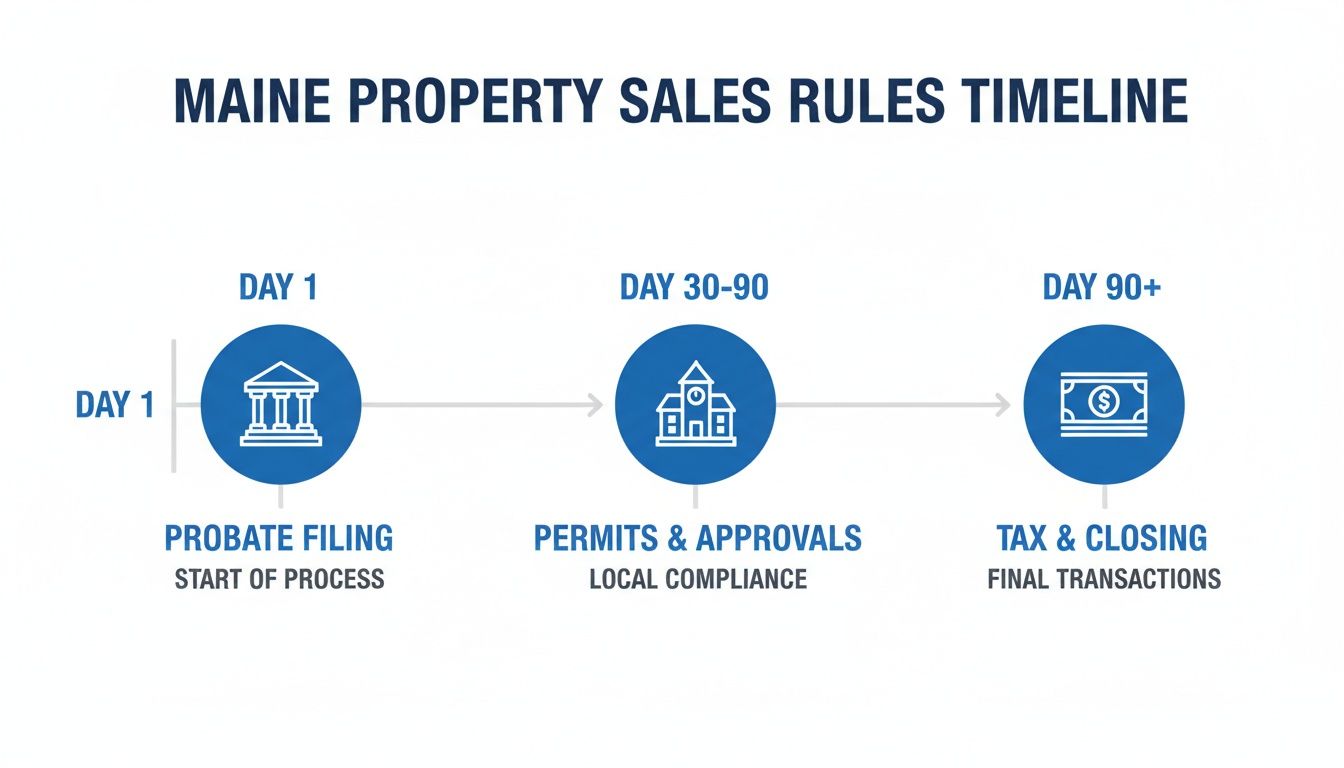
Seeing these official steps—from probate filings to permits and taxes—helps put all your physical prep work into the larger context of what it takes to run a successful, compliant sale.
The Initial Sorting Phase: Keep, Sell, or Let Go
Your first week is all about decision-making. Go through the home, room by room, and sort every single item into one of three buckets: Keep, Sell, or Donate/Discard. This is often the most emotionally taxing part of the whole process, so be kind to yourself and take your time.
A simple system of colored stickers can be a lifesaver. Maybe blue for keep, yellow for sell, and red for donate. This visual approach helps you see your progress at a glance and stops you from second-guessing every decision.
You'll be surprised by what you find. Forgotten treasures will emerge, but you'll also get a very clear picture of just how much needs to go. The goal here is simply to get clarity.
Decluttering and Deep Cleaning
Once the sorting is done, it’s time to clear the decks. Get everything marked for donation or discard out of the house. While you're at it, pack up any personal documents and photos you're keeping. This single step instantly creates a more open, shop-able space for buyers.
With the clutter gone, a deep clean is non-negotiable. A home that looks and smells clean makes every item in it seem more valuable.
Hit these key areas:
- Wipe down all surfaces, from baseboards to windowsills.
- Clean the windows to flood the space with natural light.
- Polish up any wood furniture and give upholstery a good cleaning.
- Make sure the floors are spotless—swept, mopped, or vacuumed.
A pristine setting signals to buyers that the contents have been well cared for. Once the sale is over, you'll need a game plan for anything left behind; a good homeowner's guide to junk removal can be a huge help for clearing the property efficiently.
To give you a better idea of how to structure your time, here’s a sample schedule that breaks down the major tasks week by week.
Sample 4-Week Estate Sale Preparation Timeline
| Week | Key Tasks |
|---|---|
| Week 1 | Sort & Decide: Go room-by-room. Assign items to "Keep," "Sell," or "Donate/Discard" categories using colored stickers or designated zones. |
| Week 2 | Clear & Clean: Remove all non-sale items. Perform a thorough deep clean of the entire house, including windows, floors, and surfaces. |
| Week 3 | Catalog & Photograph: Take clear, well-lit photos of every sale item. Write detailed descriptions and begin setting starting bids. |
| Week 4 | Stage, Launch & Promote: Arrange items for pickup day. Launch your online auction and begin marketing to attract local buyers. |
Following a checklist like this ensures you don't miss any critical steps as you approach your sale date.
Staging for Maximum Appeal
Staging isn't just for selling a house—it's absolutely critical for an estate sale. Your goal is to create a temporary retail environment. Group like items together, putting all the glassware on one table and all the tools in a specific part of the garage.
Arrange the furniture to create easy-to-navigate pathways for buyers. Pull pieces away from the walls and create little vignettes, like a fully set dining table or a cozy reading nook. This helps people imagine the items in their own homes, which is a powerful sales tool.
Thinking systematically is the key to turning a daunting project into a successful one. For a more granular, step-by-step guide, our comprehensive estate sale checklist will keep you on track and in control.
Smart Cataloging and Pricing for the Maine Market

With everything sorted and staged, it’s time to get down to business. Creating a detailed inventory and setting the right prices are what will make or break your sale. This is the moment your Maine estate sale stops being just a project and starts becoming a profitable venture.
Your smartphone is your best friend for this part of the job. You'll want to take several clear, well-lit photos of every single item. Don't just take one quick shot—capture different angles, zoom in on maker's marks, and be upfront about any dings or scratches. A flaw on an antique isn't a deal-breaker, but hiding it certainly is.
These pictures are the heart of your online auction catalog. Pair them with a clear title and a short, honest description covering condition, size, and any backstory you know. Good descriptions build trust and get people excited to bid.
Researching Maine-Specific Market Values
Pricing for a Maine audience means you have to understand what local buyers are actually looking for. A mid-century modern piece might sell well anywhere, but what about those L.L. Bean collectibles, maritime antiques, or even that high-quality outdoor gear? That’s where local knowledge pays off.
To nail down the right price, you need to see what similar items have actually sold for, not just what people are asking.
- Check "Sold" Listings: Head over to sites like eBay and filter your searches to show only "Sold" or "Completed" items. This is real data on what people were willing to pay.
- Review Local Auction House Results: Many Maine auction houses, such as Casco Bay Auctions, post their past results online. This is an incredible resource for seeing what antiques and collectibles are fetching right here in Maine.
- Use Image Search Tools: Got something you can't identify? An app like Google Lens can be a lifesaver, giving you a name and a starting point for your research.
This isn’t about guesswork; it's about using real data. The goal isn’t to set a high, firm price but to find an appealing starting bid that sparks some friendly competition.
Setting Bids to Maximize Profit
The magic of an online auction is finding that perfect starting price—low enough to get people interested but not so low that you risk giving something valuable away. A great rule of thumb is to set your starting bids at roughly 20-30% of an item's fair market value.
Let's say you have a vintage duck decoy that your research shows typically goes for about $100 in Maine. A $25 starting bid is the perfect hook. It feels like a steal, getting that first bidder emotionally invested. Once they're in, their competitive side often takes over, and that’s what drives the price up.
Think about the Maine real estate market for a moment. With 21.7% of homes recently selling above list price, it’s clear that Mainers aren’t afraid of a little competition for something they want. A DIYAuctions sale taps into that very same energy for personal property. You get to bypass the hefty 30-50% commissions of traditional estate sale companies and let local demand do the work. You can see more on Maine's competitive housing market on Redfin.com.
This bidding dynamic is your secret weapon. It reveals what your items are truly worth in today's market, far better than a static price tag ever could. By cataloging with care and pricing with strategy, you set the stage for a fantastic sale that leaves more money in your pocket.
Marketing Your Sale and Managing Pickup Day
With your items cataloged and priced, you’re on the home stretch. Now it’s all about two things: getting the word out to the right people and planning a pickup day that runs like a well-oiled machine.
A successful Maine estate sale really boils down to reaching motivated local buyers and then making it incredibly simple for them to get their hands on their winnings. Nail this, and you're set for a smooth, profitable finish.
Platforms like DIYAuctions give you a massive head start on marketing, automatically pushing your sale to a network of buyers all across Maine. This digital reach is a game-changer, connecting your items with folks from Aroostook County all the way down to York. But you can pour a little fuel on that fire with some smart, local marketing of your own.
Getting the Word Out Across Maine
Your real goal here is to create a little local buzz. When you combine the platform's broad marketing with your own grassroots efforts, you get a powerful synergy that pulls in more bidders. Think of it as a team effort—we bring the wide audience, and you bring the hyper-local touch.
A few simple but incredibly effective ways to boost your sale's visibility:
- Tap into Local Facebook Groups: Find the community groups for your town or county. Think "Portland Maine Online Yard Sale" or "Bangor Area Buy/Sell/Trade." A quick post with a link to your auction, highlighting a few cool items, can work wonders. These groups are full of people actively looking for local deals.
- Post on Facebook Marketplace: Even though your auction is online, create a Marketplace listing to point people toward your sale. Use a few eye-catching photos and a clear title like, "Online Estate Auction - Local Pickup in [Your Town]."
- Tell Your Network: Don't ever underestimate good old-fashioned word-of-mouth. Share the link with friends, family, and coworkers. You never know who’s been looking for that exact vintage Pyrex set you’re selling.
The secret is to meet buyers where they already are. By plugging into existing online communities, you aren't trying to build an audience from scratch. You're just directing a stream of interested local people right to your auction.
Planning a Flawless Single Day Pickup
This is where all your organization really pays off. A single, well-managed pickup day is efficient and saves you a ton of headaches. The alternative—dribs and drabs of people showing up for weeks—is a logistical nightmare.
The key is creating a logical flow. Before pickup day, get all the winning items grouped by buyer. A simple system of taping the buyer's name and invoice number to each lot saves a world of time and confusion. When someone shows up, you can grab their entire purchase in one go instead of scrambling to find that one last item.
A Checklist for a Smooth Pickup Experience
Thinking through the logistics beforehand will make the day itself feel calm and under control.
- Schedule Pickup Windows: This is non-negotiable. Instead of a free-for-all, have buyers sign up for specific time slots. It staggers arrivals, prevents a traffic jam in your driveway, and lets you focus on one person at a time.
- Verify Every Item: Before a buyer leaves, have them sign a copy of their invoice. This is just a quick confirmation that they've received everything they paid for. It’s a simple step that protects you from any "I didn't get this" emails later on.
- Prioritize Safety: Keep your pickup area and pathways clear of clutter and trip hazards. If people are moving heavy furniture, make sure there’s a clear, safe path to their vehicle. It's always a good idea to have a friend or family member there with you to help out.
- Have a No-Show Policy: Life happens, and some buyers just won't show up. Communicate your policy clearly in your auction terms. Most sellers offer a second-chance pickup time, but if they miss that, the items are considered forfeited. You can’t be expected to manage pickups indefinitely.
By combining smart marketing with meticulous pickup planning, you ensure the final phase of your Maine estate sale is just as successful as all the work that came before it.
Got Questions? Let’s Talk Maine Estate Sales
Even with the best-laid plans, questions are going to pop up as you get ready for your Maine estate sale. That’s completely normal. I've put together some straightforward answers to the questions we hear all the time, designed to give you the confidence to keep moving forward.
Do I Need a Permit for an Estate Sale in My Maine Town?
This is a big one, and the answer is a classic "it depends." What's required in Portland is often different from the rules in a smaller town up north. There's no single statewide law, so you absolutely have to check locally.
Your first call should be to your town or city clerk's office. Don't do a thing until you've spoken with them. Be specific when you call—ask about the rules for an "estate sale," not just a "yard sale," because the regulations can be different. They'll tell you about any permits you need, what they cost, and any rules about posting signs or the hours you can operate. Trust me, a five-minute phone call can save you a potential fine and a major headache.
What's the Best Way to Price Antiques for Maine Buyers?
Pricing unique items, especially things with that specific Maine character, is more of an art than a science. Think nautical antiques, classic L.L. Bean gear, or works by local artists. You need to know what a local buyer is actually willing to pay.
A great place to start is by looking up "sold" listings on eBay and checking the results of past sales from Maine-based auction houses. If you think you've got a real treasure on your hands, getting a professional appraisal can be money well spent.
For most things, though, this is where an online auction really shines. You can set a reasonable starting bid based on your research and then let local bidders compete. This friendly competition almost always drives the final price higher than what you would have gotten with a simple price tag.
Deciding between a traditional company and a DIY platform is one of the biggest forks in the road. It really boils down to what you value most—convenience or control and profit.
Should I Hire an Estate Sale Company or Go DIY in Maine?
This is the classic trade-off: time and effort versus profit. A traditional estate sale company in Maine is the full-service, hands-off option. They'll handle everything from staging the house to cleaning it out afterward. This can be a lifesaver if you live out of state or just don't have the bandwidth to manage it all.
But that convenience comes at a steep price. Their commissions typically run anywhere from 30% to 50% of your total sales.
On the flip side, if keeping as much of the profit as possible is your top priority, a platform like DIYAuctions is almost always the better financial move. With our low commission, you keep a much bigger piece of the pie. This approach gives you total control, but still provides all the professional marketing and payment tools you need to run a successful sale. If you're willing to put in the organizational work, the financial upside is huge.
What Do I Do With the Stuff That Doesn't Sell?
It happens in every single sale: you're going to have items left over. The key to a stress-free wrap-up is having a plan for the leftovers before your pickup day even starts.
You've basically got three options:
- Donate: A lot of Maine charities, like Goodwill Northern New England, are happy to take donations. They might even offer to pick up larger items like furniture, which is a big help.
- Dispose: For anything that's broken or not fit for donation, your best bet is to call a local junk removal service. It's the quickest way to get the property completely cleared out.
- Bundle: Sometimes you can offer a last-minute "bundle deal" to a buyer who is already there picking up their winning bids. It’s an easy way to clear out a few more things for a low price.
Figure out your post-sale game plan ahead of time. It makes the final step of clearing the house so much smoother.
More guides in Estate Sale Basics
July 28, 2026
Revenue Reporting for Estate Sales and Auctions
Learn revenue reporting essentials for estate sales and auctions. Discover key metrics, templates, and best practices to simplify tracking and compliance.
Read guideJuly 26, 2026
Stamp Collection Valuation: A Practical Step-by-Step Guide
Stamp collection valuation made simple. Learn how to identify, grade, price, and sell your stamps with confidence for estate sales or consignment.
Read guideJuly 23, 2026
Estate Sales Brick NJ: Your 2026 Guide to Success
Planning your estate sales brick nj? Our guide covers permits, pricing, marketing, & running a safe sale with DIYAuctions.
Read guideGet the estate sale pricing guide
Enter your email for pricing ranges, planning notes, and a clearer path to launch.