OKC Estate Sales: How to Plan, Price and Run One
Learn how to run OKC estate sales step by step: probate rules, Oklahoma sales tax, pricing, buyer marketing and pickup-day logistics.

Most advice about OKC estate sales starts with the same instruction. Price everything fast, hang a few signs, and open the doors this weekend. I wouldn't do it that way.
That order works for an ordinary garage sale. It can fail badly when the property belongs to an estate, when an heir disputes a bargain price, or when the sale doesn't meet Oklahoma's tax conditions. The fastest sale isn't always the safest sale. Start with authority, tax and records. Pricing comes after you've established what you're allowed to sell, where you can sell it, and how you'll prove what happened.
Estate Sale Timeline From Eight Weeks Out to Pickup
A full family home needs eight weeks. A partly cleared house or a single room can compress to four, but only if the legal work is already done and there are no restricted items.
Oklahoma City gives you a wide buyer pool, not just a street of neighbours. The U.S. Census Bureau QuickFacts for Oklahoma City counts 681,054 residents in 2020, estimated at 719,849 on July 1, 2025, with 280,065 households during 2020 to 2024. That scale supports metro-wide online discovery, but it also means buyers will compare your lots against many others.
| Timing | Main tasks | Done when |
|---|---|---|
| 8 weeks before | Confirm legal authority, check sales tax conditions, walk the house room by room | Authority and tax path are written down |
| 6 weeks before | Check permit and property rules, isolate restricted items, book appraisals | Restricted items are separated from sell-now goods |
| 4 weeks before | Catalog lots, photograph every item, research comparable prices | Every lot has an ID and photos |
| 2 weeks before | Set opening bids and reserves, schedule closing window and pickup day | Auction launch date is fixed |
| 1 week before | Publish listing, start local promotion, confirm pickup logistics | Listing is public and buyers can find it |
| Sale week | Monitor bids, answer buyer questions, close the auction | Auction closed and winners notified |
| Pickup day | Run one coordinated pickup window, verify payment, sign releases | All collected items released with signed records |
| After pickup | Reconcile the ledger, decide on uncollected items, report to the estate | Ledger balances and file is complete |
How to Read the Phases
At eight weeks, you settle who can authorise the sale and which tax path applies. At six weeks, you pull out items that need appraisal, title checks or court permission before they're mixed into ordinary lots.
Four weeks out is production work. Catalog every lot, photograph it properly and research comparables while there's still time to correct a weak description. At two weeks, you set opening bids, decide reserves and lock the closing window and pickup day. Don't publish first and invent those dates later.
One week out, the listing goes public and promotion starts. During sale week, your job is answering questions and watching bidding, not adding poorly documented lots. Pickup is a single coordinated event, and reconciliation after pickup closes the file.
Practical rule: Every lot needs an ID and at least four usable photos two weeks before launch, or the schedule slips.
Legal Authority and Sales Tax Checks Before Advertising
Start with one question. Is this an ordinary downsizing sale or a probate liquidation?
A living homeowner selling their own property has broad discretion. An executor or personal representative doesn't. According to Oklahoma Bar Association probate guidance, a personal representative generally cannot give away estate assets, sell them cheaply to friends or relatives, or personally buy estate property without attorney involvement or a court order, and must instead act to maximise the estate's benefit. If the will doesn't authorise a sale, court permission and notice to heirs may also be required.
That distinction changes pricing. A friendly discount that looks harmless at a household sale can become a fiduciary problem if another heir later asks why a relative paid less than market value. Document comparable prices and any relationship between the seller and buyer before money changes hands.
Triage What Can Sell Now
Oklahoma law doesn't treat every object in the house the same way. Under Oklahoma Title 58, Section 58-387, after receiving letters, an executor may sell perishable or depreciating personal property, property that creates storage expense, and certain property needed for the family allowance without prior court authorisation, although the transaction must still be reported in the estate accounting. Other property may need a petition, heir consent, notice or court approval.
Work through this order before you advertise anything.
- Confirm authority in writing. Keep the letters, trustee authorisation or other governing document in the sale file, and read whether it authorises this type of sale.
- Split inventory into two groups. Mark lots as sell now or hold for advice, and physically separate them so a helper doesn't photograph a held item into the catalog.
- Isolate restricted categories. Hold vehicles, collectibles, firearms, jewelry, business equipment and anything with unclear ownership for title, valuation or legal review.
- Get support for valuable items. Obtain an appraisal or several bids where value is contestable, and file the evidence with the lot record.
- Preserve the paper trail. Keep photos, condition notes, invoices, buyer records and payment receipts for every lot, including items that don't sell.
Say a garage holds a deteriorating appliance that's costing money to store, a titled vehicle and a box of coins of unknown ownership. Those aren't three equal lots. The first may justify prompt action, the second needs title work, and the third needs ownership and valuation checks before anyone guesses a price.
Our overview of estate sale laws is a useful starting point for organising questions, but it doesn't replace Oklahoma probate counsel when court approval or heir notice is in play. Ask counsel before listing restricted assets, not after a bidder has won them.
Verify All Five Tax Conditions
Calling an event an estate sale doesn't create a tax exemption. The Oklahoma Tax Commission sales and use tax rules exempt gross proceeds only when all listed conditions are met, including a sale of no more than three days, within six months of death, consisting of property from the decedent's estate at the decedent's former residence.
| Condition | What to verify | If it is not met |
|---|---|---|
| Sale length | Three days or fewer | Tax treatment may change; confirm with the Oklahoma Tax Commission |
| Timing | Within six months of the date of death | Tax treatment may change |
| Property source | Property from the decedent's estate, not later-acquired household items | Later-acquired items may be taxable |
| Location | Held at the decedent's former residence | Tax treatment may change |
| Seller status | Not required to hold a sales-tax permit or transient-merchant license | A permit or license may be required |
One missed condition can change the treatment. Verify the inventory belonged to the decedent, confirm the sale location, identify the date of death and document the seller's status before you set dates.
Keep the death certificate and executor or trustee authorisation with the transaction file. Separate estate-owned inventory from later-acquired household property, record the sale dates and location, and don't run exempt and potentially taxable items through one checkout stream without item-level records.
Numbered lots solve much of that problem. Use one sales ledger that ties each lot to its source, buyer, price, payment receipt and release record. After pickup, reconcile proceeds and unsold assets against that ledger so the executor can substantiate both the accounting and the tax decision.
Check City Controls Before You Publish
Tax isn't the only pre-advertising check. Ask Oklahoma City's Development Center or the relevant department whether signs, parking, traffic or other event controls apply to your location and format. A quiet online sale with scheduled pickup creates a different traffic footprint from an open-house sale, but you shouldn't assume either format is exempt from local rules.
An online catalog improves reach and documentation. It doesn't erase probate duties, statutory authority or required reporting, and a one-day pickup doesn't cure a sale you weren't authorised to make.
Catalog, Tier and Price Every Lot
Use a two-track valuation model. Research scarce or high-value items individually, and price common household goods for throughput.
That separation keeps a valuable asset from being buried in a box lot and keeps you from spending an hour researching a used toaster. It also gives heirs and buyers a defensible record of how each price was set.
Good cataloging starts with close inspection, as shown here.
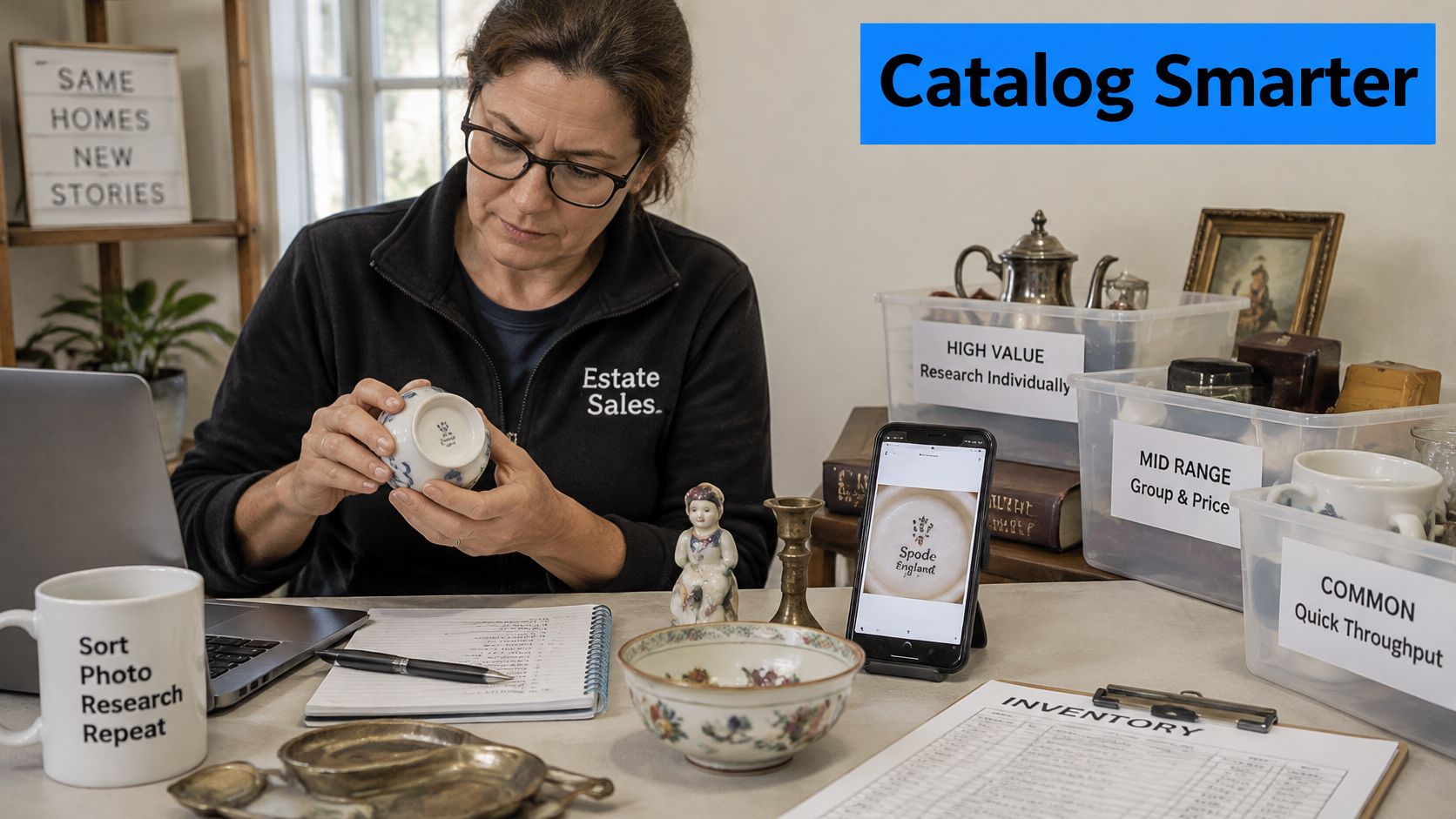
Photo and Record Standard
Photograph every item from multiple angles. Capture maker marks, dimensions, condition, serial numbers, provenance and comparable-market evidence before you assign a price. Show chips, stains, missing parts and repairs rather than cropping them out, because an undisclosed flaw costs more in disputes than it gains in bids.
Build one spreadsheet for the whole house. Each row needs a lot ID, category, comparable price, opening bid, reserve decision, pickup constraints and final result. Add room location and a condition tier so the pickup crew can find the item without searching through descriptions.
| Tier | Typical items | Pricing approach | Records to keep |
|---|---|---|---|
| Specialist review | Jewelry, coins, art, vehicles, firearms, rare collectibles | Appraisal or specialist review before any price is set | Maker marks, serial numbers, provenance, multi-angle photos |
| Higher-value furniture and tools | Antique furniture, power tools, quality rugs | Comparable-sale research and a reserve decision where justified | Dimensions, condition tier, comparable prices |
| Common household | Kitchenware, linens, decor, small appliances | Low opening bids to draw competition and move volume | Condition tier, staged photos, final result |
Bidding sets the final price, so an opening bid isn't your prediction of value. Set common goods low enough to create competition. Save reserves for higher-value lots where a thin bidder pool could produce a result you can't accept, and use our guidance on how to price estate sale items to sanity-check those decisions.
The video below is useful for seeing how lot presentation affects buyer confidence.
Judge Fees Against Execution
Don't compare a service fee against a hoped-for headline price. Compare it against the reach, labor and execution it replaces. Washington Consumers' Checkbook on estate sales reports a traditional liquidator's 30 to 50% share of gross proceeds, which gives you a useful benchmark when weighing professional help against doing the work yourself.
The usual failures are predictable. Sellers overprice ordinary furniture, upload dark or cluttered photos, hide damage in the description and leave pickup logistics until after payment. Each one either suppresses bidding or creates work on the worst possible day.
After closing, track sell-through rate, average discount, gross proceeds per lot, payment exceptions and labor hours. Those five numbers tell you whether lower opening bids increased total recovery or just gave away margin, and they make the estate accounting far easier to defend.
Reach OKC Buyers Before the Doors Open
Your buyer may live in Edmond or Moore, not on the same block. Write the listing for someone deciding whether a drive across the metro is worth it, and make that decision easy in the first screen of photos and titles.
We publish the sale, route local buyers to it, handle the payment flow and keep bidding organised. Your job is to give those buyers clear reasons to bid and no avoidable reasons to hesitate.
Listing Moves in Order of Payoff
- Lead with strength: Put the three or four strongest lots first, whether that's a solid wood dining set, a complete tool collection or a recognisable collectible.
- Name brands and materials: Write the manufacturer, wood, metal, fabric or model in the title when you know it, instead of using vague labels such as vintage chair or miscellaneous tools.
- Add dimensions everywhere: Measure furniture, rugs, appliances and large decor so buyers can judge fit and vehicle space without messaging you.
- Show flaws plainly: Photograph edge wear, upholstery damage and missing hardware, then name the flaw in the description.
Set bidding to close on a weekday evening, when buyers are home and able to watch lots finish. You choose the closing window and pickup day, so build both around your staffing and access to the house rather than copying another sale's schedule. Don't pick a closing time you can't monitor for last-minute questions.
About five days before closing, publish a preview that shows one room at a time. Email past buyers and neighbours, then add a short social post that names the neighbourhood area, highlights a few lots and states the pickup window. Don't post the full street address publicly. Share the general pickup area first and confirm the exact address only with winning bidders.
Answer buyer questions within a day. A bidder asking about a sofa's length or a tool's model number is telling you they're close to bidding, and silence gives them time to move to another sale. Correct the listing if a question exposes a missing measurement.
Reach doesn't help if the listing makes buyers guess. Clear titles, dimensions and flaw photos do more than another generic promotional post.
Pre-Launch Checklist
Finish four things before launch. Confirm the lead lots and photos, proof every title for brand and material, verify the closing and pickup windows, and prepare the preview and email. Once bidding opens, promotion should support the catalog, not compensate for an unfinished one.
Pickup Day Logistics, Payment and Safety
Pickup day should feel boring. Buyers arrive in assigned windows, show ID, collect tagged lots, sign and leave. Searching rooms, negotiating payment or checking screenshots at the door means the system failed earlier.
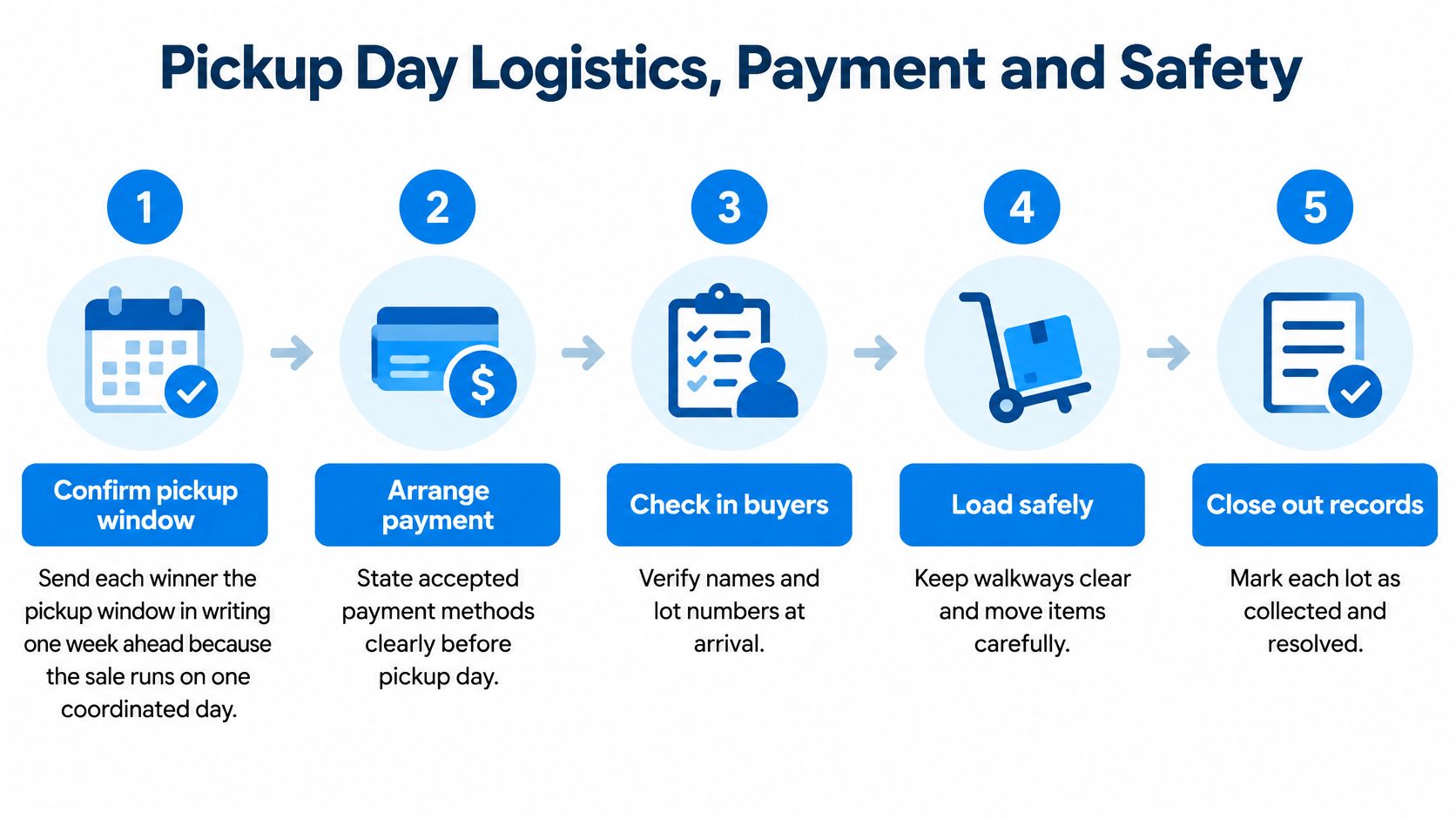
The process below keeps payment, identification and release records in the right order.
Run Pickup in Six Steps
- Confirm windows in writing a week ahead. The sale ends with one coordinated local pickup day instead of multiple days of buyers walking through the house, so stagger arrivals before the day begins.
- Verify payment before release. We use a secure pre-payment system, so buyers have already paid before they collect their items. Check the paid list rather than accepting cash or a promise at the door.
- Stage lots by room. Tag each item with the lot number from the ledger and group lots where the handler can reach them without opening closed rooms.
- Check ID against the winning list. Match the person, lot numbers and payment status before anything leaves the house.
- Release and record each lot. Mark the lot collected, note the time and get a signature on the release sheet.
- Flag uncollected items at closing. You can re-list them, donate them or offer them to the next-highest bidder, but record which option you chose and when.
Keep two adults on site. One person checks buyers in while the other retrieves lots, which prevents an unattended door and reduces the chance of the wrong item going out. Lock valuables, financial papers, medications and unsold restricted items in a closed room, and keep the window in daylight hours.
Don't release property to a friend, spouse or driver who isn't on the winning list unless the buyer authorised that person in advance and you've recorded it. Goodwill at the door creates bad records later.
Vehicle lots need extra care because title, keys and identity all change hands at once. The same caution that helps you sell your car safely on Craigslist applies here. Verify the winner, complete the paperwork in a visible area and don't hand over keys until the release record matches the paid lot.
Keep receipts, the winning list and signed release sheets in the estate file. They're not administrative clutter. They're the proof an executor needs if an heir, buyer or tax reviewer later questions where an item went.
Decide Whether to Run the Sale Yourself
Run it yourself when the estate has no restricted assets, the inventory can be cataloged in one pass, and you can staff one pickup day with two reliable people. That seller-led route suits families settling a parent's home, people downsizing after decades in one house, and sellers clearing a house before listing it.
Bring in probate counsel before any sale when court approval, heir notice or restricted categories are involved. That's true even if you still handle the catalog and pickup yourself. Our guidance on estate sale agents helps you compare that middle route with full-service help.
| Sale price | Commission |
|---|---|
| $2,000 | $200 |
| $5,000 | $500 |
| $10,000 | $1,000 |
| $25,000 | $1,000 (capped) |
The math is a commission of 10% of the sale price, capped at $1,000 per transaction. A $5,000 sale pays $500, and any total above $10,000 pays the $1,000 maximum. Judge that against your labor, likely pricing errors and the value of organised bidding and payment, not against an assumption that DIY work is free.
I would book the authority and tax checks this week, before photographing a single lot. Once those answers are in writing, start the eight-week clock and use the free estate sale pricing guide, which includes typical fee ranges, pricing guidance and a 30-day launch checklist, to build your catalog.
Ready to plan your Oklahoma City sale without guessing at prices or pickup? Start your sale with DIYAuctions, build your first lots room by room, set your closing window and pickup day, and let us publish the sale, route local buyers and handle secure payment while you stay in control of the house and the records.
Get the estate sale pricing guide
Enter your email for pricing ranges, planning notes, and a clearer path to launch.