Tax Reporting Requirements for Estate and Online Sales
Learn the tax reporting requirements for estate sales and online auctions: 1099-K thresholds, basis rules, sales tax and a recordkeeping checklist.
You listed the dining set, the couch, and a box of tools, and the payout landed in your account last night. The platform total looks like income. It is not. That number is a gross reporting figure. Tax reporting requirements ask a narrower question: did any item leave you ahead of what it cost you, after fees, and who has to report that difference.
A one-time garage cleanout, an inherited estate, and a string of sales run for profit do not follow the same path. Personal losses usually stay off the return. Gains on household goods and inherited pieces can land on capital-gain forms. A regular selling activity can become a business. The work is matching each lot to its basis, its fees, and its reporting route before you touch a form.
Which Tax Reporting Rules Apply to Your Sale
Find your row before you read any form. The route depends on what you sold and why, not on the size of the deposit.
| Situation | Usual tax treatment | Reporting route | Watch for |
|---|---|---|---|
| Personal items sold for less than you paid | Usually no taxable income; the loss is generally a nondeductible personal loss | Keep a sales record; report only if a gain or business activity applies | Platform forms that show gross payments, not profit |
| Personal items sold for more than you paid | Gain may be taxable; collectibles can face higher maximum rates | Form 8949 and Schedule D if reporting is required | Original purchase records and receipts |
| Inherited items sold by an executor or heir | Gain or loss measured from the date-of-death value | Form 8949 and Schedule D; estate income return if the estate has income | Date-of-death appraisal and estate inventory |
| Repeated sales with a profit motive | Business income, with ordinary and necessary expenses deductible | Schedule C or the business return that applies to you | Itemized ledger of fees, shipping and listing costs |
| Paying an auctioneer or helper for services | Not your income; you may owe an information return to the payee | Form 1099-NEC when nonemployee compensation meets the federal reporting amount | Payee name, taxpayer identification number, and the invoice |
The form in your inbox shows money that moved. It does not show profit. A couch sold for less than you paid it is usually a personal loss you cannot deduct. A clock sold for more than its cost, or more than its date-of-death value, can be a gain. Paying a helper is the helper's income, not yours, and it can create a separate information-return duty.
A missing form is not a free pass. The OECD tax administration report found that 89% of surveyed tax administrations receive data directly from third parties, including digital platforms, and that nearly 95% use data-science tools on that electronic data to guide compliance. Payment records can be matched to returns even when you never got a slip.
Write down the row that matches your sale, then start a ledger of gross amount, fees, and cost. Later parts of this guide cover taxable gain, information returns, sales tax, federal estate thresholds, the executor's routine, and the year-end ledger.
Taxable Gain Versus Money You Get Back
A sale is a swap of an object for cash. Tax asks only whether the swap left you ahead of what the item cost you. Money you merely get back is not a gain.
Taxable gain equals sale proceeds minus selling expenses minus your basis. For something you bought, basis is generally what you paid. For something you inherited, basis is generally fair market value on the date of death, or an alternate valuation date only when that election is properly made. A short guide to what fair market value means helps when you are setting that starting number from an appraisal rather than a receipt.
Say a grandmother's dining set was appraised at $1,500 on the date of death and later sold at online auction for $1,800, with a $180 commission. Net proceeds are $1,620. Gain is $120, not $1,800 and not $1,620. Contrast that with the family's own couch, bought for $900 and sold for $400. That $500 shortfall is a loss on personal-use property, and it is generally not deductible.
A four-question check for each lot
Run every lot through the same questions, in this order.
- Personal or held for profit. A household cleanout is not a shop. Repeating sales with a profit motive can be.
- Purchased or inherited. Receipts set one basis. A date-of-death appraisal sets the other.
- Gain or loss. Only the amount above basis, after selling costs, is the gain.
- Occasional or repeated. One weekend is different from a pattern of buying to resell.
The IRS estate-tax FAQ states that gross proceeds from selling inherited property are included in gross income when you test whether a filing requirement exists, and that a taxable sale is generally reported on Schedule D and Form 8949. Selling inherited household items is not automatically tax-free, even when no federal estate tax is owed. A sale close to the date of death often produces little gain. Later appreciation can be taxable. Basis-consistency rules can also apply when estate-tax reporting was required.
Reporting the whole auction payout as gain is the mistake that inflates the tax. Subtract basis and selling costs first.
Watch a short walk-through of how proceeds, costs, and basis meet on the return, then apply the four questions to your own lots.
Information Returns You Might Receive
An information return proves that a payer told the tax agency about a payment. It does not compute your tax.
| Form | Issued by | Threshold | What it shows | How to reconcile |
|---|---|---|---|---|
| Form 1099-K | Payment settlement organization or marketplace | Over $20,000 and 200 transactions for goods or services; some states set lower thresholds | Gross payments, not profit | Match to your ledger, remove refunds, check for duplicates |
| Form 1099-NEC | Business that paid a non-employee for services | Nonemployee compensation at or above the federal information-return amount | Amounts paid to the service provider | Confirm the payee's taxpayer ID and keep the invoice |
| Form 1099-MISC | Payer of rents, prizes, or other non-service income | When those non-wage, non-service payments meet the federal reporting amount | Payments that are not wages or service fees | Rarely issued for item sales; check the payer's reason |
Reconcile the 1099-K before you trust it
Under IRS guidance on Form 1099-K, a third-party settlement organization generally reports gross payments for goods or services when the year exceeds $20,000 and 200 transactions. Payment-card transactions can be reportable regardless of that goods-and-services threshold, and some states use lower thresholds. The form reports gross receipts, not profit.
Work the form in this order.
- Pull the annual report. Download the marketplace or processor summary for the same year as the form.
- Match listing IDs. Each line on the form should tie to a lot, a date, and a gross amount in your ledger.
- Pull out refunds. Documented refunds are not money you kept.
- List the costs. Platform commissions, payment-processing charges, shipping, and advertising sit beside the gross, not inside it.
- Hunt duplicates. The same proceeds can be reported by both a payment processor and a marketplace. Identify the overlap. Do not add the two forms together.
The threshold is not a tax test
A year under the reporting line can still contain a taxable gain on one collectible. A year over the line can be full of personal items sold at a loss. Taxable treatment follows the facts of each sale: a household liquidation, a nondeductible personal loss, or repeated activity with a profit motive that belongs on a business return.
Practical rule: Download the year's report, reconcile it line by line, and mark any sale that still needs a basis or an ownership note.
Sales Tax and Platform Reporting Across State Lines
No form in the mail does not mean the sale is invisible. Sales tax and income reporting travel on different tracks, and a platform can create a trail even when you think of the weekend as a private cleanout.
Sales tax is set by the state, and sometimes by the city or county. Many states treat an occasional sale of your own household goods differently from a seller who sells regularly or holds a seller's permit. Income tax on a gain is a separate question, and it often starts from the same federal gain math, then applies the state's own rates and thresholds. A state inheritance tax is not the federal estate tax. Check each one on its own.
Questions to answer for every lot
- Where the item sat. The state where the goods were located often matters for sales tax.
- Where the buyer took delivery. Shipping across a state line can change the answer.
- Whether you crossed a registration line. Some states expect a permit after a set pattern of sales, not after one pickup day.
- Whether an exemption fits. A resale or other exemption certificate has to be valid for that state and that buyer.
- Whether the platform already collected. In many states a marketplace facilitator collects and remits sales tax on marketplace sales. Confirm that for your auction before you collect a second time.
The OECD platform reporting framework notes that 29 jurisdictions take part in an initiative under which platform operators report seller income each year and tax authorities can exchange that information with the seller's jurisdiction of residence. You can live in one state, list on a platform based somewhere else, and still generate a report. Gross figures in that report can include items sold at or below basis, personal losses, refunds, shipping, and commissions. None of those automatically equal profit.
State information-return thresholds can sit below the federal goods-and-services line, so a state slip can arrive when a federal one does not. For a plain-language look at online-seller filing habits, the Allied Tax Advisors online business guide is a useful cross-check beside your state's own instructions.
Record the state of each sale, and do not treat a blank mailbox as a completed return.
Federal Estate Thresholds by Year of Death
An auction check almost never decides whether Form 706 is due. The IRS estate-tax page states that Form 706 generally must be filed when the gross estate, increased by adjusted taxable gifts and the specific gift-tax exemption, exceeds the threshold for the year of death.
| Year of death | Filing threshold |
|---|---|
| 2011 | $5.0 million |
| 2015 | $5.43 million |
| 2018 | $11.18 million |
| 2022 | $12.06 million |
| 2023 | $12.92 million |
| 2024 | $13.61 million |
| 2025 | $13.99 million |
| 2026 | $15.0 million (listed threshold) |
Use the year the person died, not the year you held the sale. A 2011 death sat at $5.0 million. By 2018 the figure had more than doubled to $11.18 million. The 2025 figure is $13.99 million, and the listed 2026 threshold is $15.0 million.
One estate, two years of death
Take a gross estate of $13.5 million, with no adjusted taxable gifts added for this example. If death was in 2025, $13.5 million sits under the $13.99 million line, so Form 706 is generally not required on that comparison alone. If the same estate's death falls in 2026, the listed threshold is $15.0 million, and $13.5 million is still under that listed line. Change the gifts, or move the death back to 2015, and the same dollars can cross the older, much lower line. The sale proceeds do not make that comparison. The whole estate does.
Most estates fall below the federal filing line. State estate or inheritance rules, and income tax on later sales, can still apply. Local counsel such as the Law Office of Bryan Fagan guidance can help when the gross estate sits near a line or gifts complicate the total.
Write down the year of death and the gross-estate figure. If those two numbers are close, or if lifetime gifts exist, have a professional review the Form 706 question before you assume no return is due.
How an Executor Reports Estate Sale Proceeds
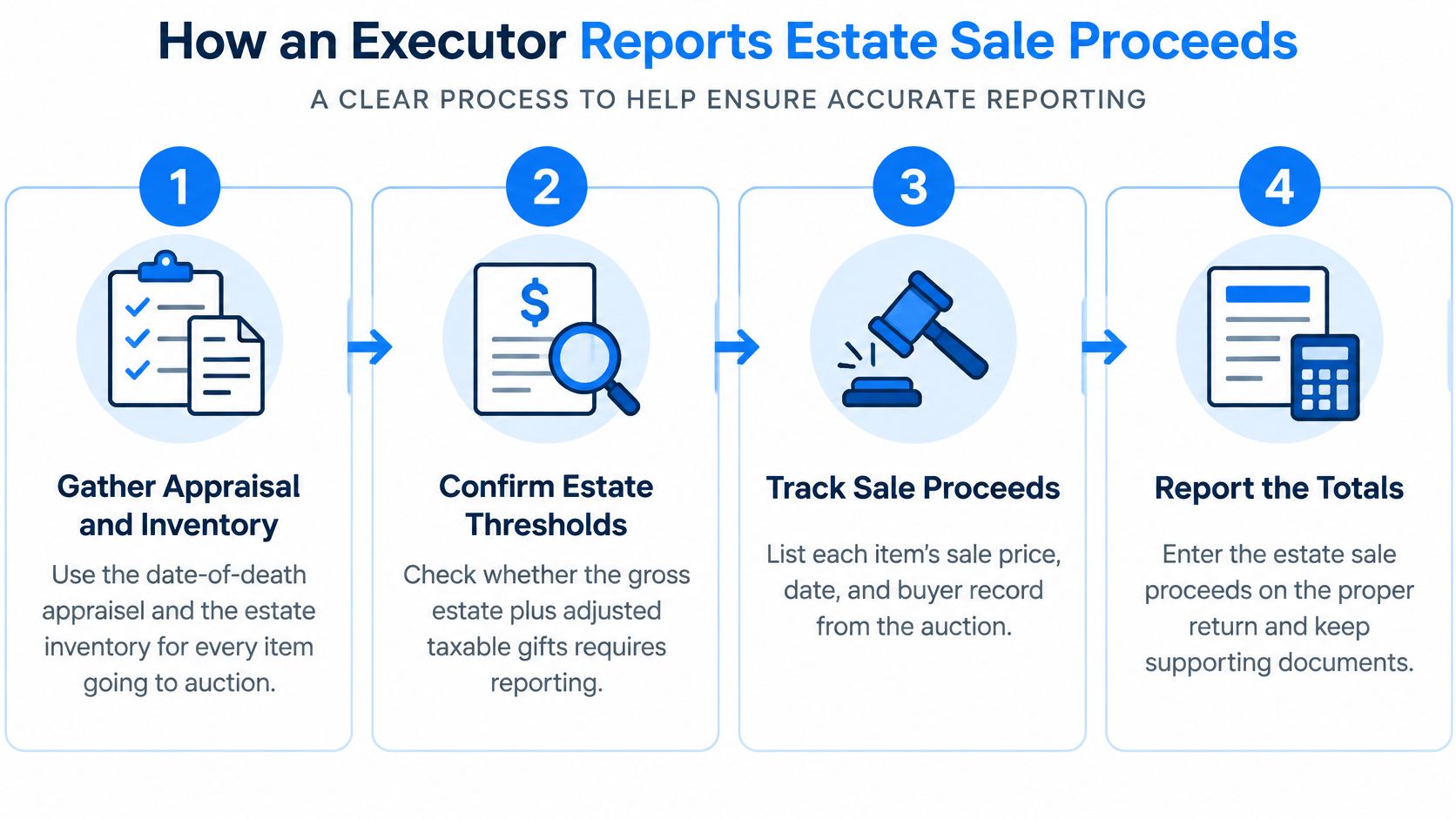
An executor reports a sale as gain or loss against basis, not as a pile of cash. Work the lots in order, and keep the paper that proves each step. A probate sale process overview is worth reading alongside the inventory so the auction date and the court timeline do not fight each other.
The IRS FAQ on inherited property is the backbone of this routine. Inherited property generally takes a basis equal to fair market value on the date of death. An alternate valuation date applies only when the executor files Form 706 and elects that method.
- Gather the appraisal and the inventory. Pull the date-of-death appraisal and the estate inventory for every item headed to auction. You cannot compute gain on a lot that is not on the list.
- Test the federal estate threshold. Compare the gross estate plus adjusted taxable gifts with the threshold for the year of death. That comparison, not the auction total, decides whether Form 706 is on the table.
- Lock each lot's basis. Use fair market value on the date of death, or the alternate date only if Form 706 elects it. This step stops you from treating the whole payout as gain.
- Log the settlement and the costs. Keep the auction settlement statement. Assign commission, processing, and other selling expenses to each lot so net proceeds are real.
- Compute gain or loss per lot. Net proceeds minus basis is the number. If reporting is required, it goes on Form 8949 and Schedule D for the estate or the beneficiary who reports it. IRS instructions direct you to enter "INHERITED" as the acquisition date.
- File the estate's income return when gross income requires it. The estate reports its own income. Do not assume the beneficiaries' personal returns cover estate-level income automatically.
- Hand beneficiaries a consistent basis. If Form 706 was required, beneficiaries may receive Schedule A of Form 8971 and generally must use the estate-tax value as their starting basis. Keep your copy with the allocation.
Collectibles, vehicles, and jewelry need the tightest values, because resale prices wander far from whatever the decedent once paid. Match each catalog lot to the estate record before the pickup day ends.
Hold three things before the auction closes: the inventory, the appraisal, and a lot-by-lot basis sheet.
Court calendars and fee bills run on their own clock. A practical note on estate administration fees and timelines helps you see which costs belong to administration and which belong on the sale ledger.
Ledger, Pre-Filing Checklist and Next Step
Item lines beat a headline total. The platform's gross figure is what buyers paid. Your return needs net proceeds, basis, and the name of the person who reports the gain.
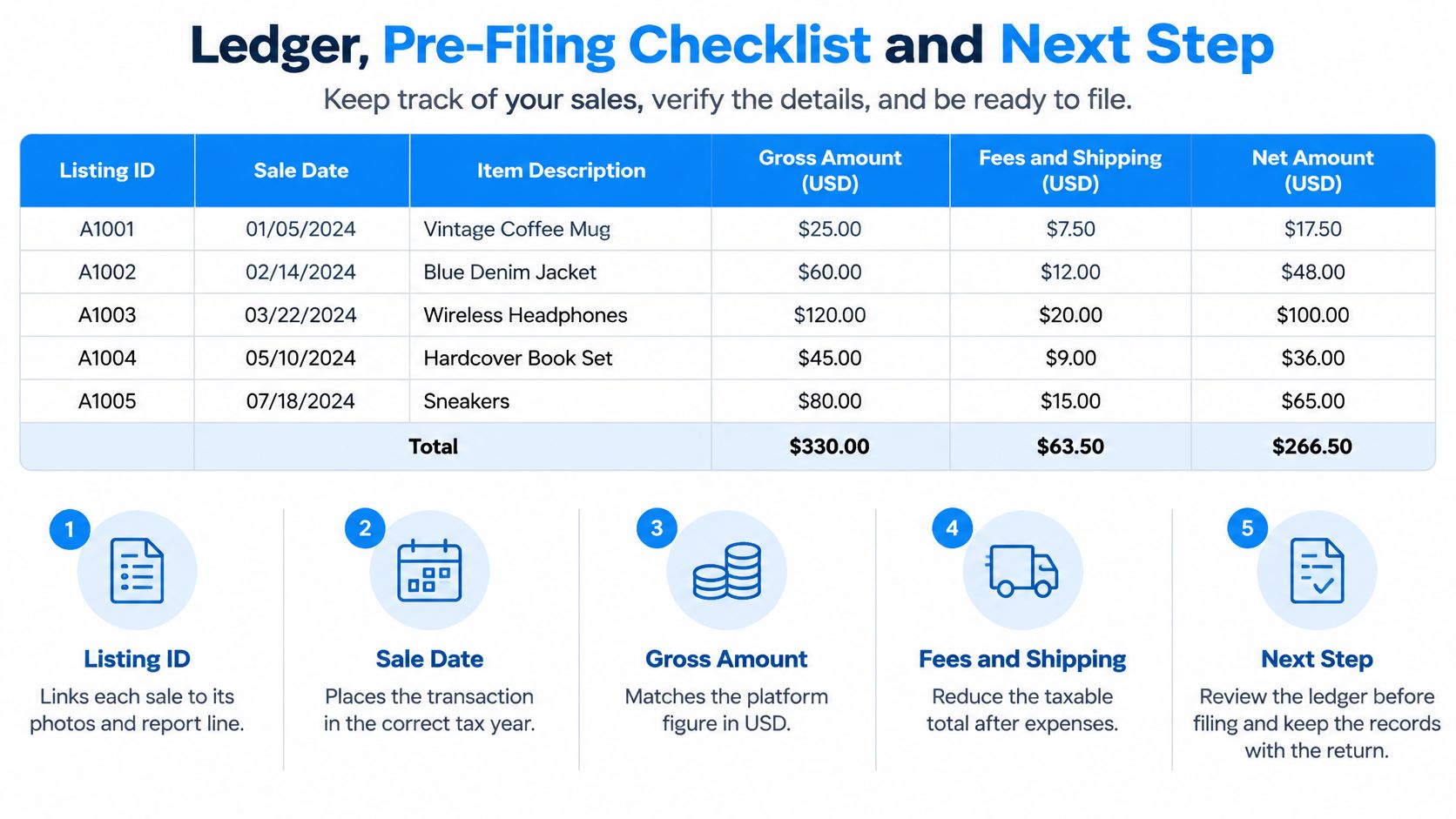
| Ledger field | What to record | Why it matters |
|---|---|---|
| Listing ID | Your DIYAuctions listing or lot number | Links each sale to its photos, description, and report line |
| Sale date | Date the sale closed and payment settled | Places the sale in the correct tax year |
| Gross amount | Price paid by the buyer | Matches the platform's gross figure |
| Fees and shipping | Commission, processing, and shipping costs | Reduces gross to net proceeds |
| Refunds | Money returned to buyers | Removed from reportable gross |
| Acquisition or basis | Purchase price, or date-of-death value for inherited items | Sets the gain or loss |
| Ownership | Your name, the estate, or a named beneficiary | Shows who reports the gain |
| Net proceeds | Gross minus fees, refunds, and costs | The figure you reconcile to your return |
Our commission is 10% of the sale price, capped at $1,000 per transaction. Fees can change on 30 days' notice, so write the schedule that applied on the sale date into that fees line. A later notice does not rewrite a closed lot.
Year-end checklist
- Export the annual sales and fee report. Use the same calendar year as the return.
- Reconcile gross to the ledger. Remove refunds, then confirm fees, shipping, and processing against each listing ID.
- Tag each item. Mark it personal, inherited, or business so the reporting route is obvious.
- Attach proof of basis. Receipts for purchases, date-of-death appraisals for inherited lots, on every item that shows a gain.
- Note sales tax. Record the state of the sale and whether tax was collected by you or by the platform.
- Compare information returns. Match totals, and flag any duplicate 1099 so you do not add the same dollars twice.
- Keep the file. Hold ordinary records at least three years, and hold inherited-basis papers longer, because a later sale can reopen the starting value.
A figure you cannot trace to a listing, a fee, and a basis is not ready for a return. If the estate must file, if a state rule is unclear, or if the sales have become a regular business, have a tax professional review the package. For a reporting layout you can mirror, see how to prepare financial reports from auction activity.
Open the ledger today. Tag each sale with its route, and fill every blank basis line before you file.
Download your annual gross-payment and fee report from your DIYAuctions account, match each listing ID to basis and ownership, and take that packet to your preparer if any lot is inherited, cross-state, or part of a repeating sales pattern.
Get the estate sale pricing guide
Enter your email for pricing ranges, planning notes, and a clearer path to launch.