Transitional Design Online Auctions: How Sellers Win Bids
Sell transitional design online auctions well: classify pieces, photograph flaws, set comparable-based prices, and run a clean pickup day.
You're standing in a parent's living room with a tape measure, a stack of boxes, and a closing date on the house. The oak console has clean lines and brass pulls. The dining chairs keep a traditional shape, but the pale stain looks recent. A beige upholstered chair could belong in almost any room built in the last thirty years. Nothing has a retail tag, and writing "transitional" on a sticky note will not tell a bidder what to pay.
Transitional design online auctions work when you price construction, condition, and provenance instead of a style trend. Online auctions became a mainstream format after eBay's launch in 1995, and by 2020 they represented approximately 7% of combined U.S. business-to-consumer and business-to-business e-commerce, inside a global market of roughly $4 trillion, according to an AGC Partners industry analysis. That channel fits furniture whose value is hard to standardize.
I would start with the rooms, not the software. Sort what you can prove, who is allowed to sell it, and how a buyer will get it onto a truck.
How to Spot Transitional Pieces That Sell
A transitional piece mixes a traditional form with contemporary lines, finishes, or proportions. The label alone does not sell it. Buyers pay for solid construction, honest condition, and a provenance story you can document. Classify each item before you write a title.
Demand for the look is real and broad. In the 2025 U.S. Houzz kitchen trends study, transitional style was the top choice among renovating U.S. homeowners, selected by 25% of respondents, while traditional style rose to 14% and farmhouse declined to 7%. That spread means a neutral, classic-looking chair is not automatically a premium lot. Treat the word as a search cue, then sell the piece on wood, joinery, scale, and wear.
Five signals you can actually prove
Walk each room and sort what you see into one of these signals. Verify before you name a maker or a finish.
| Signal | What to verify | How to list it |
|---|---|---|
| Solid wood with traditional joinery | Dovetails, drawer interiors, maker marks | Lead with construction and dimensions |
| Traditional shape with refinished or new finish | Finish age and repair history | State the finish as original, refinished, or new |
| Contemporary lighting or hardware on a traditional base | Working condition, mounting, wiring | Pair with a room photo showing the mixed-era look |
| Designer or maker claim | Label, invoice, or catalogue reference | Use the name only with documents, otherwise write unsigned |
| Neutral upholstered or mass-produced piece | Stains, cleaning history, frame condition | Sell on function and size, not on the style word |
A dovetailed oak drawer with a later brass pull is a lead candidate. Say so in construction language, not in decorator language. A pale refinish on a cabriole leg is still sellable if you state that the finish is new and show the repair. A lamp with a cloth cord on a traditional base needs a working test and a room shot, because the mix is the point.
Practical rule: If you cannot point to a label, invoice, or catalogue page, the listing says unsigned.
Mark every item as a lead lot, a piece for a coordinated set, or a bulk lot. Matched side tables and a full dining set can stay together. A single signed case piece should not ride along with a stained chair that drags the price down. The same pass is how you catch fakes of value. Our guide on how to identify valuable antiques is the right checkpoint before you call anything a designer piece.
The common loss is a dispute, not a low bid. Calling a mass-market beige chair "designer transitional" without a label invites a chargeback and a bad review. Sell that chair on seat height, fabric condition, and the room it fits.
Confirm Authority and Privacy Before You List
Do not take a listing photo until you know who may sell. You need written authority over the contents. That is a grant of probate or letters of administration, or the executor's written consent when the household is downsizing rather than going through probate.
Inherited homes are a large share of the market you are walking into. In the 12 months ending August 2025, 340,000 U.S. homes were transferred through inheritance, a record 7% of property transfers, according to Cotality. A large house can hide ordinary-looking pieces whose value sits in a maker's label or an invoice in a desk drawer. Authority and privacy come before catalogue work.
- Hold back private property. Walk each room with a list. Pull personal papers, mail, medication, jewellery, family photographs, and anything the will names for a specific person.
- Clear those items before any photo. A letter on a shelf or a prescription bottle in a nightstand becomes a privacy problem the moment it is online.
- Flag provenance separately. A labelled maker's piece, or an item with an invoice in the estate papers, waits for a document check. Do not list it on memory.
- Put shared decisions in writing. If siblings or co-trustees share authority, agree the reserve and the cut-off rules before launch. Dates and signatures beat a group text.
- Match lots to access. Confirm that every lot left in the house sits where a buyer can reach it under the pickup terms. A piece in a locked attic is not a ready lot.
Record each decision in a lot log with the date and who signed off. On DIYAuctions, sellers create lots room by room and decide what stays, what each item is worth, and when pickup happens. That log is what you answer with if a beneficiary later asks why a sideboard sold.
How to Photograph and Document Each Lot
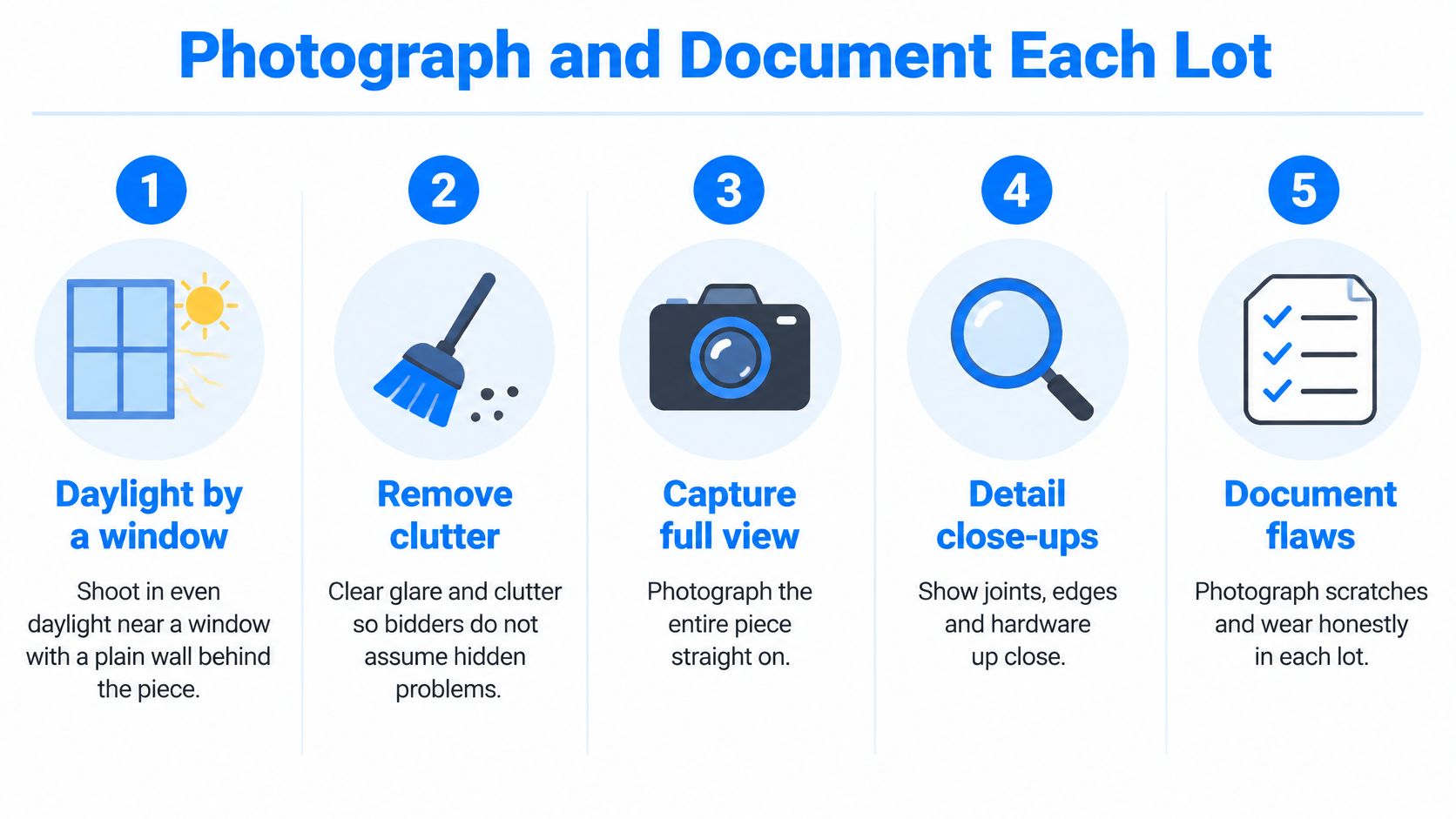
Start with light. Shoot in even daylight near a window, with a plain wall behind the piece. Glare and a cluttered background make bidders assume you are hiding a repair. Bidders price uncertainty as risk, so the photo set is part of the price.
The shoot, lot by lot
Work the same sequence on every piece so a bidder can compare a console with a sideboard without guessing.
- Frame the whole piece. Take a full front shot and two three-quarter angles. Put a tape measure or a familiar object in frame so scale is obvious. A bidder who cannot judge width will either skip the lot or message you, and messages slow the sale.
- Open the construction. Photograph drawer interiors, dovetails, the back panel, and the underside of tabletops. Joinery is what separates solid wood from a printed veneer, and it is what a furniture buyer zooms in on.
- Catch every mark. Labels, stamps, and hardware makers belong in the set even when they look minor. A small brass stamp can be the difference between "unsigned" and a named workshop.
- Show the flaws up close. Chips, veneer lifts, water rings, and old repairs get their own frames. Hiding a ring under a lamp invites a dispute after payment.
- Measure in inches. Record width, depth, height, and seat height on chairs and tables. Write the numbers into the lot the same day, while the tape is still out.
- Add one room shot. Show how the piece sits with the other items you might sell beside it. Mixed-era hardware reads clearly in a room and poorly in a white-background crop.
- Crop private life out. Family photos, papers, and mail on shelves come out before upload. If you cannot crop them cleanly, reshoot.
If you want a fuller shot list for smaller goods, use how to photograph items to sell online and keep the same honesty on wear.
One schema for every lot
Enter the same fields on each lot so bidders are comparing like with like. Use title, attributed period or style, dimensions, materials, condition grade, defects, provenance evidence, quantity, pickup location, and closing time. Grade condition in plain words such as "sound frame, refinished top, one veneer chip at the front left corner." Do not use "good for its age" as a grade.
A buyer should be able to judge size, condition, and style without sending you a message.
If the answer is no, you are missing a measurement, a flaw shot, or a sentence about the finish. Fix the lot before it goes live. A thin photo set is how sellers lose money on pieces that would have cleared a fair bid.
Set Opening Bids and Reserves From Comparable Sales
Price from completed sales, not from asking prices on unsold listings. Find sold results for the same maker, period, and material. Set the opening bid near the low end of that sold range so there is room for bids to move. An opening bid parked at your dream number usually sits there until the clock runs out.

Bidder pools are not one type of buyer. Work on multi-item online auctions finds that bidder populations are heterogeneous, and that less-experienced bidders often bid reactively instead of placing a single valuation-based proxy bid, as described in proceedings on online bidding behavior. Repeated one-dollar jumps can look busy without improving price discovery. That is why a documented walk-away value, set before launch and kept private, matters more than watching the bid count.
Four lot situations
| Lot situation | Opening bid | Reserve approach |
|---|---|---|
| Single high-value antique or designer piece | Near the low end of completed comparables | Reserve only if the price floor is firm |
| Matched pair or coordinated set | One lot priced at combined comparables | Reserve on the set, not on each part |
| Mixed-era collection of modest pieces | Low opening to draw bidders | No reserve; disclose condition clearly |
| Bulky piece with loading difficulty | Below comparables to reflect pickup cost | Reserve set after estimating loading effort |
Keep a scarce designer or antique piece as its own lot. One weak chair in a bundle discounts the signed cabinet beside it. Bundle only when the joint use is obvious, such as a matched pair of side tables or a dining table with its chairs. For a heavy sideboard on a second floor, price the opening below clean comparables, because the buyer is also pricing stairs, padding, and a second person.
A public reserve tells bidders where the floor is. Use it when you will not sell below that number. A hidden floor feels safer and often produces fewer completed sales, because bidders cannot tell whether they are wasting a bid. For household liquidation, a stated minimum and an accurate condition grade cut surprise disputes more cleanly than an aggressive secret reserve.
Before you launch, write three decisions together. Sellers choose reserve prices, closing windows, and the pickup day that fits their timeline. Letting the platform default pick the close, while you invent the reserve later, is how a good cabinet fails to sell. Watch the short walk-through below if you want a quick view of how a reserve sits against a live bid, then go back to your comparables sheet.
Do not read a high hammer price as proof your estimate was right. Control for how many people bid, whether a reserve was on, how long the lot ran, and the condition you disclosed. Track impressions, watchers, unique bidders, bid count, and realized price against your estimate. That split tells you whether the next estate needs better photos or a lower floor.
Write Listings Buyers Searching for Style Can Find
Lead the title with the piece, the material, and one style cue. Solid Oak Console, Clean Lines, Brass Pulls tells a searcher more than "Beautiful Transitional Piece." The first version names what is in the photo. The second version is a compliment.
Titles and first lines
Use the phrases buyers type. Transitional oak dining table, solid walnut sideboard, and neutral upholstered accent chair belong in titles when they are true. Repeat the material and the size in the first two lines of the description. A searcher who lands on the lot should see "72 inches wide, solid oak, refinished top" before any sentence about the room it came from.
Skip designer language you cannot document. If you know the look but not the workshop, write "unsigned, attributed to a regional maker by style" and point at the photos of the joinery. Tie any stronger attribution to the label or invoice you already filed. For a mixed-era group, explain the link in one sentence. The brass lamp echoes the pulls on the walnut cabinet. That is enough. A paragraph of design history does not raise the bid.
Online bidding is a large enough market that wording is worth the extra pass. One forecast put the global online-auction sector at $4.2 billion in 2024 and projected $7.7 billion by 2030, a 10.7% compound annual growth rate, in a Global Industry Analysts market estimate. Style-led buyers search past the local classifieds. They will not find a lot titled with adjectives.
Where the lot should live
Pick the most specific category the platform offers, by piece type and by room, so a search for a sideboard does not bury you under lighting. Then take the link outside the site. Share the auction in local renovation and home-furnishing groups, on neighborhood pages, and with friends who furnish houses for a living.
Answer questions within a day. A bidder who asks about stair access at 9 p.m. and hears nothing until the last hour often drops the lot. Our notes on online auctions for furniture cover how piece-level listings behave once they are in front of local buyers. DIYAuctions publishes the sale and routes those buyers. You still own the words on the lot.
Run Bidding, Payments and Pickup Day Without Surprises
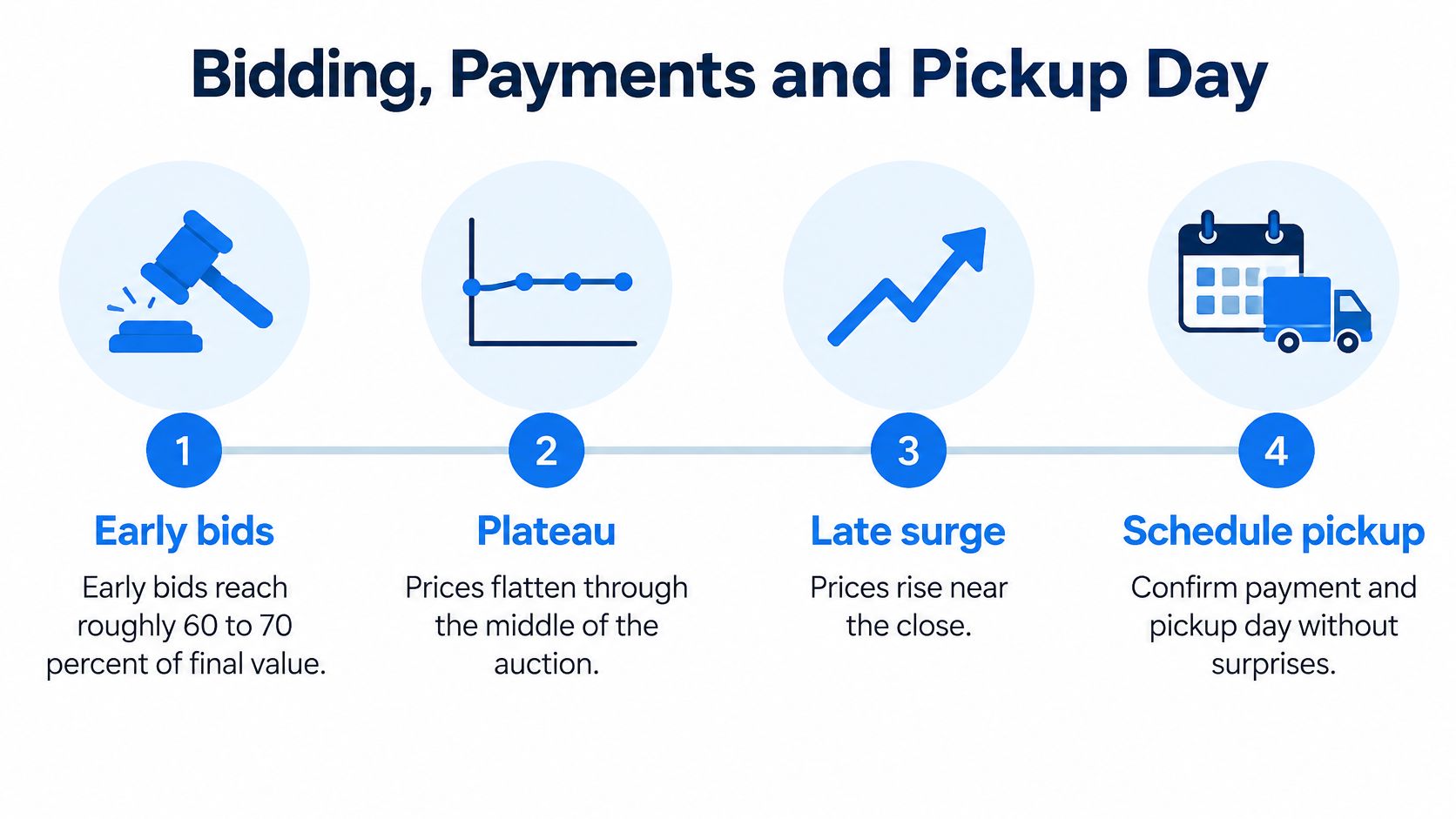
Most of the price is decided late, not in the first flurry of bids. In a study of 1,051 completed online English auctions, early bids reached roughly 60 to 70% of final value, prices then flattened, and bidding accelerated near closing. A separate review found late bids in 89 of 240 antique auctions, including 29 auctions with bids in the final 10 seconds, in NBER working paper research on online auctions. If you vanish during the close, you miss the only window that still moves the number.
A closing timeline that matches how people bid
- 14 days out: Publish the lot with dimensions, the payment deadline, and the pickup rules already visible. Do not add a stair warning on the last afternoon.
- 7 days out: Remind watchers. A short note beats a new round of price edits. Leave your walk-away number alone.
- Last 48 hours: Answer questions the same day. Do not counterbid emotionally and do not change the reserve because a friend thinks the wood is "worth more."
Competitive bidding sets the final price, so buyers are not haggling in the comments. Your job in that last stretch is clarity, not a second negotiation.
Problems that break an otherwise good sale
| Problem | Likely cause | Fix |
|---|---|---|
| Buyer does not show up | Pickup window too vague, no reminder sent | Set a two-hour window and send it 48 hours ahead |
| Damage during removal | Piece moved without padding or tools | Stage items at the door and list required tools in the listing |
| Winning buyer does not pay | Payment deadline unclear | Show the deadline in the listing and release only after payment confirms |
| Disputes over late bids | Closing time and reserve status not visible | Put closing time and reserve status at the top of each listing |
Buyers pay before they collect. DIYAuctions uses a secure pre-payment system, so buyers have already paid before they collect their items. Release nothing on a promise to pay at the curb. The sale ends with one coordinated local pickup day instead of multiple days of buyers walking through the house. A single day costs you a tight schedule. It saves the scuffs, the no-shows spread across a week, and the neighbors who did not agree to a parade of trucks.
Before that morning, print a lot list with a photo of each piece, a staging area near the door, and a sign-out sheet. Name the loading rule in the listing. Buyer brings pads, a second person, and a vehicle that fits a 72-inch top. You point, you do not carry a sideboard down stairs alone. Each item leaves with a named buyer, a paid invoice, and a date on the sheet. That sheet is what you show if someone later claims the wrong chair left the house.
Handle Unclaimed Lots and Plan Your Next Sale
Set the rule for unclaimed lots before the first bid, and put the cut-off date in the listing. For items left uncollected, sellers can re-list them, donate them, or offer them to the next-highest bidder. Pick one path per lot and write the date. A sideboard still in the dining room three days after pickup is not a surprise if the listing already said what happens on day four.
What to record after the close
| Metric | What it tells you |
|---|---|
| Unique bidders | Reach of marketing and buyer interest |
| Bid count and timing | Whether bidding stayed active near closing |
| Realized price vs estimate | Accuracy of valuation |
| Payment completion | Whether buyers followed through |
| Pickup completion | Whether logistics worked |
Read the five numbers by category, not as a single house total. Transitional lighting may have beaten your estimate while case goods sat. That split is the lesson. A high bid count with a weak price usually means reactive bidding on a lot whose floor was wishful. Strong watchers and almost no bids usually means the photos, the pickup rules, or the title failed, not the wood.
Keep a short log for each lot with the walk-away value, the final price, and one sentence on why it sold or did not.
That log is the most useful paper you carry into the next estate. It stops you from repeating a bundle that hid a better cabinet, or from reserving a bulky piece above what a local buyer will pay once stairs are in the picture.
Choose one category to test in a different format next time. If single lighting lots drew bids and the mixed box did not, list the next lamps alone and write the result you expect beside that test. If a matched pair cleared and the orphan chairs did not, bundle only the pair. One test, one expected result, then run the house. Families use this kind of sale to settle a parent's home, downsize after decades in one house, or clear a property before it is listed. The second sale is faster when the first sale's log is honest.
If you are ready to turn a house of mixed-era furniture into a single pickup day, open a sale on DIYAuctions, set your reserves and your pickup date, and catalogue the rooms with the checks above. Questions about how a sale runs can go to support@diyauctions.com during weekday support hours.
Get the estate sale pricing guide
Enter your email for pricing ranges, planning notes, and a clearer path to launch.