Disclosure Requirements for Estate Sales: A Seller's Guide
Learn which disclosure requirements apply to estate and household sales, from state rules and fiduciary duties to the records you should keep.
You're sorting a relative's belongings, photographing furniture, and deciding what can go into the sale. Then someone mentions that the dining table was repaired, the basement once flooded, or a valuable-looking signature might not be genuine. You don't want to mislead anyone, but you also can't promise facts the original owner never documented.
Disclosure requirements aren't a single rule. Estate sellers must consider property-specific laws, the obligation not to mislead buyers, and an executor's or trustee's responsibilities to beneficiaries. A useful sale record connects those obligations to evidence: what you knew, what you told the buyer, who authorized the sale, and where the money went.
Which Disclosure Rules Apply to Your Items
A disclosure requirement is a legal or fiduciary duty to tell a buyer or beneficiary material facts about an item before the sale closes.
| Property type | Governing rule | Who discloses | What must be stated |
|---|---|---|---|
| Residential real estate | Applicable state seller-disclosure statute | Seller or authorized estate representative | Known material defects and property condition, using the applicable form |
| Older homes potentially subject to lead rules | Federal lead-based paint requirements | Seller and participating agent, as applicable | Known lead information and required notices when the transaction is covered |
| Vehicles | State titling law and applicable federal odometer rules | Authorized seller | Required mileage information, title brands, and ownership documentation |
| Furniture, household goods and collectibles | General fraud and misrepresentation law | Seller or executor | Known material faults and accurate descriptions of repairs and authenticity |
| Inherited items held by an estate | State probate law, trust terms, and fiduciary duties | Executor or trustee | Authority to sell, valuation support, and sale accounting for beneficiaries |
| Consumer products under recall | Applicable product-safety and recall restrictions | Seller, with obligations affected by seller status | Product identity and recall findings; disclosure alone doesn't authorize resale |
Treat this as a routing table, not a substitute for checking the law governing the transaction. In particular, giving a warning isn't enough when an item cannot legally be offered for sale.
For estate items, the executor or trustee should coordinate accurate disclosures and retain their supporting records. The platform is responsible for its own representations and transaction terms. The buyer relies on the listing, photographs, and agreed conditions, but buyer inspection shouldn't be treated as permission to make unsupported claims.
Separate the legal layers
State statutes and applicable federal rules create item-specific obligations. A home, a titled vehicle, and an ordinary chair don't follow the same paperwork path. Our overview of estate-sale laws can help you identify the questions to take to the estate's attorney.
General fraud and misrepresentation law matters even when there's no standard disclosure form. Say an executor describes an oak dresser as having its original finish despite knowing it was refinished. The absence of a furniture disclosure form doesn't make that statement safe.
Fiduciary duty adds a different audience: beneficiaries. A description might be accurate for the buyer while the executor still lacks documentation explaining ownership, valuation, or a decision to sell to a relative.
Before photographing an item, identify its property category, the person authorized to sell it, and any facts requiring investigation. Write the proposed disclosure while the object and its paperwork are in front of you.
How Real Property Forms Differ From Estate Sales
Check for a state property-condition form before listing a house. An academic review hosted by the University of Connecticut reports that almost two-thirds of U.S. states require a state-mandated seller property-condition disclosure form. The applicable form, timing, exemptions, and liability rules differ by state.
Start with the actual form rather than a generic checklist. Its questions may direct you to roof leaks, foundation problems, plumbing, electrical systems, water damage, pests, or repairs. An executor who never lived in the house should distinguish information found in records from facts personally observed.
Keep the structure and contents separate
Suppose an estate sells a house together with its piano, workshop tools, and freestanding appliances. The property disclosure addresses the house under the applicable state rules. A separate contents schedule should identify the personal property included in the agreement and describe its condition.
Those documents must agree. If the house listing says appliances are included, the contents schedule shouldn't exclude them. If an inspection identifies a leaking appliance, don't leave an unqualified working-condition statement in the personal-property description.
Use these checks before approving the listing:
- Form requirement: Confirm which state disclosure document applies and when it must reach the buyer.
- Transfer status: Ask whether this particular estate transfer qualifies for an exemption. Don't assume that inherited ownership creates one.
- Contents reconciliation: Walk through the property with the contents schedule and confirm that included items are physically present.
An inspection and a seller disclosure serve different purposes. Think of the disclosure as the seller's account of known information, not a substitute for a buyer's independent evaluation.
Pull the current state form before advertising the house. Give the estate's attorney or real-estate professional the inspection reports, repair invoices, and unanswered questions early enough to resolve inconsistencies before anyone commits.
Fiduciary Duties Executors and Trustees Owe
An executor or trustee should approach a sale with loyalty, reasonable value, and accountable records in mind. The precise duties come from state law, the governing documents, and any court orders, but the practical question is straightforward: can you explain why this sale served the beneficiaries rather than your own interests?
Review authority and documentation before committing estate property to a sale.

A newly appointed representative can use the guide for newly named executors from Law Office of Bryan Fagan – Kingwood TX Lawyers to prepare questions about the role. Someone acting under a trust should separately review trustee responsibilities after death, rather than assuming executor procedures apply unchanged.
Distinguish proceeds from taxable gain
Under IRS guidance on inherited property, basis generally equals fair market value at the decedent's death, subject to applicable alternate-valuation rules. The taxable result depends on that basis, not on the amount collected from the buyer.
For a hypothetical example, suppose inherited silver has a documented basis of $3,000 and sells for $3,400. Before considering selling expenses or other adjustments, the difference is $400, not the full sale price. The estate's tax adviser should confirm the basis, expense treatment, taxpayer responsible, and reporting method.
Gross proceeds are the sale amount before deductions. Net payout is what remains after commissions, processing charges, and applicable adjustments. Beneficiaries should be able to trace both figures rather than receiving only a deposit total.
Use this sequence to prepare the accounting:
- Confirm authority: Retain the appointment documents or relevant trust provisions and identify any required approvals.
- Preserve valuation support: Keep appraisals, valuation notes, and the basis allocation used for grouped property.
- Record the transaction: Capture each item's price, sale date, commission, and shipping or pickup adjustments.
- Reconcile the payout: Match deductions and deposits to the sale ledger.
- Obtain tax review: Send the ledger and supporting documents to the estate's tax adviser before filing.
Use the accompanying video alongside your written preparation, not as a replacement for advice on the estate's circumstances.
A transaction export supports professional review; it doesn't replace it. Don't tell beneficiaries that inherited-property sale proceeds are automatically tax-free.
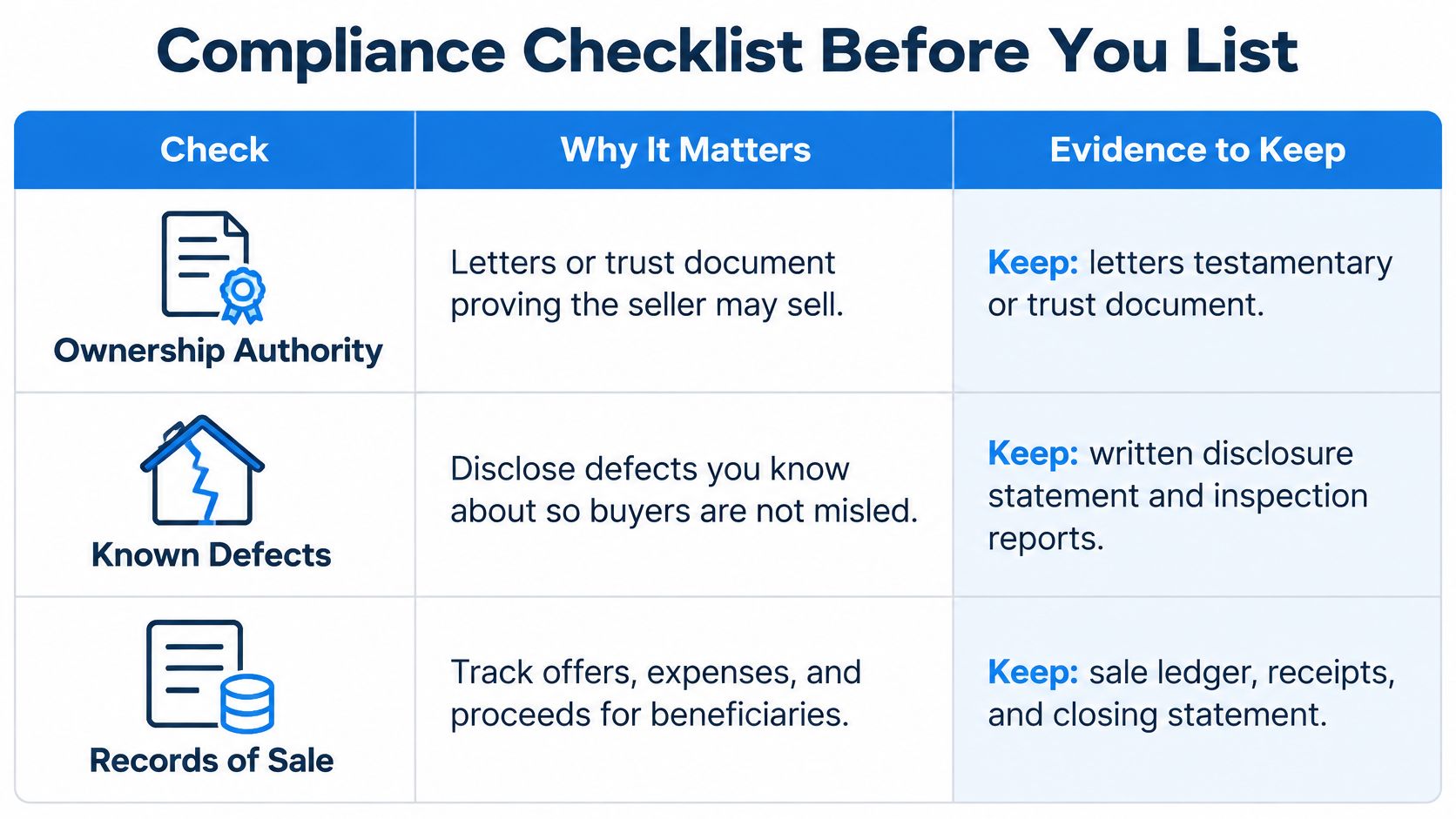
Compliance Checklist Before You List
| Check | Why it matters | Evidence to keep |
|---|---|---|
| Ownership authority | Establishes who may authorize the sale | Letters testamentary or relevant trust document |
| Known defects | Helps prevent a misleading condition description | Written condition note and dated photographs |
| Repairs and alterations | Separates original condition from later changes | Repair invoices, receipts, or attributed history |
| Authenticity claims | Gives important claims an identifiable basis | Appraisal, certificate, or an unverified label |
| Recall and safety status | Helps identify unsafe or restricted goods | Dated recall search using the model number |
| Hazards at pickup | Allows buyers to plan safe removal | Written access and pickup warnings |
| Prices and fees | Makes the estate's receipts reconcilable | Sale report with separate deduction lines |
Start with ownership, not cleaning or photography. A family member's confidence that an object belonged to the deceased isn't enough to resolve a competing ownership claim. For help organizing the preliminary inventory, the Law Office of Bryan Fagan inventory help offers a resource to discuss with counsel familiar with the estate's jurisdiction.
Keep a visible checklist beside the inventory while preparing listings.
Inspect first and label second
Follow a consistent order:
- Establish permission to sell. Separate estate property, borrowed belongings, and personally owned additions.
- Inspect the item. Photograph damage, maker's marks, serial numbers, replaced parts, and missing components.
- Check product restrictions. Use identifying information to investigate recalls or safety concerns before offering the item.
- Assign a supported label. Use verified, unverified, repaired, incomplete, or sold as-is, then explain exactly what the label covers.
These labels are working descriptions, not legal certifications. Verified should identify the particular fact checked, such as a model number, rather than suggesting that every aspect of the object was authenticated. An item can also need more than one condition note.
The European Commission's explanation of the Digital Services Act illustrates an important distinction between marketplace seller traceability and product information. Verifying who is selling doesn't establish an inherited object's authenticity or safety, and EU marketplace rules shouldn't be mistaken for U.S. estate-sale requirements.
Stop before listing suspected counterfeits, regulated goods, hazardous materials, or property with disputed ownership. Obtain appropriate specialist advice rather than trying to solve the problem with an extra disclaimer.
At the end, you should have a disclosure line for each lot and a matching evidence folder. Where evidence is missing, the description should preserve that uncertainty instead of filling it with a guess.
Disclosure Wording and Common Pitfalls
Put material disclosures where a buyer evaluates the item, beside the description, price, or commitment button, not only in general terms. The FTC's online advertising guidance calls for truthful, substantiated advertising and clear, conspicuous necessary disclosures; a disclaimer generally cannot cure a false or deceptive headline.
For DIYAuctions, present the 10% commission and $1,000 cap, applicable payment-processing charges, pickup deadlines, purchase conditions, refund limitations, and relevant responsibilities beside the action they affect. Explain which party pays each charge and the scope of the cap rather than letting buyers or sellers infer that every cost is included.
Use descriptions that show the limits of your knowledge
Adapt these templates to the actual evidence. Remove any statement you can't support.
Verified: Maker's mark photographed on the base. [Appraiser's name] appraisal dated [date] attached; its stated scope is [scope].
This identifies the evidence without treating a photographed mark as conclusive authentication.
Unverified: Family members attribute this item to [maker or collection]. The executor hasn't independently confirmed that attribution; no supporting certificate is available.
This separates reported family history from a seller's factual claim.
Repaired: [Component] was repaired or replaced on [date], according to [invoice or identified informant]. Current observed condition is [description].
This tells buyers both what changed and where the information came from.
Sold as-is: [Describe the defect fully]. Testing was limited to [test performed]; [functions] weren't tested. Included parts are [list].
This gives the buyer useful condition information instead of relying on a broad disclaimer.
Correct the claim rather than burying a qualification
Avoid authentic without evidence, all in working order without adequate testing, and guaranteed without a defined promise you can honor. A family attribution to a famous collection belongs in an attributed, unverified description, not an emphatic headline.
Apply the same discipline to commercial claims. A claim that sellers retain up to a stated share needs its fee assumptions; secure payment needs an accurate explanation of the protection provided. Maintain a simple claim register showing the wording, supporting evidence, and where the qualification appears.
Common problems have practical fixes:
- Private-seller assumptions: Don't treat private status as permission to mislead. Describe known material issues accurately.
- Hidden damage: Show flaws clearly in photographs and text. Don't crop them out or wait until pickup to mention them.
- Mixed ownership: Keep estate and personal property distinguishable, with authorization and proceeds allocated correctly.
- Excess personal information: Redact account numbers, medical details, and unnecessary identifying information from documents and photographs.
If a newly discovered fault changes the offer, pause the transaction and resolve it before asking the buyer to proceed. If a sentence can't be backed by a document, photograph, or test, narrow it or rewrite it as an unverified statement.
How Long to Keep Sale and Estate Records
Records establish what was represented, who authorized the transaction, and what the estate received. A beneficiary, court, or tax preparer may need those answers after the furniture has left and the listing is no longer publicly visible.
There isn't a single retention period that can safely be assigned to every estate and record type. Ask the estate's attorney and tax adviser to set disposal dates around applicable tax rules, probate requirements, unresolved claims, and any preservation obligations.
| Record | Keep for | Reason |
|---|---|---|
| Sale reports and gross proceeds | Through accounting and tax review, then the adviser-approved retention period | Supports reported receipts and gains or losses |
| Item-level prices, commissions and pickup adjustments | With the corresponding sale and tax records | Explains the net payout |
| Date-of-death valuations and appraisals | Through disposition and the applicable tax-record period | Supports basis calculations |
| Signed disclosures and condition notes | Through estate administration and any applicable claim period | Documents what the buyer was told |
| Authority documents | Through administration and counsel-approved retention | Establishes the seller's authority |
| Buyer and pickup communications | Through complaint resolution and the applicable claim period | Preserves transaction context |
File by lot rather than by memory
Create an estate folder with a subfolder for each lot. Store its listing export, dated photographs, condition note, relevant messages, receipt, and payout entry together. Keep authority documents and the master ledger in clearly named estate-level folders, with a backup separate from the working copy.
Our overview of tax reporting requirements can help you prepare questions for the tax adviser. Before deleting platform messages or closing an account, export the records you'll need independently.
Test the system by choosing a sold item and retrieving its listing, disclosure, sale price, and payout. If you can't connect them promptly, fix the filing structure before adding more transactions.
Confirm Your Disclosures Before You Publish
The estate is ready to publish when the listing tells a supportable story, not merely when every photograph looks good. Each lot should have an appropriate condition label, an explanation of its limits, and evidence matching the factual claims. Any house included needs its separate disclosure process completed or a professionally confirmed exemption.
A completed field isn't the same as a verified fact. If an appraisal refers to a different object, a receipt doesn't identify the repaired component, or a beneficiary disputes ownership, resolve that mismatch before accepting bids.
Use the platform to organize the sale
At DIYAuctions, our guided process helps sellers create the catalog, select prices and dates, and prepare promotion. Photo-upload, bid-management, and sales-tracking tools help organize the transaction. Review the fees and terms shown with the relevant pricing and commitment steps before proceeding.
Those tools structure and record a sale; they don't independently authenticate your objects or establish your authority to sell them. You remain responsible for the accuracy of the claims you submit.
Route questions to the appropriate channel:
- Terms questions: Contact us at support@diyauctions.com.
- Accounts, auctions, or features: Use our general support.
- Technical problems: Use the separate Report Issue option.
Don't let an approaching auction date pressure you into publishing an uncertain attribution or unresolved ownership claim. Leave that lot unpublished while you obtain the missing evidence or advice.
Start with the first lot today: complete its record, confirm that its condition label matches the evidence, and save the supporting photographs and documents together. Once that process works and the remaining lots are equally ready, set your auction dates.
Get the estate sale pricing guide
Enter your email for pricing ranges, planning notes, and a clearer path to launch.