Estate Liquidation Companies or DIY A Complete Guide
Deciding between estate liquidation companies and a DIY sale? This 2026 guide compares costs, control, and outcomes to help you make the best choice.
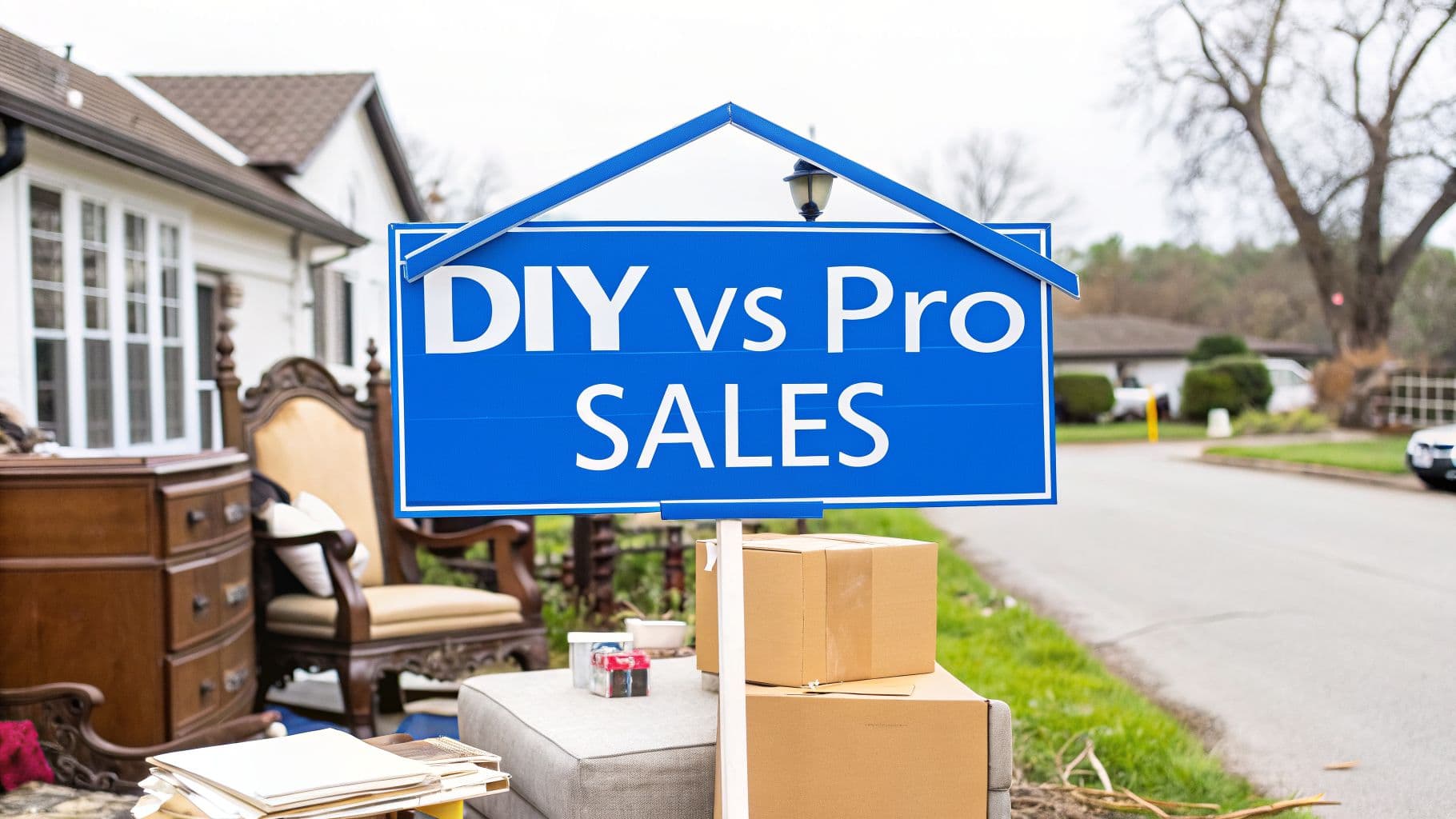
When you need to clear out a home—often after a major life event like a death, a big move, or downsizing—estate liquidation companies step in to handle everything. They are a full-service, hands-off solution, managing the entire sale of a home's contents for a commission.
Think of them as the ultimate project managers for a very personal and often stressful task. Their entire business is built on providing expertise and taking the weight off your shoulders.
What Do Estate Liquidation Companies Actually Do

Hiring a professional team means you're outsourcing every single task involved in selling the contents of a home. Their main selling point is managing the overwhelming logistics from start to finish. This all-inclusive approach is what truly separates them from any do-it-yourself method.
It all starts long before any buyers show up, with a process designed to maximize the sale's outcome while requiring minimal effort from you.
The Full-Service Process
First, the company sends a team to the home for an initial walkthrough. This is their chance to see what you have and determine if the estate is a good fit for a professional sale. It's also your opportunity to ask questions and get a feel for their style. You’ll talk about your goals, ideal timeline, and point out any specific items you want to keep.
From there, the real work begins, broken down into a few key phases:
- Inventory and Appraisal: The team sorts through absolutely everything, from antique furniture to the contents of the kitchen junk drawer. They create a detailed inventory and research items to set fair market values.
- Staging and Pricing: They transform the home into a pop-up retail shop. Everything is cleaned, attractively displayed, and given an individual price tag.
- Marketing and Promotion: The company gets the word out. They tap into their dedicated network of buyers, send email blasts, and list the sale on industry sites like EstateSales.net to draw a crowd.
- Sale Management: For the next one to three days, they run the entire public sale. They field questions from shoppers, negotiate prices, and handle all the money.
- Post-Sale Clean-Out: Once the sale is over, their job isn't done. They manage the removal of all unsold items, which might be donated, sent to a consignment shop, or cleared out in a final buyout.
At its core, an estate liquidation service is about removing the burden from the family. You’re paying a premium for a team to handle hundreds of hours of physical labor, detailed research, marketing, and sales—a service many find invaluable.
Who Hires These Companies
The typical client is someone who simply doesn't have the time, energy, or emotional bandwidth to manage a massive sale on their own. This often includes people in very specific situations.
For instance, an executor of a will who lives out of state has no practical way to oversee the process. A family downsizing after decades in one house might be overwhelmed by the sheer volume of possessions. Or, for many, sorting through a loved one's belongings is just too emotionally draining to handle alone.
Essentially, estate liquidation companies are for anyone who values professional management and convenience more than squeezing every last penny out of the sale. They offer a clear, structured path to an empty, broom-swept house—a result that, for many, is well worth the commission.
The True Cost of Professional Liquidation

While the convenience of a full-service estate liquidation company is tempting, it’s a service that comes at a steep price. The biggest hit to your bottom line will be the commission, which is taken directly from the total sales revenue.
Getting a handle on this fee structure is the only way to know if this hands-off approach truly makes financial sense for your situation.
That commission isn’t just pocketed by the company owner. It has to cover some serious overhead—we're talking about paying a team to sort, stage, and price every single item, plus staffing the sale itself. It also goes toward advertising, credit card processing fees, and business insurance.
Deconstructing The Commission Rate
The industry standard commission for a professional liquidator hovers between 30% and 50% of the gross sales. Where your estate falls in that range depends on the perceived value of what you’re selling. An estate packed with in-demand antiques might snag a lower rate, but a home with more standard household goods will likely face a higher percentage.
It’s crucial to do the math and see how this percentage carves up your final payout.
Let’s look at a real-world scenario. A typical estate sale generating $50,000 in gross revenue could see a 35% commission, which means $17,500 goes to the liquidator. That leaves you with $32,500.
Now, compare that to a modern platform like DIYAuctions, which caps its commission at a flat 10% or $1,000, whichever is less. In the same $50,000 sale, you'd keep $49,000 of your earnings. That’s a $16,500 difference in your pocket.
Real-World Impact on a $20,000 Estate
- Gross Sale Revenue: $20,000
- Professional Liquidator's Commission (at 40%): -$8,000
- Your Net Profit: $12,000
A seemingly simple percentage drastically redefines the financial outcome of your sale.
Uncovering Potential Hidden Costs
On top of that hefty commission, many liquidation company contracts have other fees lurking in the fine print. These "hidden" costs can eat away at your net profit if you're not paying close attention.
Always, always ask for a complete breakdown of every possible charge before you sign anything.
Here are a few of the most common extra fees to watch out for:
- Unsold Item Removal: What happens to the leftovers? Some companies charge a separate fee for hauling away unsold items or coordinating donations after the sale is over.
- Specialized Appraisals: If you have fine art, rare coins, or high-end jewelry, the company may bring in a third-party expert. You’ll almost certainly be the one footing the bill for that appraisal.
- Extensive Cleaning Services: If the property needs more than a basic tidying up after the sale, you can bet that deep cleaning or junk removal services will show up as an extra line item on your invoice.
- Credit Card Fees: Some liquidators will pass the 2-3% transaction fees from credit card purchases directly to you, taking it off the top before they even calculate their commission.
By understanding the total financial picture, you can make a smarter decision. It's worth checking out our guide on the full cost of an estate sale to get prepared. This knowledge gives you the power to negotiate a better deal and ensures there are no nasty surprises when that final check arrives.
Comparing Professional Liquidators And DIY Platforms

When it comes to liquidating an estate, your choice really comes down to one big question: What do you value more—total convenience or hands-on control and higher profit?
On one side, you have traditional, full-service estate liquidation companies. On the other, you have modern DIY online platforms that give you the tools to run the sale yourself. Picking the right path isn't just about saving a few dollars; it's about finding the best fit for your specific needs, your timeline, and your comfort level.
Control And Seller Involvement
The most immediate difference is how much control you keep. When you hire a full-service liquidator, you're essentially handing over the keys. They make the calls on pricing, marketing, and negotiation. It’s the definition of "hands-off"—you pay them to handle every last detail so you don't have to.
A DIY online platform like DIYAuctions offers guided control. Think of yourself as the project manager with a full suite of professional tools. You decide what to sell and for how much. You set the auction schedule and manage the pickup. This approach lets you use your personal knowledge of the items while the platform provides the marketing muscle and technical framework.
The key question is simple: Do you want to be completely removed from the process, or do you want to steer the ship yourself? Your answer will point you in the right direction.
The Financial Equation
Money is often the deciding factor, and the two models couldn't be more different. As we covered, a traditional estate liquidation company charges a hefty commission, usually between 30% and 50% of the gross sales. That fee pays for their large team, marketing, and overhead.
DIY platforms completely flip the script. A platform like ours charges a much lower commission—typically 10%—and even caps the fee to maximize your profit on larger sales. The fee is lower because you're supplying the "labor" by taking photos and managing the pickup day. We handle the rest.
Let's look at the numbers:
- Scenario A: Professional Liquidator. An estate grosses $25,000. At a 40% commission, the company takes $10,000. You walk away with $15,000.
- Scenario B: DIY Platform. The same $25,000 estate sale. At a 10% commission, the platform takes $2,500. You keep $22,500.
That $7,500 difference is the money you earn for the time you put in. For a closer look at the numbers, you can explore our full guide on different estate liquidation options and their financial results.
Timeline And Flexibility
Timelines also diverge significantly. A professional liquidator runs on their own schedule. After you sign the contract, they'll slot your sale into their calendar, which could be weeks or even months out. The sale itself is usually a fast-paced, 2-3 day event, followed by a final clean-out.
With a DIY online auction, you have far more flexibility. You can start cataloging items whenever you have free time—evenings, weekends, whenever works for you. The online auction itself typically runs for 7-10 days, giving buyers plenty of time to discover your sale. It all leads up to a single, scheduled pickup day that you control.
Side-By-Side Feature Comparison
To help you decide, here’s a direct comparison of the two approaches.
Comparison: Estate Liquidator vs. DIY Platform
This table breaks down the core differences between hiring a full-service company and using a platform like DIYAuctions.
| Feature | Traditional Estate Liquidation Company | DIY Online Platform (e.g., DIYAuctions) |
|---|---|---|
| Seller Effort | Low. Completely hands-off; the company manages everything. | Medium. You are responsible for photos, descriptions, and pickup. |
| Cost | High. 30-50% commission on gross sales. | Low. Typically 10% commission, often with a fee cap. |
| Seller Control | None. The company controls pricing, timing, and negotiations. | Full. You set prices, schedule, and manage the entire sale. |
| Timeline | Rigid. Sale is scheduled based on the company's availability. | Flexible. You control the cataloging and sale dates. |
| Market Reach | Local. Primarily attracts local buyers through signs and local ads. | Broad. Reaches a wider, targeted online audience of local buyers. |
| Specialty Items | Handled by their network, may incur extra appraisal fees. | You research and set prices, leveraging a wider online market. |
In the end, neither option is universally "better." A traditional company is the right call if you have zero time, live out of state, or simply need the most convenient, hands-off solution possible. A DIY platform is built for people who want to maximize their profit, have some time to invest, and prefer to stay in control of their family's assets.
When Hiring An Estate Sale Company Makes Sense
Despite the steep commissions, there are absolutely times when bringing in a professional estate liquidation company is the right call. It’s not just a convenience—it’s a necessity. The decision really boils down to a simple trade-off: your time and energy versus your money.
For many people, paying a premium for a completely hands-off process is a smart investment, especially when you’re dealing with a difficult situation from far away. If you’re an executor living out of state, trying to manage an estate sale on your own is a logistical nightmare. A professional crew acts as your local, on-the-ground team, handling everything from sorting through closets to the final clean-out.
Handling High-Value Or Overwhelming Estates
The sheer size and complexity of the estate can also make a professional service the only practical option. A house packed with a lifetime of possessions or a significant collection of valuable items can be completely overwhelming to tackle alone.
Professionals are set up to manage estates with assets that need an expert eye for appraisal and marketing. This is critical for:
- Fine Art and Antiques: These pieces require a specialist to identify them, determine their true value, and connect with the right collectors. Estate sale companies have these networks.
- Extensive Collections: Whether it’s coins, rare books, or vintage fashion, a pro knows the niche markets and how to get the best prices.
- Overwhelming Volume: For large homes or properties with barns and outbuildings, the physical labor of sorting, pricing, and staging can easily add up to hundreds of hours.
While liquidators focus on selling assets, some homes come with bigger challenges, like hoarding. In these tough cases, knowing how to approach navigating hoarding situations after the loss of a loved one is a critical first step, often requiring specialized help before any sale can even be considered.
When Time Is Your Most Valuable Asset
Sometimes, the choice is made for you by a non-negotiable deadline. If you need to clear a house fast to get it on the market or to meet probate requirements, you simply can't beat the speed of a professional service.
The single biggest advantage of an estate sale company is pure efficiency. They offer a guaranteed, start-to-finish timeline to get a home cleared out—a promise a DIY approach can't make.
Even for large estates, a full-service company can often wrap things up in just one to three weeks. That kind of turnaround is a world away from a DIY effort that can stretch on for months. For anyone who can’t afford to let the process drag on, this speed is a game-changer.
If you’re facing a tight deadline, dealing with a complex and valuable estate, or are just too far away—geographically or emotionally—to handle it yourself, hiring a pro is the clear answer. The peace of mind that comes from knowing it’s all being handled correctly often makes the commission well worth it.
When a DIY Approach Maximizes Your Profit
Hiring an estate sale company is certainly convenient, but that convenience comes at a steep price. If your main goal is to get the most money back from the estate, a do-it-yourself (DIY) approach using an online auction platform is often the smartest financial move.
This path is perfect for anyone comfortable with a bit of tech who wants to maximize the inheritance, control the process, or handle a small-to-midsize estate where a professional's high commission just doesn't make sense. It’s a hybrid approach: you bring the knowledge of the items, and the platform provides the reach and the tools.
This flowchart breaks down the decision based on what you value most.

As you can see, if maximizing your net profit is the top priority, the DIY route is the clear winner.
Ideal Scenarios for a DIY Online Auction
So, when does it really pay to roll up your sleeves? If any of these situations sound familiar, a DIY online auction is almost certainly your best bet.
- You Have Some Time and Energy: The biggest trade-off is your own time. If you can spend a few evenings or a weekend taking photos and writing descriptions, you can literally save thousands of dollars in fees.
- You Want Control Over Pricing: Nobody knows the stories behind your family's belongings better than you. A DIY platform lets you set starting bids and reserve prices, so you can be sure sentimental or valuable items don't get sold for pennies on the dollar.
- The Estate is Small to Medium-Sized: Many professional estate liquidation companies have high minimums and will simply turn down smaller jobs. A DIY platform is perfect for liquidating the contents of an apartment, a small home, or what’s left after the family has picked their keepsakes.
The DIY hybrid model gives you professional-grade tools for marketing and payment processing without forcing you to surrender a huge chunk of your proceeds. It’s about working smarter, not harder.
The Financial Advantage in Practice
The numbers really tell the story. For a moderate estate—think a typical household valued between $20,000 and $50,000—the difference is staggering. While a traditional company might take 35-50%, a DIY platform lets you keep 90% or more of the final sales price.
We see it all the time. One executor recently managed a $45,000 estate sale through our platform. After our $1,000 fee cap, they netted $42,000. The quotes they got from traditional companies would have left them with just $27,000. That’s a $15,000 difference.
This approach puts you firmly in the driver's seat. You’re not just saving money on commissions; you're actively earning a higher return by investing your own time wisely. For those who want the best possible financial outcome, the choice is pretty clear.
You can learn more about how to run your own sale in our complete guide to estate sale liquidation.
Your Decision Making Checklist And Next Steps
Alright, so you have two clear paths: hiring a full-service estate liquidation company or taking a DIY approach. The right choice really just boils down to what you value most right now.
To figure this out, you need to get honest about your situation. Run through these questions—your answers will make the best path forward pretty obvious.
The Final Checklist
- How much time do you actually have? If your schedule is completely swamped, a hands-off service is probably the only realistic option. But if you can find some evenings and a weekend, you could save yourself thousands.
- What's the main goal here? Are you trying to squeeze every last dollar out of the contents for the estate (profit)? Or is the goal just to get the house empty, fast, and with minimal stress (convenience)?
- What are we dealing with? A huge home packed with antiques and fine art demands professional appraisal and marketing. A more typical home with standard furniture and household goods? That’s perfect for a DIY sale.
- Are you comfortable with basic tech? A DIY platform means using your phone to take pictures and navigating a website. If that sounds like a headache, a traditional company might be your best bet.
- Who needs to be in control? Do you want the final say on every price and deadline, or would you rather hand the keys to an expert and trust their process?
The bottom line is this: If your answers leaned toward "profit," "smaller estate," and "full control," a DIY platform is the clear winner. If you found yourself saying "convenience," "large/valuable estate," and "hands-off," then hiring a professional company is where you should focus your energy.
Next Steps If You Hire A Professional
Decided to go with a pro? Great. Now your job is to find a good one. A little due diligence here goes a long way in protecting the estate's assets.
- Gather Referrals: Start by asking for recommendations. Estate attorneys, real estate agents, and even friends who've been through this are your best sources.
- Interview At Least Three Companies: Have them walk through the home with you. Get a feel for their process, how they communicate, and their proposed strategy.
- Verify Insurance and Bonding: This is non-negotiable. Ask for their certificate of liability insurance. A legitimate company will have it ready, no questions asked.
- Read The Contract Carefully: Before you sign anything, scrutinize the commission rate, all the fees, and what happens to items that don't sell.
Next Steps For A DIY Online Auction
If the DIY route feels right, getting started is actually pretty straightforward. Your focus will be on setting up a great online sale that leads to a simple, one-day pickup event.
- Choose Your Platform: Look for a platform like DIYAuctions that offers low, capped commissions and gives you the marketing and support tools you need.
- Organize and Declutter: Walk through the house and sort everything into three piles: keep, donate, and sell. As part of preparing an estate for sale, whether you choose a DIY approach or professional help, a crucial step involves effectively decluttering the home for sale, which can significantly impact its market appeal.
- Start Cataloging: Now for the fun part. Start taking photos and writing simple descriptions for your items. Remember to group smaller, similar things into "lots."
- Schedule Your Sale and Pickup: Pick the dates for your auction to run and lock in a single day for all the winning bidders to swing by and collect their new treasures.
Answering Your Big Questions
When you're weighing a full-service estate sale company against a DIY approach, a few key questions always surface. Getting straight answers is the best way to make a decision you feel good about.
How Long Does The Entire Estate Liquidation Process Take?
The timeline is one of the biggest differences between the two paths. A traditional liquidation company works on a very compressed schedule. From the day you sign the contract to the final check, you’re usually looking at a 2 to 4-week whirlwind, with the in-person sale itself lasting just 2-3 days.
A DIY online platform, on the other hand, puts you in charge of the clock. The process of cataloging and photographing items is entirely self-paced—you can chip away at it over a few weeks or knock it out in a weekend. The online auction itself typically runs for 7-10 days, all leading up to one scheduled pickup day. You set the pace, whether that’s a quick two-week sprint or a more relaxed month-long project.
What Happens To Items That Do Not Sell?
This is a crucial point, as it really gets to the heart of who is responsible for what. When you hire an estate sale company, handling the leftovers is part of their job. Your contract will usually outline a few options:
- Company Buyout: The liquidator might offer to buy all the remaining items for a single, low price.
- Donation Coordination: They can arrange for a charity partner to come and pick up what’s left.
- Clean-Out Service: For an added fee, they’ll bring in a crew to haul away everything, leaving the property "broom swept."
With a DIY platform, what happens to unsold items is entirely up to you. You have total freedom to donate things to a charity you care about, offer them to friends and family, or handle the disposal yourself. You maintain full control over the assets to the very end.
Your responsibility for unsold items is a key differentiator. A company manages it for you (often for a fee), while a DIY platform leaves you in full control to handle it as you see fit.
Can I Sell Specialty Items Like Vehicles Or Firearms?
Absolutely, but how they’re sold can make a huge difference in your final payout. Most professional liquidators can include a car in their sale, but their marketing reach is generally limited to the local crowd that shows up on sale days. For regulated items like firearms, they have to partner with a Federal Firearms License (FFL) holder, which can add complexity and fees to the process.
This is where modern online auction platforms really shine. They can market a vehicle, boat, or RV to a massive, targeted audience of interested buyers, which naturally creates more competition and drives up the price. When it comes to firearms, platforms like DIYAuctions often have built-in partnerships with FFLs, ensuring the transaction is secure, compliant, and connects you with serious collectors across the country—not just the handful who might walk through the door.
More guides in Estate Sale Basics
July 28, 2026
Revenue Reporting for Estate Sales and Auctions
Learn revenue reporting essentials for estate sales and auctions. Discover key metrics, templates, and best practices to simplify tracking and compliance.
Read guideJuly 26, 2026
Stamp Collection Valuation: A Practical Step-by-Step Guide
Stamp collection valuation made simple. Learn how to identify, grade, price, and sell your stamps with confidence for estate sales or consignment.
Read guideJuly 23, 2026
Estate Sales Brick NJ: Your 2026 Guide to Success
Planning your estate sales brick nj? Our guide covers permits, pricing, marketing, & running a safe sale with DIYAuctions.
Read guideGet the estate sale pricing guide
Enter your email for pricing ranges, planning notes, and a clearer path to launch.