estate sale new jersey: A Practical Guide to Selling
estate sale new jersey: Your expert guide to planning, pricing, and running a successful estate sale from start to finish.
Before you even think about putting a price tag on anything, you need to get a feel for the unique landscape of New Jersey’s estate sale market. It’s about more than just slapping a “seller’s market” label on it. To run a successful sale, you have to dig into the current dynamics to set realistic expectations from day one.
The success of any estate sale in New Jersey is tied directly to the local real estate market. It’s simple, really. When houses are flying off the market at high prices, the stuff inside tends to be seen as more valuable, and you’ll get more people showing up. When things cool down, sellers have to be a bit smarter.
Understanding the New Jersey Estate Sale Market
The Garden State is moving away from the super-hot, hyper-competitive market we saw a couple of years ago. Things are becoming more balanced, though the odds are still generally in a seller’s favor. It’s a nuanced picture: demand is still strong, but rising inventory means buyers have more power than they used to.
Current Market Dynamics
Let's look at the numbers. The median home price recently hit $584,700, which is a 5.8% increase from last year. That sounds great, but it’s a big slowdown from the double-digit jumps we got used to during the pandemic peak.
At the same time, the amount of housing inventory shot up by 10.6%. More houses for sale means more estate sales to compete with. You can dig deeper into the complete New Jersey housing market analysis to see how these trends are playing out.
This infographic breaks down three key stats that really tell the story of the current market: the median price, the change in inventory, and how many homes are actually selling above the asking price.
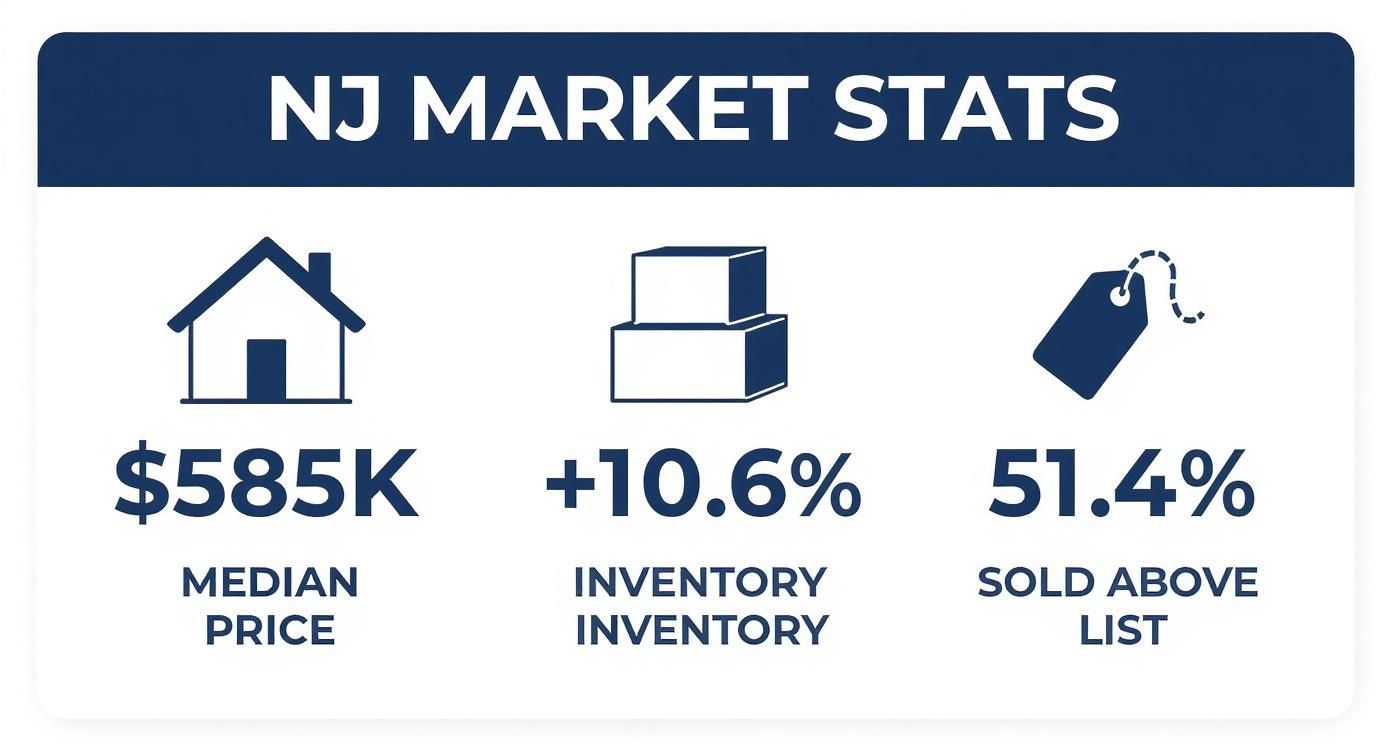
What this all shows is that while prices are holding strong and many properties still fetch a premium, that rising inventory means your sale needs to stand out.
To help you get a quick read on the situation, here’s a snapshot of the key market indicators and what they mean for your upcoming estate sale.
New Jersey Market at a Glance
| Market Indicator | Current Trend | Implication for Your Sale |
|---|---|---|
| Median Home Price | Up 5.8% to $584,700 | Buyer confidence is still high, supporting solid prices for quality items. |
| Housing Inventory | Up 10.6% | More competition from other estate sales. Your marketing and photos need to pop. |
| Homes Selling Above List | 51.4% (decreasing) | You can't assume a bidding war. Price items competitively from the start. |
| Days on Market | Increased to 43 days | Buyers are taking their time. Be patient and prepared to be flexible. |
| Price Reductions | ~19% of listings | Don’t be afraid to adjust prices on items that aren't getting bids. |
This table gives you the tactical view, showing how broader real estate trends translate directly into how you should be thinking about pricing and marketing your items.
What This Means for Your Sale
Okay, so what do you actually do with all this information? It boils down to this: your pricing, timing, and marketing strategy are more critical now than ever before.
Here’s how to translate those market stats into a winning game plan:
- Your Pricing Strategy is Everything: With just 51.4% of homes selling over the list price (down from the frenzy of before), you can’t just hope for a bidding war. You need to price your items to sell right from the get-go.
- Be Patient, Buyers Are: Homes are sitting on the market longer—an average of 43 days now, up from 34. That same patience applies to estate sale shoppers, who are likely to be less impulsive and more selective.
- Don't Be Afraid of Price Drops: Nearly 19% of home listings are seeing price reductions. Take a cue from that. Be ready to be flexible with your own pricing, especially on big-ticket furniture or items that don't get early bids.
The bottom line? It’s still a fantastic time to hold an estate sale in New Jersey. But the days of frenzied, anything-goes buying are over. Today’s buyers are more discerning, and success now demands a thoughtful plan grounded in what’s happening in the market right now—not what you read in last year’s headlines.
How Location Impacts Your NJ Estate Sale

When you're planning an estate sale in New Jersey, it's easy to forget that the state isn't one big, uniform market. The truth is, it’s a collection of dozens of hyper-local markets, and your zip code is one of the most powerful factors in your sale’s success. It doesn’t just dictate the property's value—it dramatically shapes buyer turnout and how you should price the items inside the home.
Location determines everything. A sale in a quiet, rural town down in South Jersey is a completely different ballgame than one in a bustling North Jersey suburb with a direct train line into Manhattan. You’ll get different buyers, different expectations, and you'll need a different strategy. Getting to know the unique vibe of your specific town is the first step.
Why High-Demand Counties Are a Different Beast
Some parts of New Jersey, especially in the more affluent counties, almost operate in their own little economic bubbles. These areas tend to be shielded from broader market slowdowns because of a few key ingredients: top-tier school districts, lively downtowns, and an easy commute to New York City. This recipe creates intense, non-stop demand.
Bergen County is the perfect example. Towns like Ridgewood, Wyckoff, and Franklin Lakes consistently see fierce interest. It’s not uncommon for homes in the $1.2 million to $1.8 million range to spark bidding wars and sell well above asking, simply because there isn't enough inventory to go around. In fact, statewide data recently showed that nearly 60% of homes were selling above their list price. That’s a ton of negotiating power for sellers.
This kind of hyper-local demand is a huge advantage. When a neighborhood is that desirable, buyers aren't just competing for the house itself. They’re often eager to snap up furniture and decor that fit the home's style, which creates a fantastic secondary market for your items.
Do a Little Local Reconnaissance
To really make your location work for you, you need to think like a local marketer. Start by digging into recent comparable sales in your immediate area—not just for real estate, but for other estate sales, too. See what's selling fast and what isn't.
- Study Local Buyer Habits: Are people in your town hunting for high-end antiques, or is mid-century modern furniture the hot ticket? Check out local Facebook groups and online marketplaces to get a feel for what people are actually buying.
- Pinpoint Community Strengths: Does your town have a big historical society, a thriving arts scene, or a flood of young families moving in? You can tailor your marketing to highlight items that will catch their eye specifically.
- Use the Right Tools: A platform like DIYAuctions lets you reach a targeted audience of people who are already looking for sales right in your county. It’s way more effective than just casting a wide, generic net and hoping for the best.
Understanding these local quirks is the key to promoting your sale effectively. To learn more about getting the word out, check out our guide on digital marketing for local businesses—it’s packed with strategies you can apply directly to your sale. When you tailor your game plan to your specific New Jersey location, you’re setting yourself up for a much more profitable event.
Your Blueprint for a Successful NJ Estate Sale

Running your own estate sale in New Jersey can feel like a huge undertaking, but it’s really just a project with a few key phases. If you break it down into manageable chunks—preparation, marketing, and the sale itself—it becomes much less intimidating. Honestly, getting the prep work right from the start makes everything else fall into place.
The first real job is to sort through everything. Go room by room, closet by closet, and create three distinct piles: items to keep, items to sell, and things to donate or toss. It pays to be decisive here, but don't rush. You'd be surprised how many hidden gems turn up in the most unlikely places.
Once you’ve decided what's for sale, it’s time to build your inventory. This is the single most important organizational step you'll take.
Creating Your Digital Inventory
For every single item you plan to sell, you need to capture the essential details. Good photos are completely non-negotiable. Use natural light whenever possible and find a simple, neutral background to really make your items pop. Make sure to take pictures from a few different angles, and be honest about any special features or flaws.
Next up, you'll write a short but compelling description. What are the dimensions? Who’s the manufacturer? What's the condition? For example, instead of just "old dresser," try something like: "Mid-Century Modern Walnut Credenza by Lane Furniture. Excellent vintage condition with minor surface wear consistent with age. Measures 60" W x 18" D x 30" H." That level of detail gives buyers the confidence to bid.
With a platform like DIYAuctions, you can easily upload your photos and descriptions to create a professional-looking online catalog. This catalog becomes the heart of your sale, driving your marketing and helping you manage everything on pickup day.
Pro Tip: Don't forget to bundle smaller, lower-value items into lots. Think "Kitchen Essentials" with mixing bowls, utensils, and a toaster, or a "Gardening Tools" lot. It’s a great strategy to clear out clutter quickly and appeals to buyers who are hunting for a bargain.
After you've cataloged everything, you'll hit a crossroads: Do you run this sale yourself or bring in a professional company? There are clear pros and cons to each, and this decision will shape the rest of your process.
DIY Sale vs Hiring a Professional
Choosing between a DIY approach and a traditional estate sale company comes down to what you value most: control, cost, or convenience. There's no single right answer, but this table should help you figure out what's best for your situation.
| Feature | DIY Approach | Traditional Estate Sale Company |
|---|---|---|
| Control | Full Control: You set all prices, schedules, and rules. | Limited Control: Professionals manage pricing and sale logistics. |
| Cost | Lower Cost: Typically a small platform fee or commission. | Higher Cost: Commissions range from 30% to 50% of total sales. |
| Effort | High Effort: You handle all sorting, cataloging, and staging. | Low Effort: The company manages the entire process for you. |
| Profit | Higher Profit Margin: You keep the vast majority of the revenue. | Lower Profit Margin: A significant portion goes to the company. |
Ultimately, the DIY route puts more money back in your pocket and gives you the final say on everything, but it requires your time and effort.
Marketing Your New Jersey Sale
With your digital inventory ready to go, it's time to get the word out to local buyers. Smart marketing is all about finding the right people. Start by sharing the link to your online catalog on local hubs like Facebook Marketplace and Craigslist, but don't stop there. Post it in community groups specific to your New Jersey town—that’s where you’ll find the most engaged local shoppers.
Create a headline that makes people stop scrolling, something like, "Huge Estate Sale in Montclair NJ – Vintage Furniture, Collectibles & More!" In your post, showcase a few of your best items with really great photos to reel people in. And always, always include the key details: the sale dates, times, and a direct link to your full catalog on DIYAuctions where they can see everything and start bidding.
This isn’t just about hoping people stumble upon your sale. You’re actively creating buzz and pulling in committed buyers long before the pickup day arrives. That pre-sale excitement is what really drives a successful outcome.
Pricing Your Items in a Shifting Market
 Figuring out prices for an estate sale in New Jersey is less about guesswork and more about striking a delicate balance. It’s part art, part science. When you nail it, you build the kind of buzz that makes a sale a huge success. But if you price things too high, you’ll watch shoppers walk away empty-handed, leaving you with a house still full of stuff.
The real trick is to take your emotions out of the equation and start thinking like a smart retailer. Your goal isn't to get back what was originally paid for an item. It's about selling it for what it’s worth today. That takes a little bit of research, a solid strategy, and being ready to listen to what the market is telling you.
Reading the Local Market Signals
The New Jersey market has its own unique rhythm, and right now, buyers are being more thoughtful with their money. While home listing prices have been stable, the number of active listings shot up by 14.49% compared to last year. Even more telling? Over 4,600 properties have had their prices cut—that’s a huge 30.96% jump.
What does that mean for you? It’s a clear signal that sellers are adjusting their expectations to meet buyers where they are. And you should, too.
More items for sale means more competition for you. The spike in price reductions shows that today's buyers are patient and will wait for a deal they feel is fair.
Your pricing strategy has to reflect this new reality. It's far better to start with competitive, attractive prices from day one than to aim high and hope for the best. In this market, a great initial price is what creates the momentum you need to clear the house.
Practical Pricing Strategies for NJ Sellers
To set your prices with confidence, you’ll want to blend some online digging with a good understanding of what you’re selling. Different categories of items need slightly different approaches.
Here are a few tips to get you started:
- Check "Sold" Listings: Don't just look at what people are asking for on sites like eBay or Facebook Marketplace. Filter your search to see what items like yours have actually sold for. That’s your true north for market value.
- Be Honest About Condition: This is where you have to be brutally honest. A vintage armchair with perfect original upholstery could be a big-ticket item. But that exact same chair with a few tears and stains? It’s worth only a fraction of the price.
- Value Precious Metals Correctly: If you have broken jewelry or outdated gold pieces, their value is in the raw material, not the design. Getting a basic handle on understanding the scrap gold price will help you set a fair price based on weight and purity, ensuring you don't leave money on the table.
For a much deeper dive into getting your prices just right, check out our complete estate sale pricing guide. It's packed with detailed, category-specific advice to help you confidently price everything from your grandmother's fine china to the tools in the garage.
Navigating Legal and Financial Rules
Running a successful estate sale in New Jersey is about more than just great photos and smart pricing. It's a financial and legal event, and that comes with a few responsibilities.
Ignoring the rules can lead to fines or other headaches nobody wants to deal with. But don't worry—a little bit of prep work makes the whole process smooth and stress-free.
The first thing to understand is that regulations aren't uniform across the state. They can change dramatically from one town to the next. What works in Cherry Hill might be completely different from the rules in Jersey City, so you can't ever make assumptions.
Permits and Local Ordinances
Before you even think about announcing your sale, your first call should be to your local municipal clerk's office. Many—if not most—towns in New Jersey require a permit for any kind of garage or estate sale. The process is usually pretty simple, but it's absolutely non-negotiable.
Trust me, you don't want your sale shut down on the spot for skipping this step. When you call the clerk, be ready to ask a few key questions:
- Permit Fees: How much is it, and what are the payment options?
- Sale Duration: Are there limits on how many days the sale can run? Two or three days is a common cap.
- Signage Rules: This is a big one. Ask where you can place signs and if there are size restrictions. Many towns have strict rules against posting on utility poles or public property.
Getting this info upfront saves you from last-minute scrambles and ensures your sale is fully compliant from day one.
Remember, as an executor or family member, your job is to manage the estate ethically and legally. Following all local and state regulations protects both you and the estate from any potential liability down the road.
Handling Taxes and Sale Proceeds
Another area to get right is sales tax. The rules here can be a bit complex. For a one-time liquidation of personal household goods, you might not be required to collect sales tax.
However, if you're holding sales regularly, you almost certainly need to register with the state. For a single estate sale, it’s always wise to check the New Jersey Division of Taxation's guidelines to clarify your specific situation. Professional estate sale companies, for instance, are almost always required to collect it.
Properly managing the proceeds is just as important. All the money from the sale becomes part of the estate's assets. It has to be distributed according to the will or, if there isn't one, state law. This is where detailed, transparent record-keeping becomes your best friend. You can dive deeper by exploring our comprehensive guide to navigating estate sale laws.
And what about the items that don't sell? If you decide to donate them, understanding what donations are tax deductible can create an additional financial benefit for the estate. It's a smart way to handle leftovers while staying on top of your financial duties.
Common Questions About NJ Estate Sales
Even the best-laid plans can hit a snag. When you're managing an estate sale in New Jersey, you’re bound to run into questions about local rules, tricky items, and what to do with the leftovers. Getting ahead of these common hurdles is the key to avoiding last-minute stress.
Think of this as your personal FAQ, built from the most common questions we see from people just like you. Here are the straight-up answers you need to keep things moving.
Do I Need a Permit for an Estate Sale in New Jersey?
Yes, almost certainly. The catch is that the rules change dramatically from town to town. One municipality might have a simple garage sale form, while the next town over has a detailed ordinance just for estate liquidations, spelling out everything from how many days you can run the sale to where you can put your signs.
Your first call should be to your local municipal clerk’s office, well before you even think about setting a date. Ask them about the permit process, any fees involved, and what restrictions you need to know. Trust me, skipping this step can get your sale shut down and even land you a fine. It’s not worth the risk.
How Should I Handle Valuables Like Jewelry or Art?
When you come across fine jewelry, original artwork, or legitimate antiques, your first move should always be a professional appraisal. A certified appraiser gives you a documented valuation, which is non-negotiable for setting a fair price and for any insurance purposes.
With that valuation in hand, you can confidently set a reserve price on the item in your online auction. This is the secret weapon to ensure your valuable doesn't sell for less than it's worth. For truly rare or high-demand pieces, you might even consider consigning them to a specialty auction house that can reach a global network of collectors.
Pro Tip: Never, ever guess the value of a potentially precious item. An official appraisal protects you from undervaluing a family treasure and gives serious buyers the confidence to place competitive bids.
What Happens to Items That Do Not Sell?
It’s a fact of life: not everything will sell. And that’s perfectly fine! You have a few great options for clearing out the remaining items efficiently once the auction is over.
- Donations: Charities like Goodwill, The Salvation Army, and Habitat for Humanity ReStore are excellent choices. Many will even schedule a pickup for furniture and larger items, plus you’ll get a tax-deductible receipt.
- Cleanout Services: For a fast and total clear-out, you can hire a professional estate cleanout or junk removal company. They’ll empty the entire property for a fee, which can be a lifesaver when you’re on a tight deadline.
- Bulk Buyouts: Some cleanout services might offer to buy all the remaining contents for a single lump sum. You won't get top dollar, but it’s the absolute quickest way to leave a property completely empty.
Am I Required to Collect Sales Tax?
This is where things can get a little tricky. If you were running estate sales as a regular business, you’d absolutely need to register with the state and collect sales tax. But for a one-time estate sale to liquidate personal property, you often fall into a bit of a gray area.
Because every situation is different, the smartest move is to check directly with the New Jersey Division of Taxation. Getting the official word straight from the source (or from a tax professional) is the only way to ensure you’re 100% compliant and avoid any future headaches.
More guides in Estate Sale Basics
July 28, 2026
Revenue Reporting for Estate Sales and Auctions
Learn revenue reporting essentials for estate sales and auctions. Discover key metrics, templates, and best practices to simplify tracking and compliance.
Read guideJuly 26, 2026
Stamp Collection Valuation: A Practical Step-by-Step Guide
Stamp collection valuation made simple. Learn how to identify, grade, price, and sell your stamps with confidence for estate sales or consignment.
Read guideJuly 23, 2026
Estate Sales Brick NJ: Your 2026 Guide to Success
Planning your estate sales brick nj? Our guide covers permits, pricing, marketing, & running a safe sale with DIYAuctions.
Read guideGet the estate sale pricing guide
Enter your email for pricing ranges, planning notes, and a clearer path to launch.