A Guide To Estate Sales Dallas That Maximize Your Profit
Discover how estate sales Dallas work. Our guide helps you price, stage, and sell items for maximum return, whether you're downsizing or liquidating.

Navigating an estate sale in Dallas can feel like a monumental task, especially when you're already dealing with a major life change like a move, downsizing, or settling a loved one's affairs. At its heart, an estate sale is simply a way to liquidate the contents of a home—turning a lifetime of belongings into cash.
The biggest choice you'll face is how to do it. You can go the old-school route with a traditional, high-commission company, or you can take control with a modern, more profitable approach.
Understanding The Dallas Estate Sale Landscape

Think of it this way. If you’re moving across the country, you could hire a full-service moving company. They’ll pack every spoon and drive the truck for you. It’s convenient, sure, but it’s also incredibly expensive, and they take a huge chunk of your budget. The other option? You rent the truck yourself, use some smart tools to stay organized, and pocket all the savings.
An estate sale in Dallas presents the exact same choice.
Traditional estate sale companies are those full-service movers. They handle everything from pricing your items to managing the sale days. But that convenience comes at a steep cost—they typically charge commissions of 30% to 50% of your total sales. In a competitive market like DFW, that’s a massive amount of money to leave on the table.
The Modern Alternative for Dallas Sellers
Today, technology gives you a much smarter path forward. Platforms like DIYAuctions give you all the tools and support to run your own professional-grade online auction. It’s like being the project manager for your own move—you’re in the driver's seat, but you have an expert system guiding you and handling the heavy lifting like marketing and payments.
This approach directly solves the biggest challenge for Dallas sellers: keeping more of their own money. Instead of watching nearly half your earnings walk out the door in fees, you can retain up to 90% of the profits.
Why Now Is The Time to Reconsider Your Strategy
The recent shifts in the Dallas housing market make this more critical than ever. With median home sale prices hovering between $375,600 and $430,000 and properties staying on the market longer, maximizing your return from personal property isn't a luxury—it's a financial necessity.
As homes take an average of 67 days to sell, you simply can't afford to lose thousands to an outdated commission model. This environment demands a modern, cost-effective solution that puts you first.
The core goal of any estate sale is to convert assets into cash efficiently and with minimal stress. The method you choose—high-commission service or a DIY platform—directly determines how much of that cash ends up in your pocket.
To see just how different these two paths are, let's compare them side-by-side.
Comparing Traditional Estate Sale Companies To The DIYAuctions Model
| Feature | Traditional Estate Sale Company | DIYAuctions Platform |
|---|---|---|
| Commission/Fees | 30% to 50% of total sales | 10% commission (capped at $1,000) |
| Your Net Profit | 50% to 70% of total sales | Up to 90% of total sales |
| Control | Limited; company dictates pricing & timeline | Full control over pricing, schedule, and items |
| Buyer Reach | Local foot traffic during a 2-3 day event | Targeted online marketing to thousands of local DFW buyers |
| Process | In-person tag sale, requires shoppers in the home | Online auction with a single, scheduled pickup day |
| Privacy & Security | Opens your home to the public for days | No public access to your home; secure online payments |
The choice becomes pretty clear. For Dallas sellers who want to maximize their returns and maintain control, the modern DIY approach is a game-changer.
Platforms like DIYAuctions empower you by providing everything you need:
- A Guided Process: We give you step-by-step instructions for cataloging, pricing, and photographing your items. You can learn more about how to determine fair market value in our detailed guide.
- Targeted Marketing: Your sale is automatically promoted to our network of qualified local buyers who are actively searching for items in the Dallas area.
- Secure Transactions: Forget the risks and hassles of handling cash. All payments are processed securely online before anyone picks anything up.
- Streamlined Logistics: The entire process is built around a simple, one-day pickup event, making the final step easy and organized.
By choosing a modern approach, you aren't just running an estate sale. You're making a strategic financial decision that puts you in charge and ensures your assets are valued properly in the dynamic Dallas market.
Navigating Dallas Regulations And Pre-Sale Preparations
Before you even think about taking photos or pricing a single teacup, you have to lay the groundwork. This early stage is all about smart planning and organization, not selling. Think of it like prepping a kitchen before you start cooking a big meal—the work you do upfront makes everything that follows smoother and more successful.
For many people, this process starts right after the legal side of things has been settled. If you've been working through an estate, you might have already spent time finding the best probate attorney in Dallas to get the official matters in order. Once that's done, you can finally turn your attention to the house and everything in it.
The very first practical step? Figuring out the local rules. While the city of Dallas is generally pretty easygoing about estate sales, some neighborhoods and homeowners associations (HOAs) across the DFW area have their own ideas.
Checking Local And Neighborhood Rules
Getting a handle on the rules for estate sales in Dallas is usually simple, but you have to do your homework. Certain gated communities or specific subdivisions in places like Preston Hollow or Lakewood might have limits on how long a sale can run, where you can put signs, or how many people can be there at once.
A quick look at your HOA bylaws or a phone call to the association manager can clear up any potential roadblocks before they become a problem. It’s a simple step that saves you from last-minute headaches and makes sure your sale doesn’t get shut down unexpectedly. For a broader look at the legal side, you can learn more about estate sale laws and how they might apply in Texas.
The Four-Box Method For Sorting Belongings
Once you’ve confirmed you’re clear on the rules, it's time to roll up your sleeves and sort. This can feel like the most monumental task of all, but a system makes it manageable. The "Four-Box Method" is a lifesaver for tackling a whole house without losing your mind.
Just grab four boxes (or use colored tape, or just designate four corners of a room) and label them:
- Keep: These are the non-negotiables—items with deep sentimental value or things you absolutely need in your next home.
- Sell: Anything you're ready to part with that has resale value. This will become your auction inventory.
- Donate: Items that are still in good shape but probably won't sell. They can find a new life with a local charity.
- Discard: Anything that's broken, unusable, or expired.
The key is to tackle one small space at a time. Don't try to sort the whole kitchen at once—just do one cabinet or one drawer. Progress over perfection is the goal here.
This method forces you to make a decision for every single item, so you don't end up with a massive "deal with it later" pile. As you go, keep an eye out for potential treasures. It’s amazing what you can find tucked away in old boxes or at the back of a closet.
Identifying Potentially Valuable Items
While you’re sorting, be on the lookout for things that often have more value than you'd expect. People overlook these all the time, but they can seriously boost your final earnings. Your "Sell" pile might be hiding some real gems.
Here are a few categories where you can often find hidden value:
- Jewelry and Watches: Don't dismiss costume jewelry! Check for designer names on vintage pieces. For fine jewelry, look for hallmarks like 14k, 18k, or 925 (for sterling silver).
- Coins and Currency: Old coin collections, silver dollars, and even certain old paper bills are huge hits with collectors.
- Art and Collectibles: Signed paintings, numbered prints, unique pottery, or interesting sculptures are worth a second look. A quick search for the artist's name can tell you a lot.
- Vintage Toys and Comics: Got any toys from the 1980s or earlier still in the box? Or comic books from before 1970? These can be surprisingly valuable.
- Tools and Equipment: Good brand-name power tools and well-kept machinery are always in demand at Dallas sales.
Whenever you find something that might be valuable, set it aside. You can do the detailed research later. This initial sort is what builds the foundation of your inventory—the very items that will be cataloged, priced, and sold in your successful online auction.
The Art Of Pricing Your Items For Dallas Buyers
Pricing is where a great sale is made. It’s a bit of a balancing act: aim too high, and your items won't get a second look. Price too low, and you're practically giving away your profits. Your goal is to find that sweet spot that gets Dallas buyers excited while making sure you get what your items are truly worth.
This isn’t about plucking numbers out of thin air. It’s a mix of good research, knowing the local Dallas market, and a dash of sales psychology. For most of what’s in a home—from everyday furniture to kitchen gadgets—the best place to start is by seeing what similar things have actually sold for lately.
Using Online Tools for Real-World Values
Forget listing prices; the only number that matters is the final sale price. That’s the true market value. Thankfully, a few powerful online tools make this research pretty straightforward.
- eBay's Sold Listings: This is your best friend for common collectibles, electronics, and well-known brands. Just search for your item, then use the filter menu to check the "Sold Items" box. You'll see exactly what people have been willing to pay recently, giving you a solid baseline.
- WorthPoint: For the more unique stuff—think antiques, art, or specialized collectibles—WorthPoint is an amazing resource. It’s a subscription service, but it pulls sales data from hundreds of auction houses, giving you a deep dive into an item's value history.
This research phase is more important than ever. Dallas has seen huge demand for liquidation options, but with local home values recently dipping by 4.1% to an average of $300,462, sellers have to be sharp with their pricing to stand out in a competitive market.
When to Call in a Professional Appraiser
While you can handle most items yourself, some things just need an expert eye. If you come across fine jewelry, an original piece of art from a known artist, or a particularly rare antique, paying for a professional appraisal is a smart move. Their insight could be the difference between selling a ring for $200 and its real value of $2,000.
To find a reputable appraiser in the Dallas area, look for someone with credentials from organizations like the American Society of Appraisers (ASA) or the International Society of Appraisers (ISA). They stick to strict ethical codes and have proven their expertise.
Pro Tip: If you're dealing with an entire collection of something valuable, like coins or stamps, it’s always best to find a specialist appraiser. They live and breathe that specific market and will have the most accurate knowledge.
Pricing Psychology to Drive More Bids
Once you've done your homework and set your baseline values, you can use a few simple tricks to make your items more attractive in an online auction.
- Strategic Bundling: Got a set of mismatched but cool coffee mugs? A handful of garden tools? Grouping them into a single lot is way more effective than trying to sell them one by one. A "Gardening Essentials" bundle with a $15 opening bid will get far more clicks than ten separate $2 items.
- The Power of the Opening Bid: For an online auction, a low starting bid is your secret weapon. Kicking off the auction for a cool mid-century modern chair at just $1.00 creates a buzz and gets more people to jump in. The competition that follows often pushes the final price higher than you might have set as a fixed price.
By pairing solid research with these simple strategies, you build a pricing foundation that works. You can learn even more by reading our detailed guide on how to price items for an estate sale. This approach helps ensure your estate sales dallas event is a profitable success, not just a clean-out.
How To Stage And Market Your Dallas Estate Sale
Let’s be honest: presentation and promotion are the two things that will make or break your sale. It’s a lot like running a restaurant. You could have the best brisket in Texas, but if the dining room is a mess and nobody knows you're open, you're not going to sell a single plate.
Staging is your dining room, and marketing is your "Open for Business" sign. In a market like Dallas, where buyers have plenty of options, creating an atmosphere that draws people in is everything.
Staging Your Home Like A Pro
Staging for an estate sale isn't about covering up flaws in the house; it's about showcasing the potential of every single item you're selling. You want buyers—whether they're scrolling online or walking through the door—to immediately see the value in what you have. The goal is to make the space feel less like a cluttered garage and more like a curated shop.
And this doesn't have to cost a fortune. While it helps to understand the real cost to stage a house for context, a little elbow grease goes a long, long way.
Here are a few simple tips that make a huge difference:
- Clean Everything: Seriously, everything. Dust off that bookshelf, polish the silverware, and wipe down appliances. A bit of sparkle signals that an item was well-cared for, instantly increasing its perceived value.
- Organize and Group: Put like with like. All the kitchen gadgets go on one counter. All the power tools get arranged on a workbench. This makes it incredibly easy for buyers to find what they're looking for.
- Let There Be Light: Open every curtain and flip on every light. A bright, welcoming space feels bigger and safer, and it allows buyers to properly inspect items before they bid.
A well-staged item tells a story. A clean, polished silver teapot sitting on a neatly arranged shelf feels like a treasured heirloom. That same teapot, caked in dust and shoved in a dark corner, just looks like junk.
Marketing Your Sale To Eager Dallas Buyers
While a platform like DIYAuctions gets your sale in front of its built-in network of local buyers, you can pour a little gasoline on the fire with some smart, targeted marketing. Think of it as putting up extra flyers around the neighborhood for a big block party.
This is especially true in the current Dallas market. With home sales fluctuating and plenty of people moving in and out of the area, you want your sale to stand out. A little extra promotion is the key to tapping into all that activity and getting more eyes on your auction.
Here’s where to focus your efforts for maximum impact:
- Local Dallas Facebook Groups: Search for groups like "Dallas Online Garage Sale," "DFW Resellers," or even hyper-local neighborhood buy/sell groups. Post a link to your online auction along with a handful of your most appealing photos.
- Nextdoor App: This is pure gold for reaching people in your immediate vicinity. A quick post announcing your online sale can generate a ton of interest from neighbors who can easily swing by on pickup day.
Taking Photos That Sell
In an online auction, your photos are your storefront. Blurry, dark, or cluttered pictures will kill a buyer's interest before they even read the description. The good news? Your smartphone is more than powerful enough if you just follow a few simple rules.
Here’s a quick guide to taking great photos:
- Use Natural Light: Find a spot near a window. Natural daylight is your best friend. Ditch the flash—it creates ugly glares and harsh shadows.
- Create a Simple Background: For smaller items, place them on a neutral backdrop. A plain white sheet, a piece of poster board, or even a clear spot on a wood floor works wonders.
- Capture Multiple Angles: Show the front, back, and sides. For furniture, get shots of the details—open a drawer, show the hardware, capture the wood grain.
- Showcase Any Flaws: Be upfront. If there's a scratch, chip, or stain, take a clear photo of it. This builds trust with your buyers and prevents headaches on pickup day.
A Step-By-Step Guide To Running Your Sale With DIYAuctions
Alright, you’ve sorted, staged, and priced your items. Now for the fun part: bringing your sale to life. This is where a platform like DIYAuctions transforms what could be a massive headache into a simple, straightforward process. Think of it as your digital co-pilot, handling the tricky logistics so you can focus on the important stuff.
Here’s the playbook for running a successful online auction for your estate sale in Dallas, from start to finish. We'll walk through every step, showing you exactly how to run a professional-level sale without the high price tag.
Setting Up Your First Sale
Getting started is designed to be painless. First, you'll create your account and build out your sale profile. This is the foundation of your online auction—it’s your chance to tell local Dallas buyers what your sale is all about.
- Sign Up and Create a Profile: The initial registration on DIYAuctions.com is quick. You’ll create a basic profile that establishes you as a seller.
- Name Your Sale: Give your auction a title that will actually grab someone's attention. "Preston Hollow Mid-Century & Collectibles Sale" is a lot more compelling than just "Dallas Estate Sale."
- Set Your Auction Dates: You are in complete control of the timeline. Pick the start and end dates for your auction. Most sales run for about 7-10 days, which gives Dallas buyers plenty of time to browse, bid, and get excited.
Once that's done, you're ready to build your catalog.
This is the core of your sale prep. It really boils down to three simple actions.
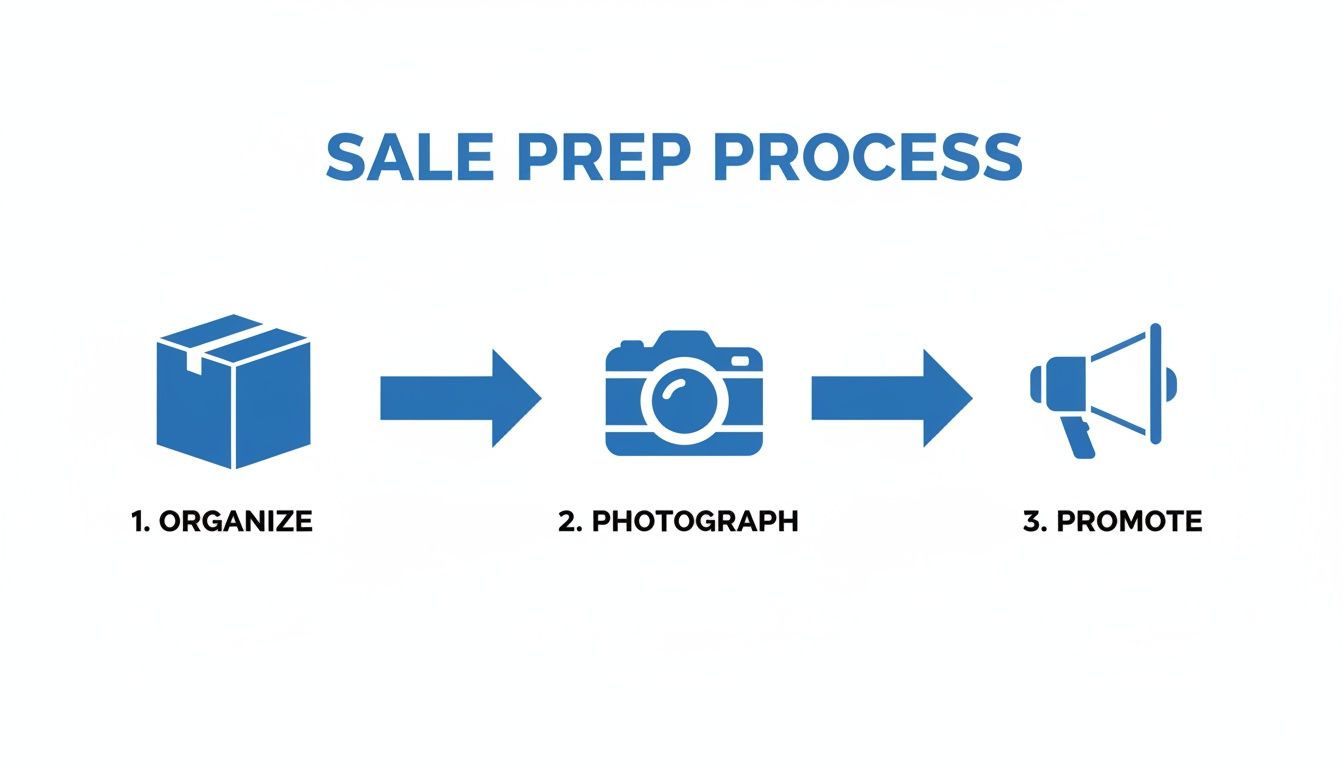
It’s all about organizing your items, taking great photos, and then letting the platform handle the promotion.
Cataloging Items and Uploading Photos
This is where all your hard work starts to pay off. The DIYAuctions platform has an easy-to-use tool for adding each item to your online sale. You're essentially creating a digital price tag and product page for every single thing you’re selling.
For each item, you’ll add:
- A Clear Title: Be specific. Think "Vintage Lane Acclaim Walnut End Table."
- A Detailed Description: Include dimensions, condition, brand names, and any unique history. Don’t be afraid to point out flaws—it builds trust.
- Great Photos: Upload the clear, well-lit pictures you took earlier. You can add multiple images for each item to show it from every angle.
- An Opening Bid: This is where a little psychology comes in handy. A low starting bid, often just $1.00, gets more people in the game and can spark bidding wars that drive the final price higher.
Your catalog is your virtual showroom. The more care you put into your photos and descriptions, the more confident buyers will feel—and the more they'll be willing to bid.
The platform is built for speed. You can add items from your computer or just use your phone to snap photos and upload them directly as you walk through a room. It's a huge time-saver.
Marketing and Monitoring Your Auction
Once your catalog is ready and you hit "go," DIYAuctions takes over the heavy lifting on the marketing front. Your sale is automatically pushed out to a big network of qualified buyers right here in the Dallas-Fort Worth area who are actively looking for sales just like yours. You don't have to hunt for an audience; we bring the buyers to you.
During the 7-10 days your auction is live, you can sit back and watch the action unfold. The seller dashboard gives you a real-time look at how things are going.
You get an at-a-glance view of active bids, which items are popular, and your total earnings, so you always feel in control. You can track which items are getting the most attention, follow bidding wars as they happen, and watch your total proceeds climb. It’s completely transparent—no mysteries, no guessing games. You see everything as it happens.
Coordinating a Smooth Pickup Day
When the auction clock hits zero and the final bids are in, the platform handles all the payment processing. No fumbling with cash, checks, or payment apps. Winning bidders are charged automatically, and you get a clean report of every single sale.
Your last job is to host one, organized pickup day.
Here’s how to make sure it runs without a hitch:
- Set a Clear Timeframe: Pick a day and a specific time window that works for you, like Saturday from 9 AM to 2 PM, for buyers to come get their items.
- Organize Winning Lots: Before anyone shows up, group sold items together by buyer. Print the invoices from your dashboard and attach them to each pile to make things fast and easy.
- Create a Simple Flow: Designate a pickup spot, like the garage or an area near the front door, to keep foot traffic contained and organized.
- Check In and Check Out: When buyers arrive, have them sign their invoice to confirm they’ve received their items. This simple step protects you and creates a clean, documented handoff.
By following this process, you can pull off a professional, profitable, and low-stress estate sale in Dallas, all while keeping up to 90% of the proceeds. We provide the tools and support; you stay in control and reap the rewards.
Common Estate Sale Mistakes (And How to Sidestep Them)
When it comes to running an estate sale in Dallas, learning from others' missteps is the fastest way to get it right. Even the most organized person can fall into a few common traps that cost time, money, and sanity. Knowing what to watch for ahead of time is your best defense for a smooth, successful sale.
One of the easiest mistakes to make happens right at the beginning: accidentally tossing something valuable. It’s so tempting to clear out the clutter, but that dusty box in the corner could be hiding signed costume jewelry or a rare first-edition book.
The Fix: Think like a treasure hunter. Create a simple rule for yourself: "research first, toss second." If something looks unique, has a brand name you recognize, or just feels special, set it aside. A quick Google search can reveal if that vintage board game or old painting has a dedicated collector base. You’d be amazed at what people are looking for.
The Pricing Puzzle: Too High or Too Low?
This is a big one. Pricing items based on what you paid for them 20 years ago or on pure sentimental value is a recipe for a stalled auction. Bidders in Dallas are savvy; if starting prices are too high, they won't even engage.
But the opposite is just as bad. Guessing at an item's worth without a little research can mean you leave a lot of money on the table.
The goal isn't to get the original retail price. It's to find the sweet spot—the fair market value—that gets people excited and bidding against each other. A low starting bid often creates a bidding war that pushes the final price higher than a steep "buy it now" price ever would.
The Pickup Day Pile-Up
You've done everything right, the auction was a huge success... and then pickup day turns into total chaos. A disorganized pickup event is the last impression you leave with buyers, and a frustrating experience can sour the whole sale.
Don't let it happen to you. A little prep goes a long way:
- Group by Winner: Before anyone arrives, sort the sold items into piles based on the buyer's name or invoice number.
- Set Up a "Welcome" Spot: Have a table ready where you can greet buyers, look up their invoice, and direct them to their items.
- Use Invoices as a Checklist: Have buyers sign a copy of their invoice when they pick up their winnings. It's a simple way to confirm everything is accounted for.
This is exactly why a platform like DIYAuctions is so helpful. It gives you the framework to avoid these pitfalls from the very beginning, guiding you toward a sale that’s not just profitable, but stress-free too.
Your Dallas Estate Sale Questions, Answered
Even with the best game plan, you're bound to have questions when you're doing something for the first time. Let's tackle some of the most common ones we hear about running an estate sale in Dallas, so you can move forward with total confidence.
How Long Does It Take to Plan an Estate Sale in Dallas?
This really depends. A smaller estate might come together in just two weeks, while a larger, more complex one could take a month or more. The biggest variables are the sheer volume of items you have and how much time you can personally set aside for sorting, cataloging, and pricing. Using a platform with a clear, step-by-step process can be a game-changer, helping you stay organized and moving forward without getting overwhelmed.
What Kinds of Items Sell Best?
In the Dallas market, we see a few categories that consistently get buyers excited and drive up bids in online auctions. If you have any of these, you're in a great spot.
- Quality Furniture: Mid-century modern pieces are still incredibly popular, but any well-made, solid wood furniture tends to do well.
- Vintage Collectibles: Think unique home decor, old toys that spark nostalgia, and interesting, rare books.
- Tools and Equipment: Good brand-name power tools and machinery that's been taken care of are always a big draw.
- Jewelry: This includes everything from fine jewelry to distinctive, signed costume pieces from years past.
Dallas buyers have a real eye for quality and uniqueness. Items that are photographed well and described honestly almost always find their audience, and that's when the magic of competitive bidding really kicks in to boost your final prices.
What Happens to the Stuff That Doesn't Sell?
It's pretty rare for everything to sell, so having a plan for the leftovers is smart. You've got some great local options. Donating to Dallas charities like The Salvation Army or Genesis Women's Shelter is a fantastic way to support the community. You could also try listing a few remaining items on other marketplaces or, for a completely clean slate, call a junk removal service to handle the final clear-out for you.
More guides in Estate Sale Basics
July 28, 2026
Revenue Reporting for Estate Sales and Auctions
Learn revenue reporting essentials for estate sales and auctions. Discover key metrics, templates, and best practices to simplify tracking and compliance.
Read guideJuly 26, 2026
Stamp Collection Valuation: A Practical Step-by-Step Guide
Stamp collection valuation made simple. Learn how to identify, grade, price, and sell your stamps with confidence for estate sales or consignment.
Read guideJuly 23, 2026
Estate Sales Brick NJ: Your 2026 Guide to Success
Planning your estate sales brick nj? Our guide covers permits, pricing, marketing, & running a safe sale with DIYAuctions.
Read guideGet the estate sale pricing guide
Enter your email for pricing ranges, planning notes, and a clearer path to launch.