A Guide to Estate Sales in Fort Worth
Our guide to estate sales in Fort Worth helps you navigate local laws, pricing, and marketing. Learn how to manage your sale for maximum profit.
When you’re facing a house full of possessions in Fort Worth, you essentially have two ways to go: bring in a traditional estate sale company or take the reins yourself with a modern, DIY online auction platform.
The right decision really comes down to your timeline, your financial goals, and just how much you want to be involved. Let's break down what each path looks like here in the Tarrant County market.
Understanding Your Fort Worth Estate Sale Options
Sorting through an estate can feel like a monumental task, but the first big decision is simple: Do you pay for a full-service company, or do you take a more hands-on approach to maximize your profit? Your choice here will directly impact your bottom line, the sale timeline, and how much control you have.
Before you jump in, it helps to get a clear picture of what the process involves. This guide on What Is an Estate Sale is a great starting point for understanding the fundamentals.
The Traditional Company Route
Hiring a traditional estate sale company in Fort Worth is the "hand it over and walk away" option. They come in and handle pretty much everything—sorting, pricing, staging, marketing, and managing the sale days. For many, this is a lifesaver, especially when time and energy are short.
But that convenience doesn't come cheap. Most Fort Worth estate sale companies charge commissions anywhere from 35% to 50% of the total sales. On a typical $18,000 sale, you could be paying between $6,300 and $9,000 in fees. You’re also giving up control over how your items are priced and what happens to anything that doesn't sell.
The core trade-off with a traditional service is convenience for control and profit. While they manage the heavy lifting, you're left with a much smaller share of the estate's value.
The Modern DIY Auction Path
The alternative is a DIY online auction platform, which puts you in the driver's seat and lets you keep far more of the money. With a platform like DIYAuctions, for example, you can keep up to 90% of the proceeds. It’s a huge difference.
This approach gives you total say over pricing, scheduling, and how your items are presented, all through a simple, guided online process. You have to put in the work to photograph and describe your items, but the platform takes care of the trickiest parts, like marketing, payment processing, and buyer communication.
This path is perfect for anyone comfortable using a smartphone who wants to get the best possible financial return. You can learn more about the different estate liquidation options to see exactly how they compare.
To make the choice clearer, here’s a side-by-side look at the two primary approaches for managing an estate sale here in the Fort Worth area.
Comparing Fort Worth Estate Sale Methods
| Feature | Traditional Estate Sale Company | DIY Online Auction Platform |
|---|---|---|
| Your Profit Share | 50% - 65% of gross sales | Up to 90% of gross sales |
| Typical Fees | 35% - 50% commission | 10% commission (capped at $1,000) |
| Control Over Pricing | Limited; company sets prices | Full control over starting bids & reserves |
| Your Time & Effort | Low; company handles most tasks | Medium; you photograph & describe items |
| Timeline | Can take weeks to schedule & run | Flexible; you set the auction dates |
| Sale Format | In-person event over 2-3 days | Online auction with a single pickup day |
| Buyer Reach | Local foot traffic | Entire DFW metroplex & beyond |
Ultimately, the best method depends on what you value most—hands-off convenience or maximizing your financial return.
How Fort Worth's Market Plays a Role
The local real estate market definitely adds another wrinkle. Fort Worth has a huge range of neighborhoods and home values, from areas like Woodhaven with median prices around $229,500 to historic Fairmount, where homes can top $522,500.
This diversity means the potential value and type of items in an estate can vary dramatically, which might make one sales method a much better fit than the other for your specific situation.
Getting Your Fort Worth Estate Sale Off to a Compliant Start

Before you even think about putting price tags on anything, it’s crucial to get the legal and logistical groundwork squared away. This isn't the exciting part, but trust me, getting this right from the start is what makes for a smooth and protected sale.
Skipping these foundational steps when planning estate sales in Fort Worth can lead to some serious headaches—think legal challenges or financial hiccups that were entirely avoidable.
First things first, you have to answer one simple question: do you actually have the legal authority to sell the property? If you’re a homeowner just downsizing, this is a no-brainer. But if you’re the executor of an estate, this becomes your single most important hurdle.
You’ll need the official paperwork, usually Letters Testamentary issued by a Tarrant County probate court, that proves you have the authority to act. Trying to move forward without this document opens you up to a world of personal liability. Don’t do it.
Secure the Home and Everything In It
Once you’ve confirmed you're legally good to go, your next move is to secure the physical property. It’s a practical step that so many people, in their rush to get started, completely overlook. You’re now responsible for every asset in that home, and you need to protect them.
Start by changing the locks. It’s a simple action, but you never really know who might have a key—a former caregiver, a helpful neighbor, maybe a distant relative. This one move gives you complete control and protects the contents from anyone just wandering in.
Next up, find and secure all the important personal documents. You’re looking for things like:
- Wills and trust documents
- Bank statements, tax returns, and other financial records
- Passports and driver’s licenses
- Titles and deeds for the house and any vehicles
These items aren't for sale, and they contain sensitive information that needs to be protected. Gather them up and store them somewhere safe and off-site, like in a safe deposit box or with your attorney.
Securing the property isn't just about locking a door. It's about establishing clear responsibility and protecting the estate's value from day one.
Separating Keepsakes from Inventory
With the home secured, it’s time for the emotional but necessary job of sorting. This is where you draw a clear line between family heirlooms and the items destined for your sale. It's best to make these decisions before you start cataloging to keep the pricing and listing process clean and objective.
I always recommend a simple three-category system: things the family will keep, things to sell, and things to donate or discard. A pack of colored sticky notes can be your best friend here—assign a color to each category to make it visually clear what goes where. This is how you prevent a cherished family photo album from accidentally ending up in the auction.
This is also the time to pull out any specific items mentioned in the will. If a particular piece of art or jewelry is bequeathed to an heir, it needs to be removed from the sale inventory immediately. Honoring the deceased's wishes is paramount and keeps you clear of legal trouble.
The legal side of this can get tricky. For a better understanding of the rules of the road, you can explore some of the common estate sale laws and regulations.
And while you’re at it, don’t forget local city rules. If you're planning to put up signs to direct buyers, you’ll want to check Fort Worth's sign permit requirements to sidestep any potential fines. Getting these details right builds a solid, compliant framework for your entire sale.
How to Price and Catalog Items for Local Buyers
This is where the rubber meets the road. Pricing isn't just about slapping a sticker on something; it's a delicate dance between research and intuition that can make or break your sale. Get it right, and you'll have a flood of happy Fort Worth buyers. Get it wrong, and you're left with a house full of stuff and money left on the table.
This is all about strategy, not guesswork. Before you even think about a price tag, you need to get a real sense of what your items are worth in today's local market.
Finding Fair Market Value in Fort Worth
Your first mission is to become a temporary expert on everything in the house. No, you don't need to be a certified appraiser, but you do need to know where to find reliable price comparisons.
Luckily, you have a ton of information at your fingertips. The trick is to look at what things have actually sold for, not just what people are asking.
- eBay's Sold Listings: This is your secret weapon. Search for an item, then use the filter to show only "Sold Items." This reveals what people were truly willing to pay, which is a far more accurate measure of value than an active listing.
- Replacements, Ltd.: The absolute authority for valuing china, silver, and crystal. Their massive database is an incredible resource for identifying patterns and establishing a solid retail benchmark.
- LiveAuctioneers & Heritage Auctions: For higher-end antiques, art, and collectibles, check the pros. Seeing the final "hammer price" from past auctions provides real-world data on what unique pieces command.
Don't forget local flavor. If you've got vintage Texas Ware or pieces from regional artists, what they fetch in Fort Worth might be different than elsewhere. Pop into a few antique shops in the Cultural District or check the past catalogs of local auction houses like Rusty By Design to see what they're getting for similar inventory.
Your Catalog Is Your Sales Team
A detailed inventory, or catalog, is the engine of your sale, especially for an online auction. Think of it as more than just a list—it's your primary marketing tool. A great catalog entry describes an item accurately, shows it off with great photos, and maybe even tells a little story that helps a buyer connect with it.
When you're writing, put yourself in the buyer's shoes. What would you want to know before placing a bid?
Your catalog is your virtual showroom. Each description is a salesperson, and every photo is a product demonstration. The time you invest here pays off directly in your final sales numbers.
It's also worth noting how the broader Fort Worth economy can play a role. For example, the average home value in the city is around $293,827, and it's seen a slight dip over the last year. That kind of softening in the real estate market can make local buyers a bit more careful with their spending, which just underlines the need for sharp, competitive pricing. You can dig into more details about Fort Worth property values on Zillow.com.
The Art of Photos and Descriptions
Good news: you don't need a fancy camera. Your smartphone is more than powerful enough if you just follow a few simple guidelines.
- Let the Light In: Always shoot in a well-lit space. Natural light from a window is best. It avoids the harsh glare of indoor lights and weird shadows.
- Show Every Angle: Take more photos than you think you need. For a dresser, that means the front, back, sides, top, and inside the drawers. For glassware, get a shot of the maker's mark on the bottom.
- Highlight the Good and the Bad: Zoom in on cool details, like the dovetail joints on a desk or the hand-stitching on a quilt. Be just as upfront about any flaws—a scratch, a chip, a small stain. Honesty builds trust and prevents problems later.
Your descriptions should work hand-in-hand with your photos. Go beyond the obvious.
- Be Specific: Don't just say "wood chair." Say "Mid-century modern walnut armchair with original tweed upholstery."
- Measure Everything: Always include the height, width, and depth for furniture and other large items. No one wants to guess if that bookcase will fit.
- Tell a Quick Story: If you know the history, share it! "This cedar chest was a wedding gift to my grandmother in 1948" is way more interesting than "Old wooden chest."
For a deeper dive into valuation techniques, check out our complete guide on pricing strategies for estate sales.
Smartly Grouping Items into Lots
Let's be real, not every item is a star. You'll have tons of everyday things like kitchen utensils, cleaning supplies, and mismatched tools. The key to selling these is to "lot" them together into attractive bundles.
Grouping similar items creates a package with a much higher perceived value. This is a game-changer for online auctions. A single fork isn't going to get any bids, but a "Lot of 25+ Pieces of Assorted Kitchen Utensils" will definitely get attention.
Examples of Effective Lotting
| Category | Bad Lot | Good Lot |
|---|---|---|
| Kitchen | A single spatula | Lot of assorted cooking utensils |
| Linens | One pillowcase | Set of vintage embroidered linens |
| Tools | A loose screwdriver | Toolbox with assorted hand tools |
By combining solid research, great photos, and smart grouping, you turn a house full of belongings into a must-see catalog. This methodical approach is the best way to get top dollar for every single item in your Fort Worth estate sale.
Getting the Word Out: Your Fort Worth Marketing Playbook
You’ve put in the hard work of sorting, cataloging, and pricing. Now comes the fun part: getting eager Fort Worth shoppers excited about your sale. A perfectly prepped auction won't mean a thing if nobody knows it's happening.
This is all about creating a buzz. You don't need a huge marketing budget, just a smart, targeted strategy that combines the best of online outreach with some tried-and-true local methods. Your mission is to make sure every potential buyer—from Saginaw down to Mansfield—has your sale circled on their calendar.
Tapping into Fort Worth’s Digital Marketplace
In this day and age, an online presence isn't just an option; it's essential. The great news is you can reach thousands of local buyers right from your laptop. There are dedicated platforms and social media hubs where North Texas bargain hunters and collectors are actively looking for their next big find.
Start with the heavy hitters. Websites like EstateSales.net are the first stop for serious buyers and dealers. Listing your sale here puts you directly in front of the most dedicated audience looking for estate sales in Fort Worth. A listing packed with great photos is your ticket to standing out from the crowd.
Beyond the specialty sites, cast a wider net with these powerhouse platforms:
- Facebook Marketplace: This is a monster for reaching a massive local audience. Create a detailed post filled with photos and use tags like "Fort Worth estate sale," "vintage furniture," and "antique collectibles" to get seen.
- Local Facebook Groups: Don't sleep on these. Search for buy/sell groups in Fort Worth, Arlington, Weatherford, and other Tarrant County towns. These hyper-local communities are goldmines of engaged shoppers.
- Craigslist: It might feel a bit old-school, but Craigslist still delivers, especially for big-ticket items like furniture and appliances. Make sure to post in both the "for sale" and "garage sale" sections for double the visibility.
Pro-Tip: Your headline is everything. Create a sense of urgency with phrases like "Everything Must Go!" or "Final Fort Worth Sale - One Day Only!" This gets people off the couch and ready to buy.
It also helps to understand the local temperature. The Fort Worth housing market is active, with homes getting an average of two offers and selling for about 2% below list price. This tells us that while buyers are out there, you still need to market effectively to grab their attention. You can see more about the Fort Worth housing market trends on Redfin.com.
Writing Ads That Actually Work
Think of your ad copy and photos as your sales pitch. Your goal is to make people feel like they’ll miss out on something amazing if they don't show up. You want to showcase your best items and create an irresistible pull.
Start with a headline that packs a punch, like "Huge Fort Worth Estate Sale! Mid-Century Modern Furniture & Rare Collectibles!" Then, use a bulleted list to highlight your most desirable categories.
What to Do:
- Name-drop specific, sought-after brands (Pyrex, Waterford, Craftsman tools).
- Put your most unique or rare items front and center.
- Clearly state the sale dates, times, and address.
- Mention the payment types you'll accept (cash, Venmo, credit cards).
What to Avoid:
- Vague descriptions like "lots of household goods." Be specific!
- Skimping on photos. A good listing needs at least 15-20 quality pictures.
- Being fuzzy about the location or hours. Clarity is key.
Don't Forget Old-School Methods
While a strong digital game is crucial, some traditional methods still work wonders, especially for reaching neighbors and serious collectors who aren't glued to their phones.
One of the most effective tactics? Directly notifying local antique dealers and resellers. A quick email or call to shops in the Fort Worth Design District or along Camp Bowie can bring in professional buyers looking to purchase inventory. Send them a few photos of your star items to really get their attention.
And finally, never underestimate the power of good, old-fashioned signs. Bright, bold, and easy-to-read signs placed at key intersections near the home can drive a ton of foot traffic. Just make sure you're following Fort Worth's city ordinances on temporary signage. This one-two punch of online buzz and on-the-ground visibility is your formula for a can't-miss event.
Running a Profitable DIY Online Auction
When you handle your own online auction, you’re in the driver's seat. That means you keep a much bigger piece of the pie. Using a platform like DIYAuctions, you can pocket up to 90% of the profits. Compare that to the 35% to 50% commissions that traditional Fort Worth estate sale companies charge, and the difference is huge.
Let's walk through how to make your sale a success, turning your online listings into a competitive event that brings in the best prices without all the stress.
Setting Up Your Auction for Success
A successful auction starts with a solid foundation. This isn't just about snapping pictures; it's about crafting item titles and descriptions that grab the attention of Fort Worth buyers.
You have to think like a shopper. Instead of just "Old Wooden Desk," get specific: "Vintage Mid-Century Modern Walnut Executive Desk." That simple tweak instantly connects with collectors and designers actively searching for those keywords, making your item far more visible and desirable.
Another critical piece of the puzzle is setting the right starting bid. It’s tempting to start high, but it’s often a mistake. A low starting bid—even just $1.00—is a powerful psychological trick. It lowers the barrier for that first bid, gets the ball rolling, and sparks the kind of competition that drives the final price way up.
Setting a low starting bid isn't about undervaluing your item; it's about igniting bidder engagement. An item with multiple bids is far more likely to achieve its true market value than one with a high starting price and zero interest.
Managing Your Live Auction Like a Pro
Once your auction goes live, your job shifts to manager and communicator. Bidders will have questions, and how quickly you respond builds the trust they need to place a bid. Be ready to answer questions about an item's condition, its dimensions, or its history.
A quick, honest answer can be what convinces a hesitant buyer to jump in. If someone asks about a scratch you missed, be transparent and update the description for everyone to see. That integrity is what makes your sale feel professional, not like a typical garage sale.
DIYAuctions is built to make this part easy, keeping all your bidder conversations organized in one spot. Staying on top of these messages keeps the auction running smoothly and heads off any potential confusion down the road.
This is all about creating a multi-channel buzz to get the word out around Fort Worth.
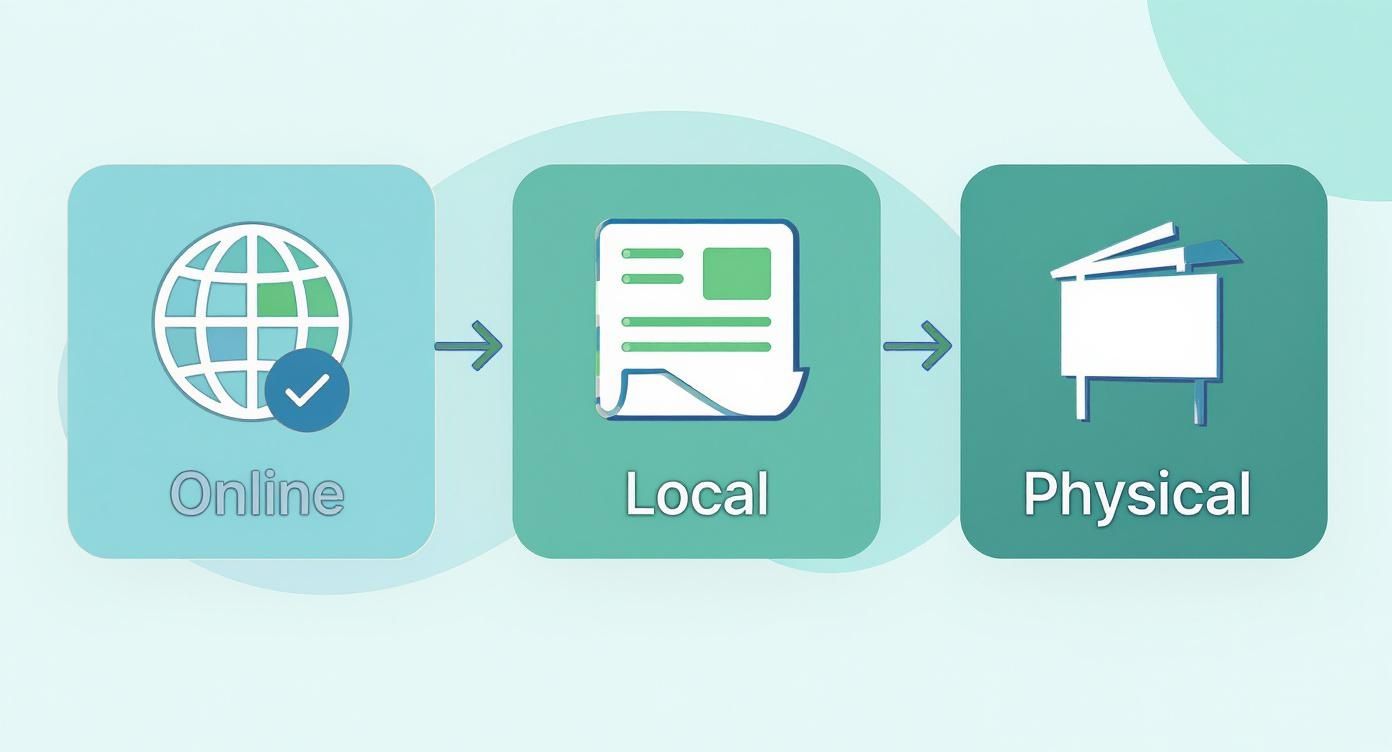
This process shows how combining online, local, and even physical marketing efforts creates a net that pulls in the widest possible range of buyers for your items.
Organizing a Seamless Single-Day Pickup
The final—and arguably most important—phase is the pickup day. A disorganized pickup can leave a bad taste after an otherwise great sale. The key here is all about organization and clear communication with your winning bidders.
Your goal is one efficient, scheduled event where buyers can get their items without any hassle or long waits.
Your Pickup Day Success Checklist:
- Schedule Appointments: Don't just leave the doors open for a free-for-all. Use a simple tool like Calendly or a shared spreadsheet to have every single buyer book a specific time slot. This is the secret to avoiding a crowd.
- Send Detailed Instructions: The day before pickup, shoot an email to every winner with the full address, where to park, and a reminder of their time. It's also smart to include your cell number for any last-minute issues.
- Prep the Items: Before anyone shows up, have everything organized and clearly marked with the buyer's name and invoice number. If you can, stage smaller items in the garage or a room near the door to make things even faster.
- Manage the Flow: For big items like furniture, think through the path someone will need to take to get it out of the house. Clear any obstacles and remind buyers in your instructions to bring their own muscle for heavy lifting.
- Secure Payments in Advance: One of the biggest advantages of an online platform is that payments are handled beforehand. You don't have to mess with cash or card readers on pickup day, which makes everything faster and more secure for everyone.
Following these steps ensures you end on a high note, leaving buyers with a professional and positive impression of your well-run estate sale in Fort Worth.
Your Top Questions About Fort Worth Estate Sales, Answered
When you’re staring down the process of liquidating an estate, a lot of questions pop up. It’s completely normal. We hear the same concerns from families across Fort Worth, so we’ve gathered the most common ones here to give you clear, no-nonsense answers.
Think of this as your practical FAQ for handling the details, from the leftover items to the final payout.
What Happens to Items That Don’t Sell?
This is easily the biggest worry for most sellers. The reality is, you'll almost always have some things left over, whether you run a traditional sale or an online auction. The trick is to have a game plan before your sale wraps up so you aren't left scrambling.
You’ve got three great options right here in the Fort Worth area:
- Donate the Rest: Charities like Goodwill Fort Worth or The Salvation Army are fantastic resources. They will gladly take most unsold goods, and many even offer pickup for larger loads. It’s a fast way to clear the house while getting a handy tax-deductible receipt.
- Consign the Best: Did some higher-value art or designer furniture not hit its reserve? Don’t give up on it. Local consignment shops can be a perfect second chance, selling the item for you in exchange for a cut of the final price.
- Hire a Clean-Out Service: When the primary goal is just getting the house empty—and fast—a professional junk removal or clean-out service is the way to go. They take everything, sorting what can be salvaged from what can't, and leave the property broom-clean.
Honestly, the most effective strategy is usually a combination of all three. You get every last bit of value out of the best items while still clearing the property on your schedule.
How Much Money Can I Realistically Expect to Make?
Ah, the million-dollar question. The truth is, it varies wildly. While industry averages show a typical estate sale can bring in around $18,000 in gross revenue, that number is completely dependent on what's inside the house. A home full of unique antiques, tools, and collectibles will always perform better than one with standard, everyday furniture.
What you actually pocket—your net earnings—comes down to the sales method you pick.
A traditional Fort Worth estate sale company is going to take a commission somewhere between 35% and 50%. On that same $18,000 sale, you’re handing over $6,300 to $9,000 in fees. That leaves you with a net profit of around $9,000 to $11,700.
This is where a DIY online auction completely changes the math. Because the commission is so much lower, you keep a massive chunk of the proceeds. Having direct control over those fees is the single most powerful tool you have for maximizing what ends up in your bank account.
Do I Need to Be There During the Sale?
This one causes a lot of confusion, and the answer is different depending on your approach.
If you go the traditional route and hire a full-service company, the answer is a hard no. In fact, they insist on it. Most companies prefer the family to be away during the in-person sale days. It lets buyers browse more comfortably and prevents any emotional attachments from getting in the way of a good deal.
But when you run a DIY online auction with a platform like DIYAuctions, you’re the one in the driver's seat. You won't be "present" while the bidding happens online, but you will be the one to organize and oversee the single-day pickup event. It’s a short, focused block of time that gives you complete control over that final, crucial step of handing items off to their new owners.
More guides in Estate Sale Basics
July 28, 2026
Revenue Reporting for Estate Sales and Auctions
Learn revenue reporting essentials for estate sales and auctions. Discover key metrics, templates, and best practices to simplify tracking and compliance.
Read guideJuly 26, 2026
Stamp Collection Valuation: A Practical Step-by-Step Guide
Stamp collection valuation made simple. Learn how to identify, grade, price, and sell your stamps with confidence for estate sales or consignment.
Read guideJuly 23, 2026
Estate Sales Brick NJ: Your 2026 Guide to Success
Planning your estate sales brick nj? Our guide covers permits, pricing, marketing, & running a safe sale with DIYAuctions.
Read guideGet the estate sale pricing guide
Enter your email for pricing ranges, planning notes, and a clearer path to launch.