Running Estate Sales in Ohio A Practical Guide
Discover how to run successful estate sales in Ohio. Our guide covers legal steps, pricing, marketing, and managing the sale for a stress-free process.
When you're facing an estate sale in Ohio, the first big decision you’ll make is also the most important: do you hire a full-service company and hand over a hefty commission, or do you roll up your sleeves and manage it yourself to keep more of the profits?
With the average sale pulling in between $18,000 and $20,000, this choice has a huge impact on your bottom line.
Making Your First Choice in Ohio Estate Liquidation
Getting started with an estate liquidation in Ohio puts you at a fork in the road. Will you give the keys to a professional company, or will you take a more hands-on approach? This one decision will color every step that follows, from pricing grandma’s antique china to the final check you receive.
Let's break down the two main paths.
The Professional Company Route
Hiring a professional estate sale company in Ohio can seem like the simplest option. They come in and handle just about everything—staging, pricing, marketing, and running the show on sale days. They have the experience and a built-in network of buyers, which is a huge plus.
But that convenience comes with a hefty price tag. Commissions typically run anywhere from 35% to 50% of the total gross sales. On a $20,000 sale, that's up to $10,000 right off the top.
The DIY Advantage
On the flip side, managing the sale yourself gives you complete control. When you use a platform like DIYAuctions to support your efforts, you keep a much bigger piece of the pie. You set the prices, you pick the dates, and you decide how everything is presented.
Sure, it takes more of your time and sweat equity, but the financial payoff can be massive.
To help you decide, think honestly about these points:
- Your Time: Do you realistically have the hours to sort through, catalog, photograph, and price every item in a home? It's a bigger job than most people think.
- The Emotional Toll: Can you stay objective when pricing sentimental items? This is one of the toughest parts, especially when it’s a loved one’s estate.
- What's in the House: A home full of everyday furniture and goods is one thing. But if you’re dealing with fine art, rare collectibles, or valuable antiques, you might need an expert eye.
- The Bottom Line: Is your main goal to squeeze every last dollar out of the sale, or is paying for the convenience of a hands-off process more appealing right now?
To get a better handle on the basics, our guide explains in detail what estate liquidation is.
This infographic gives you a quick visual on the two main paths you can take.
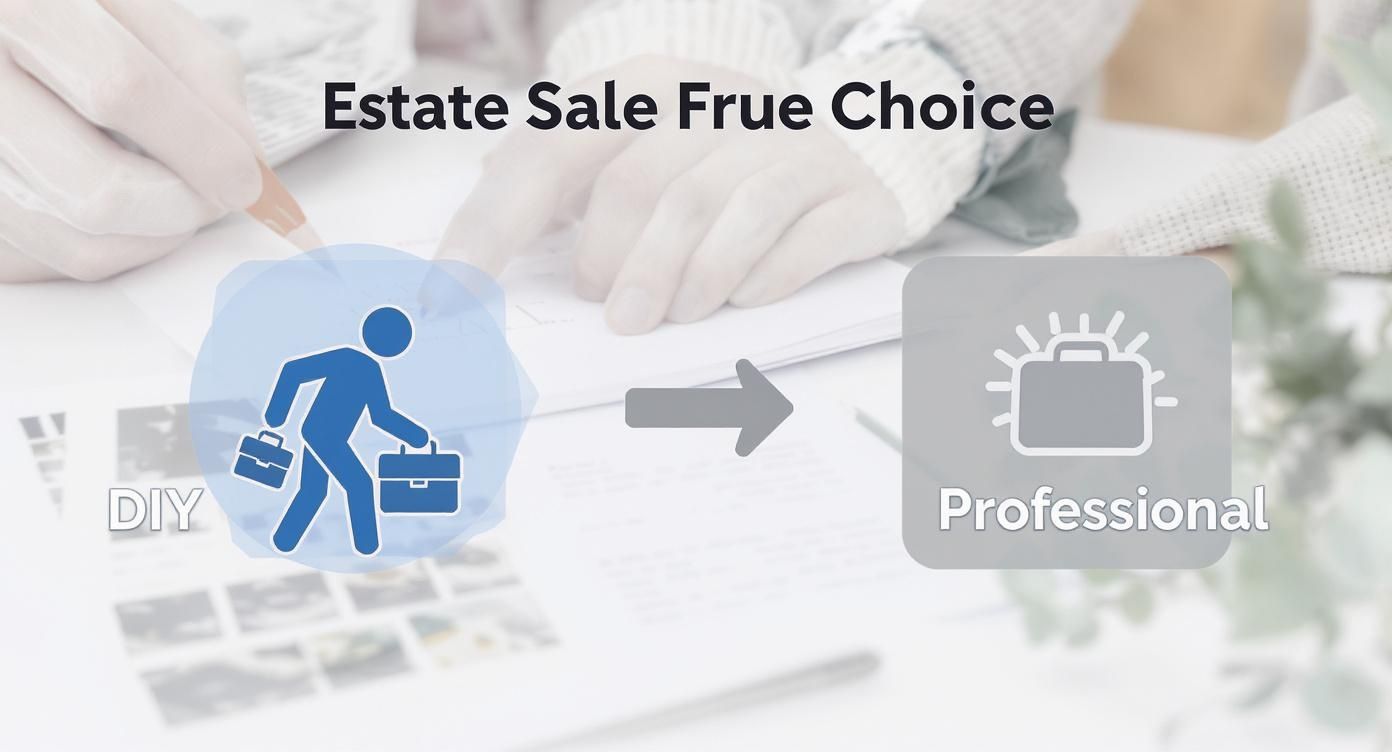
It really comes down to the trade-off: hands-on control and higher profit with a DIY sale, versus delegated responsibility and lower profit with a hired company.
Thinking through the differences is a crucial first step. This table lays it all out, helping you compare the two approaches side-by-side.
Comparing DIY vs Professional Estate Sales in Ohio
| Factor | DIY Estate Sale | Hiring a Professional Company |
|---|---|---|
| Cost | Minimal upfront costs; platform fees (e.g., DIYAuctions' 10% commission) | High commissions, typically 35% - 50% of total sales |
| Profit | You keep 90% of the revenue | You keep 50% - 65% of the revenue |
| Control | Full control over pricing, schedule, and item presentation | Little to no control; company makes all decisions |
| Time Commitment | Significant time required for sorting, cataloging, and managing the sale | Minimal time commitment from you; they handle all logistics |
| Expertise | Relies on your own research and platform guidance | Access to their experience, pricing knowledge, and buyer network |
| Ideal For | Executors/homeowners willing to invest time for maximum financial return | Those who value convenience over profit or are managing the sale from a distance |
Ultimately, there's no single "right" answer—just the one that's right for your specific situation, your budget, and your timeline.
Don't Forget About the Aftermath
No matter which route you take, the job isn’t over when the last buyer walks out the door. You’ll almost always have unsold items to deal with.
An essential, yet often overlooked, part of any estate sale plan is the final clean-out. Having a strategy for what to do with remaining furniture, personal effects, and accumulated debris is just as important as the sale itself.
After the sale wraps up, you might need help clearing out whatever is left. You can look into local house clearance and rubbish removal services to handle that final, crucial step. It’s the best way to get the property completely empty and ready for whatever comes next.
Navigating Ohio's Legal and Financial Rules
Before you start snapping photos of vintage furniture or fine china, let's talk about the legal side of running an estate sale in Ohio. Getting a handle on the rules upfront will save you from massive headaches later. It’s the key to making sure your sale is not only a success but also completely above board.
The first thing to consider is the probate process. If the estate is currently in probate, the court has the final say on how assets are handled. As the executor, you'll likely need official permission from the probate court before you can sell any personal property.
Don't jump the gun on this. Selling items without the proper clearance can create serious legal trouble. Always check in with the estate's attorney to get that official green light. Seriously, timing is everything here.
Understanding Ohio Sales Tax Requirements
So, do you need to collect sales tax? It's one of the first questions people ask, and the short answer is yes, almost always. The state of Ohio considers an estate sale a retail event, putting it in the same category as any other store.
To collect tax legally, you’ll need a vendor's license from the Ohio Department of Taxation. The process is pretty straightforward and can usually be done online. Trust me, you don't want to get caught having skipped this step—the penalties and back taxes just aren't worth it.
Here’s a quick rundown of what’s involved:
- Get Your License: You'll apply for a transient vendor's license. It's designed specifically for temporary sales events like yours.
- Know Your Rate: Sales tax rates change from county to county in Ohio. You have to charge the correct rate for the county where the sale is physically located.
- Track Everything: Keep meticulous records of every single sale. Good news—platforms like ours often automate this for you, which makes bookkeeping much easier.
- Remit on Time: Once the sale is over, you're responsible for sending all the sales tax you collected to the state by the deadline.
The responsibility for sales tax lands squarely on you, the seller. Pleading ignorance won't get you out of trouble, so getting this sorted out from the start protects both you and the estate.
For a deeper look into the rules and regulations, we've put together a guide on general estate sale laws that can help clarify things, especially if you're dealing with a more complex estate.
Protecting Yourself with Clear Terms and Conditions
Beyond the official stuff like taxes and probate, you need to set clear rules for your buyers. Think of it as your risk management plan. A solid set of terms and conditions is your best defense against misunderstandings and arguments during and after the sale.
This is basically the contract between you and every customer. When you use an online platform like DIYAuctions, these terms are often part of the listing process, but it’s crucial you understand what they cover and why they’re so important.
Your terms need to spell out your policies on a few key things.
Key Policies to Define for Buyers
- Payment Methods: Be specific about what you’ll accept. Is it cash, credit, digital payments? If you're passing on a credit card processing fee, state that clearly.
- Item Condition: This is a big one. Always include an "as-is, where-is" clause. It makes it clear that all sales are final and buyers are responsible for checking items out before they bid, because they're accepting them in their current state.
- Pickup and Removal: Set a firm, non-negotiable deadline for when winning bidders must pick up their items. You also need to state that buyers must bring their own muscle and moving supplies for heavy things like appliances and furniture.
- Liability: Include a sentence that says you are not responsible for any accidents or injuries that might happen on the property during the pickup event.
These rules aren't meant to be difficult—they create a transparent and fair playing field for everyone. When you communicate your expectations clearly from the start, you slash the potential for confusion, protect the estate, and make the entire experience smoother for you and your buyers.
How to Inventory and Price Items for Success
Any seasoned estate sale pro will tell you that a successful event comes down to two things: knowing exactly what you have and pricing it to sell. This is the foundational work. It’s where you turn a house full of memories and belongings into a structured, sellable collection that will maximize your profit.
It takes a bit of organization and research, sure, but a methodical approach here makes all the difference.
The first thing you need to do is just create a master list. Don't even think about pricing items as you go—that’s a classic mistake that slows you down and leads to wonky, inconsistent values. Just focus on one room at a time, documenting every single thing you plan to sell.
Using something like an essential moving inventory list template is a great way to get started. It forces you into an organized system so you don't overlook valuable pieces tucked away in a closet or drawer.
Systematically Cataloging the Estate
To keep from feeling buried, you have to break the job down into smaller chunks. Grab a notepad, open a spreadsheet, or use an app and just go room by room. For every item, jot down a quick description, its condition, and any special features—think brand names, an artist's signature, or a model number.
And take pictures as you go. Clear photos are absolutely non-negotiable for an online auction. They not only become the backbone of your sale listings but also serve as your visual record of everything.
If you want to go deeper on creating a really efficient system, we've put together a guide on inventory management best practices that's packed with tips to make this whole process smoother.
Once you have that complete list, it's time to put on your researcher hat. Pricing is part art, part science. You're looking for that sweet spot between what an item feels like it's worth and what a buyer in the Ohio market is actually willing to pay for it right now. This is where you have to be objective.
Researching Fair Market Value in Ohio
I hate to be the one to break it to you, but sentimental value doesn't translate to market value. To price things right for estate sales in Ohio, you need to look at real-world data.
Here are a few practical ways to figure out what things are worth:
- Check Online Marketplaces: Hop onto eBay and use the "sold" listings filter to see what similar items have actually sold for. Facebook Marketplace and other local Ohio auction sites are also great resources for real-time pricing information.
- Use Appraisal Tools: For things that might be more valuable—antiques, art, or special collectibles—online appraisal tools or collector's guides can give you a solid ballpark figure.
- Bundle the Small Stuff: Not every single item needs its own price tag. Everyday kitchen gadgets, common paperbacks, or mismatched linens can be grouped together into "lots" or sold as a "box lot" for a single price. This is a great way to move lower-value items quickly.
It's also worth noting how broader economic trends can play a role. Ohio's residential real estate market, for instance, has seen steady growth. The Ohio House Price Index shows a 3.6% increase in average home values, which have climbed to around $240,288. This kind of market appreciation can subtly lift the perceived value of the home's contents as well.
Setting Your Pricing and Discount Strategy
With your research done, you can start putting prices on your list with confidence. This is also when you should think about your overall sales strategy. Are you going to set firm prices, or will you let bidders determine the final value in an auction? An online auction platform like DIYAuctions takes care of the bidding for you, which often drives prices higher on the most sought-after items.
Pro Tip: Plan your discounts from the get-go. A common strategy for multi-day events is offering 25% off on day two and 50% off on the final day. This creates urgency and helps you clear the property out by the end of the sale.
Finally, take the time to write compelling descriptions for your most important items. A great description is more than just "brown dresser." Mention the condition, measurements, brand, and any cool history it might have.
For example, instead of just "Mid-Century Modern Dresser," try something like this:
- Example: "Vintage 1960s Kent Coffey Perspecta walnut nine-drawer dresser. Excellent original condition with signature rosewood arches and brass pulls. A real statement piece for any collector."
That level of detail is what attracts serious buyers from Cleveland to Cincinnati and makes them feel confident about what they're bidding on. Your hard work in inventorying and pricing is what ultimately turns a house full of stuff into a profitable, successful event.
Marketing Your Estate Sale to Ohio Buyers
You've meticulously sorted, cataloged, and priced everything. Now comes the part that makes all that hard work pay off: getting the word out. A truly successful estate sale in Ohio depends on drawing a crowd of enthusiastic buyers, and let’s be honest, a sign on the front lawn just won't cut it anymore.
The goal is to create a buzz that reaches collectors in Cleveland, antique hunters in Cincinnati, and everyday folks right in your own neighborhood. You need a modern marketing game plan that builds a bridge between the items you have and the people who are actively looking for them. This means using a mix of powerful online platforms and good old-fashioned community networking.
Crafting Compelling Online Listings
Your online listing is your storefront window. It’s the very first impression most buyers will get, and it needs to do more than just list what's for sale—it needs to tell a story and build excitement. While a platform like DIYAuctions syndicates your sale to local buyers automatically, the quality of your listing is what will make people stop scrolling.
Without a doubt, high-quality photos are the most critical piece of your online presence. Blurry, dark pictures just scream "amateur" and will absolutely kill interest and drive down your final sale prices.
- Let the Sun In: Always take your photos during the day near a window. Natural light is your best friend. Ditch the harsh camera flash; it creates glare and washes out the true colors of your items.
- Spotlight Your Stars: For your most valuable or interesting pieces, take several detailed shots. If you have a vintage dresser, capture the brand mark, the dovetail joints on the drawers, and any unique hardware. Show buyers why it's special.
- Stage Your Smalls: For general household goods, don't just snap a picture of a cluttered room. Arrange them neatly on a table or shelf. It’s a small step that makes a huge difference in how appealing the items look.
The words you use are just as important as the pictures. Write a headline that grabs attention and includes key details like the city and the types of items people can expect (e.g., "Huge Columbus Estate Sale Featuring Mid-Century Furniture & Collectibles").
Key Takeaway: Your online marketing directly impacts how many people show up and how much they bid. Every photo you take and every word you write should be aimed at making someone feel like they absolutely can't miss this sale.
It's also worth noting that the broader real estate market can signal how many buyers are out there. For instance, Ohio's housing market recently saw a 9.5% jump in home sales in a single month, with the median sale price climbing to about $260,600. This surge means more people are buying homes and are on the hunt for items to furnish them. You can dive deeper into Ohio's active housing market on Redfin.com.
Leveraging Social Media and Niche Communities
Beyond dedicated estate sale websites, social media is an incredible—and free—tool for reaching a massive local audience. Facebook Marketplace is a great place to start, but don't stop there. The real magic happens in local community groups and specialized collector forums, which are goldmines for finding truly passionate buyers.
Search for Ohio-based Facebook groups that focus on:
- Antiques and Collectibles: Look for groups with names like "Ohio Antique Collectors" or "Midwest Vintage Finds."
- Specific Hobbies: If the estate has a large stash of vinyl records, model trains, or crafting supplies, find the online groups where those enthusiasts gather.
- Local Buy/Sell/Trade Groups: Post in the groups for your specific city, town, or county. This is the best way to attract nearby shoppers who love the convenience of picking something up down the street.
When you post, tailor your message. For a general community group, you'll want to highlight practical things like furniture, kitchenware, and tools. But for a niche collector's group, that's where you show off the rare and unique pieces they'll appreciate, complete with detailed info and crystal-clear photos. This targeted approach gets your message in front of the right people and drives highly motivated buyers to your sale.
Running a Smooth and Secure Sale Event
After all that prep work, this is where the magic happens. The sale event itself—whether it's the pickup day for your online auction or a classic tag sale—is a high-energy environment. Your success hinges on a solid plan for logistics, security, and just generally dealing with people. It’s all about creating a professional, easygoing experience for everyone who comes through the door.
Think of yourself as a retail manager for the day. You need to stage the home to guide traffic and show off the items in their best light. Create a clear, one-way path through the house to keep people from bumping into each other, especially in tight hallways or small rooms. Don't be afraid to use ropes or even turn a couch sideways to block off areas that are off-limits.
It also helps to group similar items together. Put all the kitchen stuff in the kitchen, tools out in the garage, you get the idea. This just makes it so much simpler for buyers to find what they're looking for. A quick tip: place smaller, high-value items like jewelry or collectibles right near your checkout station where you can keep a close eye on them.
Managing Crowds and Enhancing Security
If you've done your marketing right, you're going to have a crowd. The trick is managing it. Letting a flood of people in all at once is a recipe for chaos and increases the risk of theft or accidental breakage. A good rule of thumb is to set a limit on how many people are inside at one time. Once you hit that number, just use a "one-in, one-out" policy at the door.
And let's be blunt: security is not optional. You absolutely need at least one other person helping you. It's impossible to watch every corner of a house by yourself. Station yourselves in different parts of the home so there's always a helpful, visible presence.
Here are a few practical security moves we always recommend:
- Secure Valuables: Keep tiny, expensive items (think rings, watches) in a locked display case or behind the checkout table.
- Monitor Exits: Make sure all other ways out of the house, like back doors or low windows, are locked up or have someone nearby.
- Inspect Bags: Post a clear, friendly sign asking shoppers to leave large bags in their cars or letting them know you'll check bags on the way out.
A well-run, controlled environment doesn't just prevent theft—it actually makes for a much better shopping experience. When people aren't crammed together, they relax, take their time, and are more likely to buy.
Handling Payments and Negotiations
Figure out your payment plan before the first person walks in. Cash is king, of course, but if you're not set up for digital payments, you're going to lose sales. It’s just how people shop now. Giving them options is just smart business.
| Payment Method | Pros | Cons |
|---|---|---|
| Cash | No fees, payment in hand | Risk of fakes, you have to make change |
| Credit/Debit Cards | Super convenient, encourages bigger purchases | You'll pay processing fees (usually 2-3%) |
| Digital Apps (Venmo, PayPal) | Quick and contactless | Can have transaction limits or fees |
When it comes to haggling, decide your policy ahead of time and stick to it. Are you firm on prices the first day? Will you entertain offers later on? Either way, be polite but firm. A simple, "We aren't discounting today, but feel free to check back tomorrow" works wonders. And seriously, keep a calculator handy and a notebook to track every single sale. You'll thank yourself later when it's time to tally everything up.
It's also worth knowing what's happening in the local market. For instance, a recent Ohio REALTORS® report showed a complex picture: while total home sales dropped by 6.8%, the average sale price jumped up 6.4% to $284,191. That kind of data tells you that local buyers are still willing to pay for value, which should give you confidence in your pricing strategy.
By focusing on a structured flow, staying vigilant, offering flexible payments, and communicating like a pro, you can turn a potentially frantic day into a smooth, secure, and profitable event. This is your chance to make sure all that hard work pays off.
Common Questions About Ohio Estate Sales

Even with the best plan, you're going to have questions. It’s totally normal. When you're managing an estate sale in Ohio for the first time, it can feel like you're navigating a maze of rules and "what-ifs."
Let's clear up some of the most common questions people ask. Knowing the answers upfront will save you a ton of stress and help you avoid some classic rookie mistakes.
Do I Need a Permit to Hold an Estate Sale in Ohio?
This is easily the question I hear most often, and for good reason—the answer isn't a simple yes or no. While Ohio doesn't have a universal, state-wide permit for all estate sales, that definitely doesn't mean you can just throw up a sign and start selling.
The real rules come from your local government. Your city, township, or county calls the shots here.
Many towns treat estate sales just like garage sales, and those almost always have regulations you need to follow. It is crucial to check with your local municipal office before you even start planning your advertising.
You'll likely find rules covering things like:
- How many sales you can have at one property in a given year.
- The maximum number of days the sale can run (often three consecutive days).
- Exactly where you can (and can't) place your promotional signs.
A quick call or a visit to your local government's website is a small step that can save you from getting hit with unexpected fines.
What Happens to Unsold Items After an Estate Sale?
It’s the dream to sell every last item, but the reality is that it rarely happens. You will have things left over. A smart estate sale strategy includes a plan for what to do with the remainder.
Your main options boil down to donating, consigning, or arranging for a final clean-out. I've found that using a mix of all three is usually the most effective way to get the property completely cleared.
- Donation: Ohio has fantastic charities like Goodwill, Habitat for Humanity ReStore, and local shelters. The best part? Many of them offer free pickup services for big stuff like furniture, which is a massive help.
- Consignment: Did a valuable piece of art or a high-end antique not sell? Don't just give it away. A local consignment shop or auction house has the right audience and expertise to get you a fair price.
- Buyout or Removal: You can also call a professional liquidator. Some will offer a "buyout" for all the remaining contents in one lump sum. Alternatively, a junk removal service is the fastest way to get the property broom-clean and ready for its next chapter.
The real goal is to empty the house so it can be sold or the estate can be settled. Don’t let the final clean-out become an afterthought. Build it right into your initial plan.
How Should I Handle Valuables Like Jewelry or Art?
This is where you need to be extra careful. Tossing a real diamond ring into a box of costume jewelry is an easy way to lose a lot of money. Special items demand a special approach.
Your very first step with anything you suspect is valuable should be a professional appraisal. An appraiser gives you a certified valuation, which is non-negotiable for setting an accurate price and for insurance.
Once you know what it's worth, you can decide how to sell it. Often, a dedicated auction house that specializes in art or jewelry will bring in far more money than a general estate sale.
If you do decide to sell these pieces yourself, security is everything. Keep them in a locked display case or right behind the checkout counter where you can watch them at all times. I also recommend handling these transactions personally to make sure everything goes smoothly.
More guides in Estate Sale Basics
July 28, 2026
Revenue Reporting for Estate Sales and Auctions
Learn revenue reporting essentials for estate sales and auctions. Discover key metrics, templates, and best practices to simplify tracking and compliance.
Read guideJuly 26, 2026
Stamp Collection Valuation: A Practical Step-by-Step Guide
Stamp collection valuation made simple. Learn how to identify, grade, price, and sell your stamps with confidence for estate sales or consignment.
Read guideJuly 23, 2026
Estate Sales Brick NJ: Your 2026 Guide to Success
Planning your estate sales brick nj? Our guide covers permits, pricing, marketing, & running a safe sale with DIYAuctions.
Read guideGet the estate sale pricing guide
Enter your email for pricing ranges, planning notes, and a clearer path to launch.