Fine Art Appraisal Services: Types and Costs Explained
Learn what fine art appraisal services cost, which appraisal type you need for insurance, estate tax or sale, and how to choose a qualified appraiser.
If your painting already has an insurance value, why would an executor need another appraisal before selling it? Because the number needed to replace a painting isn't necessarily the number needed for a tax return or a sale. Fine art appraisal services start with the reason for the valuation, not with a search for the highest defensible price.
For collectors, heirs, and executors, that distinction prevents expensive misunderstandings. A useful report identifies the artwork, explains the relevant market, and gives a supported value for a particular purpose and date. Before commissioning one, decide what decision the report needs to support.
Which Appraisal Type Your Purpose Requires
| Purpose | Value basis | Typical use | Key requirement |
|---|---|---|---|
| Insurance coverage | Replacement cost, the cost to buy a comparable work | Scheduled fine art policy | Insurer-accepted format; not interchangeable with a tax appraisal |
| Estate or gift tax | Fair market value on the valuation date | Estate or gift tax return | Qualified appraiser, photograph, valuation date, and stated basis |
| Charitable donation | Fair market value | Income tax deduction for a noncash gift | Qualified appraisal signed by the appraiser when required |
| Sale or consignment planning | Likely realized price in the proposed selling market | Choosing a consignor, auction, or private sale | Market-level estimate with stated assumptions and selling expenses distinguished |
| Estate division among heirs | Fair market value on the agreed date | Probate or equitable division | Agreed valuation date and independent analysis |
| Divorce or litigation | Standard specified by the court or agreement | Court filing or settlement | Credentials, scope, and report suitable for the proceeding |
The same painting can legitimately carry different insurance, tax, and sale figures. Those conclusions answer different questions. A replacement valuation asks what acquiring a comparable work would cost; a tax valuation addresses the applicable fair-market-value standard; sale planning considers the proposed venue, buyer pool, and transaction conditions.
Match the report to the trigger
Estate settlement and probate often come first for an executor. Ask the estate attorney which assets need formal valuation, the relevant date, and who will receive the report. Don't assume an old household inventory meets the assignment.
When adding a work to a fine art policy, establish the insurer's reporting requirements before commissioning the work. William Tucker Art's resource on insuring your art collection properly offers useful context for connecting the artwork's documentation with its coverage.
For sale or consignment, request an opinion tied to the proposed market. Clarify whether a quoted result means the buyer's total payment, the sale price before deductions, or the seller's net proceeds.
A charitable donation requires attention to tax documentation rather than a hopeful retail price. As Reuters' analysis of IRS art-deduction review explains, an insurance valuation doesn't satisfy income-, gift-, or estate-tax appraisal requirements; it also describes guidance that certain estate- or gift-tax art appraisals generally cannot be prepared more than 60 days before the valuation date. Coordinate the applicable timing with your tax adviser before ordering the report.
For division among heirs, agree on the date and value basis before anyone chooses artworks. For divorce or litigation, have counsel define the assignment so the appraiser isn't answering a different question from the court.
Before calling an appraiser: What is the report for, which date does it value, and who will rely on it?
What a Fine Art Appraisal Is and Why Its Weight Matters
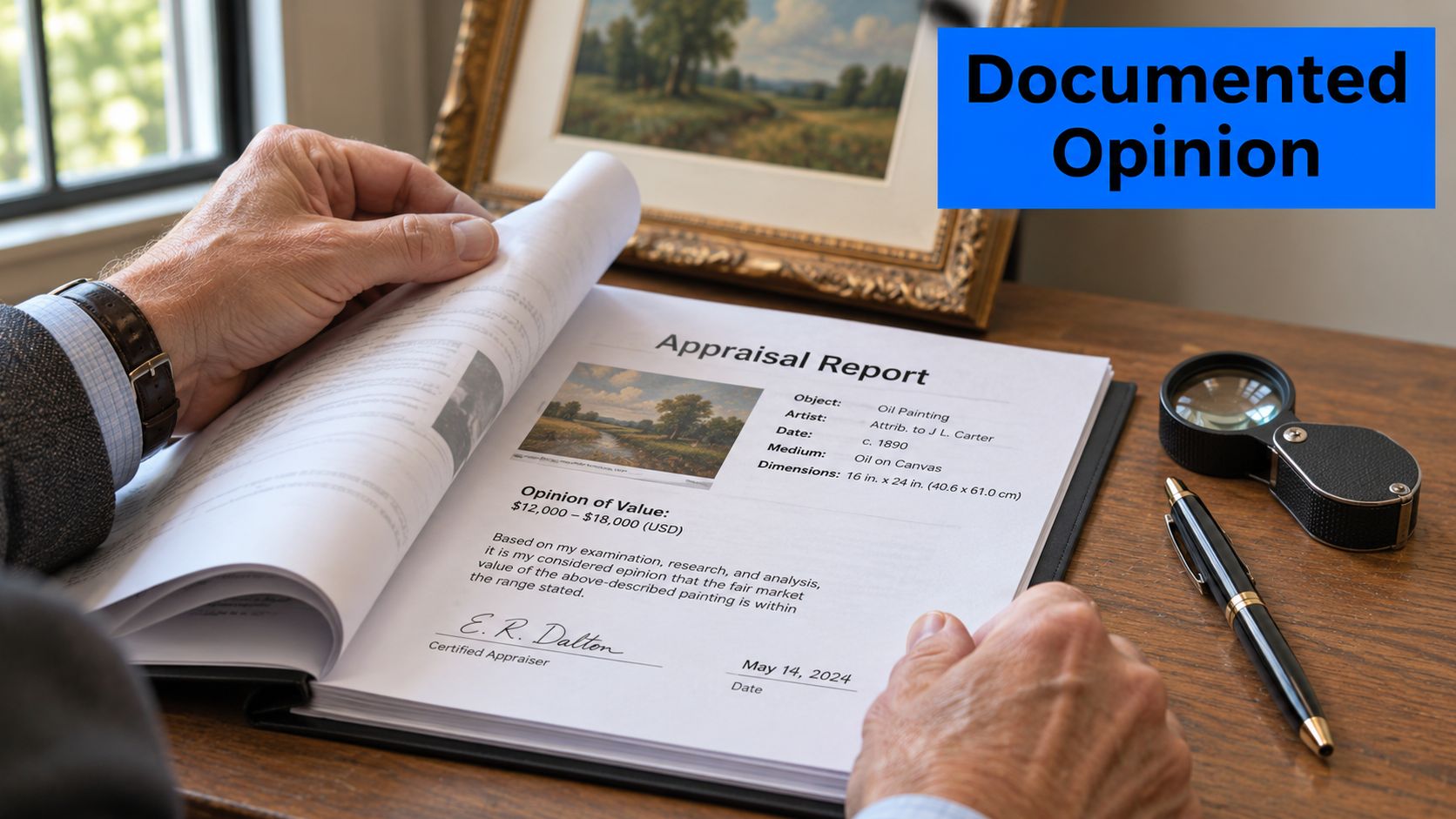
An appraisal isn't just a price printed beneath a photograph. Its usefulness comes from the documented reasoning that connects the object, the assignment, and the conclusion.
A fine art appraisal is a signed, documented opinion of value for identified property, a stated purpose, and a specified valuation date.
A dealer's asking price is a seller's opening position. An auction estimate is a pre-sale range associated with a particular selling event. Neither automatically provides the scope, investigation, or reporting needed for another purpose.
An appraisal is closer to a building inspection report than a property listing price. The reader needs to understand what the professional examined, which limitations affected the investigation, and why the conclusion follows from the evidence.
What gives the report professional weight
The Uniform Standards of Professional Appraisal Practice, or USPAP, provide a shared framework for ethics, competency, analysis, documentation, and communication, as described in the USPAP standards document. Art expertise supplies the category-specific judgment within that framework.
In practice, different readers examine different parts of the report:
- Insurers need clearly identified works and a stated replacement-value basis to support a policy schedule.
- Tax professionals need an assignment and report suited to the applicable filing requirements.
- Attorneys and courts may examine the appraiser's qualifications, assumptions, evidence, and reasoning.
Professional weight has limits. An appraiser can explain the evidence supporting an attribution, but the report doesn't automatically establish authenticity beyond that evidence. It also doesn't guarantee a future sale price or confirm clear legal title. Those questions may require separate specialists and investigations.
How Appraisers Determine a Work's Value
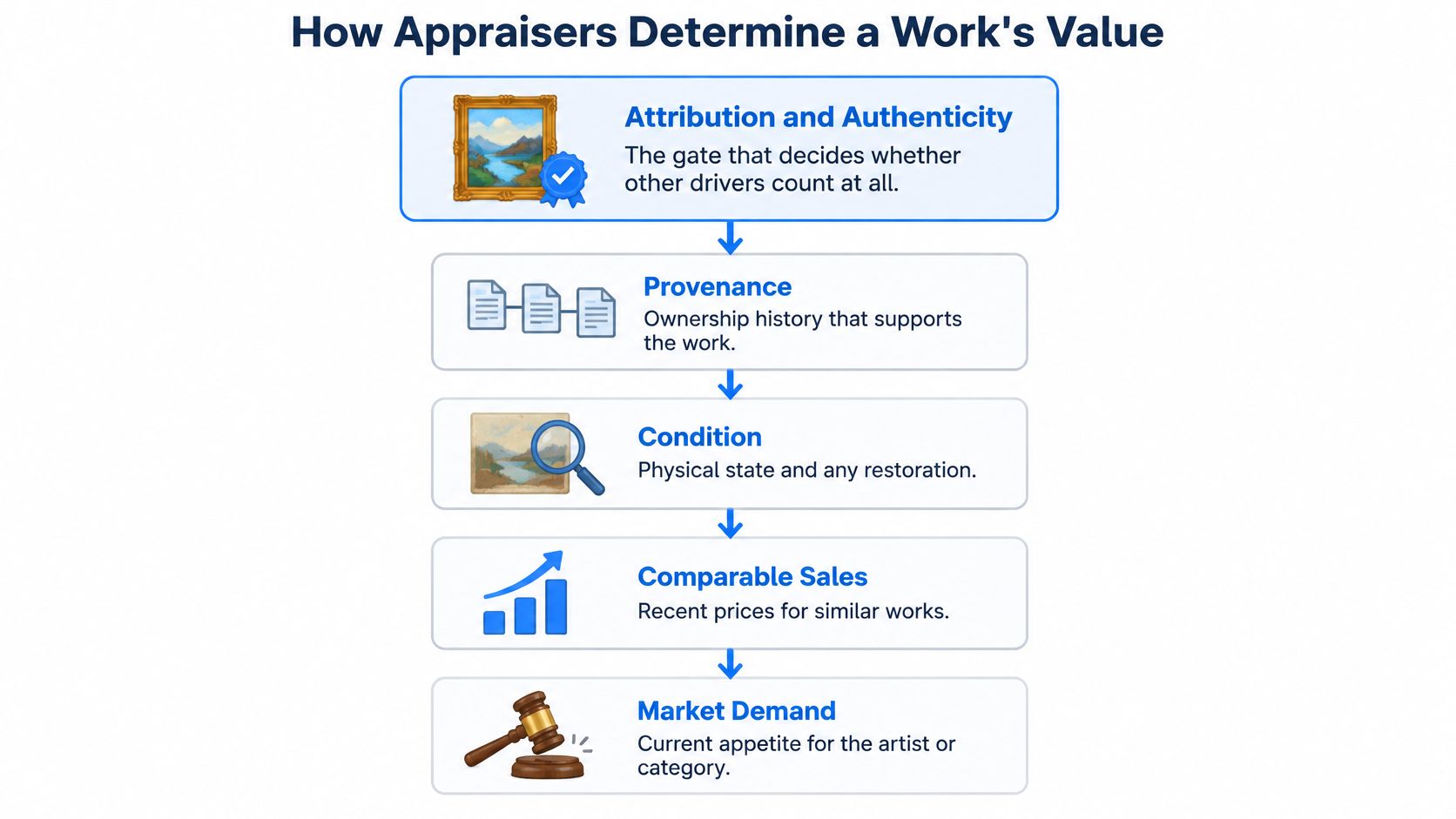
Attribution and authenticity come first. Before comparing prices, the appraiser needs to establish what the object is reasonably understood to be. A painting by an artist, a painting attributed to that artist, and a later copy aren't interchangeable appraisal subjects.
The supporting factors then follow a practical hierarchy: provenance, condition, comparable sales, and market demand. Strong ownership records can support identification; physical damage can change which transactions offer useful comparisons.
Why similar images aren't necessarily comparable objects
Say an estate contains a signed, numbered lithograph with an exhibition record. An online search produces the same image described as an unsigned trial proof. You can't assume either object is more valuable from those descriptions alone.
The appraiser checks the edition, printing history, paper, signature, margins, and condition. A documented exhibition history might support the estate's impression, while a rare proof could have its own specialist demand. The image is only part of the object being valued.
For a broader introduction to distinguishing fine art from other collectible categories, the Colorado Art Services collectible guide provides helpful context.
How comparable sales become evidence
Appraisers assess differences in medium, dimensions, production period, edition, condition, and selling context. They also distinguish completed transactions from unsold listings. An optimistic asking price doesn't establish what a buyer paid.
The concentration of art-market value makes careful comparison important: in a reported 2023 segment, 93% of artworks were priced below $50,000, while works above $1 million represented 55% of total value, according to Cerity Partners' discussion of art collecting. Those figures describe that segment, not the probable value of an inherited painting.
Buyer demand also changes. A transaction can be genuine yet offer limited guidance if it occurred under different conditions or in a different market. Our explanation of fair market value helps clarify why a supported valuation isn't the highest price found online.
Ask the appraiser to identify the most relevant comparables and explain the adjustments. If little direct evidence exists, ask how the report addresses that limitation rather than disguising it.
What Appraisal Services Cost and How Long They Take
Scope sets both the fee and the wait. Insurance, tax, and sale can each be a legitimate value for one artwork, and they are not the same assignment. A short talk that only decides which value you need is a smaller job than a written opinion a tax authority or a court may read.
| Service | Typical turnaround | Best for |
|---|---|---|
| Hourly consultation | One or two sittings, often the same week when no further research is required | Deciding which value you need, condition questions, a first look at a small collection |
| Flat fee per object | Often about one to two weeks after the records for that object are supplied | Insurance schedules and objects with a clear identity |
| Written report on a single work | Several weeks for inspection, research, drafting, and review | Tax, donation, and litigation assignments |
| Estate collection project | Often several weeks on a phased schedule, paced by access to the property and any filing date | Probate and dividing an estate |
| Percentage of sale or value | No independent delivery clock; the charge tracks the reported value or the sale | Not a sound way to buy an independent valuation; an outcome-linked fee is a red flag |
There is no single defensible dollar price for every fine art assignment. A recognizable print with a complete purchase file is a different job from an undocumented painting that needs specialist research. Compare the price for a defined scope, not the lowest advertised starting fee.
What the fee is actually buying
Inspection time is only part of the invoice. The appraiser may still have to identify an edition, check catalogues, trace ownership papers, locate comparable transactions, and explain why those transactions support the conclusion. A conversation about an insurance figure can stop once you understand the range. A donation or tax report cannot. Someone outside the family has to be able to follow the reasoning.
Cost follows the work, not a hope for a higher number. More objects, or more than one location, means travel plus time matching each record to a specific work. Uncertain signatures, disputed attributions, and incomplete edition details add research. A conservator or an authentication authority bills separately from the valuation. When attorneys, tax authorities, or an opposing expert will scrutinize the analysis, drafting and review take longer.
Ask whether the quote includes photography, travel, research access, specialist charges, revisions, and extra copies. For a collection, ask whether the fee covers every object or only the works chosen after a first review.
Why a delivery date has conditions
A completion date works like a relay. The report cannot run its leg until access to the property, missing receipts, conservation records, and the correct valuation date have all been handed over. If one of those is still missing, the date on the proposal is a wish, not a schedule.
For an estate, ask for phases: flag objects that may need a specialist, inspect those first, close the information gaps, and deliver reports in the order a filing or a family division needs. That plan is more useful than one deadline for everything, then learning that an important painting still needs research while a straightforward print could already be finished.
Budgeting rule: Obtain a written quote stating the property covered, intended use, deliverables, exclusions, payment terms, and delivery conditions.
Keep the appraisal fee separate from selling compensation. An auction house or a consignor can charge for a transaction. An independent appraiser's conclusion should not become more profitable merely because the reported value rises. If the same person offers both valuation and selling, ask for a plain account of each role and of how the fee is calculated before you proceed.
Choosing a Qualified Appraiser and Spotting Red Flags
Relevant qualifications matter more than a broad claim to know antiques. For federal tax purposes, the IRS Art Appraisal Services guidance recognizes relevant professional designation or qualifying education plus at least two years of experience valuing the property category. Verify the qualifications appropriate to your assignment rather than assuming a business card establishes them.
Match the specialist to the object. Oil paintings, editioned prints, sculpture, antiquities, and decorative arts involve different identification problems and transaction evidence. Someone well qualified to value furniture may need to bring in a print specialist for an important portfolio.
Check the work behind the credentials
Request a redacted sample report. Look for a clearly identified object, intended use, valuation date, value basis, market discussion, and explanation of the conclusion. Ask how the appraiser follows USPAP and how they handle uncertainty.
Independence deserves a direct conversation. Disclose any proposed sale and ask whether the appraiser has an ownership interest, buying interest, referral arrangement, or compensation connected to the result. You need to understand whose interests the engagement serves.
If the artwork must travel for examination, settle the handling arrangements before moving it. The Home Removals Sydney art handling guide is a useful starting point for discussing protection and transport, but transport expertise isn't a substitute for appraisal qualifications.
Red flags worth acting on
- A percentage-based valuation fee gives the appraiser a financial interest in a larger conclusion.
- A promised sale price before examination substitutes confidence for investigation.
- Pressure to sell directly to the appraiser creates a conflict that needs independent scrutiny.
- No specialty match leaves identification and comparable-selection questions unanswered.
- No written purpose or valuation date makes it difficult to know whether the report will serve your needs.
- Unverifiable credentials or no sample report prevents you from assessing the professional's work.
A cautious appraiser may decline to attribute a work or request more evidence. That's not necessarily a weakness. A credible limitation is more useful than an unsupported certainty.
Before engaging anyone, compare written proposals from competing specialists. Evaluate scope, qualifications, independence, deliverables, and fee together. A cheaper proposal that omits necessary research isn't the same service at a better price.
Preparing the Evidence File Before the Appraiser Arrives
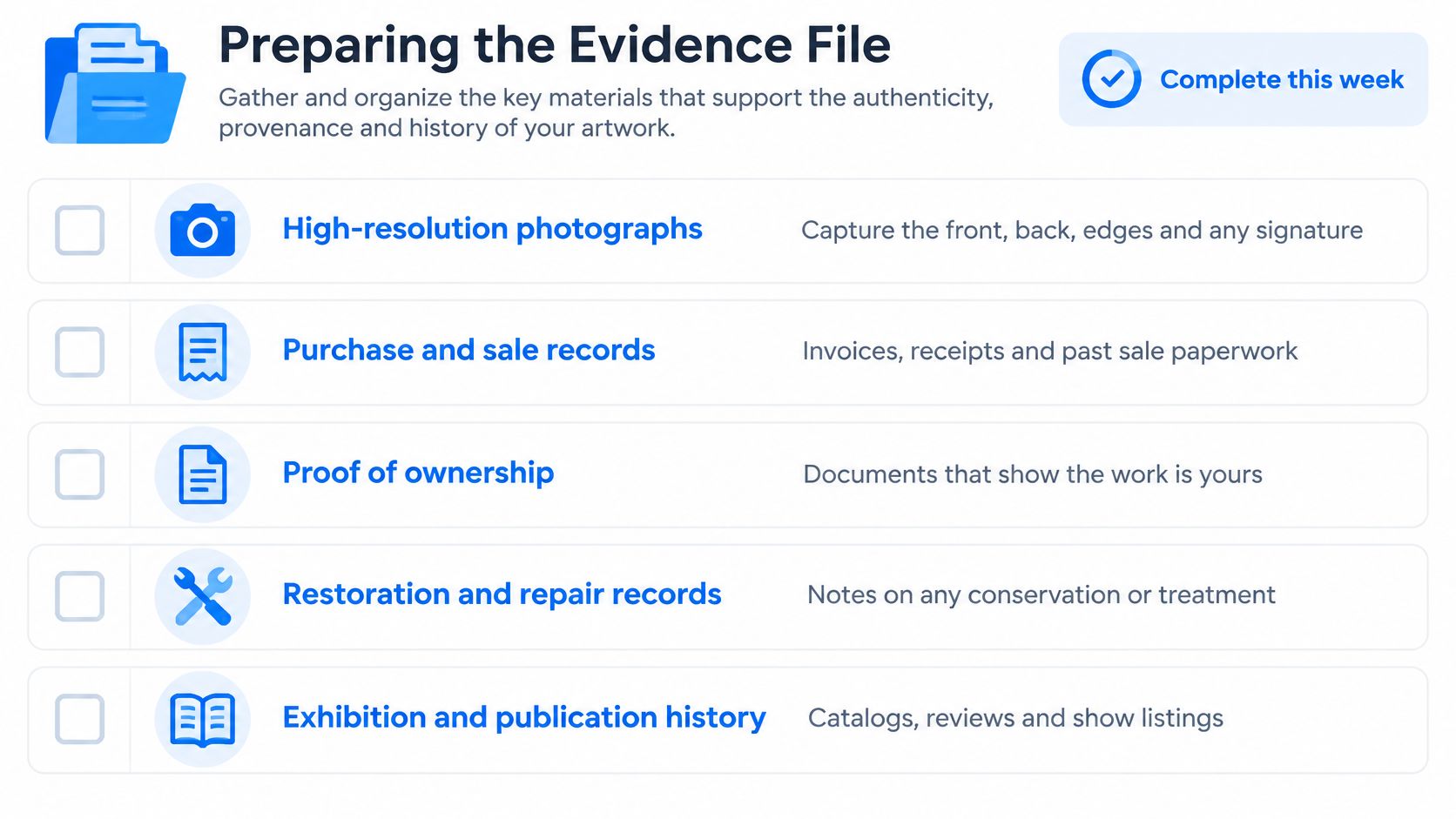
The same painting can support an insurance figure, a tax figure, and a sale figure, and the wrong file pushes the appraiser toward the wrong one. A gift-tax assignment needs dated ownership and a stated fair market value basis. An insurance assignment needs the schedule and the condition the policy is meant to cover. A sale assignment needs evidence a buyer can check. If the folder only holds a family story about what the work "should" bring, the report cannot serve the purpose you named.
Build one folder per artwork and use the same inventory label on the folder, the photo set, and every receipt. A home inventory list template keeps those labels consistent before specialist review. The file works like a case folder: each document keeps its date and its job, so a receipt is not later treated as an expert opinion.
- Photographs should show the front, back, edges, signature, inscriptions, labels, and visible damage. Keep original image files rather than screenshots.
- Object details should distinguish artwork dimensions from frame dimensions and record the apparent medium and support.
- Provenance records include invoices, gallery receipts, correspondence, ownership documents, and estate inventories.
- Exhibition and publication history should include catalogue pages, labels, reviews, and references that can be matched to this particular work.
- Previous valuations include earlier appraisal reports and insurance schedules, with their original purposes and dates intact.
- Condition and authenticity records should preserve conservation invoices, treatment notes, examination reports, and any existing expert opinions.
Record condition without trying to improve it
Leave the surface alone. Do not clean, revarnish, remove backing, or detach labels to make the artwork look better for inspection. A wiped signature or a pulled label can erase the very evidence the value depends on. Photograph what you can safely access and let the appraiser identify anything that needs a conservator.
Condition changes the analysis, not just the appearance. Relining, tears, fading, varnish discoloration, and missing components can reduce buyer interest and make an otherwise similar sale a poor comparison.
Tax paperwork needs the same care. The personal-property appraisal standards and IRS procedures reproduced in this regulatory document call for a professional-quality photograph, an appraisal date, a stated fair market value, and a specific valuation basis, and for certain art items valued at $50,000 or more, taxpayers may request an IRS Statement of Value before filing an estate- or gift-tax return.
Label certainty honestly
Separate confirmed facts, attributions, and assumptions. A dated gallery invoice is a document. A family story about where the painting originated is a lead to investigate.
Do not turn an inherited description into a confirmed artist attribution. Visible distinctions let the appraiser test the lead instead of repeating it, and they stop an uncertain statement from becoming a misleading sale listing.
Frequently Asked Questions
Do I need a formal appraisal for a small estate?
Not automatically. First establish whether a tax filing, insurer, court, or proposed division requires a formal report. For ordinary household property being sold without such a requirement, pricing guidance may be sufficient, but an unidentified artwork may still deserve specialist screening.
Is a dealer's offer an appraisal?
No. A dealer's offer states what that dealer is willing to pay under the proposed transaction. Their buying decision can reflect resale costs, holding risk, and desired margin. It can inform sale planning without serving as an independent valuation report.
How often should an insurance appraisal be updated?
Review the schedule at policy renewal and when you acquire, restore, or dispose of a work. A material change in the artist's market may also justify reassessment. Confirm the insurer's update requirements rather than assuming every work needs a fresh report on the same timetable.
Is an appraisal the same as authentication?
No. Authentication addresses who made the work; appraisal addresses its value under the assignment's assumptions and evidence. An appraiser may rely on a separate authentication opinion and should make that reliance clear rather than presenting it as their own independent finding.
Who pays for an appraisal in probate?
The estate commonly pays when the appraisal is commissioned for estate administration. The executor should confirm authorization and local treatment with the estate attorney before signing the engagement. If an heir wants a separate report for a personal dispute or purchase proposal, establish responsibility for that bill in advance.
Deciding Between an Appraisal and an Online Estate Sale
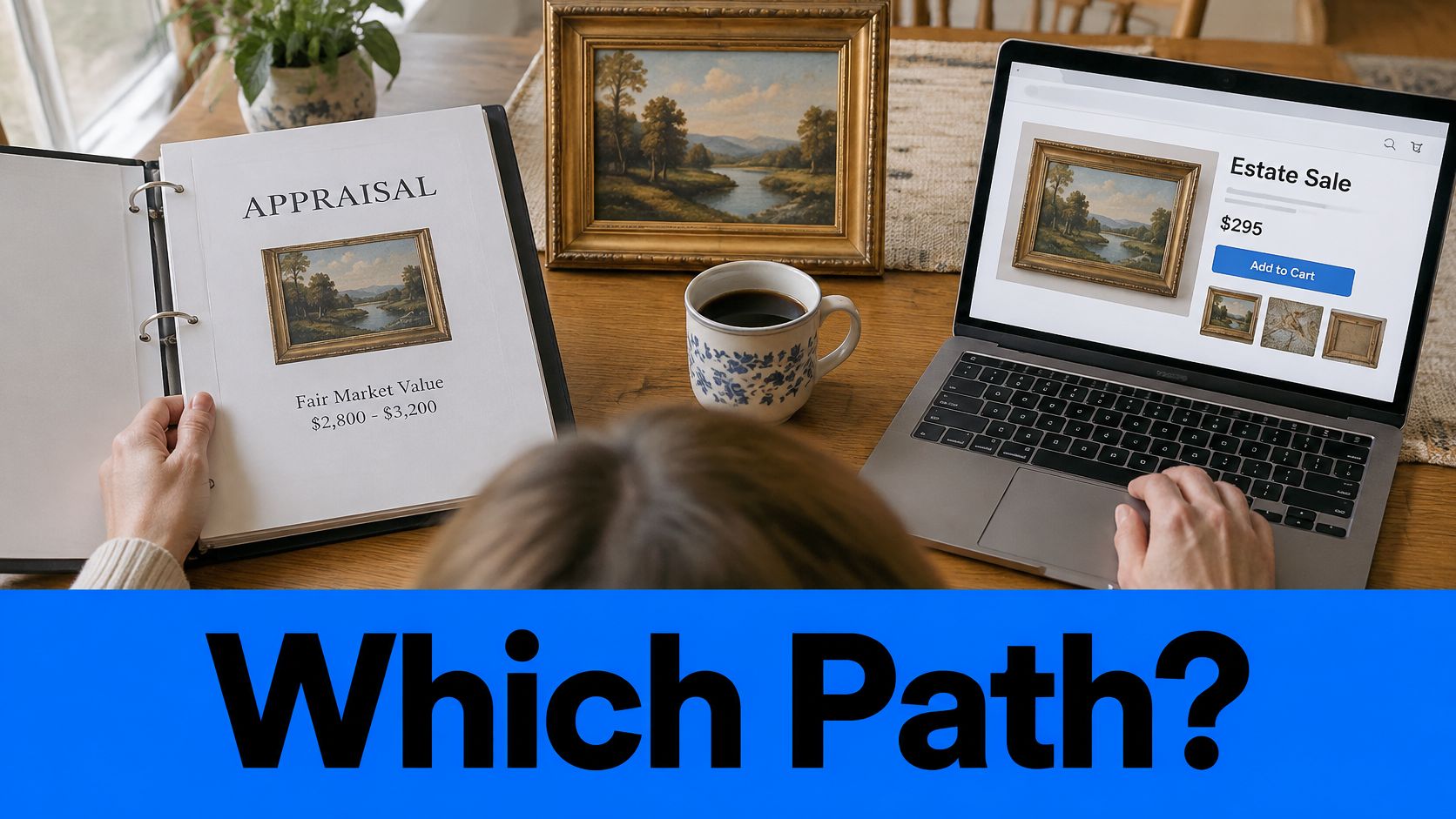
Commission the report your formal obligation requires. Tax, insurance, divorce, litigation, and court-supervised division can require an accepted valuation process. If the immediate goal is selling ordinary household belongings and no formal report is needed, a structured online estate sale may be sufficient.
The practical distinction is between documenting value for a decision-maker and discovering what available buyers will pay.
Use specialist evidence where it changes the sale
An inherited home may contain everyday furnishings alongside a painting that warrants investigation. You don't need to treat every object identically. Separate uncertain or potentially significant artworks from the general catalogue until identification and selling options are clearer.
For works proceeding to sale, turn the appraisal evidence into accurate descriptions: medium, dimensions, edition information, documented provenance, and disclosed condition. Our guide to selling estate-sale artwork can help you prepare that material for buyers.
Use a sale-relevant valuation to inform starting bids and any reserve, not as a promise of the final result. We support reserve prices for higher-value items, allowing sellers to specify the minimum they're willing to accept.
Understand what the selling platform does
DIYAuctions runs seller-led estate sales. We publish the sale, connect sellers with local buyers, organize bidding, and handle payment flow. Competitive bidding sets the final price, so buyers don't haggle. You decide what stays, what each item is worth, and when pickup happens.
Our commission is 10% of the sale price, capped at $1,000 per transaction. That's a selling charge, not an appraisal fee; additional fees may apply for premium features or services.
For sale preparation, we also offer a free estate sale pricing guide with typical fee ranges, pricing guidance, and a 30-day launch checklist for new sellers. It helps organize the selling process, but it doesn't replace a qualified appraisal for tax or insurance purposes.
Use the video alongside your preparation materials as you consider the sale process.
Make the decision before setting the sale date
- Write down the purpose, including any filing, coverage, or legal requirement.
- Choose the value basis that answers that purpose rather than selecting the largest existing figure.
- Engage a qualified specialist for significant or uncertain artworks before promising them to buyers.
- Build the sale catalogue from supported descriptions and use sale-relevant evidence to set bidding terms.
Start by identifying why you need the valuation and gathering the artwork's records. Book a qualified appraiser where the assignment requires one, then use the resulting evidence to prepare accurate listings and considered reserves on DIYAuctions before your sale begins.
Get the estate sale pricing guide
Enter your email for pricing ranges, planning notes, and a clearer path to launch.