Your Hitchcock Furniture Table: A Guide to Selling It
Our expert guide helps you identify, value, and sell your Hitchcock furniture table. Learn restoration tips and how to list for top dollar in an estate sale.
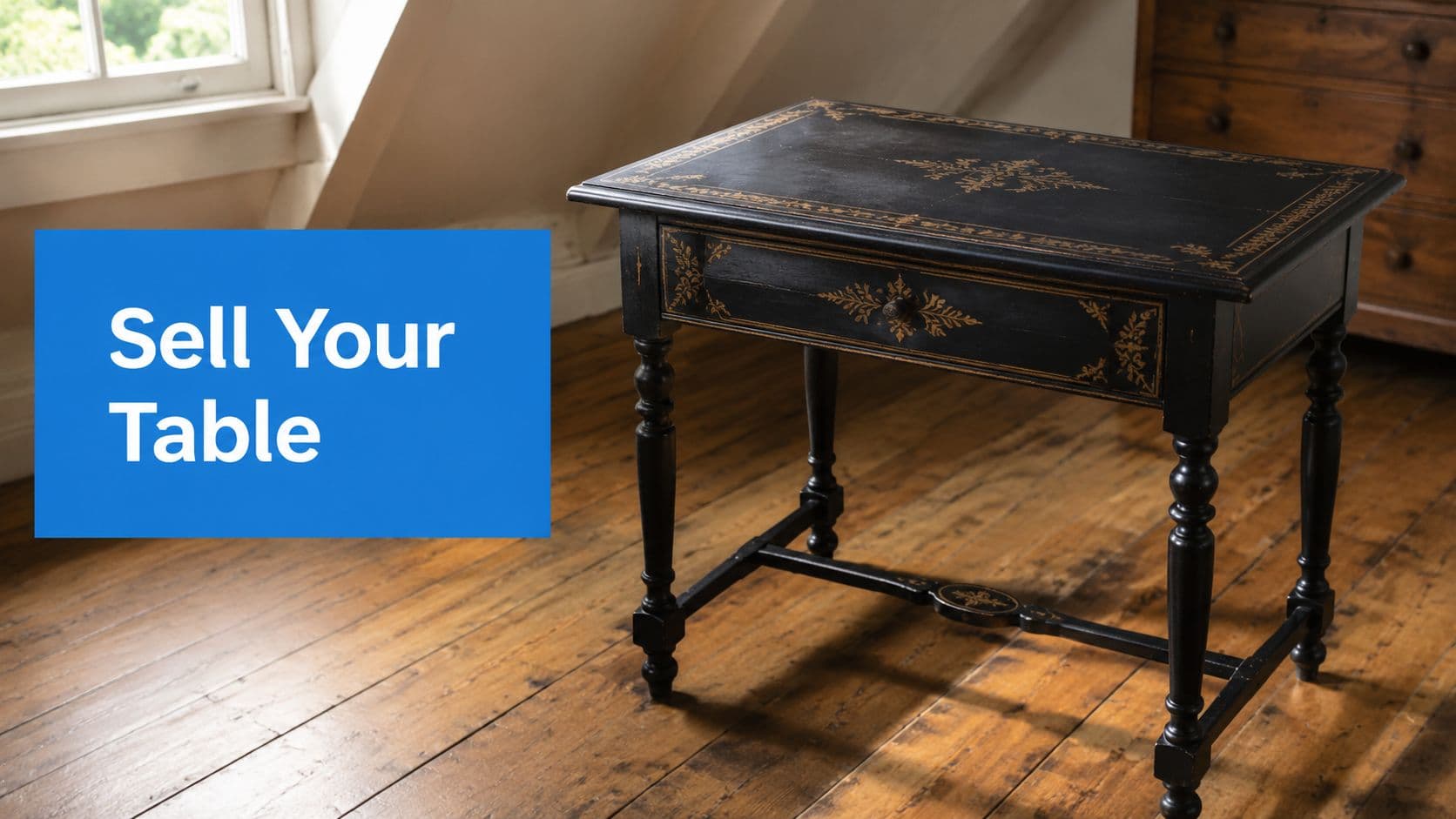
You're standing over a dark painted table with worn gold stenciling, trying to decide whether it's a keeper, a project, or something you should sell before a move, a downsizing deadline, or an estate cleanout overtakes your weekend. That moment is common. So is the uncertainty.
A Hitchcock furniture table sits in a tricky category. It can be old without being especially desirable, decorative without being original, and collectible without looking flashy. The difference usually comes down to three things: whether it's authentic, how its condition affects buyer confidence, and whether you present it properly when it goes to market.
That's where sellers lose money. They polish too aggressively, assume the stencil proves everything, skip the dimensions, or write a listing so vague that serious buyers move on. A better approach is slower and more practical. Identify it correctly, judge the condition realistically, decide whether any repair makes sense, then list it in a way that gives buyers enough evidence to act.
The Stenciled Table in Your Attic
The usual story starts with a table that has been useful for years without getting much attention. It may have held a lamp in a guest room, sat folded in a hallway, or followed the family through two or three houses. Then someone notices the painted finish, the line work, maybe a faint mark underneath, and asks the question that changes the conversation: “Is this Hitchcock?”
That question matters because Hitchcock furniture has real historical weight. Lambert Hitchcock founded the cabinet and chair manufacturing factory in 1818 in Connecticut, and he began applying mass-production methods to chairmaking in the 1820s, helping turn Hitchcock into one of the best-known American furniture lines of the 19th century, according to this Hitchcock company history overview.
For a seller, the history is useful, but only if it leads to action. Buyers don't pay for a story alone. They pay when the story is supported by evidence. If the table is authentic, its form, finish, stencil, wood, and construction all need to line up. If it isn't, no amount of enthusiastic wording will fix that.
Most owners don't need a museum lecture. They need to know whether the table is original, whether the condition helps or hurts, and how to sell it without making a costly mistake first.
I've seen sellers treat a Hitchcock table like any other painted vintage piece and wipe away the very wear buyers wanted to see. I've also seen owners undervalue a strong example because they assumed a few scratches meant “rough shape.” Neither instinct is reliable.
Start with a working mindset:
- Assume nothing from the stencil alone. Decorative details can be copied.
- Record the table as it exists today. Dimensions, finish wear, leaves, wobble, repairs, all of it.
- Think like a buyer. A collector, decorator, and restorer won't view the same piece the same way.
That's the practical path from attic discovery to a sale that makes sense.
How to Confirm It Is an Authentic Hitchcock Table
Authenticating a Hitchcock table is a hands-on job. You're building a case, not hunting for one magic clue. The best clue is what appraisers often treat as the authentication stack: construction details, finish system, and markings considered together. Independent references describe authentic Hitchcock furniture as typically made from birch, maple, or oak, often painted in dark tones, with rectilinear profiles and possible stenciling and maker's marks, as noted in this Hitchcock furniture review and authentication guide.

Start underneath, not on top
Most owners begin with the decorated surface because that's what draws the eye. I'd do the opposite. Turn the table carefully and inspect the underside, the rails, and any secondary surfaces first.
Look for:
- Maker's marks or stamps under the top or on less visible areas
- Evidence of original painted finish continuing into protected spots
- Wood species and secondary wood consistency
- Joinery that fits period production, not later decorative reproduction work
If the underside looks freshly sanded while the top looks old, pause. If the finish stops where it would be inconvenient to reproduce, that can be useful. If the wear pattern looks theatrical rather than natural, be skeptical.
Use marks as part of the whole picture
Maker's marks help most when they're read in context. Historical references note that Hitchcock inscriptions changed across different periods, with inscriptions used from 1820 to 1832, then 1832 to 1843, and again for chairs made from 1843 to 1852, which helps date and identify pieces more precisely in the Hitchcock line, according to the Sharon Historical Society's Hitchcock history.
That doesn't mean every authentic table will hand you an easy date. Marks can be worn, refinishing can obscure them, and some sellers mistake later labels or decorative additions for proof. Use the mark to support the furniture, not to override what the furniture is telling you.
Practical rule: If the mark says one thing but the wood, paint, and construction say another, trust the object before the label.
Check whether the style fits the brand
Hitchcock's early reputation came from efficient production and repeatable design. That history matters because it shaped the furniture itself. The factory's roots go back to 1818, and mass-production methods were being applied by the 1820s, borrowing ideas associated with assembly-line thinking in Connecticut manufacturing, as described in the historical background on Lambert Hitchcock's production methods.
That usually shows up in a table as clean, straightforward geometry rather than fussy cabinetmaking. Think rectilinear construction, practical proportions, and finishes meant to present a recognizable surface treatment.
A quick field checklist helps:
- Profile first. Is the overall shape plain, balanced, and structurally sensible?
- Wood next. Does the visible grain and base material fit birch, maple, or oak?
- Finish after that. Does the dark painted surface look layered with age rather than recently distressed?
- Stencil last. Is it integrated into the finish, or sitting on top in a way that feels newer?
If you need a broader antique ID framework before you list, DIYAuctions has a useful guide on how to identify valuable antiques that complements this kind of object-level inspection.
Assessing Your Tables Condition and Value
Once you believe the table is authentic, value comes down to form, condition, and how buyers will use it. A side table bought for everyday decorating is judged differently than a dining form aimed at a collector or period-minded buyer.

Record the form before you estimate value
This is the step many casual sellers skip, and it costs them. Authentic Hitchcock tables appear in multiple forms, including side tables, dining tables, drop-leaf forms, and extension tables with leaves. One documented Hitchcock dining table listing shows an adjustable length from 33 inches to 89 inches, while another side table is listed at 29 inches high, 21 inches wide, and 15.5 inches deep, according to documented Hitchcock table listings.
That tells you two important things.
First, there is no single “standard Hitchcock table size.” Second, dimensions matter because they define use. A compact side table attracts a different buyer than an extension dining table with leaves, and buyers often shop by fit before they shop by history.
Separate patina from damage
Patina supports value when it reads as age and use. Damage undercuts value when it creates cost, instability, or doubt.
Good wear usually includes:
- Gentle edge rub that exposes age naturally
- Minor finish thinning in places hands would have touched
- Consistent color mellowing rather than patchy stripping
More serious problems include:
- Loose or wobbly legs
- Deep gouges or heavy water marks
- Refinishing that has blurred or erased decoration
- Repairs that use the wrong hardware or obvious filler
- Missing leaves or mismatched replacement parts
A buyer can live with age. A buyer hesitates over confusion.
Here's a useful visual reference for how antique tables are inspected and discussed in the trade before pricing is set:
Value follows confidence
In estate sale work, I watch for one thing above all else: how quickly a buyer can understand what they're seeing. A table with clear dimensions, stable structure, honest finish wear, and documented details is easier to price and easier to sell.
Buyers forgive honest wear much faster than they forgive uncertainty.
If you need a market reality check before setting expectations, DIYAuctions offers an online antique price guide that helps frame how age, category, and presentation affect selling range. Use that kind of tool to calibrate your expectations, not to substitute for object-specific judgment.
The Restoration Dilemma To Restore or Sell As Is
Most owners ask the restoration question too late. They clean the table, touch up the finish, maybe “freshen” the stencil, and only afterward wonder whether they erased part of the value.
That concern is justified. Many owners specifically worry about restoring a Hitchcock table without ruining the stenciling, and that concern shows up plainly in restoration discussions and demonstration content around damaged Hitchcock pieces, as reflected in this restoration-focused Hitchcock table video.
When restoration helps
Restoration can make sense when the work is structural, limited, and sympathetic to the table's original character. Tightening a loose joint, stabilizing a corner, or addressing grime that obscures the finish may improve buyer confidence without changing the object's identity.
The key question is simple: does the work preserve the defining features, or replace them?
If the table has attractive original wear and readable decoration, aggressive refinishing usually works against you. Sellers often imagine a cleaner, glossier surface will broaden the audience. In practice, it can strip the very evidence that serious buyers wanted to inspect.
When selling as is is smarter
If the finish is original or likely original, and the stencil is still visible, I lean toward restraint. Honest wear often sells better than amateur improvement. A buyer who collects Hitchcock furniture would usually rather see age than speculation.
Use this decision table before doing anything irreversible.
| Consideration | Restore First | Sell As-Is |
|---|---|---|
| Structural stability | Good choice if joints are loose and repair can be done cleanly | Fine if the table is stable enough for display or light use |
| Original stencil | Only if work avoids disturbing it | Best option when stencil is a major feature |
| Finish wear | Appropriate for dirt, grime, or isolated issues | Better when wear reads as natural patina |
| Past bad repairs | Helpful if a professional can correct obvious mistakes | Acceptable if repair history is part of the disclosed condition |
| Buyer type | Useful for functional buyers who want a ready-to-use table | Useful for collectors and restorers who prefer untouched surfaces |
The rule that protects value
The safest repair is the one that leaves the fewest unanswered questions. Tighten, stabilize, clean gently, and stop there unless a professional with period-furniture experience is involved.
If you can't explain exactly what was done to the finish, a cautious buyer will assume the worst.
For most inherited or attic-found pieces, the profitable decision isn't “restore everything.” It's “preserve what's left, disclose what's wrong, and let the next owner choose the next step.”
Crafting a Winning Listing on DIYAuctions
A Hitchcock table doesn't need hype. It needs proof. The best listings answer the buyer's next question before they have to ask it.
Pricing is fragmented across marketplaces, and the same general category can be positioned very differently depending on condition, type, and rarity. Current market coverage leaves sellers to decide whether the piece should be presented as a functional item, a collectible, or a restoration project, as noted in this overview of Hitchcock tables across marketplace listings.

Photograph for evidence, not atmosphere
Soft lamps and decorative staging don't sell antiques well online. Buyers want clarity.
Your photo set should include:
- Full views from front, side, back, and top
- Underside shots showing construction and any labels or marks
- Close-ups of stenciling with enough light to show wear and sharpness
- Condition photos of scratches, chips, repairs, wobble points, and edge wear
- Leaf and extension details if the table changes size or comes apart
A plain background is fine. Daylight is better than yellow indoor lighting. Keep the camera level so the table doesn't look warped when it isn't.
DIYAuctions has a practical guide on how to photograph items to sell online, and it matches what works in estate liquidation: clear, honest, complete photos beat artistic shots every time.
Write the description like an appraiser would speak
A strong listing description is factual and specific. It doesn't oversell. It identifies.
Use a structure like this:
-
What it is Example: “Painted Hitchcock-style side table with stencil decoration and visible underside marking.”
-
What it measures Include height, width, depth, and any expanded dimensions if leaves or drop sides are involved.
-
What it's made from and how it presents Mention visible wood, painted dark finish, rectilinear profile, and stencil location if present.
-
What condition issues matter Note wear, refinishing, looseness, scratches, water marks, or replacement parts in plain terms.
-
How to position it Decide whether the listing presents the piece as:
- A functional table for everyday use
- A collectible with authentication interest
- A restoration project for a buyer comfortable with repair
Price to attract the right buyer
A common mistake is choosing a number based on hope rather than buyer type. If your table has good authenticity indicators but visible wear, say so and price with that reality in mind. If it's a more decorative example than a collector-grade one, position it accordingly.
The listing title should also work harder. Instead of “Old table,” use something like “Hitchcock furniture table with stencil decoration, painted finish, marked underside.” That gives search visibility and helps the buyer identify the category quickly.
Preparing for a Smooth Sale and Pickup
Once the listing is live and bidding starts, the final stretch is mostly about follow-through. Here, good sellers separate themselves from chaotic ones.
Answer questions like a professional seller
Buyers of antique and vintage furniture usually ask practical questions. Is it sturdy? Are the leaves included? Has it been refinished? Is the stencil original-looking? Can one person carry it?
Answer directly. If you don't know, say so. “I don't know whether the finish is original, but the listing photos show the current surface clearly” is far better than guessing. Fast, clear replies build trust and reduce bid hesitation.
Get the table pickup-ready
Preparation for pickup should be light and careful.
Use this pre-pickup checklist:
- Dust gently. A soft cloth is enough. Don't polish right before handoff.
- Gather all parts. Leaves, pads, hardware, and any paperwork should be together.
- Clear the path. Buyers shouldn't have to make their way through a packed attic or cluttered basement.
- Note the weight and shape accurately. If it's awkward, say so in advance.
- Protect vulnerable edges. A light blanket or wrap nearby helps during transfer.
If the buyer will be moving the piece through stairs or tight doorways, a general moving reference like Sydney removalists' heavy furniture guide is a useful read because it covers the practical handling issues people forget until pickup day.
A smooth pickup starts before the buyer arrives. Access, loose parts, and accurate communication matter as much as the sale price.
Keep the handoff simple
Set the table where it can be inspected quickly. Let the buyer confirm the condition against the listing photos. If the table extends, show how the leaves fit. If there's a wobble or old repair already disclosed, point it out calmly instead of waiting for the buyer to discover it.
That kind of straightforward handoff protects everyone. It reduces disputes, keeps the pickup moving, and leaves the buyer with the feeling that they got exactly what was advertised.
If you're ready to sell a Hitchcock furniture table without handing away a large share of the proceeds, DIYAuctions is the tool I'd point you to. It gives sellers a professional way to catalog antiques, manage bidding, handle secure payment, and coordinate a single pickup day while keeping control of the process. For downsizing, inherited estates, and single-item specialty pieces, that combination is hard to beat.
More guides in Selling Antiques & Collectibles
July 31, 2026
Ceramic Christmas Tree Atlantic Mold Seller's Guide
Identify, value, and sell a Ceramic Christmas Tree Atlantic Mold piece with confidence. Covers markings, rarity, condition, pricing, and listing tips.
Read guideJuly 30, 2026
Nurre Mirror Value: How to Identify and Sell for Profit
Learn to assess nurre mirror value with our step-by-step guide. Identify authentic pieces, estimate price, and sell profitably on DIYAuctions.
Read guideJuly 29, 2026
Distinction Deluxe Stainless Steel by Oneida HH: A Complete
Learn to identify, assess, and price your distinction deluxe stainless steel by oneida hh set for maximum profit.
Read guideGet the estate sale pricing guide
Enter your email for pricing ranges, planning notes, and a clearer path to launch.