Household Goods Valuation: A Practical Estate Sales Guide
Master household goods valuation for estate sales with comparable sales, condition grades, a copyable worksheet, and when to hire an appraiser.
You've got two documents in front of you and they disagree by a factor of ten. One is a homeowners policy schedule that lists the contents of the house at replacement cost. The other is a draft catalog for the sale, room by room, with prices that look almost insulting next to it. Both are honest documents. They answer different questions.
Sorting that out comes before anything gets tagged. The first conversation I have with a family isn't about what the dining table is worth. It's about which question the number is supposed to answer, and who will read it later.
Three Values Every Household Item Can Have
U.S. consumer units averaged $2,508 on household furnishings and equipment in 2023, down from $2,606 in 2022 and $2,701 in 2021, and furniture alone averaged $619 against $746 the year before, according to the Bureau of Labor Statistics consumer expenditure report. Those figures measure what households spend on new goods. They say nothing about what used goods sell for, and that gap is where pricing mistakes start.
The standard that governs an estate is fair market value: the price a willing buyer would pay a willing seller, with neither party under compulsion and both reasonably informed. U.S. federal estate-tax regulations apply that standard directly to a decedent's household and personal effects, recommend a room-by-room inventory, and direct appraisers to weigh antiquity, utility, desirability, condition and obsolescence, as the estate-tax rule for household and personal effects sets out.
Many households never separate these numbers. In a survey of Australian policyholders reported by Insurance Business, 32.8% guessed their contents value instead of calculating it. Guessing is how an insurance total ends up in a seller's head as an opening price.
Three figures, one item, three different answers. The refrigerator column is a worked illustration, not a quote, and it shows why the same appliance can carry a large number on one document and a small one on another.
| Value Type | Question It Answers | Where It Is Used | Example on a 15-year-old refrigerator | Relation to Sale Price |
|---|---|---|---|---|
| Replacement cost | What would a new equivalent cost today? | Insurance inventories | Near the price of a new comparable model | Usually higher than any sale price |
| Fair market value | What would a willing buyer pay a willing seller, neither under pressure, both informed? | Estate tax filings and estate valuations | Reduced for condition and obsolescence | Basis for most estate pricing |
| Liquidation price | What will a buyer pay in a local, time-limited sale? | Online estate auctions | Lowest of the three, set by what local bidders will pay before pickup day | Often lowest; depends on demand and pickup |
Read down the refrigerator column and the pattern is clear. Replacement cost sits near the price of a new model because that is what the insurer would have to spend. Fair market value drops once wear and obsolescence enter the calculation. Liquidation price lands lowest, because a time-limited local sale narrows the pool of buyers to whoever can collect the item on pickup day.
The reverse case exists too. A well-kept mid-century sideboard may hold or gain value because demand for it exists, which is why original purchase price tells you almost nothing in either direction.
The rule for every family: choose the value type before you start, write it in the column header, and never let the insurance figure become a starting bid.
In an auction, competitive bidding sets the final price, so the liquidation figure is discovered by buyers rather than negotiated. That makes the column header more than a label: it decides whether a number is evidence for a filing or a ceiling you expect bidders to approach.
If the inventory includes carved figures or sculpture, compare Southeast Asian sculpture prices against sold examples before assigning a number, because region, material and provenance move those figures more than age does. For the estate standard in plain language, our explainer on what fair market value means in an auction covers how the definition is applied in practice.
How to Value Each Item Step by Step
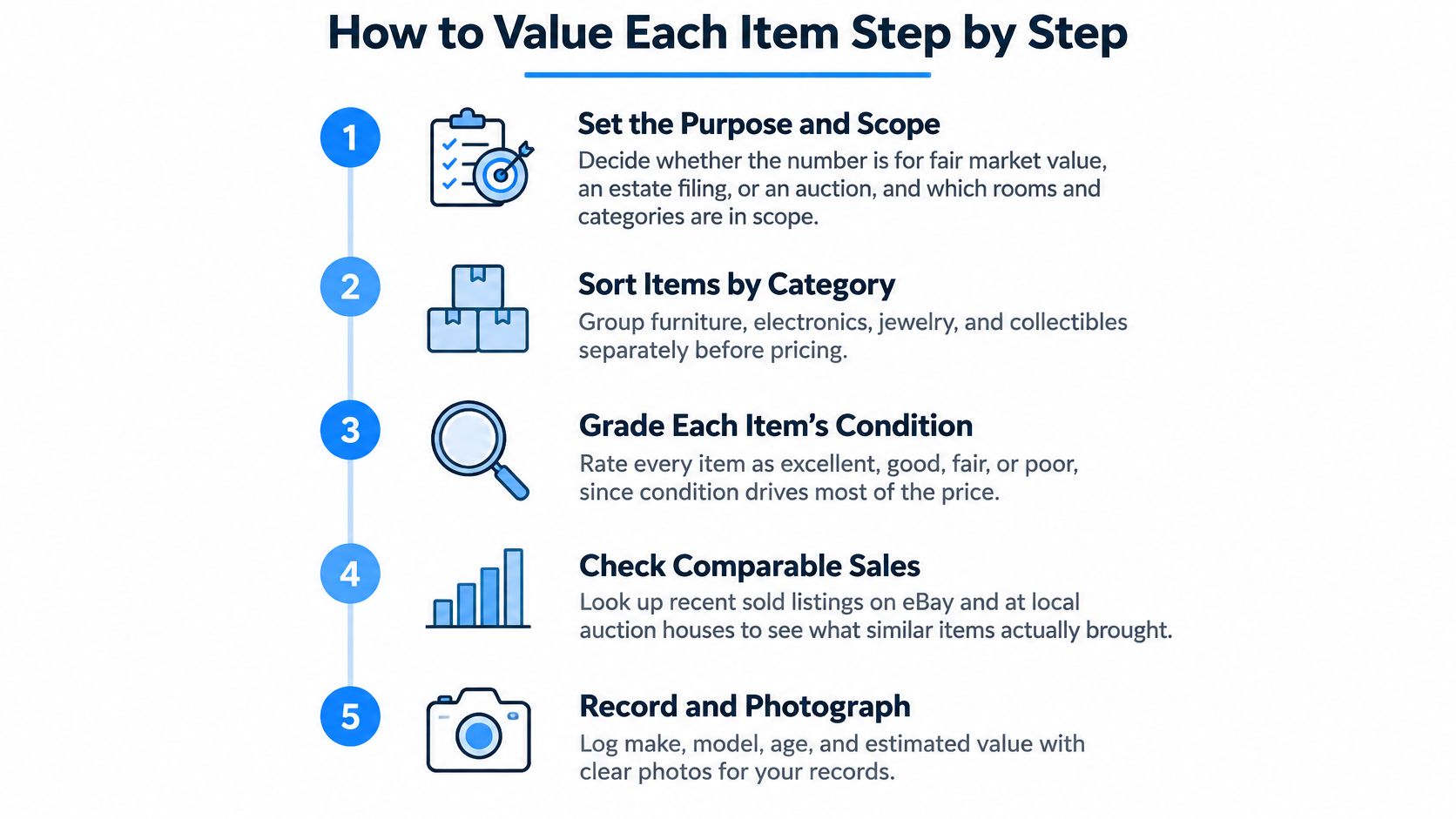
A house is valued one decision at a time. Start with a sideboard, a refrigerator and a silver service, and the reason the work gets difficult is clear: the replacement figure, the fair market figure and the auction figure can sit far apart on the same item. The routine below keeps those figures separate, so an insurance inventory total never turns into a starting bid.
-
Set the purpose and scope. Decide whether the number is for fair market value, an estate filing or an auction, and which rooms and categories are in scope. The IRS tangible personal property guidance treats planning the engagement, identifying critical factors and documenting evidence as the front end of the work rather than paperwork you catch up on later. Write the value type in the column header before you open the spreadsheet. That one habit prevents most mixed-number mistakes.
-
Walk the house room by room. Build one record per item, and group only low-value goods in the same room. The federal estate rule allows that grouping solely when no single item exceeds $100, so a line reading "living-room furniture" is both weak evidence and a place where a valuable piece can disappear. Sellers using DIYAuctions create lots and organize the house room by room, which keeps family context attached to the items that need it.
-
Identify the item, then triage it. Record brand, model, material, dimensions, age, maker's mark, serial number and hallmark. This is also the stop where items leave the DIY routine. Maker's marks, signatures, serial numbers, precious-metal hallmarks, unusual materials or provenance, and specialized construction are the six signals that send a piece to the specialist list. The $3,000 aggregate threshold matters here. Household and personal effects with marked artistic or intrinsic value above that total require an expert appraisal, and related items count together, so a 64-piece silver service or a matched run of prints is valued as one figure. The slip to avoid is pricing a collection as a single ordinary used object because no individual piece looks expensive.
-
Photograph the marks and the defects. Several angles of the maker's stamp, the serial plate, the chip on the rim, the missing foot. Photographing only the good side is the mistake that costs you a dispute at pickup. Keep the full item shot separate from the close-up, and make the defect visible in both.
-
Pull at least three sold comparables. Use completed sales, not asking prices, and adjust the search terms until you find real transactions. A listing that expired unsold is not evidence of anything. Match the item's brand, pattern, size, age band and condition before you use the price.
-
Adjust for condition, completeness, location, pickup burden and lotting. A heavy item on a second floor with no elevator carries a discount that has nothing to do with its quality. An item sold in a box lot with eleven others prices differently from one sold alone. Record the adjustment beside the number, because the reason matters more than the arithmetic later.
-
Record the working price, the comparables, the date accessed and your assumptions. Another reviewer should be able to reproduce your number from what's written down. A price with no trail is a guess with a decimal point.
Practical rule: if you can't name the three sold listings behind a number, the number isn't finished. It's a placeholder.
The steps compress well once you've run them a few times. Here's the same discipline applied to a single category, in a short walkthrough you can watch before you start tagging.
A Sample Valuation Worksheet You Can Copy
Six rows won't cover a house, but they cover the range of problems a house throws at you. Copy the columns into a spreadsheet, keep one row per item, and put the reason for every adjustment in the same cell as the number.
| Item | Identifiers | Condition | Comparables Used | Adjustment and Working Price | Confidence |
|---|---|---|---|---|---|
| Oak dining table with six chairs | Maker's stamp checked underneath; 72 in long | Good | Three completed sales of comparable oak sets | Median of the three sales, less a deduction for two loose joints, with the working price recorded at that adjusted figure | High |
| Refrigerator, 15 years old | Model and serial from label inside the door | Fair | Two completed sales of used units | Midpoint of the two, less a deduction for a worn door gasket, with the working price recorded at that adjusted figure | Medium |
| Sterling flatware, 8-place set | Hallmark and pattern name; 64 pieces counted | Good | Three completed set sales in the named pattern | No adjustment for light tarnish; working price $900 | High |
| Unsigned oil painting in gilt frame | Frame style; no signature; back label | Good | None usable | Flagged for appraisal; not priced until the appraisal returns | Low |
| Cast-iron cookware set, four pieces | Brand marks on the bases | Good | Three completed sales of the same brand | $110 median, no adjustment for light seasoning, working price $110 | High |
| Mass-market sofa, five years old | Fabric tag under the seat cushion; 84 in | Good | One completed sale and one asking price | Working price taken from the completed sale, less a deduction for a faded arm, recorded at $200 | Medium |
Read the table across, not down. The dining table row starts with a maker's stamp because an unmarked oak set and a signed one are different markets. The refrigerator row starts with the label inside the door, since the model number is what tells you whether parts are still available and whether a buyer for that brand exists. The flatware row starts with a piece count, because sterling is priced on weight and completeness far more than on how it looks in the box.
The painting row is the one that teaches the most. There are no usable comparables for an unsigned work with no attribution, and no amount of looking will produce them. It sits unpriced until an appraiser sees it in person. Trying to force a number onto that row is how families end up selling a real painting for the price of its frame.
Confidence works on a simple scale. High means three or more completed sales of comparable items. Medium means one or two, or comparables that needed real adjustment. Low means you're working from asking prices only, and anything at low confidence goes to review before it's listed. The rating isn't decoration. It tells you which rows to revisit when the first week of bidding comes back softer than you expected.
Every adjustment carries its reason next to the number. "Less a deduction for the faded arm" survives an audit. "Less a deduction" does not.
Condition, Age and Depreciation Adjustments
A chair with three legs and a fourth somewhere in the garage is incomplete until that leg is found and fitted. Buyers price the chair they can collect, not the repaired version the family has in mind. Missing parts and visible damage belong in the valuation before the item is listed.
Grade every item using six observable states:
- Excellent means it looks and works as new, with no marks you'd need to point out.
- Good means light wear consistent with use, with everything present and working.
- Fair covers stained cushions, scuffed edges or a drawer that needs a push.
- Damaged covers cracks, chips, tears and water marks.
- Incomplete means a missing part, piece from a set or accessory.
- Nonfunctional means it doesn't do its job. A lamp with a frayed cord stays here until the cord is replaced and the lamp is tested.
Use category-specific descriptions. The condition grades for budget UK buyers concern refurbished phones; they aren't a grading standard or pricing reference for furniture and other household goods.
Adjust downward for missing parts, repairs, odors, water or smoke damage, outdated technology and difficult removal. Before reducing the figure, check whether the comparable already has the same defect. Otherwise, you deduct twice. Adjust upward only for authenticity, rarity, provenance or strong demand supported by evidence. Sentiment and the original purchase price don't establish today's value.
Keep replacement cost, fair market value and liquidation price separate when making these adjustments. An insurance replacement figure isn't an auction estimate, and depreciation alone won't convert one into the other.
In a disaster-recovery survey reported by United Policyholders, 53% of respondents said their insurer did not explain depreciation or the requirements for recovering full replacement value, while 64% reported insufficient insurance to replace their belongings, averaging a $87,600 shortfall. Those are insurance-claim figures, not estate-sale discounts.
Judge depreciation by category and demand, not by a single rate. An aging mass-market television can lose much of its resale value, while a discontinued design object, specialist tool or collectible may hold value when condition and demand support it.
When comparables are thin, keep the estimate tentative. A lower reserve can encourage bidding, but it also lowers the minimum you're willing to accept. Choose that minimum deliberately rather than using a low reserve to test an uncertain valuation.
When to Hire a Professional Appraiser
The threshold to remember is $3,000. Under the federal estate-tax rule described in the regulation on valuation of household and personal effects, household and personal effects with marked artistic or intrinsic value that exceed $3,000 in total require an expert appraisal. The total is aggregated across related items, so a silver service, a matched set of prints or a collection of figurines counts together rather than piece by piece. That aggregation is what catches people out.
| Item Category | Signals to Look For | Action Before Listing |
|---|---|---|
| Jewelry | Hallmarks, gemstones, designer signature | Specialist appraisal before listing |
| Furs | Maker's label, lining, construction marks | Appraiser review before listing |
| Silverware | Sterling or silver-plate marks, named patterns, large sets | Triage; appraise if the set is large or antique |
| Paintings and prints | Signature, provenance, frame and back labels | Appraiser or auction house review |
| Antiques and statuary | Maker's marks, age, specialized construction | Specialist review |
| Rugs | Hand-knotted construction, age, origin marks | Specialist review |
| Books and collections | First editions, rare series, complete sets | Specialist review |
The triage itself is mechanical. Look for maker's marks, signatures, serial numbers, precious-metal hallmarks, provenance paperwork and unusual construction, then pull those items out of the ordinary workflow and set them aside. The regulation's own list of characteristics for silverware, antiquity, utility, desirability, condition and obsolescence, is a useful reminder that a tarnished set in a drawer is not automatically a low-value item.
Here's the pitfall that causes the most disappointment. An appraisal is an opinion of value, not a guaranteed sale price. A document that puts a high value on a rug tells you what a considered buyer might pay given time, marketing and the right room of buyers. Your sale has a closing date, a pickup window and a local buyer pool, and those constraints sit between the appraisal figure and the check.
For everything below the specialist line, you don't need a formal appraisal. Two or three independent market references plus a written note disclosing every defect is usually enough, provided the note is honest and specific. If you're also dealing with an insurance claim on the same contents, the process for hiring an insurance appraiser runs on a different track and a different standard of proof, so keep the two files separate.
Keep the appraisal document filed with the worksheet row it supports, not in a folder somewhere else. When a buyer asks why a piece is priced where it is, or an heir asks why it sold for less, the answer should take ten seconds to find. For anything heading to a specialist sale, our overview of fine art appraisal services explains what an appraiser will ask you for before the appointment.
Setting Starting Bids and Reserves Online
A starting bid is not a valuation. It's a decision about how much room to leave for competition. Set it below your working price, and let bidders close the gap. Price the opening bid at your working number and you've removed the only mechanism that pushes a final price above it.
Lotting follows the same logic. Box and lot the low-value goods by room so pickup stays manageable and nothing sits unsold for want of a $6 item. List mid-value pieces individually, where a photo and a description can do their work. Put a reserve on the higher-value items, which on DIYAuctions is the minimum price you're willing to accept, and treat that reserve as a floor derived from your working price rather than from the insurance schedule.
The buyer pool is real and it's growing. The global second-hand homeware market was valued at USD 31.4 billion in 2025, according to Global Market Insights, and that demand is what a well-cataloged local sale is tapping into.
Three things stay in the seller's hands throughout. You decide what stays, what each item is worth and when pickup happens. You choose the reserve, the closing window and the pickup day. And because the sale is an auction where competitive bidding sets the final price, buyers don't haggle, which means the number you publish is the number the room works from. Our guide to how a reserve price works in an online auction walks through the mechanics.
A reserve set too high is the most expensive mistake in this section, and it fails without a sale. An item that never meets its reserve returns nothing to the seller, and you've spent the photos, the description and the week of attention for zero. Set the reserve from the working price, review the first week of bids before moving it, and be willing to lower it rather than relist the same item at the same number twice.
The pricing ladder, in order: bundle the low-value goods into room lots, list mid-value pieces individually, put a reserve on the high-value items, then review everything after the first week of bids and reprice from what the bidding did.
Confirm Your Valuation Before the Sale Date
Five decisions close this out, and each one has a deadline attached.
- Build the full inventory this week. One row per item, identifiers and photos included. A partial inventory is how a valuable piece gets sold inside a box lot.
- Book the appraisals. Every item you flagged in triage needs an appointment before the sale date, not after, because the pricing for those rows depends on the answer.
- Check the working prices against three sold comparables each. Any row still at low confidence drops into review rather than onto the catalog.
- Decide the fallback for unsold or uncollected items. You can relist them, donate them, or offer them to the next-highest bidder, and choosing in advance keeps the schedule from stalling.
- Check the timeline against a plan. Our free estate sale pricing guide includes typical fee ranges, pricing guidance and a 30-day launch checklist for new sellers, which is a sensible way to test whether your dates are realistic.
Value each item against what a buyer will pay in your market, and label every number with its value type. Do that consistently and the insurance schedule stops being a disappointment and becomes what it always was, a different document answering a different question.
Start with one room tonight. Photograph the labels, write the three values on one line per item, and flag anything you can't price with confidence. When the worksheet holds up, list your first lot on DIYAuctions and let competitive bidding tell you what the market thinks. You keep control of the reserve, the closing window and the single pickup day, and the commission is 10% of the sale price, capped at $1,000 per transaction.
Get the estate sale pricing guide
Enter your email for pricing ranges, planning notes, and a clearer path to launch.