How to Sell Estate Jewelry a Definitive Guide
Discover how to sell estate jewelry for maximum value. Our guide covers appraisal, pricing, and choosing the right platform to sell your inherited treasures.
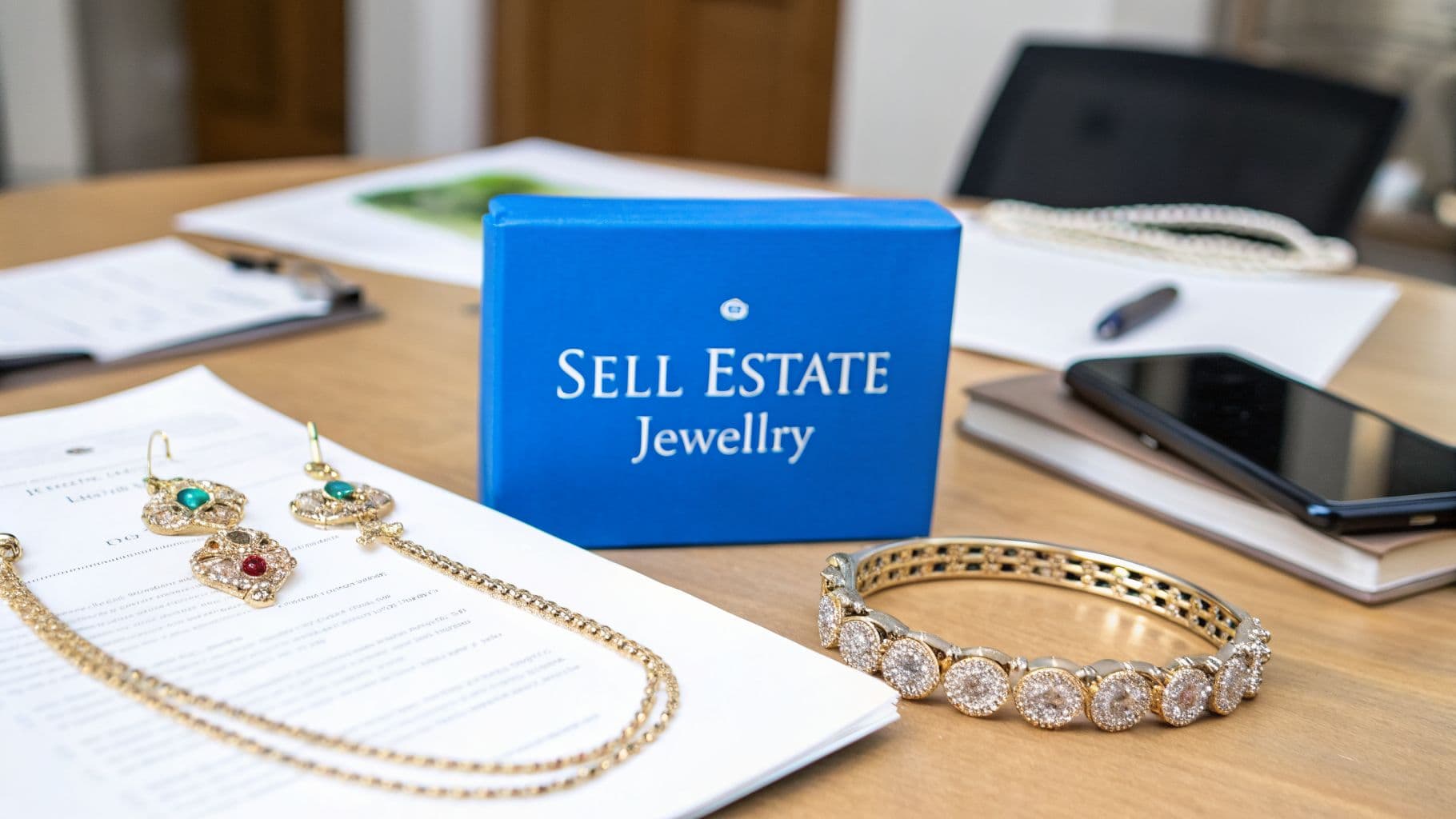
When you inherit a collection of estate jewelry, you're holding more than just precious metals and stones. You're holding history, memories, and significant financial value, all at once. It can feel overwhelming, but turning those heirlooms into cash doesn't have to be a stressful or confusing process.
With a clear plan, you can navigate the sale confidently and profitably. This guide will walk you through it, step by step.
A Quick-Start Guide to Selling Estate Jewelry

Why It's a Great Time to Sell
Right now, the market is incredibly strong for unique, pre-owned jewelry. Buyers are actively looking for pieces with a story and character, which is a big shift away from mass-produced items. This isn't just a trend; it's a massive market.
The global estate and antique jewelry retail market is valued at a staggering $5.5 billion. That figure represents a huge consumer appetite for authentic, historical pieces just like the ones you might have.
This demand means your jewelry can find an appreciative new owner while delivering a fantastic financial return. For sellers who know how to approach it, it’s an ideal time.
Your High-Level Selling Roadmap
The key to feeling in control is breaking the process down into manageable phases. Before we get into the details, here's a quick overview of the journey ahead. Think of it as your roadmap from discovery to deposit.
| Quick-Start Roadmap for Selling Estate Jewelry | ||
|---|---|---|
| Phase | Key Action | Primary Goal |
| Preparation | Identify, document, and clean your items. | Build a complete and accurate inventory. |
| Valuation | Get professional appraisals and research market prices. | Understand the true market worth of each piece. |
| Sale & Logistics | Choose a sales channel and manage the transaction. | Secure the best price and ensure a safe, final sale. |
Tackling the sale in these distinct stages turns a complex project into a series of simple, actionable tasks. If you're managing a larger inheritance, professional estate cleanout services can also be a huge help, freeing you up to focus on high-value items like jewelry.
Let's break down what each of those phases really involves.
- Preparation & Documentation: This is all about getting organized. You’ll sort through what you have, gather any existing paperwork (like old receipts or appraisals), and get the items ready for their close-up with some gentle cleaning and great photos.
- Valuation & Pricing: Next, you need to figure out what everything is worth. This is where you learn the difference between what a piece is made of (its melt value) and what someone will actually pay for it (its market value). This step is crucial for setting a price that is both realistic and profitable.
- Sales & Logistics: The final phase is choosing how and where you'll sell. You'll pick a sales platform that fits your goals, handle the transaction securely, and make sure the jewelry gets to its new owner safely.
Documenting and Preparing Your Jewelry for Sale

Before you even think about listing prices, there’s some crucial prep work to do. This is where you lay the foundation for a successful sale, and honestly, it’s where you can seriously boost the final price you get.
This isn’t just about making a pile of jewelry. It's about understanding what you have, proving its history, and then presenting it in a way that makes buyers excited. Get this part right, and the rest of the process becomes so much easier.
Identifying Key Value Markers
Those tiny stamps and engravings on your jewelry? They're like a passport, revealing its origin, purity, and creator. You don't need to be a gemologist to get started—just a good eye and maybe a magnifying glass.
Take a close look for these valuable clues:
- Hallmarks: These are the official marks that tell you the metal content. A stamp that says "14k" means it's 14-karat gold, while "925" signifies sterling silver.
- Maker's Marks or Signatures: This is the logo or name of the designer. A signature from a big name like Tiffany & Co. or Cartier can make a piece worth exponentially more than an identical but unsigned item.
- Era-Specific Clues: Certain design styles, stone cuts, and even the way a piece is constructed can point to a specific period like Art Deco or Victorian. Collectors often hunt for these distinct historical aesthetics.
Here's a pro tip: A signed piece from a known designer will almost always fetch a higher price than an identical, unsigned one. That signature is verifiable proof of authenticity that serious collectors are willing to pay for.
Finding these marks turns a piece from "a gold ring" into "a 14k gold ring by a specific designer from the 1950s"—a far more compelling story for any buyer.
Gathering Your Essential Paperwork
Once you’ve played detective with the jewelry itself, it's time to hunt for its paper trail. Any documentation you can find adds a huge layer of trust and legitimacy, making buyers more confident and willing to meet your price.
Think of it as building a complete dossier for each piece. You'll want to look for:
- Original Receipts: Fantastic for establishing provenance and purchase history.
- Previous Appraisals: Even if they're old, they provide a great baseline of information on materials and quality.
- Certificates: For major gemstones, a report from a reputable lab like the Gemological Institute of America (GIA) is the gold standard. A GIA certificate can dramatically increase a diamond's value and marketability.
- Original Boxes and Packaging: Don't toss that old box! Branded packaging from houses like Cartier or Van Cleef & Arpels is highly collectible and adds real value.
If you come up empty-handed on the paperwork, don't panic—it's incredibly common with inherited jewelry. This just means the hallmarks and maker's marks you found are now even more important. For any piece you suspect is high-value, investing in a new appraisal or GIA report is often a very smart move.
Safely Cleaning and Photographing Your Items
Now that you know what you have, let’s make it shine. But a quick word of caution: aggressive cleaning is one of the fastest ways to ruin antique jewelry and tank its value. That soft aging on silver, called patina, is often desirable to collectors, and harsh chemicals can easily dislodge delicate stones.
For most pieces, simple and safe is the way to go. Just use a soft, lint-free cloth with a bit of warm water and a few drops of mild dish soap. A baby toothbrush can work on durable stones like diamonds, but never use it on fragile gems like opals or pearls. When in doubt, do less.
With your jewelry clean, you’re ready for the final, most critical step: photography. Your photos are your best salesperson, but you don't need a fancy studio. A smartphone and some natural light will do the trick.
- Set the Scene: Use a plain, neutral background. A simple sheet of white paper or a piece of dark felt works perfectly.
- Find the Light: Set up near a window, but stay out of harsh, direct sunlight. Bright, overcast days are your best friend here.
- Capture the Details: Take lots of shots. You need a clear photo of the entire piece, close-ups of any gemstones, and—most importantly—a crisp, readable shot of any hallmarks or signatures you found.
These clear, honest photos are your most powerful sales tool. If you want to take your pictures to the next level, check out our guide on how to take professional product photos for your listings. Taking the time to prepare your jewelry properly ensures you’re not just selling an item, but its full story and value.
Understanding True Value and Setting a Smart Price
Getting the price right is probably the single most important part of selling estate jewelry. If you aim too high, you'll scare off serious buyers before they even start. Price it too low, and you're essentially giving money away. The real secret is learning to see your pieces through two different lenses: their material worth and their market appeal.
This knowledge is especially powerful on a platform like ours, where you’re in the driver's seat. You set the price, you control the sale.
Intrinsic Value Versus Market Value
Let's get one thing straight: intrinsic value and market value are not the same thing. Understanding the difference is your first step toward a smart pricing strategy.
-
Intrinsic Value: This is the baseline, raw material value of your piece. It’s what the gold, platinum, and gemstones are worth if you melted them down or sold them wholesale. Think of it as your absolute bottom line—the "melt value" you should never go below.
-
Market Value: This is the more nuanced—and usually much higher—figure. Market value is what a real buyer is willing to pay for the piece as a whole, factoring in its design, brand, history, rarity, and what's currently in style.
For example, a simple, unsigned gold ring has an intrinsic value based on its weight. But a signed Cartier ring with the exact same gold content could have a market value ten times higher. Why? Because of the brand, the craftsmanship, and its status as a collector's item. Our guide on what is fair market value dives deeper into this crucial concept.
When to Get a Professional Appraisal
For a quick ballpark figure, you can always check the "sold" listings on auction sites for similar items. But if you have even a slight suspicion that a piece is special, getting a professional appraisal is a non-negotiable investment.
An appraisal isn't just about a number. It's official documentation that proves your item's value and gives buyers the confidence to bid high. You absolutely need an appraisal if your jewelry:
- Features a large diamond or another significant gemstone.
- Is signed by a famous maker (like Tiffany & Co., Van Cleef & Arpels, etc.).
- Is a rare antique or comes from a hot collector's period, like Art Deco.
Professional certification is what separates a pretty piece from a premium investment, like this GIA Certified Pink Sapphire and Diamond Ring. That piece of paper is proof.
Finding a Qualified Appraiser
Be careful who you ask. Not all appraisers are created equal, and you need an unbiased expert—not someone who also wants to buy your jewelry. That's a huge conflict of interest.
Look for an appraiser with credentials from respected organizations. Reputable groups like the American Gem Society (AGS) have searchable databases to help you find a certified professional near you.
Using a certified gemologist gives your listing instant credibility and provides the justification you need to ask for a top-tier price.
Setting Your Price Based on Market Demand
Once you have the intrinsic value and an appraisal in hand, there's one last piece to the puzzle: checking the current market. What’s popular today might not have been five years ago, and demand for certain styles can shift dramatically.
The global vintage ring market is projected to grow from $3.8 billion in 2025 to $6.2 billion by 2034. Some reports show vintage rings from sought-after periods like the Art Deco era are appreciating by 15-20% annually, far outpacing inflation.
This is a market with a serious appetite for unique, historical pieces.
By layering these three elements—intrinsic value, professional appraisal, and current market demand—you can triangulate a final price that's both strategic and easy to defend. This data-driven approach takes the guesswork out of the equation, giving you the confidence to list your jewelry for what it's really worth.
Choosing the Right Sales Channel for Your Goals
You’ve done the hard work of documenting and valuing your jewelry. Now comes the most important financial decision of the entire process: choosing where to sell it.
This single choice will have the biggest impact on how much money you walk away with, how fast the sale happens, and how much say you have in the outcome. There's no one "best" way to sell—the right channel depends entirely on your goals. Are you chasing top dollar, or do you need fast cash?
The Old-School Routes: Fast Cash vs. Fair Value
Let's start with the places most people think of first. These traditional options are familiar, but they come with some serious trade-offs you need to understand before you commit.
- Pawn Shops: The appeal here is pure speed. You can walk in with a ring and walk out with cash. But that convenience costs a fortune. Pawn shops almost always offer a fraction of the metal's melt value, ignoring brand, history, or artistry.
- Consignment Stores: Leaving your jewelry with a local shop to sell on your behalf can feel easy, but it’s often a slow-motion disaster for your wallet. It can take months, even years, to find a buyer, and their commission will be staggering—often 30% to 50% of the final price.
- Local Jewelers: Some jewelers buy estate pieces directly, but they’re buying inventory. Their offer has to be low enough for them to mark it up for a profit, which means you leave a lot of money on the table.
These methods are popular because they feel simple. In reality, you’re just trading a huge chunk of your profit for that simplicity.
The World of Auctions
For pieces with real character and value, an auction is often the best way to let the market work its magic. But not all auctions are created equal.
Traditional Auction Houses
When you hear names like Sotheby's or Christie's, you're thinking of the big leagues. These auction houses are incredible at what they do, but they are built for museum-quality, six-figure-plus masterpieces.
A seller's premium (the commission you pay them) can easily hit 25% or more, not to mention extra fees for photography and insurance. It's the right choice for a royal tiara, but totally inaccessible for most estate jewelry collections.
Self-Directed Auction Platforms
The modern approach flips the script and puts you in charge. Platforms like DIYAuctions give you the tools to run your own online auction, connecting you directly with a pool of eager local buyers. It’s a model designed for sellers who want to maximize their profit and keep control.
Understanding what drives an item's final price is crucial. This flowchart breaks down the two core components of value.

While the metal and gems give you a baseline price (intrinsic value), the real money is in the story, brand, and desirability (market value). You need a sales channel that captures both.
A Direct Comparison of Your Options
Putting the numbers side-by-side makes the financial impact of your decision impossible to ignore. This table lays out what you can expect from each channel.
Comparing Estate Jewelry Sales Channels
| Sales Channel | Typical Commission/Fee | Seller Control | Best For |
|---|---|---|---|
| Pawn Shop | N/A (Offers are 20-50% of value) | Low | Immediate cash for low-value items |
| Consignment Shop | 30% - 50% | Low | Sellers who are not in a hurry |
| Traditional Auction House | 25% + additional fees | Low | Extremely rare, high-value pieces |
| DIYAuctions | 10% (capped at $1,000) | High | Maximizing profit and retaining control |
The difference is stark. On a $5,000 sale, a 40% consignment fee means $2,000 goes to the shop owner. With a 10% DIYAuctions commission, you keep $1,800 more of your own money. Our complete guide on where to sell estate jewelry dives even deeper into these options.
By choosing a path with lower fees and greater control, you ensure the value you've uncovered ends up where it belongs: in your pocket.
Finalizing the Sale with Confidence and Security

You’ve found an excited buyer and agreed on a price—congratulations! Now it's time to handle the final details. This is where you need to be extra cautious to make sure the transaction is secure for both you and the buyer.
When you’re selling privately, payment can be a real headache. Checks can bounce, and cash apps offer almost zero protection if a deal goes south. This is exactly why using a managed marketplace is such a relief.
Platforms like DIYAuctions handle the payment processing for you, acting as a secure middleman. This gives you built-in fraud protection and a clear, documented record of the sale, so you never have to worry about handling large sums of money directly.
Shipping Your High-Value Items Safely
Shipping a priceless family heirloom isn't something you can do with a padded envelope and crossed fingers. One mistake here can be absolutely heartbreaking. Your mission is to make the package secure, anonymous, and fully insured.
Always double-box your items. Start by putting the jewelry in its original box or a new gift box. Wrap that box in plenty of bubble wrap, then place it inside a slightly larger, plain cardboard shipping box. Fill any empty space with packing material so it's snug and can't shift around.
Your outer box should be completely nondescript. No branding, no logos, and definitely no words that even hint at "jewelry" or "valuables." Anonymity is your best defense against theft while the package is in transit.
When you head to the post office, skip the standard mail service. You need a carrier like FedEx or UPS that provides top-notch tracking and declared value insurance.
- Declare the Full Value: This is non-negotiable. You have to declare the full sale price to get proper insurance coverage. It costs a bit more, but it’s the only way to protect yourself from a potential loss.
- Require a Signature: Always, always select the “Direct Signature Required” option. This ensures the package is physically handed to your buyer, not just left on their porch.
- Keep Your Receipt: Don't throw away that shipping receipt! Hold onto it and the tracking number until the buyer confirms they've received the item and everything is perfect.
Navigating Legal and Tax Considerations
The last step is figuring out your financial and legal responsibilities. The money you make from selling estate jewelry isn't always 100% profit, and it’s smart to get ahead of any potential tax implications.
The rules here can get tricky. If you inherited the jewelry, your cost basis is usually its fair market value at the time you inherited it. If you sell it for more than that value, you might owe capital gains tax.
I always recommend talking to a tax professional or an accountant. They can give you advice tailored to your exact situation, making sure you stay compliant and don't get any nasty surprises when you file your taxes. A little planning now helps you close the sale with total peace of mind.
Your Estate Jewelry Questions, Answered
Selling estate jewelry often brings up a lot of questions, even for seasoned sellers. It's a unique process with its own set of challenges. We've compiled a few of the most common questions we hear, along with straightforward advice from our experience.
What If I Don’t Have Original Paperwork for My Jewelry?
Don't panic. It's incredibly common to find or inherit beautiful jewelry without a single receipt or appraisal certificate. This is the rule, not the exception, and it definitely doesn't mean your pieces are without value.
Your first step is to become a bit of a detective. Look closely at the piece itself for any small markings.
- Hallmarks: These tell you the metal content, like "14k" for gold or "925" for sterling silver.
- Maker's Marks: A tiny signature or symbol can identify the designer or brand.
If you suspect you have something special, your next move is to find a qualified appraiser. A good appraiser can identify materials, craftsmanship, and the likely era of a piece just by examining it. For a significant diamond, getting a new report from a reputable lab like the GIA is a smart investment that can fully replace a lost certificate.
Should I Sell My Jewelry as a Collection or Piece by Piece?
While the idea of a single, quick sale is tempting, you will almost always make more money by selling items individually.
Selling piece by piece lets you connect with specific collectors and buyers who are looking for that exact ring or brooch. This targeted demand is what drives prices up. A bulk sale, on the other hand, usually only attracts dealers looking to buy low so they can resell everything for a profit. Their offer will reflect that wholesale goal, meaning you leave a lot of money on the table.
The big exception here is a true "parure" or "demi-parure." This is a matching set of jewelry (like a necklace, bracelet, and earrings) designed and created to be worn together. If you have a complete, original set from a good maker, it’s almost always more valuable sold as a single unit.
How Do I Handle the Emotional Part of Selling Heirlooms?
This is a real and important part of the process. These aren't just assets; they're tied to memories and people you loved. It's perfectly normal to feel a sense of loss or sadness, so give yourself grace.
Before you even think about listing anything, take a moment to honor the connection you have to these pieces.
- Create a Digital Keepsake: Take beautiful, clear photos of every item. You can create a small private album to look back on long after the pieces have moved on to their new homes.
- Keep One Special Thing: You don't have to sell it all. Choose one or two items that mean the most to you or that you'd like to pass down to another family member.
- Reframe Your Goal: Think of yourself as giving these treasures a new life. Instead of sitting unseen in a jewelry box, they'll be worn and cherished again. The money you earn can, in turn, provide security for your own family—a wonderful way to honor the legacy of the person who left them to you.
What Are the Most Common Mistakes to Avoid?
The single biggest mistake we see is rushing. When you feel pressured to sell quickly, you're almost guaranteed to make a costly error.
Watch out for these common pitfalls:
- Taking the first offer. This is especially true with pawn shops or "cash-for-gold" buyers, whose business model relies on lowball offers.
- Skipping an appraisal. For anything that seems valuable, failing to get an expert opinion is like guessing the price of a house. You'll likely underprice it.
- Cleaning it wrong. Never use harsh chemicals or abrasive brushes on antique jewelry. You can easily strip off the patina—the aged surface that collectors value—and destroy its worth.
- Ignoring the market. The market for high-end and vintage jewelry is hot. The global luxury jewelry market is on track to hit $59.06 billion by 2026, and understanding current demand is key. You can get a feel for the market by reading up on these exciting jewelry market trends.
Take your time, do your homework, and make informed choices. That's the secret to avoiding these mistakes and getting the true value for your estate jewelry.
More guides in Estate Sale Basics
July 28, 2026
Revenue Reporting for Estate Sales and Auctions
Learn revenue reporting essentials for estate sales and auctions. Discover key metrics, templates, and best practices to simplify tracking and compliance.
Read guideJuly 26, 2026
Stamp Collection Valuation: A Practical Step-by-Step Guide
Stamp collection valuation made simple. Learn how to identify, grade, price, and sell your stamps with confidence for estate sales or consignment.
Read guideJuly 23, 2026
Estate Sales Brick NJ: Your 2026 Guide to Success
Planning your estate sales brick nj? Our guide covers permits, pricing, marketing, & running a safe sale with DIYAuctions.
Read guideGet the estate sale pricing guide
Enter your email for pricing ranges, planning notes, and a clearer path to launch.