How to Sell Fine Art Online: Pricing, Listings and Payouts
Learn how to sell fine art online: document works, price them, pick a channel, write trusted listings, and handle payment and shipping.
You've taken a painting off the wall, found a gallery label on the back, and discovered that nobody in the family knows exactly when it was bought. Or you're thinning a collection and facing a different problem: you know what you paid, but not what a buyer will pay today.
Learning how to sell fine art online starts with separating what you know from what you can prove. A successful sale needs more than an attractive photograph. You need a defensible description, a price grounded in comparable works, and a clear plan for getting paid and handing over the right object.
Document Each Work Before You Price It
Say you're an executor sorting a closet and find a numbered lithograph. The pencil edition mark in the margin and faded gallery label on the back give you useful leads. They don't automatically establish authenticity, but they're evidence worth preserving before anyone cleans, reframes, or moves the work.
Start a spreadsheet in Microsoft Excel or Google Sheets and give each object a unique inventory ID. Use that ID in its photo filenames, document folder, and eventual listing. Keep price, storage location, channel, and sale status on the same row so you don't accidentally sell a work that's already committed elsewhere.
Build a record a buyer can follow
Record the artist's name exactly as supported, including any qualification to the attribution. Add the exact title when documented, or identify your descriptive title as such. Then enter the creation date or supported range, medium, support, and measurements.
Documentation fields for every listed work
| Record | What to capture | Why buyers ask |
|---|---|---|
| Artist and attribution | Full name and exact attribution wording | Authenticity is the first question |
| Dimensions | Height, width and depth in one unit, framed and unframed | Frame changes wall fit and shipping cost |
| Medium and date | Materials, support, year or supported date range | Medium and date set expectations |
| Condition | Plain notes on damage, plus close photos | Buyers need to assess flaws they can't inspect |
| Provenance and history | Prior owners, exhibitions, publications, with supporting records | Shows ownership without overstating it |
| Edition and certificate | Edition number and certificate of authenticity, where present | Buyers need to assess edition claims |
| Shipping origin | City and country the work ships from | Buyers need delivery and duty estimates |
Photograph the front, reverse, signature, labels, frame, and damage before further handling. Keep original image files, not just compressed copies downloaded from a listing. Scan invoices and correspondence, and note which object each document describes.
Identify what still needs checking
Don't turn a partially legible label into a confident attribution. Transcribe what you can read, mark uncertain passages, and retain the photograph. A handwritten family note belongs in the file, but it needs a different evidentiary status from a contemporary purchase invoice.
If a potentially valuable work needs professional assessment, use our guide to fine art appraisal services to understand the assignment before commissioning it. Ask whether you need an opinion of value, identification, or specialist authentication. Those aren't interchangeable services.
Before pricing, flag missing measurements, uncertain materials, and works you haven't photographed clearly. Resolve practical gaps first. You shouldn't pay for an elaborate valuation while still guessing whether an object is an original drawing or a reproduction.
Choose the Channel That Fits Your Works
Online channels compared for fine art sellers
| Channel | Seller cost | Price control | Best for |
|---|---|---|---|
| Own website with checkout | Payment processing, site costs, and your own marketing spend | Full asking-price control | Repeat collectors and an established mailing list |
| Major art marketplace | Listing or commission fees set by the platform | Partial, subject to platform rules | Mid-market works with reliable comparables |
| Dealer consignment | Commission negotiated in a contract | Negotiated, often delegated | High-value works that need expert selling |
| Online auction | Platform commission on the sale price | Low to moderate, through accepted reserve arrangements | Works where bidding can reveal value |
| Estate-sale platform | Published commission, with a cap where offered | Control over starting terms and reserves, not the final bid | Estates, downsizing, and multi-item clearances |
The best channel isn't necessarily the one with the lowest commission. Compare the likely net proceeds, the work you'll have to do, and whether the platform can reach appropriate buyers.
A polished storefront helps present a coherent collection, but it doesn't supply collectors by itself.

Pay for the help you actually need
An independent website suits sellers who already have an audience or want to build a continuing business. Before selecting a builder, compare inventory pages, image zoom, checkout, and export options. The artist site picks from own.page provide a starting point for that shortlist, rather than a reason to choose on appearance alone.
A marketplace provides discovery within its own environment, but you accept its eligibility requirements, fees, and dispute procedures. Dealer consignment can make sense when specialist relationships and attribution expertise matter more than direct control. Put discount authority, expenses, insurance, and payment timing into the agreement.
Auctions need plausible bidder competition. A rare-looking object with no identifiable audience can still attract little bidding. For broader household sales, consider whether coordinated local collection is more practical than arranging separate shipments; our discussion of traditional design auctions offers another comparison point.
Match the channel to the buyer
According to the Art Basel and UBS market-report trends summary, 46% of dealers' online sales in 2024 were made to first-time buyers, and 62% of online sales by value occurred below $50,000. Those findings support making the buying process understandable, not assuming every visitor already knows auction terminology or an artist's history.
Sort inventory by likely value, specialist knowledge required, and collection or delivery needs. Assign each group a primary channel. Don't force a fragile decorative mirror, a documented edition, and a specialist painting through an identical sales process.
Price Works and Test Two or Three Points
A listing that changes price every few days teaches you nothing. Treat each price you publish as part of the work's evidence trail, something a future buyer, appraiser, or dispute process may read back to you.
Price tiers, approach and review points
| Tier | Pricing approach | Review point |
|---|---|---|
| Accessible and mid-market works | Fixed price supported by comparables; test alternative asking prices on genuinely comparable pieces | Scheduled early and later listing reviews |
| High-value works | Supported asking price, detailed condition report, and appraisal where justified | Review evidence and buyer feedback before changing price |
| Auction candidates | Reserve near an acceptable gross selling floor, allowing for selling costs | After the closing window |
These are working categories, not universal monetary cutoffs. An inexpensive but poorly understood object can need more investigation than a valuable, well-documented edition.
Separate asking prices from achieved prices
Search auction results and dealer inventories for the same artist, medium, approximate dimensions, period, and edition characteristics. Record the sale or listing date and whether the figure represents an asking price, hammer price, or total including buyer charges. Comparing those figures without adjustment produces misleading conclusions.
Reject weak matches. A signed original drawing isn't interchangeable with an unsigned reproduction of the same subject, and a framed print with staining isn't equivalent to a clean example.
The Art Basel and UBS Global Art Market Report estimated that global online-only art sales fell 11% in 2024 to $10.5 billion, while remaining 76% above 2019. Online access is established, but publishing an asking price doesn't guarantee demand.
Pricing rule: Set your minimum acceptable net proceeds before deciding the asking price or auction reserve.
Run a controlled review
Test two or three price points on comparable pieces, and schedule reviews at fixed intervals, for example 14 and 30 days after listing. Write down every change and its date so the pricing log becomes part of the work's file. Avoid repeatedly repricing a single unique work; a trail of unexplained reductions tells buyers the original price was guesswork.
Track these signals alongside each listing:
- Views and saves: Indications of attention, not evidence that someone will pay.
- Qualified inquiries: Questions about inspection, shipping, payment, or a specific condition issue.
- Conversion and time to sale: Whether attention becomes a completed transaction.
- Fulfillment cost and net proceeds: What remains after commissions, packing, delivery subsidies, and other seller expenses.
Suppose a watercolor receives attention but no serious inquiries. Before discounting, check whether buyers can see the paper edges, understand the condition, and calculate delivery. Improve the missing evidence, then observe the response without changing the price at the same time.
A price cut can't fix an unreadable signature photograph or an unexplained shipping charge. Change one meaningful variable at a time and record the date, so the next decision rests on evidence rather than impatience.
Selling Inherited or Undocumented Art Honestly
An executor finds a painting with an old receipt, a faded exhibition label, and no record of the artist's full name. The tempting move is to connect the clues into a confident story. The safer move is to preserve each clue and describe exactly what it establishes.
A receipt may document a purchase without authenticating the painting. An exhibition label may identify a venue without proving that the label belongs to the current frame's contents. More paperwork isn't the same as stronger authentication.
Choose language that matches the evidence
The Art Basel and UBS market-report overview describes online channels as an established part of art-market activity. For an estate seller, that makes a defensible digital record important even without a gallery's resources.
Wording for uncertain attribution
| Wording | Use when | Buyer expectation |
|---|---|---|
| Signed and dated by the artist | Authorship, signature, and date are supported by verification | Full attribution backed by evidence |
| Attributed to [artist] | A reasoned assessment supports possible authorship, but confirmation is incomplete | Possible or likely authorship, not certainty |
| In the manner of [artist] | The work resembles an artist's style without claiming their authorship | Stylistic resemblance, not a work by that artist |
| After [artist] | The object copies or reproduces an identified work | A derivative work, described and priced accordingly |
| Artist unknown | There's no adequate evidence identifying the maker | Assessment based on the object, condition, and decorative appeal |
These terms aren't shortcuts around investigation. Style alone doesn't justify an attribution, and a signature that resembles an artist's name doesn't establish who made the work. Auction houses and marketplaces may also define attribution terms differently, so use their definitions when selling there.
Write a statement you can stand behind
Keep family recollection separate from documented history. A suitable disclosure might explain that family tradition associates the painting with a local artist, but no documents confirm that association. Put that limitation in the listing itself, not only in a private reply to a cautious buyer.
- Preserve originals: Retain invoices, correspondence, labels, and earlier photographs.
- Avoid intervention: Don't clean the surface or remove backing merely to make the object more saleable.
- Commission targeted help: For a plausible specialist work, ask an appropriately qualified professional what investigation is warranted.
- Correct uncertainty openly: Don't supply a precise date or medium because the listing form requests one.
An appraisal can address value within its stated assumptions. It doesn't automatically settle authenticity.
Finish with a concise provenance statement you would be comfortable signing. Match every ownership claim to something you can produce, and mark the gaps rather than smoothing them away.
How to List and Photograph Fine Art
Build the public listing from your object record, but arrange it for someone deciding whether to buy. Lead with the supported artist attribution and work title, followed by medium, dimensions, date where known, and a visible price. Don't make visitors open a message thread to learn basic terms.
In Artsy's 2025 art-market findings, 48% of online buyers cited insufficient information about the work as a purchase barrier, while 43% cited the absence of a visible price. Beautiful images and complete descriptions solve different problems; you need both.
Make the photographs usable evidence
Set the artwork upright and keep the camera parallel to its surface. Use a tripod or stable support, neutral surroundings, and soft, even lighting. Check the image for glare before dismantling the setup.
Use this visual sequence to organize the shoot.
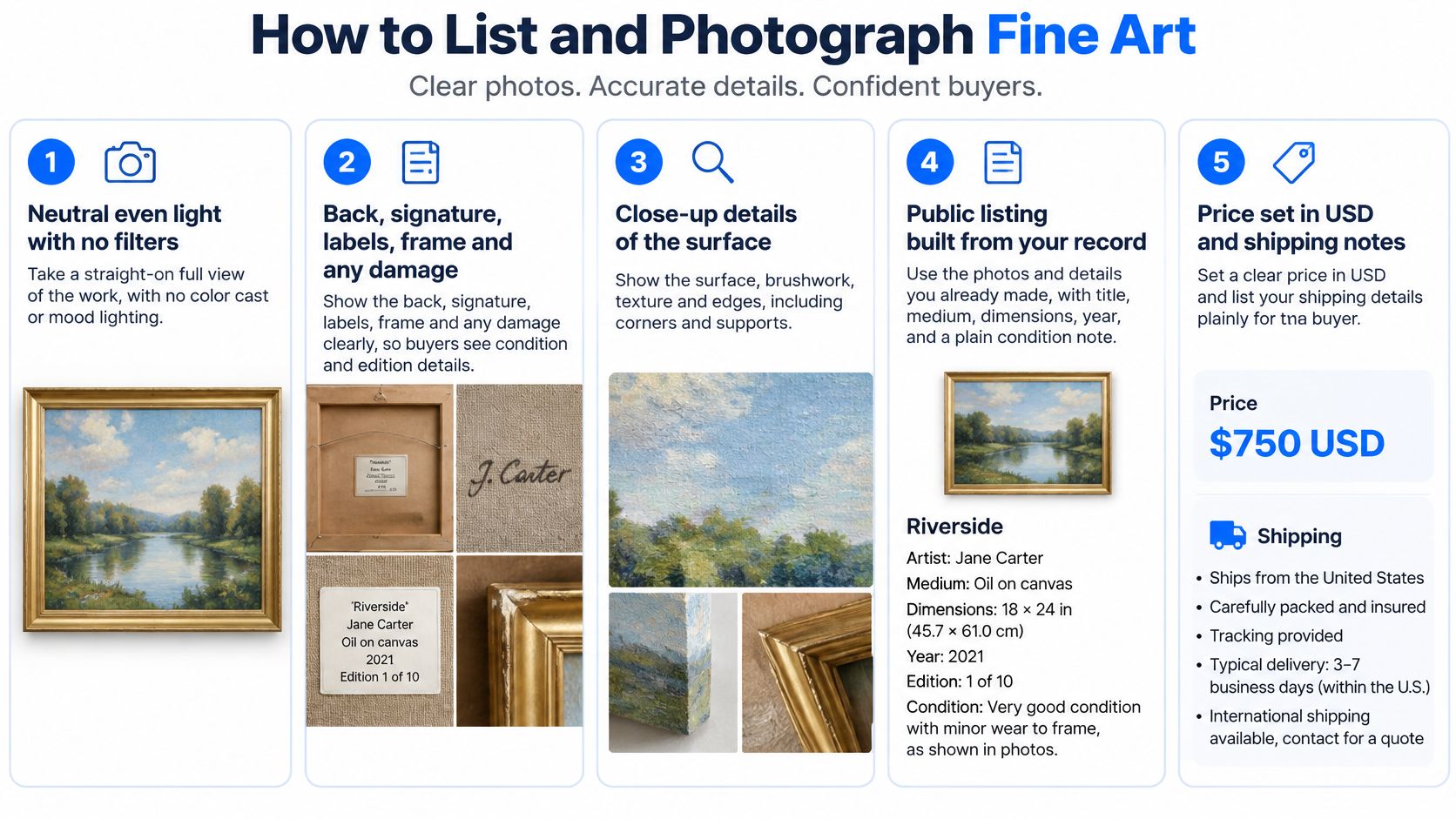
- Start with the whole object: Show a straight-on view without cutting off edges or corners.
- Show the reverse and frame: Include backing, hanging hardware, labels, and structural problems.
- Add readable details: Photograph signatures, edition marks, surface texture, and any damage close enough to inspect.
- Check color: Use a neutral reference and a calibrated display where available. Avoid filters and aggressive saturation adjustments.
Keep a room-view photograph secondary. It helps buyers imagine placement, but it shouldn't substitute for an accurate object view. Label digital room mockups clearly and don't use them to imply an unsupported scale.
Put buying decisions close to the price
State whether measurements include the frame and whether the frame is included in the sale. Use a consistent measurement system; if you add conversions, check them rather than relying on a marketplace's automatic field.
Describe condition with location and extent. Surface cracking along the lower edge tells a buyer more than age-related wear. Don't hide a defect inside flattering language such as character or patina.
A condition photograph should make the flaw easier to understand, not harder to notice.
Place delivery arrangements, applicable charges, returns, and transit-insurance responsibility where buyers can find them before paying. For a higher-value work, provide a separate condition report and identify who prepared it.
Finally, have another person match the listing against the object and photo folder. Ask them to check attribution, dimensions, edition marks, price, and included accessories. That review catches the ordinary cataloging mistakes that polished prose won't prevent.
Handle Payment, Shipping, Insurance and Tax
Agree on fulfillment terms before accepting payment. A buyer shouldn't discover after checkout that the work requires specialist packing, that collection is mandatory, or that the frame shown isn't included.
Use the platform's payment flow and verify payment status inside the account. Don't release artwork because someone emails a payment screenshot or promises that a transfer is processing.
Payment and local collection
At DIYAuctions, we use secure pre-payment, so buyers have already paid before collecting their items. Our sales finish with a coordinated local pickup day rather than repeated visits through the house.
For collection, organize sold works by inventory ID and keep fragile pieces away from general traffic. Confirm the collector is the buyer or an authorized representative, and retain a handover record. If the buyer sends a carrier, agree in advance who may sign for the work.
- Set collection terms: Publish the pickup arrangements and the procedure for missed collection.
- Document the handover: Record which object and accessories leave with the buyer.
- Resolve uncollected items properly: Under our terms, sellers can re-list them, donate them, or offer them to the next-highest bidder.
Payment disputes can turn on what was promised and what was delivered. Disputely's explanation of why online shoppers dispute payments is a useful prompt for checking your description, communication, and delivery records. Keep those records together rather than relying on messages scattered across accounts.
Shipping and insurance
Get a packing and shipping assessment before quoting delivery for a fragile or valuable work. Use a fine-art packer or custom crate where the object's construction warrants it. Don't place bubble wrap directly against a painted surface or assume ordinary parcel packaging protects an ornate frame.
Choose tracked delivery and check that the insurance covers the object, its value, packing method, route, and carrier. A declared value isn't a substitute for reading the coverage terms.
Your sales terms should identify who arranges insurance and how damage claims are handled, subject to applicable law. For international transactions, state the currency, delivery estimate, and who handles import duties and customs charges.
Authority and tax records
For estate property, confirm that the person directing the sale has authority to do so. Don't assume possession alone resolves an executor's, trustee's, or beneficiary's rights.
Tax treatment follows jurisdiction and circumstances. Use our guide to tax reporting requirements to organize your questions, then confirm collection, reporting, and inherited-property treatment with an accountant.
Retain the sale invoice, acquisition or inheritance records, selling expenses, condition photographs, provenance documents, and delivery confirmation. Calculate the payout from actual deductions, not just the headline selling price.
Launch the First Batch and Reach Collectors
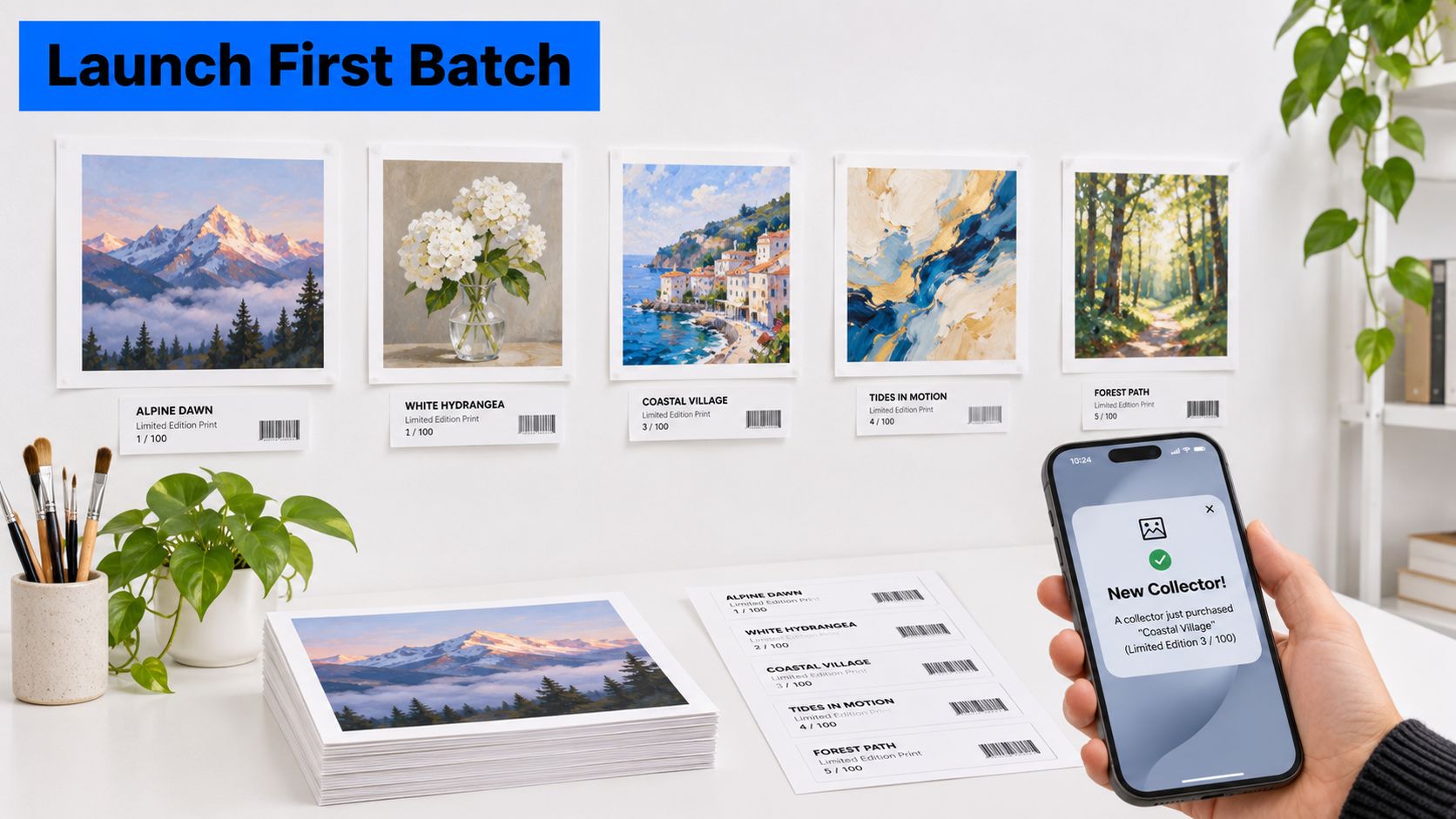
Launch a manageable group of ready works rather than waiting for the entire house or collection to be resolved. Choose objects with complete records, clear images, defensible descriptions, and a practical handover plan. Hold back anything whose identity or ownership needs investigation.
A completed purchase should leave both parties with a clear record of what changed hands.
Send buyers to a complete sales page
Publish the authoritative listing on the chosen channel, then market outward from that page. Keep availability synchronized if you also display the work elsewhere. A buyer shouldn't pay for something already sold through another route.
Email interested collectors a specific work, its asking price or auction terms, and a direct listing link. Explain why it may suit their interests without pretending an ordinary decorative picture is an investment opportunity.
For social promotion, use an engaging image and a clear reason to open the full listing. Sup Growth's Instagram growth tips for artists can help shape an outreach checklist, but follower growth shouldn't replace qualified buyer conversations.
- Answer publicly useful questions: If someone asks whether the frame is included, improve the listing instead of leaving the answer buried in messages.
- Record objections: Separate price concerns from delivery problems, uncertain attribution, and missing condition information.
- Follow through promptly: Send requested detail photographs and accurate answers rather than applying pressure.
- Update availability: Mark sold or withdrawn works immediately wherever you've promoted them.
For a visual introduction to the selling workflow, watch the following video.
Keep the channel accountable
Judge the first batch by completed sales, qualified inquiries, fulfillment effort, and the money you retain. If buyers engage but can't collect, the audience or delivery arrangement may be wrong. If visitors repeatedly question authorship, improve the evidence or narrow the claim rather than increasing promotion.
Don't move every unsold work immediately. Give each listing a fair test, document changes, and switch channels when you can identify what another channel would solve.
Choose the works you can confidently describe and prepare their listings this week. For a multi-item estate clearance, start with DIYAuctions' free estate sale pricing guide, which includes typical fee ranges, pricing guidance, and a 30-day launch checklist. We provide secure payments and buyer verification, with a commission of 10% of the sale price, capped at $1,000 per transaction. Compare the likely net return with your other options, then choose your reserves, closing window, and pickup day before publishing.
Get the estate sale pricing guide
Enter your email for pricing ranges, planning notes, and a clearer path to launch.