Lubbock Estate Sales: A Step-by-Step Local Guide
Learn how to plan, price and run Lubbock estate sales, from legal authority and sales tax to marketing and pickup day.

Lubbock's population reached 273,071 residents in the July 1, 2025 estimate, according to the U.S. Census Bureau. That's a substantial local audience for household goods, tools and inherited collections, but finding buyers isn't the first job. For Lubbock estate sales, the safer starting point is documenting who can sell, determining the tax requirements and building records that will still make sense after the house is empty.
A rushed listing can turn an unresolved family decision into a completed transaction. Get the authorization and accounting organized first, then tackle pricing, promotion and pickup.
Confirm Who Can Legally Sell the Contents
A will in a drawer isn't blanket permission to sell everything in the house. Possession, ownership and authority to act for an estate are different questions. Permission to handle a real-estate transaction also shouldn't be treated as an automatic answer about household contents.
Lubbock County's probate guidance distinguishes a will admitted as a muniment of title from proceedings involving Letters Testamentary or Letters of Administration, and warns that some asset holders won't release property without those letters. The county also directs probate applications and related papers to the County Clerk.
Build the authorization packet
- Identify the authorized representative. Record who will act for the estate and obtain the document establishing that person's authority. Being the relative who lives nearest the house isn't enough.
- Check the probate status. Confirm whether the will has been admitted and whether letters were issued. Have an estate attorney explain what the actual proceeding permits rather than guessing from a document's title.
- Resolve family approvals. Obtain written agreement on disputed belongings, exclusions and proposed sales where appropriate. Beneficiary consent helps document decisions, but it doesn't replace legal authority.
- Ask asset holders about release requirements. Contact the bank, storage facility or other custodian before promising property to a buyer. Keep their written requirements with the estate documents.
- Record item-level decisions. Mark property that belongs to someone else, has been promised to a beneficiary or must remain on hold.
- Get legal advice before publishing uncertain lots. Remote heirs, blended families and conflicting instructions are reasons to stop and clarify, not reasons to accelerate the sale.
Our estate sale laws guide can help organize the questions to take to counsel. Keep personal-property liquidation separate from any proposed transfer of the house itself.
Before you list: Written family agreement is useful evidence of a decision. It isn't a substitute for the authority required to carry it out.
A ready packet contains the authority document, a signed beneficiary consent list where applicable, the inventory and a record of who approved each item for sale. Store scanned copies in a shared folder with controlled access. If someone challenges a sale later, a clear approval trail is more useful than a message saying everyone seemed comfortable.
Lubbock Estate Sale Timeline by Phase
Timing mistakes can derail an otherwise sensible sale: the house must be cleared before the catalog is ready, listings go live while ownership is unresolved, or pickup begins without a payment station. Work backward from the actual possession deadline, not from the weekend that looks convenient.
Use the following as a sample planning calendar, not a guaranteed completion schedule. The checkpoints matter more than the dates.
| Timing | Main task | Finished when |
|---|---|---|
| Eight to twelve weeks out | Confirm authority and tax permit status before inventory work, walk every room, start the inventory and book specialist appraisals | Authority packet is complete, permit status is known and every room has an inventory list |
| Six weeks out | Photograph items, record marks and dimensions, research recent sold prices | Every lot has photos, a condition note and a price range |
| Four weeks out | Choose the sale format, set dates, publish listings and start local promotion | Sale dates are public and listings are live |
| One week out | Print lot tags, set up the cash box and log, plan the pickup layout | Checklist is signed off and tags match the catalog |
| Sale day or pickup day | Run the sale, log each transaction and reconcile payments that evening | Gross receipts match payment records |
| Two weeks after | Pay out authorized proceeds and decide on unsold items | Records are archived and unsold items have a plan |
Give each phase a finish line
Assign a named person to each checkpoint. A task marked “family” tends to stay unfinished because nobody knows whether they're responsible for it.
Don't publish uncertain lots just to keep the calendar intact. You can hold back an unresolved collection while moving approved ordinary goods through preparation.
For summer pickup, build in shaded waiting space, drinking water for helpers and a workable loading route. Around holidays, confirm helper availability before announcing dates. Add a buffer to your proposed schedule rather than assuming buyers, appraisers and relatives will all be available when needed.
Close-out also needs calendar space. An empty room doesn't mean the estate's records are finished.
How to Price Items Without Guessing
Pricing from memory usually means confusing what an item cost with what a buyer will pay now. A well-kept dining set can be useful without being scarce, while an unremarkable-looking tool may deserve careful identification before it goes into a mixed box.
Treat pricing as triage followed by market testing. Research effort should follow uncertainty and potential value, not the size of the object.
Work through the pricing passes
- Triage the contents. Photograph each proposed lot and record maker marks, dimensions, model numbers, condition, completeness and provenance. Separate jewelry, firearms, coins, art, antiques and high-end tools for specialist review when you can't confidently identify them.
- Check completed sales. Compare similar items that sold, not ambitious listings that remain available. Match maker, material, model, condition and included parts before treating a result as useful evidence.
- Document the selling decision. For fixed-price goods, record the opening price, minimum acceptable price and markdown trigger. For auction lots, establish an appropriate reserve before publication rather than planning to renegotiate after bidding.
The workflow keeps uncertain pieces from being priced like ordinary household goods.
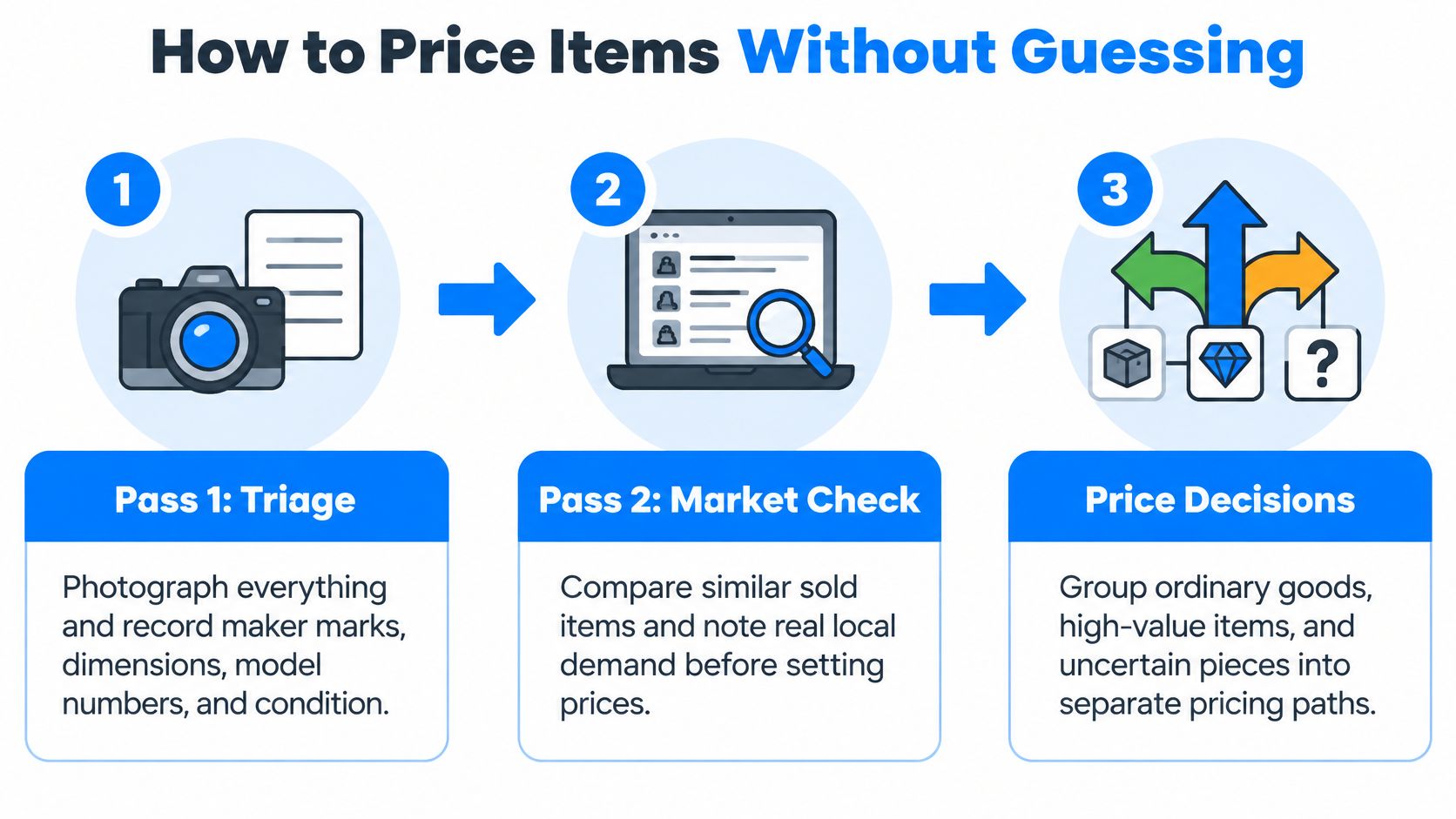
Say you're selling a solid oak dresser. Comparable completed sales may support an opening price toward the stronger end of the observed range if yours is clean and complete, but stairs, difficult loading or sticking drawers justify an adjustment. For a fixed-price sale, decide the markdown trigger before buyers arrive.
Pickup friction affects value. A heavy cabinet that requires disassembly asks more of a buyer than a boxed drill they can carry to the car. Describe that burden openly instead of relying on an attractive photograph to overcome it.
Keep the evidence relevant
Don't use local home-price trends to justify furniture prices. The Texas Real Estate Research Center limits its housing aggregates to residential properties sold through MLS systems, not household contents.
Give scarce branded goods more research time, and avoid burying them in miscellaneous lots. Group ordinary low-value items when individual cataloging would consume more effort than the likely return warrants.
Use our estate sale item pricing guide to structure the worksheet. Before publication, every lot should pass these checks:
- Identity: You can describe what it is without unsupported attribution.
- Condition: Damage, missing parts and testing limits are disclosed.
- Comparable evidence: Your price has a defensible basis.
- Pickup constraints: Buyers know what removal requires.
If a lot fails a check, use conservative pricing or seek an appraisal.
Reach Lubbock Buyers Locally and Online
Promote across Lubbock County rather than treating the nearest neighborhood as the entire market. Furniture needs buyers who can collect it, while a distinctive instrument or collectible may justify a buyer making a longer trip. Broad exposure helps only when the listing gives those buyers enough information to commit.
Start with a dated sale listing. Include the sale format, closing details, pickup arrangements and clear condition descriptions, then adapt that information for local groups rather than writing conflicting versions.
Match the channel to the contents
| Channel | Effort | Best for |
|---|---|---|
| Dated listing on sale platform | Low | Tools, vintage collectibles and instruments |
| Local buy-and-sell group post | Low | Dining sets, furniture and yard equipment |
| Neighborhood networks and yard signs | Moderate | Local buyers on sale days |
| Email to past buyers and collectors | Low | Repeat collectors and standout lots |
| Social post featuring standout items | Low | Items shown in use with a size reference |
In local groups, lead with recognizable items and the pickup area. Follow each group's posting rules and send buyers to the same catalog so availability stays consistent.
Neighborhood networks are useful for practical goods, especially dining sets and yard equipment. Signs can help with navigation, but check permission and applicable placement rules before putting them out. Remove them promptly afterward.
A browseable display helps buyers understand what's available, but online photographs should still isolate individual lots.

Spend effort before spending money
Email collectors with specific descriptions, not a general invitation to look through everything. A model number, maker mark or photograph of an instrument's label gives a specialist a reason to open the listing.
For furniture, show a useful room view alongside close-ups and measurements. A size reference helps, but it doesn't replace dimensions. Our neighborhood marketing tactics guide offers ways to organize that local outreach.
Paid promotion won't fix a listing that hides damage, omits dimensions or leaves pickup arrangements unclear.
As a sample campaign, allow a couple of weeks for initial promotion, then review remaining lots before extending it. Continue only when the unsold inventory justifies the work. If exposure is adequate but interest is weak, improve descriptions, grouping or pricing instead of repeatedly posting the same advertisement.
Run Sale Day and Close Out the Records
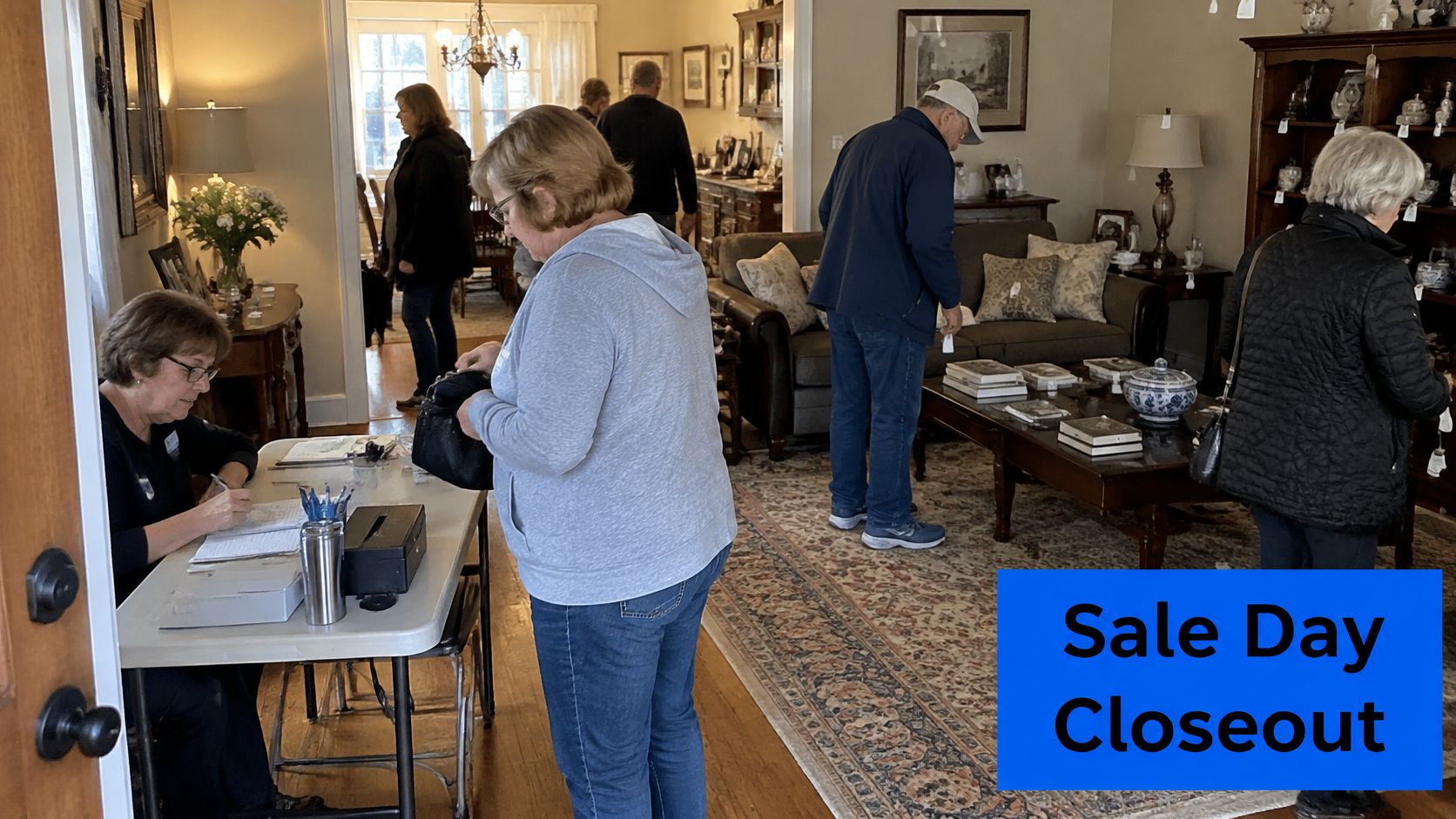
A steady flow of strangers through a house containing valuables and cash requires more than a friendly person at the door. Separate admission, payment and release duties so helpers aren't trying to watch every room while answering loading questions.
For an online auction, organize the property as a pickup site rather than reopening it for unrestricted browsing. For an in-person sale, clearly mark which rooms and items are off limits.
Keep the public area deliberate and easy to supervise.
Control access, money and release
- Set entry rules. Use designated entry and exit routes without blocking emergency exits. Keep a sign-in sheet and limit admission to what your helpers can supervise.
- Secure small valuables. Use a locked room for excluded property and a staffed counter for small high-value sale items. Don't leave jewelry beside an unattended checkout area.
- Record cash custody. Log the opening float, collections, transfers and closing balance. Have a second person verify opening and closing counts, with signatures identifying who handled the money.
- Record every transaction. Capture the lot number, buyer, final price, taxable amount, tax collected and pickup status. Release items against the payment record, not a buyer's verbal assurance.
- Reconcile that evening. Match receipts to cash, electronic payment records and deposits. Investigate discrepancies while helpers can still explain them.
Use a spreadsheet with separate fields for description, condition, provenance, asking price, final price and tax category. Don't overwrite the original asking price when a lot sells; preserve the difference so the accounting remains understandable.
Apply the tax determination correctly
The Texas Comptroller states that a person engaged in business selling tangible personal property in Texas generally needs a sales-and-use-tax permit; the state rate is 6.25%, with local jurisdictions adding up to 2%, for a maximum combined rate of 8.25%. Verify the rate and rules applicable to your transaction rather than automatically charging the maximum.
Estate ownership doesn't automatically make goods exempt. Nor should you assume that a household liquidation falls outside business activity because it looks occasional. Resolve permit status before cataloging and document the seller or estate's legal identity.
Keep the operating sequence visible to everyone helping. The following video offers additional estate-sale context.
Finish the estate records
Close-out is a separate task from clearing the driveway:
- Authorize distributions: Pay proceeds according to the estate's authority and obligations, retaining an accounting of expenses and payments.
- Resolve remaining property: Assign each unsold lot a documented next step.
- Handle uncollected purchases: With our process, sellers can re-list them, donate them or offer them to the next-highest bidder. Resolve the original transaction status before another disposition.
- Archive supporting documents: Keep donation receipts, payment records, tax-remittance proof and the final inventory together.
Don't distribute money that still needs to cover unresolved charges, refunds or estate obligations. A clean final file should explain both where the property went and where the proceeds went.
Which to Choose
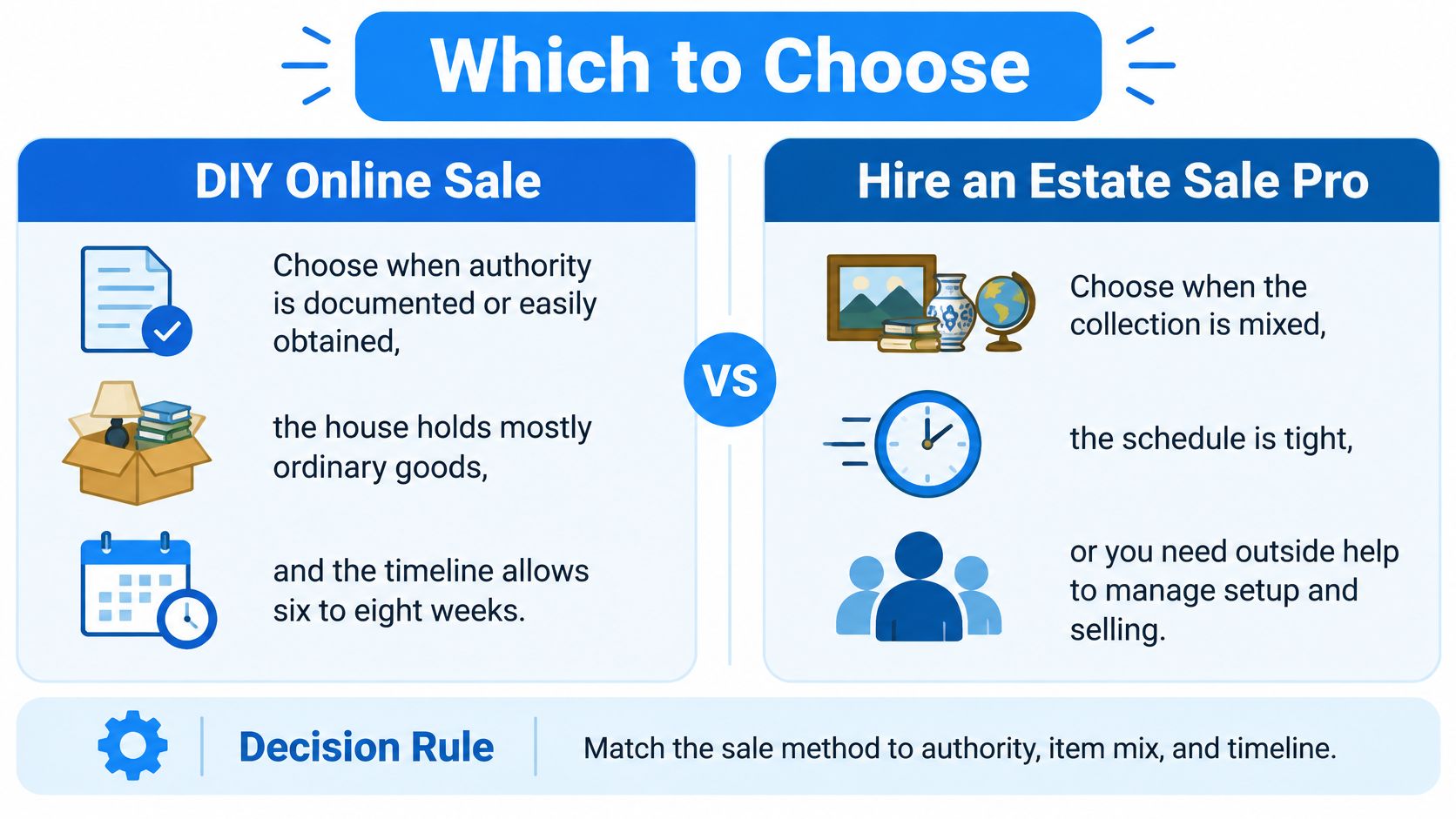
Choose a DIY online sale when authority is settled, the house contains mostly ordinary goods and someone can own the cataloging work. Choose outside management when the family can't supply that labor or the contents demand specialist judgment. Neither option removes the need for valid authorization.
A flexible preparation window helps with DIY work, but available hours matter more than the number of weeks on a calendar. A relative who can visit only briefly shouldn't become the default project manager just because they're comfortable using a computer.
Compare responsibility, not just commission
| Option | Typical commission or fee | Who prices and markets | Family time needed | Best fit |
|---|---|---|---|---|
| Traditional estate company | Contract-specific commission and charges | Company | Low to moderate | Large estates with many specialist items |
| Garage or yard sale | No platform fee, but unsold items still need handling | Family | High if repeated sale dates are needed | Small sets of ordinary goods |
| DIY online estate auction | Platform fee, confirm current terms | Family, with platform support | Moderate, concentrated in preparation | Downsizing or clearing a house with a flexible timeline |
| Specialist auction house | Consignment terms set by lot and category | Auction house | Moderate for documentation and consignment | Fine art and high-value collectibles |
For a traditional company, examine the proposed scope rather than assuming commission covers everything. Get written terms for setup, staffing, marketing, removal, unsold goods and the final accounting. A cheaper proposal isn't better if the family must still perform the tasks it needed help with.
A garage sale can be sensible for a modest amount of ordinary property. The trade-off is direct negotiation, public attendance and the possibility of repeating the work if too much remains. It's less attractive when distant relatives need a clear item-level record.
The decision depends on the work the family can realistically take on.
Understand the DIY exchange
With our process, the family creates lots room by room, chooses reserves and closing windows, and sets the pickup date. We publish the sale, route buyers, handle payment flow and keep bidding organized. Competitive bidding sets the final price, so buyers don't haggle.
The event ends with one coordinated local pickup day, rather than repeated days of buyers walking through the house. That concentrates the physical work, but it doesn't eliminate it. Someone still needs to label lots accurately, answer condition questions and supervise removal.
DIYAuctions charges 10% of the sale price, capped at $1,000 per transaction. Fees may change with 30 days' notice, so confirm current terms before listing. Compare the expected net proceeds after all selling expenses, not commission alone.
Specialist auction houses deserve consideration for fine art and high-value collectibles. Evaluate category knowledge, consignment conditions, transport and the proposed sales route. Ordinary household goods don't necessarily belong in the same channel as a documented collection.
Choose the method your family can execute accurately, not the one that looks easiest before anyone opens a closet.
A mixed approach can also make sense: hold specialist pieces for appraisal while preparing approved household goods for a local sale. Keep separate inventories and release instructions so nothing is accidentally included in both channels.
Before committing, name the person responsible for catalog accuracy, the person authorized to approve decisions and the person who will supervise removal. If those roles remain unfilled, reduce the scope or arrange outside help before announcing the sale.
Start this week by assembling your authorization packet, walking the house with the timeline table and setting a date for the first inventory review. If you're considering a seller-led auction, request our free estate sale pricing guide, which includes fee ranges, pricing guidance and a 30-day launch checklist. Use it to assess the workload before publishing your first lot, not as a substitute for resolving authority or tax questions.
Get the estate sale pricing guide
Enter your email for pricing ranges, planning notes, and a clearer path to launch.