Milk Glass Shoe Guide: Identify, Value and Sell
Learn how to identify a milk glass shoe, judge its condition and value, photograph it, and price it for an estate sale or online auction.
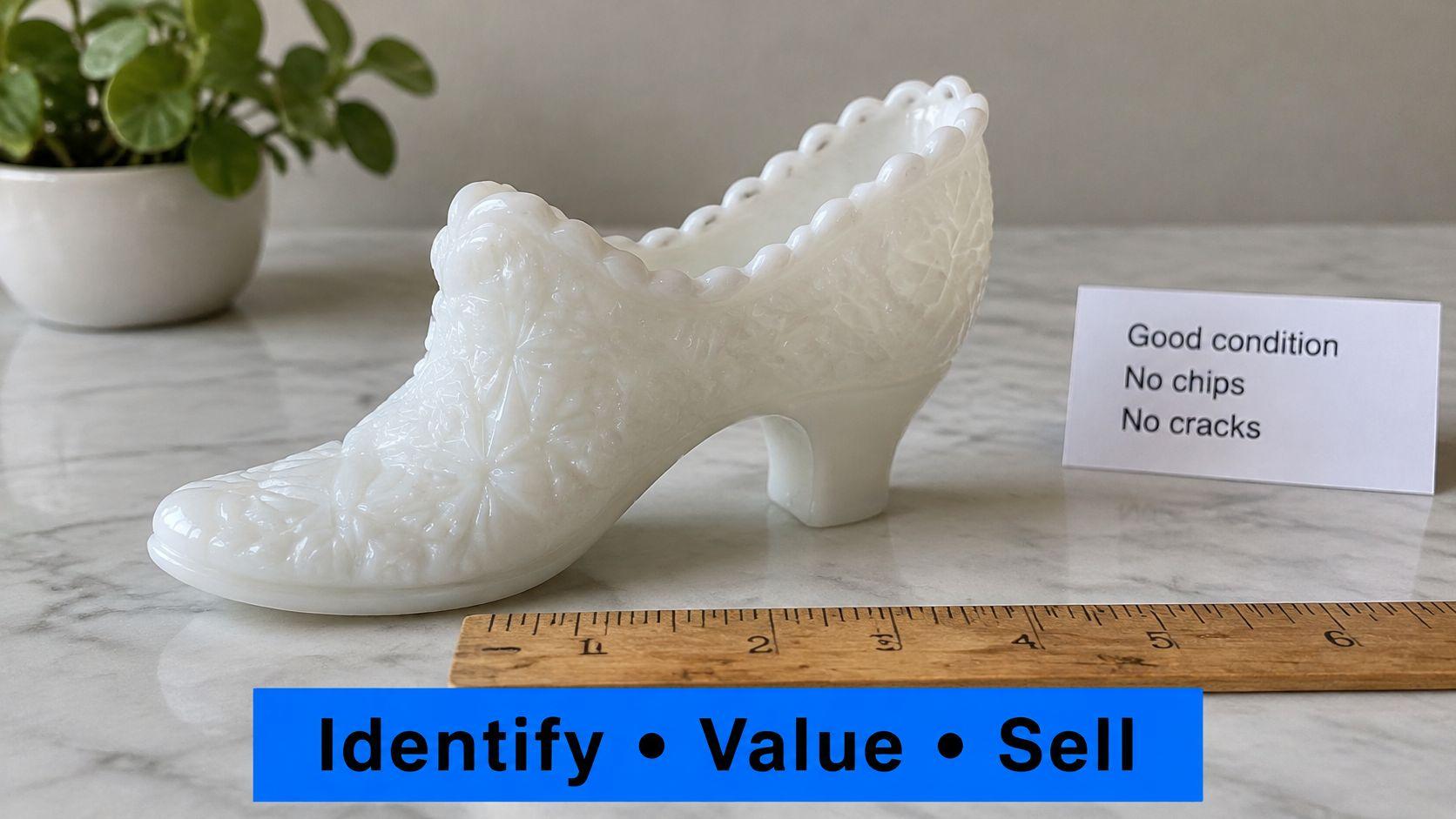
The popular advice to look for white glass, hobnails and an old-fashioned shoe shape isn't enough to identify a valuable collectible. A milk glass shoe can be attractive, vintage and still be common. Before you attach a maker's name or a premium price, you need evidence that distinguishes your piece from similar decorative shoes.
For an estate seller, the useful questions are practical: What is it made from? Can you support the attribution? Where is it damaged? And what have buyers paid for a comparable example? A careful inspection and an honest catalog entry will serve you better than an ambitious age claim.
Identify a Milk Glass Shoe Before You Price It
White color alone doesn't confirm milk glass. Porcelain, resin and glass can look remarkably similar in a listing photograph. Start with the object on a padded, well-lit surface, not with an image search for the closest-looking shoe.
Examine existing edge chips with a magnifier, look for molded seams and shine a cool light through thin areas. Don't create a scratch or chip to test the material. The milk glass reference explains that dispersed particles scatter light within the glass, producing appearances ranging from translucent and opalescent to fully opaque.
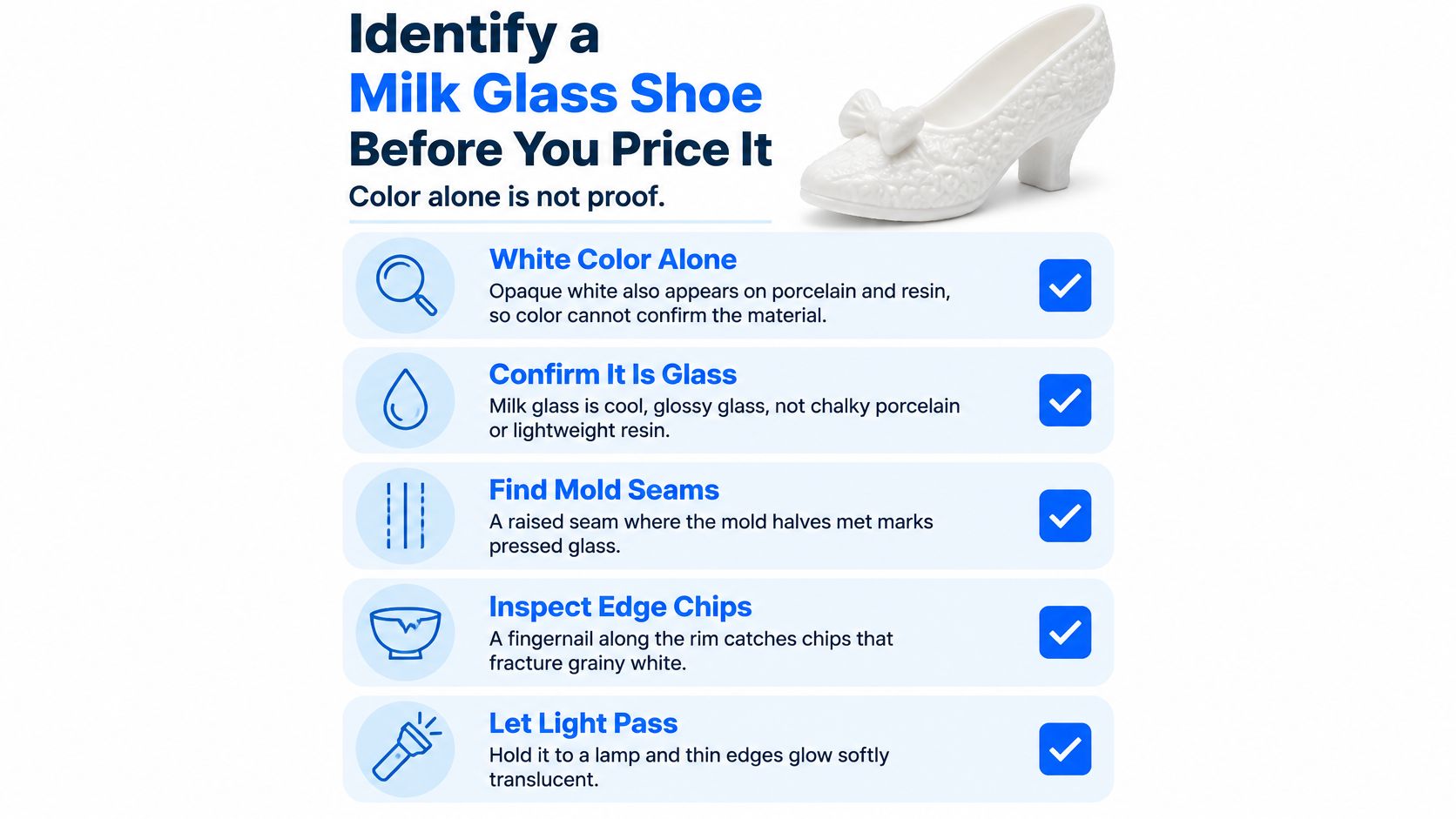
Five checks for identifying a milk glass shoe
| Check | What to look for | What it tells you |
|---|---|---|
| Material | Molded seams, existing edge chips, light passing through thin areas | Together, these support identification as glass rather than porcelain or resin |
| Forming method | Mold seam and repeated relief on pressed pieces, or uneven wall thickness on blown pieces | Points to the production method and helps narrow pattern comparisons |
| Opacity | Translucent, opalescent or fully opaque white | Describes appearance only, not proof of age or rarity |
| Base and heel | Base shape, heel construction, sole relief | Helps match the piece to documented patterns |
| Marks | Any maker's mark, partial label or molded mark | Supports attribution only when clear and legible |
Pressed examples may have repeated relief details, matching sides and a visible mold seam. Blown examples may show less uniform wall thickness. Treat these as construction clues, not a complete dating system.
Opacity is equally easy to overinterpret. Batch composition, melting conditions and cooling affect appearance, so a dense white shoe isn't automatically newer, older or scarcer than a softly translucent one. A glow at the rim is an observation, not an authentication result.
Practical rule: Record what you can see before deciding what you think it means.
Your working record should include length, height, base shape, heel construction, sole relief and surface wear. Describe an indistinct mark as indistinct rather than guessing at its letters. Keep provenance separate from physical findings: a family recollection can guide further checking, but it doesn't establish a manufacturing date.
The useful output is a short, reproducible description that another person could verify by handling the same object.
Match the Maker Without Overclaiming
Hobnails plus a shoe shape do not equal Fenton. That shortcut turns a pattern observation into a manufacturer claim without the evidence in between.
The Antique Answers milk glass identification guide identifies Fenton, Westmoreland, Kemple, Hobbs Brockunier and British manufacturers among producers of hobnail milk glass; it dates Fenton's milk-glass hobnail introduction to 1950 and notes that earlier Fenton milk glass can be less dense and opaque than production from 1958 onward. Those comparisons help you investigate an attribution, but they don't identify a shoe by themselves.
Use company history as a boundary
The West Virginia Encyclopedia's Fenton history records the company's beginning in 1905, construction of its Williamstown factory in 1906, and the end of traditional glassmaking in 2011. These dates establish the company's production context, not the age of an unmarked object.
A date claim still needs a documented pattern match or other supporting evidence. Likewise, the end of traditional production is a useful boundary when evaluating a seller's description, not permission to date every recognizable Fenton-style object to the same period.
Marks require similar restraint. Fenton's logo generally appears on later production, while Westmoreland used different marks over its history. An unmarked base doesn't automatically exclude a manufacturer, and an unclear raised shape doesn't justify reading a familiar logo into it.
Build an attribution from matching details
Use a comparison sequence rather than choosing the most familiar brand:
- Start underneath. Compare sole relief, base outline and heel attachment with documented examples.
- Compare the entire mold. Check the opening, toe profile, rim treatment and arrangement of raised decoration.
- Check dimensions. Similar-looking shoes may differ in size or proportions.
- Assess the mark independently. Photograph it clearly before comparing it with an identified example.
- Assign confidence. Use confirmed, attributed or maker unknown according to the evidence you have.
Kemple, Hobbs Brockunier and British makers remain possibilities, not fallback attributions. Evidence that a company produced hobnail glass doesn't establish that it made your particular shoe.
When support is weak, use maker unknown, pressed white milk glass. Add a likely period only if you can explain the basis. A cautious description isn't a weaker listing. It gives buyers a clear boundary between identification and inference.
Check Condition and Clean Without Damage
Inspect the heel, toe, narrow sole and projecting decoration before concentrating on the broad side panels. Changes in glass thickness can concentrate stress, making these areas particularly important during handling. The opal glass materials guide explains the role of controlled cooling in reducing residual stress, a useful reason to avoid abrupt temperature changes with vintage glass.
Use a bright lamp at a low angle and rotate the shoe over a padded tray. Don't run a bare fingertip along a visibly broken edge. A magnifier and close photograph are safer ways to establish whether a rough area is a chip, seam or production irregularity.
Defects to record and where to find them
| Defect or feature | Where to look | How to record it |
|---|---|---|
| Chips | Toe, heel and narrow sole | Size, location and whether edges are sharp |
| Flea bites | Rim and toe edges | Count and location |
| Hairline cracks | Heel, toe and molded projections | Photograph under side light |
| Repairs | Base and seams | Note adhesive or fill if visible |
| Staining or yellowing | Interior and base | Describe extent; don't scrub |
| Iridescence | Surface in raking light | Note as a surface feature |
| Manufacturing bubbles | Walls and base | Describe as a production feature |
Separate damage from manufacturing features. An enclosed bubble isn't the same as a missing fragment. Similarly, a mold seam shouldn't be called a crack just because it forms a visible line.
If you can't resolve a suspicious area, photograph it and state the uncertainty. Don't conceal it beneath a broad condition grade such as excellent.
Clean only as far as necessary
- Photograph the untouched piece. Preserve the appearance of labels, residue and suspicious joins before handling them.
- Test an inconspicuous area. Use a soft, nonabrasive microfiber cloth lightly dampened with room-temperature water.
- Wipe gently. Avoid soaking paper labels or pushing moisture into a suspected repair.
- Dry completely. Support the shoe on a soft cloth rather than balancing it on its heel.
Keep it out of the dishwasher. Don't alternate hot and cold water, polish the surface, scrub stubborn deposits or conduct chemical tests. Aggressive treatment can remove evidence that helps identify the piece, while a cleaner-looking repair is still a repair.
A disclosed stain is preferable to a damaged surface created while trying to remove it.
The selling advantage comes from making condition understandable, not making the shoe appear untouched. Buyers should be able to locate each disclosed defect without having to ask for another photograph.
Photograph and Catalog Each Shoe Step by Step
Every photograph should answer a buyer's question. A handsome side view establishes appearance, but it won't show whether the heel is repaired or the base carries a mark. Build a repeatable sequence so you don't finish cataloging an estate and discover that every shoe needs to be unpacked again.
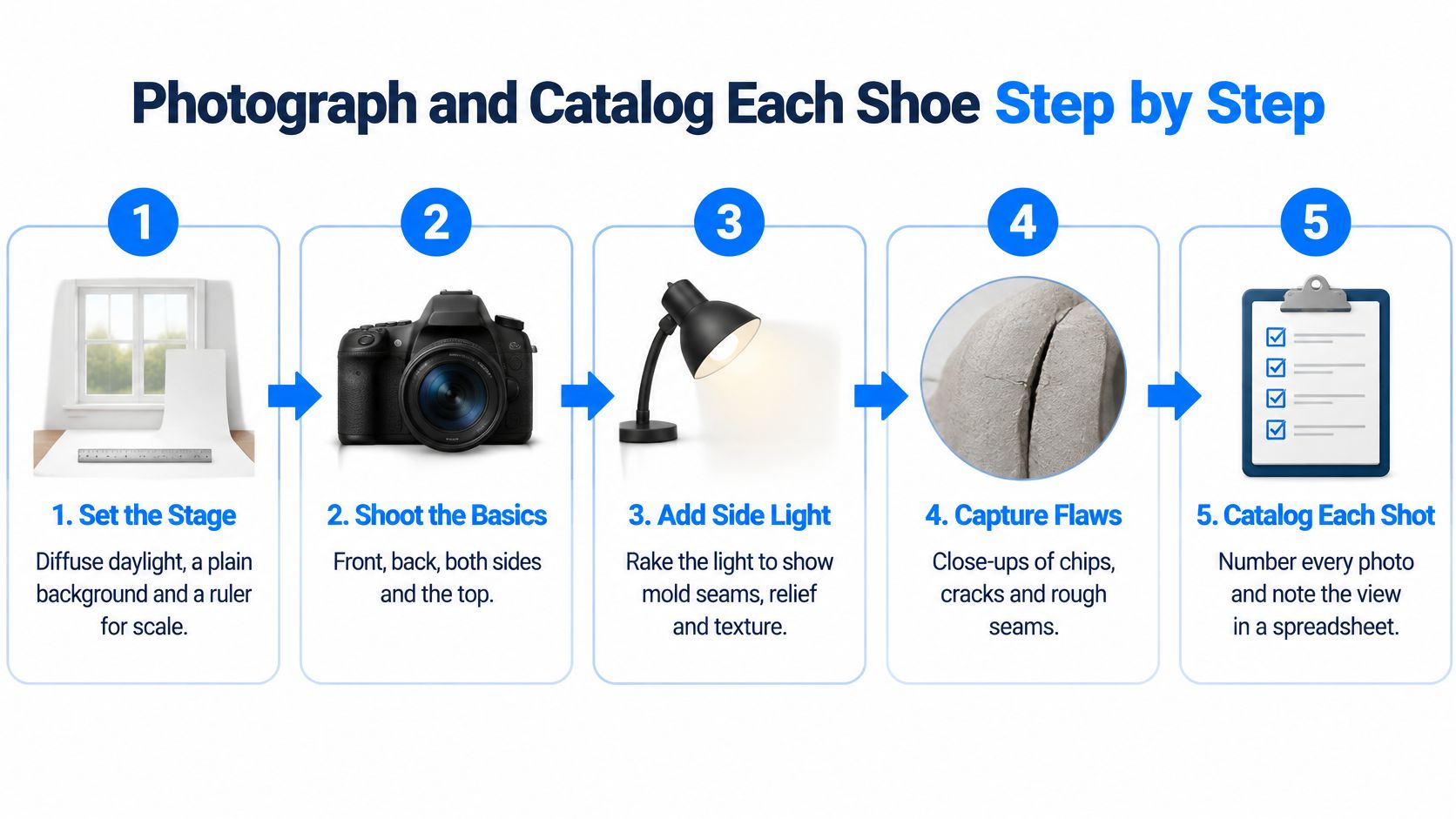
Capture the evidence in a consistent order
- Set up diffuse daylight. Use a plain, contrasting background and include a ruler in a reference view. Buyers need a reliable sense of scale, not a distracting display.
- Photograph the overall form. Capture the front, back, sides and opening. Leave enough space around the object to avoid cropping away the toe or heel.
- Add side lighting. Move the lamp so light skims the surface. This makes relief, seams and texture easier to judge.
- Use transmitted light. Place a cool light behind the shoe to reveal thin areas and bubbles. Keep this separate from the normal-light views so buyers don't mistake the lighting effect for its everyday color.
- Capture the vulnerable details. Photograph the base, sole, heel, toe and every disclosed defect. Take a wider location shot as well as the close-up.
- Record measurements. Note length and height, plus weight if you have a suitable scale. Describe the heel and base rather than assuming the photographs explain them.
- Write a supportable title. Lead with the object and visible pattern. Add a manufacturer only at the confidence level your evidence supports.
- Describe condition by location. Replace vague praise with specific findings and corresponding image references.
- Review the listing before pricing. Confirm that the object, photographs and description agree before selecting completed-sale comparisons.
For help controlling glare and backgrounds, use this guide to photographing antiques. Avoid filters that make white glass look creamier or brighter than it appears in ordinary light.
Keep the catalog usable after photography
Assign each shoe a lot identifier and use that identifier in its image filenames. Keep a simple spreadsheet with columns for title, measurements, attribution confidence, condition, photograph references and storage location.
An example entry might describe an unmarked pressed milk glass shoe with hobnail decoration, an open top and a rim chip, followed by the measured dimensions. That gives a buyer usable facts without turning a tentative comparison into a brand claim.
Don't hide uncertainty in the final line. Put attribution confidence beside the maker field, where a skimming bidder will see it.
Set a Realistic Price for an Auction or Estate Sale
Hobnail milk glass shoes are often common, so the pattern and apparent age alone rarely justify a premium. Price the specific shoe based on condition and evidence buyers can check, not the highest asking price for a similar-looking piece.
Reference price points from documented sales
| Reference point | Typical range | What it does not prove |
|---|---|---|
| Common Fenton hobnail pieces, a category range in the hobnail milk glass identification guide | $8–$40 | Not a value for an individual shoe |
| Westmoreland hobnail examples, the same guide's category range | $15–$60 | Not evidence that an ordinary shoe qualifies for a rarer-form premium |
These ranges cover hobnail objects, not shoes alone. Treat them as context, not a minimum price, and don't average unlike forms together. A comparable sale is useful only when its form, attribution and condition are close enough to your piece to explain the comparison.
Choose comparables that survive inspection
Search completed sales rather than active listings. An asking price shows what a seller hopes to receive; a completed transaction shows what a buyer accepted for that particular item.
Compare details buyers can verify:
- Exact form and size. Match length, height, toe profile and opening, rather than comparing only white hobnail glass.
- Function. A planter, ashtray and decorative shoe are different forms of comparison.
- Attribution strength. Distinguish clearly identified pieces from listings that repeat a familiar brand name.
- Condition and completeness. Consider rim damage, repairs, discoloration and original packaging.
- Mold detail. Look for distinctive features, not just a similar silhouette.
Use the collectible pricing guide to organize the comparisons. Keep the listing details with your working records and note why each example is relevant or unsuitable. That gives you a defensible basis for an estimate without turning a broad category range into a claim about one shoe.
Set a starting bid you can accept
A conservative opening bid may attract participation, but choose one you're prepared to accept unless the auction format provides another safeguard. Include the time required for cataloging and buyer coordination, along with any packing obligation, when deciding whether the likely proceeds justify the sale.
Condition and supported attribution can matter more than apparent age. A clean, clearly attributed later shoe may appeal more than an older unmarked example with rim damage. Neither age nor a familiar pattern guarantees a higher result. Price the object buyers will receive, and let documented details support any premium.
Pack and Ship Fragile Glass Safely
Protect the heel, toe and narrow sole before adding decorative wrapping. Tight packing that presses directly on a projection can be as unhelpful as loose packing that allows the shoe to move.
Choose pickup or shipment before publishing the lot. Buyers need to know whether they're collecting a wrapped object locally or paying for protective packaging and transport. Don't discover after the auction that the expected proceeds won't justify the shipping work.
Support the object without loading the projections
- Wrap each shoe separately. Start with acid-free tissue, then add bubble wrap. Don't let glass surfaces touch, even when the shoes belong to the same lot.
- Build support around the shape. Cushion the space around the heel and toe without forcing material into a delicate opening.
- Choose a rigid box. Leave generous room for cushioning on every side, including beneath the sole and above the opening.
- Fill empty space. The wrapped shoe shouldn't slide or knock against the box when you gently change its position.
- Keep packing materials off labels. Apply tape to wrapping, never directly to glass or surviving paper labels.
- Mark and store appropriately. Label the parcel fragile and keep it away from direct heat while awaiting dispatch.
Sendaparcel's fragile parcel packaging tips are a useful reference when choosing cushioning and an outer carton. For estate-sale preparation, this guide to packaging fragile items can help you organize supplies before pickup day.
Document the handoff
Photograph the shoe's condition before wrapping, then retain an image of the packed item and lot identifier. Put any existing damage in the written description rather than relying on a verbal reminder at collection.
Handoff check: Match the lot identifier to the buyer's receipt before the package leaves your table.
For a shared pickup event, stage protected lots on a stable table with clear identifiers. Keep unwrapped display pieces away from the edge and from bags buyers might set down.
Good packing protects more than the glass. It preserves the agreement between the photographs, the description and the object the buyer receives.
Decide How to Sell Your Milk Glass Shoes
Choose the selling method for the whole group of belongings, not just the shoe that caught your attention. A collection of glass footwear alongside bowls, vases and household goods presents a different task from selling a single well-documented specialty piece.
The practical test is whether separate listings are likely to justify separate photography sessions, messages, packing and handoffs. A consolidated online estate auction can suit a mixed household clearance because you build a coordinated catalog and arrange a shared pickup event. Individual sales may make more sense when a distinctive piece needs focused exposure and you have time to wait.
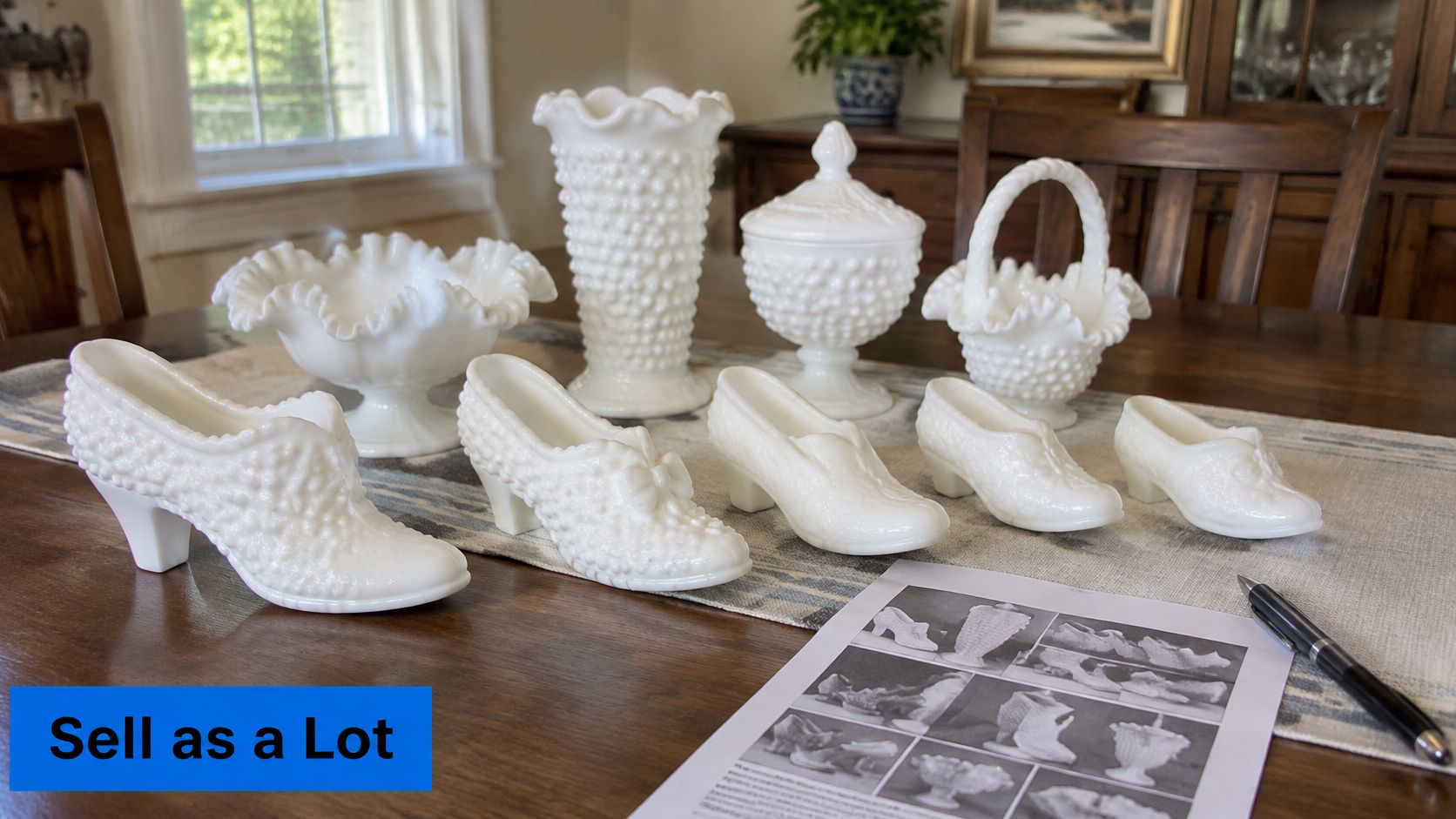
Sort by evidence and effort
Don't give every object the same amount of research time. Start with pieces that have readable marks, distinctive construction or useful documentation. Keep ordinary unmarked examples separate so a confident attribution on one shoe doesn't spill over into the description of another.
For each proposed lot, compare the likely proceeds with the work still required. A badly damaged common piece may not justify an individual listing. Grouping can reduce handling, but it shouldn't hide defects or imply that unrelated shoes form an original set.
Put the sale into motion
- Sort by attribution confidence. Keep confirmed, tentative and unknown makers distinct in your working inventory.
- Catalog the strongest pieces first. Establish your photography and description standard before processing the remainder.
- Choose individual or grouped lots. Give distinctive items room to stand alone; make grouped descriptions item-specific.
- Set acceptable starting bids. Use relevant completed sales and your willingness to complete the transaction.
- Schedule the sale and pickup. Allow time for buyer questions and keep identified lots accessible.
- Remove unsuitable pieces. Set aside objects whose instability or unclear condition prevents a responsible listing.
Don't let an approaching sale date become a reason to guess. If a milk glass shoe can't be described accurately with photographs, it isn't ready to list.
Start by inspecting and photographing your best-documented shoe, then use that finished entry as the standard for the rest of the collection. If a coordinated estate auction fits your workload, consider DIYAuctions for cataloging your lots, choosing starting prices and dates, and organizing local pickup. Confirm the current seller terms and available marketing and payment services before scheduling, then publish only the claims your evidence supports.
Get the estate sale pricing guide
Enter your email for pricing ranges, planning notes, and a clearer path to launch.