Revenue Reporting for Estate Sales and Auctions
Learn revenue reporting essentials for estate sales and auctions. Discover key metrics, templates, and best practices to simplify tracking and compliance.
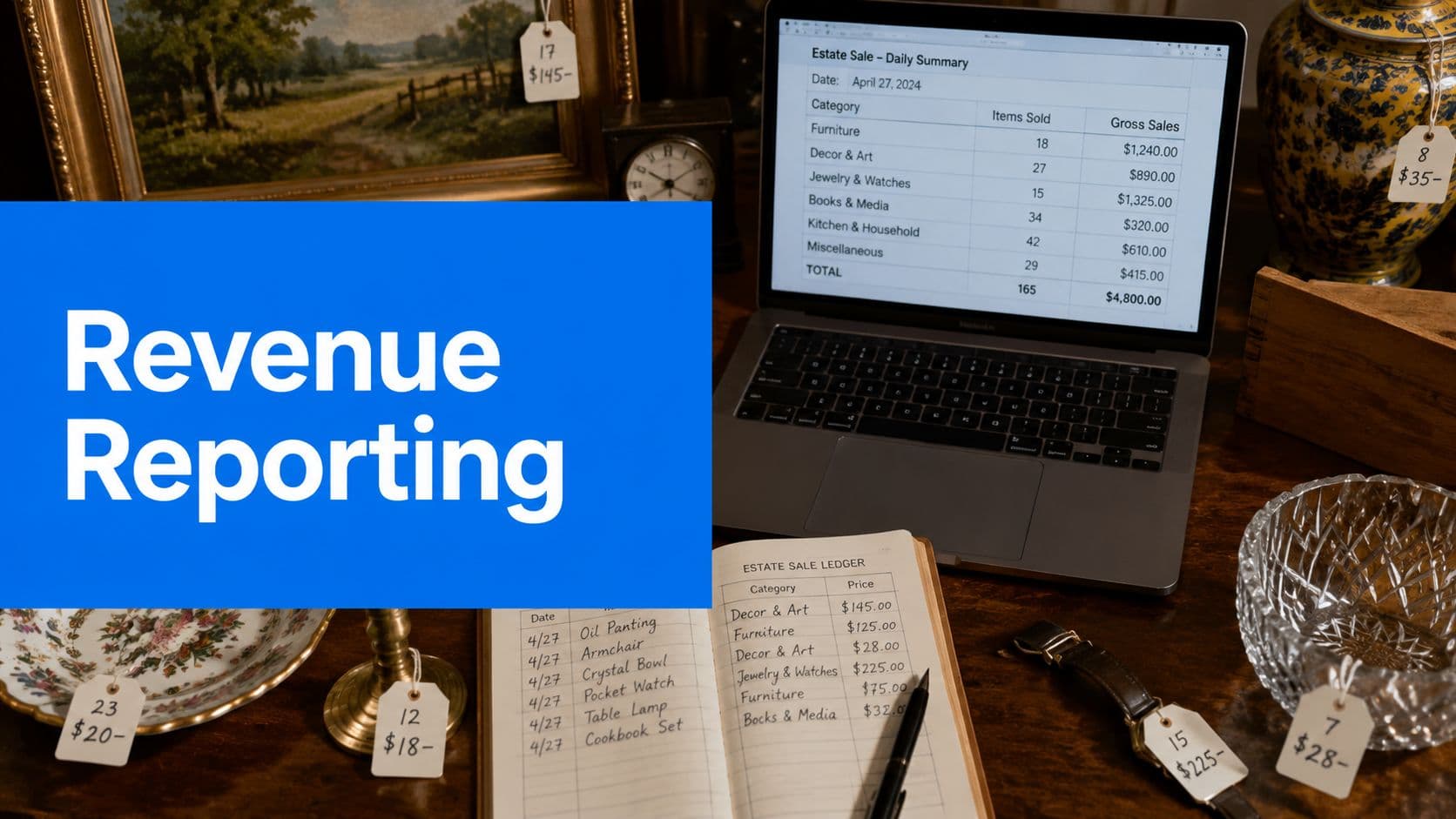
You're standing in a house full of tagged furniture, a few jewelry trays, stacks of books, and a phone that won't stop buzzing with bids and buyer questions. By the time pickup day ends, the sale may have felt busy, even successful, but the question is simple: what did you earn after fees, refunds, and any last-minute adjustments?
That's where revenue reporting earns its keep. For estate sales and auctions, it turns a messy stream of bids, payments, and pickups into one clear financial story you can trust, share, and file away for later. The goal isn't to turn a one-time liquidation into corporate finance. It's to give hosts, heirs, and advisors a clean picture of what happened, item by item and sale by sale.
Why Revenue Reporting Matters for Your Estate Sale
A sale can feel like it went well right up until the receipts, bid sheets, and payout notices are spread across a kitchen table. One item sold fast, another got discounted at the last minute, and a buyer paid through one channel while pickup was confirmed through another. Without a reporting process, that kind of sale leaves people with a vague impression instead of a number they can defend.
That matters because an estate sale is usually a one-time event, not an ongoing business. You don't get another chance to go back and reconstruct the numbers cleanly once the house is empty and the items are gone. A solid revenue report gives you financial clarity, but it also gives heirs, executors, and advisors a record of what was sold, what was collected, and what was paid out.
The other reason it matters is emotional. Estate sales often happen during a move, after a loss, or under time pressure. A clear report lowers the mental load because you're not trying to remember whether the dining room set sold for more than the rugs, or whether a refund was already processed.
Practical rule: If you can't explain the final payout from your sale in a few lines, you probably don't have a usable revenue report yet.
The same idea shows up in official finance systems. The OECD's standardized Revenue Statistics framework exists so revenue can be compared consistently across countries and over time, because numbers only become useful when they're defined the same way. For estate sales, the logic is smaller in scale but identical in spirit, the report has to mean the same thing from start to finish. The OECD's long-running framework shows why consistent definitions matter in any revenue system, even if your sale lasts only a week. OECD Revenue Statistics framework
What Revenue Reporting Actually Means
Think of revenue reporting as the scorecard at the end of a game. The game is the sale itself, the points are the dollars collected, and the scorecard only matters if every point is counted the same way and the final number can be checked. In an estate sale or auction, that means recording every sale, subtracting refunds or fees, and presenting a result that someone else could review without guessing.

Gross sales, fees, and payouts
The first number most sellers see is gross sales, which is the total amount buyers agreed to pay before deductions. If a chair sells for $200 and a lamp sells for $50, gross sales are $250. That number is useful, but it's not what lands in your account.
Next come fees, which might include platform commission and payment processing costs. Those are part of the sale's cost structure, so they need to be shown separately instead of getting buried inside the final payout. If a report skips that step, you can't tell whether a lower payout came from weak pricing or higher fees.
The last number is net revenue or payout, the amount left after deductions. For estate-sale hosts, that's the figure that usually matters most because it's the money available to distribute, save, or account for. If you want a simple primer on how a statement groups money before and after costs, how a P L is like a can help the structure make more sense, even though an estate sale is much simpler than a full business ledger.
Revenue reporting sits between bookkeeping and tax filing. Bookkeeping records what happened, tax filing reports it to the right authority, and revenue reporting turns the sale into a readable summary first. Under the ASC 606 and IFRS 15 five-step recognition model, accurate reporting depends on mapping contracts, obligations, pricing, and recognition logic, not just staring at invoice totals. That's the business version of the same principle estate hosts need, the final number has to come from a traceable process, not a guess. Revenue reporting and recognition basics
Key Metrics Every Estate-Sale Seller Should Track
A lot of sellers stop at the payout figure, then wonder later why it's hard to explain the sale to a beneficiary or accountant. The better approach is to track the pieces separately so you can see where the money came from and where it went. That makes the report useful for both judgment and recordkeeping.
| Metric | What It Measures | Example Value |
|---|---|---|
| Gross sales | Total winning bids before deductions | $14,500 |
| Platform fee | Sale commission charged by the auction platform | 10%, capped at $1,000 |
| Payment processing fees | Card or electronic transaction costs | Fee per transaction |
| Refunds or chargebacks | Money returned to a buyer | $0 |
| Net revenue | Amount left after deductions | Final payout |
| Sell-through rate | How much of a category or listing actually sold | A box of books sold as one lot |
Why each metric tells a different story
Gross sales show demand. If a dining table sells for $500, you know the market accepted that price. If a box of books sells for $20, you know the category moved, but at a different pace.
Platform fees show the cost of selling. DIYAuctions' sales-performance guidance also frames lot-level results as a performance metric, which is useful because a fee line should never be mistaken for item value. Sales performance metrics guide
Payment processing fees show how much friction comes from taking money electronically. They're small on a per-transaction basis, but they still belong in the report because they reduce the amount you keep.
Refunds or chargebacks show whether the sale had reversals. If there aren't any, that's good. If there are, they need to sit beside gross sales so the report stays honest.
Net revenue is the number that is often remembered, but it makes the most sense only after the other lines are visible. That's especially true when you're distributing proceeds to heirs or keeping documentation for a tax professional.
Sell-through rate helps you read the room. If furniture moved quickly but linens sat unsold, the report tells you what the market liked and what it ignored.
A simple rule helps here. If you can only track three numbers, gross sales, fees, and net revenue tell the most complete story.
Reconciling Sales Data Across Systems
Estate-sale hosts rarely get a single neat report that contains everything. The auction platform knows what sold, the payment processor knows what cleared, and the pickup table knows what left the property. Reconciliation is the process of making those three views agree.

A simple four-step reconciliation routine
- Export the platform sales report. Start with the auction summary so you have a list of winning bids, lot numbers, and buyer names.
- Cross-check payment deposits. Match those sales against what the processor deposited into the bank account.
- List offline payments or adjustments. Cash payments, manual discounts, and post-sale refunds belong in a separate note so they don't vanish.
- Calculate the reconciled total. Once every line is matched, you can state the final revenue number with confidence.
Here's a small example. Suppose your auction report shows $1,200 in sales. The processor deposits $1,170 after fees, one buyer pays $30 in cash at pickup, and you issue a $20 refund for a damaged item. Your reconciled revenue isn't just the platform total or the deposit total. It's the number that reflects all four pieces together.
Reconciliation isn't a sign that something went wrong. It's how you catch timing gaps, missing transactions, and manual overrides before they become confusion.
This is also where estate sales differ from clean retail systems. A buyer may win online, pay later, and pick up in person. A cousin helping with checkout may accept cash for a small lot. A damaged item may need a partial refund after pickup. None of that means the report failed. It means the report has to be built from more than one source.
The best habit is to reconcile while the sale is still fresh. Waiting too long makes it harder to remember why a transaction was adjusted, especially when several family members or helpers handled the event.
Tax and Compliance Considerations for Estate Hosts
Many estate-sale hosts aren't operating a business at all. They're executors, heirs, trustees, or homeowners clearing out a property. That changes the tone of the paperwork, but it doesn't remove the need for records.
The first question is simple: what kind of sale was it? Personal estate liquidations and business asset sales are treated differently, so the reporting context matters. If the sale came from inherited household goods, the proceeds may need to be documented for the estate or distributed to beneficiaries. If it came from business assets, ordinary income rules may apply instead.
This is one reason a clean revenue report helps. It shows what was sold, what was collected, and what ended up in the final payout. That makes it easier to answer questions later from an estate attorney, an accountant, or a tax authority if records are requested.
DIYAuctions processes payments, but it doesn't replace tax advice. If the sale involves inheritance, a trust, or a larger collection of assets, a tax professional can help determine how the proceeds should be handled. If you're unsure whether local obligations apply, a local sales tax lawyer can also be a useful starting point for understanding state-level issues.
Keep the report even after the sale ends
A lot of hosts think compliance ends when the pickup truck leaves. That's not really true. The report itself becomes documentation, which means it can serve as proof of sale proceeds long after the event.
- Save the final report: Keep a copy with the sale date, item list, and payout summary.
- Keep adjustment notes: Refunds, discounts, and offline payments should be documented in plain language.
- Store distribution records: If beneficiaries receive proceeds, note who got what and when.
That recordkeeping usually feels boring in the moment. Later, it's the thing that saves you from having to reconstruct the sale from memory.
Reporting Frequency and Template Design
A strong revenue report doesn't have to be complicated, but it does have to arrive at the right times. For estate sales, the cleanest habit is to pull a report three times: first when the auction closes, again after pickup once payments have cleared, and one last time after any late adjustments settle out. The timing matters because a sale can look finished before the final money lands.

A template that stays useful across sales
A simple template keeps the process from turning into a scavenger hunt. The structure can be plain, as long as it's consistent.
- Sale summary: Dates, number of items listed, and number of items sold.
- Financial summary: Gross sales, fees, and net revenue.
- Category breakdown: Furniture, collectibles, electronics, books, linens, and any other useful grouping.
- Notes and adjustments: Refunds, cash payments, disputes, and manual corrections.
- Distribution record: Who receives the proceeds and when they're paid.
That structure works whether you're running one estate sale or several in a year. It also makes later tax preparation easier because the same categories keep showing up in the same place. A spreadsheet is enough if that's what you have. If you prefer a more guided format, DIYAuctions has a financial report preparation guide that fits the same basic logic.
Practical rule: Use the same template every time. Consistency matters more than design.
The value of a template is that it helps you compare sales without rethinking the format each time. If furniture always sits in one line, collectible items in another, and adjustments in the same note field, you can scan the report quickly and see what changed from sale to sale. That kind of stability is especially useful for hosts who may only run an estate sale once or twice, because it reduces the chance of forgetting where a number belongs.
A Worked Example of an Estate Sale Revenue Report
A host catalogs 150 items from a family home, including a $2,000 antique dining set, smaller kitchen goods, vintage décor, and a box of paperback books. The sale runs as a seven-day online auction, with pickup scheduled for Saturday. By the time bidding closes, gross sales total $14,500, and the host has enough detail to build a report instead of just celebrating the result.
The platform fee is simple to interpret because the commission model is transparent, with a 10% commission capped at $1,000. In a sale this size, the cap matters, because the fee does not keep rising with the full gross amount. Payment processing fees still apply on individual transactions, and there are no refunds in this example, so the report stays clean.
The final payout becomes the number the host cares about most, but the category breakdown tells the better story. Furniture drives most of the revenue, while books and linens contribute far less. That doesn't mean the smaller items were a failure. It means they helped complete the sale, attracted buyers, and cleared space that would have been harder to sell later.
What the report reveals
- Furniture: The antique dining set anchors the sale and shows where the strongest demand lived.
- Books and linens: These items move, but they don't carry the same dollar weight.
- Miscellaneous household goods: Smaller lots help fill in the auction and improve overall participation.
A report like this turns a sale into a decision tool. If the furniture category consistently performs well, the host knows where to invest time photographing, describing, and staging in future liquidations. If the lower-value categories underperform, they can be grouped differently next time.
For a closer look at how a final payout is estimated, the net proceeds calculator guide gives the same basic idea in a more compact format. The key point is still the same, the gross total is only the starting point.
How DIYAuctions Simplifies Revenue Reporting
Once you understand the moving parts, the appeal of a platform workflow becomes obvious. Instead of exporting sale data from one system, payment data from another, and pickup notes from a clipboard, DIYAuctions pulls the pieces into a single report after the auction closes. It tracks winning bids, processes payments through its secure system, and applies the transparent commission structure so the payout is easy to follow.

Who benefits from that setup
Executors and trustees get a clearer paper trail for inherited property. Downsizing homeowners get a cleaner way to understand what the sale produced. Specialty-item sellers get a report they can review without building one from scratch.
The value is that the report is usable, not just available. You can share it with family members, an accountant, or an advisor without having to explain every line from memory. You can also use it as a baseline for the next sale, which helps when you want to compare pricing decisions or category performance across multiple liquidations.
DIYAuctions fits especially well for sellers who want the control of running the event themselves without the bookkeeping burden of stitching together separate systems. That doesn't eliminate judgment, but it does remove a lot of manual cleanup after the pickup day is over.
If you're preparing for a sale right now, start with a simple report template, track gross sales and fees separately, and keep every adjustment in writing. Then run the numbers again after pickup so the final payout is backed by a clear record, not a rough memory of a busy week.
If you're getting ready to host an estate sale or auction, set up your revenue report before the first lot goes live. A clean template, a clear reconciliation habit, and a final payout summary will save you time later and make the sale easier to explain to everyone who needs the numbers.
More guides in Estate Sale Basics
July 26, 2026
Stamp Collection Valuation: A Practical Step-by-Step Guide
Stamp collection valuation made simple. Learn how to identify, grade, price, and sell your stamps with confidence for estate sales or consignment.
Read guideJuly 23, 2026
Estate Sales Brick NJ: Your 2026 Guide to Success
Planning your estate sales brick nj? Our guide covers permits, pricing, marketing, & running a safe sale with DIYAuctions.
Read guideJuly 19, 2026
How to Prevent No Shows at Your Estate Sale
Learn how to prevent no shows for your estate sale pickup. Our guide offers actionable policies, reminder templates, and scheduling tips for a smooth event.
Read guideGet the estate sale pricing guide
Enter your email for pricing ranges, planning notes, and a clearer path to launch.