Stamp Collection Valuation: A Practical Step-by-Step Guide
Stamp collection valuation made simple. Learn how to identify, grade, price, and sell your stamps with confidence for estate sales or consignment.
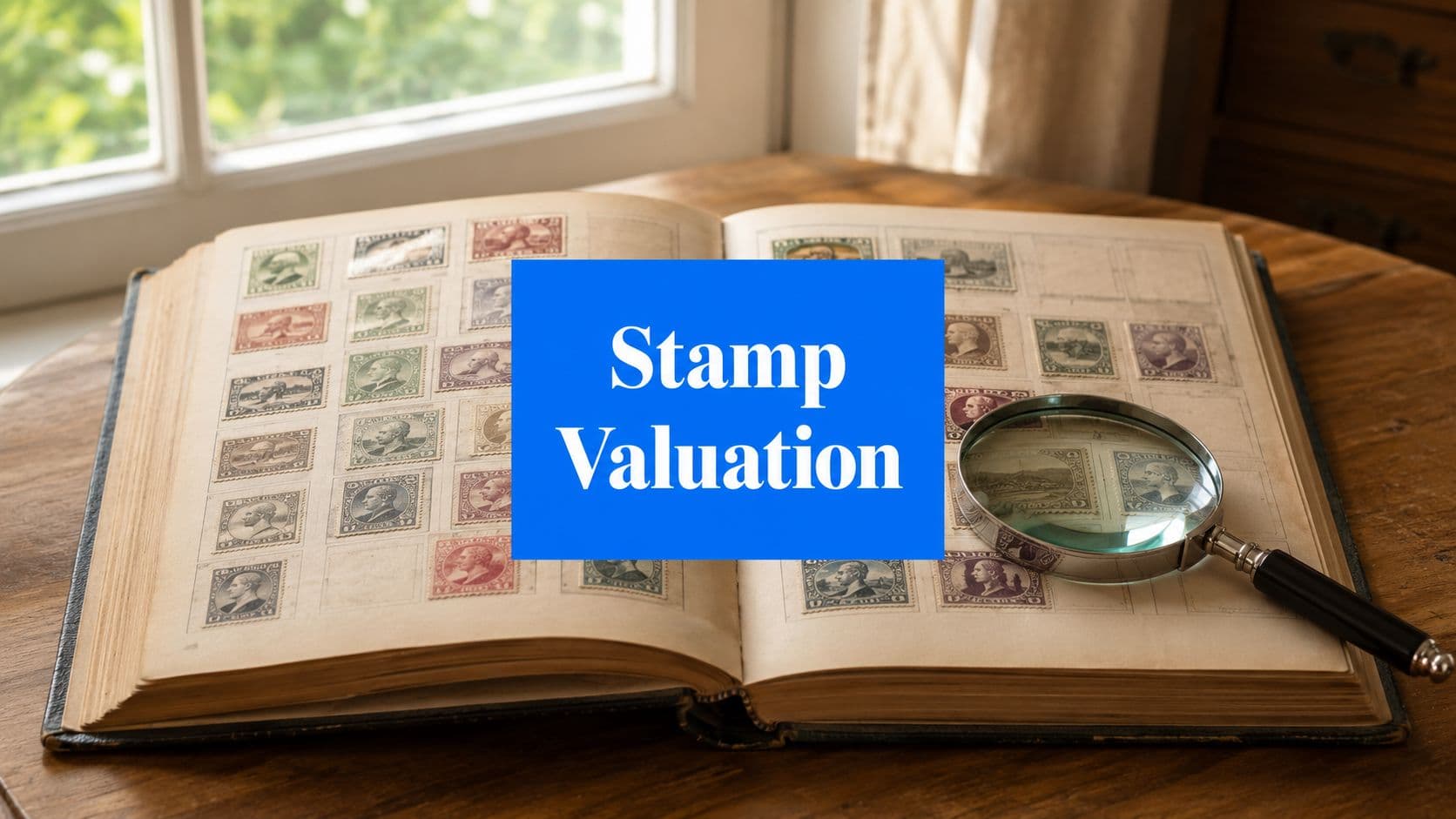
You're standing in a hallway with a box of albums, loose envelopes, maybe a few glassines, and no idea whether you're holding junk, a modest inheritance, or something a dealer would flag immediately. That's the normal starting point. The wrong move is to start guessing, rearranging, or pricing from memory. Stamp collection valuation starts with what can be proven, not what feels impressive.
Where to Begin When You Inherit a Stamp Collection
The first mistake executors make is treating the collection like a pile of paper that needs tidying. Don't do that. Leave the albums, envelopes, mounts, receipts, and notes exactly where they are until you've documented the collection as found, because original context matters and can affect identification and value.
I've watched families split up an inherited collection before anyone knew whether the better material was in the front album, the back binder, or a shoebox of covers. That's how value gets lost. A market price is what someone paid, not the number printed in a catalog, and collectors routinely have to compare catalog references with sold examples and then adjust for faults, completeness, and demand. Stamp valuation is evidence-based, not sentimental, and the evidence is in the physical collection first, not in a guess.
Practical rule: photograph the haul before you touch a page. If there are receipts, certificates, old dealer invoices, or handwritten notes, keep them with the collection.
Set aside anything that looks like it might deserve special attention, but don't separate it from the rest yet. That means mint sheets, covers, early high-denomination issues, and anything with obvious overprints or unusual presentation. Those pieces are easier to misread when they're pulled out of context too early.
A quick container-level inventory is enough at this stage. Write down what you see, for example one United States album, two international binders, and one box of loose envelopes. That gives you control without destroying the original structure, and it's the cleanest way to avoid costly sorting errors later.
Sorting and Cataloguing the Collection Step by Step

Start with country, not color, not face value, and not whether a stamp “looks old.” Once stamps are grouped by country, move them into broad era buckets, because historical period changes the kind of attention a collection deserves. A practical appraisal framework treats issues before 1900 and specialized collections from before 1945 as stronger candidates for auction-house interest, while mostly mint post-1900 material often fits dealer sales better Brixton Chrome guidance.
Build a simple working inventory
Record only the facts you can verify by looking at the item. Country, year, denomination, mint or used status, and basic condition notes are enough to start. If you can identify a likely catalog number from Scott, Stanley Gibbons, Yvert et Tellier, or Michel, log it, but treat that as a reference label, not a price tag StampWorld valuation overview.
Use this order every time:
- Sort by country. Keep United States, Canada, France, Germany, China, India, and mixed world material in separate stacks.
- Group by era. Split into pre-1900, pre-1945, and post-1945, because the age bracket often determines whether expert review is worth your time.
- Flag special material. Mark early issues, high denominations, unusual overprints, mint stamps, and covers for closer review.
- Separate condition tiers. Put the cleanest, most centered examples apart from heavily hinged, toned, or faulty pieces.
- Catalog the obvious. Enter each flagged item or group in a spreadsheet before pricing anything.
Many heirs overcomplicate things by trying to identify every common stamp down to a perfect catalog number before they know whether the collection has any real upside. Don't waste the first afternoon on low-value clutter. Get the structure right first, then inspect the outliers.
Keep the collection intact until you know what deserves item-by-item attention. Once mixed material is broken apart, it's harder to recover context and harder to sell intelligently.
Grading and Condition Checklist That Drives Price

Grading is where amateur valuations usually fall apart. A stamp can be rare and still bring a weak price if collectors don't want that specific copy. The standard grading language is commonly described in 7 levels, from Superb and XF down through VF, F, VG, Good, and Fair, and condition categories such as sound, faulty, and defective materially affect price StampWorld valuation overview.
The four checks that matter most
Look at these four things before you trust any catalog number:
- Centering. Is the design balanced in the margins, or pushed hard to one side?
- Perforation quality. Are the perforations full and clean, or pulled, short, or clipped?
- Gum condition. For mint stamps, is the original gum intact and undisturbed?
- Cancel quality. For used stamps, does the cancel help the stamp, or does it kill the eye appeal?
One valuation framework recommends condition multipliers roughly from 0.6 for Fine to 1.5 to 3.0 for XF or Superb, depending on the issue and market, and cross-checking against at least three recent comparable sales to reduce pricing error valuation framework. That's the right mindset. The same catalog value can translate into very different realized prices once condition is applied.
A stamp catalogued at $100 in VF can become a much weaker seller if it's Fine, or a much stronger one if it's XF. That isn't theory, it's how buyers behave when they inspect the actual piece. Thin spots, toning, pulled perforations, and hinge remnants on mint stamps are the faults that usually kill confidence fastest.
What to reject, what to tolerate
Tolerable issues are the minor flaws that don't change the stamp's identity or destroy its eye appeal. Deal-killers are the defects that make collectors hesitate or walk away. If you're unsure, treat the item as weaker than you hoped, not stronger. Sellers lose money by overgrading, not by being cautious.
For a deeper pricing framework, use the collector-pricing approach in the collectible pricing guide and apply it conservatively to stamps rather than optimistically.
Valuation Resources and How to Read Recent Sale Data
Catalogs are starting points, not promises. Scott Specialized Catalogue in the United States, Stanley Gibbons in the UK, Yvert et Tellier in France, and Michel in Germany are the names people reach for first, but they're reference guides rather than guaranteed market prices StampWorld valuation overview. If you use catalog numbers as if they were cash offers, you'll overestimate value.
Compare reference sources to sold data
Recent sold listings matter more than asking prices. Professional valuation guidance emphasizes using sold listings from the last 90 days rather than asking prices, because transaction data shows what buyers actually cleared at Brixton Chrome guidance. That's the cleanest way to separate wishful thinking from real market demand.
| Source | Region | Best Use | Type |
|---|---|---|---|
| Scott Specialized Catalogue | United States | Identification and baseline reference | Catalog |
| Stanley Gibbons | UK | British and Commonwealth reference | Catalog |
| Yvert et Tellier | France | French and related material | Catalog |
| Michel | Germany | European reference work | Catalog |
| Siegel Auction Galleries | International | High-end realized examples | Sold listings |
| Heritage Auctions | International | Cross-checking stronger pieces | Sold listings |
| StampAuctionNetwork | International | Market comparison across houses | Sold listings |
| eBay sold listings | Broad retail market | Lower and mid-level realized prices | Sold listings |
| HipStamp | Collector marketplace | Dealer and collector pricing context | Sold listings |
The hard truth is that catalog value often overstates resale value in the secondary market. That's why you should compare the stamp against actual sold examples, then adjust for condition, completeness, and demand stamp collection valuation workflow.
Read the data like a seller, not a collector
A strong stamp in a weak group still needs market proof. A weak copy of a scarce stamp is still weak. When you compare sales, look for the same country, issue, mint or used status, centering, and obvious faults. Ignore noisy outliers unless you can explain why they sold higher, or lower, than the rest.
If you want to understand how valuation shortcuts fail across collectibles, the broader antique price guide online logic applies here too. Asking prices tempt sellers. Sold prices settle the argument.
When a Professional Appraisal Is Worth the Cost
Not every collection needs a formal written appraisal. A box of mixed world stamps with heavy duplication usually doesn't justify that expense. But if you've found pre-1900 material, a specialized pre-1945 collection, or anything with significant China, India, or Indian States content, I'd strongly lean toward a formal evaluation because those are the kinds of holdings that can draw auction-house interest Brixton Chrome guidance.

Appraise the right collections, not every collection
Mostly mint post-1900 material, common duplicates, and mixed album accumulations usually belong with dealer offers or bulk liquidation, not expensive paperwork. That's not a slight. It's just the reality of liquidity. You're paying for expertise when the upside is plausible and the potential return is significant.
A credible appraisal should explain identification, condition, scarcity, and demand in plain language. If the evaluator won't discuss those factors, walk away. Look for membership in the American Philatelic Society or the Royal Philatelic Society London when you're checking credentials, and ask exactly what the document is meant to support, estate settlement, insurance, or sale.
For heirs dealing with probate questions, probate asset valuation assistance can be useful context when the stamp collection is one piece of a larger estate.
A good appraisal doesn't just give you a number. It tells you which parts of the collection deserve attention, which parts are ordinary, and which parts should never be sold blindly.
Don't pay for reassurance you don't need
A written appraisal is worth the money only when the collection has enough potential value or legal importance to justify it. Otherwise, use a careful market review and focus on realized sales. The goal isn't to decorate the file cabinet with a certificate. The goal is to make a better financial decision with less risk.
Pricing Strategy for Estate Sales Versus Collector Sales
Most sellers either leave money on the table or waste time chasing it. If the collection is ordinary, lot it as a whole. If it has standout stamps, break those out and sell them individually. The middle ground, batching lower-value stamps into themed lots while isolating the top material, usually produces the cleanest result.

Choose the selling channel by the quality of the material
Whole-album lotting is fast and simple. It attracts dealers, estate buyers, and newer collectors who want volume without heavy cataloging. Individual listing takes more work, but it gives stronger material a better shot at competitive bidding from serious buyers.
Set reserves conservatively. For many collections, a reserve around 60 to 80 percent of recent comparable sales leaves room for bidder psychology without pretending the market will chase your highest expectation. Don't anchor to catalog numbers when you set the floor. Anchor to the last real sale that looked like your stamp.
Think in net proceeds, not gross fantasy
A seller who ignores fees is guessing badly. Traditional estate-sale companies often charge 30 to 50 percent, while DIYAuctions uses a 10 percent commission capped at $1,000, which lets a seller retain up to 90 percent of profits DIYAuctions overview. That difference changes how aggressively you should price and how much effort you should spend on itemizing.
If you're deciding whether to sell as one mixed lot or as several targeted lots, ask one question. Which option gives you the highest likely net after fees, time, and risk? That's the only question that matters.
Practical rule: isolate the top 5 to 10 percent of the collection as individual lots. Everything else should be grouped for speed unless there's a clear reason not to.
Photographing, Listing, and Selling Stamps the Right Way
A great stamp photographed badly looks ordinary. A mediocre stamp photographed clearly at least gives the buyer a fair shot at seeing what matters. Use even daylight from a north-facing window if you can, keep the background neutral, and make sure perforation edges stay in focus. The reverse matters too, especially for gum, hinge marks, or cancellation detail.
For a clean photo workflow, the how to photograph items to sell online guide is a useful model, even though stamps demand more close-up attention than furniture or décor.
Write descriptions buyers can trust
A stamp listing should include country, year, denomination, catalog number if known, grade, perforation notes, centering notes, faults, and provenance if you have it. Keep it factual. Don't pad the description with collectible jargon unless it helps identify the piece.
A practical listing template looks like this:
- Country and issue: State the country and, if possible, the issue year.
- Catalog reference: Add Scott, SG, Yvert, or Michel only when you've confirmed it.
- Condition notes: Mention centering, gum, cancel, and obvious faults.
- Format: Clarify whether it's single, pair, block, sheet, cover, or lot.
- Provenance: Include prior certificates, album notes, or invoice copies if they exist.
If you want a parallel example of how clean presentation helps rare items sell, see the resource on where to sell photos online. The medium is different, but the buyer psychology is the same. Clear images and honest descriptions reduce friction.
Watch for the red flags
Some buyers will try to push you off-platform, ask for shipping refunds after overpaying, or pressure you to close before the auction ends. Those are bad signs. The safest sale is the one where the payment stays inside a controlled system and the bidding runs its course.
Keep your process simple. Photograph, describe, and list what you can confidently support. The collection will sell better when the buyer can inspect the facts without guessing.
If you've inherited a stamp collection and want the cash value, not a catalog illusion, start by sorting it intact, separating the obvious candidates for expert review, and pricing the rest against recent sold examples. If you're ready to turn that collection into a clear selling plan, use DIYAuctions to list the stamps you want to keep organized, price them realistically, and move them through a controlled sale that protects more of your proceeds.
More guides in Estate Sale Basics
July 28, 2026
Revenue Reporting for Estate Sales and Auctions
Learn revenue reporting essentials for estate sales and auctions. Discover key metrics, templates, and best practices to simplify tracking and compliance.
Read guideJuly 23, 2026
Estate Sales Brick NJ: Your 2026 Guide to Success
Planning your estate sales brick nj? Our guide covers permits, pricing, marketing, & running a safe sale with DIYAuctions.
Read guideJuly 19, 2026
How to Prevent No Shows at Your Estate Sale
Learn how to prevent no shows for your estate sale pickup. Our guide offers actionable policies, reminder templates, and scheduling tips for a smooth event.
Read guideGet the estate sale pricing guide
Enter your email for pricing ranges, planning notes, and a clearer path to launch.