How to Prevent No Shows at Your Estate Sale
Learn how to prevent no shows for your estate sale pickup. Our guide offers actionable policies, reminder templates, and scheduling tips for a smooth event.
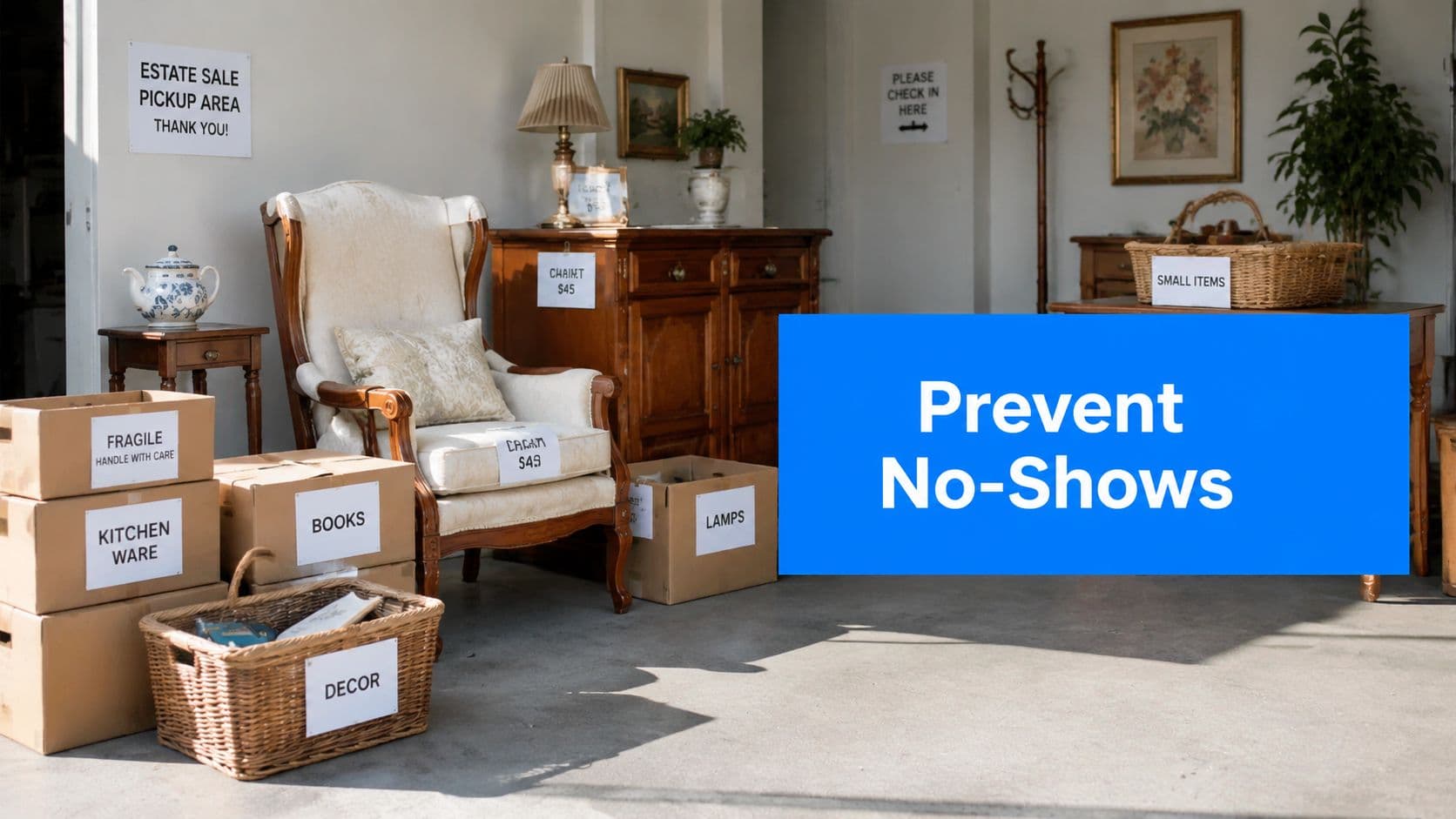
You've finished the hard part. The auction is over, buyers won their lots, payments cleared, and the house finally looks like progress instead of chaos.
Then pickup day shows up on the calendar, and that's when many first-time hosts realize the sale isn't complete until the items leave the property.
If buyers don't arrive, everything backs up fast. Furniture blocks walkways. sold tags stay attached to things you can't release to anyone else. Family members ask whether the sale is really over. You spend your pickup window checking your phone, answering last-minute texts, and deciding whether to wait, relist, refund, or enforce your terms. That stress is avoidable.
The most useful way to think about how to prevent no shows is this. A no-show usually isn't just a reminder problem. It's a commitment problem. Buyers skip pickup when the rules feel soft, the value feels vague, or the process feels harder than the item is worth. Strong hosts fix all three before pickup day starts.
The Real Cost of No-Shows for Your Sale
A no-show at an estate sale pickup doesn't look dramatic at first. It looks like one lamp left on a folding table, one chair still in the den, one box of kitchenware that “should have been gone by noon.”
But those leftovers create real problems for the host.

Pickup day is where organization gets tested
A smooth online sale can still end with a messy property. Buyers who don't arrive force you to hold space for items that were supposed to be gone. That often means:
- Blocked cleanup work because sold items are still sitting in rooms you need to empty
- More trips to the property when you thought pickup day would be the final visit
- More handling of fragile items as you move them out of the way and then move them again
- More buyer communication after the sale, usually with people who already ignored the first instructions
For first-time hosts, this is the moment where the sale starts feeling bigger than expected. You're no longer just matching buyers to items. You're managing access to a home, timing, safety, and the seller's patience.
A missed pickup doesn't just waste one buyer's time slot. It keeps the item, the space, and your attention tied up after the sale should be finished.
The damage shows up in the last mile
Single-day pickup events work because they compress effort. You stage once, staff once, open once, and close the sale cleanly. No-shows break that rhythm.
If one buyer misses a small lot, it's annoying. If several buyers miss large pieces, your entire closeout plan changes. You may need to store abandoned items temporarily, coordinate another access window, or explain to the seller why “sold” items are still in the house.
That's why experienced hosts treat no-show prevention as part of sale operations, not customer service cleanup.
What a professional host protects
A solid pickup system protects more than convenience. It protects:
| What's at risk | What no-shows disrupt |
|---|---|
| Seller trust | The seller expected the property to be cleared on schedule |
| House condition | More foot traffic and repeat access create more chances for scuffs, dirt, and damage |
| Host time | Extra texting, waiting, and follow-up eat the hours you thought were finished |
| Item control | Unclaimed lots create confusion about what is paid, released, forfeited, or available |
The best hosts don't assume buyers will “probably come.” They build the sale so pickup feels mandatory, clear, and worth showing up for.
Setting Firm Policies Before the Bidding Starts
The easiest no-show to manage is the one you prevent before someone places a bid.
Most first-time hosts write policies as housekeeping. Experienced hosts use them as a filter. Your terms tell buyers whether this is a casual marketplace transaction or a real estate sale pickup with firm expectations.

Write pickup terms like they matter
If your pickup language is loose, buyers will treat pickup as flexible. That's the mistake.
Research on no-shows notes that 68% of no-shows occur because the meeting lacked perceived value rather than logistical failure, and if the host can't articulate firm, tangible rules and outcomes, the event becomes vague and easier to skip (Smart Sales Coaching on why buyers and sellers no-show).
For estate sales, that means your terms need to answer basic questions without wiggle room:
- When exactly is pickup
- Where exactly does the buyer go
- What does the buyer need to bring
- What happens if the buyer misses the window
- Who is responsible for lifting, loading, and packing
When those points stay vague, buyers tell themselves they can “work it out later.” Later is where no-shows happen.
The policies that do the heavy lifting
These are the rules I'd bake into every sale from day one:
-
Use a tight pickup window
“Saturday, 10 AM to 2 PM only” works better than “weekend pickup available.” A limited window signals scarcity and seriousness. -
State forfeiture plainly
If an item isn't picked up during the published window, say that it may be considered abandoned or forfeited under your sale terms. Don't hide this in small print. -
Assign loading responsibility
Buyers should know in advance that they need appropriate help, packing materials, and vehicles for large purchases. -
Tie payment and pickup together
Buyers should understand that payment completes the purchase, but pickup completes the transaction. -
Reserve the right to refuse improvised exceptions
If you allow pickups “whenever possible,” buyers hear “rules are optional.”
Practical rule: A policy only works when a buyer can repeat it back in one sentence.
Commitment starts before the invoice
Tools that combine booking logic, payment flow, and confirmation messaging can help you think more clearly about commitment. Even outside estate sales, looking at systems like the Samba booking and payment platform is useful because they show how strong payment and scheduling design reduce ambiguity at the point where customers commit.
That same principle applies here. A buyer who knows the exact pickup window, accepts the terms before bidding, and understands the consequence of missing pickup is far less likely to treat the event like an optional errand.
Your Automated Communication Blueprint
Once bidding ends, your messages need to carry the sale across the finish line.
Often, many hosts either overdo it with long emails nobody reads, or underdo it with one bland reminder. Neither works well. Buyers need short, clear touches that keep pickup active in their mind.

Use three lightweight touches
A structured confirmation sequence is the most impactful strategy after booking. The verified guidance is specific: send an instant confirmation within five minutes, a 24-hour reminder with a clear contact number, and a final 2-hour nudge with logistical details like a map pin (YouTube guidance on structured multi-touch confirmation).
For estate sale pickups, I'd adapt that like this.
Instant confirmation
Send this as soon as the buyer wins and pays.
Include:
- buyer name
- invoice number
- item summary
- exact pickup date and time window
- full address
- direct contact number
- rules for loading help and packing
- what happens if the item isn't picked up
This message shouldn't sound like marketing. It should read like release instructions.
The 24-hour reminder should reduce excuses
The day-before message does two jobs. It reminds the buyer, and it gives them a simple way to reschedule or contact you before they become a no-show.
A practical version looks like this:
Hi [Name], this is your reminder for estate sale pickup tomorrow from [time window] at [address]. Reply if you have a problem getting there. Bring help for heavy items and packing materials if needed. Call or text [number] with questions.
If you want your system to support these workflows after the sale closes, a resource like post-sale support guidance is useful because it keeps your follow-up steps organized when multiple buyers are arriving in a short window.
The 2-hour message handles last-mile confusion
The last message should be short enough to read in the car.
Send:
- address again
- parking note
- map pin
- entry instructions
- your phone number
- a prompt to reply if delayed
If you use text-based outreach, setup ideas from tools built around repeat messaging can help. For example, this overview of WhatsApp automation for agencies is worth reviewing because it shows how teams keep reminders consistent without rewriting them every time.
Keep the messages short and specific
Here's what works versus what doesn't:
| Works | Usually fails |
|---|---|
| Short messages with date, time, address, and action | Long paragraphs explaining the entire sale |
| Contact number in every key message | Making buyers search old emails |
| Map pin and parking note in the final nudge | Assuming buyers will figure it out |
| A reply path for delays or conflicts | One-way reminders with no next step |
The mistake most hosts make is treating reminders like courtesy notes. They're not. They're operational messages that keep pickup from slipping into the background.
Designing a Flawless Pickup Experience
Even committed buyers can still get frustrated if the pickup experience feels disorganized.
I've seen buyers arrive on time, ready to load, and then stall out because nobody can find their lots, the driveway is jammed, or the item location changed without notice. That kind of friction turns a reliable buyer into an irritated one fast.

Remove every avoidable point of confusion
One verified point matters here. The final communication before arrival should include logistical detail because the “wrong place” problem accounts for up to 15% of non-attendance in scheduled appointments, and the guidance specifically calls for map pins and parking coordinates in that last nudge (US Tech Automations on logistical detail in reminder workflows).
That's the communication side. On the ground, the physical setup should match the clarity of the messages.
Prepare the property like a release station
Before the first buyer arrives:
- Group each buyer's items together so nobody waits while you hunt through rooms
- Label each group clearly with buyer name and invoice number
- Create a check-in point at the entrance, garage, or driveway
- Mark traffic flow so buyers know where to park, wait, and load
- Keep your release list printed in case your phone battery drops or service gets spotty
For high-value lots, antiques, jewelry, and small boxed collections, it also helps to follow disciplined handling procedures. A guide on chain of custody procedures is useful here because pickup day gets much easier when you can prove who collected what and when.
If a buyer can park, check in, confirm their invoice, and leave with their items in a few minutes, they remember your sale as organized.
Build for speed, not improvisation
The cleanest pickup days usually have one simple pattern.
A buyer arrives. Someone greets them. Their invoice gets checked. Their items are already staged. Questions are answered quickly. The buyer loads and leaves.
That only happens when the host decides in advance where large furniture sits, where smalls are handed over, who verifies ID if needed, and how sold tags are removed. Good pickup flow feels calm to the buyer because the host already made the decisions before the first car pulled up.
Managing Last-Minute Cancellations and Penalties
Even strong systems won't eliminate every problem. Someone will get delayed, forget, stop replying, or decide the item isn't worth the trip.
When that happens, hesitation makes things worse. If your stated policy says pickup is required during the scheduled window, enforce it fairly and consistently.
Why strict follow-through matters
Hosts sometimes worry that enforcing penalties feels harsh. In practice, vague enforcement is harsher on everyone else. It wastes your time, confuses the seller, and teaches buyers that the written terms don't mean much.
The better standard is simple. Be polite, be clear, and do what your terms say.
A clean no-show response usually includes:
- A final notice after the window closes stating that the buyer missed pickup
- Reference to the agreed terms on abandonment, forfeiture, or lost claim
- A brief deadline if your policy allows one final remedy
- A firm statement about what happens next if there's no response
Host standard: Don't negotiate from scratch after the buyer ignored the original agreement.
Use a fallback plan to recover value
A no-show doesn't have to mean the item sits in limbo. Verified guidance supports a fallback system, including notifying a waitlist or underbidders about forfeited items so the value isn't completely lost (RentPilot on fallback systems for missed appointments and inventory recovery).
For estate sales, that can mean:
| Situation | Best response |
|---|---|
| Buyer says nothing | Send the no-show notice, enforce terms, move to your fallback list |
| Buyer contacts you after closing | Decide based on your written policy, not pressure |
| Large item was abandoned | Offer it to an underbidder or backup buyer quickly |
| Buyer disputes payment later | Keep records of terms, reminders, and release status |
If you're thinking beyond the pickup itself, reviewing chargeback prevention practices is smart because missed pickups sometimes turn into payment disputes when records are weak.
Turning Successful Pickups into Future Sales
A good pickup process does more than close one sale. It shapes how buyers talk about you the next time your name comes up.
Buyers remember whether pickup felt chaotic, confusing, and slow. They also remember when it felt crisp. Clear terms. Clear texts. Clear staging. Fast handoff. That's the kind of experience that brings serious bidders back.
Reputation is built in the last step
This is why no-show prevention matters so much. It isn't just about saving one afternoon. It tells buyers what kind of host you are.
When your process is consistent, buyers learn a few things quickly:
- Your listings are real
- Your timelines are real
- Your policies are real
- Your pickups are worth planning for
That kind of trust compounds. Buyers who know you run organized pickups are more likely to bid without second-guessing whether the final handoff will be a mess.
The system works when the parts reinforce each other
The strongest pickup operations usually have three layers working together:
- Firm policies that make commitment clear before anyone bids
- Short, timed communication that keeps buyers engaged after the sale
- Smooth on-site logistics that make arrival and release easy
Miss one layer and the others have to work too hard. Good reminders can't rescue weak terms. Strong terms can't rescue a chaotic driveway. A neat staging area can't fix buyers who never understood pickup mattered.
That's the practical answer to how to prevent no shows. You make the commitment real, the instructions obvious, and the pickup easy to complete.
If you want a platform that helps you run the sale side cleanly so you can focus on pickup execution, DIYAuctions gives sellers a structured way to manage estate sales while keeping control of the process.
More guides in Estate Sale Basics
July 28, 2026
Revenue Reporting for Estate Sales and Auctions
Learn revenue reporting essentials for estate sales and auctions. Discover key metrics, templates, and best practices to simplify tracking and compliance.
Read guideJuly 26, 2026
Stamp Collection Valuation: A Practical Step-by-Step Guide
Stamp collection valuation made simple. Learn how to identify, grade, price, and sell your stamps with confidence for estate sales or consignment.
Read guideJuly 23, 2026
Estate Sales Brick NJ: Your 2026 Guide to Success
Planning your estate sales brick nj? Our guide covers permits, pricing, marketing, & running a safe sale with DIYAuctions.
Read guideGet the estate sale pricing guide
Enter your email for pricing ranges, planning notes, and a clearer path to launch.