Sell Estate Jewelry: Expert Valuation & Top Offers 2026
Get expert advice to sell estate jewelry. Our 2026 guide covers valuation, finding trusted buyers & strategies to maximize your profit. Sell confidently.
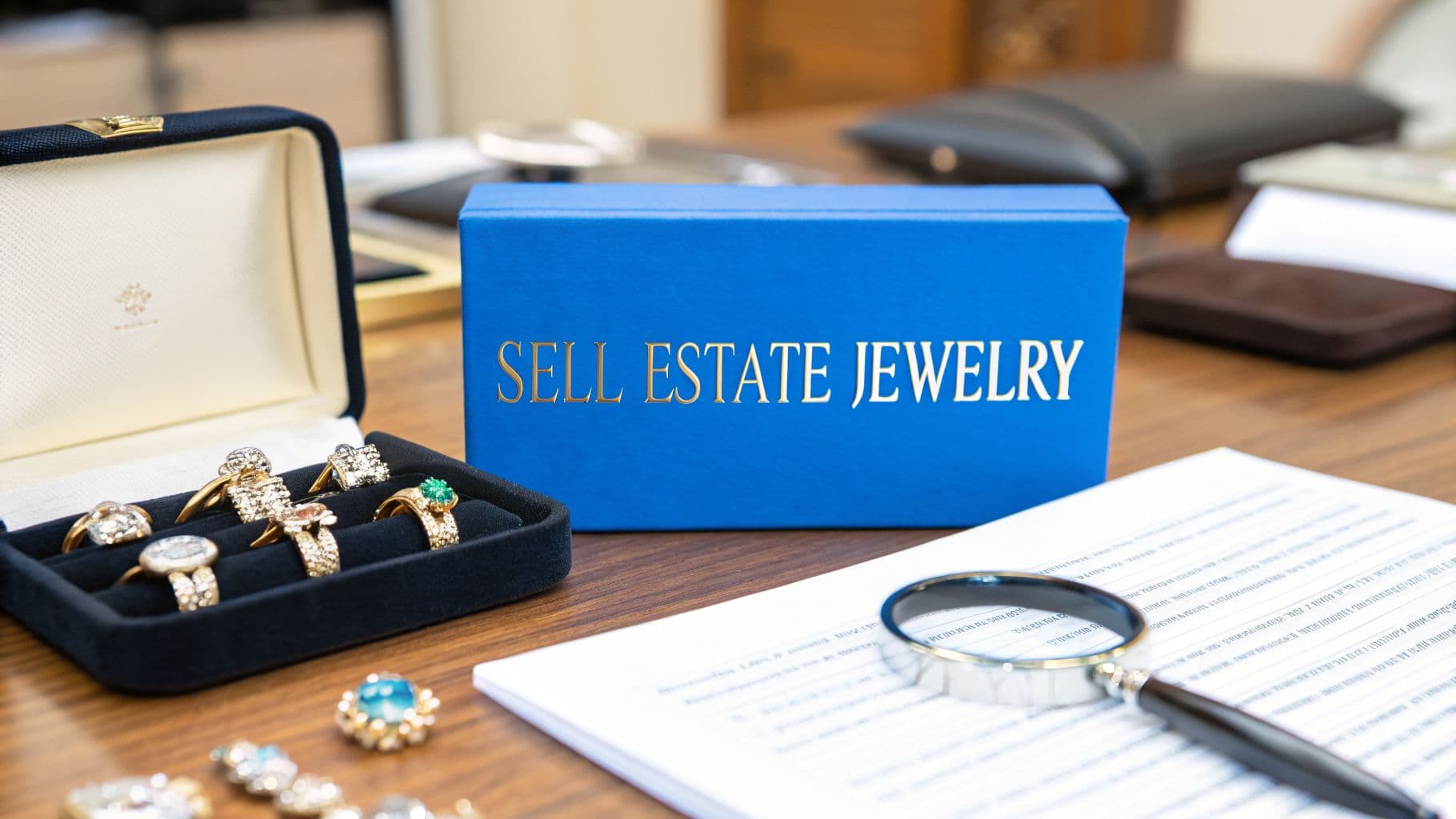
When you inherit a collection of jewelry, the first moments can feel like you've stumbled upon a hidden treasure chest. But that excitement is often followed by a wave of uncertainty. What is all of this? Is any of it valuable? Where on earth do you even begin?
The key is to take a breath and start with a simple, methodical sorting process before you even think about selling. This groundwork is what separates a successful, profitable sale from a disappointing one. It arms you with the knowledge you need to talk to buyers confidently and get the best possible value for your heirlooms.

First Steps to Understanding Your Estate Jewelry
Don't let the sheer volume overwhelm you. Your first job is to become a bit of a detective and get a handle on what you actually have.
And make no mistake, people are looking for these exact kinds of pieces. The global estate and antique jewelry market recently topped $5.5 billion as more buyers seek out unique designs and sustainable luxury. Your collection isn't just a box of memories; it's a potential asset in a very active market.
A Foundational Understanding
First, it helps to know what is estate jewelry actually means. It's simply a term for anything pre-owned. That could be a 150-year-old Victorian brooch or a designer bracelet someone bought just five years ago.
Start by laying everything out and sorting it into basic categories like rings, necklaces, brooches, and earrings. From there, you can start looking closer at each group.
- Look for Hallmarks: These are the tiny stamps hidden on the inside of a ring, on a clasp, or on the back of a pin. They tell you the metal content (like "14K," "925" for sterling silver, or "Plat" for platinum). Sometimes, they even reveal the maker, which can dramatically increase a piece's value. A good magnifying glass is your best friend here.
- Identify Materials: Try to separate the "real" from the "costume." Fine jewelry is made with solid gold or platinum and genuine gemstones, while costume pieces often use plated metals, glass, or plastic. You can often feel the difference in weight.
- Recognize Different Eras: With a bit of online research, you can start to spot characteristics of different design periods. Art Deco pieces from the 1920s and '30s often have bold, geometric lines. Victorian-era jewelry, on the other hand, tends to be more ornate and sentimental.
Pro Tip: Grab a notebook or open a simple spreadsheet. Log each piece with a basic description, any markings you find, and any family stories you know about it. This initial inventory will become your roadmap for the entire selling process.
Gather Your Documentation
Finally, go on a hunt for any and all paperwork. Old receipts, original branded boxes, and especially any past appraisal documents are absolute gold.
This documentation provides provenance—a recorded history of ownership—which proves authenticity and can significantly boost a piece’s value to serious collectors and buyers. It’s the difference between selling a "nice old ring" and a "documented antique with a known history."
Navigating Jewelry Appraisal and Documentation
If there's one step you can't afford to skip when selling estate jewelry, it's getting a proper valuation. This is the foundation for getting a fair price. Without a professional appraisal, you're just guessing, and that puts you at a huge disadvantage when it's time to negotiate.
Your first move should be finding a qualified, independent appraiser. Look for a graduate gemologist (GG) from a reputable organization like the Gemological Institute of America (GIA). Be wary of anyone who appraises your jewelry and then immediately offers to buy it—that’s a clear conflict of interest. You want an unbiased opinion, not a lowball offer disguised as help.
Insurance Value Versus Market Value
This is where a lot of sellers get tripped up. Confusing these two values is a common—and costly—mistake. You absolutely have to know the difference to price your items correctly.
- Insurance Appraisal (Replacement Value): This is the high number you see on an insurance policy. It reflects the full retail cost to buy a brand new, similar item. It is not what you'll get when you sell.
- Fair Market Value (FMV): This is the realistic price a knowledgeable buyer would pay a willing seller for the piece in its current condition. This is the number you need.
A professional appraiser will give you a detailed report for each major piece. It should list specifics like carat weight, cut, color, and clarity (the 4Cs for diamonds), along with the metal type, weight, and notes on craftsmanship or condition.
To get a better handle on this, you can also dig into how to determine fair market value yourself. It’s a great way to supplement a professional's report and feel more confident in your pricing.
Creating Your Own Detailed Inventory
While the formal appraisal is critical, your own documentation is what will sell the jewelry. Think of it as building a resume for each piece. This work proves authenticity and answers a buyer's questions before they even have to ask.
Start with great photos. Take clear, well-lit pictures from every angle—front, back, clasps, and especially any hallmarks or maker's marks. Use a simple, neutral background like a white sheet of paper and natural daylight if you can. Avoid the harsh glare of a camera flash.
Next, create an inventory log. For each item, you’ll want to note:
- Measurements: The length of a necklace chain, the inside diameter of a ring, or the dimensions of a brooch.
- Markings: Write down any stamps you find, like "14K," "Tiffany & Co.," or "925."
- Condition: Be brutally honest. Note any scratches, chips, missing stones, or broken parts. Transparency is key to building trust.
- History: If you know the story behind a piece, write it down. Was it a 50th-anniversary gift from a grandfather? This provenance adds a layer of emotional value that can make a piece more desirable.
When you're dealing with family heirlooms, there are unique factors to consider. For more on this specific situation, check out this excellent guide on Selling Inherited Jewelry.
Combining your detailed log with a professional appraisal puts you in a position of strength. It shows buyers you’re a serious, knowledgeable seller and justifies your asking price with both hard facts and a compelling story. This prep work isn't just for your own records—it’s the cornerstone of a successful sale.
Choosing the Right Channel to Sell Your Jewelry
So, you’ve had your jewelry appraised and you know its history. Now for the big question: where do you actually sell it?
There's no single "best" place. The right choice for you boils down to what you value most. Are you after a quick sale? The highest possible price? Or do you want to stay in control of the entire process?
Each option has its pros and cons. The perfect venue for a rare Art Deco diamond ring is probably the wrong one for a box of vintage sterling silver charms. Knowing the differences will help you match your expectations to reality and feel good about your decision.
This guide can help you figure out your main goal—speed, price, or control—and steer you toward the right selling channels.

As you can see, if you need cash in hand tomorrow, a direct buyer is your best bet. But if your goal is getting top dollar, you’ll need a healthy dose of patience and a different approach.
Local Jewelers and Pawn Shops
For pure speed, nothing beats walking into a local jeweler or pawn shop. You can walk in with a piece and walk out with cash, sometimes in the same afternoon. But that convenience comes at a steep price.
These businesses buy for their own inventory, meaning their offers will be far below retail—and often a lot lower than fair market value. They have to build in their own overhead and profit for when they resell it. This route is really for people who need cash immediately and are okay with sacrificing a big chunk of the item's potential value to get it.
Consignment Shops and Services
Consignment is a decent middle ground. You leave your jewelry with a shop, and they sell it for you in exchange for a cut of the final price. It’s less work than selling it yourself, but you give up control and a good portion of the profit.
This can work well for well-known designer or branded pieces that have broad appeal. The shop does the legwork of marketing and dealing with customers. The trade-offs? Time and money.
- Long Timelines: It can take months—sometimes more than a year—for the right person to discover your piece.
- High Commissions: Consignment fees are no joke. Expect to pay anywhere from 25% to 50% of the final sale price.
- No Guarantees: There’s always a chance your item might not sell at all, and you’ll just get it back after months of waiting.
This path is for the patient. You’re swapping quick cash for a potentially higher payout later, but only after the shop takes its hefty commission.
Remember, any reseller's offer is based on their business model. A local jeweler has to buy low to mark it up for their showcase. A consignment shop takes a huge cut for doing the selling for you. Knowing their angle helps you set realistic expectations.
High-End Auction Houses
If you're holding a truly exceptional piece—something rare, historically important, or from a top-tier designer—a major auction house like Sotheby's or Christie's is where the magic can happen. They connect your items with a global audience of serious collectors ready to pay a premium.
Let’s be clear, though: this world is extremely exclusive. These auction houses are incredibly selective and typically only take on items valued in the tens of thousands of dollars or more. The process also takes a long time, and the commission structure (which includes both a "buyer's premium" and a "seller's commission") can get complicated and eat into your final take.
Got a signed Cartier piece from the 1920s or a rare colored diamond? It's worth a call. For almost everything else, it’s not a practical option.
Online Marketplaces Like eBay or Etsy
Selling directly to buyers on a platform like eBay or Etsy puts you in the driver's seat. You have total control and can reach a massive audience. You set the price, tell the story, and manage the whole sale, which often means you walk away with more profit.
But all that control means a lot more work and risk. You’re on the hook for everything.
- Photography and Listings: Taking professional-looking photos and writing descriptions that sell.
- Customer Service: Fielding a stream of questions from potential buyers, some serious, some not.
- Risk Management: Protecting yourself from all-too-common fraudulent buyers and payment scams.
- Shipping and Insurance: This part is surprisingly stressful. Securely packing and properly insuring a high-value piece is a job in itself.
You can definitely sell estate jewelry this way and do well, but it demands a serious time commitment and a sharp eye for spotting the risks.
A Modern Approach: Host Your Own Online Auction
If you want full control over your jewelry sale and plan to keep as much of the profit as possible, running your own online auction is a total game-changer. This approach gives you the massive reach of an online marketplace combined with the focused, high-energy event of a traditional estate sale—all without the staggering commissions.
Think about it. A typical estate sale company will pocket anywhere from 30% to 50% of your final sales. If your jewelry collection is worth $10,000, you could lose up to $5,000 in fees. With a platform like DIYAuctions, which uses a straightforward fee model, you can keep 90% or more of the proceeds. That’s a fundamentally different outcome.
Take Control of Your Jewelry Sale
This method is all about putting you in the driver's seat. Instead of handing over your precious heirlooms and just hoping for the best, you run the show. You set the schedule. You decide on the starting prices. And you get to write the listings that truly tell your jewelry’s story.
The real magic happens when you combine your personal knowledge of the items with a professional platform that handles all the technical headaches. You get to focus on what you know best—your jewelry—while the system manages secure payments and markets your sale to a network of local buyers who are already looking for what you have.
The whole process is designed to guide you step-by-step, from uploading your first photo to scheduling the final pickup day.
Create Listings That Get Bidders Excited
To successfully sell estate jewelry in an auction, your listings have to do more than just list facts. They need to build a buyer’s confidence, making them feel comfortable placing a bid even without seeing the item in person.
Your cataloging process should be thorough:
- High-Quality Photos: Use the macro setting on your smartphone to get crystal-clear shots of hallmarks, gemstones, and any unique metalwork. Natural light against a simple, solid background works wonders.
- Strategic Starting Bids: Don't be afraid to set a low starting bid. A $1 start can spark a bidding frenzy, creating momentum that attracts more serious buyers as the auction clock winds down.
- Detailed, Honest Descriptions: Pull in the information from your appraisal and inventory notes. Be sure to mention the era (like Art Deco or Victorian), all materials, dimensions, and be upfront about any flaws. It's always better to disclose a small scratch than to have a buyer discover it on their own.
Expert Tip: Tell a story. If you know a brooch was a grandmother's favorite or a ring was a special anniversary gift, include that detail. Buyers aren't just purchasing an object; they're buying a piece of history, and that emotional connection often leads to higher bids.
Schedule and Manage Your Online Event
Unlike a traditional estate sale that can take over your home and your life for a weekend, a DIY online auction is clean and efficient. You simply schedule the auction to run online for a set time—usually about a week—which gives buyers plenty of time to find your items and place their bids.
The process is incredibly straightforward:
- Catalog Your Items: Upload the photos and descriptions for each piece of jewelry you're selling.
- Schedule the Auction: You choose the start and end dates for bidding that work for you.
- Plan for Pickup: The entire sale wraps up with a single, pre-scheduled pickup day where winning bidders come to a designated spot to collect their items.
This model completely eliminates the stress and risk of shipping valuable, often irreplaceable, items. It also removes the security concerns of having dozens of strangers walking through your home. Since the platform handles all payment processing, you never have to deal with cash, haggle over prices, or worry about bounced checks.
For a deeper dive into the nuts and bolts, this guide on how to do an online auction is an excellent roadmap. By managing your own event, you maintain complete authority over your assets, ensuring they’re presented beautifully and sold for a price that makes you happy.
Staging and Marketing Your Jewelry to Attract Buyers

You’ve done the research and sorted the collection. Now it's time to focus on the one thing that will make or break your sale: presentation.
Great staging is what separates a piece that sells for top dollar from one that gets ignored. Think of it like a digital storefront. You’re not just listing an item; you’re creating desire and inspiring confidence in potential buyers.
Create Photos That Sell
In an online auction, your photos are the product. Buyers can’t hold the pieces, so your images have to tell the whole story. You don’t need a professional camera—your smartphone is powerful enough to get the job done.
The goal is to capture the details that make each piece unique: the intricate metalwork, the color of a stone, and the crispness of a maker's mark.
Here’s how we get professional-looking results every time:
- Find Natural Light: Set up near a window with bright, indirect sunlight. Direct sun creates harsh glare, and indoor lights often cast a yellow, unflattering tint.
- Use a Simple Background: A plain white or gray background keeps the focus where it belongs—on the jewelry. A piece of paper or simple fabric works perfectly.
- Get Sharp Close-Ups: Use your phone's macro mode to capture tiny details. Buyers want to inspect the craftsmanship and see any identifying hallmarks for themselves.
- Show the Scale: Take at least one photo that gives a sense of size. Placing a coin next to the piece is good; wearing it in a photo is even better.
For a deeper dive into setting up your shots, check out our guide on how to take professional product photos. The tips in there will pay for themselves with your first sale.
Write Descriptions That Tell a Story
With your photos ready, it's time to write a description that connects with buyers. Your appraisal report has the cold, hard facts. Your listing is where you add the heart.
Start with the essentials from your inventory:
- Type of Piece: "Art Deco Platinum and Diamond Ring"
- Materials: List all metals and gemstones, including carat weights.
- Dimensions & Weight: Include measurements and total weight in grams.
- Hallmarks: Transcribe any stamps you found (e.g., "Stamped '14K' and 'Tiffany & Co.'").
- Condition: Be brutally honest. Point out scratches, loose settings, or chips. Transparency builds trust and prevents problems later.
Once the facts are covered, weave in what you know about the piece. Was it a family heirloom? Do you know its history? A description that reads, "This brooch belonged to my grandmother, who wore it every holiday," is far more compelling than one that just lists its weight.
This narrative is what fuels the market. The collectible vintage luxury segment is valued at $2.4 billion and is projected to grow 17.50% annually. By telling a story, you're tapping directly into the romance that makes these pieces so desirable.
Securing the Sale and Avoiding Scams
After the auction ends or you accept an offer, the final step is to close the deal safely. Whether you’re managing a local pickup or shipping the item, protecting yourself and the buyer is non-negotiable.
Scammers love high-value items like jewelry. They often try to rush you, offer to overpay, or push you to take the payment and conversation off the sales platform. Never deviate from the platform's secure process.
For local pickups, always meet in a safe, public place like a bank lobby or police station. Never invite buyers to your home.
For shipped items, only send the package to the confirmed address on file and always, always use a service that provides tracking and requires a signature on delivery.
Most importantly, insist on insured shipping. This is not optional for high-value jewelry. It’s a small price to pay for complete peace of mind, ensuring your hard work is protected right up to the very end.
Common Questions About Selling Estate Jewelry
As you get ready to sell, a few key questions always come up. Tackling the details of value, preparation, and taxes can feel like a lot, but getting clear answers now will ensure you sell with confidence and get the best possible return.
Here are the most common questions we see from people selling estate jewelry, along with the straightforward answers you need.
What Is the Difference Between Scrap and Resale Value?
Understanding this difference is probably the single most important factor in how much money you’ll make. Getting it wrong can literally cost you thousands.
Scrap value is just the base melt value of the precious metals, plus a wholesale price for any gemstones if they were pulled out and sold loose. It's the rock-bottom price a piece is worth. This is the value a pawn shop or a "cash for gold" business will offer you.
Resale value, on the other hand, is what a real buyer is willing to pay for the piece as a whole. This value accounts for the important stuff: craftsmanship, brand name, its history and age, rarity, and overall condition. A signed Cartier ring from the 1920s, for example, has a resale value that flies past its simple gold and diamond scrap value because of its iconic design and heritage.
Unless a piece is smashed beyond repair, you should always be shooting for its resale value.
Should I Clean My Estate Jewelry Before Selling?
Yes, but you have to be extremely careful. A light, proper cleaning can make a piece look a hundred times better in photos and in person. But the wrong kind of cleaning can cause permanent damage and tank its value.
For most modern gold, platinum, and diamond pieces, a quick bath in warm water with a few drops of mild dish soap is perfect. Use a very soft-bristled toothbrush to gently remove any grime and bring back the sparkle.
However, be very cautious with specific types of jewelry:
- Porous Gemstones: Never use harsh chemicals or ultrasonic cleaners on stones like opals, pearls, emeralds, turquoise, or coral. These gems can absorb liquids, which leads to cracks or discoloration.
- Antique Pieces: Sometimes, the dark patina that develops on old silver or gold is a huge selling point for collectors. It's part of the item's story. Over-cleaning can strip this history away and dramatically lower its value.
When in doubt, it’s always better to do less. You can simply note in your description that the piece has its "original, untouched patina." The new owner can decide if they want to have it professionally cleaned.
How Are Taxes Handled When I Sell Estate Jewelry?
This is a critical question, as the answer directly affects your bottom line. When you sell inherited jewelry, you're selling a capital asset. This means you might owe capital gains tax.
Here's how it works. Your taxable gain is the final sale price minus the jewelry's "cost basis." For inherited items, the cost basis is its fair market value (FMV) on the date the original owner passed away. This is called a "stepped-up basis," and it’s a huge benefit.
For example, let's say a ring was appraised for $3,000 on the date you inherited it. If you sell it for $3,500, your taxable capital gain is just $500. If you end up selling it for $2,500, you actually have a capital loss of $500.
Because tax rules can be tricky, keeping flawless records is non-negotiable. Save all your appraisal documents, receipts from the sale, and any other paperwork. We always recommend talking with a qualified tax professional to make sure you handle everything correctly and avoid any nasty surprises later on.
More guides in Estate Sale Basics
July 28, 2026
Revenue Reporting for Estate Sales and Auctions
Learn revenue reporting essentials for estate sales and auctions. Discover key metrics, templates, and best practices to simplify tracking and compliance.
Read guideJuly 26, 2026
Stamp Collection Valuation: A Practical Step-by-Step Guide
Stamp collection valuation made simple. Learn how to identify, grade, price, and sell your stamps with confidence for estate sales or consignment.
Read guideJuly 23, 2026
Estate Sales Brick NJ: Your 2026 Guide to Success
Planning your estate sales brick nj? Our guide covers permits, pricing, marketing, & running a safe sale with DIYAuctions.
Read guideGet the estate sale pricing guide
Enter your email for pricing ranges, planning notes, and a clearer path to launch.