Tag Estate Sales: Master Pricing and Tagging to Boost Profit - tag estate sales
Discover how to tag estate sales confidently with proven pricing and tagging tips to boost profits and run a smooth sale.
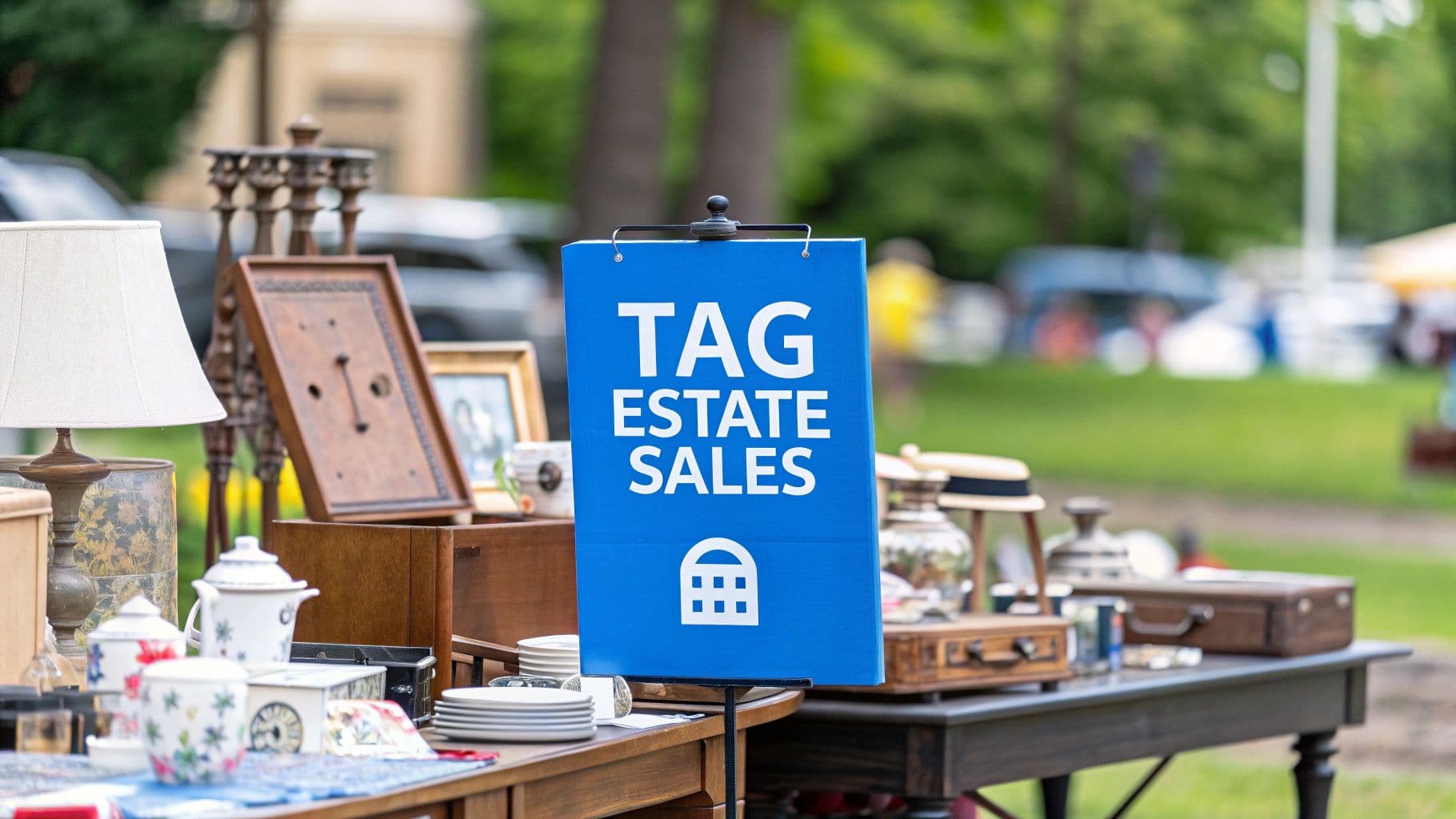
The real secret to a profitable estate sale isn't just what you're selling. It’s all about how you present, price, and tag every single item. When you tag estate sales the right way, you’re doing more than just putting a price on something—you’re creating a strategy that reflects true market value and, just as importantly, builds buyer trust.
This approach is what turns a house full of possessions into a well-organized, shoppable experience that people feel good about spending money in.
The Foundation of a Profitable Estate Sale
A great estate sale is made long before the doors ever open. The behind-the-scenes work you put into pricing and tagging sets the entire tone for the event, directly impacting how buyers feel and how much you’ll earn. If you rush this part, you're almost guaranteed to underprice good items, confuse shoppers, and leave a lot of money on the table.
Think of it like setting up a pop-up retail shop inside a home. Just like in any store, customers need clear, consistent information to feel confident about buying. This is about more than just a price tag; it’s about providing quick context and building trust from the moment they walk in.
Your goal is to make the shopping experience totally seamless. A well-tagged item answers a buyer’s questions before they even have to ask, which helps them make faster decisions and, ultimately, buy more stuff.
Core Components for Success
A profitable sale really boils down to balancing four critical components. Each one supports the others, creating a system that’s efficient for you to run and easy for buyers to navigate. Get these right, and you're setting yourself up for maximum returns.
Here’s what you need to master.
You'll need a solid plan for your tagging and pricing system before you even think about putting a number on anything. It's the engine that drives a smooth, profitable sale. This table breaks down the essential parts of that engine and why they're so critical.
| Component | Why It's Essential | Real-World Impact |
|---|---|---|
| Strategic Price Research | Prevents guesswork and ensures items are priced according to current market demand, not just what you think they're worth. | You avoid selling a $300 collectible for $20 or pricing a common item so high that it never sells. |
| Consistent Tagging System | Creates a professional, organized look. It makes information easy for buyers to find and dramatically speeds up the checkout line. | Shoppers feel more confident and spend less time asking questions. Checkout is faster, meaning more sales can be processed. |
| Honest Item Information | Builds immediate trust. Clearly noting condition—both good and bad—manages buyer expectations and reduces post-sale issues. | A tag that says "minor scratch on left arm" on a chair prevents haggling and shows you’re a trustworthy seller. |
| Logical On-Site Staging | Helps shoppers find what they’re looking for intuitively. Grouping like items together encourages browsing and cross-selling. | A customer looking for a coffee pot in the kitchen might also spot and buy a set of vintage mugs they didn't know they wanted. |
Focusing on these four areas will pay off big time, not just in your final profits but in how smoothly the entire sale runs from start to finish.
- Strategic Price Research: This is all about knowing what your items are actually worth in today’s market. It’s the difference between guessing and knowing. This step is what stops you from underpricing a hidden gem or asking way too much for a common household good.
- A Consistent Tagging System: Using the same style of tag with clear, easy-to-read info across the whole sale just looks professional. It cuts down on confusion and makes the checkout process a breeze for everyone.
- Honest Item Information: A good tag gives a quick, useful description ("Vintage Mid-Century Armchair") and is upfront about any flaws ("minor scratch on left arm"). That kind of honesty builds instant trust and heads off any complaints.
- Logical On-Site Staging: This one is just common sense that goes a long way. Put all the kitchen stuff in the kitchen and all the tools in the garage. It makes browsing feel natural and helps shoppers discover things they weren’t even looking for.
Equipping Yourself for Professional Tagging
Before you can price a single item, you need the right tools for the job. Honestly, showing up with just a Sharpie and a roll of masking tape screams "amateur hour," and that's not the vibe that attracts serious buyers. Putting together a dedicated tagging kit is the first step in transforming a potentially chaotic process into a smooth, methodical one.
This little bit of prep work pays off big time. You'll save hours of frustration, and the professional look gives shoppers more confidence in your pricing. A well-stocked kit is truly the foundation of an organized and profitable sale.
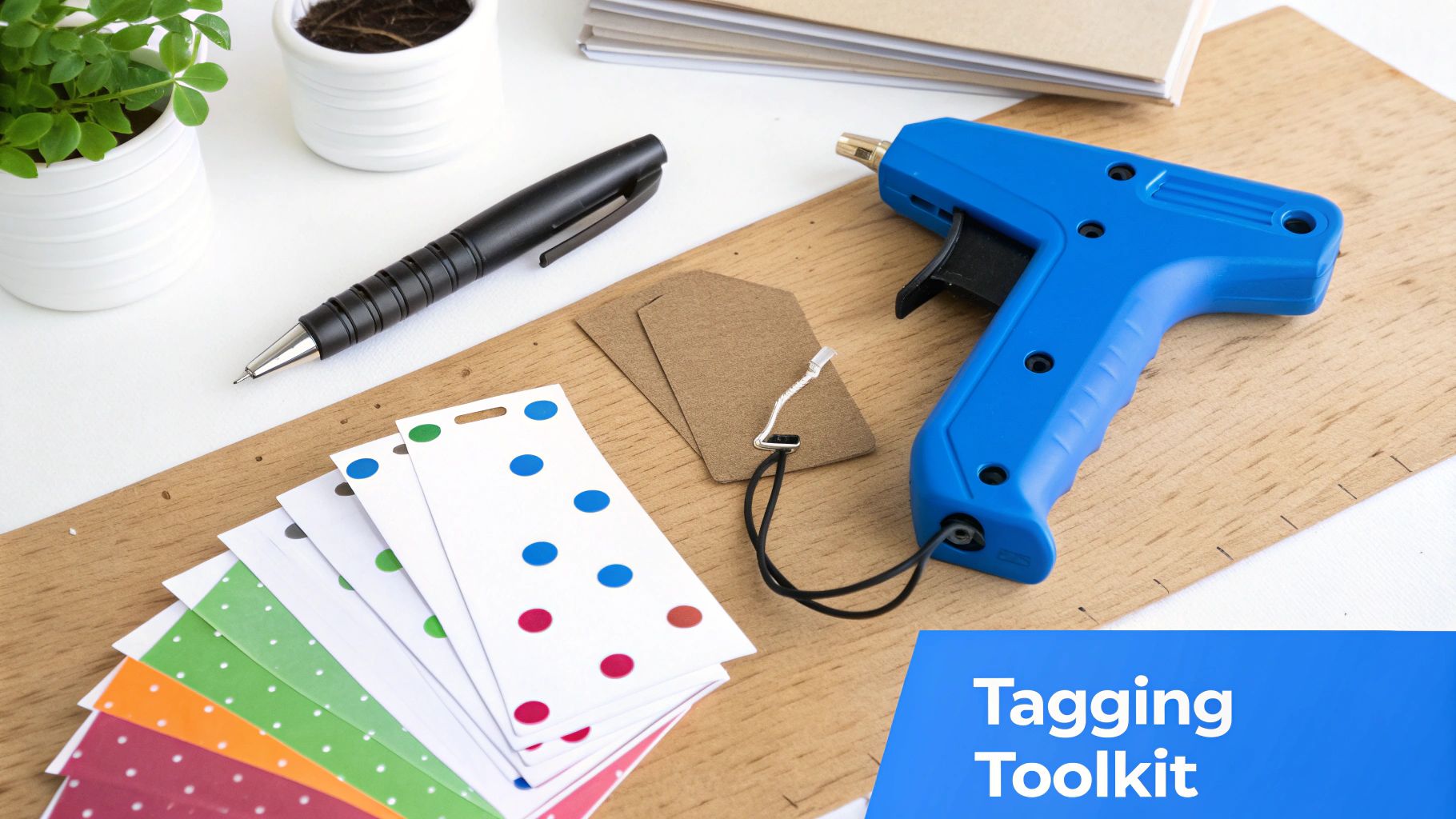
Your Essential Tagging Supplies
Think of this as your pricing arsenal. Keep these items in a portable tote or box so you can grab it and get to work without having to hunt things down. Every tool here has a specific job, helping you tackle any kind of item you come across.
-
Multi-Part Perforated Tags: These are the industry standard for a very good reason. They usually have two or three sections—one for the buyer's receipt, one for your sales records, and one that stays with the item until it's paid for. This system is a lifesaver for tracking what's sold and keeping the checkout line moving.
-
Stringed Tags: For delicate items like fine china, crystal glassware, or antiques, an adhesive sticker can cause real damage. Simple string tags are the perfect solution. You can loop them around a handle or stem without leaving any sticky residue behind.
-
A Tagging Gun: If you're selling any clothing, linens, or other soft goods, this is non-negotiable. A tagging gun securely attaches a price tag in seconds, making the process at least 5x faster than trying to use safety pins on every single item.
-
Fine-Point Permanent Markers: Don't go cheap on your markers. A good quality, fine-point marker makes your prices easy to read and prevents smudging. Black is the classic choice, but it’s smart to have a second color, like red, handy for marking down items on the final day of the sale.
Pro Tip: Write every price clearly and boldly. Never use a pencil—it's just too easy for a dishonest shopper to erase and change it. The price should be the clearest, most obvious thing on the tag.
Strategic Extras for Organization
Beyond the basics, a few extra items can make a world of difference in keeping the sale organized and manageable, especially once the doors open.
For instance, a roll of blue painter’s tape is fantastic for big-ticket items like furniture, where a tiny tag could easily get lost. You can write the price in large, can't-miss-it numbers right on the tape.
Small, colored dot stickers are another secret weapon. You can use one color (like red) to mark items that are "Not For Sale" and another (like green) to show which items will be 50% off on the last day. This simple visual system saves you from answering the same questions a hundred times.
How to Price Estate Sale Items Like a Pro
Pricing is where the rubber meets the road in any estate sale. It's less about sentimental value and more about solid detective work—figuring out what an item is actually worth to a real buyer, right now. Get this part right, and you'll sell more, avoid leaving cash on the table, and run a much smoother event.
The very first step is to detach emotionally. We all have that one piece of furniture with a story, but at a sale, it’s just an item. Its value is simply what someone else is willing to pay for it today. You have to learn to see everything with a critical, objective eye, just like a seasoned bargain hunter would.
Start with Real-World Data
Forget about guessing. The only reliable way to price is to find out what similar items have recently sold for. Online marketplaces are your best friend here, but there's a trick to it that most people miss.
When you're researching on a site like eBay, ignore the current listings. Those are just what people hope to get. Instead, you need to use the advanced search filters to view "sold items" only. This shows you the actual price someone paid, which is the only number that matters. This one small adjustment is the secret to accurate, market-driven pricing.
A classic rookie mistake is pricing based on the original retail cost. That beautiful sofa you bought for $2,000 ten years ago? It isn’t going to sell for $1,000 today, no matter how pristine it is. The hard truth is that resale value for most household goods is somewhere in the 10-30% range of the original price.
Pricing Common Household Categories
Not all items are created equal in the resale world. A mid-century modern dresser, for example, will hold its value way better than a standard particleboard bookshelf from a big-box store.
- Furniture: Here, condition and style are king. A solid wood dining set from a known brand will always fetch more than a generic one. Make sure you honestly note any scratches, dings, or stains right on the price tag. A little transparency goes a long way in building trust with buyers.
- Dishware & Glassware: Complete sets are where the value is. Price that full 8-person set of vintage Pyrex bowls as a single lot. If you’ve just got a mishmash of individual plates and glasses, price them separately and group them together on a "bargain" table for quick sale.
- Collectibles (Books, Vinyl, etc.): Condition is absolutely paramount. For vinyl, look for scratches on the record and check for wear on the album cover. For old books, first editions or signed copies are the prizes. Common paperbacks? Price them cheap and consider bundling them to move them out the door.
Detach and Assess Honestly
Okay, you've done your research. Now it’s time for a brutally honest walk-through of the home. You have to look at every single item with a critical eye.
- Does that armchair have a faint stain on the cushion you’ve been ignoring?
- Is there a tiny chip on the rim of that teacup?
- Have you tested that lamp to make sure it actually powers on?
Putting these flaws directly on the price tag is a game-changer. It not only justifies your price but also cuts down on the endless haggling during the sale. A tag that reads "Solid Oak End Table - $75 (minor water ring on top)" is so much more effective than just a price. It tells buyers you're an honest seller, which makes them trust your pricing on everything else.
For a deeper dive into pricing, check out our complete guide on how to price estate sale items.
Creating a Simple and Effective Tagging System
Once you've done the hard work of pricing, it's time to get everything tagged. This is more than just slapping a sticker on an item; how you tag estate sales items is your direct line of communication with every shopper who walks through the door.
A messy, inconsistent system breeds confusion and makes buyers question your pricing. Think of it this way: a clean, professional tagging system tells people you know what you're doing, and that encourages them to buy.
What to Include on Every Tag
Every single tag needs three core pieces of information. No more, no less. Keep it simple.
- The Price: This has to be the most obvious thing on the tag. Write it big, make it bold, and make sure it’s crystal clear. You don't want anyone squinting or guessing.
- A Brief Description: Just a few words like "Mid-Century Walnut Dresser" or "Set of 4 Lenox Mugs" does two things. It stops people from swapping tags and it clarifies what the price applies to when items are bunched together.
- An Inventory Number (Optional): This is a pro move. If you need to track what sells for a client or for your own books, adding a unique number to each tag (#101, #102, etc.) makes checkout and reconciliation a breeze.
For a really sharp, uniform look across the entire sale, think about using custom product labels. They save you from handwriting hundreds of tags and give the whole event a more professional feel.
This whole process—from initial research to the final price—is a deliberate one.
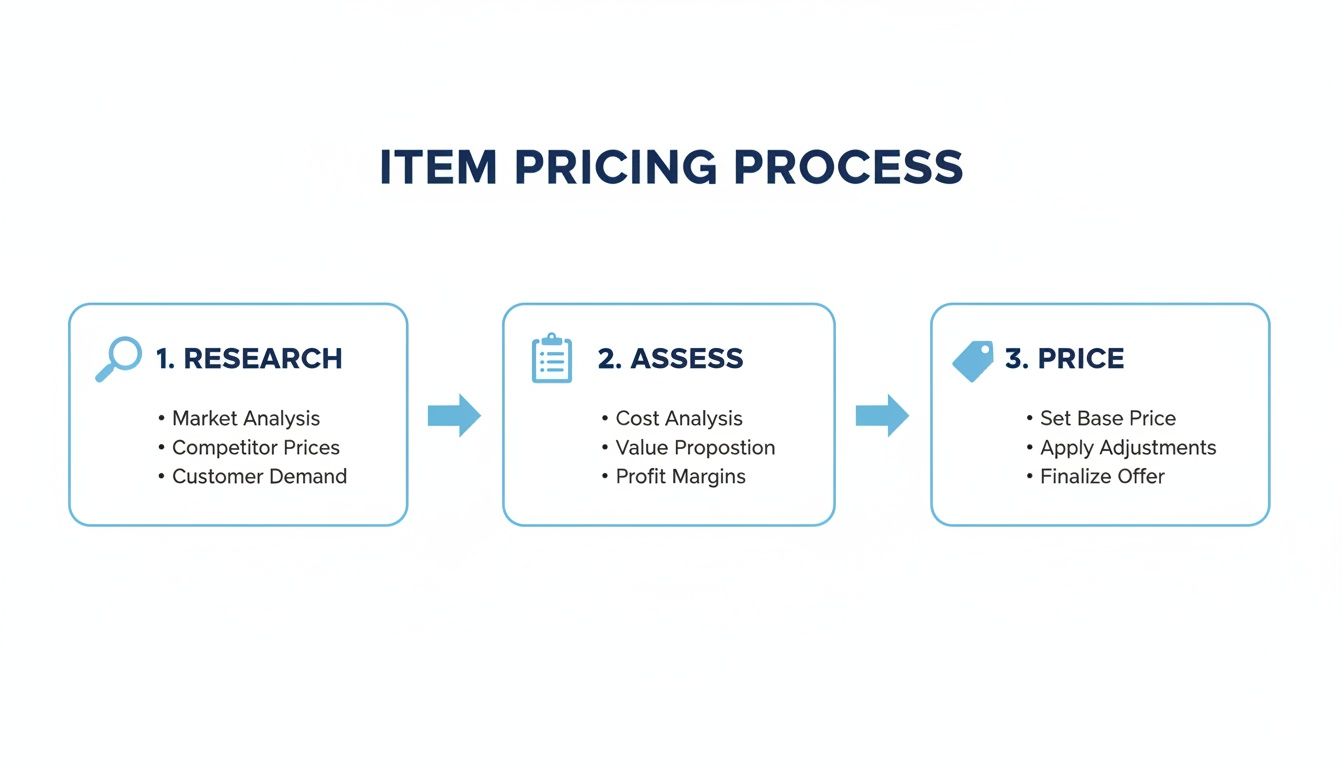
As the visual shows, you have to do your homework before you ever write out a price. Good research and assessment ensure the prices you put on your tags are both fair to the buyer and profitable for the estate.
Smart Tag Placement and Strategy
What’s on the tag is important, but where you put it is just as critical. The goal is to make the price easy to find without damaging the item in any way.
Common sense goes a long way here. You’d never stick a price tag on the canvas of a painting or on the delicate finish of an antique dresser. Instead, grab a string tag and loop it around a furniture leg, a picture hanger, or the cord of a lamp.
Pro Tip: Use a simple color-coding system to handle negotiations before they even start. A small colored dot sticker on your tags can speak volumes. For example, a red dot can mean the price is firm, while a green dot signals the item is 50% off on the last day.
This simple visual trick manages shopper expectations and saves your staff from answering the "What's your best price?" question a hundred times. It keeps the checkout line moving and makes the final hours of the sale run much more smoothly.
For a deeper dive into these kinds of strategies, check out our guide on https://www.diyauctions.com/learn/estate-sales-tag.
Staging And Photographing Items To Attract Buyers
Great presentation is non-negotiable, whether you’re running an in-person event or listing everything online. The way you stage and photograph your items directly impacts buyer interest and, ultimately, the prices you can command. You’re not just selling stuff; you’re creating an inviting atmosphere that encourages people to browse and helps them imagine these items in their own homes.
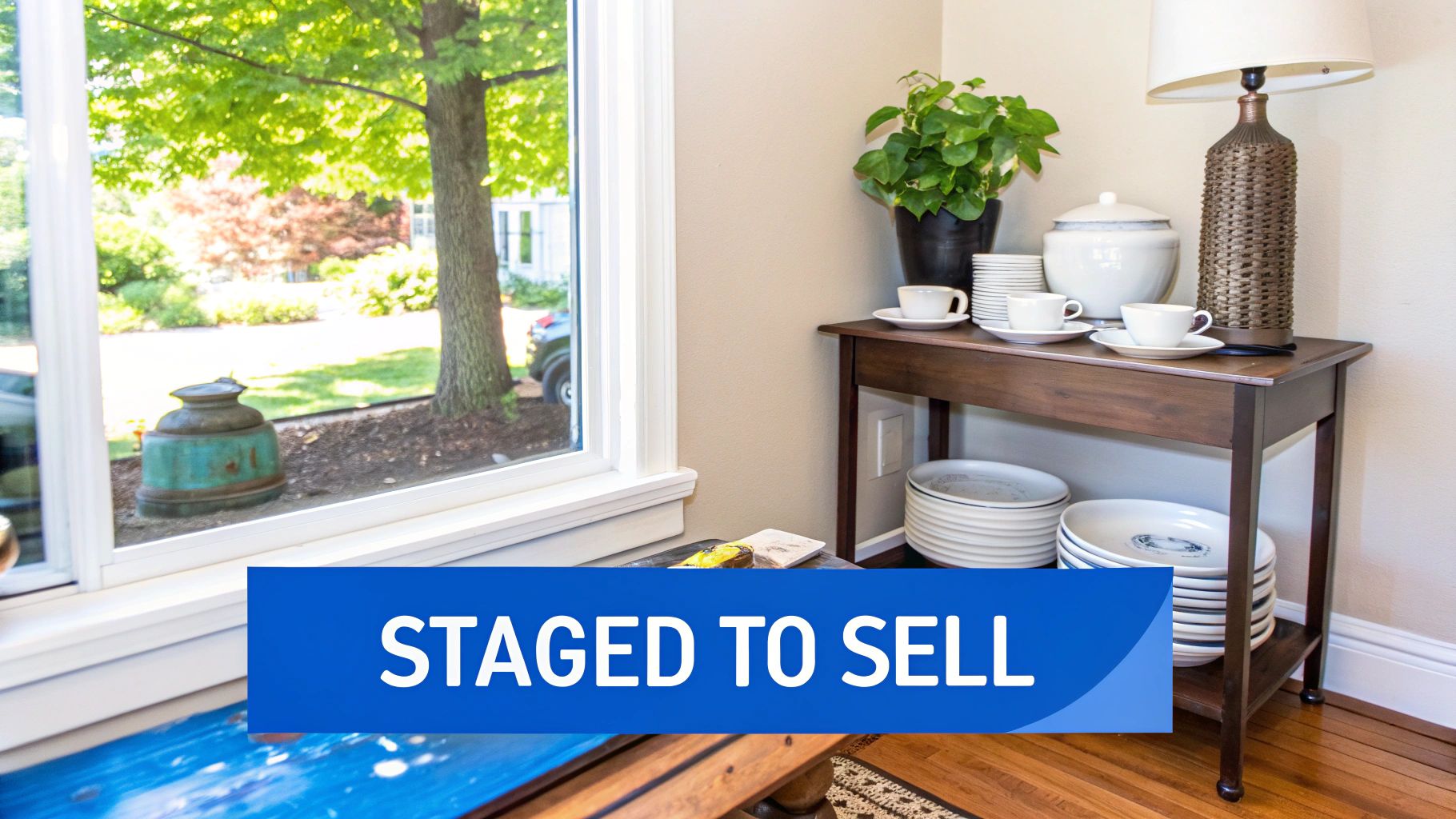
Start by creating a logical flow. You want people to feel like they’re in a well-organized shop, not a cluttered basement. Group similar items where they naturally belong—all the kitchenware should be neatly arranged on the kitchen counters, and the tools should be laid out in the garage. Piles are your enemy. They overwhelm buyers and make valuable items look like junk.
Taking Photos That Actually Sell
Once the house is staged, it’s time to pull out your most powerful marketing tool: your camera. And no, you don't need a fancy professional setup. Your smartphone is more than capable of taking photos that sell, as long as you use it right. High-quality images can make the difference between an item that sparks a bidding war and one that gets completely ignored.
Natural light is your best friend. Seriously. Open the curtains and turn off those harsh, yellow-toned overhead lights. Place items near a window, and shoot with the light source coming from behind you. This one simple trick will illuminate the item, show its true colors, and get rid of distracting shadows.
For a really professional look, think about your background. A clean, uncluttered setting—like a solid-colored wall or even a simple sheet—keeps the focus squarely on the item you’re selling. If you need some inspiration, there are tons of great ideas for product backgrounds online that can make your items pop.
A great photo tells a story and answers a buyer's questions before they even have to ask. It shows off the item's best features while being honest about its condition, which builds trust right from the start.
Creating A Comprehensive Shot List
For big-ticket items like furniture, antiques, or collectibles, one photo just isn’t going to cut it. You need a strategic set of images to give potential buyers the full picture and leave no room for doubt. For even more pointers, check out our guide on how to take professional product photos to make your listings really stand out from the crowd.
Here’s a simple but effective shot list I always recommend:
- The Full View: A wide shot that captures the entire item in great light.
- Detail Shots: Get up close and personal with unique features—think intricate carvings, cool hardware, or fabric textures.
- The Brand Mark: A clear photo of any manufacturer's label, signature, or stamp. This is a must for proving authenticity.
- Imperfections: Be honest. Take a well-lit photo of any scratches, chips, or stains. Buyers appreciate the transparency.
This level of detail in your photography will attract more serious, confident buyers. It’s a game-changer, especially if the property itself is part of the sale. With multifamily construction starts projected to be 74% below their 2021 peak by mid-2025, the real estate market is seeing some interesting shifts. For estate sellers, this means a well-marketed property in a supply-constrained area could command a premium price—making your photos more important than ever.
Common Questions About Pricing and Tagging
Even with a solid game plan, you're bound to run into a few tricky situations when you start pricing and tagging. I’ve seen it happen at countless sales. How you navigate these moments can make a huge difference in your final profits and, frankly, your stress levels.
Let's walk through some of the dilemmas that pop up time and time again. Getting these sorted out ahead of time means you'll run your sale with confidence instead of getting bogged down by last-minute panic.
Should I Price Items High to Allow for Haggling?
This is the classic debate, isn't it? My experience has shown that the answer is almost always no. It feels like a smart move to build in a negotiation buffer, but pricing an item way above its actual market value can backfire.
Serious buyers do their homework. When they see an inflated price, they often won't even bother making an offer, assuming you're unreasonable. The goal when you tag estate sales is to move inventory, not hold out for a record-breaking price on one or two pieces.
For big-ticket items like furniture, a small buffer of around 10% is fine, but for everything else, a fair price is what gets things sold.
Pricing items at their true market value builds trust. When shoppers see your prices are fair, they're more likely to buy multiple items without feeling the need to haggle on every single tag.
How Should I Handle Potentially Valuable Items?
If you stumble upon something that gives you that "this might be special" feeling—like a signed piece of art, old jewelry, or a rare collectible—just stop. Resist the temptation to slap a price on it based on a quick Google search. This is when you bring in an expert.
Getting a professional appraisal for these items is non-negotiable. An appraiser will:
- Verify Authenticity: First and foremost, they'll confirm if it's the real deal.
- Provide Market Value: You'll get a realistic valuation based on actual auction results and current market demand.
- Suggest a Sales Venue: They can advise whether it's best to sell at your estate sale or if you'd get a much better return by consigning it to a specialty auction house.
Spending a little on an appraisal could be the difference between selling a $5,000 painting for $50 and getting what it's truly worth. It’s a crucial step in maximizing the estate’s value.
Is It Better to Sell Items as a Set or Individually?
This one really comes down to the items themselves. For complete, matching sets, selling them together is almost always the way to go for a higher price.
A complete dining room suite—the table, all the chairs, and the matching hutch—is far more appealing (and valuable) as a single lot. The same principle applies to a full set of vintage china or a matching collection of sterling silver flatware. Tag these with one clear price for the entire group.
On the other hand, if a set is incomplete or made up of items that are just as useful on their own, splitting them up is the smarter play. Think of a box of mismatched wine glasses or a few odd plates from a discontinued pattern. Buyers are often looking for just one or two pieces to complete their own collection, so individual pricing can actually be more profitable in these cases.
More guides in Estate Sale Basics
July 28, 2026
Revenue Reporting for Estate Sales and Auctions
Learn revenue reporting essentials for estate sales and auctions. Discover key metrics, templates, and best practices to simplify tracking and compliance.
Read guideJuly 26, 2026
Stamp Collection Valuation: A Practical Step-by-Step Guide
Stamp collection valuation made simple. Learn how to identify, grade, price, and sell your stamps with confidence for estate sales or consignment.
Read guideJuly 23, 2026
Estate Sales Brick NJ: Your 2026 Guide to Success
Planning your estate sales brick nj? Our guide covers permits, pricing, marketing, & running a safe sale with DIYAuctions.
Read guideGet the estate sale pricing guide
Enter your email for pricing ranges, planning notes, and a clearer path to launch.