Third Party Verification Explained for Estate Sales
Learn what third party verification checks, why it protects estate sellers and buyers, and how DIYAuctions applies verification and fraud protection.
You're looking at an online estate sale listing for a solid walnut dining table, or maybe you're sorting through boxes in your parents' home getting ready to host a sale of your own. Right next to a user's name sits a small blue checkmark and the word "Verified." You pause for a second, because that single word leaves a lot of questions unanswered.
Does that badge mean the seller owns the house? Does it confirm the dining table has no hidden veneer cracks under the tablecloth? Or does it only mean someone clicked a confirmation link in an email six months ago?
A generic badge hides what was tested. Real third-party verification only protects buyers and sellers when you know four specific things: which check ran, which independent source ran it, on what date it happened, and which action it enabled. Once you know how to read those four details, you can separate meaningful proof from decorative checkmarks in any estate sale.
What Third-Party Verification Means
Suppose an estate seller lists a 1960s oak dresser online and describes it as "in excellent condition with original brass hardware." As the buyer, you live forty minutes away and can't pull out the drawers or inspect the dovetail joints before bidding. All you have in front of you are four photos and the seller's word.
In any transaction, a seller has a financial reason to make an item look as good as possible. That doesn't make the seller dishonest, just invested in the outcome. Think of a basketball game: a team can't score points and officiate its own fouls at the same time. You put a referee on the court precisely because that official doesn't win or lose based on the final score.
Third-party verification works the exact same way. An outside organization with no commercial stake in whether the dresser sells examines a specific claim before anyone relies on it. When an estate sale includes high-value pieces like designer watches or gold jewelry alongside household furniture, buyers often expect that outside check to follow clear inspection standards, similar to the steps outlined in Idaho Pawn & Gold Exchange's authentication guide for luxury sellers.
The Three Parties in Every Estate Sale
To make sense of any trust claim, it helps to separate the three roles involved in checking facts:
- First-party claim: The seller's own statement about their identity, their right to sell, or the condition of a dresser.
- Second-party check: The buyer inspecting the item directly, asking follow-up questions, or checking the seller's history themselves.
- Third-party verification: An independent reviewer evaluating a specific claim against defined rules and reporting the result.
Consumers lean heavily on that third role whenever they can't inspect goods with their own hands. In a February 2019 NSF survey of 1,000 Americans covering food, dietary supplements, personal-care products, and household cleaning products, 61% of respondents said they were concerned about the safety of products they put in, on, or around their bodies, yet 34% rarely or never researched product claims on their own. Even with that research gap, 85% said they trusted independent third-party certification organizations across those four categories, compared with 78% who trusted claims from government agencies.
Practical rule: Independent verification is a narrow spotlight, not a blanket guarantee. It confirms one defined claim at one point in time, and nothing outside that boundary.
Online estate buyers sit in that exact information gap. They can't touch the silver flatware or test the lawnmower engine before placing a bid, so an impartial check gives them a concrete reason to move forward without blindly trusting a listing caption.
Verification Types and What Each One Confirms
Most confusion around estate-sale safety happens because people treat verification as a single switch that flips from off to on. In practice, online marketplaces and estate hosts rely on seven distinct checks, and each one answers a completely different question.
| Verification type | What it confirms | Typical method | Where it matters most |
|---|---|---|---|
| Identity | The real person named on the account | Government ID match and liveness check | Account opening and high-value listings |
| Address | The account holder lives where they say | Utility bill or database match | Pickup logistics and records |
| Payment account | The payment method belongs to the account holder | Bank or card authorization | Buyer payments and seller payouts |
| Legal authority | The executor or trustee can sell the estate's goods | Review of letters testamentary or a court order | Inherited estate sales |
| Item condition and provenance | The item matches its description and history | Photos, appraisal or documentation | Collectibles and specialty items |
| Pickup handoff | The person collecting is the authorized winning buyer | ID check against the order record | Single-day pickup events |
| Device and behavior risk | Account activity fits normal use patterns | Device signals and velocity checks | Bidding and account fraud screening |
Most household estate sales don't need every row in that table. Selling a basement full of everyday kitchenware, garden tools, and paperback books rarely justifies formal appraisals or layered provenance dossiers. A "verified" label only tells you something useful when it specifies which row was confirmed.
Why Identity and Legal Authority Are Separate Checks
Estate hosts mix up identity and legal authority more than any other pair on that list. A government ID match and selfie liveness check prove that the person opening an account really is David Miller. They tell you nothing about whether a probate court appointed David to liquidate his late aunt's house.
An heir who hasn't received letters testamentary or trustee sign-off can pass a standard ID check in two minutes and still lack the legal right to sell family property. Separating those two rows prevents painful post-sale disputes among relatives and protects buyers who paid in good faith.
When Specialty Goods Require Item-Level Proof
Item condition and provenance work differently from personal checks because they attach to the object rather than the account holder. For graded trading cards, buyers look to serialized cases from grading houses, and collectors often study how to compare PSA slab marketplaces to see how external certification numbers anchor fair market value.
For original paintings, bronze sculptures, or inherited fine art, photos alone rarely settle questions about artist attribution or restoration history. Bringing in fine art appraisal services gives bidders a documented valuation and condition record before they commit serious money.
How an Independent Check Runs From Start to Finish
Knowing which check you need is half the equation. The other half is seeing how an independent review moves from an initial request to an approved action without turning into a black box.
The workflow below traces how a platform coordinates with an outside verification provider before proceeding to a high-stakes step like listing a valuable estate lot.
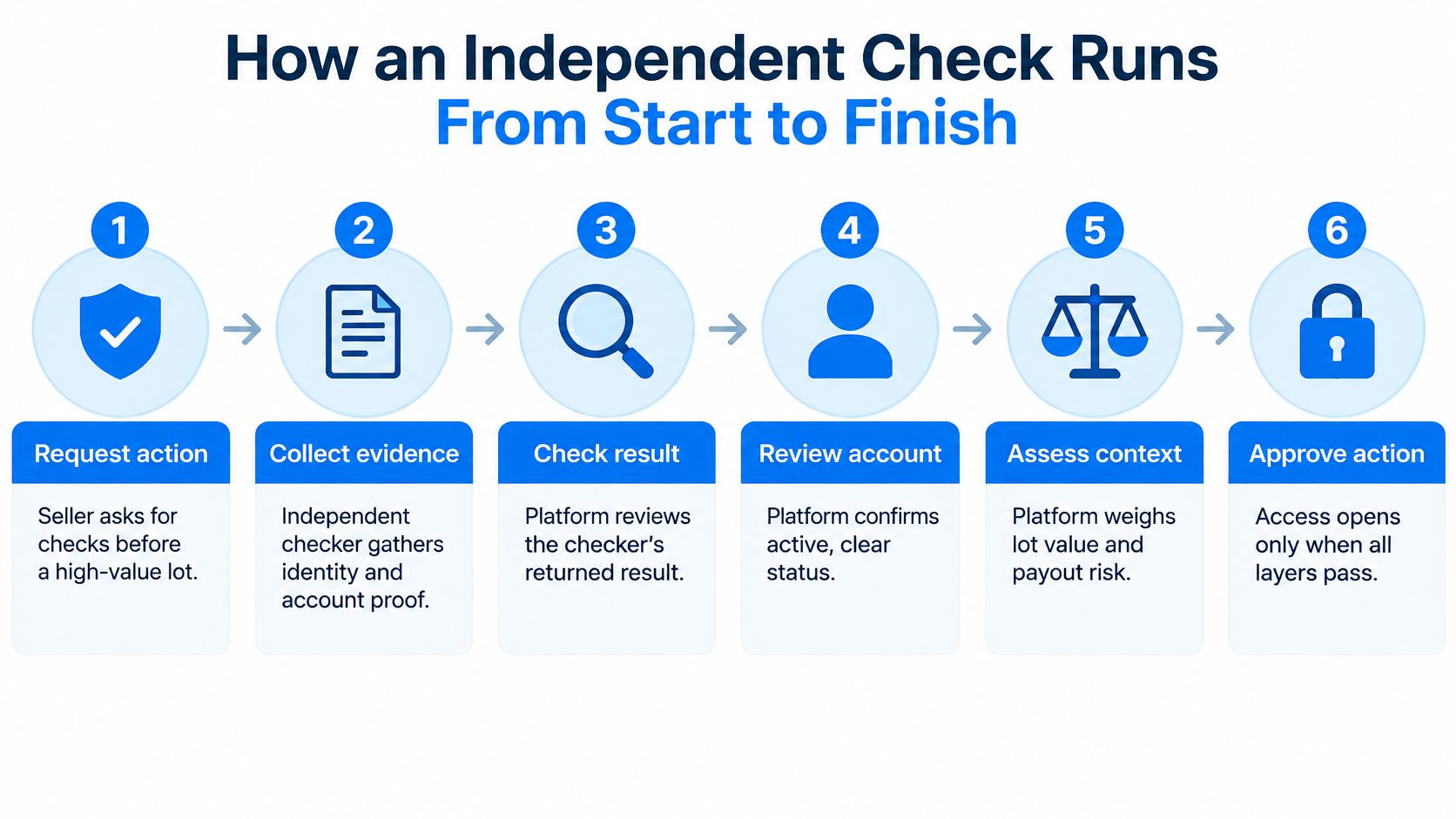
- The seller requests verification for a defined action. Before publishing a high-value lot or updating payout settings, the host triggers a check tied directly to that task. Defining the trigger up front prevents the platform from collecting unrelated personal data too early.
- The independent checker gathers scoped evidence. An external verification provider collects only the proof required for that check, such as a driver's license scan and a short liveness video. Narrowing the evidence reduces privacy exposure while keeping the review fast.
- The checker tests that evidence against written criteria. Instead of relying on an informal glance, the verifier checks document security features, expiration dates, and biometric alignment against standardized rules. Consistent rules mean two different reviewers reach the same decision on the same evidence.
- The checker returns a structured decision record. Rather than sending back a bare "pass" or "fail," a thorough verifier returns an assurance level, the exact checks performed, a timestamp, and reason codes. That record gives the platform an audit trail if anyone questions the transaction later.
- The platform reviews the record before approving the sale. The marketplace confirms the account is active, matches the verification level to the risk of the lot, and opens access only when every layer clears. At DIYAuctions, once a host's sale is ready to go live, we publish the sale, route buyers, handle payment flow, and keep bidding organized.
- The pickup handoff closes the loop. On collection day, the host matches the person standing at the door against the paid winning order and retains that confirmation. Without that final step, an online identity check wouldn't stop the wrong person from walking off with a paid item.
What Formal Standards Require From an Independent Checker
That six-step rhythm mirrors how formal conformity standards treat verification across industries. In its conformity assessment guidance, the International Organization for Standardization (ISO) defines certification as written assurance from an independent body that a product, process, service, or system satisfies specified requirements, setting it apart from first-party self-assessment and second-party purchaser checks.
According to that framework, a credible verification statement never hides behind vague wording. It specifies the exact system boundary examined, the criteria or standard applied, the assessment period, the sampling method, any exceptions found, and the validity or surveillance schedule. When an assessor uncovers a gap, nonconformities get classified by severity, assigned to specific owners, and re-tested before anyone signs off.
Before trusting any verification claim on a marketplace or estate listing, apply a three-question test: who checked it, against what written criteria, and on what date?
If a platform or seller can't answer those three questions clearly, you're looking at a marketing claim rather than a verifiable check.
Why a Verified Label Is Not the Same as Trust
Even when a third-party check runs cleanly, a shiny badge on a profile page still isn't the same thing as trust. Most verification labels compress complex checks into a single binary symbol, leaving buyers to guess whether the checkmark covered an email address, a driver's license, a bank account, or the authenticity of an antique sideboard.
A badge also can't read a person's intentions. Consider a buyer who signs up with their real driver's license, passes a live selfie check, pays with their own credit card, picks up an antique china cabinet, and then files a false chargeback claiming they never authorized the purchase. Every automated identity test marked that account as legitimate.
This pattern is known as first-party fraud. Research from LexisNexis Risk Solutions notes that first-party fraud is increasingly mistaken for third-party or synthetic-identity fraud, precisely because a real person uses their own valid identity while deliberately disputing a transaction or misrepresenting the facts.
Routine compliance checks struggle with the same blind spot in the corporate world. RiskRecon's 2024 State of Third-Party Risk Management research, published in a 2025-2026 cyber-risk statistics report, found that 44% of organizations assessed more than 100 third parties annually in 2024, yet only 4% expressed high confidence that third-party questionnaires accurately reflected supplier risk.
Building a Visible Evidence Trail
The fix isn't piling on more intrusive document uploads. Demanding extra personal records creates real privacy, exclusion, and accessibility costs without guaranteeing honest behavior.
Instead, verification works better when every piece of information carries clear provenance. The Association of Certified Fraud Examiners has advocated attaching metadata that labels each claim as self-reported, institutionally verified, or third-party attested. Look at how clearly that separates claims in an estate sale:
- Self-reported: The seller writes that a Persian rug came from a grandmother's home decades ago and has no pet odors.
- Institutionally verified: A probate court's stamped letters testamentary confirm the executor's legal standing, or a bank confirms payment authorization.
- Third-party attested: An independent identity provider confirms the user's government ID, or an outside appraiser certifies a piece of artwork.
When you can see the source behind every statement, you don't have to guess what a generic badge covers. You choose the least invasive control that matches the value and risk of the sale, and you keep pickup photos, payment confirmations, and messages together in case a dispute arises later.
How DIYAuctions Applies Verification and Fraud Protection
A single identity check at signup ages quickly. Accounts get hijacked, bank details change, and fraud tactics shift faster than static rules can catch them.
That's why NIST's digital identity guidance defines a verifier as the party that confirms a claimant's identity by validating control of authenticators and their binding to an active account, while allowing external credential-service or identity providers to run specialist assurance controls. NIST also recommends continuous assessment of fraud-detection effectiveness because attack patterns evolve over time.
In practice, that creates a layered control loop rather than a one-time gate. An independent verification provider supplies identity evidence, and the platform validates that assertion alongside account status and live transaction context before enabling sensitive actions.
Several controls keep that loop dependable from listing day through final payout:
- Authenticated provider-to-platform handshakes: Verification responses travel over secured channels so outsiders can't spoof an approval record.
- Expiration and revocation handling: Old checks don't stay valid forever if an account changes owners, updates payout details, or flags a security alert.
- Contextual risk escalation: When identity records, payment methods, device signals, and bidding behavior disagree, the action pauses for closer review before high-value listings publish or bank details change.
- Auditable minimal records: Storing the assurance level, checks performed, timestamp, and reason codes keeps verification traceable while minimizing how much raw personal data stays on file.
How Pre-Payment Connects Verification to Pickup
Verification also changes what happens on pickup morning. At DIYAuctions, we use a secure pre-payment system, so buyers have already paid before they collect their items. Instead of counting cash on a driveway or worrying about a bounced check while ten people wait in line, you confirm that the person arriving matches the paid order.
Accountability behind the platform matters just as much as the software controls. DIYAuctions is operated by Stanforce Labs LLC, doing business as DIYAuctions, so sellers and buyers know the exact company responsible for the marketplace.
For a deeper breakdown of how bidding protections, account checks, and payment flows work together, read our guide on online auction security. Never assume any platform runs checks beyond what it explicitly documents. If your estate includes specialty assets or unusual estate payout rules, confirm the specific verification requirements with our support team before you publish.
Where Verification Blocks Honest Sellers and Buyers
Every security check introduces friction. Make the checks too loose, and bad actors slip through; make them too rigid, and legitimate bidders close the browser tab before placing a single bid.
Data from the Veriff Fraud Report shows why platforms take screening seriously: 4.18% of verification attempts were fraudulent in 2025, while its e-commerce sample recorded a 19.2% net fraud rate, nearly five times the overall average. Keep the scope of those numbers in mind, though. They reflect one verification provider's customer data rather than a universal benchmark for every local estate-sale platform.
Because most local shoppers aren't trying to defraud anyone, forcing every casual browser through full government-ID verification just to view a catalog kills turnout. Risk-based, staged verification solves that balance by matching friction to the risk of the moment:
- Browsing and watching lots: Lightweight account creation and contact checks let neighbors explore the catalog without pulling out a passport.
- High-value bidding and seller payouts: Stronger identity and payment checks kick in where financial exposure rises, increasingly paired with layered verification that combines identity matching, device intelligence, and behavioral scoring (the kind of multi-signal approach Mastercard describes using consumer-permissioned financial data alongside predictive risk models).
- Pickup handoff: Matching the collector's ID to the authorized winning order protects the physical transfer without slowing down earlier browsing.
Fallback Paths That Keep Legitimate Users Moving
Automated document scanners aren't built for every real-world situation. Rigid software checks disproportionately block older homeowners whose IDs have worn laminate, executors managing an estate from another state, international buyers using foreign passports, and people whose address databases haven't caught up after a recent move.
A fair verification system plans for false positives from day one, because locking out an honest executor hurts an estate sale just as surely as letting a scammer through.
Strong platforms build four clear fallback paths into their workflow:
- Manual review: A human specialist examines blurred scans, older license formats, or mismatched legal names that automated algorithms reject by default.
- Alternate documents: Allowing secondary government IDs or official estate papers gives executors a practical way to verify their role when standard records don't fit.
- Trusted payment instruments: Confirming ownership through an established bank account or verified card helps validate legitimate users whose residential address recently changed.
- Clear appeal procedures: Publishing straightforward steps to contest a flagged check ensures an honest seller or buyer gets a timely answer instead of hitting a dead end.
No single verification step eliminates every risk. Pairing right-sized checks with transparent human fallbacks keeps honest estate transactions moving while still filtering out organized abuse.
Run the Verification Checklist Before Your Next Sale
Preparation turns verification from a last-minute headache into a smooth routine. Before you open bidding on an estate sale, walk through these seven steps and keep the notes together in a single sale folder.
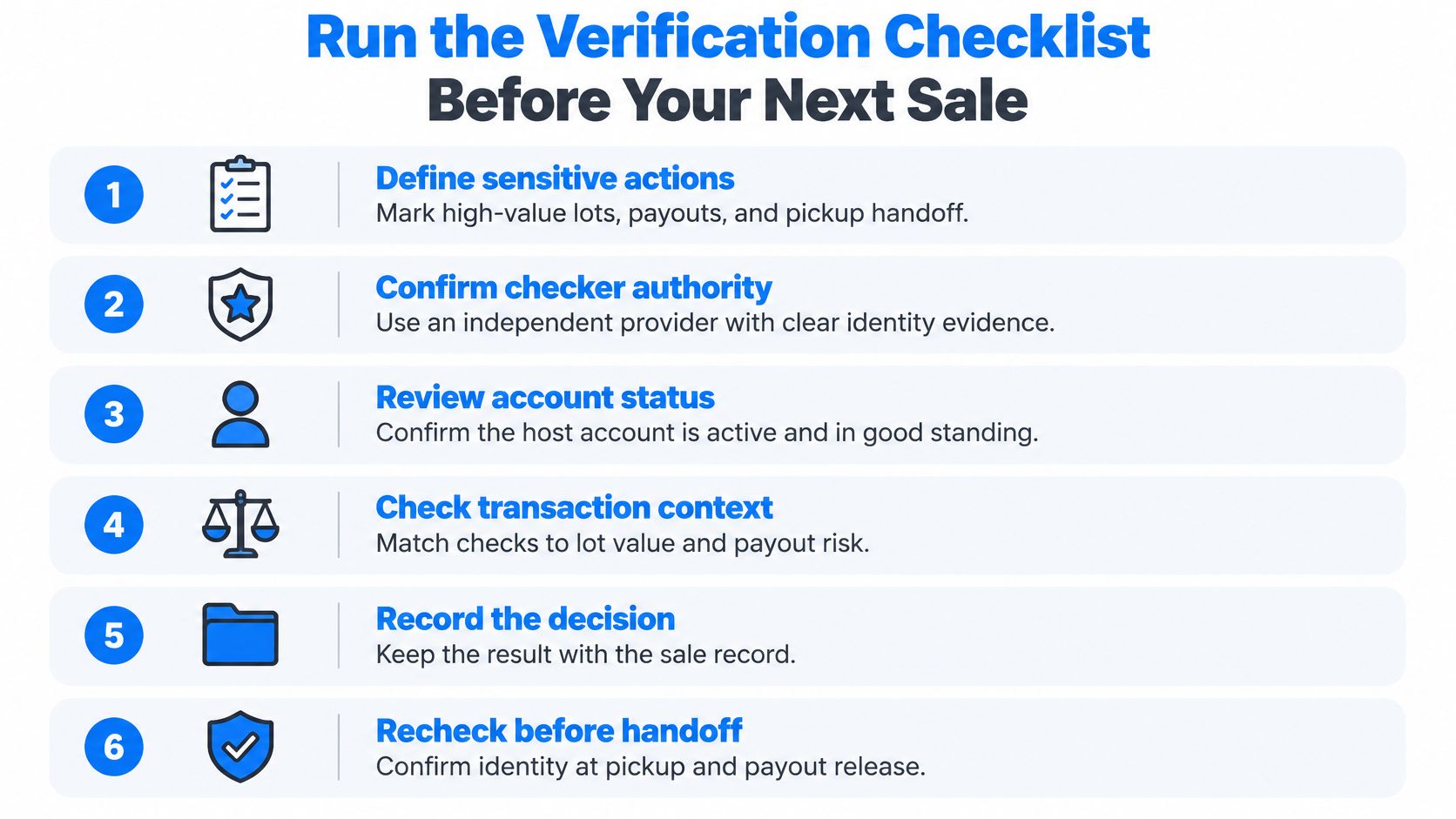
- Decide which actions require verification. Flag high-value lots, seller payout setup, and pickup handoff ahead of time so your safeguards match the actual financial stakes of the catalog.
- Confirm your legal authority to sell. Gather letters testamentary, trustee authorization, or the relevant court order before cataloging an inherited home, so family or buyer questions never stall closing day.
- Verify payout account ownership. Confirm that the bank account receiving funds belongs to the verified account holder before any bids come in, avoiding payout holds after the sale ends.
- Photograph condition and save provenance records. Capture clear angles of wear, maker's marks, and serial numbers, and store receipts or appraisals alongside the lot notes so buyers see concrete evidence rather than bare adjectives.
- Log every verification with four facts. Note the specific check completed, the source that performed it, the date it ran, and the exact action it cleared. That simple log turns vague assurances into an auditable trail.
- Set your pickup handoff protocol. Plan how you'll check each collector's ID against the winning buyer's paid order record, and keep a signed or digital release note for every lot that leaves the property.
- Prepare fallback documents in advance. Keep an alternate government ID or verified payment record within reach so a scanner glitch or address mismatch doesn't delay your launch timeline.
Pair this log with our broader fraud prevention checklist to tighten listing details, buyer messaging, and pickup-day organization across the whole event. If you have questions about accounts, auctions, or platform features while preparing, DIYAuctions general support handles those inquiries, while technical issues with the platform go through our separate Report Issue option.
Publish your estate sale only after every item on this checklist is complete, and reuse the same four-detail verification log for every future sale you run.
Ready to run an estate sale where verification, pre-payment, and pickup handoff work together? Create your host account on DIYAuctions to keep up to 90% of your proceeds with a straightforward 10% commission capped at $1,000, or contact our general support team before you list so we can confirm the exact verification steps for your upcoming sale.
Get the estate sale pricing guide
Enter your email for pricing ranges, planning notes, and a clearer path to launch.