Bundle Pricing Strategy: Sell More in Your Estate Sale
Learn the bundle pricing strategy to sell items faster and increase profits in your DIYAuctions estate sale. Our guide covers types, pricing, and examples.
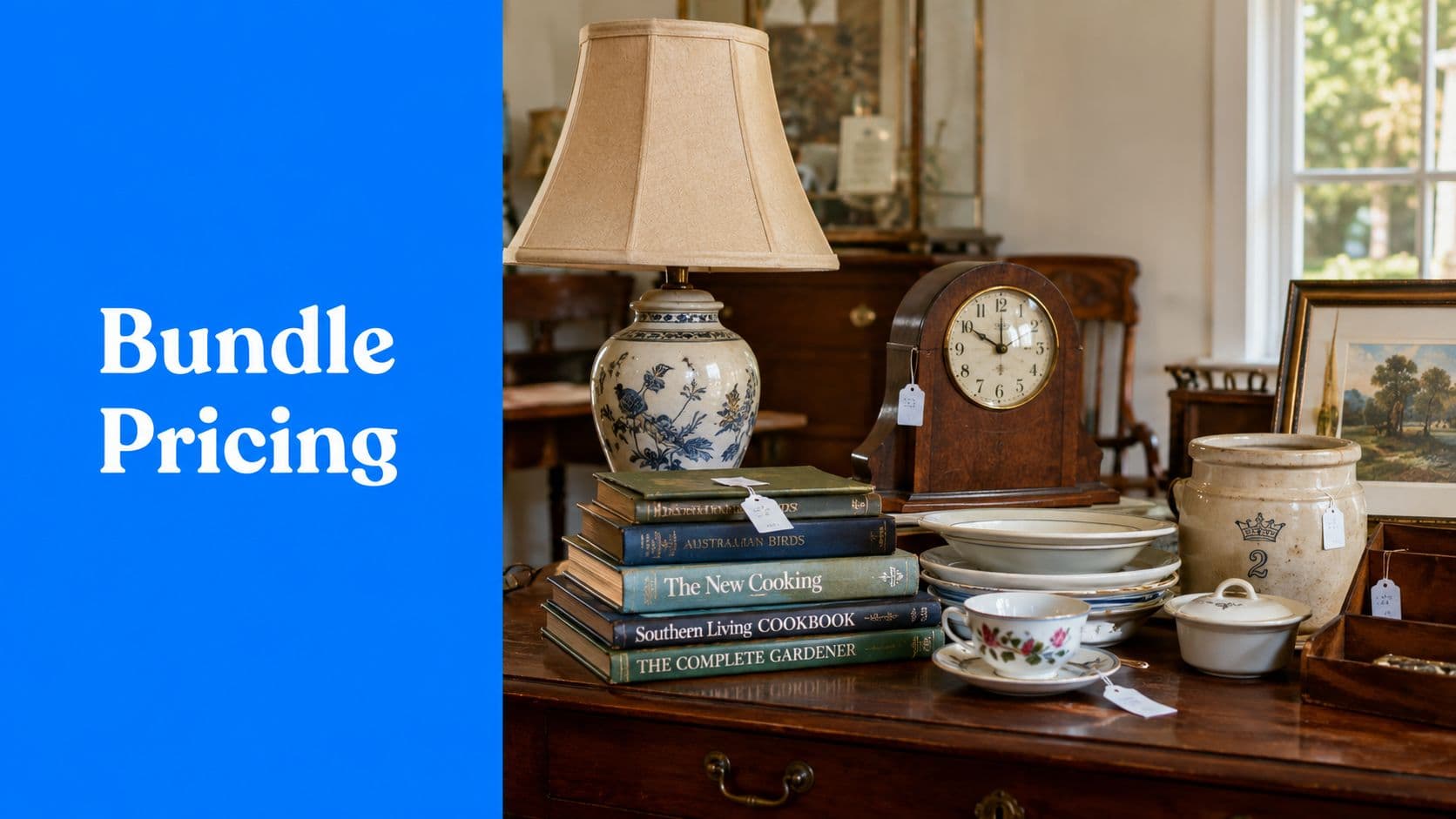
You're staring at the kind of inventory every estate sale has. A few pieces look obviously valuable. A lot more sit in the middle. Then there's the hard stuff: the half-complete china set, the drawer of hand tools, the stack of framed prints, the sewing basket, the holiday decor, the box lot of kitchen gadgets nobody seems excited about on its own.
Selling item by item sounds smart until you realize how much time it takes, how many listings it creates, and how often the low-interest pieces just sit there.
That's where a bundle pricing strategy earns its keep. Estate sale pros use it because it helps turn scattered household goods into offers buyers can understand quickly and bid on with confidence. If you're running your own online estate sale, bundling is one of the easiest ways to move more inventory without giving everything away.
What Is a Bundle Pricing Strategy
A bundle pricing strategy is simple. You group multiple items together and sell them as one lot at one price.
For an estate sale, that means you stop thinking only in terms of individual objects and start thinking in terms of buyable groups. Instead of listing six teacups, a sugar bowl, and a creamer separately, you create one china tea service lot. Instead of ten loose garage items, you create a usable hand tool bundle. Instead of random decor, you build a shelf-ready vintage display group.

Why bundling fits estate sale inventory
Most homes don't contain neat retail stock. They contain lived-in collections. That's the key difference.
A traditional store might bundle identical products or accessories. In an estate sale, you're often bundling items that share a purpose, a room, a style, or a buyer type. The items may not match perfectly, but they still make sense together. Buyers respond well when the grouping saves them effort and feels curated instead of random.
Bundling also solves a problem that almost every estate seller faces. Some items attract attention fast. Others don't. If you only sell one by one, the good items disappear and the leftovers become harder to move. A smart bundle lets a stronger piece help carry weaker ones.
What bundling really does
At a practical level, bundling changes the job from “price every object” to “build offers people want.”
That can mean:
- Creating a complete lot for items that belong together, like a box of vinyl records or a set of matching glasses
- Pairing demand with utility by grouping a wanted item with useful companions, like a drill with bits and a case
- Building a theme that makes the listing easier to understand, like a baker's box, gardener's kit, or office starter set
Practical rule: A good bundle answers one question fast. Why would one buyer want all of this together?
What bundling is not
It's not dumping unrelated leftovers into one listing and hoping for the best.
Buyers can tell when a seller is forcing a pile. A bundle works when it feels intentional. The more clearly the items fit together, the stronger the listing becomes. That's true whether you're selling vintage barware, holiday ornaments, craft supplies, or garage hardware.
In estate sales, the best bundles usually do one of three things. They preserve a set, solve a need, or create a collectible lot. If your grouping does none of those, break it apart and rethink it.
Why Bundle Pricing Is So Effective for Sellers
A buyer opens your online sale and sees two options. One listing is a single gravy boat from a partial china set. The other is a clearly photographed 18-piece serving group with platters, bowls, and matching extras. In estate sales, the second listing usually gets more attention because the value is easier to see and the work is already done for the buyer.
Big retailers have used this for years. Simon-Kucher points to McDonald's Extra Value Meal as a well-known example of bundle pricing in action. The lesson for estate sellers is simple. People respond to offers that feel complete, easy to understand, and worth buying together (Simon-Kucher on bundle pricing).

Bundles reduce buyer hesitation
Estate sale buyers are often sorting through mixed inventory, uneven photos, and unfamiliar brands. A bundle cuts through that. Instead of asking them to decide whether they want one teacup, one saucer, one creamer, and one sugar bowl, you give them a finished offer they can judge in seconds.
That matters online, where small delays cost bids and sales.
A useful bundle helps because it:
- Cuts decision time by turning several choices into one
- Makes value easier to spot because the buyer sees the full group at once
- Feels more practical when the items support one use, collection, or room
- Creates stronger buying intent because a complete lot often feels harder to pass up than a single stray item
If you're also tightening up your listing presentation, this guide on how to improve ecommerce conversion rate is worth a look. The ideas around reducing friction and clarifying the offer translate well to online estate sales.
Bundles improve the economics of the sale
The biggest advantage for sellers is not convenience. It is throughput.
A bundle can raise the total amount one buyer spends, help slower items leave with stronger ones, and reduce the time spent managing dozens of low-dollar listings. That is the same basic logic big-box stores use at checkout. Put related items into a single offer, make the choice easier, and increase the size of the transaction.
In an estate sale, that shows up in practical ways:
| Benefit | What it looks like in an estate sale |
|---|---|
| Higher cart value | A buyer takes the hand mixer, measuring cups, bakeware, and recipe box as one kitchen lot |
| Better sell-through | Extra china pieces, loose hand tools, or accessory items move with the main item instead of getting stranded |
| Less admin work | Fewer listings to write, fewer tags to manage, fewer pickup handoffs to coordinate |
That last point gets overlooked. If you have ever had to label, store, and answer questions on 40 small garage items, you already know why good lot building saves time. Clear estate sale tagging practices also matter more when you are organizing grouped inventory for photos, listings, and pickup.
Bundling works especially well with estate sale inventory
Estate sales are full of items that make more sense together than apart. A box of old china may have modest value piece by piece, but as a replacement lot or entertaining set it becomes easier to buy. A group of tools can look like clutter spread across ten listings, yet read as a useful workshop starter lot when photographed and priced together.
Here, estate sellers can borrow from retail without acting like a retail store. You are not stocking identical products. You are curating one-of-a-kind household inventory into offers that feel intentional.
The trade-off is real. Some standout items should stay separate because they can carry their own price. But mid-range pieces, partial sets, accessories, and practical household goods often perform better when the buyer can see the use case immediately.
What weak bundles get wrong
Bad bundles usually fail for clear reasons. The group feels random, the value is hard to judge, or the bundle asks the buyer to take too much dead weight with one good item.
A box with one quality wrench set, three rusty screwdrivers, a broken tape measure, and unrelated garage leftovers is not a smart tool bundle. A drill, charger, bits, case, and safety glasses can be.
Strong bundles feel edited. They show judgment. Buyers notice that fast, and that confidence often carries straight into higher bids or quicker sales.
Choosing the Right Bundle Type for Your Items
Not every item should be bundled the same way. In estate sales, I've found it helps to think in plain terms instead of pricing jargon. You don't need a theory lesson. You need a way to look at a room and decide what should stay together, what should be paired, and what should become a themed lot.
The three bundle types below cover most estate sale inventory.

Lot sale for items that belong together
This is the estate sale version of pure bundling. The items are sold as one group, not split up.
Use this when separating the pieces would weaken the offer or create too much work. A partial china service is the classic example. One buyer may want the whole set for use, replacement pieces, or resale. Very few want to chase individual saucers across separate listings.
Lot sales work well for:
- China and glassware sets
- Boxes of records
- Collections of figurines
- Holiday ornament groups
- Sewing baskets with notions and tools
This approach is especially useful when the buyer naturally expects completeness. If the value comes from the group, keep the group intact.
For physical tagging and lot organization before you list, this guide to an estate sale tag is useful because clear lot identification prevents confusion later.
Strategic add-on for mixed demand
This is the estate sale version of mixed bundling or a complementary pairing. One item pulls attention. The other items make the deal stronger.
Think of a power drill with extra bits, safety glasses, and a case. Or a cast iron skillet with a cookbook stand and kitchen utensils. Or a desk lamp paired with office supplies and a letter tray.
The anchor item matters here. It gives the buyer a reason to click. The supporting items make the listing feel complete.
Use this type when:
- one item has clear appeal,
- the companion items are useful but unlikely to sell well alone,
- and the combined offer solves a small practical need.
Don't attach junk to a good item. Attach support.
That distinction matters. A bundle should feel like an upgrade, not a cleanup project.
Themed kit for scattered household goods
This is often the most creative and profitable estate sale bundle type. You build a group around a theme or buyer identity.
A themed kit works because estate inventories are full of related things that were never stored together neatly. Your job is to assemble them into a coherent offer.
Examples include:
- Baker's box with mixing bowls, measuring cups, rolling pin, spatulas
- Gardener's kit with hand tools, gloves, small pots, twine
- Reading nook lot with lamp, books, throw blanket, bookends
- Workshop corner with clamps, screwdrivers, sanding blocks, hardware jars
A quick sorting method
When you're deciding what type to use, ask these questions:
- Would this lose value if split up? If yes, make it a lot sale.
- Does one item naturally lead and the others support it? If yes, build a strategic add-on.
- Do these items create a useful theme even if they came from different places in the house? If yes, make a themed kit.
In this context, many DIY sellers start seeing opportunity instead of clutter. That box of old china isn't just a storage problem. It's a ready-made lot. That spread of garage tools isn't random. It may be two or three buyer-ready bundles.
How to Price Your Bundles for Maximum Profit
You pull together a box of old china, price every piece separately, and end up with a dozen listings that sit. Or you group the set, price it with intention, and give one buyer a clear reason to click Buy Now. Bundle pricing works best when the number reflects both item value and selling efficiency.
The goal is simple. Price high enough to protect the good pieces, and low enough that the buyer sees an obvious advantage in taking the whole group.

The basic pricing formula
Quikly recommends starting with the total standalone price, subtracting cost of goods sold, and then applying a discount in the 10% to 20% range. Its example shows $100 in retail value, $40 in COGS, and an $85 bundle price that leaves $45 in gross profit (Quikly bundle pricing guidance).
Estate sale sellers rarely have neat retail accounting, but the method still helps. Add up what the items could reasonably bring on their own. Then reduce the total enough to make the bundle feel like a better buy, while keeping the anchor item from carrying a pile of low-value extras for free.
That second part matters.
A bundle of hand tools, for example, should not be priced by tossing every screwdriver, clamp, and rusted wrench into one number and hoping volume does the work. A better method is to price around the strongest pieces first, then ask whether the supporting items make the offer more useful or just heavier.
A practical estate sale workflow
Use this sequence when you set the number:
-
Add up realistic separate-sale prices Use the prices you would list, not best-case fantasy numbers. If a shop vac would probably sell for $35 and the hose attachments might bring $10 more, start there.
-
Mark the anchor item
Every good bundle has a lead piece. In estate sales, that might be the drill, the cast iron skillet, the silverplate tea set, or the framed print buyers notice first. -
Apply a clear bundle discount
As noted earlier, a modest discount often works better than an aggressive one. Buyers need to see savings right away, but you still need room for profit and negotiation. -
Test the bundle for usefulness
A china set with serving pieces feels complete. A garage lot with a saw, blades, and safety glasses feels usable. A random stack of leftovers feels cheap, even at a low price. -
Count the labor you are saving
One strong listing can replace six weak ones. That saved time has value, especially if you are managing pickup messages, offers, and relisting yourself.
Here's the video version if you want a visual walk-through of bundle thinking in action.
An estate sale example
Say you have a garage group with a circular saw, extra blades, safety glasses, an extension cord, and a carrying case. Sold one by one, the saw has the most value. The blades may sell. The glasses and cord may not move at all, or they may take weeks and extra messages to clear.
Bundle pricing fixes that if you do it with discipline. Start with what each piece could bring separately. Then shave enough off the total that the buyer sees a ready-to-use setup at a better price than piecing it together. The saw remains the reason to buy. The rest of the items support the sale and increase perceived value.
The same logic works with household goods. A box of old china often sells better as a complete service set with platter, creamer, and sugar bowl than as twelve separate listings. Buyers shopping estate sale inventory are often looking for completeness, giftability, or easy resale potential. Price for that use case, not just for item count.
What to avoid when setting the number
Weak bundle pricing usually comes from three mistakes:
- The discount is too small, so buyers compare the bundle to separate listings and see no advantage.
- The discount is too steep, so the best item carries too much filler and your margin disappears.
- The grouping lacks logic, so even a cheap price cannot fix the feeling that the lot was assembled to clear clutter.
Set the bundle price so the value gap is obvious within a few seconds.
If you want help with the broader math behind listing and sale setup, this guide on pricing for estate sales is a useful companion.
For sellers running more complex ecommerce catalogs, the technical side can get much deeper. This overview of technical architecture for custom bundle apps shows how larger stores handle bundle logic behind the scenes. Estate sales do not need that level of setup, but the lesson carries over. Strong bundles are planned, priced, and presented with purpose.
Smart Bundling Examples for Your Online Estate Sale
The easiest way to build confidence with a bundle pricing strategy is to start with common household groupings. Most estate sales already contain them. You just need to name them well and present them like complete offers.
The complete kitchen starter
This is one of the best themed bundles in a downsizing sale. Pair mixing bowls, measuring cups, wooden spoons, a colander, oven mitts, and a small appliance if it fits.
A buyer sees a useful setup, not six separate kitchen listings.
Sample title: Complete Kitchen Starter Lot
Sample description: Mixing bowls, measuring tools, utensils, colander, and everyday kitchen basics ready for first apartment, rental, or backup kitchen use.
The gardener's weekend haul
Group hand trowels, pruners, gloves, small pots, plant markers, and twine. If there's a watering can or garden kneeler, even better.
This kind of lot works because the items support one activity and often come from several corners of the property.
The cozy reading nook
Pair a side lamp, stack of hardcovers, bookends, throw blanket, and small accent decor if it suits the style. A chair can work too if pickup is simple.
This bundle is less about strict matching and more about mood. That's often enough.
- Best for books that are ordinary individually but stronger together
- Works especially well when the items share a vintage, cottage, or traditional look
- Listing note should mention ambiance, not just object names
If you want these bundles to perform well online, your photos matter almost as much as the grouping. This guide on how to photograph items to sell online is worth using before you publish the lot.
The workshop corner
This is a classic garage bundle. Combine clamps, screwdrivers, measuring tape, sanding blocks, drill bits, and hardware organizers. Keep it practical.
Don't over-clean this one into sterility. Buyers expect a workshop lot to look used, but they still need to see what's included clearly.
The collector's lot
Small collectibles often do better when grouped by type, era, material, or style. Think costume jewelry, postcards, stamps, figurines, lighters, or souvenir spoons.
Sample title: Vintage Figurine Collector's Lot
Sample description: Group of decorative figurines sold together as one estate lot. Good fit for display, collecting, or resale.
The guest room linen bundle
This is a quiet winner in many sales. Pair sheet sets, pillowcases, blankets, and a bedspread if condition is solid and presentation is clean.
It works because one buyer can solve a full household need in a single purchase. That's exactly what a good bundle should do.
How to Know If Your Bundles Are Working
You don't need advanced analytics to judge whether your bundle pricing strategy is doing its job. In an estate sale, the signals are usually visible if you know what to watch.
The best evaluation starts with simple comparison. Did the grouped items sell more cleanly than they would have alone? Did the bundle attract interest without dragging down the stronger piece? Did it make the sale easier to manage?
Watch sell-through first
Sell-through is the first test because unsold inventory tells the truth fast.
If you've bundled a box of tools and it sells promptly, while similar loose tools usually linger, the bundle did useful work. If your grouped china lot gets bids and individual place settings never would have been worth the effort, that's a win.
Ask yourself:
- Did this bundle move items that might otherwise stall?
- Did the group attract attention as listed?
- Would I have been left with leftovers if I had split it up?
This measure is especially useful for middle-value and low-glamour categories like kitchenware, linens, garage items, and craft supplies.
Compare the final price to the effort saved
A bundle doesn't need to beat the absolute best-case item-by-item total to be successful. It needs to produce a solid result with less friction.
That means you should judge final price alongside labor. Fewer listings, fewer questions, and fewer pickup complications all matter. In real estate sale work, operational ease is part of profitability.
A basic way to understand this is:
| Signal | Healthy outcome |
|---|---|
| Final bid activity | Buyers understood the value and competed for it |
| Bundle close price | The lot landed at a number that felt fair for both sides |
| Handling effort | The group saved listing and pickup time |
A bundle is working when it clears inventory, protects the appeal of the best item, and saves you from managing five weaker listings.
Pay attention to buyer behavior
Buyer response teaches you what kind of bundle to build next time.
If themed bundles get quick attention, make more of them. If mixed lots with one strong anchor perform well, repeat that pattern in other categories. If random assortment boxes get ignored, stop making them.
You can learn a lot from the wording of questions too. When buyers ask, “Is everything in the photo included?” that often means the theme is attractive but the listing needs clarity. When buyers ask to split pieces out of a bundle, that can mean one item is too dominant or the rest of the group isn't pulling its weight.
Build your next sale from what sold cleanly
After the sale, make a short note of which bundle types worked best:
- Room-based bundles such as kitchen, office, patio
- Activity bundles such as gardening, baking, workshop
- Collector bundles such as records, figurines, vintage linens
- Anchor-led bundles such as tool plus accessories, lamp plus decor
Over time, you'll get faster at seeing inventory in groups instead of individual objects. That shift is what makes bundling so useful in estate sales. It helps you turn a house full of mixed belongings into a sale that feels organized, attractive, and efficient.
If you're ready to put this into practice, DIYAuctions gives you a way to run your own professional online estate sale, build listings around smart bundles, and keep more of the proceeds.
More guides in Estate Sale Basics
July 28, 2026
Revenue Reporting for Estate Sales and Auctions
Learn revenue reporting essentials for estate sales and auctions. Discover key metrics, templates, and best practices to simplify tracking and compliance.
Read guideJuly 26, 2026
Stamp Collection Valuation: A Practical Step-by-Step Guide
Stamp collection valuation made simple. Learn how to identify, grade, price, and sell your stamps with confidence for estate sales or consignment.
Read guideJuly 23, 2026
Estate Sales Brick NJ: Your 2026 Guide to Success
Planning your estate sales brick nj? Our guide covers permits, pricing, marketing, & running a safe sale with DIYAuctions.
Read guideGet the estate sale pricing guide
Enter your email for pricing ranges, planning notes, and a clearer path to launch.