A Seller's Guide to Estate and Garage Sales
Our guide to estate and garage sales helps you choose the right sale, price items for profit, and manage logistics. Learn how to maximize your earnings.

Choosing between an estate sale and a garage sale is your first big decision, and it’s a crucial one. Think of it this way: a garage sale is like a weekend clear-out to make some quick cash. An estate sale is more like setting up a pop-up shop to sell the entire contents of a home.
It all boils down to the volume and value of what you're selling.
Choosing Between an Estate Sale and a Garage Sale
Picking the right path from the get-go will save you a ton of time, effort, and can seriously boost your final earnings. While both involve selling secondhand items, they are worlds apart in their scope, the kind of buyers they attract, and what it takes to run them successfully.
Understanding these differences is the key to matching the sale type to your actual goals. Are you just trying to declutter quickly, or do you need to get the best possible price for a lifetime of accumulated possessions?
This is so important because each type of sale draws a completely different crowd with different expectations. A garage sale is a classic neighborhood event, pulling in bargain hunters looking for everyday stuff.
The scale of these events is massive. Every week, Americans host around 165,000 yard sales, attracting about 690,000 eager buyers. These sales generate a staggering $4.2 million in revenue, with the average item selling for just 85 cents each.
Key Factors in Your Decision
An estate sale, on the other hand, is a destination. People will drive from all over to attend one. It attracts serious collectors, resellers, and folks hunting for specific high-quality pieces like antique furniture, original art, or fine china.
Here are the core questions to ask yourself:
- Scope of Inventory: Are you dealing with a few boxes of household odds and ends, or are you liquidating the entire contents of a house?
- Item Value: Is your stuff mostly low-cost, everyday items, or do you have higher-value antiques, collectibles, and quality furniture?
- Time and Effort: Are you looking for a quick, DIY weekend project, or can you commit to a more involved, structured event?
- Profit Goals: Is the main goal just to clear out space, or do you need to maximize the financial return on every single item?
To help you see which way to go, here’s a quick-glance comparison.
Estate Sale Vs Garage Sale At a Glance
This table breaks down the fundamental differences between the two, helping you quickly see which one aligns with your needs.
| Characteristic | Garage Sale | Estate Sale |
|---|---|---|
| Primary Goal | Decluttering, quick cash | Liquidating an entire household, maximizing value |
| Typical Inventory | Clothing, toys, kitchen gadgets, general clutter | Furniture, antiques, collectibles, art, appliances |
| Location | Driveway, garage, or front yard | Inside the home, with all rooms accessible |
| Pricing | Low, designed for quick sale, heavy haggling | Researched, based on fair market value, often fixed |
| Audience | Neighbors, local bargain hunters | Serious collectors, antique dealers, resellers |
| Duration | 1-2 days (usually a weekend) | 2-4 days, sometimes longer |
| Marketing | A few signs on street corners, local classifieds | Professional marketing, online listings, social media |
| Effort Level | DIY, relatively low effort | High effort, often requires professional help |
Ultimately, the best choice depends on what you're selling and what you hope to achieve.
This decision tree infographic can also help you visualize which path is the best fit for your situation.
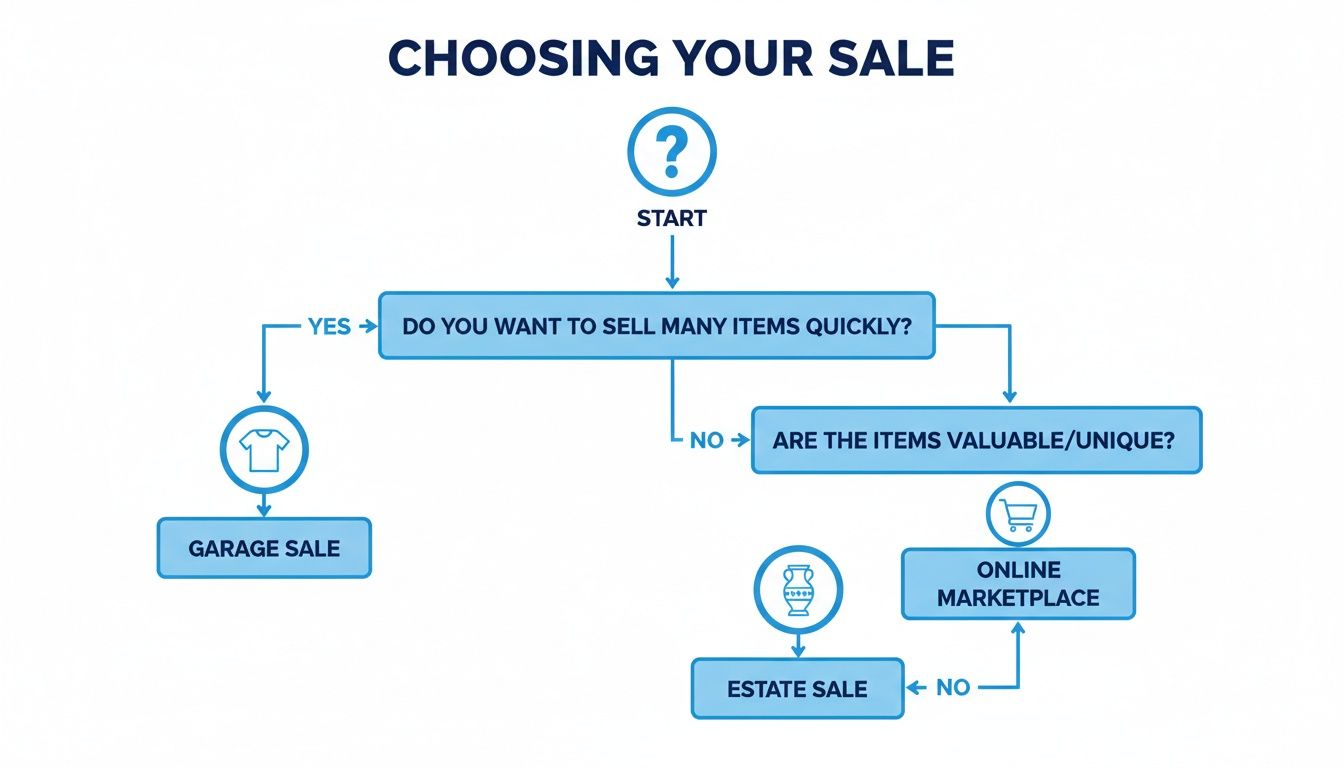
As the flowchart shows, the volume and type of items you have are what really drive the decision. Today, platforms like DIYAuctions are creating a powerful hybrid option. It gives you the control of a garage sale but with the professional marketing and reach of an estate sale, getting you the best of both worlds.
For a more detailed breakdown, you can check out our full guide on garage and estate sales to learn more.
Matching Your Items to the Right Buyers
Before you can figure out who will buy your stuff, you need to know what you’re selling. It’s a bit like fishing—you wouldn't use the same tiny bait to catch a sunfish that you would to land a giant marlin. The items you have on hand will naturally point you toward the right kind of buyer.
A classic garage sale is perfect for all the everyday household goods you no longer need. Think outgrown kids' clothes, that extra set of coffee mugs, board games, and general home decor. The crowd here is almost always local, looking for a great deal on something they can use right away.
On the flip side, an estate sale is designed to liquidate an entire household. That means you’ll find a much broader range of items, often including higher-value pieces like furniture, antiques, art, and specialized collections. The buyers for these sales are a different breed entirely—they're serious collectors, interior designers, and professional resellers on the hunt for unique inventory.
Identifying Your Ideal Customer
To put it another way, imagine you’re selling a used blender versus a complete set of antique sterling silverware. The blender is a classic garage sale find, perfect for a neighbor whose old one just broke. But that silverware? It’s an estate sale treasure. Finding the right buyer for it requires a totally different strategy, one that reaches people who understand its real market value.
This distinction is key because it will shape everything from your pricing to your marketing.
The entire secondhand economy is exploding right now, driven by a desire for both sustainability and one-of-a-kind finds. Buyers are actively seeking out quality used goods. In fact, platforms like eBay report that searches for 'vintage' items happen more than 1,200 times per minute across the globe.
By knowing what you have, you can tap directly into this powerful trend.
What Sells Best at Each Sale Type
Let’s get practical. Here’s a breakdown of the typical inventory for both estate and garage sales to help you start sorting.
Common Garage Sale Items:
- Clothing and Accessories: Everyday wear, kids' clothes, and costume jewelry.
- Toys and Games: Board games, puzzles, and children's toys.
- Kitchenware: Mismatched dishes, small appliances, and utensils.
- Books and Media: Paperback novels, DVDs, and CDs.
Common Estate Sale Items:
- Furniture: Antique dressers, mid-century modern pieces, and dining sets.
- Collectibles: Fine china, vintage glassware, stamps, or rare books.
- Art and Décor: Original paintings, sculptures, and high-end decorative items.
- Valuable Jewelry and Metals: Gold, silver, and precious stones.
When you're dealing with truly valuable pieces, getting the right offer is everything. If you have gold or silver, finding the best place to sell gold is critical to getting top dollar. For other specific collectibles, you can check out our guide on the best websites to sell antiques. Once you correctly identify what you've got, you can connect your items with enthusiastic buyers who are ready to pay a fair price.
Understanding Pricing and Profit Potential

This is where estate and garage sales really part ways: the money.
Think of garage sale pricing as a race to the finish line. The whole point is to clear out clutter fast, so prices are set low, kept simple, and are almost always negotiable. It's the land of "fill a bag for $5" and bundle deals on books and clothes. Profit is a nice bonus, but it's not the main objective. Speed is everything.
Estate sales, on the other hand, are all about strategy. Pricing is a careful, calculated process focused on getting the best possible return for every single item. You're not just trying to get rid of things; you're honoring their value. This often involves a bit of research, and for high-value pieces like antiques or fine art, it might even mean calling in a professional appraiser to nail down an accurate market price.
The Hidden Costs of Traditional Sales
When you hire a traditional estate sale company, you’re paying for their expertise, but that service can come with a surprisingly steep price tag. These companies typically take a commission ranging from 30% to 50% of the total gross sales. That fee covers all their work—the sorting, pricing, marketing, and running the event itself.
While having them handle the heavy lifting is convenient, that commission can take a massive bite out of your final proceeds. It's a classic trade-off between convenience and your bottom line.
Imagine your sale brings in a solid $10,000. If a traditional company charges a 40% commission, you'll hand over $4,000 of that directly to them. That leaves you with $6,000. That’s a huge chunk of the estate's value gone, just for the service.
Maximizing Your Returns with a Modern Approach
This is where a modern platform completely changes the financial picture. By giving you the right tools to run your own sale, platforms like DIYAuctions help you sidestep those hefty commission rates entirely. Instead of a percentage that grows with your earnings, you pay a much smaller, totally transparent fee.
This simple shift puts you right back in the driver's seat of your own profits. For that same $10,000 sale, a platform with a 10% fee means you keep $9,000. That's an extra $3,000 that goes directly into your pocket, all by choosing a more efficient way to sell.
For a deeper dive into getting the most for your items, check out our complete estate sale pricing guide to master your valuation strategy.
Navigating the Logistics and Legal Side of Things
A successful sale isn't just about putting price tags on stuff. It's really an exercise in managing the nitty-gritty details, from logistics to legal rules. For both estate and garage sales, good planning is what separates a smooth, profitable weekend from a total chaotic headache. The challenges, though, are worlds apart.
A garage sale is often a battle against the elements and neighborhood traffic. Its success can literally depend on a sunny forecast, good signage, and having a pocket full of quarters. The legal side is usually simpler, but you can't just ignore it. Many cities and even HOAs require a permit for a yard sale, and they almost always have rules about where you can stick your signs.
An estate sale, on the other hand, especially one tied to probate, comes with a much higher level of legal responsibility. The person in charge of the estate (the executor) has what’s called a fiduciary duty. This is a legal obligation to get the best possible value for the heirs, meaning every decision has to be transparent and justifiable.
Comparing On-the-Ground Challenges
When it comes to the actual day of the sale, the two couldn't be more different. A garage sale feels more casual, but it demands your constant attention. You’re managing crowds in your driveway, haggling over a few bucks, and dealing with the general unpredictability of a weekend-long event open to the public.
A professionally managed or platform-assisted estate sale is a much more structured event, typically run inside the home. This gives you more control, but it brings its own set of problems—like figuring out how to manage the flow of people through a private house and making sure the property and everything in it stays secure.
The sheer logistical burden is a huge factor for sellers. It’s not just about selling; it’s about running an entire event—marketing, payments, crowd control, and cleanup—all while dealing with personal and legal duties.
How Modern Platforms Change the Game
This is where a modern platform completely flips the script. Instead of you juggling dozens of different tasks, a tool like DIYAuctions brings the whole process under one roof. It takes the most painful parts of running a sale and automates them, turning an overwhelming project into something you can actually handle.
Here’s a look at how it helps with the biggest logistical hurdles:
- Targeted Marketing: The platform automatically gets your sale in front of a network of qualified local buyers who are already looking for items just like yours. No more posting on ten different websites or stapling signs to telephone poles.
- Secure Online Payments: Every transaction is handled safely online. That means no fumbling for change, no bounced checks, and no security risk from having a pile of cash in your house.
- A Single Pickup Day: This is probably the biggest relief. The entire physical event gets condensed into one scheduled pickup day. Buyers pay online ahead of time, then show up during a specific time slot to grab their winnings. This gets rid of the multi-day crowds, the constant stream of people, and the stress of a long, drawn-out sale.
How Modern Platforms Make Your Sale Easier
For years, you had two choices: a chaotic, do-it-yourself garage sale or hiring an expensive estate sale company that takes a massive cut of your profits. It often felt like a lose-lose situation. One gave you total control but very little reach, while the other brought in the pros but cost you a fortune.
Thankfully, there’s now a middle ground that combines the best of both worlds.
Online platforms have stepped in to fill that gap. Think of them as a complete toolkit for running your own sale, but with professional-grade tools. They take the hardest parts of managing an estate sale and make them incredibly straightforward. Instead of handing over your keys—and up to 50% of your earnings—you stay in the driver's seat, backed by technology that does the heavy lifting.
This approach puts you in a position to run a really polished, effective sale without needing to be an expert in liquidations. You get to decide on the pricing, set the schedule, and present your items how you see fit, while the platform works in the background to bring interested buyers right to you.
Your Step-by-Step Digital Toolkit
The whole process is designed to be intuitive, walking you through everything from start to finish. It all begins with creating an online catalog of your items, which sounds more complicated than it is. You just snap photos with your phone, upload them, and write a few clear, simple descriptions.
From there, the platform helps you structure everything into a professional-looking online event. Most will include key features like:
- Guided Setup: A simple, step-by-step walkthrough that helps you list items, set your sale dates, and define the rules for pickup.
- Automated Marketing: Your sale gets promoted automatically to a network of local buyers who are already looking for the kinds of things you're selling.
- A Secure Dashboard: This is your command center. You can track bids as they come in, see what’s sold, and get a clear picture of your earnings in real-time.
This screenshot from DIYAuctions gives you an idea of how a clean, easy-to-use interface can make the process feel organized and empowering.
The dashboard gives you a clean, at-a-glance view of your sale's progress, putting all the important information right at your fingertips.
Keep Control, Maximize Your Profit
The biggest difference here is empowerment. Traditional estate sale companies take over completely, making every decision for you. With a modern platform, you're the one calling the shots. You decide the final price on a family heirloom and set a pickup time that actually works for your schedule, not a third-party company's.
That control extends right to your bottom line, and the financial model is a total game-changer. Instead of a high commission that eats into your profits—especially on valuable items—platforms like DIYAuctions use a transparent, low flat-rate fee. This simple change ensures that the vast majority of the proceeds—often 90% or more—goes straight into your pocket.
This shift completely changes the outcome of a sale. It means you can get the professional results of a managed estate sale without giving up the lion's share of your profit. You get the financial perks of a DIY approach combined with the reach and security of an expert-run event.
Your Essential Sale Planning Checklist
Having a clear plan of attack makes any sale feel less overwhelming. Whether you’re setting up a classic driveway sale or a modern online auction, a checklist is your best friend. It breaks a massive project down into simple, manageable steps you can actually tick off.
Before you even think about setting a date, one of the most critical first steps is creating a thorough inventory. This isn't just a good idea—if the sale is happening because of a probate matter, a formal list is often a legal requirement. You might need to know how to make an itemized inventory for probate in Texas, for instance.
To give you a clearer picture, let's look at the two different paths you can take.
Traditional Garage Sale Checklist
This is the old-school, hands-on approach. It's all about physical labor and turning your front yard into a temporary retail shop for a weekend.
- Physical Setup: Time to haul out tables, dig up clothing racks, and figure out how to display everything so it doesn't look like a pile of junk.
- Signage and Marketing: This means designing, printing, and spending a morning driving around plastering signs on every telephone pole in a two-mile radius.
- Pricing and Tagging: Get ready for hours of sticker-gun fun. You'll need to manually price and tag every single item you want to sell.
- Permits and Rules: You have to do the legwork to find out if your town requires a permit and what rules you have to follow.
- Payment Prep: A trip to the bank is in order. You'll need a cash box loaded with small bills and coins to make change all day.
- Day-Of Management: Brace yourself for a very long day of haggling with strangers over a 50-cent price difference and managing the constant flow of people.
The Modern DIYAuctions Sale Checklist
This approach swaps all that heavy lifting for a bit of smart, digital prep. The whole point is to create an organized online event that practically runs itself.
By taking your sale online, you can condense weeks of physical prep and a chaotic weekend into a structured digital event with one single, scheduled pickup day. It’s a game-changer for saving time and your sanity.
- Digital Cataloging: Just use your phone to snap a few pictures of each item and write a simple, honest description. No price tags needed.
- Online Setup: Our guided process walks you through setting your sale dates and the pickup window. It only takes a few minutes.
- Effortless Marketing: No staples or telephone poles involved. We give you a single link to your sale that you can easily share on social media.
- Automated Payments: Forget the cash box. The platform handles all the secure online payments for you.
- Scheduled Pickup: As items sell, you just organize them for a quick and easy pickup event on a single day. No more weekend-long yard duty.
Actionable Checklist Garage Sale Vs DIYAuctions Sale
To really see the difference side-by-side, we've put together a handy table that compares the workload. It shows just how much physical effort you can save by moving your sale online.
| Task | Traditional Garage Sale | DIYAuctions Sale |
|---|---|---|
| Inventory & Prep | Manually sort, clean, and price every item with stickers | Photograph items and write descriptions on your phone |
| Setup | Haul out, assemble, and arrange heavy tables and racks | None. Items stay in place until they are sold |
| Marketing | Design, print, and physically post signs around town | Share a single, auto-generated link on social media |
| Running the Sale | Spend 1-2 full days outside managing shoppers and haggling | Monitor bids online from your computer or phone |
| Handling Payments | Manage a cash box, make change, and deal with lowball offers | All payments are handled securely and automatically online |
| Permits & Legal | You must research and obtain any necessary local permits | Platform is compliant; no individual sale permit is needed |
| Post-Sale Cleanup | Pack up and haul away all unsold items immediately | Buyers pick up sold items; manage leftovers on your own time |
| Pickup Logistics | Buyers take items as they purchase them all day | One scheduled pickup window for all winning bidders |
Looking at it this way, it’s clear that while a traditional sale requires you to be a merchandiser, marketer, and cashier all at once, an online auction lets you be a manager. You set it up, and the platform does the heavy lifting.
Frequently Asked Questions
 Even after you've weighed the options, a few questions always seem to come up when you're on the fence between an estate and a garage sale. Let's tackle some of the most common ones.
Can I Run an Estate Sale Myself Without a Company?
Yes, absolutely. In the past, hiring a company was the only real option, and it came with a hefty price tag—their commission often eats up 30-50% of your total sales.
But today, you can run a professional-level sale on your own terms. Modern platforms like DIYAuctions give you the tools to manage the entire process, from cataloging to payment, for a much smaller fee. You get full control over your timeline and pricing, and you end up keeping a whole lot more of the profit.
What Sells Best at an Estate Sale vs. a Garage Sale?
It really comes down to the quality and type of items you have.
Garage sales are king for moving everyday household goods quickly. Think clothes the kids have outgrown, extra kitchen gadgets, old toys, and paperback books. It's the perfect way to clear out general clutter that still has some life left in it.
Estate sales, on the other hand, are where your higher-value items will truly shine. This is the place for antique furniture, fine china sets, valuable collectibles, original artwork, and fine jewelry. If you have a curated collection of anything—from quality power tools to vintage records—an estate sale will attract the right buyers.
The core difference is simple but crucial. A garage sale moves clutter quickly. An estate sale aims to maximize the financial return on valuable assets and entire household contents.
How Much Time Should I Plan For a Sale?
This depends entirely on which path you take. If you go the traditional route and hire an estate sale company, get ready for a longer haul. They often need several weeks to come into the home, sort through everything, research pricing, and run a multi-day event.
Using an online platform dramatically shrinks that timeline. You can catalog and photograph your items at your own pace, run the online auction for about a week, and then schedule a single, organized pickup day. It’s a much more efficient approach that cuts down on the time commitment and the disruption to your home.
More guides in Estate Sale Basics
July 28, 2026
Revenue Reporting for Estate Sales and Auctions
Learn revenue reporting essentials for estate sales and auctions. Discover key metrics, templates, and best practices to simplify tracking and compliance.
Read guideJuly 26, 2026
Stamp Collection Valuation: A Practical Step-by-Step Guide
Stamp collection valuation made simple. Learn how to identify, grade, price, and sell your stamps with confidence for estate sales or consignment.
Read guideJuly 23, 2026
Estate Sales Brick NJ: Your 2026 Guide to Success
Planning your estate sales brick nj? Our guide covers permits, pricing, marketing, & running a safe sale with DIYAuctions.
Read guideGet the estate sale pricing guide
Enter your email for pricing ranges, planning notes, and a clearer path to launch.