Estate liquidation co: Your Guide to Smart Estate Asset Sales
See how estate liquidation co stacks up against DIY options—fees, timelines, and control to help you decide.

When it's time to clear out a home, you're faced with two very different paths. One is the traditional route: hiring an estate liquidation company to handle everything for you. This is a full-service, hands-off solution where they take a commission of 30-50% of the total sales. The other path is a DIY online sale, where you manage the process yourself using a specialized platform, giving you far more control for a much smaller fee.
Your first major decision is choosing between professional management and personal control. This choice will shape the entire liquidation experience.
Comparing Your Two Main Liquidation Paths
Clearing out an estate, whether it’s for an inheritance or your own downsizing effort, is a massive undertaking. The central decision you’ll make is whether to trade convenience for a higher profit. Do you hire a traditional estate sale company, or do you roll up your sleeves and run an online sale yourself to keep more of the proceeds?
Getting this right from the start is crucial for hitting your financial goals and matching the process to your personal situation.
This isn't a small niche, either. The need for these services is exploding as the Baby Boomer generation transfers a massive amount of assets. In fact, the global estate administration market is on track to hit $50 billion by 2025. If real estate is part of the equation, a good guide to selling inherited property can be a lifesaver.
Key Operational Differences
The biggest difference comes down to who does the work. A professional company steps in and manages it all—sorting, pricing, staging, marketing, running the sale, and even the final clean-out. The DIY route, on the other hand, puts you in the driver’s seat. You’ll be the one cataloging and photographing items, but you'll have a powerful platform backing you up to handle the marketing and payment processing.
At its core, the choice is a classic trade-off between your time and your money. Hiring a company saves you a ton of effort but at the cost of a hefty chunk of the final sales. The DIY approach demands more of your personal time but lets you keep a much larger share of the profit.
To help you see how these two options stack up, here’s a quick look at the major differences.
Estate Liquidation Co vs DIY Online Sale At a Glance
The table below breaks down the fundamental differences between hiring a full-service company and managing your own sale on a platform like DIYAuctions. It’s designed to give you a clear, high-level overview to see which approach might be a better fit for you.
| Factor | Traditional Estate Liquidation Co | DIY Online Platform (e.g., DIYAuctions) |
|---|---|---|
| Commission Rate | Typically 30-50% of total gross sales. | Often a lower flat fee or a small percentage, like 10% capped at $1,000. |
| Your Involvement | Minimal; the company manages nearly every aspect of the sale. | High; you are responsible for cataloging, photographing, and organizing items. |
| Pricing Control | Limited; the company's experts set prices based on their market knowledge. | Full control; you set the prices, starting bids, and any reserve amounts. |
| Sale Timeline | Can take several weeks for setup, followed by a multi-day in-person event. | Flexible; you can set up the sale online in days and run it for a week or more. |
| Buyer Access | Primarily local foot traffic during the sale days. | Broader reach to a database of qualified local buyers who shop online. |
| Final Cleanup | Often included or available as an add-on service for a fee. | Your responsibility; you manage the pickup event and handle unsold items. |
Ultimately, there isn't a single "best" answer—just the best one for your specific circumstances. Consider your timeline, budget, and how much time you can realistically commit before making a final call.
A Detailed Comparison of Liquidation Methods
When it's time to liquidate an estate, you're faced with a big decision: hire a traditional company or run the sale yourself online? To make the right call, you need to look at the realities of each path. It all comes down to four things: the money, the effort, your control, and the support you get along the way.
First, a quick clarification. People often mix up the terms liquidation or insolvency, but they aren't the same. We're focused purely on liquidation—the process of selling assets.
The need for clear solutions is undeniable. The global liquidation services market was valued at $3,323.85 million in 2021 and is on track to hit $4,198.66 million by 2025. That growth tells a story: more and more families are navigating this exact process and looking for the best way forward.
Financial Outcomes: Commission vs. Capped Fees
The biggest difference between the two approaches is how you pay. It’s a classic commission vs. fee showdown, and it massively impacts your bottom line.
A traditional estate liquidation co almost always works on a high commission. You can expect them to take anywhere from 30% to 50% of the gross sales. If your estate brings in $20,000, that’s between $6,000 and $10,000 straight to the company.
A DIY platform like DIYAuctions flips that model on its head. Instead of a massive percentage, you pay a much smaller fee—like our 10% commission—that’s also capped. For that same $20,000 estate, your fee is capped at just $1,000. You walk away with $19,000 instead of as little as $10,000.
This chart breaks down the major differences at a glance.
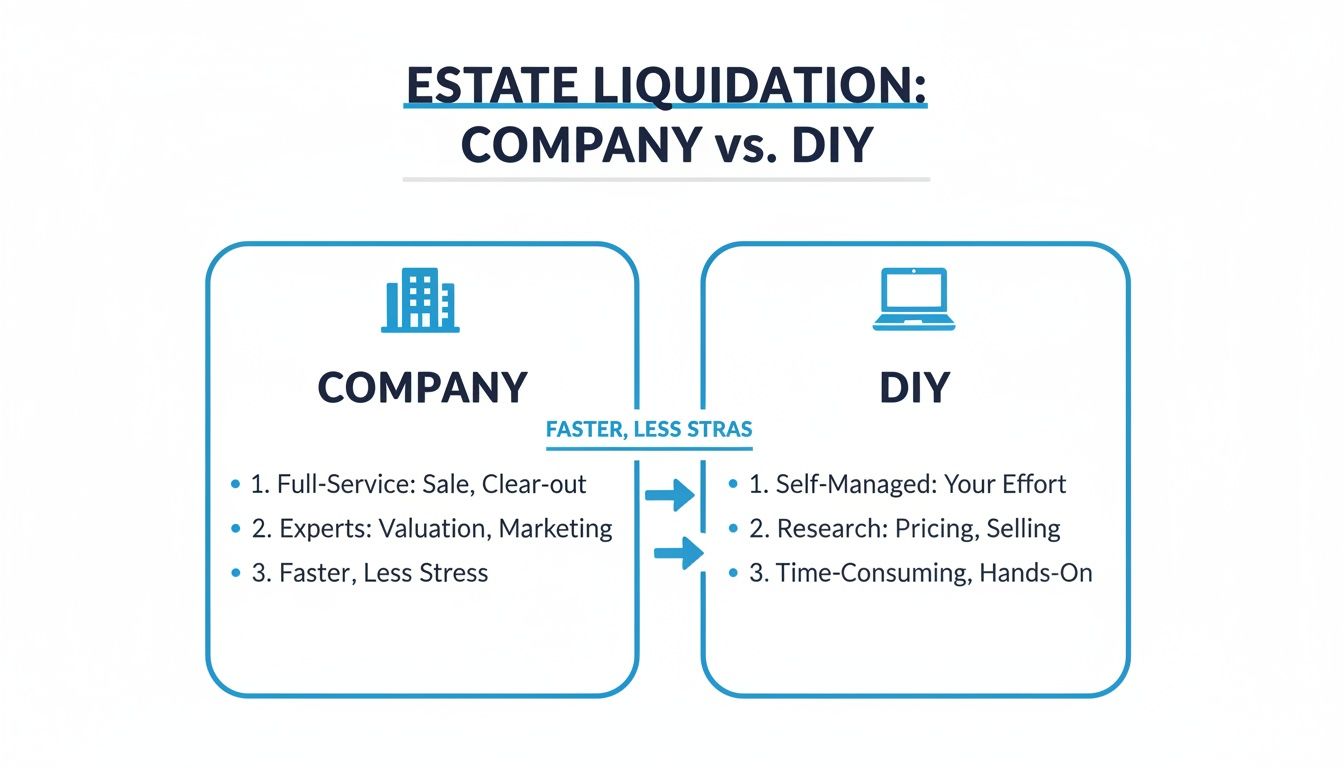
It’s pretty clear how your choice affects not just your wallet, but also your time.
Required Effort: Hands-On vs. Hands-Off
How much time and energy can you realistically commit? Your answer here is a major fork in the road.
Hiring an estate liquidation co is the definition of "hands-off." They handle pretty much everything for you.
- Sorting and organizing the entire home.
- Researching and pricing every single item.
- Staging the house for an in-person, multi-day sale.
- Managing all the advertising and controlling the crowds.
- Dealing with payments and the final clean-out.
This all-in-one service is a lifesaver for executors who live out of state or simply don't have the time. But that convenience comes with that steep commission we talked about.
The DIY online route is "hands-on," but with a powerful support system. You’re in the driver's seat, but you're not driving blind. Your main job is to catalog and photograph the items, which you can do on your own schedule with just your phone. After that, the platform handles the heavy lifting—marketing to local buyers, processing secure payments, and communicating with winners. You get total control without the logistical nightmare.
Level of Control: Expert Pricing vs. Your Pricing
Who gets to decide what your items are worth? This is another huge point of difference.
When you hire an estate sale company, you're trusting their "experts" to set the prices. While they know the market, you get very little say. This can become a real problem if you feel they've undervalued an item, whether it has sentimental meaning or you just know it's worth more.
Key Differentiator: The DIY approach gives you 100% pricing autonomy. You set the starting bids. You decide on a reserve. You can add a "buy it now" price. This is a game-changer for anyone with niche collections or specialized items.
Imagine you're selling a collection of rare comic books. Chances are, you know their value far better than a generalist appraiser. A DIY platform lets you use that knowledge to your advantage and ensure you get what they're actually worth. You can dive deeper into the various estate liquidation options to see what fits best.
Support and Security: On-Site Staff vs. Platform Protection
Both paths offer support, but in very different ways.
A traditional company provides boots on the ground. They have staff at the home to manage the sale, watch for theft, and handle cash transactions. It's a physical presence that provides a sense of security during the chaos of a sale.
An online platform provides modern, tech-focused support and security. This is a different, but often more robust, kind of protection.
- Secure Payment Portals: Every transaction is handled online, so you never have to worry about managing large amounts of cash, bounced checks, or payment disputes.
- Buyer Vetting: You’re selling to a community of registered, local buyers, not just random people who walked in off the street.
- Fraud Protection: The system is built to shield you from common online scams.
- Guided Process: You get step-by-step instructions and customer support to help you from start to finish.
In the end, it’s about your priorities. If you value total convenience over profit and are okay with giving up a huge chunk of the proceeds, a traditional company can work. But if you want to maximize what the estate earns while keeping complete control, a DIY online platform is the smarter, more modern, and far more profitable solution.
How a Traditional Estate Liquidation Company Works
When you hire a traditional estate liquidation company, you're choosing a full-service, hands-off option. It’s the go-to path for executors who value convenience over maximizing every last dollar, especially when you're short on time or managing the estate from another city.
The whole process follows a pretty standard timeline, from the first walkthrough to the final check. Knowing what to expect is the key to finding a good partner and avoiding any surprises. Let's break down the journey so you know exactly what happens after you hand over the keys.

Initial Consultation and Contract
It always starts with a consultation. A rep from the company will meet you at the house to walk through and see what’s there. They’re sizing up the job, figuring out the scope, and making sure the estate has enough value for them to take on the sale. This is your moment to grill them on their process, fees, and schedule.
If it feels like a good fit, the next step is signing a contract. This is non-negotiable; never, ever work with a company based on a verbal agreement.
A solid, professional contract will spell out everything clearly:
- Commission Rate: Expect this to be anywhere from 30% to 50% of the total sales.
- Sale Dates: The exact weekend the in-person sale will happen.
- Payment Terms: When and how you’ll get your money.
- Additional Fees: Potential extra costs for things like advertising, clean-out services, or security.
Always get the contract in writing and read it carefully. A legitimate company will be transparent and won’t rush you. High-pressure sales tactics are a huge red flag. This document protects both of you.
Preparation and Staging
Once the ink is dry, the company's team gets to work. This is the heavy lifting phase, and it can take anywhere from a few days to a couple of weeks, depending on how much stuff there is. They handle every single detail.
Here's what goes on behind the scenes:
- Sorting and Organizing: The crew goes through every room, closet, and cabinet, separating items to be sold from trash or donations.
- Research and Pricing: They’ll have specialists who research the market value for antiques, art, or collectibles, while pricing everyday household goods based on their experience.
- Staging: They essentially turn the home into a pop-up shop. Items are cleaned up, displayed on tables, and arranged to make it easy for shoppers to browse and buy.
- Marketing: The company pushes the sale out to its network. This usually includes an email list of dedicated buyers, social media posts, and listings on specialty estate sale websites.
The Multi-Day In-Person Sale
The sale itself is almost always a two or three-day event, typically held over a weekend. The company’s staff is on-site managing everything—controlling the number of people inside, handling all the payments, and keeping an eye on things to prevent theft.
Your job here is to stay away. Seriously. Most companies insist that family members not be present during the sale. It helps avoid emotional moments and prevents awkward haggling between family and shoppers. You're trusting them to be the professionals. If you want to learn more about finding the right team, our guide on choosing an estate liquidation company has some great tips.
Post-Sale Reconciliation and Payout
The work isn’t done when the last shopper leaves. Now, the house has to be cleared of everything that didn't sell. A good company will have a clear plan for this, which might involve coordinating with a charity for donations or bringing in a junk removal service—often for an extra fee.
Finally, they tally up the numbers. You should receive an itemized statement showing the gross sales, their commission, any other fees that were deducted, and your final net profit. A check for your portion usually arrives within a few weeks, and the process is officially complete.
Running a DIY Online Estate Sale Yourself
If you’re someone who wants full control over the process and a much bigger slice of the profits, the modern approach to estate liquidation might be a perfect fit. Using a DIY platform puts you in the driver's seat, turning what feels like a massive project into a series of simple, manageable steps. This path is really built for people who appreciate transparency and are comfortable using a smartphone.
This is a world away from a traditional estate liquidation co, where you basically hand over the keys and a hefty commission check. This method lets you run the sale on your terms and on your schedule. It’s a powerful mix of your personal knowledge of the items and an online system that handles all the heavy lifting—marketing, payments, and dealing with buyers.
Let's walk through how it actually works.

Getting Started and Cataloging Items
First things first, you’ll create an account on a platform like DIYAuctions. The setup is quick and walks you through creating a profile for your sale—the location, dates, and a little description. Once that’s done, you dive into the cataloging process, which is where you’ll be the most hands-on.
It's all done with your smartphone. You just:
- Photograph Items: Snap a few clear pictures of each item from different angles. Good lighting and a clean background can make a huge difference in the final sale price.
- Write Descriptions: Jot down a quick note about each piece, including its condition, size, and any cool history or features. Your inside knowledge here is priceless.
- Set Your Prices: You're in complete control. You can set a low starting bid to get an auction going, add a "Buy It Now" option, or put a reserve on more valuable items.
The best part? You can do this at your own pace. Tackle one room this weekend, another next week. It makes the whole thing feel much less overwhelming.
Marketing and Managing the Online Sale
As soon as you publish your sale, the platform’s marketing machine kicks in. This is a huge leg up over trying to sell things yourself on a generic site like Facebook Marketplace. The system automatically promotes your sale to its database of registered local buyers who are actively searching for sales just like yours.
Think of the platform as your marketing team, cashier, and receptionist all in one. It frees you up to focus on organizing the physical items while the tech handles the logistics of getting bidders in the door and collecting their money.
During the sale, you can watch the bids come in, answer questions from shoppers through a built-in messaging system, and see your earnings add up in real-time. That kind of transparency is a big change from the traditional model, where you often have to wait weeks to see a final spreadsheet.
Payment Processing and Pickup Coordination
One of the biggest reliefs of using a platform is how it handles payments. Every transaction goes through a secure online portal. No handling cash, no worrying about bad checks, no payment disputes. It's all taken care of.
After the sale ends, the system automatically notifies the winners and sends them a link to schedule their pickup time. You set a single day for this, creating a smooth, organized event. Instead of a chaotic, multi-day free-for-all, you get one scheduled day where buyers show up at their assigned time to get their stuff. You just check them off a list, and you’re done. You're left with a clean house and a much healthier bottom line.
When to Choose Each Liquidation Option
Trying to decide between a traditional estate liquidation co and a DIY online platform isn't about finding a one-size-fits-all "best" option. It's about finding the best option for you.
The right choice really boils down to your specific circumstances, what you hope to get out of the sale financially, and how much time you can realistically set aside. Let's walk through some real-world situations to see where each approach makes the most sense.
Scenarios Favoring a Traditional Estate Liquidation Co
For a lot of people, the pure convenience of a full-service company is the main draw. That high commission stings, for sure, but some situations make it a necessary and completely logical choice.
You're an Out-of-State Executor Let’s be honest, managing an estate from hundreds of miles away is a logistical nightmare. If you can't be there in person to sort, catalog, and run the sale, a traditional company becomes your boots on the ground. They handle absolutely everything, giving you a physical presence when you can't be there yourself.
Your Time is Extremely Limited Maybe you have a demanding career, young kids, or other personal responsibilities that leave you with zero spare time. Even with a streamlined DIY platform, the process still requires a real time investment. If you just don’t have dozens of hours to spare, handing the entire project over to an estate liquidation co is a practical trade-off.
You're Overwhelmed by Grief Sifting through the belongings of a loved one is emotionally draining. If the thought of going through sentimental items is simply too painful right now, hiring a compassionate, professional team can create a much-needed emotional buffer. They can manage the process with respectful distance, giving you space to heal.
Situational Takeaway: A traditional company is the best fit when your primary need is to delegate the entire physical and emotional labor of the liquidation, and you accept the high commission as the cost of that convenience.
Scenarios Where a DIY Online Platform Excels
On the flip side, for anyone who wants to maximize the financial return and keep control of the process, a DIY approach has a clear edge. If you're comfortable using a smartphone and your goal is to get the most value out of the estate, this modern path is almost certainly the way to go. Our guide on selecting the right estate liquidation companies can offer some extra perspective here.
Maximizing Financial Return is Your Top Priority This is the single biggest reason people choose a DIY platform. Technology is fundamentally changing this industry for the better. Traditional sales often only bring in 40-60% of an item's value after you subtract commissions of 40% or more. In contrast, digital auctions can hit 70-90% recovery by tapping into a much larger, more competitive pool of buyers. As you can find out in more detail in this report about the liquidation service market on datainsightsmarket.com, platforms with capped fees offer massive savings. A $20,000 sale could cost you $7,000 with a traditional company, versus just a $1,000 capped fee online.
You Have Niche or Specialty Collections Do you have a collection of rare books, vintage tools, designer handbags, or specific memorabilia? Chances are, you know far more about those items than a generalist appraiser. A DIY platform gives you total control over the descriptions and pricing, letting you market them directly to fellow enthusiasts who will pay their true market value.
You Prefer a Transparent, Guided Process If you're the kind of person who likes to see progress in real-time and follow a clear, step-by-step system, a DIY platform is perfect. You can watch bids come in live, run the sale on your own schedule, and see your earnings update instantly. It takes all the mystery out of the process and puts you in the driver's seat from beginning to end.
Making Your Final Decision with Confidence
Choosing between a traditional estate liquidation co and a modern DIY platform really comes down to what you value most right now. To figure this out, you just need to ask yourself a few direct questions. Answering them honestly will point you straight to the path that fits your goals and your life.
First, take a hard look at your finances and your timeline. Is the number one goal to get the absolute most money out of the sale, or is a fast, hands-off process more important? If you're focused on maximizing every dollar, the lower, capped fees of a DIY platform are tough to beat. But if time is a luxury you just don’t have, the higher commission of a traditional company might be a price worth paying for the convenience.
The Decision-Making Checklist
Run through these questions to get some clarity. There’s no right or wrong answer here—just what’s right for your specific situation.
- How much time can I realistically commit? Be honest with yourself. Do you have a few weekends you can dedicate to organizing and cataloging, or do you need someone to come in and handle everything from start to finish?
- What’s my comfort level with technology? Are you comfortable snapping photos with your phone and writing a quick description for an item? A DIY platform is designed to be user-friendly, but it does require some basic tech skills.
- How important is having control over pricing? If you have antiques, collectibles, or other items you know the value of, do you want the final say on what they sell for? A DIY approach gives you total control, while a traditional service makes all those calls for you.
- What’s my financial priority? Do you need to keep as much of the profit as possible, making a low, capped fee a must-have? Or is the high commission of a full-service company an acceptable trade-off for not having to lift a finger?
By weighing your answers, a clear preference should start to take shape. This isn't just about money versus time. It's about matching the process to your personal needs for control, convenience, and the final financial outcome.
Your Next Steps
Once you've made your choice, it’s time to move forward.
If you’ve decided on a traditional estate liquidation co, the next step is to research and vet your options carefully. Don't even think about signing a contract without seeing their proof of insurance and bonding. You should also ask for at least two recent client references and actually call them to hear about their experience. A reputable company will give you a detailed, written contract that clearly outlines all commissions and fees—and they won’t pressure you to sign it on the spot.
If you’re ready to run your own DIY online sale, your next move is simple. You can get started right away by creating an account on a platform like DIYAuctions and begin cataloging your items whenever it fits your schedule. The guided system walks you through every step, giving you the confidence to move forward.
Frequently Asked Questions About Estate Liquidation

As you get deeper into the estate liquidation process, the practical questions start to surface. It’s one thing to understand the options in theory, but another to know how they play out in the real world. Let’s tackle some of the most common concerns we hear from executors and homeowners.
How Are Valuable or Specialty Items Handled?
This is a huge one, and the difference between the two approaches can directly hit your bottom line.
A traditional estate liquidation co. usually brings in an appraiser or has someone on staff to research and price high-value pieces like art, antiques, or jewelry. You’re essentially trusting their market knowledge to land on a fair price, but at the end of the day, you give up control over the final say.
With a DIY online platform, you have 100% pricing control. This is a game-changer for specialty collections. If you’re dealing with rare vinyl records, vintage tools, or anything with a niche following, you can leverage your own expertise. You set the starting bid, the reserve price, and write those detailed descriptions that speak directly to serious collectors who will pay what it's worth.
What Happens to Items That Do Not Sell?
The after-sale process can be a source of hidden costs and extra work, so it's smart to know what you’re getting into.
Most traditional estate sale companies will offer a “clean-out” service, either built into their fee or as an add-on. This typically means they’ll coordinate donations for what's left and hire a junk removal service for the rest, leaving the house broom-clean.
With a DIY online sale, you’re in charge of the post-sale clear-out. But here's the thing: because an online auction reaches a much wider, more motivated audience, you’ll find that far fewer items are left unsold. For the few things that might remain, you can schedule a single charity pickup or arrange for disposal on your own terms.
Are There Different Legal and Liability Concerns?
Absolutely. Understanding your responsibilities is crucial for protecting the estate and yourself from any unexpected issues.
When you hire a professional company, they are required to carry their own liability insurance and bonding. This is your shield if a shopper gets hurt on the property or if there’s an issue like employee theft. Always—and I mean always—ask for proof of their coverage before you sign anything.
Running a DIY sale means your homeowner's insurance is your primary coverage. The key difference, though, is the structure of the sale itself. An online auction with a single, scheduled pickup day dramatically cuts down on foot traffic and the overall on-site risk compared to a multi-day, open-house style sale where dozens of people are wandering through the home.
More guides in Estate Sale vs Alternatives
July 20, 2026
7 Smart Garage Sale Alternatives for 2026
Skip the hassle. Explore 7 smart garage sale alternatives to sell your stuff faster, from online auctions to local apps. Find the best option for you in 2026.
Read guideJuly 4, 2026
Estate Sales Charleston WV
Your complete guide to running profitable estate sales charleston wv. Learn how to plan, price, and sell online to maximize your return without high fees.
Read guideMarch 25, 2026
Where to Sell Estate Jewelry for the Best Price in 2026
Discover where to sell estate jewelry for its true value. Our guide compares jewelers, auctions, and online platforms to help you maximize your return.
Read guideGet the estate sale pricing guide
Enter your email for pricing ranges, planning notes, and a clearer path to launch.