Rocking Horse Cookie Jar: A Seller's Guide to Value & Sale
Discover the history, value, and identity of your vintage rocking horse cookie jar. Our guide helps you price, photograph, and sell it on DIYAuctions.
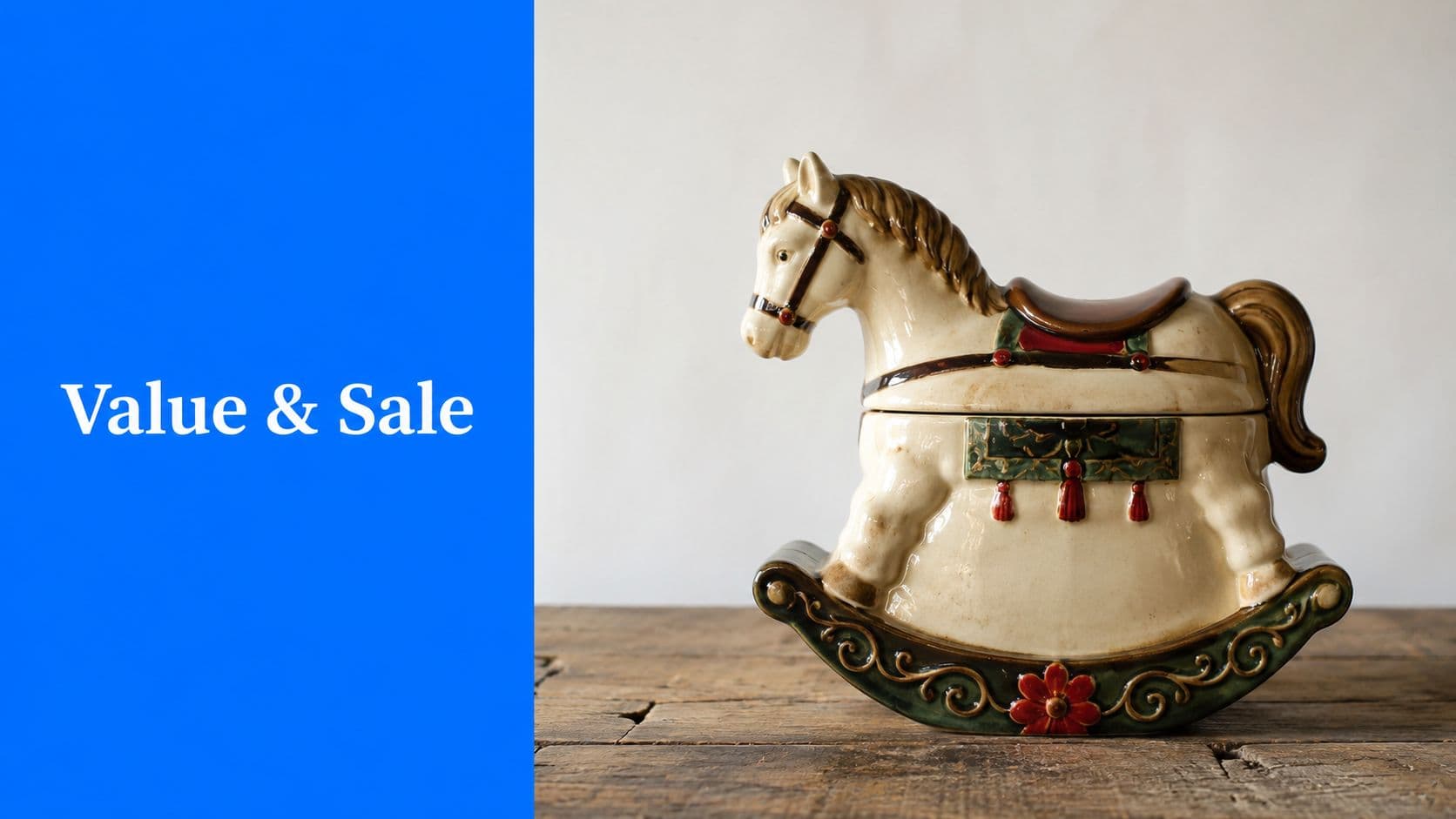
You're clearing shelves, sorting inherited kitchenware, and then one piece stops you. It's a rocking horse cookie jar, maybe dusty, maybe still bright, maybe sitting on the top shelf for decades. The first mistake most sellers make is treating it like ordinary housewares. The second is assuming every cute cookie jar is automatically valuable.
A rocking horse cookie jar can be a collectible, a décor piece, or just a ceramic container with a horse-shaped lid. Which category it falls into determines how you price it, photograph it, and sell it. If you want the best return with the least hassle, you need to identify the maker, grade the condition accurately, and build a listing that gives buyers enough confidence to bid.
Unpacking the Charm of the Rocking Horse Cookie Jar
A lot of estate sellers find these jars in exactly the same way. They're tucked above the cabinets, wrapped in old newspaper, or grouped with other mid-century kitchen pieces that nobody used anymore but nobody threw away either. That's usually your clue that the jar was kept for sentiment, display, or collecting, not just for storing cookies.
That distinction matters. A rocking horse cookie jar isn't appealing only because it's cute. It sits inside a larger collectible category with a real historical arc. According to this history of cookie jars, cookie jars originated in 18th-century Britain as biscuit jars, the style familiar to collectors was introduced in 1930s America, and the heyday for whimsical figural jars ran from 1940 to 1970. That places most authentic rocking horse examples in the mid-century collecting boom, not in the modern giftware aisle.

Why collectors pay attention to these jars
The rocking horse design checks several boxes buyers like. It's nostalgic. It crosses categories. It can appeal to cookie jar collectors, mid-century pottery buyers, nursery décor shoppers, and people who like novelty ceramics.
That broad appeal is useful in an estate sale because it gives you more than one selling angle. If the jar is branded vintage pottery, you lean into collectibility. If it's a later decorative piece, you position it as display-friendly and charming.
Practical rule: Don't list it as “old horse jar” and hope the market figures it out. Buyers pay more when the object's story is clear.
A mid-century object, not just kitchen clutter
The strongest historical anchor for the specific form comes from a documented Metlox California Pottery example reported by an owner as being in the home since 1958, which places that style firmly in the postwar collectible era and gives the design more than 60 years of surviving history by 2026 in practical collecting terms, as noted in this owner-reported example.
That doesn't prove every rocking horse cookie jar is a Metlox piece. It does tell you the form itself was circulating by the late 1950s, which helps when you're trying to separate a likely mid-century jar from a newer decorative lookalike.
What this means for a seller
When I catalog estate items, I don't start with value. I start with category. A rocking horse cookie jar usually lands in one of these buckets:
- True vintage collectible. Maker identified, period styling, visible age, often ceramic or pottery.
- Later branded decorative jar. A named retail product with known dimensions or packaging history.
- Generic novelty ceramic. Attractive, sellable, but not strongly tied to a known maker.
That category decision affects everything after it. Your photos change. Your title changes. Your buyer pool changes. Your expectations get realistic fast.
How to Identify Your Jars Maker and Age
Identification starts on the bottom, not the front. Sellers waste time staring at paint colors and decorative details before doing the simple work first. Turn the jar over carefully, remove the lid, and inspect the base in strong light.
Look for stamped names, incised marks, painted marks, mold numbers, country of origin text, and any factory label residue. If the base is dirty, wipe it gently with a soft dry cloth first so you don't miss a faint impression.

What to inspect before you search online
A good identification pass is physical first, internet second. Write down what you see.
-
Base markings
Look for names such as McCoy or Metlox, but also partial words, model numbers, or hand-painted initials. Even an incomplete mark can narrow your search. -
Material and weight
Is it ceramic, pottery, or stoneware-like in feel? Heavier, thicker bodies often read differently in the market than thin decorative ceramics. -
Glaze and paint application
Factory-painted surfaces often show repeatable patterns and cleaner lines. Handmade or hobby pieces can look softer, less standardized, or slightly uneven. -
Lid fit and construction
Original lids usually fit the opening naturally. Replaced lids often wobble, sit high, or show a glaze mismatch.
A similar process helps with other animal-form jars too. If you want a comparison point for how makers and styling clues show up in another novelty category, this guide to antique elephant cookie jars is useful.
Maker names that matter
For rocking horse cookie jars, two names appear often enough to matter in seller research. Metlox ties into California pottery and the postwar era. McCoy shows up in estate-market listings and collector conversations often enough that buyers search for it directly.
That doesn't mean every horse jar with age is McCoy or Metlox. It means those names can move a listing from decorative to collectible if the mark and construction support the attribution.
This video gives a useful visual reminder of how condition and identification questions often overlap in ceramic collecting:
When the jar is unmarked
Unmarked jars are where sellers either get careful or get sloppy. “Looks vintage” is not identification. If there's no mark, describe what you know and stop there.
Use a checklist like this:
| Checkpoint | What it tells you |
|---|---|
| Mold quality | Crisp molding can suggest factory production rather than casual hobby work |
| Bottom finish | Smooth glazed base, rough foot, or unglazed ring can hint at production style |
| Paint style | Hand-applied details may suggest studio or hobby origin |
| Wear pattern | Natural shelf wear can support age, but it does not prove maker |
| Lid consistency | Matching glaze and wear help confirm the lid belongs with the jar |
If you can't prove the maker, sell the jar as an unmarked vintage or decorative rocking horse cookie jar and let the photos do the work.
That's safer, more credible, and usually better for buyer trust than forcing an attribution you can't support.
Grading Condition and Its Impact on Value
Condition decides whether buyers feel comfortable bidding. A rare-looking jar with visible problems can stall fast if the flaws aren't documented clearly. On the other hand, a modest jar with honest condition notes often sells more smoothly because buyers know what they're getting.
The key is to separate structural condition from surface condition. A jar can be structurally sound and still have paint loss that hurts value. It can also look bright from the front and hide a lid chip that matters a lot.

The flaws that matter most
Vintage McCoy rocking horse cookie jars appear in listings at around 10 1/2 x 9 1/4 inches and can show chipping paint, which is a critical value issue for painted novelty ceramics because surface wear needs to be assessed separately from structural integrity, as shown in this listing example.
That's the right way to think about any rocking horse cookie jar. Ask two separate questions:
- Is the jar cracked, chipped, repaired, or restored?
- How much paint loss, glaze wear, rubbing, or fading does it show?
Those are not the same problem.
A practical grading method
Use this order when you inspect the jar:
- Start with the rim and lid seat. Chips here are common and often hidden when the lid is on.
- Check projecting points. Ears, tail edges, rocker ends, and nose details take the most impact.
- Hold it under angled light. Hairlines and old repairs often show better from the side than straight on.
- Run a fingertip lightly over paint breaks. You're checking whether it's simple wear or an overpainted repair.
- Inspect the bottom edge. Base chips matter less visually, but buyers still want them disclosed.
A chip on the underside is easier for buyers to live with than a chip on the horse's face or ear.
Cleaning and restoration choices
Most jars should be cleaned conservatively. Dry dusting and a careful wipe are usually enough. Aggressive scrubbing can remove loose decoration, brighten a repair line, or scratch older glaze.
Don't touch up paint before selling unless you know what you're doing and are prepared to disclose it. Amateur restoration often creates a bigger problem than the original wear because buyers can spot mismatched color, gloss, and texture.
If there's any repair, say so plainly. “Old repair to lid edge,” “paint wear to mane,” and “crazing visible throughout” are useful phrases. “Looks good for age” is not.
Determining a Fair Market Price
Pricing a rocking horse cookie jar is harder than pricing common glassware because the market is scattered. You'll find vintage examples on collector-friendly marketplaces, single pieces in social posts, and decorative versions mixed in with modern giftware. That creates noise.
The useful fact is simple. The market for vintage rocking horse cookie jars is active but fragmented across channels like Etsy and individual seller posts, with limited neutral guidance on why prices differ, as noted in this vintage rocking horse cookie jar marketplace view. So your job is to build a range, not hunt for one magic number.
Compare like with like
Sellers lose money when they compare unlike items. A branded mid-century pottery jar should not be priced against a newer retail decorative piece just because both are horses.
Use these comparison filters:
| Filter | Why it matters |
|---|---|
| Maker | A named pottery producer usually attracts collector interest differently than a generic jar |
| Condition | Paint wear, chips, repairs, and lid issues can split prices sharply |
| Era feel | Mid-century styling often sells on a different track from modern novelty décor |
| Size | Larger visual presence can help, but shipping and shelf fit also matter |
| Selling channel | Collector platforms, local pickups, and décor-focused venues attract different buyers |
Use dimensions to avoid bad comps
One solid retail anchor exists for a non-vintage branded example. The Global Amici rocking horse cookie jar is listed at 9 inches high, 7 inches long, and 4.6 inches wide, with a 60-ounce capacity, according to this product listing. That tells you it falls into a mid-size decorative kitchenware segment rather than the oversized collectible-jar class.
That's useful because dimensions affect visual impact and buyer expectations. If your jar is much larger, older-looking, and marked by a known maker, don't let a mid-size retail comp pull your price down. If your jar is similar in scale and more decorative than collectible, a retail-style comparison can keep your estimate grounded.
Price for the buyer path you actually want
Some rocking horse jars sell best as collectibles. Others move faster as display pieces. If you're downsizing, relocating, or managing an estate, speed and pickup logistics matter too. For fragile ceramics, it's also smart to insure your valuables during relocation if the piece is traveling with the rest of the estate before sale.
For pricing discipline, this internal collectible pricing guide is a good framework. The best practice is to set a realistic range based on maker, condition, and selling venue, then decide whether you want a faster sale or room for bidding competition. Don't build your price around the most optimistic listing you found. Build it around the most comparable one.
Photographing Your Jar to Attract Bidders
Photos sell ceramic collectibles. Descriptions support the sale, but photos create the first decision. If your images are dark, cluttered, or incomplete, buyers assume the worst. If your images are bright and thorough, they'll forgive minor wear because they can see exactly what they're buying.
You don't need a studio setup. A table near a window, a plain background, and a steady hand are enough.
The shot list that actually works
Take the jar through a standard sequence. Don't improvise and don't stop at two pretty angles.
- Front view. This is the thumbnail image. Show the horse straight on.
- Both side profiles. Buyers want to see the rocker shape, paint placement, and molded detail.
- Rear view. Important for completeness and hidden wear.
- Top view with lid on. Shows the silhouette and lid design.
- Top view with lid off. Proves it's a real cookie jar and shows the opening.
- Bottom view. Essential for maker marks, mold numbers, and wear.
- Close-ups of flaws. Chips, crazing, paint loss, and repairs need dedicated images.
A lot of sellers skip the bottom photo. That's a mistake. For collectible ceramics, the underside is often where confidence starts.
Light, background, and handling
Natural light is best. Indirect daylight gives the glaze enough life without creating harsh flash reflections. Use a plain white, gray, or neutral background so the jar stands out.
Keep your hands out of frame unless you're showing scale. If the lid is separate, photograph it both on and off the jar. If the fit is imperfect, show that clearly too.
Buyers don't punish honest flaw photos. They punish surprises after pickup.
Make the listing feel complete
Your image order should tell a story. Start with the strongest hero shot, then move through all sides, then the mark, then the flaws. That sequence mirrors how a buyer would inspect the item in person.
A strong reference for building that set is this guide on how to photograph items to sell online. The biggest win is consistency. When every collectible in your sale has the same disciplined photo treatment, buyers trust the entire catalog more.
One more point. Don't crop too tightly on the main image. The rocking horse shape is the charm. Let buyers see the full silhouette first, then show detail.
Listing and Selling for Top Dollar on DIYAuctions
A strong listing doesn't sound fancy. It sounds clear. Buyers searching for a rocking horse cookie jar want quick answers: who made it, what condition it's in, whether the lid is original, and whether the photos support the claim.
That means your title should do real work. “Vintage McCoy Rocking Horse Cookie Jar” is stronger than “Cute Horse Jar.” If the maker isn't confirmed, say so. “Vintage Unmarked Rocking Horse Cookie Jar” is still searchable and honest.
Build a title that attracts the right bidder
Good titles usually include these pieces, in this order:
- Era or style cue such as vintage or mid-century
- Maker name if confirmed
- Object name which should include rocking horse cookie jar
- Useful qualifier such as hand-painted, unmarked, or ceramic
- Condition note only if it's a major selling point or issue
Examples:
- Vintage Metlox Rocking Horse Cookie Jar Ceramic
- Unmarked Vintage Rocking Horse Cookie Jar Hand-Painted
- McCoy Rocking Horse Cookie Jar With Paint Wear
Write the description like a catalog entry
Your description should read clean and factual. Include the maker if marked, note whether the lid is present, summarize condition, and mention any visible flaws individually. If dimensions are available from your own measurement, include them. If you're relying on known product dimensions for a branded modern example, make sure the item matches.

A practical description format looks like this:
Vintage rocking horse cookie jar. Marked on underside. Lid included. Surface paint wear visible on raised areas. No major structural damage observed. Please review all photos for close-ups of the base, lid, and condition details.
That kind of copy works because it answers the buyer's main risk questions fast.
Why DIYAuctions fits this kind of sale
Fragile collectibles do well when local buyers can inspect the photos carefully, bid with confidence, and handle pickup in a controlled window. That's where DIYAuctions earns its keep. You control the catalog, the timing, and the pricing strategy, while the platform handles buyer reach, payment flow, and the mechanics that usually bog down a self-run estate sale.
For sellers trying to maximize returns, the biggest practical advantage is simple. DIYAuctions lets you keep up to 90% of the final price under its 10% commission model capped at $1,000, while giving you the tools to present niche items professionally through DIYAuctions.
That matters with a collectible like a rocking horse cookie jar because presentation is most of the battle. A vague local listing gets vague buyers. A proper catalog entry with sharp photos, condition notes, and a targeted title brings in the people who already know what they're looking at.
If you've found one on a shelf during cleanout, don't rush it into the miscellaneous box. Identify it, grade it, photograph it well, and list it like it deserves attention. That's how you turn a charming estate find into a clean, profitable sale.
More guides in Selling Antiques & Collectibles
July 31, 2026
Ceramic Christmas Tree Atlantic Mold Seller's Guide
Identify, value, and sell a Ceramic Christmas Tree Atlantic Mold piece with confidence. Covers markings, rarity, condition, pricing, and listing tips.
Read guideJuly 30, 2026
Nurre Mirror Value: How to Identify and Sell for Profit
Learn to assess nurre mirror value with our step-by-step guide. Identify authentic pieces, estimate price, and sell profitably on DIYAuctions.
Read guideJuly 29, 2026
Distinction Deluxe Stainless Steel by Oneida HH: A Complete
Learn to identify, assess, and price your distinction deluxe stainless steel by oneida hh set for maximum profit.
Read guideGet the estate sale pricing guide
Enter your email for pricing ranges, planning notes, and a clearer path to launch.