Antique Elephant Cookie Jars: A Seller's Value Guide
Our expert guide to antique elephant cookie jars covers identification, valuation, and selling. Learn how to price and list your collection on DIYAuctions.
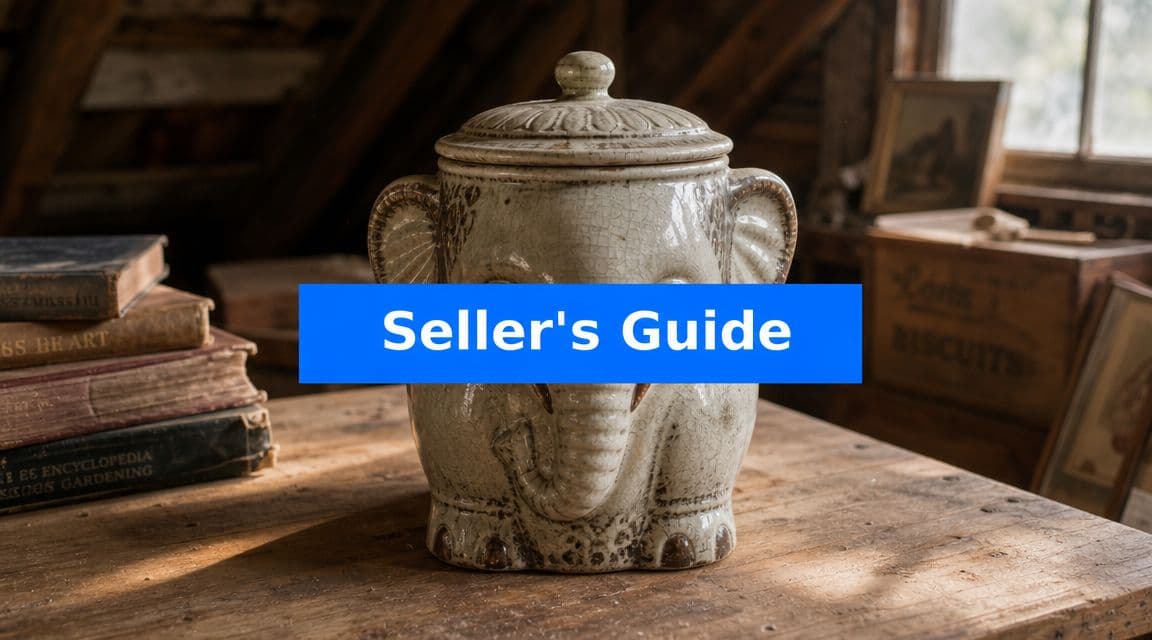
A lot of estate sellers meet their elephant cookie jar the same way. It turns up in a basement cabinet, inside a china hutch, or on a pantry shelf that hasn't been touched in years. It looks charming, a little odd, and possibly old enough to matter. The hard part is knowing whether it's a sentimental keepsake, a modest decorative piece, or a collectible worth listing carefully.
That uncertainty is where most value gets lost. Sellers either price too low just to move it, or they call it “antique” without enough support and lose buyer confidence. Antique elephant cookie jars sit in a niche that rewards careful identification, honest condition reporting, and smart presentation far more than guesswork.
This is the approach I'd use for a first-time estate seller who wants a clean, profitable sale. Start with what the jar is, verify what it isn't, assess condition like a buyer would, and then build a listing that answers the questions serious bidders always ask.
From Attic Treasure to Auction Success
The first thing I tell an estate seller is simple. Don't wash it in the sink and don't start gluing anything back on.
An elephant cookie jar often looks sturdier than it is. Dust hides flaws. Old repairs hide under grime. A lid that seems loose may be original fit, not damage. If you rush the first hour, you can lower the selling price before you've even figured out what you own.

I've seen this pattern repeatedly in estate cleanouts. Someone finds a jar, assumes age is the value driver, and lists it with a vague title like “old elephant cookie jar.” That leaves money on the table. In this category, buyers want specifics. They look for material, surface quality, lid design, charm, and condition issues around vulnerable features.
What a seller needs to get right early
Before you think about price, lock down these basics:
- Handle it like pottery, not kitchenware. Support the body and lid separately.
- Photograph it before cleaning. Dusty “before” photos can help you document original condition.
- Check the high-risk areas first. Ears, trunk, tusks, lid rim, base edge, and seams deserve close inspection.
- Separate fact from family lore. “Grandma had it forever” is meaningful family history, but it isn't proof of age or maker.
Practical rule: The best first listing isn't the fastest one. It's the one with fewer unanswered buyer questions.
A profitable sale starts with patience. If you can describe the jar accurately, disclose flaws plainly, and show why it belongs in the collectible market, you're already ahead of many casual sellers.
Understanding the Appeal of Elephant Cookie Jars
Elephant cookie jars aren't random novelty pieces. They belong to a larger cookie-jar collecting tradition that goes back to the early 1900s, when the first cookie jars were made from ceramic or pottery for home use. That same source notes that elephant-themed jars became especially collectible in the postwar era, when ceramics companies produced whimsical character jars in forms like elephants, kittens, puppies, lamps, and rabbits.
Why collectors respond to them
Collectors usually aren't buying these pieces just because they're old. They're buying design, personality, and recognizability. The same guidance on cookie-jar collecting points out that design, condition, and rarity matter more than the calendar date for many buyers, which explains why a visually strong mid-century example can attract more attention than an older damaged jar.
That matters for estate sellers because buyer interest often starts with emotion and finishes with evidence. An elephant jar has shelf presence. It can read as playful, nostalgic, or graphic depending on the glaze, expression, and silhouette. Some buyers collect cookie jars broadly. Others collect animal forms, character ceramics, or elephant-themed decor.
Why elephant form helps a sale
The elephant motif gives you more angles to market the piece well:
- It crosses categories. A buyer may come from cookie-jar collecting, animal collectibles, or vintage kitchenware.
- It photographs well. Trunks, ears, and sculpted lids create strong profile shots.
- It feels display-ready. Even buyers who don't collect cookie jars may want one as a decorative object.
For visual context, it can help to study how elephant imagery is valued across collectible and display objects. A piece like this natural history gallery malachite elephant shows how strongly the elephant form carries decorative appeal even outside kitchen collectibles. That doesn't make a cookie jar more valuable by itself, but it does help explain why elephant objects keep drawing buyer attention.
Buyers don't need your jar to be the oldest. They need it to be appealing, believable, and accurately described.
The practical takeaway is this. Don't sell your piece as “just an old jar.” Sell it as a collectible elephant-form cookie jar with design value, display value, and niche buyer appeal.
Identifying Your Antique Elephant Cookie Jar
Identification is where most estate sellers either gain confidence or drift into vague guesses. With antique elephant cookie jars, vague guesses hurt. Many are sold generically, and authentication is a real challenge. Guidance on this category notes that a useful process includes checking body material, glaze wear, seam lines, and maker marks, and that many authentic pieces are unmarked, which makes careful physical inspection especially important for estate sellers (collector guidance on authentication and mislabeling risk).

If you need a broader framework for sorting clues the same way appraisers do, DIYAuctions has a helpful primer on how to identify valuable antiques. For a cookie jar, though, you want to move from the easiest evidence to the most interpretive.
Start with the base and interior
Turn the jar over carefully. Then inspect the underside of the lid.
Look for:
- Maker's marks stamped, impressed, painted, or paper-labeled
- Country of origin wording
- Mold numbers or pattern codes
- Surface wear that looks consistent with age rather than freshly distressed
An unmarked jar isn't automatically bad news. In this niche, many authentic examples are unmarked. What matters is whether the rest of the object supports the story.
Read the material correctly
It is common for first-time sellers to blur terms. Ceramic, pottery, and bisque are not interchangeable in a listing if you want serious buyers to trust you.
Use this quick comparison:
| Material clue | What to look for | Why it matters |
|---|---|---|
| Glazed ceramic | Smooth glazed surface, reflective finish | Common in many collectible cookie jars |
| Bisque | More matte or softer-looking body, less glassy finish | Often described in collectible listings and can affect how buyers assess age and wear |
| Pottery | Broader category, often used when the exact body type is uncertain | Better than guessing a maker or date you can't prove |
If you aren't sure, describe what you can see instead of overcommitting. “Glazed ceramic elephant cookie jar” is stronger than “rare antique bisque” when you haven't confirmed bisque body.
Look for construction evidence
Manufacturing clues can tell you a lot. Check the jar in strong side light and rotate it slowly.
Focus on:
- Seam lines running through the body or lid
- Join points around applied details
- Glaze pooling or thinning around edges and recessed areas
- Hand-finished variation in paint, facial detail, or trim
Slip-cast production often leaves a readable physical history. Even when you can't name the maker, construction can support “vintage ceramic” more credibly than guesswork.
Compare design language, not just age claims
A first-time seller usually wants one answer. “How old is it?” Buyers usually want a different answer. “Does it look right for its type?”
That means comparing:
- Expression and modeling. Cartoonish, realistic, simplified, or nursery-like
- Lid design. Separate head, top opening, or integrated cap style
- Color palette. Bright whimsical glaze, muted household finish, or later decorative styling
- Function. True cookie jar, canister form, or decorative container
If the jar is unmarked, your credibility comes from observation. Clear photos and careful wording can do more than a shaky age claim.
A strong identification note in a listing might read like this: “Vintage glazed ceramic elephant cookie jar, unmarked, with visible molded construction seams and hand-finished painted details.” That tells a buyer you looked closely and stayed honest.
How to Value an Antique Elephant Cookie Jar
Value comes from a stack of factors, not one magic trait. Sellers often fixate on age, but the working rule in this category is more useful than that. Rarity and condition can outweigh age, and one documented example, a Ruby Lane listing for a “Vintage Ceramic Elephant Cookie Jar 1975” in good condition at $55, shows that even a mid-1970s jar can hold a defined market price when it has survived well (reference to the valuation example and pricing principle).

If you're new to pricing, it helps to think in terms of buyer-perceived value instead of family sentiment. A general value based pricing guide can be useful for that mindset shift, even though collectibles require their own category-specific judgment. DIYAuctions also offers a practical resource on how to determine fair market value.
The four value drivers that matter most
I use a simple decision screen.
| Driver | What raises value | What lowers value |
|---|---|---|
| Condition | Clean surface, intact lid, no visible damage | Chips, cracks, repairs, heavy wear |
| Rarity | Uncommon form, hard-to-find variant, unusual finish | Very common generic examples |
| Design appeal | Strong sculptural look, expressive modeling, decorative charm | Flat or awkward forms with weak shelf presence |
| Buyer confidence | Good photos, honest details, material clarity | Vague title, missing condition notes, unsupported claims |
The table matters because no single factor carries a weak piece. A rare jar with poor repairs may still struggle. A common jar in appealing, well-kept condition may outperform expectations.
Condition usually decides the final number
Collectors pay closest attention to damage because pottery damage is permanent. They want to know whether a flaw is cosmetic, structural, restored, or hidden.
Use terms carefully:
- Good condition suggests stable, presentable wear with no serious undisclosed issues.
- Hairline crack means a fine crack, often visible in reflected light.
- Crazing refers to fine lines in the glaze, not always structural but important to disclose.
- Paint loss or glaze loss should be described by location, not minimized.
Don't write “excellent for age” unless the condition really supports that phrase. Buyers have seen too many listings where “excellent” means “chip on the ear and repair on the lid.”
Use comps without copying them blindly
Comparable listings are useful only when they are comparable. Match your jar against examples with similar material, style, and condition. A ceramic elephant jar shouldn't be priced by using a metal-tin example, and a restored jar shouldn't be benchmarked against a clean untouched one.
Valuation shortcut: The more unusual the jar, the less helpful generic comps become. In that case, condition reporting matters even more than price matching.
A practical pricing range often comes from triangulating three things: what similar jars are offered for, how yours compares visually, and whether your condition is stronger or weaker. That produces a realistic asking strategy instead of a hopeful one.
Cleaning and Basic Repair for Your Cookie Jar
Cleaning should improve presentation, not rewrite history. With elephant cookie jars, the danger points are predictable. Authentic mid-century ceramic examples were often slip-cast in sections, which creates vulnerability at seam lines and at projecting features such as ears and trunks. One documented vintage elephant jar measures about 11 inches tall, 9 inches wide, 7 3/4 inches deep, and 3 pounds 8 ounces, which is a good reminder that these jars can be heavier than they look and easier to stress while handling (documented dimensions and condition-risk areas).
What to do
Use a conservative cleaning routine:
- Dust first with a soft brush. Get dirt out of creases before wiping glaze.
- Use a barely damp soft cloth. Wipe gently and dry immediately.
- Clean the lid separately. Never hold the jar by the lid knob or ear.
- Inspect as you clean. Good light can reveal old repairs, hairlines, or glaze flakes.
What not to do
At this point, sellers cause avoidable damage.
- Don't soak it. Moisture can worsen old repairs and get into cracks.
- Don't use abrasive pads or powdered cleaners. They can scratch glaze and painted detail.
- Don't run it through a dishwasher. Heat, vibration, and water exposure are all bad bets for old ceramics.
- Don't polish over flaws. Buyers want to see real surface condition.
Minor repair is usually where I advise restraint. If a piece is already broken and you have the detached part, professional restoration may be worth considering for a high-end object. For most estate-sale cookie jars, home glue work often lowers trust unless it's disclosed clearly. A clean “sold as found with visible old repair” listing is usually better than a fresh amateur repair that a buyer spots immediately.
Sometimes the most profitable move is simple. Clean lightly, disclose fully, and let the buyer decide whether restoration belongs in the next chapter of the piece.
Your Step-by-Step Guide to Selling on DIYAuctions
A strong listing sells the jar twice. First in search results, then on the item page.
The first sale happens through the title and thumbnail. The second happens when the photos and description answer every objection before the buyer has to ask. That's especially important in this category because elephant cookie jars can be ceramic or metal-tin, and sellers need to note material, lid fit, and any paint or glaze loss since those details affect condition grade, buyer interest, and shipping risk (marketplace guidance on material differences and cataloging needs).

For platform basics, DIYAuctions explains the process clearly in its guide to how to do an online auction. Here's how I'd tailor that process for this specific kind of estate item.
Build the listing around evidence
Start with photographs before you start writing. Good photos keep you from forgetting details later.
Your photo set should include:
- Front view with the best expression and full silhouette
- Back view because many buyers want complete glazing and form
- Both side views to show trunk, ears, and body contour
- Top and lid view for opening style and fit
- Base photo for marks, numbers, or unglazed foot details
- Close-ups of flaws including chips, crazing, repairs, paint or glaze loss
- Interior photo because buyers often want to assess cleanliness and use wear
If the jar has an awkward lid fit, show that. Don't force it into place just for the photo.
Write a title that buyers would actually search
A title should identify, not decorate. Skip filler like “beautiful” and “must see.”
A useful structure is:
Vintage or antique + elephant cookie jar + material + marked or unmarked + notable trait
Examples:
- Vintage ceramic elephant cookie jar, unmarked, hand-finished glaze
- Elephant cookie jar, metal-tin canister form, handled lid, vintage
That title style helps both collectors and casual buyers find the listing.
Use a description that lowers buyer hesitation
Your description should read like a condition report with personality, not like an ad.
Include these points in short paragraphs or bullets:
- Material
- Markings or lack of markings
- Approximate style era if supportable
- Condition issues by location
- Lid fit
- Whether the piece appears decorative, usable, or both
- Any known estate history, clearly labeled as family history rather than proof
A buyer will forgive age uncertainty faster than they'll forgive omitted damage.
Pick a pricing method that matches confidence level
If you have strong identification, clean condition, and solid comps, a fixed asking price can work well. If the jar is appealing but harder to pin down, an auction format can let the market find the right level.
A simple way to choose:
| Listing approach | Best when | Watch out for |
|---|---|---|
| Auction | Interest may be wider than your comps suggest | Weak photos can suppress bidding |
| Set price | You have clear support for value and condition | Overpricing can stall the listing |
| Reserve mindset | You know your minimum acceptable outcome | Too much rigidity can reduce momentum |
Manage the sale professionally
Once the listing is live, stay responsive. Buyers may ask for underside photos, lid measurements, or more detail on a crack. Fast, plain answers build trust.
Then prepare for the handoff:
- Wrap the lid separately
- Pad projecting features heavily
- Use stable boxing
- Label fragile clearly if shipping applies
- Keep pickup instructions simple if the sale is local
The seller who wins the better result usually isn't the one with the rarest jar. It's the one who made the buyer feel safe clicking bid.
Common Questions About Elephant Cookie Jars
What's the difference between antique, vintage, and retro
In estate selling, those words shouldn't be used as decoration. Antique implies genuine age and should be used only when the evidence supports it. Vintage is often the safer label for older collectible household items when the exact age isn't fully documented. Retro usually describes style rather than age.
If you can't prove antique status, say “vintage” or describe the jar by material and appearance instead.
Is an unmarked cookie jar worthless
No. In this category, unmarked examples can still be collectible and saleable. What matters is how well you identify the physical evidence. Material, glaze, seam lines, lid design, and condition all help support the listing when a maker's mark isn't present.
An unmarked jar with strong design and honest photos is far more marketable than a marked jar with vague condition disclosure.
Is it worth selling just one cookie jar
Usually, yes, if the jar has visual appeal and you present it well. A single collectible can draw real buyer interest, especially when it fits a recognizable niche like antique elephant cookie jars. The key is to treat it like a featured item, not an afterthought from a box lot.
If you're ready to sell inherited collectibles, kitchen antiques, or an entire household, DIYAuctions gives you a practical way to run an online estate sale, keep control of pricing, and retain more of the proceeds.
More guides in Selling Antiques & Collectibles
July 31, 2026
Ceramic Christmas Tree Atlantic Mold Seller's Guide
Identify, value, and sell a Ceramic Christmas Tree Atlantic Mold piece with confidence. Covers markings, rarity, condition, pricing, and listing tips.
Read guideJuly 30, 2026
Nurre Mirror Value: How to Identify and Sell for Profit
Learn to assess nurre mirror value with our step-by-step guide. Identify authentic pieces, estimate price, and sell profitably on DIYAuctions.
Read guideJuly 29, 2026
Distinction Deluxe Stainless Steel by Oneida HH: A Complete
Learn to identify, assess, and price your distinction deluxe stainless steel by oneida hh set for maximum profit.
Read guideGet the estate sale pricing guide
Enter your email for pricing ranges, planning notes, and a clearer path to launch.