Mastering Chain of Custody Procedures for Estate Sales
Learn to establish and maintain proper chain of custody procedures for estate sales and asset transfers. Our guide covers documentation, logs, and legal tips.
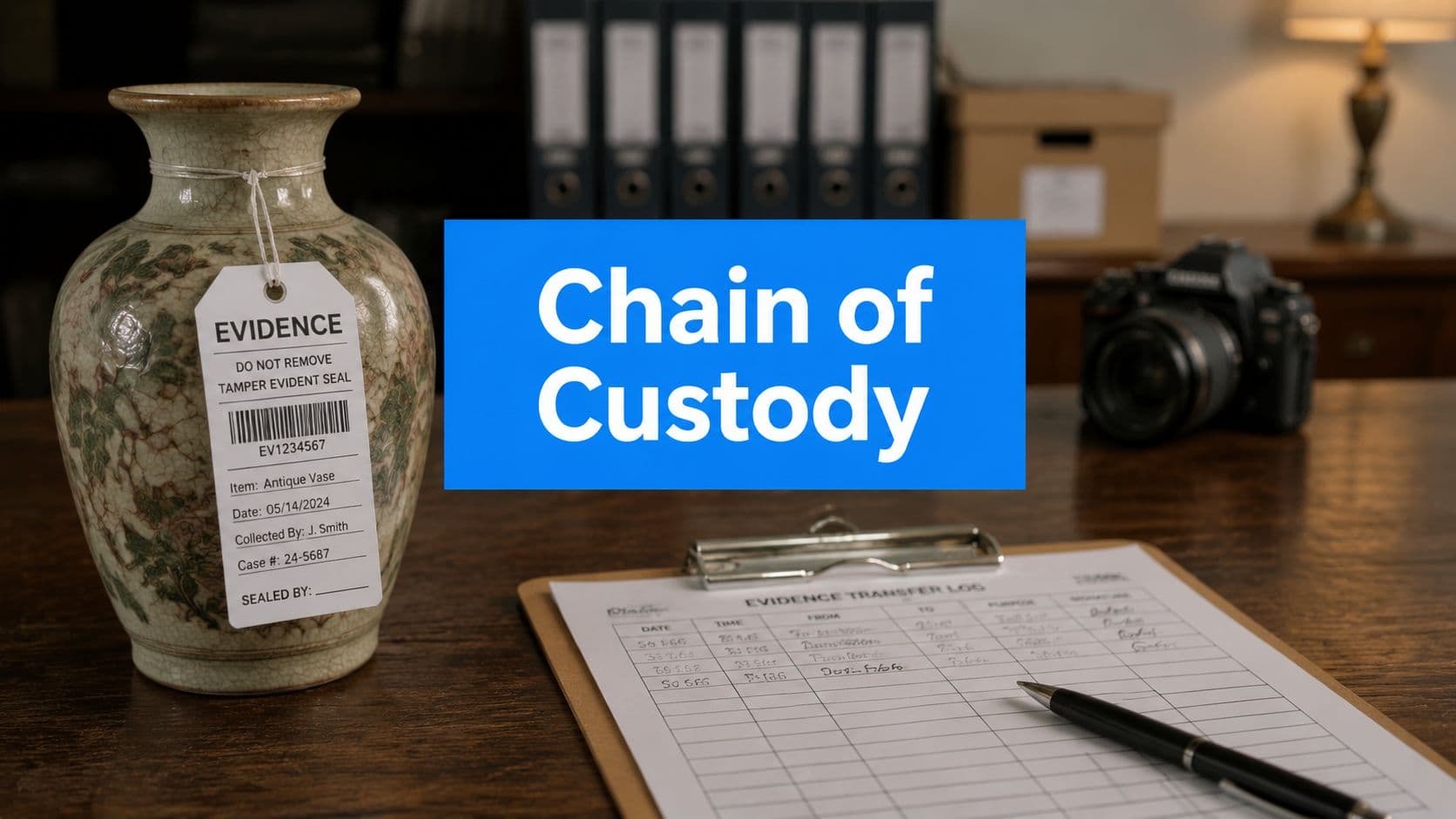
You're usually not thinking about chain of custody procedures when you first open a house for an estate sale. You're thinking about keys, closets, family timelines, pickup dates, and the one cabinet everyone suddenly cares about.
Then the hard questions start. Was that chip already on the porcelain platter? Who moved the watch box from the bedroom to the garage? Did the jewelry case leave the property before or after photos were taken? If you can't answer those questions with records, the discussion turns personal fast.
Most guidance on chain of custody comes from police work, forensic labs, and legal evidence handling. That leaves private sellers, executors, heirs, and collectors with a real gap. They need a practical system, not a courtroom protocol. The good news is that the core idea translates well. A documented history of who had an item, when they had it, what condition it was in, and where it went protects everyone involved.
Why Chain of Custody Matters for Your Estate Sale
A family dispute rarely starts with a formal accusation. It usually starts with uncertainty.
One sibling remembers an antique desk as pristine. Another says the scratch appeared after movers touched it. A nephew claims a boxed train set was promised to him before the sale. An executor insists nothing left the home without approval, but there's no written trail. In that situation, memory becomes evidence, and memory is weak evidence.
That's where chain of custody becomes useful outside law enforcement. Formal chain of custody is best known in criminal and forensic settings, but private individuals can use the same thinking as a risk-mitigation tool for asset transfers, especially when inherited or high-value property may later be contested, as noted in this chain of custody backgrounder for non-forensic contexts.
The difference between trust and proof
Families often tell me, “We all trust each other.” That may be true at the start. But deadlines, grief, money, and sentimental value change the tone quickly.
A simple record does three things at once:
- Fixes the timeline: You can show when an item was first documented, moved, listed, stored, and released.
- Locks in condition: Photos and written notes stop arguments about whether damage was pre-existing.
- Clarifies responsibility: If three people handled the same item, your records show who had custody at each step.
Practical rule: If an item is valuable enough to argue about, it's valuable enough to document.
Why this standard exists at all
Chain-of-custody style documentation didn't appear by accident. Its roots go back to early forensic handling, and the FBI formalized evidence-integrity procedures in the 1930s so handlers recorded transfers clearly and consistently. That principle matters just as much when the item is a family heirloom as when it's evidence. The setting is different. The need for a defensible record is not.
For estate sales, the point isn't to imitate a crime lab. It's to avoid preventable disputes. A clean paper trail gives executors something objective to rely on. It gives heirs fewer reasons to speculate. It gives buyers confidence that the item they inspected is the same item they received.
What happens without a system
Without a chain of custody process, people fill gaps with assumptions. Items get retagged casually. Photos sit in one person's phone. Notes live on sticky pads. Storage rooms are left unsecured because “it's only for a day.” That setup works right up until something valuable goes missing or arrives damaged.
A workable estate-sale system doesn't need legal jargon. It needs consistency. One item, one ID, one record, one photo set, one transfer log.
That's enough to turn chaos into a trackable process.
The Foundation of Your System Documentation and Labeling
The strongest chain of custody procedures start before anything is sold, packed, or moved. They start when you create the first reliable record.
If the first entry is sloppy, every later step gets weaker. Item descriptions become vague. Labels drift. Photos don't match tags. Then you spend sale week trying to reconcile three versions of the same object.
Build a master inventory first
Your master inventory is the control document. It can live in a spreadsheet, a shared folder with a structured form, or a purpose-built catalog system. What matters is that every item gets a unique record before it changes hands.
For probate work, families often need a formal inventory anyway. If you need a stronger legal and administrative framework, this guide to probate inventory help for Texas families is useful because it shows the level of specificity that prevents later confusion.
For each item, capture:
- Unique item ID: Use a simple code such as LR-014 or BR2-031.
- Plain-language description: “Mahogany secretary desk with glass-front top” is better than “old desk.”
- Condition notes: Record scratches, chips, missing hardware, repairs, odors, stains, or loose joints.
- Where found: Note the room, cabinet, shelf, or storage bin.
- Known origin: If the family knows prior ownership or inheritance history, add it.
- Initial custodian: Write down who first documented and tagged the item.
- Date and time logged: Use an exact timestamp, not just a day.

Label the object so the record stays attached
The most common failure I see is good inventory paired with bad labeling. Someone writes a beautiful item description, then tapes on a tag that falls off in storage or gets swapped during setup.
Use labels that connect the physical object to the record with as little room for interpretation as possible. The tag should show the item ID clearly, and it should be attached in a way that won't damage the piece.
Good options include:
- String tags for furniture: Tie them to a stable part that won't snap off during handling.
- Removable adhesive labels for hard goods: Place them where they're easy to find but unlikely to rub off.
- Bag-and-tag method for small parts: Put loose accessories, keys, or replacement pieces in a labeled zip bag tied to the main item.
- Tamper-aware seals for premium items: If an item has small removable components, a seal helps show whether it was opened after documentation.
In labs, standardized forms, tamper-indicating seals, and system integration are recommended because chain-of-custody mistakes are a recurring source of audit failure. In fact, roughly 20% of failed laboratory audits involve chain-of-custody documentation deficiencies, and integrating records into a management system can reduce documentation-related non-conformities by up to 60%, according to this laboratory chain-of-custody implementation guide. The lesson for estate work is simple. Standardize early, or you'll correct errors later under pressure.
Keep the tag format boring
Fancy labels don't help. Consistent labels do.
A solid estate-sale tag includes:
| Field | What to show |
|---|---|
| Item ID | Exact code matching the master record |
| Short name | Brief description |
| Condition cue | Optional shorthand like “chip on base” |
| Location | Optional room code |
| Status | In house, staged, sold, picked up |
If you need a practical tagging workflow, this guide to estate sale tags and item labeling is a strong reference point.
The best tag is the one nobody has to interpret twice.
Capturing Every Detail Photographing and Secure Storage
Written descriptions help, but photos settle arguments faster.
A note that says “minor wear on edge” leaves room for debate. A timestamped close-up of the exact edge does not. When I'm protecting a sale from disputes, photographs do as much work as the inventory.

Use a repeatable photo sequence
Don't improvise item photography from room to room. A repeatable shot list keeps records useful.
For most pieces, I recommend this sequence:
- Overall view: Show the entire item from the front.
- Second angle: Capture the side, back, or another angle that helps with scale and shape.
- Item ID shot: Photograph the tag attached to the item.
- Detail shot: Maker's mark, serial plate, signature, carving, hardware, or pattern.
- Condition shot: Every crack, scratch, stain, dent, repair, or loss.
- Accessory shot: Keys, cords, lids, manuals, boxes, or companion pieces.
That sequence creates a baseline. If the item later arrives with fresh damage or missing components, you can compare the release condition to the pickup condition quickly.
If you want a cleaner sale catalog while preserving your audit trail, this guide on how to photograph items to sell online helps separate listing photos from documentation photos.
Storage needs levels, not one rule
Not every item needs the same physical controls. A box of kitchenware doesn't require the same handling as a diamond ring, rare coin set, signed artwork, or firearm accessory.
Use a tiered approach:
- General inventory: Keep items in a designated staging area with limited traffic and clear shelving.
- Breakables: Use padded surfaces, shelf spacing, and no-stack zones.
- High-value smalls: Store them in a locked cabinet, safe, or lockable room with a short access list.
- Disputed or reserved items: Separate them physically from sale inventory and mark them as hold, not for sale, or pending review.
A documented item in an uncontrolled room is still at risk. Recordkeeping and storage have to support each other.
Control access like a sign-out room
A storage area fails when too many people can enter without being noticed. Good control doesn't require expensive security. It requires discipline.
Keep a short list of authorized handlers. Limit key access. If someone removes an item for cleaning, photography, appraisal, or buyer pickup, log it immediately. For paper records, receipts, and supporting files, the same storage principle applies. This essential guide for UK business owners is aimed at paperwork, but the organizational habits map well to estate documentation too.
A quick visual walkthrough helps when you're setting up your own process:
What doesn't work
Some habits create risk immediately:
- Photos mixed with personal camera roll clutter: You won't find the right image when challenged.
- Items photographed after they're already moved twice: You lose the original baseline.
- Unsecured “temporary” storage: Temporary usually lasts longer than planned.
- Loose accessories stored separately without cross-reference: That's how keys and certificates disappear.
Secure storage isn't about paranoia. It's about reducing the number of ways an item can drift away from its record.
Managing Transfers The Custody Log in Action
A missing entry is usually where the trouble starts.
I see it all the time in estate sales. The inventory is done, the photos are taken, the labels are in place, and then a watch goes with a jeweler for sizing, a painting goes to a cleaner, or a box of coins gets moved to a safer room. Nobody writes down who took it, when it left, or what condition it was in at the handoff. Once that happens, you are relying on memory, and memory gets weak fast when several people are helping.
Treat the log like the item's travel record
Any time custody changes, the log should change too. Five minutes counts. An overnight handoff counts. A buyer's courier picking up on someone else's behalf counts.
For estate work, the goal is not forensic perfection. The goal is a clear, low-cost record that shows where an item was, who had it, and why it moved. That is enough to prevent most arguments before they turn into formal disputes.
Use a sign-out and sign-in record with these fields:
| Item ID | Item Description | Date & Time | Released By (Print & Sign) | Received By (Print & Sign) | Reason for Transfer |
|---|---|---|---|---|---|
Keep the log physically close to the storage area or open on the phone or tablet your team already uses. Distance kills compliance. If the form is upstairs and the silver is in the basement, people skip the step.
What belongs in the log
The simplest rule is this: if an item changes hands or changes location under someone's control, record it.
Common entries include:
- Removal from the original room: Bedroom dresser to inventory table, study cabinet to locked tote, garage shelf to sorting area.
- Handoff for photography or appraisal: The item leaves general custody and goes to a named person for a defined purpose.
- Cleaning or light prep: Especially for jewelry, silver, handbags, art, and anything with condition sensitivity.
- Transfer to sale staging or pickup area: A lot of mix-ups happen in these short moves because people treat them as informal.
- Release to buyer, shipper, or family representative: Record the name, time, and any ID or authorization checked.
For the reason field, plain wording works best. "Appraisal." "Moved to locked cabinet." "Released to buyer pickup agent." Short, specific entries are easier to review later than vague notes.
Small handoffs create expensive problems
A ring leaves a dresser, goes to the photo table, sits in an office, and ends up locked in a safe by someone else before dinner. That path took only a few hours. It also involved multiple handlers, two locations, and at least three chances for confusion.
If a stone is missing later, the question is no longer who meant well. The question is who had custody at each point.
That is also why storage insurance should match your handling process. If you are holding items off-site or in temporary storage during an estate sale, review what qualifies as cover for your valuables in storage and whether your insurer expects proof of possession, transfer, or condition after a loss. A custody log will not replace insurance, but it gives you something far better than guesswork when you need to file a claim.
Field habit: The receiving person checks the tag, confirms visible condition, and counts any accessories before signing.
Paper log or digital log
Both options work. The best one is the one your helpers will use every single time.
A paper log works well at one property with a small team and a central storage point. It is fast, visible, and hard to ignore. The downside is sloppy handwriting, missed timestamps, and no easy backup unless someone scans it.
A digital log works better if you have several handlers, off-site storage, or staggered pickups. Timestamps are cleaner, photos can be attached, and searching later is much easier. The trade-off is friction. If people need three apps, two passwords, and a signal that barely works in the basement, they will stop logging.
What fails in practice:
- Entries filled in later from memory
- One person signing both sides of the transfer
- Multiple valuables dropped into one unlabeled container
- Pickup approved by text with no matching release record
- Helpers using nicknames like "gold ring" instead of the item ID
A good custody log is not paperwork for its own sake. It is the record that lets you reconstruct the item's path, assign responsibility at each handoff, and shut down bad claims with a clean timeline.
Legal Considerations and Preventing Future Disputes
Most private sellers hear “chain of custody” and assume it's only relevant if something ends up in court. That's too narrow.
Its primary value shows up much earlier. It shows up when an heir challenges condition. When an insurer asks what happened between storage and delivery. When an executor needs to demonstrate that sale property was handled carefully and released correctly.
Good records change the tone of a dispute
Without documentation, every disagreement becomes a credibility contest. With documentation, the conversation shifts to the file.
Suppose an heir says a painting was damaged after the estate took possession. If you have intake photos, a condition note, storage records, and a transfer entry showing who moved it to staging, you're no longer arguing from memory. You're showing a timeline.
Or say a buyer claims a sterling set was incomplete at pickup. If your record includes an accessory photo, item count, and a signed release, you can check the claim against the evidence. That doesn't guarantee agreement, but it gives you a grounded starting point.
Professionalism protects relationships
Families often think formal procedures will feel cold. In practice, they usually calm people down.
A written process tells everyone the same thing: no one is getting special treatment, no one is operating off private side conversations, and no one has to rely on memory alone. That consistency matters in emotionally loaded sales.
Use chain of custody procedures to support:
- Executor diligence: Show how assets were identified, secured, and released.
- Insurance support: Document condition before storage, transit, and pickup.
- Family transparency: Reduce suspicion about who handled what.
- Buyer confidence: Show that the listing matched the physical item.
Clean documentation doesn't prevent every dispute. It prevents the weak ones from becoming expensive.
Insurance and storage claims
Storage and transit are frequent problem points. Items get stacked poorly, shifted during relocation, or exposed to moisture and temperature swings. If you're storing valuables offsite, coverage terms matter as much as your records. This overview on cover for your valuables in storage is a useful reminder that protection isn't just physical. It's also contractual.
Your paperwork should support any later claim by showing:
| Record type | Why it matters |
|---|---|
| Intake photos | Proves pre-storage condition |
| Inventory entry | Identifies the exact object |
| Custody log | Shows who handled it and when |
| Storage note | Shows where it was kept |
| Release record | Clarifies final handoff |
What to keep and what to avoid
Keep your process simple enough that you'll follow it. That means standard forms, a dedicated photo folder, one naming system, and one place for signed releases.
Avoid these habits:
- Editing old records without preserving the original
- Using vague phrases like “miscellaneous antiques”
- Letting family members remove items informally
- Treating verbal permission as enough for high-value transfers
You're not trying to build a legal fortress. You're showing care, consistency, and a documented handling process that stands up when someone asks hard questions later.
Integrating Procedures with Your DIYAuctions Sale
A good chain of custody system doesn't need to sit outside your sale process. It works best when the sale workflow itself creates the record.
That's the practical advantage of a structured online auction setup. Catalog creation, photo uploads, buyer communication, payment confirmation, and pickup records naturally create timestamps that support your documentation.
Turn the listing into the first live record
When you build a digital catalog entry, you're already doing part of the inventory work. The item title, description, category, and photos create an identifiable record tied to a specific object.
That doesn't replace your private condition notes or transfer log for sensitive items. It does mean you're not starting from a blank slate. The catalog becomes a working extension of your item file.

Use platform actions as documentation anchors
The strongest setups use one source of truth for public-facing sale activity and a separate private log for internal handling.
Here's how the workflow fits together:
- Catalog entry: Serves as the item's sale-facing identity.
- Photo upload: Preserves a visual record attached to the listing.
- Bid history: Documents buyer interest and final sale outcome.
- Payment record: Connects the item to the final purchaser.
- Pickup coordination: Creates a final handoff checkpoint.
That's especially useful for estate hosts who want a cleaner process without building custom paperwork from scratch. If you're evaluating whether a self-managed online sale fits your situation, this overview of the online auction application process shows how the platform workflow is structured.
Keep the chain unbroken at pickup
Pickup is where sloppy operations undo otherwise good documentation. Items get grouped by buyer, helpers rush, tags come off, and someone leaves with the wrong lot.
For final release, match three things before the item leaves:
- Buyer identity or authorized pickup name
- Item ID or lot reference
- Condition and included accessories at handoff
If a buyer sends a friend, write down that person's name and note that they collected on the buyer's behalf. If an item leaves in multiple boxes, label every box with the lot reference before loading.
Final pickup is not a courtesy exchange. It's the last custody event, and it deserves the same discipline as intake.
Where digital helps and where it doesn't
Digital tools are excellent at preserving timestamps, photos, and buyer records. They're less effective if the physical item in your garage no longer matches the listing because the tag fell off or someone swapped accessories.
That's why the best estate-sale process combines both:
- Digital records for cataloging and sale activity
- Physical tags for item identity
- A custody log for internal transfers
- Signed or documented release at pickup
Used together, those pieces give you something most private sellers never build: a coherent item history from first documentation to final possession.
If you want a sale workflow that supports organized listings, buyer records, and a cleaner final handoff, explore DIYAuctions. It's built for sellers who want to run professional estate sales themselves while keeping control of the process and more of the proceeds.
More guides in Estate Sale Basics
July 28, 2026
Revenue Reporting for Estate Sales and Auctions
Learn revenue reporting essentials for estate sales and auctions. Discover key metrics, templates, and best practices to simplify tracking and compliance.
Read guideJuly 26, 2026
Stamp Collection Valuation: A Practical Step-by-Step Guide
Stamp collection valuation made simple. Learn how to identify, grade, price, and sell your stamps with confidence for estate sales or consignment.
Read guideJuly 23, 2026
Estate Sales Brick NJ: Your 2026 Guide to Success
Planning your estate sales brick nj? Our guide covers permits, pricing, marketing, & running a safe sale with DIYAuctions.
Read guideGet the estate sale pricing guide
Enter your email for pricing ranges, planning notes, and a clearer path to launch.