Estate Sales VA: How to Plan and Run One in Virginia
Estate Sales VA guide: plan a sale step by step, covering Virginia licensing, sales tax, pricing, buyer pickup and fraud checks.

You're standing in a four-bedroom brick colonial in Midlothian or a split-level in Virginia Beach, looking at forty years of furniture, power tools, kitchenware, and boxes tucked into the attic. A realtor wants the house cleared before photos, relatives have already claimed the handful of pieces they want, and you're left trying to figure out how estate sales VA families run from start to finish.
Across the Commonwealth, that scene plays out every week. According to U.S. Census Bureau QuickFacts for Virginia, the state had an estimated 3,746,256 housing units as of July 1, 2024, with an owner-occupied housing rate of 67.2% from 2019 through 2023. Long-term homeowners accumulate far more durable goods than short-term renters, which means clearing a house usually involves hundreds of items that carry real resale value alongside plenty of everyday clutter.
Most advice you'll find online stops at putting price stickers on lamps and taping cardboard arrows to telephone poles. In Virginia, the problems that stall a liquidation happen earlier and later in the process: hiring an unlicensed auction operator, misclassifying sales tax on auctioned goods, getting road signs pulled down, or handing over a dining set on a fake payment receipt. Handle those gates in the right order, and clearing a home becomes a manageable project instead of a legal headache.
Your Estate Sale Timeline, Week by Week
Plan on roughly two months from the day your family commits to liquidating until the final accounting clears. Trying to compress an entire household into two weekends almost always forces sloppy pricing, missed paperwork, and leftover rooms you end up paying a junk hauler to empty.
That workload isn't unusual right now. About 340,000 U.S. properties were transferred through inheritance during the 12 months ending in August 2025, according to Cotality figures published in a HousingWire report on inherited housing inventory. Closer to home, Census estimates cited in the Virginia Housing Commission housing report show that 17.2% of Virginia residents (roughly 1.5 million people out of the state's 2024 population estimate of 8,811,195) are already 65 or older. Thousands of families across Northern Virginia, Hampton Roads, and the Shenandoah Valley are working through this exact same calendar.
Estate Sale Timeline From Authority to Payout
| When | Task | Done when |
|---|---|---|
| 8 or more weeks before | Confirm legal authority and who signs the contract | Signed authority documents are on file |
| 6 to 8 weeks before | Verify auctioneer license and disciplinary history if a third party sells | License status checked with the state regulator |
| 4 to 6 weeks before | Sort items into keep, sell, donate and dispose piles | Sell pile is sized and separated from restricted goods |
| 3 to 4 weeks before | Catalog lots room by room and set starting bids or prices | Every lot has photos, measurements and a written description |
| 2 to 3 weeks before | Publish the sale and promote to local buyers | Listing is live and ads carry the license number |
| 1 week before | Set pickup day and confirm payment and tax records | Pickup schedule is sent to winning buyers |
| Pickup week | Check buyer identity and release items against receipts | Paid lots match the ledger |
| After the sale | Reconcile gross sales, tax, commission and net proceeds | Net distribution is documented for beneficiaries |
Why the Sequence Belongs to the Family
Every stage in that table protects the next one. Sorting before you photograph prevents relatives from pulling a cherry dresser out of the catalog after buyers have already bid on it. Separating restricted items, such as firearms, prescription medications, or titled vehicles, keeps them out of general household lots before anyone writes a description.
Practical rule: The family controls what stays, what each piece is worth, and when pickup happens. A vendor's open weekend should never dictate your closing schedule.
Timing your publicity matters just as much as sorting rooms. Driving strong local turnout for a fixed sale date works much like the staggered countdown Express Text lays out in its guide on how to fill a club night, where early announcements build awareness and final reminders bring people through the door.
One rule can rearrange the entire schedule right at the start. If you bring in a third-party auctioneer or auction firm, move the license verification up to week one. Every ad and online listing has to carry that license number before you publish a single photo, and discovering a lapsed credential after you've photographed 300 lots puts the whole sale on ice.
Virginia License and Contract Rules Before You Publish
Many executors assume their probate papers give them blanket cover to bring in anyone they like to run an auction. Under Virginia law, that assumption is a trap.
While Virginia exempts certain fiduciaries acting in their official capacities, that exemption doesn't automatically pass to an outside auctioneer or auction firm you hire. Under the Virginia Administrative Code rules for the Auctioneers Board, any person or firm selling at auction in Virginia generally needs an active Auctioneers Board license unless a specific statutory exemption applies. Earning that credential requires approved auction-school education, a passing exam score, and a surety bond of at least $10,000.
Say an executor in Chesapeake hires a local liquidation outfit to run an online bidding event for a deceased parent's home, relying on a handshake agreement and a quick text message. Two weeks later, a sibling questions the fees, or a buyer reports an ad that lacks a license number. If the operator's license lapsed or the executor never documented signing authority, the sale stalls immediately, and sorting out disputed ownership or unauthorized auction activity gets far more expensive than checking paperwork up front.
What Must Go Into the Written Contract
Virginia regulations require a written auction contract to spell out the exact terms under which the auctioneer or firm receives property and how proceeds get disbursed. Before you sign anything, check that the document clearly covers:
- Property inventory accepted: Attach or reference a complete item list so everyone agrees on what is included and what stays with the family.
- Sale mechanics and schedule: State the format, preview dates, closing dates, and what happens to unsold items afterward.
- Fee and expense structure: Spell out commissions, advertising allowances, setup charges, and any buyer's premium in plain figures.
- Proceeds disbursement: Lock in the settlement deadline and specify how gross receipts, expenses, and net payouts will be reported.
Looking at how established online marketplaces lay out seller obligations, such as the clear payout and listing responsibilities in Loyaltie seller terms, gives you a useful benchmark for the level of specificity a written agreement ought to provide.
Your Pre-Publication Compliance Gate
Before any listing goes public, run four quick checks yourself:
- Look up the auctioneer or firm through Virginia's Department of Professional and Occupational Regulation (DPOR) database to confirm an active license and inspect any disciplinary history. Verify in writing that the license number will appear on every advertisement.
- Put the signer's legal authority in the sale file, whether that's Letters of Qualification from the circuit court clerk, a trust certificate, or a signed power of attorney.
- Confirm ownership on high-value or co-owned lots, separating leased equipment, titled vehicles, or family heirlooms held on loan so nothing disputed hits the catalog.
- Set up a dedicated settlement folder where every invoice, fee receipt, and payout check will live from day one.
Running that gate takes an afternoon in week one and prevents the ugliest disputes in estate administration.
How Virginia Sales Tax Applies to Estate Sale Proceeds
Sales tax catches more Virginia families off guard than almost any other part of estate liquidation. The rule hinges on who conducts the sale, not just what's sitting in the living room.
Under Virginia's sales tax regulation for fiduciaries and occasional sales, a personal representative who sells household goods or personal effects directly during estate administration is generally treated as making an occasional sale and doesn't need to register to collect sales tax. The moment that same personal representative hires an auctioneer to sell those exact same goods, the occasional-sale treatment disappears for the auctioneer, and sales tax applies.
Watch the short overview below for a plain-language look at how liquidation mechanics and reporting intersect before diving into the breakdown.
Who Collects Sales Tax on Estate Sale Goods in Virginia
| Sale path | Taxable seller | Sales tax treatment |
|---|---|---|
| Personal representative sells household goods directly | Estate, as an occasional sale | Generally no sales tax registration required |
| Personal representative engages an auctioneer | Auctioneer-mediated retail sale | Sales tax applies to the auctioned goods |
| Trustee or executor continues operating a retail business | Dealer | Certificate of Registration required and tax collected like any dealer |
Notice that third row. If a deceased parent owned a brick-and-mortar shop, antique booth, or retail side business, and the trustee or executor keeps operating that retail business while winding it down, Virginia requires a new Certificate of Registration and full dealer tax collection. Treating business inventory and personal household goods as one pile is one of the fastest ways to create a tax notice for the estate.
Keeping Estate Accounting Clean Per Transaction
Never dump liquidation proceeds into the estate checkbook as a single net deposit. Probate commissioners and beneficiaries want to see how gross sales turned into net cash, and mixing tax dollars with estate proceeds blurs the math. Follow a clean six-step workflow for every sale:
- Classify the transaction channel: Mark each batch as a direct fiduciary disposition, an auctioneer-mediated sale, or ongoing retail inventory before listing.
- Name the taxable seller: Record in writing whether the estate or the auctioneer holds responsibility for tax collection and remittance.
- Capture buyer details: Log the buyer's location and the taxable price of each lot so local rate rules stay accurate.
- Ring-fence collected tax: Calculate and reserve sales tax in a separate column or holding line rather than blending it into general estate funds.
- Issue itemized receipts: Give every buyer a written or digital transaction record showing lot numbers, item price, and any tax charged.
- Reconcile every line separately: Close out the ledger with distinct totals for gross receipts, tax collected, commissions, refunds, and net proceeds.
For a deeper look at organizing estate records for filing season, review our guide on tax reporting requirements for estate liquidation. Because local Virginia tax rates and filing schedules can shift by jurisdiction, confirm the exact current rates and registration obligations with the Virginia Department of Taxation or a qualified tax advisor before your first item goes live.
Choosing Between an In-Person Sale and an Online Auction
Deciding how to sell comes down to three practical constraints: how much time you have before the house closes, what kind of inventory fills the rooms, and how many local buyers you can realistically reach. Pick the format that fits the house, not the one your neighbor happened to use.
An in-person estate sale puts everything on display across two or three open days, drawing walk-through shoppers who inspect items in person and regularly try to negotiate prices down at the checkout table. An online auction publishes the catalog once, lets local bidders compete from their phones or laptops over a set window, and wraps up with one scheduled pickup day instead of days of strangers walking room to room.
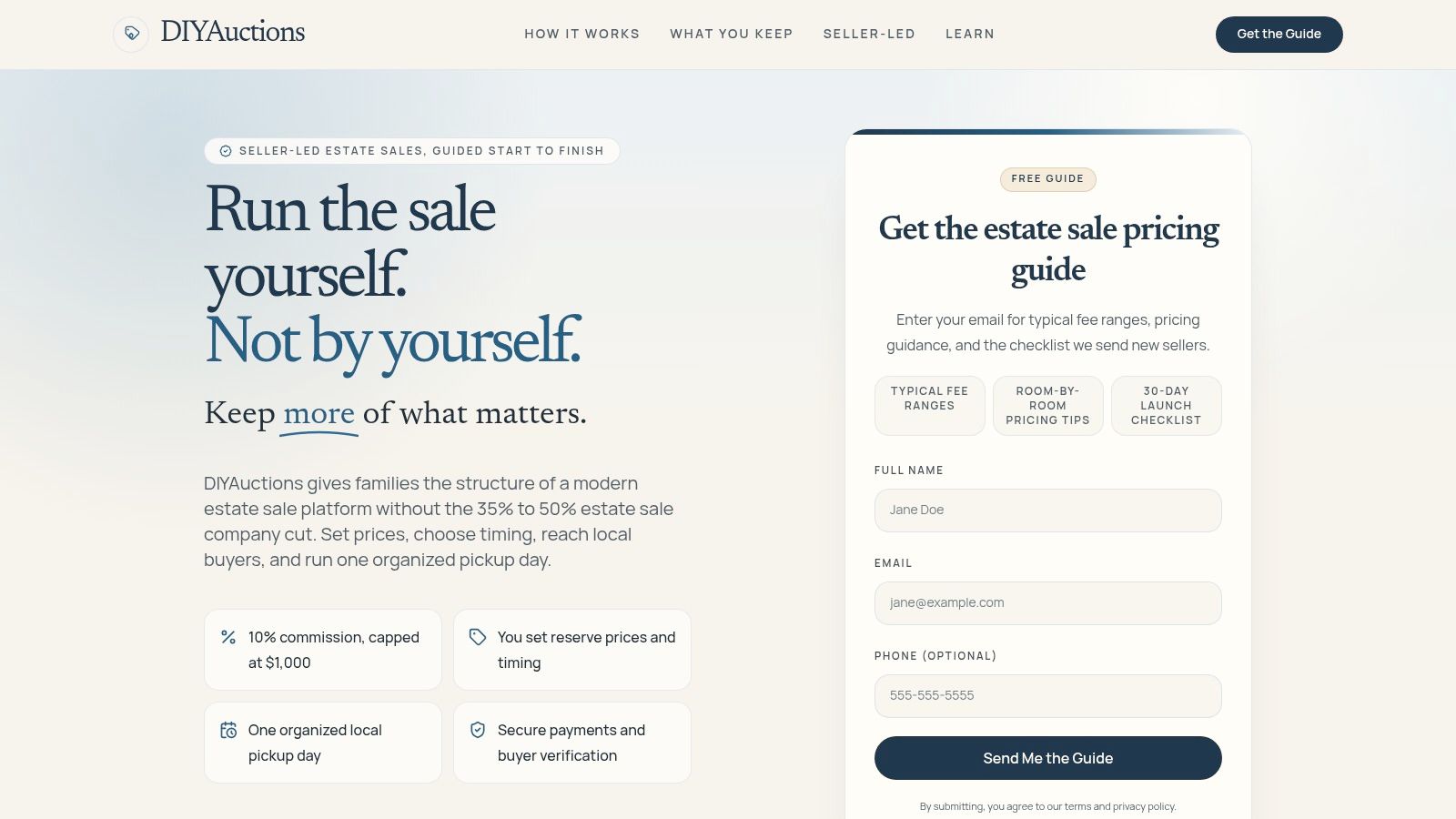
On our platform, DIYAuctions sales are auctions in which competitive bidding sets the final price, so buyers don't haggle over a dining table or tool chest on the front porch. Sellers choose reserve prices, closing windows, and the pickup day that fits their timeline, keeping the calendar anchored to the family's move rather than waiting on a third-party crew.
In-Person Estate Sale vs Online Auction in Virginia
| Criterion | In-person estate sale | Online auction |
|---|---|---|
| Time to run | Several sale days plus setup and teardown | One listing period and one pickup day |
| How price is set | Tag prices with haggling at the table | Competitive bidding sets the final price, no haggling |
| Buyer access | Walk-through traffic across multiple days | Local buyers bid remotely after a preview or photo set |
| Staffing | Family or crew on site for every sale day | Catalog and listing work, then one pickup window |
| Best fit | Bulk of the value in large furniture buyers want to see | Collectibles, tools and specialty items on a tight timeline |
Matching Your Inventory to the Right Format
Retail demand cycles affect secondhand furniture more than most families realize. Shoppers watching major retail markdowns, like the buying patterns described in Willis Furniture & Mattress's seasonal furniture buying tips, often compare used sofas and bedroom sets directly against showroom promotions. Use these criteria to make the call:
- Choose an online auction when your timeline is tight: Listing once and running a single pickup day eliminates multi-day staffing when out-of-state heirs only have one long weekend in Virginia.
- Choose an online auction for collectibles, tools, and specialty lots: Vintage Pyrex, woodworking machinery, sterling silver, military memorabilia, and framed Virginia art draw competing collectors who will bid each other up well beyond a flat tag price.
- Choose an in-person sale when large, everyday furniture holds most of the value: Shoppers often want to sit on a sectional, open dresser drawers, and test a solid-wood dining table in person before renting a truck.
- Choose an in-person sale for high-volume everyday household goods: Pantry items, linens, garden pots, and garage odds and ends move faster when browsers can fill a basket for a few dollars at a time.
Don't judge a liquidation company by its headline commission alone. Setup fees, advertising markups, and unsold-item cleanout clauses decide what actually lands in the estate account.
If you're comparing a full-service estate company against a self-run online sale, read the whole contract side by side before committing. A low-sounding rate paired with extra staffing and haul-away charges can leave the family with less than a simpler structure.
Pricing and Cataloging Every Item, Step by Step
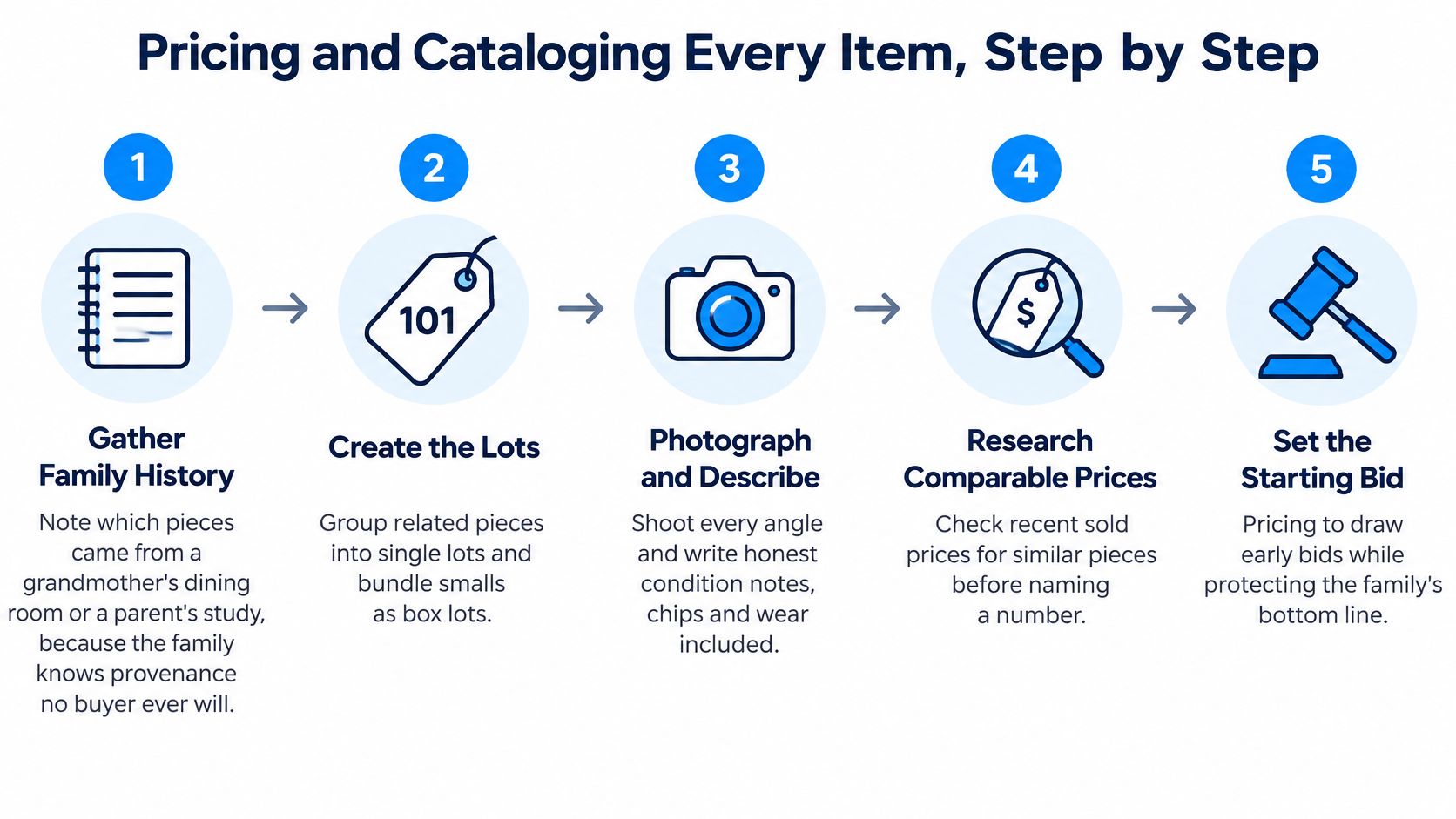
A Virginia estate sale lives or dies on the quality of its catalog. Families hold context no outside liquidator or buyer can guess: which Henkel-Harris sideboard sat in a grandmother's dining room for decades, whether a DeWalt table saw was barely used after retirement, or which set of Flow Blue china was brought back from an overseas posting.
When sellers organize the house room by room and build their own lots, that provenance stays right in the descriptions where bidders can read it. Good cataloging turns "brown wooden cabinet" into a specific, searchable listing that draws serious local interest.
Six Steps to Build a Sale-Ready Catalog
- Group items by room and category. Work one room at a time from the attic down to the garage so nothing gets missed or double-counted. Pair low-value smalls, like everyday kitchen gadgets or paperback books, into clean box lots instead of wasting time listing ten-dollar items individually.
- Shoot clear photos in bright light, flaws included. Open blinds, turn on overhead lamps, and capture the front, back, maker's mark, and any scratches, chips, or water rings. Buyers forgive honest wear when they see it up front; surprise damage at pickup causes disputes and cancellations.
- Record measurements, materials, and maker details. Grab a 25-foot tape measure and note height, width, and depth in inches for every piece of furniture and rug. Include brand stamps, wood types, fabric wear, and whether appliances or power tools turned on when tested.
- Check recent sold prices, not asking prices. Search eBay's "Sold Items" filter, Facebook Marketplace completed listings, and recent Virginia online auction archives from regional galleries to see what local buyers paid. Active listings only show what sellers wish they could get.
- Set starting bids or tag prices with restraint. In an auction format, modest starting bids bring early bidders into the race, and you only need a reserve price on standout items where a hard floor matters. For tag sales, leave room for day-two markdowns without pricing day one so high that shoppers walk right past.
- Tag every lot to match your master ledger. Stick numbered Avery labels or low-tack blue painter's tape on each lot (never standard masking tape on varnished wood or gilt frames) and mirror those exact lot numbers in a spreadsheet so pickup day runs like clockwork.
Items to Pull Aside for Appraisal First
Never guess on high-risk categories just to keep moving. Pull these items off the main floor and get a qualified appraisal or compliance check before listing:
- Fine jewelry and loose stones: Gold hallmarks, estate diamonds, and signed pieces can easily be mispriced by hundreds or thousands of dollars without testing.
- Coins, currency, and bullion: Silver content and mint marks shift values dramatically, even on worn coins sitting in an old coffee tin.
- Original fine art and bronzes: Signed regional paintings, numbered prints, and bronze sculptures deserve a quick check against auction databases.
- Firearms and regulated items: Antique pistols, military rifles, and modern shotguns carry strict federal and Virginia transfer rules and should be handled through a licensed dealer or properly compliant channel with complete paperwork.
The single biggest pricing mistake families make is anchoring furniture to retail replacement cost. A dining room suite that cost several thousand dollars new twenty years ago often sells for a fraction of that today because younger buyers favor smaller spaces and lighter styles.
Before you publish, run every entry through a four-question test: Does this lot clearly state what it is, how big it is, what shape it's in, and why someone would want to bid on it? If any answer is missing, tighten the description before going live.
Getting Local Buyers to the Sale
Local turnout doesn't happen by accident. Almost every buyer who registers or shows up at the curb comes from one of three places: the main sale listing, the photo gallery, or the directional signs at the nearest cross street.
Building Reach Without Violating Local Sign Rules
Start by publishing your primary listing with exact dates, hours, pickup instructions, and a lead gallery highlighting your fifteen to twenty strongest pieces (the Henkel-Harris furniture, sterling silver, vintage Pyrex, or workshop equipment that pulls people into the full catalog). Share that exact gallery across local estate-sale directories, neighborhood Facebook groups, Nextdoor, and the town paper's classifieds so collectors and nearby homeowners see it where they already browse.
If a licensed auctioneer or auction firm is conducting the sale, double-check that the license number sits clearly on every digital post and printed flyer before anything goes out. On the street, keep temporary yard signs strictly inside what your city or county zoning office and HOA allow. Never stake signs in Virginia Department of Transportation (VDOT) highway medians or state road rights-of-way; road crews pull illegal right-of-way signs quickly, leaving your sale invisible right when Saturday traffic picks up.
Driving Final-Day Bids and Tracking What Worked
Give serious buyers a scheduled preview hour whenever possible so they can inspect upholstery, test equipment, and measure large cabinets in person before bidding closes. Then send one crisp reminder 24 hours before doors open or the first lot closes, which is when most hesitant watchers finally place bids. For additional outreach angles suited to tight local radii, check our guide on neighborhood marketing tactics for local estate sales.
Measure three simple numbers while the sale runs:
- Listing views by channel: Note whether neighborhood groups, estate directories, or local classifieds drove the most clicks.
- Saved or watched lots: High watch counts with low early bids usually signal that your opening price is slightly high or buyers are waiting for the final hour.
- Registered bidders per source: Track how many sign-ups convert into actual bids so if your family runs a second phase or helps another relative later, you start with a proven local list instead of guessing.
Pickup Day and Fraud Checks for Sellers
Most guides treat online estate selling purely as a convenience upgrade. The main vulnerability shows up when money changes hands and buyers arrive at the driveway, especially when older homeowners or grieving heirs are liquidating valuable collections under tight closing deadlines.
Federal enforcement numbers show how big that target has become. According to the Federal Trade Commission's 2026 report on fraud affecting older adults, consumers reported approximately $16 billion in fraud losses in 2025. Among reports that included age information, 469,597 came from people age 60 or older, and roughly 123,000 of those reports involved monetary loss, driven in part by ongoing scams targeting retirees' life savings.
Fraud during an estate sale runs in both directions. Sellers get hit with fake payment screenshots, spoofed transfer confirmations, and overpayment schemes where a scammer sends extra money via a bogus check and begs for an immediate refund from the seller's personal account. Buyers get burned by hidden damage, missing lots, and chaotic or unsafe pickup setups.
Why Cash-Only Rules Are Not Automatically Safer
Plenty of families default to "cash only at the door" thinking it eliminates scams. In practice, holding hundreds or thousands of dollars in bills inside a half-empty house creates physical security risks, invites counterfeit currency, and leaves zero digital trail.
Audit trail advantage: Documented electronic invoices and cleared digital payments give an executor clean, date-stamped proof for beneficiaries and probate commissioners showing exactly where every dollar came from.
Running one coordinated local pickup day instead of multiple days of open foot traffic also narrows your exposure window. You know exactly who won each lot, when they're arriving, and what they paid before they ever pull into the driveway.
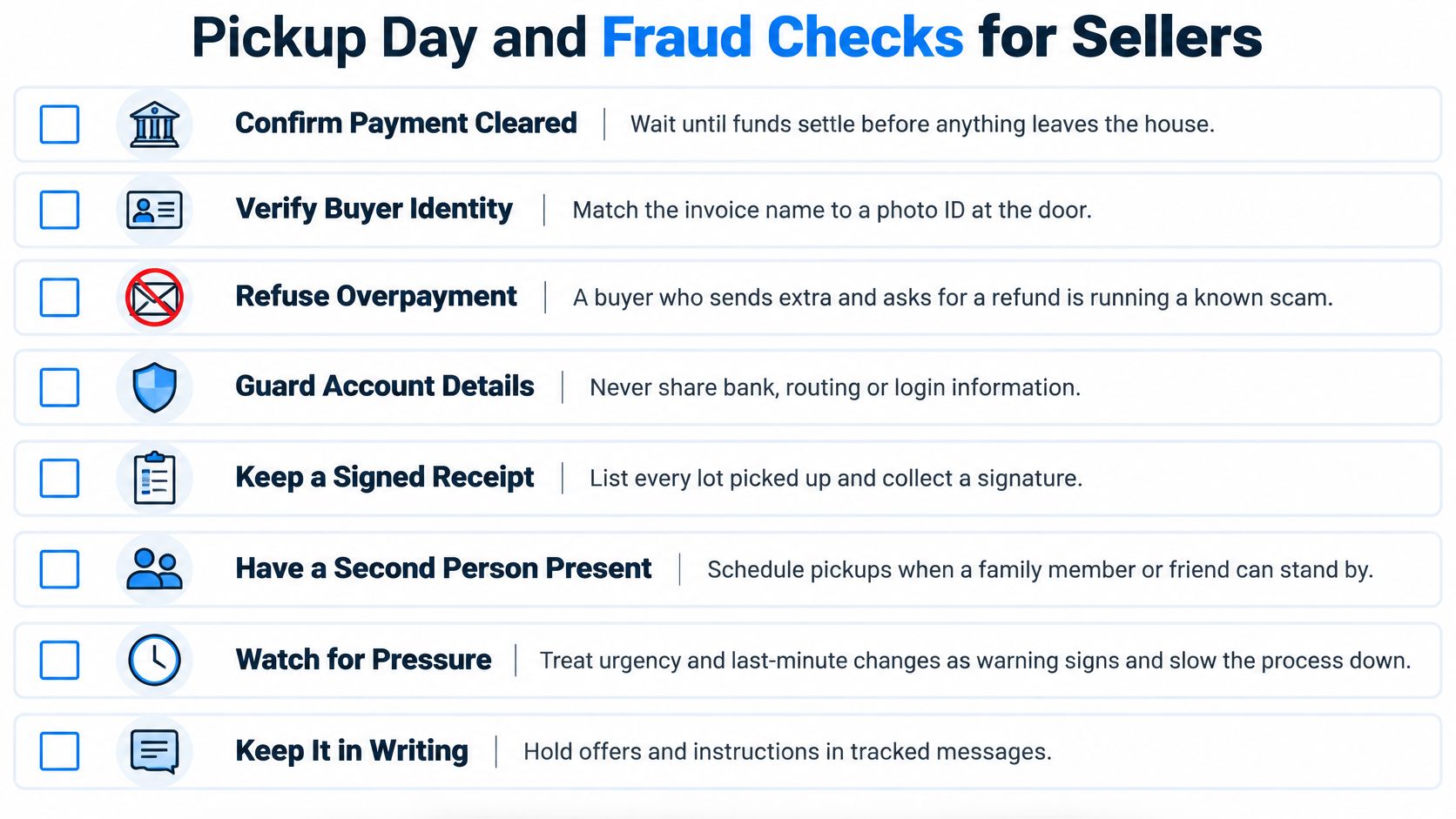
Your Six-Point Pickup Day Protocol
Keep a printed master list and a clipboard by the front door, and follow this exact routine for every buyer who arrives:
- Match buyer ID to the winning invoice: Ask for a photo ID and confirm the name matches the registered bidder (or a pre-authorized pickup representative confirmed in writing ahead of time).
- Verify cleared funds before releasing anything: Never load a sofa or box of silver based on a "pending" screenshot or a promised bank transfer; confirm settled payment inside your platform dashboard or bank account.
- Reject every overpayment request flatly: If a buyer claims they sent too much and asks you to Venmo, Zelle, or hand back cash for the difference, stop the transaction immediately.
- Snap handover photos of fragile or high-value lots: Take a quick timestamped phone photo as the buyer inspects the piece at pickup so nobody can claim post-pickup damage later.
- Keep a second adult on site all day: Have a sibling, spouse, or trusted friend handle check-in while you supervise loading so you're never alone inside the house with strangers.
- Collect a signed release on the ledger: Have every buyer initial next to their lot numbers on the pickup sheet before walking out the door.
Keep our complete pickup and fraud prevention checklist handy the night before pickup so every helper follows the same rules. When pickup hours close and a few paid or unpaid lots remain uncollected, don't let them stall your closing calendar. You can re-list them in a follow-up batch, donate them to a local Virginia charity for a receipt, or offer them directly to the next-highest bidder.
What a Virginia Estate Sale Costs and How to Start
Before you sign a single agreement, compare the three real cost models side by side on the exact same house:
- Full-service estate sale company: Typically charges a percentage commission on gross sales, often paired with setup, staging, staffing, or post-sale cleanout fees.
- Independent licensed auctioneer: Charges a seller commission and may add a buyer's premium, plus separate line items for advertising or hauling.
- Self-run online auction platform: Trades your family's cataloging and pickup-day effort for a much lower platform fee. At DIYAuctions, for example, we charge a 10% commission capped at $1,000 per transaction while handling auction pages, buyer verification, and secure payment flow.
Skip comparing headline commission percentages in isolation. Ask every provider for an all-in written estimate based on your actual inventory and target pickup date, spelling out total fees, advertising costs, unsold-item disposal, and the exact settlement date. Keep four lines separate in your estate spreadsheet from the very first lot: gross sales, sales tax collected, commissions and fees, and net proceeds to the estate.
The fastest way to break analysis paralysis is a small test run. Pick one room, catalog 20 representative lots with clean photos and measurements, and price them against recent sold listings. That single afternoon tests your workload, gives you a realistic sense of what the household will bring, and shows whether running the sale yourself or hiring a full-service crew makes more financial sense.
Ready to map out your sale with concrete numbers instead of guesswork? Download DIYAuctions' free estate sale pricing guide, which includes typical fee ranges, practical pricing guidance, and a 30-day launch checklist built for first-time sellers. Compare a self-run online auction alongside local full-service liquidators and licensed Virginia auctioneers, schedule a quick call with a Virginia tax advisor to confirm your tax classification, and start your 20-lot test catalog this week so your family stays in control of both the timeline and the proceeds.
More guides in Estate Sale Basics
July 28, 2026
Revenue Reporting for Estate Sales and Auctions
Learn revenue reporting essentials for estate sales and auctions. Discover key metrics, templates, and best practices to simplify tracking and compliance.
Read guideJuly 26, 2026
Stamp Collection Valuation: A Practical Step-by-Step Guide
Stamp collection valuation made simple. Learn how to identify, grade, price, and sell your stamps with confidence for estate sales or consignment.
Read guideJuly 23, 2026
Estate Sales Brick NJ: Your 2026 Guide to Success
Planning your estate sales brick nj? Our guide covers permits, pricing, marketing, & running a safe sale with DIYAuctions.
Read guideGet the estate sale pricing guide
Enter your email for pricing ranges, planning notes, and a clearer path to launch.