Writing Effective Product Descriptions for Estate Sales
Learn to write effective product descriptions for estate sale and secondhand items, with field checklists, condition terms, headline steps and a publish check.
You're standing in a bedroom filled with forty years of furniture, lamps, framed prints, and half-full closets, phone in hand, facing a hundred lots that need to go online before Friday. The temptation is to snap two quick pictures, type nice vintage dresser, great shape, and move to the next room. That shortcut almost always backfires in an online estate sale.
When buyers can't pull open a drawer, flip a lamp upside down, or measure a doorway themselves, vague copy forces them to guess. In Syndigo's 2025 Product Experience Report, 44% of global consumers reported abandoning a purchase because online information was insufficient, and 40% of consumers across eight countries returned an item because of incorrect information. On the flip side, 62% said clear, accurate, detailed information made them more likely to keep what they bought.
Writing effective product descriptions for an estate sale has very little to do with flowery sales copy. Treat every listing as a "trust dossier" instead. Disclosed flaws, stated unknowns, and blunt pickup constraints aren't liabilities that scare bidders away. They're the proof remote buyers need to place a confident bid and show up on pickup day without an argument.
The Fields Every Estate Sale Listing Needs
A missing dimension loses the bidder measuring a hallway alcove. A missing defect note starts an argument at the curb. Run each lot against the nine core fields below before you hit publish, and treat every answer as part of the trust dossier that replaces in-person inspection.
| Field | What to write | Example |
|---|---|---|
| Item and maker | Type, brand or maker, model if marked | Walnut dresser, maker unmarked |
| Dimensions | Width, depth and height in inches and centimeters | 42 x 19 x 33 in (107 x 48 x 84 cm) |
| Material and construction | What it's made of and how it's joined | Solid walnut top, veneered drawer fronts, dovetailed drawers |
| Age or era | A date only when you can support it | Mid-century style only if photos support it; no date mark found |
| Condition | Standard grade with the visible evidence | Good, finish worn along the front edge |
| Defects | Every flaw, including small ones, with location and size | Drawer 3 sticks; 2 cm ring mark on top |
| Included and excluded | Components in the lot and items not included | Keys included; mirror not included |
| Functional status | Test result for electrical or mechanical parts | Mechanical drawers checked; drawer 3 catches on the right runner |
| Pickup needs | Weight, stairs, tools and disassembly | About 45 kg (100 lb); ground floor; two people recommended; no disassembly needed |
Complete listing data isn't an extra flourish anymore. In a 2021 benchmark of the 60 largest e-commerce sites by the Baymard Institute, 90% maintained a consistently high level of product-description detail, while every single test participant relied on descriptions at some point to decide whether a product suited their needs. Buyers bring those same expectations directly to estate auctions.
Look at how the fields protect each other. Skip the width and depth, and anyone furnishing a tight room scrolls past rather than gambling on a guess. Omit the sticking drawer, and the winning bidder feels deceived over a flaw you could have disclosed in nine words. Fail to note that the matching mirror isn't part of the lot, and you invite a dispute at pickup when someone expects a complete vanity set. Disclosed flaws cost you nothing. Undisclosed ones cost you the sale's reputation.
For consistent numbers across every room, always give width, depth, and height in that order, measured the same way on every lot. If you want a reference for how to measure awkward pieces like recliners, corner cabinets, or items with detached parts, these estate sale measurement standards walk through the conventions, so the dresser in the bedroom and the shelving in the garage end up described the same way.
Notice what the example rows share: they state unknowns openly. "Maker unmarked" and "no date mark found" are finished answers, not gaps. A bidder who sees a stated unknown trusts the fields that do carry specifics, because nothing in the listing looks padded.
This table isn't a rigid form you must force onto a box of paperback books or a single cast-iron skillet. It's a pre-flight checklist to audit every lot before it goes live. If a buyer couldn't answer a basic question about any applicable field using only your text, that field isn't finished yet.
How to Write a Headline and Opening Highlights
Most estate-sale bidders scroll through dozens of thumbnails on a phone screen before clicking a single lot. Dense paragraphs hide the facts they need to filter quickly. In Baymard Institute's usability research on description structure, shoppers responded well to descriptions organized into scannable feature highlights, yet only 22% of benchmarked sites used that structure, leaving 78% missing a clear usability gain. The same research recorded that 21% of Crutchfield users overlooked extra text tucked inside horizontal tabs, even while actively searching for that exact information.
Keep your most decision-critical facts visible at the very top of the listing, never buried in prose or collapsed menus. Use this six-step sequence to build a headline and opening highlight block that does the heavy lifting right away.
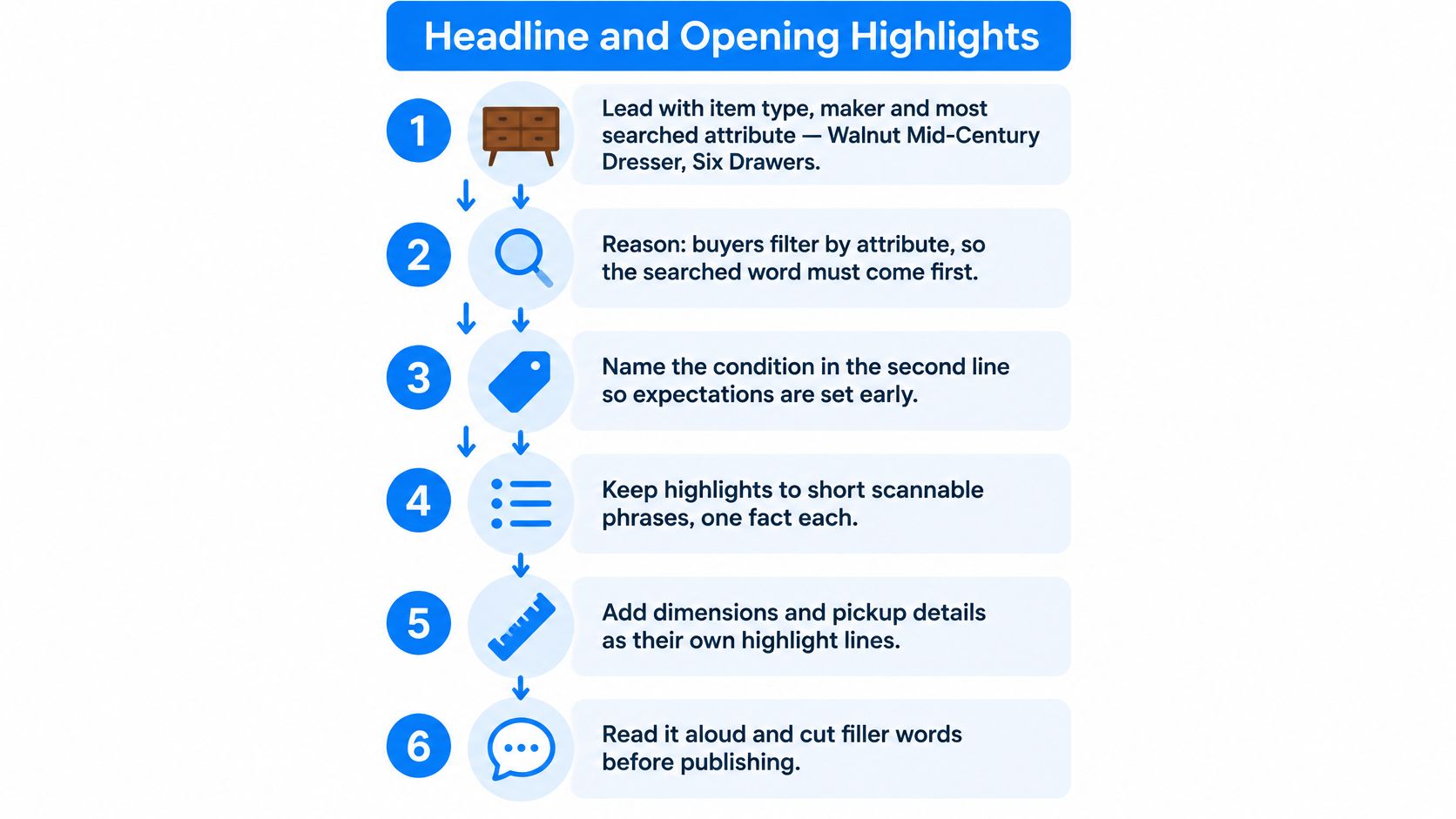
- Lead with item type, maker, and the primary searched attribute. Write Walnut Mid-Century Dresser, Six Drawers, Solid Wood Top instead of burying the noun at the end. Buyers scan search results by category and material first, so the exact words they type need to sit at the front of the title.
- Add one verified size or condition term to the headline. Appending 42 in Wide or Good Condition lets a shopper answer a dealbreaker question before they even open the listing page. That saves clicks from mismatched buyers and draws serious bidders straight in.
- Follow the title with three to five single-fact highlight lines. Put dimensions, condition grade, one standout structural feature, and key inclusions on separate short lines. Scanning four crisp bullets takes two seconds, whereas parsing a six-line opening paragraph feels like homework.
- Place pickup constraints in the second highlight block. State Pickup Saturday 9 to 11 AM, two people recommended right near the top. Showing collection effort before someone bids prevents a winning buyer from realizing on Friday night that they own a compact sedan and have no help to lift a heavy piece.
- Cut unsupported praise like stunning, rare, or gorgeous. Unless a maker's stamp, appraisal, or photograph backs up a claim, promotional adjectives erode trust. Seasoned estate buyers assume sellers use hype to distract from unmentioned wear.
- Read only the headline and highlights aloud. If someone listening with their eyes closed couldn't picture the exact object, its size, and whether it fits in their car, trim the fluff and rewrite until every line carries weight.
Seeing the Headline Rewrite in Practice
Compare how a typical rushed estate title stacks up against a disciplined one for the same bedroom piece:
- Weak headline: Beautiful old dresser, very nice piece!
- Working headline: Mid-Century Dresser, Six Drawers, 42 in Wide, Good Condition
The first version forces a buyer to click, squint at photos, and guess the scale. The second answers four filtering questions in nine words, which is how effective product descriptions earn qualified bids instead of empty page views.
Describing Condition, Defects and Provenance Honestly
Many sellers worry that pointing out a chipped veneer corner or a tarnished brass pull will kill the bidding. In practice, precise flaw disclosure protects both you and the buyer. A bidder who knows about a scratch before placing a bid prices it into their maximum offer, and they won't ask for a refund or argue in the driveway on pickup morning.
Accurate, complete information also builds repeat buyers across future sales. According to CXM World's report on Syndigo research, 75% of global consumers in 2025 said accurate and complete product information increased their likelihood of returning to a brand or retailer.
Separating Verified Facts From Unknowns
When you catalog secondhand or inherited items, you won't know every detail, and pretending you do creates liability. Keep three categories of statements strictly separated in your copy:
- What you directly verified: State what happened when you tested the piece yourself, such as Drawer 3 slides open when pulled with both hands, catches slightly on the right track.
- What you observed without testing: Never assume an unplugged appliance or vintage radio works. Write Table lamp, untested, cord shows minor fraying, not plugged in.
- What you do not know: Leave guesswork out of the listing. Write Maker unknown; no stamp, label, or burn mark found on the back or inside the drawers.
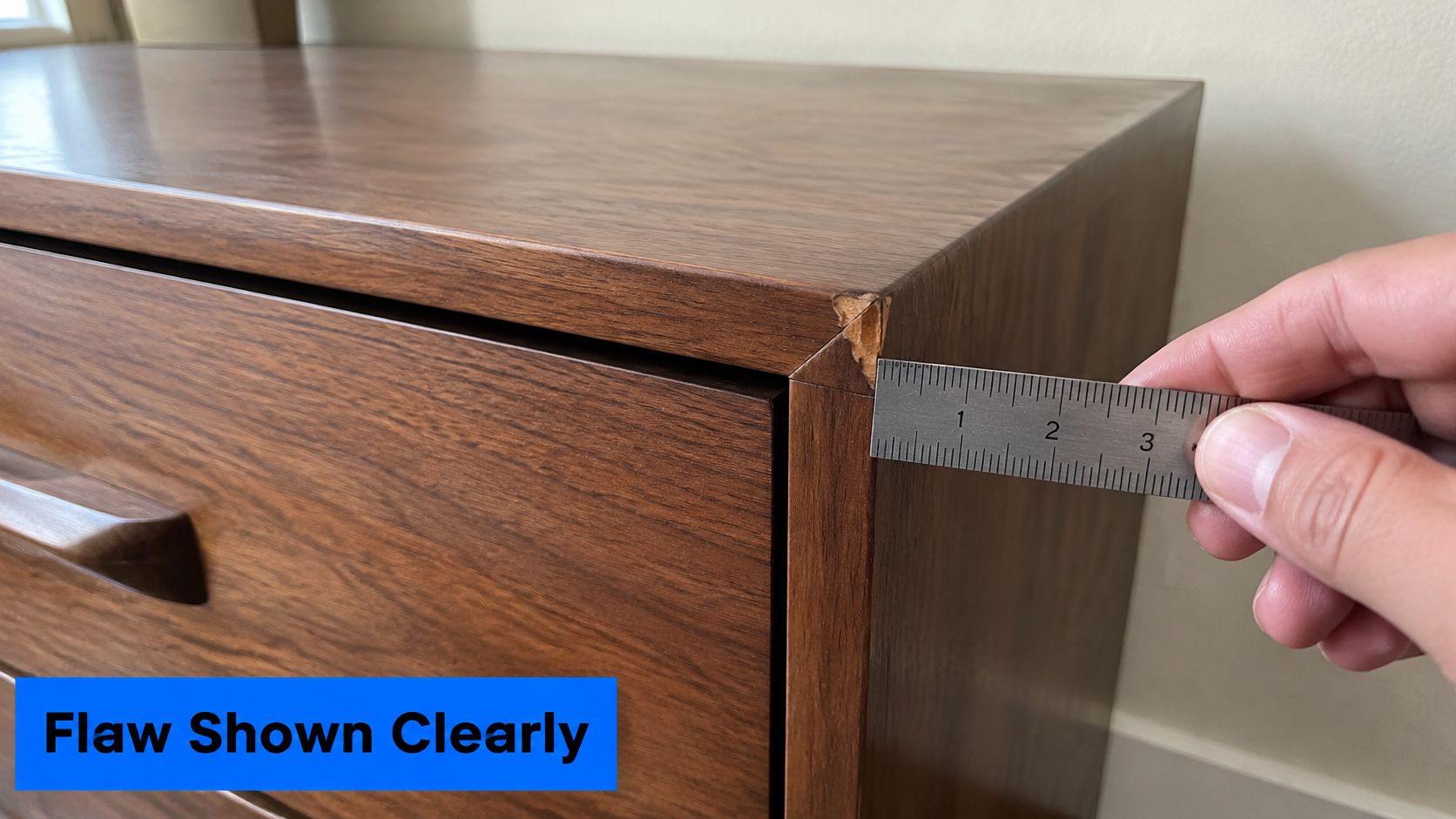
Describe every defect by location and measurement, then tie it straight to a photograph: Scratch on top left corner, about 3 cm, see close-up 4. For provenance, stick to plain, verifiable facts like From the seller's family home in Ohio, no original receipt. Drop any date, wood species, or designer attribution you can't confirm from a label or record, and review our estate sale disclosure requirements before finalizing high-value or fragile lots.
Standard Condition Vocabulary for Auction Lots
Assign one standardized grade to each lot so bidders can compare condition consistently across your entire catalog.
| Term | Use it when | Example wording |
|---|---|---|
| New | Unused, with original packaging or tags | Unopened, original box |
| Used | Working with normal wear; describe the wear | Good, light wear to the finish |
| Restored | Repaired or refinished; say what was done | Refinished top, original hardware |
| Untested | Power or function hasn't been checked | Lamp, untested, not plugged in |
| For parts | Not expected to work; sold as is | Motor seized, sold for parts |
If a scratch, stain, or missing screw would make you feel awkward pointing it out at pickup, put it in the first two lines of the description.
Keywords, Story and Pricing Words Without Overselling
Search terms and background story belong in an estate listing only when they help a buyer find and evaluate the item. Drop your core search terms into the headline and the first highlight line, then use them again only where they naturally describe the maker, style, material, or confirmed era. Stuffing a block of comma-separated synonyms like antique, MCM, retro, boho, farmhouse, vintage at the bottom of a lot irritates real buyers and clutters mobile screens.
A provenance story works best when it reads like a museum placard rather than a sales pitch. Keep it to one or two sentences of plain fact: who owned the piece, where it sat, and why it's entering the sale. Writing Purchased by the homeowner in Columbus and kept in a smoke-free guest bedroom tells a bidder far more about odor, wear, and care than three nostalgic paragraphs ever will.
Keep pricing language just as grounded. Phrases like priced to move, huge bargain, or a steal at this price signal hype rather than value. Strong, verifiable detail is what helps shoppers weigh price. According to Syndigo's 2025 Omnichannel Shopping Benchmarks Report, 86% of U.S. and Canadian consumers said high-quality product content, including detailed descriptions, images, videos, and reviews, helps them choose between higher- and lower-priced options. If you want to explain a starting bid, mention comparable sold prices only when you've checked real completed sales, and let your dimensions, material, and condition notes carry the comparison.
Replacing Sales Hype With Checkable Facts
Look at the difference between a promotional line and an evidence-backed one for a small storage piece:
- Overstated copy: Heirloom quality cabinet, perfect for any home, won't last long!
- Checkable copy: Solid pine cabinet, 36 in tall, original brass latches, paint loss along the bottom edge of the left door.
The overstated line asks the bidder to trust an opinion. The checkable line hands them four facts they can confirm in five seconds by swiping through the gallery.
The photo verification rule: Every adjective in your listing must point to something a buyer can verify in the photographs or in a documented record. If a camera can't prove the word, delete it.
Pairing Photos With Text for Remote Buyers
Text and photographs should work like matching halves of a receipt. Every claim in your description needs a visual counterpart, and every photo should back up a specific line of copy. Remote inspection matters across every category of online buying. As cited in the 2025 State of Product Experience report, DHL's 2025 shopper research of 24,000 respondents across 24 countries identified clear sizing, accurate imagery, and honest, detailed descriptions as critical when shoppers can't physically inspect goods before buying.
Taking clear, well-lit frames in natural daylight helps remote bidders judge true wood grain and proportions right away.

Shoot every lot in the same fixed order so nothing slips through the cracks when you're moving fast through a house:
- Start with a room-context shot. Frame the item next to a doorway, chair, or standard outlet so buyers immediately grasp its physical scale before reading a single measurement.
- Capture a straight-on front shot against a plain background. Pull away clutter, cords, and unrelated lamps so bidders know exactly where the lot begins and ends.
- Take close-ups of every flaw you named in the text. Lay a rigid metal tape measure or ruler directly beside chips, rings, cracks, or seam splits so size isn't left to guesswork.
- Lay out every included accessory together. Spread extra keys, table leaves, manuals, power cords, or spare lenses on a flat surface in one frame.
- Show exclusions clearly when confusion is likely. If a dresser sits beneath a wall mirror that isn't part of the lot, shoot one frame without the mirror or note the exclusion directly in the caption.
Captions, Alt Text and Room Context
Write short, factual captions under key photos, such as Close-up 3: 2 cm water ring mark on top right surface. Good captions still carry the message if a slow mobile connection delays image loading. Fill in descriptive alt text that names the object and its visible condition, like Six-drawer walnut dresser showing worn finish along front edge, rather than leaving default camera filenames like IMG_4082.jpg. For lighting angles, glare control on glass or silver, and framing tips on older pieces, check our guide on how to photograph antiques. If you also sell standardized small goods or need clean studio backdrops alongside estate pieces, exploring AI product photography for online stores from Visual Sandbox can help you see how clean presentation sharpens buyer focus.
This short walkthrough demonstrates practical framing and lighting habits you can apply while photographing household items room by room.
On DIYAuctions, sellers create lots and organize the house room by room, keeping the context only the family knows. Grouping items by bedroom, workshop, or dining room matches how local shoppers browse for what they need. When a desk spent thirty years in a basement study or a china cabinet held holiday dishes in a formal dining room, put that room context in the text so the photos have a grounded backdrop. Place the pickup window, stair count, and approximate weight right beside the photo gallery, so a buyer checking scale in the room shot can simultaneously judge whether the piece fits through their tailgate.
A Reusable Listing Template
Switching formats from lot to lot slows you down while writing and forces bidders to hunt for dimensions and pickup rules on every page. Lock in one six-part layout and copy it across every item in the house.
- 1. Headline: [Item type] [Maker if marked] [Key attribute], [Size or count], [Condition term]
- 2. Highlights (3 to 5 lines): [Width x depth x height in inches and centimeters]; [Condition grade with visible evidence]; [One standout material or construction feature]; [Included components]
- 3. Defects: [Exact location], [measured size], [photo reference number]
- 4. Excluded: [Nearby or commonly assumed item] not included
- 5. Provenance: [Source in one plain sentence], [receipt or no receipt]
- 6. Pickup: [Date and exact time window], [weight in kg and lb], [stairs, doorway, or tool needs], [number of people recommended]
Completed Example for a Walnut Dresser Lot
Here's how that exact scaffold looks once filled out for our six-drawer walnut dresser, ready to copy and paste:
Walnut Dresser, Six Drawers, 42 in Wide, Good Condition
- Dimensions: 42 x 19 x 33 in (107 x 48 x 84 cm)
- Condition: Good, finish worn along the front top edge
- Construction: Solid walnut top, veneered drawer fronts, dovetailed wood drawers
- Included: Two original brass drawer keys included
- Defects: Drawer 3 sticks on the right runner and needs two hands to pull smoothly; 2 cm water ring mark on the top right surface, see close-up 3
- Excluded: Wall mirror shown in room photo is not included
- Provenance: From the seller's family home in Ohio, no receipt
- Pickup: Saturday 9 to 11 AM, ground-floor bedroom with wide hallway access, about 45 kg (100 lb), no disassembly needed, two people recommended
Every line earns its spot. A buyer can verify fit, flaws, inclusions, and loading logistics in under twenty seconds.
Publish Your First Listing After the Final Check
When you've stared at the same bedroom furniture all week, your brain automatically fills in gaps that aren't on the page. That's why Nielsen Norman Group's usability research on product descriptions stresses answering shoppers' questions directly in simple language and giving them the facts they need to compare options, noting that users frequently lacked enough detail to make a purchase decision.
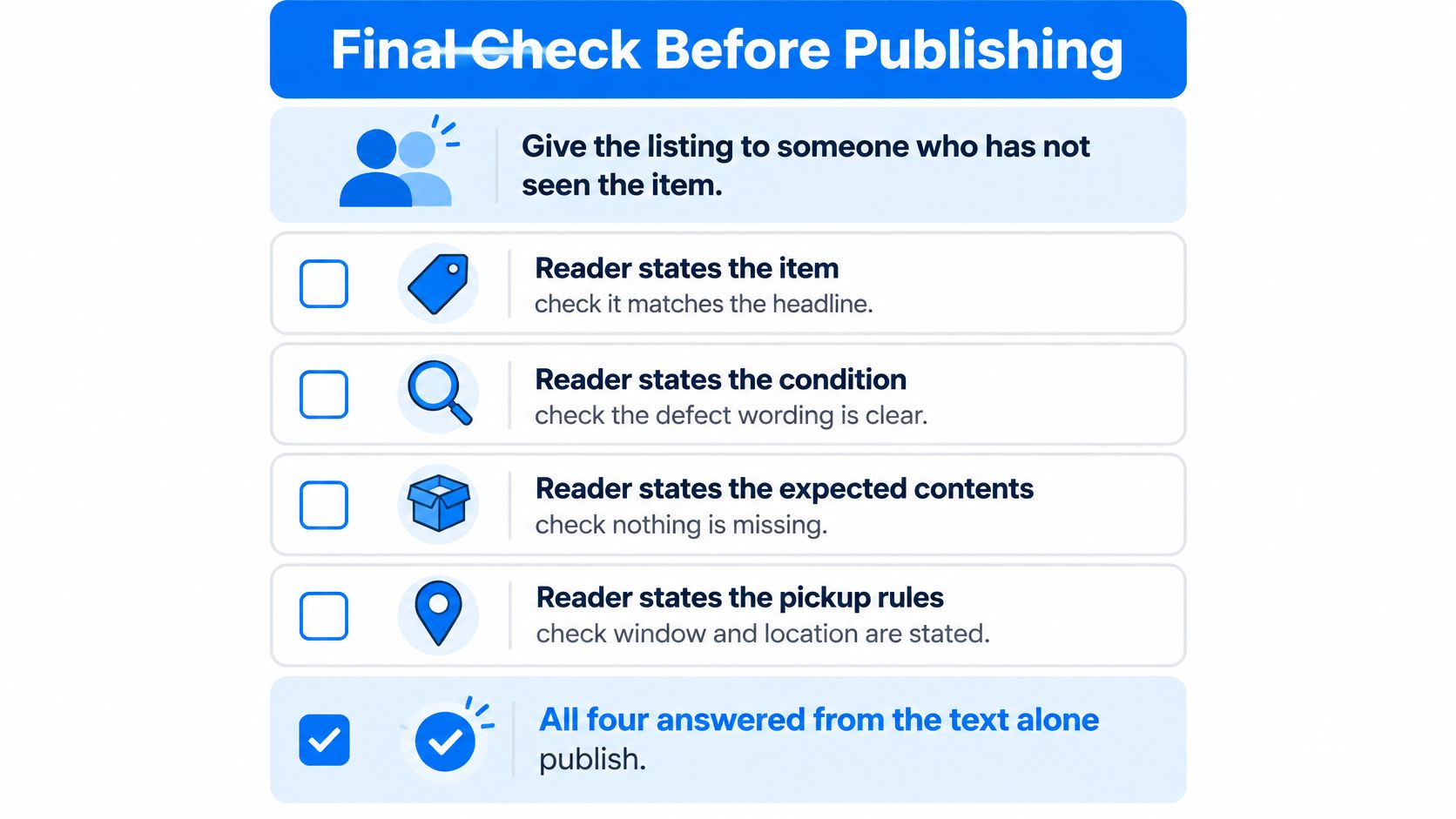
Before publishing your catalog, run a second-reader test. Hand one draft listing to a friend, spouse, or neighbor who hasn't seen the physical item. Ask them to tell you four things using only the written text: what the object is, its exact condition, what comes in the lot, and how pickup works. Every pause, guess, or missed detail becomes a mandatory edit before you publish.
Your Pre-Launch Quality Gate
Once your test reader passes all four questions, sweep the listing against these final eight checks:
- Headline clarity: The title names the item, key attribute, and size or condition without fluff.
- Dual measurements: Width, depth, and height appear in both inches and centimeters.
- Evidence-backed grade: The condition term pairs with specific visible wear notes.
- Clear boundaries: Included components and excluded nearby items are both explicitly listed.
- Matched flaw photos: Every disclosed defect links to a close-up photo with scale.
- Pickup logistics: Exact collection window, weight, access constraints, and helper recommendations are visible.
- Plain provenance: Origin and receipt status appear in one factual sentence, with unknowns stated openly.
- Verifiable adjectives: Every descriptive word can be confirmed in the gallery or a written record.
Set your starting bids only after checking completed sales of comparable items, using your dimensions, condition grade, and inclusions to make an apples-to-apples call. I would start small this week: pick a single room, draft your first lot using the nine-field checklist and reusable template, and run the second-reader test on it before cataloging the rest of the house. One airtight listing sets the standard for every lot that follows.
Ready to turn a house full of belongings into an organized online auction without handing over a steep traditional commission? DIYAuctions offers a free estate sale pricing guide that includes typical fee ranges, practical pricing guidance, and a 30-day launch checklist for new sellers. Grab the guide, pick your first room this weekend, and build your opening trust-dossier listing with confidence.
More guides in Estate Sale Basics
November 26, 2026
Estate Sales VA: How to Plan and Run One in Virginia
Estate Sales VA guide: plan a sale step by step, covering Virginia licensing, sales tax, pricing, buyer pickup and fraud checks.
Read guideJuly 28, 2026
Revenue Reporting for Estate Sales and Auctions
Learn revenue reporting essentials for estate sales and auctions. Discover key metrics, templates, and best practices to simplify tracking and compliance.
Read guideJuly 26, 2026
Stamp Collection Valuation: A Practical Step-by-Step Guide
Stamp collection valuation made simple. Learn how to identify, grade, price, and sell your stamps with confidence for estate sales or consignment.
Read guideGet the estate sale pricing guide
Enter your email for pricing ranges, planning notes, and a clearer path to launch.